Research Report
Embryo Quality: The Most Critical Factor for Pregnancy Rates
after day-2, day-3, and day-5 of Embryo Transfer
Kualitas Embrio: Faktor Terpenting pada Keberhasilan Kehamilan setelah Transfer Embrio Hari ke-2, 3 dan 5
Tono Djuwantono1,2, Wiryawan Permadi1, Harris Harlianto1, Mulya Nusa Amrulah Ritonga1,
Danny Halim2, Tri Hanggono Achmad2, Ahmad Faried2 1Department of Obstetrics and Gynecology
2Stem Cell Research Working Group
Medical Faculty of Padjadjaran University/ Dr. Hasan Sadikin Hospital
Bandung
INTRODUCTION
Infertility still remains a problem in the area of re-productive medicine. Infertility is not only become a problem for particular families and couples, but also for clinicians to meet the expectations of their pa-tients. In 2009, it was estimated 10 to 15% of the West Java population were having infertility prob-lems. Therefore, an effort is needed in order to im-prove the quality of services in promoting assisted reproductive technology.
In vitro fertilization (IVF) is one of the last options in treating infertile couples, particularly when con-ventional methods fail to achieve pregnancy.
How-ever, the average of clinical pregnancy rate remains low, ranging from 20 to 30%; moreover, the survival rate of the babies is 10 - 15%.1
Currently, Aster clinic is the only official repro-ductive clinic in West Java Province. It was estab-lished at Dr. Hasan Sadikin Hospital, Bandung, in May 2005. Aster clinic currently performs day-2 and day-3 embryo transfer, and blastocyst stage transfer. The decision regarding to the time of embryo transfer is usually made on day-2 after the embryos have gone through one division and are somewhere between the 2 - 8 cell stage (on day-2 or day-3). By day-5, an embryo should consist of 64 - 128 cells and should Abstract
Objective: To determine the most critical factor on day-2, day-3, and day-5 of embryo transfer in correlation with pregnancy rates.
Method: This research is a retrospective study in Aster Fertility Clinic, IVF program- Dr. Hasan Sadikin Hospital, Bandung, Indo-nesia. One hundred ninety five women enrolled in an IVF program conducted from March 2006 through November 2009 at the Aster Fertility Clinic. Effect of embryo-transfer day and any other factors (including quality of embryo, oocyte quantity, difficulty of embryo transfer technique, and blood or mucus contamination on the ca-theter) on pregnancy rate in IVF.
Results: The mean age of the pregnant group was 34.65 (SD = 3.91), and the mean of the infertility period was 7.25 years (SD = 3.54). There were no siginificant differences in pregnancy rates in the day-2, day-3, and day-5 groups. The most critical factor influ-encing pregnancy was the total score for the quality of embryos [p = 0.001; OR (CI 95%) = 1.94 (0.91 - 4.08)]. Otherwise, the day of embryo transfer, oocyte quantity, and difficulties in embryo transfer did not affect the pregnancy rate (p > 0.05).
Conclusion: Our study suggests that the total score for the qua-lity of the embryos was the most critical factor for the success rate of pregnancy rather than the day of embryo transfer, oocyte quan-tity, difficulty of embryo transfer technique, or contamination of blood and mucus on the catheter.
[Indones J Obstet Gynecol 2010; 34-4: 175-9]
Keywords: day of embryo transfer, in vitro fertilization, quality of embryo total score, oocytes quantity, catheter contamination
Abstrak
Tujuan: Untuk menentukan faktor yang terpenting pada keber-hasilan kehamilan setelah transfer embrio hari ke-2, ke-3 dan ke-5. Metode: Penelitian ini adalah studi retrospektif di klinik Fertili-tas Aster, Program IVF- Rumah Sakit Dr. Hasan Sadikin, Bandung, Indonesia. Penelitian ini melibatkan seratus sembilan puluh lima perempuan yang mengikuti program IVF sejak Maret 2006 hingga Nopember 2009. Efek dari waktu (hari) transfer embrio dan faktor-faktor lainnya (termasuk kualitas embrio, jumlah oosit, kesulitan dalam teknik transfer embrio, dan kontaminasi darah atau mukus dalam kateter) terhadap angka keberhasilan kehamilan pada IVF.
Hasil: Rata-rata usia perempuan hamil pada penelitian ini 34,65 (SD = 3,91), dan rata-rata periode infertilitas 7,25 (SD = 3,54). Tidak terdapat perbedaan bermakna pada angka kebehasilan kehamilan setelah transfer embrio baik pada hari ke-2, -3 dan -5. Faktor terpenting yang mempengaruhi keberhasilan kehamilan ada-lah skor total dari kualitas embrio [p = 0,001; OR (CI 95%) = 1,94 (0,91 - 4,08)]. Dilain fihak, waktu transfer embrio, jumlah oosit, ke-sulitan dalam teknik transfer embrio tidak mempengaruhi kebeha-silan kehamilan (p > 0,05).
Kesimpulan: Hasil studi kami menunjukkan bahwa faktor ter-penting yang mempengaruhi keberhasilan kehamilan adalah skor total dari kualitas embrio dibandingkan dengan waktu transfer em-brio, jumlah oosit, kesulitan dalam teknik transfer emem-brio, atau kon-taminasi darah dan mukus dalam kateter.
[Maj Obstet Ginekol Indones 2010; 34-4: 175-9]
Kata kunci: hari setelah transfer embrio, fertilisasi in vitro, skor total dari kualitas embrio, jumlah oosit, kontaminasi kateter
Correspondence: Tono Djuwantono, Department of Obstetrics and Gynecology Medical Faculty of Padjadjaran University, Dr. Hasan Sadikin Hospital, Bandung, Jln. Pasteur No. 38, Bandung. Telephone: 022-2032530. Email: [email protected]
have reached more advanced embryonal stage called the blastocyst stage (embryo transfer is performed on day-5).
Determining the transfer day is being considered essential to give the best chances of having a full-term healthy baby.2,3 Several studies have been performed to determine when is the best time to transfer the em-bryo. Unfortunately, the current study results still re-main controversial. Bungum et al4 reported that there are no significant differences between day-3 or day-5 embryo transfer in terms of the number of biochemi-cal or clinibiochemi-cal pregnancy rates, implantation rates, or abortion events. Despite those conflicting findings, Racowsky et al5 and Ragione et al6 reported that suc-cessful in achieving pregnancy was not only being determined by the day of embryo transfer but, rather, by the quality of embryos obtained.
The purpose of this study was to identify the cru-cial factors that play essential factor in the success rate of day-2, day-3, and day-5 embryo transfer. There are variables that have been considered such as the quality of embryos, number of oocytes, technical dif-ficulty of embryo transfer, and blood or mucus con-tamination on the catheter tip.
MATERIALS AND METHODS
Patients
This is a retrospective analysis study involving IVF patients from Aster Clinic, Dr. Hasan Sadikin Hospi-tal, Bandung (2006 - 2009). 195 patients who met the inclusion criteria for the IVF program were being re-cruited. All patients have signed informed consent forms according to our institutional guidelines. Pa-tients were being excluded if no significant follicle growth during ovarian stimulation, no oocytes can be collected during ovum pick up procedure, or fertili-zation at day-1 was observed 24 - 25 hours after fer-tilization.
Controlled-ovarian hyperstimulation
All patients underwent controlled-ovarian hyperstimu-lation using GnRH agonist (Busereline® 500 iu sc/ day), from day-21 of periods until complete menstrua-tion suppression occurs (estradiol < 80 pg/ml, no fol-licular diameter > 10 mm and thin endometrium). Af-ter the occurrence of complete suppression, patients received recombinant FSH (r-FSH) (Gonal-F®) start-ing from initial dose (75 - 300 IU) based on the pa-tient’s age, cause of infertility, and individual respon-se on r-FSH. Follicle growth is monitored by ultra-sound (Hitachi EUB-525 real-time follicle-scanner). Follicle is measured on day-3, day-5, and day-7 to day-12, followed by examination of serum estradiol. Follicles with diameter of more than 2 mm were mea-sured as day-7. Moreover, 250 μg of r-hCG (recom-binant human chorionic gonadotrophin) were admi-nistered after follicles achieve 18 mm.
Monitoring of embryo development
Approximately 36 hours later after hCG stimulation, the ova were picked up under ultrasound guidance.
Fertilization was conducted six hours later. A simple medium was used for the embryo culture on day-1 to day-3. Monitoring of the embryo development was carried out at 18 - 20 hours after fertilization to ob-serve the number of pro-nuclei (PN) and polar-body (PB). The embryonic development was monitored on day-1, at 24 - 25 hours after fertilization in order to assess the quantity, quality and scoring of the embryo during the stage of two-cell or early division. Embryo monitoring on day-2 (48 hours after fertilization) and day 3 (72 hours after fertilization) were done at 10 a.m. to assess the quantity, quality, and scoring of the embryo. A complex medium was used as the embryo culture reach day-3 to day-5. The embryo transfer (ET) was conducted on day-2 if fewer than four fer-tilized embryos were present on day-1 (24 - 25 hours after fertilization). Embryo transfer was performed on day-5 if more than four embryos with eight cells were observed on day-3, but if fewer were observed, the transfer was performed on day-3. The types of cathe-ter used for ET are Cook U1603094 Fr/12, 6.8 cm in size (Cook Spencer, Indiana, USA) and the K-type needle Cook 1-0 ATS in 1000, nontoxic (Queensland, Australia).
Assessment of a successful pregnancy
After ET, patients received 250 mg hydroxy proges-terone caproate intramuscularly (im) (Proluton De-pot®) or 1500-3000 IU β-hCG im at four-day intervals for 16 days for luteal phase support. The chemical pregnancy was determined by checking β-hCG serum level on day-16 after ET (> 80 IU); further transvagi-nal ultrasound examination was performed on day-30 to identify the presence of gestational sac.
Statistical analysis
All statistical analyses were conducted by SPSS® for Windows®’ 13th version. Continuous data were de-scribed as mean and standard deviation (SD). All p values were two-sided, and the statistical significance of differences was considered significant when p va-lue was ≤ 0.05.
RESULTS
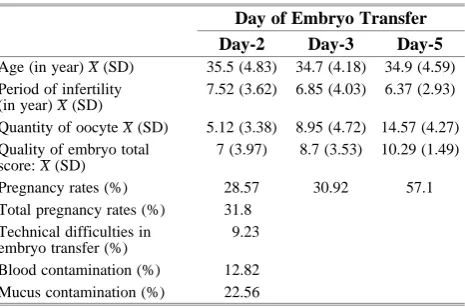
There were 195 patients have been recruited for this study, with total pregnancy rate was 31.8%. (Table 1)
Table 1. Characteristic of the patients (n=195).
Day of Embryo Transfer
Day-2 Day-3 Day-5
Age (in year) X (SD) 35.5 (4.83) 34.7 (4.18) 34.9 (4.59) Period of infertility
(in year) X (SD)
7.52 (3.62) 6.85 (4.03) 6.37 (2.93)
Quantity of oocyte X (SD) 5.12 (3.38) 8.95 (4.72) 14.57 (4.27) Quality of embryo total
score: X (SD)
7 (3.97) 8.7 (3.53) 10.29 (1.49)
Pregnancy rates (%) 28.57 30.92 57.1 Total pregnancy rates (%) 31.8
Technical difficulties in embryo transfer (%)
9.23
The pregnancy rate was not affected by the day of embryo transfer and the duration of infertility (Table 2; p > 0.05).
Table 2. Patient’s characteristic based on age & period of infertility with pregnancy rates (n=195).
Pregnancy Rates p
value Pregnant Not Pregnant
Age (in year) X (SD) 34.65 (3.91) 35.05 (4.82) 0.796
< 30 12 27
31 - 35 18 44
36 - 40 32 62
Total 62 (31.8%) 133 (68.2%) Period of Infertility
(in year) X (SD)
7.25 (3.54) 6.95 (3.92) 0.436
1 - 5 20 54
5 - 10 30 52
> 10 12 27
Total 62 (31.8%) 133 (68.2%)
Note: Pearson chi-square.
However the pregnancy rate was significantly in-fluenced by the quality of the embryos [Table 3; p = 0.001; OR (CI 95%) = 1.94 (0.91 - 4.08)], and it was not affected by the day of embryo transfer, oocyte quantity, ET technical difficulties, or ET catheter con-tamination by blood or mucus (p > 0.05).
Table 3. The effect of day embryo transfer, oocyte quantity, quality of embryo total score, embryo transfer tech-nique, catheter contamination by blood and mucus on pregnancy rates.
Pregnancy Rates p
value (CI 95%)OR Pregnant Not Pregnant
Day of embryo transfer
Day 2 24 60 0.101 1
Day 3 30 67 0.893
(0.47 - 1.69)
Day 5 8 6 0.3
(0.94 - 0.957) Quantity of
oocyte X (SD)
8.00 (4.57) 7.56 (5.09) 0.356 1.45 (0.66 - 3.02) Quantity of
oocyte:
≥ 4 52 104
< 4 10 29
Quality of embryo X (SD)
9.68 (3.98) 7.38 (3.45) 0.001 1.94 (0.91 - 4.08) - Skor total:
≥ 5.5 51 94
< 5.5 11 39
ET technical Difficulties level
0.082 0.43 (0.16 - 1.14)
Easy 53 124
Difficult 9 9
Existance of Blood on ET catheter
0.370 0.64 (0.24 - 1.69)
None 56 114
Exists 6 19
Existance of Mucus on ET catheter
0.271 0.65 (0.30 - 1.39)
None 51 100
Exists 11 33
Note: Pearson chi-square
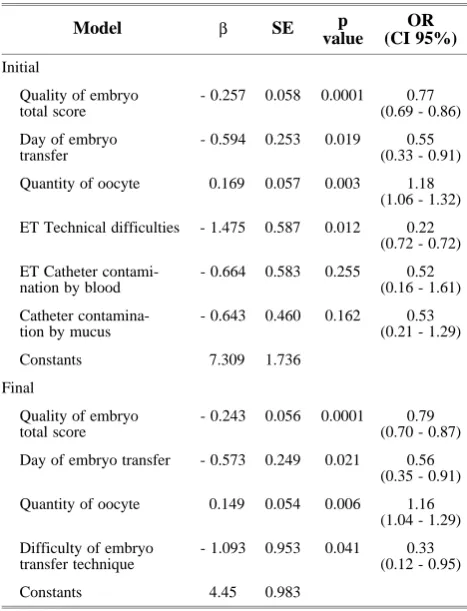
A model of multiple logistic regression shows that the total score for the quality of the embryo is an in-dependent variable that will determine the pregnancy rate (p = 0.0001) with β-coefficient value -0.243 (OR 0.79). That means by having higher total score for embryo quality, it might have 0.79 times greater chan-ce to get succhan-cessful pregnancy. This is more accurate indicator compared to other factors (oocyte quantity, difficulty level of embryo transfer, and contamination of blood or mucus on the catheter).
DISCUSSION
Based on our knowledge, this is the first study that has been done using data from day-5 embryo transfer in Indonesia. Despite the results are considered satis-factory, further study should be needed in order to observe more closely the effect of day-5 embryo transfer in terms of the pregnancy rate.
The subjects of this study were coming from Aster Clinic at Dr. Hasan Sadikin Hospital, Bandung (2005 -2009). Rapid progress in the development of assisted reproductive technology (ART) brings us more satis-factory results. However, the decision to transfer an embryo on day-5 or earlier is still being influenced by thea patient’s age at the time of the procedure.7-10 The Aster Clinic is currently using a guideline for the time of ET based on the quality of the embryo; the data represented here is influenced by the age of the patient and the number of oocytes. Therefore, our results does support the previous studies by Sjoblom et al11 and Borini et al12.
Although six variables are compared, the pregnan-cy rates are mostly being influenced by the quality of the embryos [p = 0.0001, OR (CI 95%) = 0.79 (0.70 - 0.87)], as shown in Table 4. However, the pregnan-cy rate is not being affected by oopregnan-cyte quantity, the day of embryo transfer, the level of technical difficul-ties in ET, or the contamination of blood or mucus on the ET catheter.
Independent analyses on each group for time of embryo transfer are performed, and the results indi-cates that embryo quality is more crucial for preg-nancy rate after ET in day-2 and day-3 groups. On the contrary, there are no dominant factors can deter-mine the pregnancy rate for day-5 ET. These results indicate that only high-quality embryos that could be transferred on day-5 at Aster Clinic. These results are remain consistent after being evaluated by logistic re-gression analysis. The analysis shows that the crucial factor for a successful pregnancy is the quality of the embryo.
Our study does support a prospective randomized study done by Bungum et al.4 regarding to the asso-ciation between embryo transfer and pregnancy rate., The study shows no significant implantation rate as-sociated between day-3 and day-5 embryo transfer, despite the pregnancy rate after embryo transfer on day-5 is quantitatively increase. This study is trying to used more strict criteria than other studies with a higher confidence level.
embryos classified as grade-one on day-3. They noted higher success in achieving pregnancy and embryo implantation rates on day-5 compared to day-3, al-though no significant difference was observed on the incidence of twins or other multiple pregnancies. Si-milar results were obtained in a study by Papaniko-laou et al.14 who found that embryo transfer on day-5 increased the success of pregnancy more than that on day-3 [52.5% vs. 32.1%, OR (CI 95%) = 2.33]. There-fore, both of studies suggest, if the number of em-bryos with good quality exceeds more than four, the embryo culture can be continued after day-3 and the embryo transfer finally can be performed on day-5. However, the results of these studies show no decrea-se in the incidence of multiple pregnancies, even though the Papanikolaou studies suggest that day-5 embryo transfer might reduces the complications of pregnancy, such as multiple pregnancies. Finally, nei-ther of these studies addresses the effects of multiple pregnancies.
Kovacic et al.15 issued a controversial report in 2002 with regard to the best time for embryo transfer either on day-2, day-3, or day-5. He concluded that the lengthening of the embryo culture in the labora-tory up to day-5 did not significantly increase the suc-cess rate of pregnancy. Extension of the embryo cul-ture until day-5 has been considered can increase the total cost and has potential of psychological burden if ET is fail to be done.
The success in IVF cycle is to have pregnancy with a single fetus without obstetric complications, with
lower cost.16-18 However, the results from many stu-dies have not determined which transfer day would give the best result. Further study should be needed in order to determine which parameters influence the success rate of pregnancy in IVF cycle.
The weaknesses of this retrospective study are due to its long interval, more restricted criteria on day-5 embryo transfer, and unequal number of patients in each embryo transfer group.
CONCLUSION AND SUGGESTION
In conclusion, success in achieving pregnancy is strongly influenced by the total score of the quality of embryos and not by the day of embryo transfer, oocyte quantity, technical difficulty during ET, or contamination of blood and mucus on the ET cathe-ter.
REFERENCES
1. de Mouzon J, Lancaster P, Nygren KG, Sullivan E, Zegers-Hochschild F, Mansour R, Ishihara O, Adamson D. World collaborative report on assisted reproductive technology, 2002. Hum Repod. 2009; 24(9): 2310-20
2. Bhattacharya S. Defining success in assisted reproduction. In: Single embryo transfer. Edited by: Gerris J, Adamson GD, Sutter PD, Racowsky C. 1st edition, New York:
Cam-bridge University Press, 2009; 231-40
3. Gerris JM. Single embryo transfer and IVF/ICSI outcome: a balanced appraisal. Hum Reprod Update. 2005; 11(2): 105-21
4. Bungum M, Bungum L, Humaidan P, Yding Andersen C. Day-3 versus day-5 embryo transfer: a prospective random-ized study. Reprod Biomed Online. 2003; 7(1): 98-104 5. Racowsky C, Jackson KV, Cekleniak NA, Fox JH,
Horn-stein MD, Ginsburg ES. The number of eight-cell embryos is a key determinant for selecting day-3 or day-5 transfer. Fertil Steril 2000; 73(3): 558-64
6. Della Ragione T, Verheyen G, Papanikolaou EG, Van Lan-duyt L, Devroey P, Van Steirteghem A. Developmental stage on day-5 and fragmentation rate on day-3 can influ-ence the implantation potential of top quality blastocysts in IVF cycles with single embryo transfer. Reprod Biol Endocrinol. 2007; 5: 2
7. Ceyhan ST, Katharine V. Jackson, Racowsky C. Selecting the most competent embryo. In: Biennial review of infer-tility volume 1. Edited by: Carrell DT, Racowsky C, Schlegel PN, Voorhis BJV. 1st edition, New York: Humana
Press, 2009: 143-70
8. Mansour R. Embryo transfer technique. In: In vitro fertili-zation a practical approach. Edited by: Gardner DK. 1st
edi-tion, New York: Informa Healthcare, 2007; 435-64 9. Sallam HN. Optimizing embryo transfer. In: Infertility and
assisted reproduction. Edited by: Rizk BRMB, Garcia-Ve-lasco JA, Sallam HN, Makrigiannakis A. 1st edition, New
York: Cambridge University Press, 2008; 506-17
10. Marcus SF, Brinsden PR. In-vitro fertilization and embryo transfer in women aged 40 years and over. Hum Reprod Update. 1996; 2(6): 459-68
11. Sjoblom P, Menezes J, Cummins L, Mathiyalagan B, Cos-tello MF. Prediction of embryo developmental potential and pregnancy based on early stage morphological characteris-tics. Fertil Steril. 2006; 86(4): 848-61
12. Borini A, Lagalla C, Cattoli M, Sereni E, Sciajno R, Fla-migni C, Coticchio G. Predictive factors for embryo im-plantation potential. Reprod Biomed Online. 2005; 10(5): 653-68
13. Mangalraj AM, Muthukumar K, Aleyamma T, Kamath MS, George K. Blastocyst stage transfer vs cleavage stage em-bryo transfer. J Hum Reprod Sci. 2009; 2(1): 23-6 Table 4. Multiple logistic regression analysis on day embryo
transfer, quality of embryo total score, oocyte quantity, difficulty of embryo transfer technique, catheter conta-mination by blood and mucus with pregnancy rates.
Model β SE p
value
OR (CI 95%)
Initial
Quality of embryo total score
- 0.257 0.058 0.0001 0.77 (0.69 - 0.86)
Day of embryo transfer
- 0.594 0.253 0.019 0.55 (0.33 - 0.91)
Quantity of oocyte 0.169 0.057 0.003 1.18 (1.06 - 1.32)
ET Technical difficulties - 1.475 0.587 0.012 0.22 (0.72 - 0.72)
ET Catheter contami-nation by blood
- 0.664 0.583 0.255 0.52 (0.16 - 1.61)
Catheter contamina-tion by mucus
- 0.643 0.460 0.162 0.53 (0.21 - 1.29)
Constants 7.309 1.736
Final
Quality of embryo
total score - 0.243 0.056 0.0001 (0.70 - 0.87)0.79
Day of embryo transfer - 0.573 0.249 0.021 0.56 (0.35 - 0.91)
Quantity of oocyte 0.149 0.054 0.006 1.16 (1.04 - 1.29)
Difficulty of embryo transfer technique
- 1.093 0.953 0.041 0.33 (0.12 - 0.95)
Constants 4.45 0.983
14. Papanikolaou EG, D’Haeseleer E, Verheyen G, Van de Velde H, Camus M, Van Steirteghem A, Devroey P, Tour-naye H. Live birth rate is significantly higher after blasto-cyst transfer than after cleavage-stage embryo transfer when at least four embryos are available on day 3 of em-bryo culture. A randomized prospective study. Hum Re-prod. 2005; 20(11): 3198-203
15. Kovacic B, Vlaisavljevic V, Reljic M, Gavric Lovrec V. Clinical outcome of day-2 versus day-5 transfer in cycles with one or two developed embryos. Fertil Steril. 2002; 77(3): 529-36
16. Dickey RP. Reducing the risk of high-order multiple preg-nancy due to ovulation induction. In: Infertility and assisted reproduction. Edited by: Rizk BRMB, Garcia-Velasco JA, Sallam HN, Makrigiannakis A. 1st edition, New York:
Cambridge University Press, 2008; 258-69
17. Gerris J, Sutter PD. Elective single-embryo transfer. In: Bi-ennial review of infertility volume 1. Edited by: Carrell DT, Racowsky C, Schlegel PN, Voorhis BJV. 1st edition,
New York: Humana Press, 2009; 171-84
18. Gerris J, Sutter PD. Single embryo transfer: concepts and definitions. In: Single embryo transfer. Edited by: Gerris J, Adamson GD, Sutter PD, Racowsky C. 1st edition, New
York: Cambridge University Press, 2009; 53-97