The Thirty-Third AAAI Conference on Artificial Intelligence (AAAI-19)
Robust Deep Co-Saliency Detection with Group Semantic
Chong Wang,
1,2Zheng-Jun Zha,
2∗Dong Liu,
2Hongtao Xie
2 1Institute of Intelligent Machines, Chinese Academy of Sciences2University of Science and Technology of China [email protected],{zhazj, dongeliu, htxie}@ustc.edu.cn
Abstract
High-level semantic knowledge in addition to low-level vi-sual cues is essentially crucial for co-saliency detection. This paper proposes a novel end-to-end deep learning approach for robust co-saliency detection by simultaneously learning high-level group-wise semantic representation as well as deep vi-sual features of a given image group. The image inter-action at semantic-level as well as the complementarity be-tween group semantics and visual features are exploited to boost the inferring of co-salient regions. Specifically, the pro-posed approach consists of a co-category learning branch and a co-saliency detection branch. While the former is proposed to learn group-wise semantic vector using co-category asso-ciation of an image group as supervision, the latter is to infer precise co-salient maps based on the ensemble of group se-mantic knowledge and deep visual cues. The group sese-mantic vector is broadcasted to each spatial location of multi-scale visual feature maps and is used as a top-down semantic guid-ance for boosting the bottom-up inferring of co-saliency. The co-category learning and co-saliency detection branches are jointly optimized in a multi-task learning manner, further im-proving the robustness of the approach. Moreover, we con-struct a new large-scale co-saliency dataset COCO-SEG to facilitate research of co-saliency detection. Extensive experi-mental results on COCO-SEG and a widely used benchmark Cosal2015 have demonstrated the superiority of the proposed approach as compared to the state-of-the-art methods.
1
Introduction
Discovering common and salient objects from a group of relevant images, termed as Co-saliency Detection, is benefi-cial for big image data management and various vision tasks, such as object co-segmentation (Quan et al. 2016; Dong et al. 2015; Zhang et al. 2016b), object co-localization(Tang et al. 2014), visual tracking (Li et al. 2018) and image re-trieval (Fu, Cao, and Tu 2013; Zhang et al. 2013; Hong et al. 2017) etc.visual tracking (Li et al. 2018) and image re-trieval (Fu, Cao, and Tu 2013; Zhang et al. 2013; Hong et al. 2017) etc. Co-saliency detection has attracted increasing interests from both academia and industry in recent years (Jeong, Hwang, and Cho 2017; Zhang, Meng, and Han 2017; Yao et al. 2017).
∗
Corresponding author.
Copyright c2019, Association for the Advancement of Artificial Intelligence (www.aaai.org). All rights reserved.
Effective visual representation characterizing salient and common objects is crucial for co-saliency detection. Con-ventional approaches utilize handcrafted features, such as color, texture and SIFT descriptors etc., and achieve encour-aging performance (Fu, Cao, and Tu 2013; Liu et al. 2014; Li et al. 2015; Li, Meng, and Ngan 2013). However, hand-crafted features based approaches usually suffer from multi-ple challenges including appearance variance of co-object across images, similar appearance between co-object and non-common object, and background clutter etc.Encouraged by the success of deep learning in many vision tasks (Krizhevsky, Sutskever, and Hinton 2012; Long, Shelhamer, and Darrell 2015; Zhang, Yu, and He 2018; Liu et al. 2016; Jiao et al. 2018; Xu et al. 2018), recent researches improve co-saliency detection by using deep neural network to learn visual representation in a data driven manner (Han et al. 2017; Zhang et al. 2016b; Zhang, Meng, and Han 2017; Zhang et al. 2016a; Jeong, Hwang, and Cho 2017). The deep visual features are fed into a subsequent co-saliency detection module. As the feature learning and co-saliency detection are separated as two independent processes, the learned features are not tailored for inferring co-salient re-gions, resulting in suboptimal performance. Recently, (Wei et al. 2017) proposed an end-to-end deep learning method for co-saliency detection, which integrates the process of feature learning and saliency mask prediction. A group-wise visual representation is designed to capture the interaction among visual features of individual images. As the group-wise visual feature is based on the concatenation of individ-ual image features, it varies with the order of images within a group, limiting the robustness of the model.
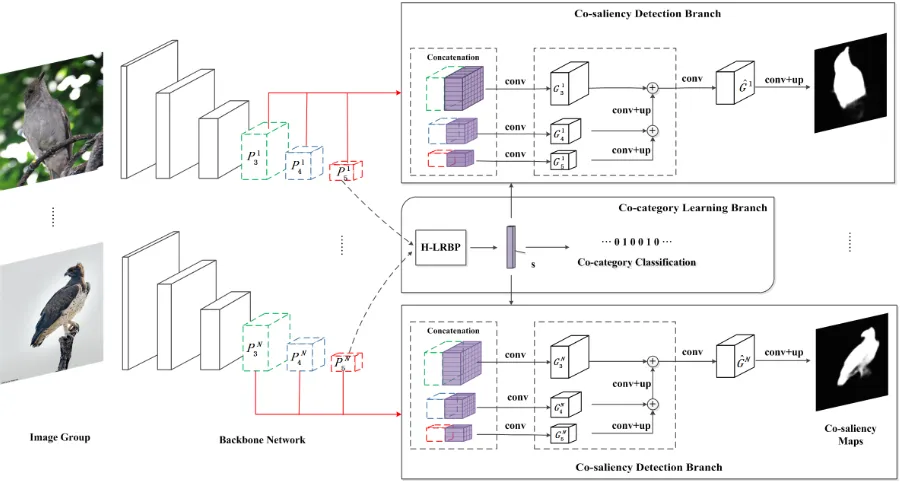
Figure 1: Overview of proposed robust co-saliency detection approach. A group of images{I1, I2, ..., IN}first go through the backbone networks to obtain the multi-scale feature maps{P3n, P4n, P5n}, n∈[1,2, ..., N]. The feature maps{P5n}N
n=1 from
every images are aggregated to learn the group-wise semantic representation with the supervision of inter-image co-category association by the Co-category Learning branch. The group-wise semantic vectorsis broadcasted to multi-scale visual features and is exploited as a top-down semantic guidance for boosting the inferring of co-salient regions by the Co-Saliency Detection branch.
optimized in an end-to-end learning manner. In particular, the proposed approach consists of two types of branches in-cludingco-category learning branchandco-saliency detec-tion branchas shown in Figure 1. Theco-category learning branchis proposed to learn group-wise semantic represen-tation by using a Hierarchical Low-Rank Bilinear Pooling (H-LRBP) function with the supervision of co-category as-sociation, which endows the group-wise feature rich seman-tic clues related to the common categories of images. The co-saliency detection branchis designed to infer precise co-saliency maps by the joint exploration of both multi-scale deep visual features and high-level group-wise semantics. The group-wise semantic vector is broadcasted to each spa-tial location of multi-scale visual feature maps and is used as a top-down semantic guidance for boosting the bottom-up inferring of co-saliency. The multi-scale visual features aug-mented by group semantics are then assembled, providing a richer information flow path for the network. The comple-mentarity and interaction of group semantics and multi-scale visual features are sufficiently exploited to facilitate the ro-bust co-saliency reasoning. On the other hand, supervised co-saliency detection with deep learning is limited by the absence of large-scale co-saliency dataset. The largest exist-ing dataset for co-saliency detection, Cosal2015 (Zhang et al. 2016b), consists of only 2,015 images with 50 groups. In order to facilitate the research of co-saliency detection, we construct a new large-scale dataset, i.e., COCO-SEG, se-lecting from the MS COCO2017 dataset (Lin et al. 2014).
More details about the proposed dataset will be discussed in Section 3.1. Extensive experiments have been conducted on the COCO-SEG dataset and a widely used co-saliency dataset Cosal2015 . Experimental results have demonstrated that the proposed method outperforms the state-of-the-art approaches.
2
Proposed Approach
2.1
Problem Formulation
Co-saliency detection aims at discovering the common and salient objects in a group of N relevant images I =
{In}Nn=1 . The co-saliency mapsM = {Mn}Nn=1are
pro-duced by a co-saliency detection model:
M=F(I;Θ), (1)
whereF(·)is the model function that takes an image group as input and outputs a group of co-saliency maps simultane-ously.Θrepresents model parameters which are optimized by a end-to-end learning scheme in this work. Inspired by the mechanism of human visual co-saliency, high-level mantic guidance as well as inter-image interaction at se-mantic level are important for co-saliency detection. Hence, we propose to learn a group-wise semantic representation s∈RDfrom the group of images:
s=fg(I;Θg), (2)
It is used as a high-level semantic guidance for inferring co-salient regions in each image:
Mn=fsaliency(In,s;Θm), (3)
whereΘmis the parameters of co-saliency prediction func-tion. This work proposes a novel deep neural network archi-tecture consisting of category learning branch and a co-saliency detection branch to jointly optimize the group-wise semantic feature learning and co-saliency map prediction in an end-to-end manner, as shown in Figure 1.
2.2
Co-category Learning
Co-category learning branch is proposed to learn group-wise semantic representation from a group of relevant im-ages using inter-image co-category association as supervi-sion. Inspired by the impressive achievements of bilinear pooling in fine-grained image classification task, it is be-lieved that bilinear pooling can maintain selectivity in holis-tic features. Low-Rank Bilinear Pooling (LRBP) has been proposed in (Kong and Fowlkes 2017) to deal with the di-mension explosion problem caused by full bilinear pooling. It is robust to feature redundancy and noise as well as saves the number of parameters and the cost of computing. Here, we design a hierarchical stack of pooling functions, termed as Hierarchical Low-Rank Bilinear Pooling (LRBP). H-LRBP first aggregates local features within a image feature map to a image representation and further encodes all im-age representations within a group into a holistic semantic representation. Such hierarchical pooling strategy decom-poses the complicated mapping from individual image fea-ture maps to group semantics and thus reduces the difficulty on learning group semantics.
H-LRBP: Denoting Xn ∈ RK×D as an image fea-ture map which contains K local feature vectors, we de-fined the normalized bilinear pooling as K1Xn>Xn =
1
K
PK
i=1X
i n >
Xi
n. TheC-way SVMs inference equation us-ing the matrix representation of the bilinear feature is given as:
fc(xn) = 1
Ktr(W
c>X>
nXn) +bc, (4)
in which,Wc∈RD×Dandbcis the parameters ofc-th SVM andfc(·)is the corresponding predict function. Following (Kong and Fowlkes 2017), we impose a hard low-rank con-straint onWc by the parameterization withU+c ∈ RD×r/2
andUc
−∈RD×r/2, namelyrank(Wc) =r. Then, the SVM inference equation can be rewritten as:
fc(Xn) =
1 K[tr(U
c
+U
c>
+ X
>
nXn)−tr(U−cUc > − X
>
nXn)] +bc
= 1 K[kU
c>
+ X
> nk
2
F− kU c> − X
> nk
2
F] +bc.
(5) Instead of the classification results, the pooled features are necessary for the subsequent processes in this work. There-fore, the prediction results of theC-way classifiers are used asC-dimensional features. A Hierarchical Low-Rank Bilin-ear Pooling (H-LRBP) strategy is proposed to aggregate the
(a) H-LRBP (b) FC + Average Pooling
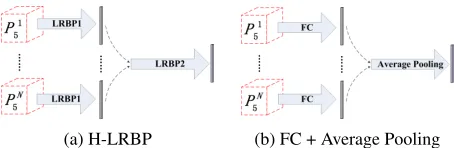
Figure 2: Two pooling strategies: (a) is the proposed H-LRBP and (b) is a baseline pooling compared in experi-ments.
local visual features into group-wise representationsby us-ing two consecutive LRBP layers in Eq.(5) as follows:
s=f({f(Xn)}Nn=1), (6)
where f(·)is the LRBP function. The pooling process is shown in Figure 2a. The group-wise semantic vector s is learned with the supervision of co-category association as elaborated in Section 2.4. The co-category learning only needs the co-category association among the images but does not require the awareness of what each category is. The co-category supervision endows srich semantic clues related to the common categories of images and is valuable for facilitating the inferring of co-salient regions. Moreover, H-LRBP is not sensitive to the number and order of images within a group, making itself robust and flexible.
2.3
Co-saliency Detection with Group Semantic
Group-wise semantics represent high-level semantic cues and inter-image semantic interaction. We exploit the group-wise semantics as a top-down semantic guidance for boost-ing the bottom-up inferrboost-ing of co-saliency. In particular, the group semantic vector is broadcasted to each spatial loca-tion of visual feature maps to augment visual features. The complementarity and interaction between high-level group semantics and low-level visual features are exploited to improve co-saliency detection. Regarding visual features, coarse-resolution features from high layers of neural net-work emphasize the abstraction of visual content and con-tains the context with large receptive field to the summary of object, while fine-resolution features from low layers em-phasize the appearance details and are more conducive to the location of objects. In order to make full use of the com-plementary between multi-scale features, we fuse the visual features from multiple layers to provide a comprehensive representation for co-saliency mask prediction.Taking VGG19 (Simonyan and Zisserman 2014) as the backbone ConvNet, we exploit the outputs of pool3, pool4 and pool5 layers as multi-scale feature maps, denoted as
{P3n, P4n, P5n}Nn=1 respectively. We concatenate the
group-wise semantic vectorswith each local feature vector, and a 1×1 convolutional layer is used to reduce the dimen-sionality. The resultant feature maps with group-wise se-mantic, called {Gn
3, Gn4, Gn5}Nn=1 , are jointly used for
then merged with the finer-resolution one by element-wise addition. This process iterates until the finest mapGˆnis ob-tained. To alleviate the aliasing effect of upsampling, we add a3×3convolutional layer after each merging operation. The final co-saliency maps Mcan be obtained with the fused features{Gˆn}by applying a3×3convolutional layer and a deconvolutional layer followed with a sigmoid activation function.
2.4
Loss Function
A classification loss is designed to learn group-wise se-mantic representation by the supervision of co-category su-pervision as follows:
ˆ
y=sigmoid(W>s+b), (7)
Lcls=− 1
L
L
X
l=1
yllogyˆl−(1−yl)log(1−yˆl), (8)
whereW ∈RD×Landb∈RLare parameters ofL-class classifier. yl and yˆl are ground-truth and prediction value for thel-th co-category.Lclsis the classification loss func-tion. We use sigmoid function as the activation function in-stead of softmax because there might exist more than one co-category appearing in an image group.
Denoting the ground-truth co-saliency masks of training image group as{Mˆn}Nn=1, the loss function of co-saliency
detection is formulated as the average of pixel-wise cross entropy losses:
Lsal= − 1
N P
N P
X
i=1
ˆ
MilogMi−(1−Mˆi)log(1−Mi) (9)
wherePis the pixel number of each training image.Mˆiand
Miare thei-th pixel values in ground truth and predicted co-saliency maps, respectively. Note that the co-category learn-ing branch and the co-saliency detection branch are trained jointly, the overall loss function is given as
L=Lsal+λ· Lcls, (10)
whereλis the tradeoff parameter.
3
Experiments
3.1
Datasets
The research and application of supervised co-saliency detection are limited by the lack of large-scale training data. The largest dataset for co-saliency detection at present,i.e., Cosal2015 (Zhang et al. 2016b), consists of only 2,015 im-ages in 50 groups. In order to evaluate the proposed ap-proach as well as facilitate future research, we construct a new dataset, termed as COCO-SEG, at a large scale.
COCO-SEG is selected from the COCO2017 dataset (Lin et al. 2014) by applying the following selection strategies:
• All the images containing object of a certain category are grouped together, leading to 80 image groups. A group may contain more than one co-category.
• For a certain group, each image should belong to at least one co-category of the group with the region area over 4,000 pixels. This is to filter out images that contain only inconspicuous foreground.
• The groups containing less than 100 images in training set are removed to ensure that each group has enough training samples, leading to 78 groups finally.
The resultant COCO-SEG dataset contains 200K images belonging to 78 groups for training and 8K images of 78 groups for testing.
3.2
Implementation Details
We select the widely used VGG 19-layer net (Simonyan and Zisserman 2014) as the backbone network for the sake of fair comparison, and initialize it with the parameters pre-trained for image classification task on ImageNet (Deng et al. 2009). The deconvolutional layers are initialized with simple bilinear interpolation parameters. We following the setting in (Wei et al. 2017), a sub-group consist of 5 im-ages are randomly selected from a certain group, and a mini-batch consisting of 56 sub-groups are fed into the model at the same time during training. All images and ground-truth maps are resized to 224×224. The proposed mod-els are optimized by the Adam Algorithm (Kingma and Ba 2014), in which the exponential decay rates for the first and second monent estimates are set to 0.9 and 0.999 respec-tively. The learning rate starts from 1e-5, and reduces by half every 10,000 steps until the model converges at about 50,000 steps. All the models are trained on the training set of COCO-SEG and evaluated on the COCO-SEG validation set and Cosal2015. During evaluation,we feed all images in a group into the model to generate all predicted masks si-multaneously.
3.3
Evaluation Metrics
To evaluate the performance of the proposed method, six widely-used metrics are adopted: (1) Precision-Recall (PR) curve, which shows the tradeoff between precision and recall for different threshold (ranging from 0 to 255). (2) Receiver Operating Characteristic (ROC) curve, which is created by plotting the true positive rate (TPR) against the false positive rate (FPR) at various threshold settings. (3) Area Under the Curve (AUC), which is the area under ROC curve. (4) Mean Absolute Error (MAE), which characterize the average 1-norm distance between ground truth maps and predictions. (5) F-measure (Fβ), which is computed by:
Fβ=
(1 +β2)P recision×Recall
β2P recision+Recall , (11)
(a) PR curves on COCO-SEG (b) ROC curves on COCO-SEG (c) Other metrics on COCO-SEG
(d) PR curves on Cosal2015 (e) ROC curves on Cosal2015 (f) Other metrics on Cosal2015
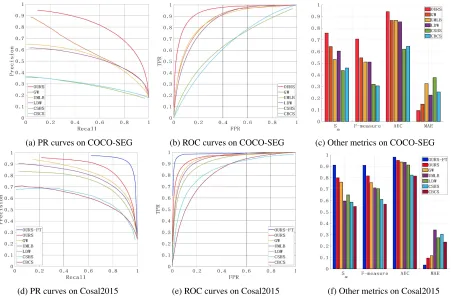
Figure 3: Performance comparison between the proposed method and the state-of-the-art methods on COCO-SEG and Cosal2015 datasets
(a) COCO-SEG (b) Cosal2015
Figure 4: Visual comparison between the proposed method and the other representative methods on COCO-SEG dataset and Cosal2015 dataset
2017), which is a reliable metric to evaluate the spatial structure similarities of foreground maps. We set the hyper-parameterα= 0.5following (Fan et al. 2017).
3.4
Comparison to the State-of-the-Arts
In order to evaluate the effectiveness of the proposed method, we compare it against five state-of-the-art
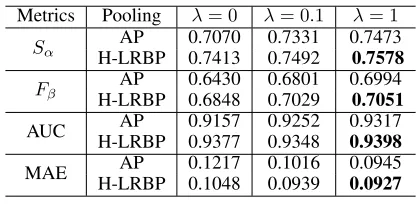
Table 1:Efficacy of co-category learning and H-LRBP.
Metrics Pooling λ= 0 λ= 0.1 λ= 1
Sα AP 0.7070 0.7331 0.7473
H-LRBP 0.7413 0.7492 0.7578
Fβ AP 0.6430 0.6801 0.6994
H-LRBP 0.6848 0.7029 0.7051
AUC AP 0.9157 0.9252 0.9317
H-LRBP 0.9377 0.9348 0.9398
MAE H-LRBPAP 0.12170.1048 0.10160.0939 0.09450.0927
the sake of fair comparison, VGG-19 is used as backbone networks for GW, LDW and UMLB. Figure 3a - 3c illus-trate the experimental results in terms of various metrics on COCO-SEG dataset. Our approach outperforms the state-of-the-art methods significantly in terms of all the metrics. For example, our method improves upon the second best algo-rithm GW by about 18%, 26%, 7% and 35% in terms of Structure Measure, F-measure, AUC and MAE respectively.
The proposed method is also evaluated on a widely used benchmark co-saliency dataset Cosal2015. As illustrated in Figure 3d - 3f, the proposed method achieves better per-formance than existing ones in terms of all the metrics. For example, the proposed method improves upon the sec-ond best method GW by about 5%, 6% and 13% in terms of Structure Measure, F-measure and MAE respectively. As aforementioned, all the models are trained on COCO-SEG and applied on Cosal2015. The experimental results have shown that the proposed method can obtain consis-tent performance improvements when dealing with new cat-egories of foregrounds that do not appear during training. Thus, the proposed method possess better generalization ability and flexibility in practical use. We also fine-tune the model without the optimization of co-category learning branch in Cosal2015 by selecting 50%-50% training-test im-ages as (Han et al. 2017). The fine-tuned model is denoted as “OURS-FT”, which exhibits impressive performance as shown in Figure 3d - 3f.
Figure 4 shows some sample co-saliency maps produced by the proposed approach and the state-of-the-art methods on COCO-SEG and Cosal2015 datasets. From the results on COCO-SEG dataset, it can be observed that two traditional methods CSHS and CBCS can hardly find common fore-ground areas in complex cases of high inter-class similarity and intra-class variations. While the end-to-end deep learn-ing method GW performs significantly better than the tradi-tional methods, our method produces the best saliency maps both in terms of the accuracy of contours and discrimination of different objects. From the saliency maps on Cosal2015 dataset, it can be seen that our method is more robust to the inter-class similarity and intra-class variations and is more meticulous in shaping the appearance details. Moreover, co-saliency maps produced by our method are more assertive than those of the others, which helps to easily select a bi-narization threshold to segment out the foregrounds given a co-saliency map.
Table 2: Efficacy of multi-scale features: With λ = 0, the models using multi-scale features are compared with the models using single-scale features.
Metrics AP AP H-LRBP H-LRBP
single-scale multi-scale single-scale multi-scale
Sα 0.6854 0.7070 0.6951 0.7413
Fβ 0.6127 0.6430 0.6248 0.6848
AUC 0.9010 0.9157 0.9104 0.9377
MAE 0.1245 0.1217 0.1208 0.1048
Table 3:Comparison between group-wise representation: Withλ= 0and single-scale features, the models using AP and H-LRBP are compared against the existing GW method.
Metrics
GW
AP
H-LRBP
Sα
0.6424
0.6854
0.6951
Fβ
0.5455
0.6127
0.6248
AUC
0.8665
0.9010
0.9104
MAE
0.1494
0.1245
0.1208
3.5
Ablation Studies
In this section, we conduct evaluation to investigate the ef-fectiveness of various components of the proposed model. The models using visual feature from multiple layers and single layer are denoted as “multi-scale” and “single-scale”, respectively. For pooling strategy, “AP” refers to the “FC + Average Pooling” strategy as show in Figure 2b, which uses fully connected layer to integrate local features into image representations and then pools all image features within a group into group-wise representation by average-pooling. All the ablation studies are conducted on the pro-posed COCO-SEG dataset.
Efficacy of co-category learning and H-LRBPTable 1 provides the performance of the proposed method with vari-ous values ofλand the two pooling strategies.λis the trade-off parameter adjusting the relative strength of exploiting co-category association supervision in learning group-wise representation. From the results, we can obtain the following observations: (1) the models withλas 0.1 and 1 outperforms the mode with λ as 0. This indicates that the exploration of co-category supervision is able to learning more effec-tive group-wise representation with semantic cues, which in turn boost the co-saliency detection. The model withλas 1 obtains the best performance; (2) “H-LRBP” achieves con-sistent performance improvements over “AP” in various set-tings.
Efficacy of multi-scale visual featuresIn order to bet-ter investigate the effectiveness of multi-scale visual fea-tures, we compare the models using single-scale and the multi-scale features in the setting of non-supervision of co-category association,i.e.,λ= 0. The single-scale feature is processed by applying a convolutional layer followed with a deconvolutional layer on{Gn
5}Nn=1. As illustrated in Table
representation characterizing both visual abstraction and de-tails of foregrounds and is useful for co-saliency prediction. Comparison between group-wise featuresWe compare the proposed model without co-category supervision and multi-scale features to the existing method GW (Wei et al. 2017) which learns a group-wise visual representation for co-saliency detection. As shown in Table 3, both the model with “AP” and “H-LRBP” strategies outperform GW signif-icantly. This indicates that the proposed method is able to learn more effective group-wise representation even with-out the supervision of co-category association. Moreover, as the group-wise feature in GW is based on the concatenation of individual image features, it varies with the order of im-ages within a group. Our method uses H-LRBP for feature agreation. It is not affected by the number and order of im-ages within a group and thus possess better robustness and flexibility.
4
Conclusion
This paper proposed a new deep learning based approach for robust co-saliency detection, consisting of a co-category learning branch and a co-saliency detection branch. The pro-posed approach explores the high-level semantic supervision as well as inter-image interaction at semantic level, which are important for co-saliency detection. A group-wise se-mantic representation characterizing inter-image sese-mantic interaction is learned by the proposed co-category learning branch using the co-category association as supervision. The co-saliency detection branch infers precise co-saliency maps by using the group semantic as a top-down semantic guid-ance as well as visual features at multiple scales. The group-wise semantic feature and co-salience map are jointly opti-mized in an end-to-end multi-task learning manner. More-over, we constructed a new large-scale co-saliency dataset COCO-SEG, which is the largest dataset for co-saliency detection at present. Extensive evaluation on both COCO-SEG and the benchmark Cosal2015 have demonstrated that the proposed approach outperforms multiple state-of-the-art methods in terms of various performance matrics.
5
Acknowledgments
This work was supported by the National Natural Sci-ence Foundation of China (NSFC) under Grants 61622211, 61472392 and 61620106009 as well as the Fundamental Research Funds for the Central Universities under Grant WK2100100030.
References
Deng, J.; Dong, W.; Socher, R.; Li, L.-J.; Li, K.; and Fei-Fei, L. 2009. ImageNet: A Large-Scale Hierarchical Image Database. InCVPR09.
Dong, X.; Shen, J.; Shao, L.; and Yang, M.-H. 2015. Interac-tive cosegmentation using global and local energy optimiza-tion.IEEE Transactions on Image Processing24(11):3966– 3977.
Fan, D.-P.; Cheng, M.-M.; Liu, Y.; Li, T.; and Borji, A. 2017. Structure-measure: A new way to evaluate foreground
maps. InProceedings of the IEEE International Conference on Computer Vision, 4558–4567.
Fu, H.; Cao, X.; and Tu, Z. 2013. Cluster-based co-saliency detection.IEEE Transactions on Image Processing 22(10):3766–3778.
Han, J.; Cheng, G.; Li, Z.; and Zhang, D. 2017. A unified metric learning-based framework for co-saliency detection. IEEE Transactions on Circuits and Systems for Video Tech-nology.
Hong, R.; Li, L.; Cai, J.; Tao, D.; Wang, M.; and Tian, Q. 2017. Coherent semantic-visual indexing for large-scale im-age retrieval in the cloud.IEEE Transactions on Image Pro-cessing26(9):4128–4138.
Jeong, D.-j.; Hwang, I.; and Cho, N. I. 2017. Co-salient object detection based on deep saliency networks and seed propagation over an integrated graph. arXiv preprint arXiv:1706.09650.
Jiao, Y.; Li, Z.; Huang, S.; Yang, X.; Liu, B.; and Zhang, T. 2018. 3d attention-based deep ranking model for video highlight detection. IEEE Transactions on Multimedia. Kingma, D. P., and Ba, J. 2014. Adam: A method for stochastic optimization. arXiv preprint arXiv:1412.6980. Kong, S., and Fowlkes, C. 2017. Low-rank bilinear pooling for fine-grained classification. InComputer Vision and Pat-tern Recognition (CVPR), 2017 IEEE Conference on, 7025– 7034. IEEE.
Krizhevsky, A.; Sutskever, I.; and Hinton, G. E. 2012. Imagenet classification with deep convolutional neural net-works. InAdvances in neural information processing sys-tems, 1097–1105.
Li, Y.; Fu, K.; Liu, Z.; and Yang, J. 2015. Efficient saliency-model-guided visual co-saliency detection. IEEE Signal Processing Letters22(5):588–592.
Li, Z.; Zhang, J.; Zhang, K.; and Li, Z. 2018. Visual track-ing with weighted adaptive local sparse appearance model via spatio-temporal context learning. IEEE Transactions on Image Processing.
Li, H.; Meng, F.; and Ngan, K. N. 2013. Co-salient ob-ject detection from multiple images. IEEE Transactions on Multimedia15(8):1896–1909.
Lin, T.-Y.; Maire, M.; Belongie, S.; Hays, J.; Perona, P.; Ra-manan, D.; Doll´ar, P.; and Zitnick, C. L. 2014. Microsoft coco: Common objects in context. InEuropean conference on computer vision, 740–755. Springer.
Liu, Z.; Zou, W.; Li, L.; Shen, L.; and Le Meur, O. 2014. Co-saliency detection based on hierarchical segmentation. IEEE Signal Processing Letters21(1):88–92.
Liu, J.; Zha, Z.-J.; Tian, Q.; Liu, D.; Yao, T.; Ling, Q.; and Mei, T. 2016. Multi-scale triplet cnn for person re-identification. InProceedings of the 2016 ACM on Multime-dia Conference, 192–196. ACM.
Quan, R.; Han, J.; Zhang, D.; and Nie, F. 2016. Object co-segmentation via graph optimized-flexible manifold rank-ing. InProceedings of the IEEE Conference on Computer Vision and Pattern Recognition, 687–695.
Simonyan, K., and Zisserman, A. 2014. Very deep convo-lutional networks for large-scale image recognition. arXiv preprint arXiv:1409.1556.
Tang, K.; Joulin, A.; Li, L.-J.; and Fei-Fei, L. 2014. Co-localization in real-world images. In Proceedings of the IEEE conference on computer vision and pattern recogni-tion, 1464–1471.
Wei, L.; Zhao, S.; Bourahla, O. E. F.; Li, X.; and Wu, F. 2017. Group-wise deep co-saliency detection. arXiv preprint arXiv:1707.07381.
Xu, Y.; Han, Y.; Hong, R.; and Tian, Q. 2018. Sequential video vlad: training the aggregation locally and temporally. IEEE Transactions On Image Processing 27(10):4933– 4944.
Yang, C.; Zhang, L.; Lu, H.; Ruan, X.; and Yang, M.-H. 2013. Saliency detection via graph-based manifold ranking. InComputer Vision and Pattern Recognition (CVPR), 2013 IEEE Conference on, 3166–3173. IEEE.
Yao, X.; Han, J.; Zhang, D.; and Nie, F. 2017. Revisiting co-saliency detection: a novel approach based on two-stage multi-view spectral rotation co-clustering. IEEE Trans. Im-age Process26(7):3196–3209.
Zhang, H.; Zha, Z.-J.; Yang, Y.; Yan, S.; Gao, Y.; and Chua, T.-S. 2013. Attribute-augmented semantic hierarchy: to-wards bridging semantic gap and intention gap in image re-trieval. InProceedings of the 21st ACM international con-ference on Multimedia, 33–42. ACM.
Zhang, D.; Han, J.; Han, J.; and Shao, L. 2016a. Cosaliency detection based on intrasaliency prior transfer and deep in-tersaliency mining. IEEE transactions on neural networks and learning systems27(6):1163–1176.
Zhang, D.; Han, J.; Li, C.; Wang, J.; and Li, X. 2016b. De-tection of co-salient objects by looking deep and wide. In-ternational Journal of Computer Vision120(2):215–232. Zhang, D.; Meng, D.; and Han, J. 2017. Co-saliency detec-tion via a self-paced multiple-instance learning framework. IEEE transactions on pattern analysis and machine intelli-gence39(5):865–878.