The Thirty-Third AAAI Conference on Artificial Intelligence (AAAI-19)
SuperVAE: Superpixelwise Variational Autoencoder for Salient Object Detection
Bo Li, Zhengxing Sun,
∗Yuqi Guo
State Key Laboratory for Novel Software Technology, Nanjing University, China
Abstract
Image saliency detection has recently witnessed rapid progress due to deep neural networks. However, there still exist many important problems in the existing deep learn-ing based methods. Pixel-wise convolutional neural network (CNN) methods suffer from blurry boundaries due to the con-volutional and pooling operations. While region-based deep learning methods lack spatial consistency since they deal with each region independently. In this paper, we propose a novel salient object detection framework using a superpixel-wise variational autoencoder (SuperVAE) network. We first use VAE to model the image background and then separate salient objects from the background through the reconstruc-tion residuals. To better capture semantic and spatial contexts information, we also propose a perceptual loss to take advan-tage from deep pre-trained CNNs to train our SuperVAE net-work. Without the supervision of mask-level annotated data, our method generates high quality saliency results which can better preserve object boundaries and maintain the spa-tial consistency. Extensive experiments on five wildly-used benchmark datasets show that the proposed method achieves superior or competitive performance compared to other al-gorithms including the very recent state-of-the-art supervised methods.
Introduction
As a fundamental but challenging problem, salient object de-tection is derived with the goal of discovering and locating distinctive objects or regions in an image which attract hu-man attention. It endows hu-many high-level computer vision systems with the capability to take advantage of human at-tention for more promising processing and analysis, such as object recognition (Ren et al. 2014), image semantic seg-mentation (Wei et al. 2017), visual tracking (Hong et al. 2015) and video summarization (Mademlis, Tefas, and Pitas 2017), etc.
∗
Corresponding author is Zhengxing Sun([email protected]). This work was supported by National High Technology Researc-hand Development Program of China (No.2007AA01Z334), Na-tional Natural Science Foundation of China (Nos.61321491 and 61272219), Innovation Fund of State Key Laboratory for Novel Software Technology (Nos. ZZKT2013A12, ZZKT2016A11 and ZZKT2018A09)
Copyright c2019, Association for the Advancement of Artificial Intelligence (www.aaai.org). All rights reserved.
(a)Image (b)GT (c)MDF (d)RFCN (e)OURS
Figure 1: (a) Input images, (b) Ground truth masks, (c-e) Results of (c) MDF (Li and Yu 2016b), (d) RFCN (Wang et al. 2018), and (e) our method.
Conventional saliency detection methods usually utilize hand-crafted features such as color, texture, contrast to rep-resent the visual properties of pixels or regions. These meth-ods then distinguish salient objects from background ac-cording to the extracted features with heuristic priors and cues. Despite their great success, however, it is rather dif-ficult for these methods to capture the semantic and struc-tural information of salient objects in images because of the hand-crafted low-level features they use. When encounter-ing complex images, such as images with low-contrast ob-jects or cluttered backgrounds, these methods usually pro-duce unsatisfying saliency results.
signifi-cant location information and many fine details of objects, leading to coarse and blurry boundary results. This prob-lem can be alleviated in some region-based methods like superpixel-wise classification networks (Li and Yu 2016b; Zhao et al. 2015). However, independently processing each superpixel makes these methods lack of ability to capture the spatial contexts information of superpixels. Therefore, it may cause failure detection results in some complex scenes. And the problem is also illustrated in Figure 1(c). Moreover, to ensure the performance, both pixel-wise and region-based networks rely on a great quantity of mask-level annotations. It is expensive, time-consuming and laborious for a funda-mental visual task like salient object detection.
In this paper, a novel salient object detection framework is proposed, in which, a superpixel-wise variational autoen-coder network is used to address these aforementioned chal-lenges. Specifically, following the basic rule of photographic composition that the image boundary is mostly background, we design a superpixel-wise VAE to model image back-ground. Then, the salient object detection can be formulated as an estimation of reconstruction residuals of all super-pixels in an image using VAE network. More importantly, inspired by the recent neural style transfer works (Gatys, Ecker, and Bethge 2016), we propose a perceptual loss in training our SuperVAE network to take advantage from deep pre-trained CNNs to capture more semantic and spatial con-texts information for superpixels. Unlike previous region-based networks which deal with each superpixel of an im-age independently, the perceptual loss of each superpixel in our SuperVAE network is calculated within the entire im-age. In this manner, our methods can maintain the spatial consistency of superpixels and generate high quality salient object detection results with clear boundaries. Meanwhile, our framework gets rid of the severe reliance on mask-level annotated data.
The main contributions of this work can be summarized as follows.
• We introduce a novel salient object detection framework. By adopting a superpixel-wise variational autoencoder network, we can separate salient objects from image back-ground effectively.
• We propose a perceptual loss to capture more semantic and spatial contexts information from deep pre-trained CNNs for training our SuperVAE network.
• The proposed method generates high quality saliency re-sults which can better preserve object boundaries and maintain the spatial consistency. Extensive experiments on five widely-used benchmark datasets show that our method achieves superior or competitive performance compared to other algorithms including the very recent state-of-the-art supervised methods.
Related Work
In this section, representative works including the recent deep learning methods in salient object detection are re-viewed. Traditional methods treat salient object detection as a low level vision problem. Most of them are based on
low-level manually designed features, such as color, gradi-ent, texture, contrast, etc. Then, heuristic priors such as s the center prior (Liu et al. 2011) and the background prior (Wei et al. 2012) (Wei et al. 2012) or high-level knowledge like objectness (Jia and Han 2013) are incorporated with hand-crafted low-level features to predict good salient scores. De-spite the efficient saliency cues these methods used, the rep-resentation ability of low-level feature on semantic infor-mation limits their performance in complex scenes, such as cluttered backgrounds and low-contrast imaging patterns. More comprehensive analysis of these low-level feature based traditional methods are summarized in a survey pa-per (Borji et al. 2015).
Recent years, deep learning has attracted a lot of at-tention for its outstanding performance in computer vision tasks. Based on the supervision of thousands of pixel-level saliency map annotations, the deep learning based saliency methods can easily capture the semantic information and produce more accurate saliency prediction results. For ex-ample, inspired by the great success of fully convolutional networks (FCNs) (Long, Shelhamer, and Darrell 2015), Wang et al (2018) developed a recurrent fully convolutional network to predict saliency maps based on the original im-age and then stim-age-wisely refine the prediction results of the last recurrent step. Zhang et al (Zhang et al. 2017b) proposed a bidirectional framework with a novel dropout technique to learn the deep uncertain convolutional features, which can improve the robustness and accuracy of saliency detection. However, while pixel-wise dense saliency predic-tion is efficient, the resulting saliency maps are coarse and with blurry object boundaries. It is because the features they used at deep layers of CNN lose location and fine details information of objects due to the multiple stridden convolu-tion and pooling operaconvolu-tions. Region-based methods alleviate this problem by better maintaining the location information through pre-segmentation. Li et al (Li and Yu 2016b) pro-posed multi-scale deep features by extracting features of all superpixels at three scales and then fused them to generate their saliency scores. Lee et al (Lee, Tai, and Kim 2016) used hand-crafted low-level features to form a low level tance map. They concatenated the encoded low level dis-tance map and the high level features to complement the low-level detail information, and then used a fully connected neural network classifier to evaluate the saliency of a query superpixel. However, these methods simply process each su-perpixel in an independent way, which cause the loss of spa-tial contexts information. Lacking spaspa-tial consistency usu-ally leads to detection errors when the salient object consists of several different parts. Moreover, the added hand-crafted low-level features are too subjective to capture the spatial consistency in all the images.
3x16216x16232x8 2
16x42
𝜎
𝜇
100
100 100 16x42
32x82
16x162 3x162 z
VGG19Net for Conceptual Loss
Input Image Reconstructed
Image
Reconstruction residuals
𝓛$%&'
Feature Map Feature Vector Spatial Pooling Convolutional+ BN + ReLU Fully Connected Deconvolutional+ BN + ReLU Spatial Unpooling Bounding Box of Superpixel
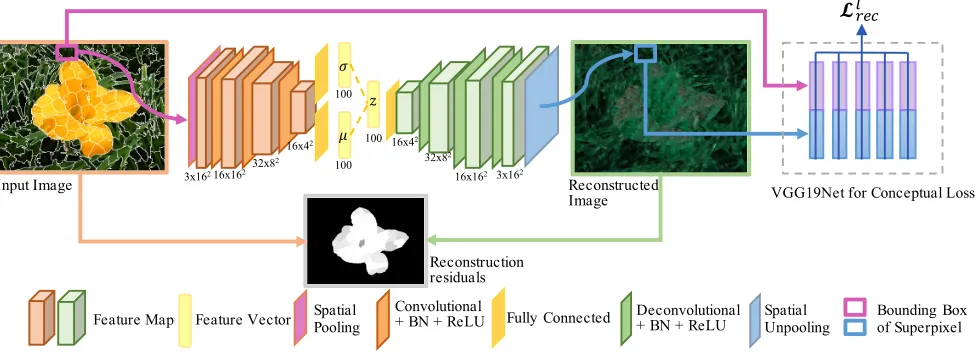
Figure 2: The main framework of our proposed superpixel-wise variational autoencoder network.
spatial consistency. In the meantime, unlike aforementioned deep learning based methods, the proposed framework also gets rid of excessive dependence on mask-level annotated data.
Method
The overview of our method is illustrated in Figure 2. For an input image, we first over segment it into superpixels by SLIC algorithm (Achanta et al. 2012). We then select the background samples from the image boundary. These back-ground superpixels are used to train the proposed VAE net-work through the perceptual loss. Next, we use the trained VAE to reconstruct all superpixels in the input image and calculate the reconstruction residual. To handle the scale problem of images in different sizes, we compute the recon-struction residuals at different scales and fuse them to gen-erate the final saliency results. In the following subsections, we will elaborate our superpixel-wise VAE network with the perceptual loss and how to generate the final saliency results through the deep reconstruction residuals.
Variational Autoencoder
Essentially, the true aim of salient object detection is to find objects that are distinctive from the image background (Han et al. 2015). So, it is natural to come up with the idea of mod-eling the property of background first and thereby separat-ing salient objects from the background. Followseparat-ing this idea, some methods (Han et al. 2015; Lu et al. 2016) intuitively consider image saliency detection as an estimation of recon-struction error of whole image with the learned background model. However, because of lacking generalization ability, their background models such as sparse coding and denois-ing autoencoders may fail to well reconstruct some back-ground regions which are variations of learned backback-ground. This leads to inaccurate salient scores in some regions. To handle this problem, we propose to use Variational Autoen-coder (VAE) (Kingma and Welling 2013) in our framework to model image background. As a probabilistic generative
neural network, VAE can give calibrated probabilities, while models of previous methods are deterministic discriminative model that do not have a probabilistic foundation. Specifi-cally, VAE encoder network maps an input samplexto a dis-tribution over latent variablesz ∼ Enc(x) = q(z|x). And decoder network maps from this latent space distribution to the original input spacex¯∼Dec(z) =p(x|z). Bothq(z|x) andp(x|z)are commonly assumed to be Gaussian distribu-tion. Therefore, instead of predicting a single latent vectorz, VAE predicts two vectorsµandσand samplez=µ+σϕ, whereϕis standard Gaussian (zero mean, unit variance) and
is element-wise multiplication. Thus, compared with the previous models, VAE can model the background patterns efficiently and generate well variations of background.
To train the VAE model, first we need to maximize the marginal log-likelihood of each observation inx, and the VAE reconstruction lossLrecis the negative expected
log-likelihood of the observations in x. Meanwhile, the differ-ence between the distribution ofq(z|x)and the distribution of a Gaussian distributionp(z), which is called Kullback-Leibler divergence, needs to be minimized to control the dis-tribution of the latent vectorz. Therefore, VAE models can be trained by optimizing the sum of the reconstruction loss
Lrecand KL divergence lossLkl.
Lrec=−Eq(z|x)logp(x|z) (1)
Lkl=DKL(q(z|x)||p(z)) (2)
Lvae=Lrec+Lkl (3)
Superpixel-Wise VAE Network Architecture
layers in the encoder network with3×3kernels. The stride of first layer is 1, while the strides of other two layers are set to be 2 to achieve spatial downsampling instead of using deterministic spatial functions such as pooling. Each convo-lutional layer is followed by an adaptive batch normalization layer and a ReLU activation layer. Then, to compute the KL divergence loss and sample latent variable z, we add two fully-connected output layers (for mean and variance) to en-code. As a symmetric architecture, we use 3 deconvolutional layers with the same3×3kernel size in the decoder network. For upsampling we use nearest neighbor method by a scale of 2 instead of standard zero-padding. We also add batch normalization layer and ReLU activation layer following de-convolutional layer to help stabilize training. The details of our superpixel-wise VAE architecture is shown in Figure 2.
However, an image superpixel may have an irregular shape with variable pixel number inside, while the convolu-tional layer usually requires fixed-length inputting vector. To obtain available inputting for each superpixel, we first gen-erate the bounding box of a superpixel. Moreover, to make the inputting vector only relevant to the pixels inside the su-perpixel, we fill the pixels outside the region but still inside its bounding box with the mean pixel values of superpixel. Then, we further perform average spatial pooling over an adaptive grid as with (He et al. 2015). We divide the bound-ing box of a superpixel into h×w cells. Let the size of the bounding box be H ×W. Average spatial pooling is performed within each cell withH/h×W/wpixels. After-wards, the aggregated feature vector of each superpixel has
h×w×3dimensions.
Perceptual Loss
As defined in neural style transfer (Gatys, Ecker, and Bethge 2016), perceptual loss of two images is the difference be-tween the hidden features in a pre-trained deep convolu-tional neural network Φ. The core idea of feature percep-tual loss is to seek the consistency between the hidden rep-resentations of two images. In our method, we propose to use the perceptual loss to capture important features such as detail and semantic information from the hidden represen-tations in different layers. Thus, our superpixel-wise VAE network can better model the background and reconstruct high quality superpixel results. Then we can separate salient objects from the background more accurately through the reconstruction residuals. Specifically, the 19-layer VGGNet (Simonyan and Zisserman 2014) is chosen as loss networkΦ to construct perceptual loss, which is trained for classifica-tion problem on ImageNet dataset. Letxrepresents a super-pixel in imageI, andx¯represents corresponding VAE out-put. Contrary to our previous process onx, we first perform spatial unpooling over x¯ to restore it to its original super-pixel size. Then we fill this reconstructed supersuper-pixelx¯into its corresponding location in the original imageIand obtain a new imageI0. Next, let Φ(I)lrepresents the feature map
of thelthhidden layer when input imageIis fed to network Φ. The perceptual loss for one layer (Ll
rec) between
super-pixelxandx¯can be calculated through the different(squared
euclidean distance) ofΦ(I)landΦ(I0)l,
Llrec=
1
RFl x×Cl
(Φ(I)l−Φ(I0)l)2, (4)
whereClis the number of channels of the feature mapΦ(I)l andRFl
xrepresents the receptive field size of superpixelxin
feature mapΦ(I)l. To accelerate the calculation of
percep-tual loss, we can fill more than one reconstructed superpixels into imageI as long as their receptive fields inlthhidden
layer do not overlap with each other. Then the only thing we need to do is replacingRFl
x with the sum of receptive
fields of all filled superpixels inI0. As can be seen, unlike previous region-based networks which simply process each superpixel in an independent way, we compute the percep-tual loss of each superpixel within the entire image. By this mean, our method can capture the spatial contexts informa-tion to better maintain the spatial consistency.
The final reconstruction loss is defined as the total loss by combining different layers of VGG Network. We also add a pixel-by-pixel reconstruction loss(cross entropy) between superpixelxandx¯in RGB space to capture low-level detail information. For a uniformly expression, we useL0
recto
rep-resent this loss. To train our superpixel-wise VAE, we jointly minimize the KL divergence lossLkland the reconstruction
lossLl
recfor different layers,
Ltotal =αLkl+ l X
i
(wlLlrec), (5)
where α and wl are weighting parameters for KL
Diver-gence and image reconstruction loss in different layers.
Saliency Detection via Reconstruction Residual
As described, after modeling the image background through our superpixel-wise VAE network, we reconstruct all super-pixels in the input image and then separate salient objects from the background through the reconstruction residuals. Just like what we do in training network, we estimate the difference between superpixelxand reconstruction resultx¯ not only in RGB space but also in hidden representations as the reconstruction residuals. Letrl(x)represents the
recon-struction residual (squared euclidean distance) of superpixel
xcalculated inlthhidden layer. Then the final
reconstruc-tion residual is defined as the combinareconstruc-tion of reconstrucreconstruc-tion residuals in different hidden representations,
r(x) =
l X
i
(wlrl(x)), (6)
where wl are the weighting parameters for reconstruction
residuals in different layers, same as the weighting param-eters in calculation of image reconstruction loss. After nor-malization, the salient scores εxfor each superpixel in the
input image can be obtained.
we assign saliency to each pixel by integrating results from multi-scale superpixel-level saliency
E(z) =
PNs
s=1ωzn(s)εn(s)
PNs
s=1ωzn(s)
, ωzn(s)=
1 kfz−vn(s)k2
, (7)
whereNsis the number of scale, andεn(s)is the
superpixel-level saliency in scales.fz is the low-level detail features
of pixelz, which consist of Lab and RGB color features and coordinate ofz.n(s)denotes the label of the superpixel con-taining pixel z at scale s andvn(s) is the mean low-level
detail features of all pixels in superpixeln(s). Thus,ω zn(s)
regards the similarity of pixelzwith its corresponding super-pixel as the weight to average the reconstruction residuals in multi-scale.
Experiments
Implementation
Our proposed SuperVAE network has been implemented on the basis of pytorch, an open source framework for CNN training and testing. When we select superpixels on the im-age boundary as background samples to train our VAE net-work, we calculate the boundary connectivity (Zhu et al. 2014) for each superpixel and then use it to eliminate incor-rect background examples on image boundary. For multi-scale reconstruction residuals, we generate superpixels at three different scales (150, 250, 350 superpixels). All su-perpixels are resized to16×16×3by average spatial pool-ing. For reconstruction loss, we use the combination ofL0
rec
and perceptual loss from layersrelu3 1, relu4 1, relu5 4, which are calledL3
rec, L4rec, L5recrespectively. The
weigh-ing parametersw0, w3, w4, w5of reconstruction loss are set
to 0.2, 0.1, 0.2, 0.5 respectively in our experiments. To en-sure our SuperVAE model can learn as much information from reconstruction loss as it can, we adopt a KL cost an-nealing method (Bowman et al. 2016) in our experiments. Specifically, we add a variable weight to the KL term in the loss function at training time. At the start of training, we set that weight to zero, and then, as training progresses, we gradually increase this weight by 0.01 until it reaches 1.
We run our method on an octa-core PC machine with an NVIDIA GTX 1080Ti GPU and an i7-6900 CPU. During the training, we use ADAM stochastic gradient optimization method with batch size 10, and learning rate 0.005. For a single input image, the training process usually converges in 200 iterations. The average training time for each image is 6.2s, then it takes 1.3s seconds for the trained model to detect salient objects in the input image with 400x300 pixels.
Datasets and Evaluation Criteria
We evaluate the performance of our method on five public datasets: ECSSD (Shi et al. 2016) dataset contains 1,000 natural images, in which many semantically meaningful and complex structures are included.ASD (Achanta et al. 2009) consists of 1000 images and most images in this dataset con-tains single object.SED (Borji et al. 2015) dataset has two non-overlapped subsets, i.e., SED1 and SED2. SED1 has 100 images each containing only one salient object, while
SED2 has 100 images each containing two salient objects. SOD (Wang et al. 2017) dataset contains 300 images and it was originally designed for image segmentation. Many im-ages in this dataset have multiple salient objects with low contrast.
To evaluate the performance of varied methods, we adopt three metrics, including the widely used precision-recall (PR) curves, F-measure and mean absolute error (MAE) (Borji et al. 2015). The PR curve of a specific dataset ex-hibits the mean precision and recall of saliency maps at dif-ferent thresholds. The F- measure is a weighted mean of av-erage precision and avav-erage recall, calculated by
Fβ=
(1 +β2)×P recision×Recall
β2×P recision+Recall . (8)
We setβ2to be 0.3 as suggested in (Borji et al. 2015).
For fair comparison on non-salient regions, we also cal-culate the mean absolute error (MAE) by
M AE = 1
W ×H
W X
x=1 H X
y=1
|S(x, y)−G(x, y)|, (9)
whereWandHare the width and height of the input image.
S(x, y)andG(x, y)are the pixel values of the saliency map and the binary ground truth at(x, y), respectively.
Comparison with the State-of-the-arts
(a)ECSSD (b)ASD (c)SOD
Pr
ec
is
ion
Recall
Pr
ec
is
ion
Recall
Pr
ec
is
ion
Recall
(d)SED1
Pr
ec
is
ion
Recall
Pr
ec
is
ion
Recall
(e)SED2
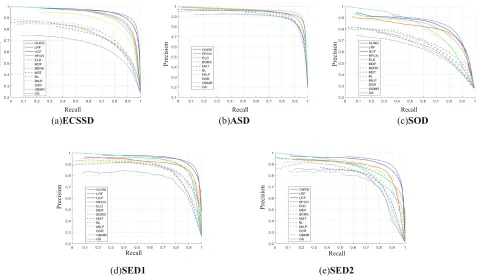
Figure 3: The PR curves of the proposed algorithm and other state-of-the-art methods.
ECSSD ASD SED1 SED2 SOD
Supervision Methods
Fβ MAE Fβ MAE Fβ MAE Fβ MAE Fβ MAE
OURS 0.828 0.103 0.867 0.068 0.822 0.121 0.789 0.101 0.733 0.159
MST (Tu et al. 2016) 0.705 0.157 0.859 0.098 0.808 0.130 0.768 0.125 0.633 0.223 BDRS (Han et al. 2015) 0.549 0.281 0.682 0.175 0.659 0.202 0.622 0.197 0.517 0.301 BL (Lu et al. 2017) 0.605 0.216 0.752 0.129 0.780 0.185 0.661 0.181 0.547 0.267 MILP (Huang et al. 2017) 0.651 0.177 0.844 0.077 0.741 0.152 0.753 0.129 0.560 0.243 DSR (Lu et al. 2016) 0.644 0.171 0.828 0.080 0.731 0.158 0.715 0.140 0.551 0.234 Unsupervised
GBMR (Zhang et al. 2017a) 0.640 0.190 0.837 0.085 0.759 0.166 0.707 0.169 0.549 0.239 GS (Wei et al. 2012) 0.553 0.206 0.745 0.109 0.660 0.176 0.696 0.150 0.527 0.251 LRF (Zhang et al. 2018) 0.880 0.054 – – 0.902 0.051 0.871 0.052 0.789 0.124 UCF (Zhang et al. 2017b) 0.844 0.078 – – 0.865 0.065 0.810 0.069 0.738 0.148 Pixel-level
RFCN (Wang et al. 2018) 0.824 0.107 0.863 0.070 0.850 0.117 0.767 0.113 0.743 0.170 Annotations ELD (Lee, Tai, and Kim 2016) 0.810 0.080 0.886 0.037 0.871 0.153 0.759 0.104 0.712 0.164 MDF (Li and Yu 2016b) 0.807 0.105 – – 0.779 0.123 0.768 0.115 0.721 0.192
Table 1: Quantitative comparison with the state-of-the-arts on five famous benchmark datasets. The bold and underlined num-bers indicate the best and the second best results, respectively. “–” means corresponding methods are trained on that dataset.
and SOD. When compared with the supervised methods in group 2, our method is weaker than LRF and UCF. But it is noteworthy that as an unsupervised framework we con-sistently outperform MDF and achieve competitive perfor-mance comparing with ELD and RFCN .
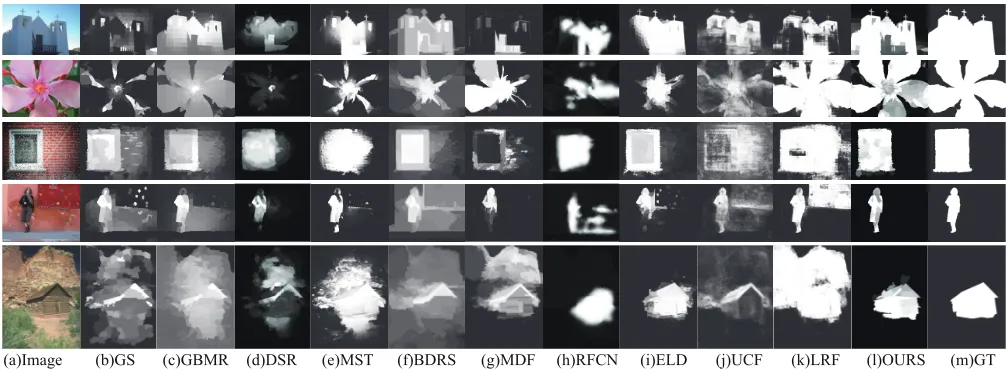
Qualitative Evaluation. We further provide some typical saliency maps of different methods to intuitively demon-strate advantages of the proposed SuperVAE over other methods, as shown in Figure 4. From these results, we can observe that our method is more effective to detect the salient objects accurately, and obtain more clear ob-ject boundaries for input images. Specifically, most of the
(a)Image (b)GS (c)GBMR (d)DSR (e)MST (f)BDRS (g)MDF (h)RFCN (i)ELD (j)UCF (k)LRF (l)OURS (m)GT
Figure 4: Comparison of typical saliency maps. (a) original image, (m) ground truth mask. Due to the limitation of space, we don’t show the results of BL and MILP.
ECSSD ASD SED1 SED2 SOD
Models
Fβ MAE Fβ MAE Fβ MAE Fβ MAE Fβ MAE
OURS-BS 0.813 0.127 0.862 0.078 0.811 0.129 0.781 0.116 0.715 0.191 OURS-MF 0.821 0.109 0.865 0.069 0.820 0.123 0.785 0.104 0.730 0.164 OURS-PL 0.759 0.138 0.861 0.072 0.813 0.128 0.776 0.122 0.707 0.196 OURS 0.828 0.103 0.867 0.068 0.822 0.121 0.789 0.101 0.733 0.159
Table 2: The F-measure and MAE of different settings on five salient object detection datasets.
Ablation Analysis
To verify the effectiveness of the key components in pro-posed model, we perform ablation experiments on the datasets mentioned above. Specifically, we compared our fi-nal results(OURS) with the results without background sam-ples selection (OURS-BS), the results without multi-scale fusion (OURS-MF), and the results without using perceptual loss (OURS-PL). InOURS-BS, we train our VAE network directly using the superpixels on the image boundary, with-out using the boundary connectivity to eliminate incorrect examples. InOURS-MF, we generate the saliency result for an input image in three different scales individually, and the results are not fused. The quantitative evaluation results of OURS-MF are calculated by averaging the quantitative eval-uation results in three scales. InOUR-PL, we only use the reconstruction loss in RGB space (L0
rec) to train our
Super-VAE network without the perceptual loss in hidden represen-tations and the reconstruction residuals are also calculated only in RGB space.
The experimental results are shown in Table. 2, from which we can see that: (1) OUR-BS obtains worse perfor-mance than our final results, which demonstrates the ef-fectiveness of background samples selection. (2) Without multi-scale fusion, the average F-measure decrease about 0.036 and MAE increase about 0.04, respectively, which means our multi-scale strategy can well handle the scale problem of images in different sizes. (3) Without using per-ceptual loss, the performance (in terms of the F-measure and
MAE) of the proposed framework gets worse more obvi-ously, demonstrating the significance of the semantic and spatial contexts information in the hidden representations. Meanwhile, even only usingL0
recloss, OUR-PL still
outper-forms all unsupervised methods in group 1, which demon-strates the effectiveness of our SuperVAE network.
Conclusions
In this paper, we propose a novel salient object detection framework using SuperVAE network. Our method first use SuperVAE to model the image background and then separate salient objects from the background through the reconstruc-tion residuals. For training, we also propose a perceptual loss to take advantage of deep pre-trained CNNs to better capture semantic and spatial contexts information. As a re-sult, our method generates high quality saliency maps which can better preserve object boundaries and maintain the spa-tial consistency, without the supervision of mask-level anno-tated data. Extensive experiments on five famous benchmark datasets show that the proposed method achieves superior or competitive performance compared to other algorithms in-cluding the very recent state-of-the-art supervised methods.
References
Achanta, R.; Shaji, A.; Smith, K.; Lucchi, A.; Fua, P.; and S¨usstrunk, S. 2012. SLIC superpixels compared to state-of-the-art superpixel methods. IEEE TPAMI34(11):2274– 2282.
Borji, A.; Cheng, M.; Jiang, H.; and Li, J. 2015. Salient ob-ject detection: A benchmark.IEEE TIP24(12):5706–5722. Bowman, S. R.; Vilnis, L.; Vinyals, O.; Dai, A.; Jozefow-icz, R.; and Bengio, S. 2016. Generating sentences from a continuous space. InSIGNLL, pages 10–21.
Gatys, L. A.; Ecker, A. S.; and Bethge, M. 2016. Image style transfer using convolutional neural networks. InCVPR, pages 2414–2423.
Han, J.; Zhang, D.; Hu, X.; Guo, L.; Ren, J.; and Wu, F. 2015. Background prior-based salient object detection via deep reconstruction residual.IEEE TCSV25(8):1309–1321. He, K.; Zhang, X.; Ren, S.; and Sun, J. 2015. Spatial pyramid pooling in deep convolutional networks for visual recognition.IEEE TPAMI37(9):1904–1916.
Hong, S.; You, T.; Kwak, S.; and Han, B. 2015. Online tracking by learning discriminative saliency map with con-volutional neural network. InICML, pages 597–606. Huang, F.; Qi, J.; Lu, H.; Zhang, L.; and Ruan, X. 2017. Salient object detection via multiple instance learning.IEEE TIP26(4):1911–1922.
Jia, Y., and Han, M. 2013. Category-independent object-level saliency detection. InICCV, pages 1761–1768. Kingma, D. P., and Welling, M. 2013. Auto-encoding vari-ational bayes. CoRRabs/1312.6114.
Lee, G.; Tai, Y.; and Kim, J. 2016. Deep saliency with encoded low level distance map and high level features. In
CVPR, pages 660–668.
Li, G., and Yu, Y. 2016a. Deep contrast learning for salient object detection. InCVPR, pages 478–487.
Li, G., and Yu, Y. 2016b. Visual saliency detection based on multiscale deep CNN features. IEEE TIP25(11):5012– 5024.
Liu, T.; Yuan, Z.; Sun, J.; Wang, J.; Zheng, N.; Tang, X.; and Shum, H. 2011. Learning to detect a salient object. IEEE TPAMI33(2):353–367.
Long, J.; Shelhamer, E.; and Darrell, T. 2015. Fully con-volutional networks for semantic segmentation. InCVPR, pages 3431–3440.
Lu, H.; Li, X.; Zhang, L.; Ruan, X.; and Yang, M. 2016. Dense and sparse reconstruction error based saliency de-scriptor.IEEE TIP25(4):1592–1603.
Lu, H.; Zhang, X.; Qi, J.; Tong, N.; Ruan, X.; and Yang, M. 2017. Co-bootstrapping saliency.IEEE TIP26(1):414–425. Mademlis, I.; Tefas, A.; and Pitas, I. 2017. Summarization of human activity videos using a salient dictionary. InICIP, pages 625–629.
Ren, Z.; Gao, S.; Chia, L.; and Tsang, I. W. 2014. Region-based saliency detection and its application in object recog-nition.IEEE TCSV24(5):769–779.
Russakovsky, O.; Deng, J.; Su, H.; Krause, J.; Satheesh, S.; Ma, S.; Huang, Z.; Karpathy, A.; Khosla, A.; Bernstein,
M. S.; Berg, A. C.; and Li, F. 2015. Imagenet large scale visual recognition challenge. IJCV115(3):211–252. Shi, J.; Yan, Q.; Xu, L.; and Jia, J. 2016. Hierarchical im-age saliency detection on extended CSSD. IEEE TPAMI
38(4):717–729.
Simonyan, K., and Zisserman, A. 2014. Very deep convo-lutional networks for large-scale image recognition. CoRR
abs/1409.1556.
Tu, W.; He, S.; Yang, Q.; and Chien, S. 2016. Real-time salient object detection with a minimum spanning tree. In
CVPR, pages 2334–2342.
Wang, J.; Jiang, H.; Yuan, Z.; Cheng, M.; Hu, X.; and Zheng, N. 2017. Salient object detection: A discriminative regional feature integration approach. IJCV123(2):251–268. Wang, L.; Wang, L.; Lu, H.; Zhang, P.; and Ruan, X. 2018. Salient object detection with recurrent fully convolutional networks. IEEE TPAMI.
Wei, Y.; Wen, F.; Zhu, W.; and Sun, J. 2012. Geodesic saliency using background priors. InECCV, pages 29–42. Wei, Y.; Liang, X.; Chen, Y.; Shen, X.; Cheng, M.; Feng, J.; Zhao, Y.; and Yan, S. 2017. STC: A simple to com-plex framework for weakly-supervised semantic segmenta-tion. IEEE TIP39(11):2314–2320.
Zhang, L.; Yang, C.; Lu, H.; Ruan, X.; and Yang, M. 2017a. Ranking saliency. IEEE TPAMI39(9):1892–1904.
Zhang, P.; Wang, D.; Lu, H.; Wang, H.; and Yin, B. 2017b. Learning uncertain convolutional features for accu-rate saliency detection. InICCV, pages 212–221.
Zhang, P.; Liu, W.; Lu, H.; and Shen, C. 2018. Salient object detection by lossless feature reflection. In IJCAI, pages 1149–1155.
Zhao, R.; Ouyang, W.; Li, H.; and Wang, X. 2015. Saliency detection by multi-context deep learning. InCVPR, pages 1265–1274.