The Thirty-Third AAAI Conference on Artificial Intelligence (AAAI-19)
PCGAN: Partition-Controlled Human Image Generation
Dong Liang,
∗Rui Wang,
∗†Xiaowei Tian, Cong Zou
SKLOIS, Institute of Information Engineering, Chinese Academy of Sciences School of Cyber Security, University of Chinese Academy of Sciences
{liangdong, wangrui, tianxiaowei, zoucong}@iie.ac.cn
Abstract
Human image generation is a very challenging task since it is affected by many factors. Many human image genera-tion methods focus on generating human images condigenera-tioned on a given pose, while the generated backgrounds are often blurred. In this paper, we propose a novel Partition-Controlled GAN to generate human images according to target pose and background. Firstly, human poses in the given images are ex-tracted, and foreground/background are partitioned for fur-ther use. Secondly, we extract and fuse appearance features, pose features and background features to generate the de-sired images. Experiments on Market-1501 and DeepFash-ion datasets show that our model not only generates realistic human images but also produce the human pose and back-ground as we want. Extensive experiments on COCO and LIP datasets indicate the potential of our method.
Introduction
Photo-realistic image editing via computer programs is an attracting idea in the computer vision field. Human image editing or generation is one of the most challenging topics. This is because our visual system is too familiar with human figures and surrounding backgrounds, which leads to a low tolerance rate for flaws in the generated images.
Recent researches on similar image generation tasks have produced fruitful results. Works based on Generative Adver-sarial Network (GAN) (Goodfellow et al. 2014) achieve the task by adapting image translation between two domains. By training the GAN model on two image domains of face, AttGAN (He et al. 2017b) can change the foreground face in the source image according to the target face attributes. In a more general sense, the CycleGAN (Zhu et al. 2017) translates domains with more complex changes, such as horse and zebra, photo and painting. However, these meth-ods generate images with appearance changes only or some-times with tiny shape changes according to the differences between domains rather than instances. The human image generation task requires image translations with non-trivial movement and even challenging changes with only semantic similarity between images.
∗
The first two authors contributed equally to this work.
†
Corresponding author.
Copyright c2019, Association for the Advancement of Artificial Intelligence (www.aaai.org). All rights reserved.
𝑥𝑠𝑟𝑐
𝑥𝑡𝑔𝑡 background pose
ො 𝑥
Body sub-parts foreground mask
Partition-controlled Generation
Tier-I Tier-II
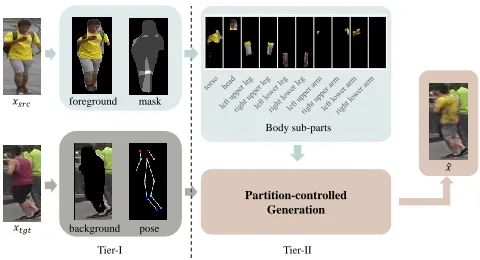
Figure 1: The partition-controlled human image generation (test phase). The proposed algorithm is two-tier: (1) Partition the foreground human body and the background and extract-ing the landmark of the human body pose; (2) Partition the body sub-parts of the foreground person. We use the parti-tion informaparti-tion to extract latent representaparti-tions of different parts. And they are further fused in the generator by skip connections in its U-Net structure.
In this paper, we aim to generate a human image using the appearance of a person in a source image, and the pose as well as background information in the target image. Specifi-cally, we turn this task into image generation by synthesizing two parts: (1) the appearance of the foreground in the source image and (2) the specific pose and background in the target image. This appearance of person is mainly related to the color and style of the clothes. While, in order to fit the pose and background of the target image, the non-rigid transfor-mation should be applied to the source image.
To alleviate this problem, the proposed method tries to partition the image in a two-tier manner. As shown in Fig.1, we consider the task of changing the foreground person in the target image xtgt to the one in source image xsrc. In
the first tier, our operation is in the image space. We parti-tion the image into foreground and background, and extract the landmarks of the human body in both images. While in the second tier, our operation is in the latent space. Inspired by the U-net structure in (Isola et al. 2017), we use two en-coders (denoted as E1 andE2 below) and one decoder to
build our W-Net. We feedE1with the source image and its
landmarks to extract source appearance feature. Meanwhile, we feedE2with target image and also its landmarks as well
as background to extract pose feature and background fea-ture. Then we connect those features in the decoder. Specifi-cally, we concatenate target features to the output of decoder layers using the same skip connection like the U-net. In or-der to handle the pose variation problem between the source and target images, we introduce an affine transformation to the feature maps generated byE1so that the source
appear-ance can better fit in the target image. Moreover, we partition both source and target foreground human body into 10 sub-parts. Using the one to one correspondence between them, the affine transformation can be learned.
In addition, we use two adversarial losses to constraint the human pose and appearance respectively. We also explore the combination of adversarial loss with the pixel-to-pixel loss to force the generated image being more realistic. The results show significant improvements on several datasets quantitatively and qualitatively.
Our contributions can be summarized as follows: • We propose a novel generation architecture PCGAN, in
which we design a W-Net to fuse foreground and back-ground features.
• We propose a new method to separate background and human foreground suitable for the human generation task. • Our experiments show that our method can generate real-istic human images but also produce the human pose and background as we want.
Related Works
Image-to-image generation
Most recently, image generation is mainly solved by Vari-ational Auto-encoder (VAE) (Kingma and Welling 2013) and GAN (Goodfellow et al. 2014). VAE is designed on the probabilistic graphical model whose objective is maximiz-ing the loglikelihood of two distributions. It first introduced the autoencoder (AE) (Hinton and Salakhutdinov 2006) to generate images from noise distribution. While the original GAN tries to project Gaussian noise to the distribution of real images by a generator. The reason for its success lies in the proposed adversarial loss which distinguishes the gener-ated data and real data using a discriminator.
The generator of GAN is built up with convolutional neural networks such as AE (Pathak et al. 2016; Wang and Gupta 2016; Salimans et al. 2016), U-net structure (Isola et al. 2017; Ronneberger, P.Fischer, and Brox 2015;
Yi et al. 2017), and ResNet (Zhu et al. 2017). Specifically, the U-net consists of an encoder and a decoder, which are a set of convolutional and de-convolutional blocks respec-tively. The skip connections between encoder layers and de-coder layers help to remain abundant levels information of the input images. In this paper, we also leverage the skip connection to combine partitioned features in the decoder to modify the output images.
Most of the image-to-image generation methods focus on changing appearance, such as, style transfer (Zhu et al. 2017), super-resolution (Ledig et al. 2017), colorization (Zhang, Isola, and Efros 2016; Sangkloy et al. 2017), while they always lack prior knowledge for spatial deformations in their models. CycleGAN (Zhu et al. 2017) does an excellent job on unpaired image transfer by introducing a reconstruc-tion loss. However, they do not have the constraint on the ge-ometric structure of objects in each image. Thus they show little structure difference between inputs and outputs. To al-leviate the problem, some researchers propose conditional GAN to constraint the generator and discriminator with su-pervised knowledge and achieve better results (Isola et al. 2017). Since then, researchers can separate and edit differ-ent kinds of attributes in GAN based architectures. AttGAN (He et al. 2017b) edits the face images by learning the latent representation of the attributes. However, there are few spa-tial deformations shown in the face images. StarGAN (Choi et al. 2018) trains only one generator for several attributes on the face generation task, which simplifies the model of multi-domain image generation.
Compared with face editing, the human pose image gen-eration is more complicated as the non-rigid structures cause more deformations and occlusions. (Ma et al. 2017) pro-poses a more general approach allowing arbitrary pose syn-thesis, which is conditioned on the image and pose key points. (Ma et al. 2018) integrates the appearance and pose of human body and background in latent space and gener-ate the images from noise distribution. (Siarohin et al. 2018) is closest to the proposed method, which modifies the fore-ground human pose by a deformable skip connection. But the background of the target image is not taken into consid-eration.
Pose Estimation
𝒇𝒆𝒂𝒕(𝑬𝟏_𝟏)
𝒇𝒆𝒂𝒕(𝑬𝟏_𝟔)
𝒇𝒆𝒂𝒕(𝑬𝟐_𝟏)
𝒇𝒆𝒂𝒕(𝑬𝟐_𝟔)
𝒇𝒆𝒂𝒕(𝑫_𝟓)
noise
ො
𝑥 𝐵(𝑥𝑡𝑔𝑡) 𝐻(𝑥𝑡𝑔𝑡)
𝑥𝑠𝑟𝑐 𝐻(𝑥𝑠𝑟𝑐)
𝐸
1𝐷
𝐸
2𝑓 ⋅ ⨀𝑀𝐹𝑠𝑟𝑐𝑖&
𝑓 ⋅ ⨀𝑀𝐹𝑠𝑟𝑐𝑖&
…
…
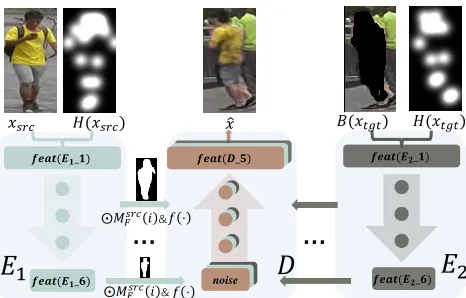
Figure 2: The generator (W-Net). Taken a pair of inputxsrc
andxtgt, we first organize the input as the concatenation of
images and heat maps (Eq. 1). Note that for the target im-agextgt, we first split out the background using the mask
extracted by Mask RCNN. To transmit the low-level infor-mation from both branches of the W-Net, we add skip con-nections from layers ofE1, E2 toD. In order to adapt the
feature maps to the decoder, we first add some transforma-tions on them.f(·)is the affine transformation of each sub-part.Msrc
R (i)splits out thei-th body sub-part ofxsrc. Skip
connections only employed in the first 4 layers.
obtain the human body pose by a state-of-the-art pose esti-mator (Cao et al. 2017). This may cause missing points in the training and testing input which is tolerable in the gener-ative models.
Segmentation
The instance segmentation annotations are also widely used in the generation tasks. (Lassner, Pons-Moll, and Gehler 2017) manipulates human images by changing the clothes in a given pose. But the model is costly in segmentation annotation and based on a complex 3D pose representa-tion. Segmentation is a basic method in the computer vi-sion field and is now developed rapidly in a short period of time. Driven by powerful baseline methods (Girshick 2015; Ren et al. 2015), the segmentation task now can be solved in satisfactory time complexity and accuracy. We apply the state-of-the-art instance segmentation method Mask-RCNN to obtain the segmentation of the foreground against the background. The segmentation results serve as a supplemen-tation of the pose estimation and help the partition method achieving more accurate prior knowledge.
Partition-Controlled Image Generation
In this section, we describe the proposed method of the partition-controlled generation networks.
Our goal is to manipulate the human image with the target pose and background. To that end, we propose the two-tier partition-controlled method. In tier-I, we partition the image into foreground and background, and extract the landmarks of the human body in both images in the image space. Con-sidering the complexity of the non-rigid transformations of
the foreground human body, we design the tier-II to partition and reconstruct the body parts in the latent space. In partic-ular, by adopting the HPE and Mask-RCNN, we extract the pose landmarks and then decompose the human body into 10 parts with coarse masks. Then we use the affine trans-formation to project the features of 10 body parts to fit the background according to the target pose.
Tier-I: Pose Estimation and Background Partition
We first introduce some notations. In short, we aim at gen-erating images xˆ which naturally change the foreground person (appearance and pose) to fit the background of an-other image. Hence, different from the Deformable GAN (Siarohin et al. 2018), the generated imagexˆ is both con-ditioned on the pose P(xtgt) and background B(xtgt).
The model is trained on paired image datasets X = {(x{srci}, x{tgti})}i=1,···,N, which contains the same person in
different pose and background. In the testing phase, we take two images xsrc, and xtgt of different persons as input,
where xsrc provides the person appearance and xtgt
pro-vides the pose and background.
To condition the generation model with the pose of the target image, we represent the landmarks as heat maps ma-trices. Following the settings in (Siarohin et al. 2018), for each landmark pj, we represent the heat map matrix as a
blurry area:
Hj(p) = exp
−kp−pjk σ2
, (1)
whereσ= 6,pruns through all the pixels in the heat map. Then we concatenate thekheat maps of imagexto form the heat map tensorH(x) = [H1(p),· · ·, Hk(p)], k= 18.
To express the pose of a person in xsrc, we extract k
landmarks using the Human Pose Estimator (HPE)P(x) = (p1,· · ·,pk)as (Ma et al. 2017) did. For fair comparison,
we extract the same 18 landmarks as (Ma et al. 2017). In order to keep the background of xtgt inx, we employ theˆ
masks M(xtgt) to split out the backgrounds B(xtgt) =
xtgt (1−M(xtgt)). In the meantime, to better fit the
appearance of the foreground person to the background, we also split out the foreground person using the extracted mask of the source images F(xtgt) = M(xtgt) xtgt.
The masks of both the source imageM(xsrc)and the
tar-get image M(xtgt) are extracted using the Mask-RCNN
(He et al. 2017a) trained on COCO2014, with two classes person and background. Both the landmarks and masks are used in the testing and training phase. Note that we do not use the ground-truth annotations for training. Because the landmarks and masks are generated using HPE and Mask-RCNN, there are some missing points and parts (usually part of the foot, hand and head). Also note that both the land-marks and masks can be done before training and testing.
Tier-II: Human Body Transformation
𝑥𝑥𝑠𝑠𝑠𝑠𝑠𝑠 𝑃𝑃 𝑥𝑥𝑠𝑠𝑠𝑠𝑠𝑠 𝑀𝑀𝑅𝑅𝑠𝑠𝑠𝑠𝑠𝑠 𝑀𝑀𝐹𝐹𝑠𝑠𝑠𝑠𝑠𝑠
𝑀𝑀𝑅𝑅𝑠𝑠𝑠𝑠𝑠𝑠 𝑀𝑀𝑅𝑅𝑠𝑠𝑠𝑠𝑠𝑠 𝑖𝑖 𝑀𝑀𝑅𝑅𝑡𝑡𝑡𝑡𝑡𝑡 𝑖𝑖 𝑀𝑀𝑅𝑅𝑡𝑡𝑡𝑡𝑡𝑡
⨀𝑀𝑀 𝑥𝑥𝑠𝑠𝑠𝑠𝑠𝑠 HPE
𝑓𝑓 ⋅
𝑥𝑥𝑠𝑠𝑠𝑠𝑠𝑠 𝑥𝑥𝑡𝑡𝑡𝑡𝑡𝑡
(a)
(b)
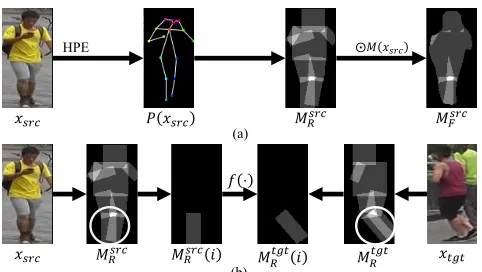
Figure 3: The first row shows the process of obtaining the masks of sub-parts. The second row shows the definition of the affine transformation on sub-parts.
changing the appearances, such as making up and dressing. In this paper, we change not only the color and style of the clothes, but also the body shape. For example, we suppose to change a thin person inxsrc to the background inxtgt,
rather than change the appearance of the face and clothes to thextgt. Similarly as (Siarohin et al. 2018), we
decom-pose the human body to 10 sub-partsRi, i ∈ {1,· · ·,10}:
the torso, the head, the left/right upper/lower arm and the left/right upper/lower leg. Here we made some adaption to the settings to take the body shape into consideration. We define the body shape index according to the torso:
Ds=
kprh−prsk2+kplh−plsk2
2 , (2)
where pls,prs,plh,prh denotes left/right shoulder and
left/right hip separately. The head region is a square cen-tered at landmarks left/right eye, left/right ear, nose with side length0.8Ds. The arms and legs contain 2
correspond-ing landmarks. We set these regions as rectangles with the width equal to0.3Ds.
With the algorithms above, we obtain 10 rough body parts according to the pose of the source and target images. How-ever, they are still not exact enough to pick out the fore-ground from the backfore-ground. Some regions may not even exist because of the absence of the landmarks. Hence, we ex-tract the human body mask using Mask-RCNN and separate it into 10 body parts. Take the source image for example. First, we compute binary masksMsrc
R (i), i ∈ {1,· · ·,10}
for each body part, which is zero everywhere except the points in thei-th sub-parts (defined above).Msrc
F is obtained
from Mask-RCNN, which is zero for the background and one for the person regions. Then we calculate the Hadamard product of the body mask MFsrc and the region masks Msrc
R (i)to gain the accurate mask:
MFsrc(i) =MFsrcMRsrc(i). (3) Considering the occlusion of the body parts, we define the torso as the rest ofMsrc
F after removing the other sub-parts:
MFsrc(1) =MFsrc\{∪2···10MFsrc(i)}.
We define a set of affine transformationsf(·)on sub-parts MRsrc(i)to control the generation of the human body. For
example in Fig. 3, for each body region, we transfer the re-gion maskMR(xsrc)toMR0(xtgt)usingf(·). Note that we
do not use the accurate maskMsrc
F to define the
transforma-tion, because of the difference of the body shape. Moreover, the mask forxtgtuses the body shape index ofxsrcin order
to remain the shape ofxsrcin the target image. The
param-eters of the affine transformation are learned by minimizing a least square error. Note that the affine transformation is adopted in the skip connections of the middle layers of the generator rather than the original images (see below).
Network Architecture
Inspired by (Liu and Tuzel 2016), we propose a two-branched reconstruction architecture for the human body and the background separately, as shown in Fig. 1. The generator Gtakes as input 4 tensors:(xsrc, H(xsrc),xtgt,
M(xtgt)H(xtgt)). Note that all these tensors can be
pre-calculated before training and testing.
W-Net In order to condition the generator with two streams of information, we propose a generator G con-sists of two encoders and one decoder with skip connec-tions (Fig. 2). We name it by W-Net as each branch of it can be regarded as a U-net. Encoder E1 aims to
ex-tract the latent representations of the foreground appear-ance and pose(xsrc, H(xsrc)). Moreover, the encoderE2
is fed with the background appearance and pose tensor (xtgtM(xtgt), H(xtgt)). These tensors are concatenated
before passing into the encoders. While both the two en-coders aim at projecting the appearance and pose to latent space, we do not share the weights of the two encoders. Because the appearance of the target background and the source foreground belongs to different categories, and also because the displacement of the landmarks is always too far regarding different poses. By doing so, we guide the net-work to remain not only the appearance but also the spatial information in the feature maps. Then, the decoder fuses the feature maps extracted fromE1andE2by U-net structure
with skip connections to join the foreground and the back-ground together.
As described in the last section, we design the feature maps of the generator highly related to the location of the landmarks. In order to partially control the generation of the human body of source imagesxsrc, we apply affine
transfor-mations to the feature maps generated byE1. Specifically,
we do the affine transformation on each sub-parts of the hu-man body in the latent space. Then we add them together and skip connect them with the layers in the decoder (Fig. 2).
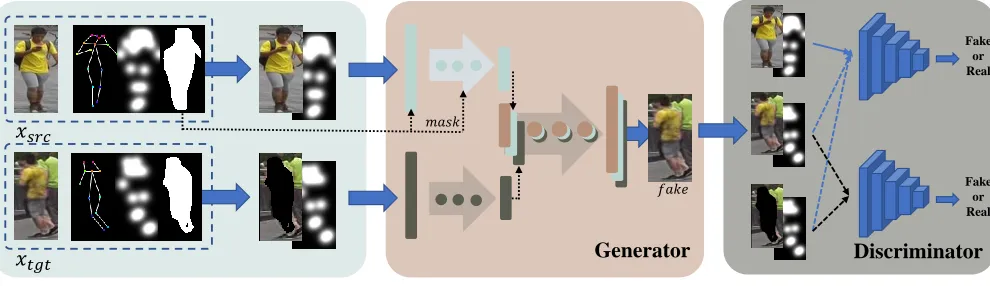
Discriminator We design two discriminator networks.D1
is a fully-convolutional discriminator conditioned on the given ground-truth appearance and pose. Specifically, we concatenate (xsrc, H(xsrc), xtgt, H(xtgt)) as positive
ex-amples and (xsrc, H(xsrc),x, Hˆ (xtgt))as negative
exam-ples. But the texture of persons on the two compared images is not aligned strictly landmark by landmark. To alleviate the misalignment, we use another discriminatorD2to
distin-guish fake images and real images. It takes as input an image xsrcorxtgt. Both the discriminators return scalar values in
𝑥
𝑡𝑔𝑡𝑥
𝑠𝑟𝑐𝑓𝑎𝑘𝑒 𝑚𝑎𝑠𝑘
Generator
Discriminator
Fake or Real
Fake or Real
Figure 4: The whole PCGAN architecture. With the given input images xsrc and xtgt, we first compute the poses
P(xsrc), P(xtgt)and masksM(xsrc), M(xtgt). The heat mapsH(xsrc), H(xtgt)are then calculated by pose. The
genera-tor is fed with(xsrc, H(xsrc))and(xtgtM(xtgt), H(xtgt))with the masks conditioned on the skip connections on layers
of ‘W-Net’. DiscriminatorD1forces the generated images to have the same pose and appearance as the target images by
con-ditioning on the ground-truth(xtgt, H(xtgt)).D2only distinguishes the real and fake pairs. Both of them take(xsrc, H(xsrc))
as true and(ˆx, H(xtgt))as false.
Objective functions We train the whole network with two standard GAN loss. The cGAN loss conditioned by the ground-truth is given by:
LcGAN(G, D1) =E[logD1(x|y)] +E[log(1−D1(ˆx|y))].
(4) wherexis the concatenation of real inputs(xsrc, H(xsrc))
andxˆis the output of the generator(ˆx, H(xtgt)). The
con-ditionydenotes(xtgt, H(xtgt)).
The GAN loss distinguishing real and fake image do-mains is given by:
LGAN(G, D2) =E[logD2(xtgt)] +E[log(1−D2(ˆx))].
(5) We also applyL1loss to the reconstructed image for the
generator:
L1(ˆx, xtgt) =kxˆ−xtgtk1. (6)
Combining Eq. 4 - Eq. 6, the objective function is: L= min
G maxD LcGAN(G, D1) +λ1LGAN(G, D2)
+λ2L1(ˆx, xtgt). (7)
The parameters are setλ1 = 1, λ2 = 0.01in the
experi-ments.
Experiments
In this section, we introduce the experiment settings and the training details of the algorithm. Both qualitative and quan-titative results are demonstrated on the human image gen-eration task. The experiment results show that the proposed method outperforms the existing algorithms especially cases with complex geometry deformations. Code can be found at https://github.com/AlanIIE/PCGAN.
Training Procedure
We train all the networks with mini-batch Adam optimizer (learning rate: 2e-4, β1 = 0.5, β2 = 0.999). The
genera-tor is designed in U-net structure with two encoders and
one decoder. Our encoder is set as 7 blocks for the Deep-Fashion dataset and 6 blocks for the Market-1501 dataset.
Letc3s1-kdenote a3×3Convolution-ReLU layer with
k filters and stride 1. dk denotes a 4 × 4 Convolution-InstanceNorm-ReLU layer with k filters and stride 2.uk de-notes a4×4 fractional-strided-Convolution-InstanceNorm-ReLU layer with k filters and stride 1/2.
The encoder network with 6 blocks consists of:
c3s1-64,d128,d256,d512,d512,d512
The encoder network with 7 blocks supplements the 6 blocks with an additionald512behind.
The corresponding decoder is:
u512,u512,u512,u256,u128,c3s1-3
The first 3 layers use dropout at rate 50% at training time. The discriminator architecture is:
c4s2-64,d128,d256,d512,d1
We replace the ReLU of the last layer with sigmoid. The InstanceNorm layer in the last layer of both the encoder and the discriminator is removed.
The network is trained 90 epochs with 500 iterations. In each iteration, we typically set the critic per iteration per generator iteration to 2. The discriminator is trained 2 steps before the generator thus the discriminator can provide more reliable results (Yi et al. 2017).
Datasets and Metrics
𝑥𝑥𝑠𝑠𝑠𝑠𝑠𝑠 𝑀𝑀𝐹𝐹𝑠𝑠𝑠𝑠𝑠𝑠 𝑀𝑀𝐹𝐹𝑡𝑡𝑡𝑡𝑡𝑡 𝑥𝑥𝑡𝑡𝑡𝑡𝑡𝑡 Def. GAN PCGAN 𝑥𝑥𝑠𝑠𝑠𝑠𝑠𝑠 𝑀𝑀𝐹𝐹𝑠𝑠𝑠𝑠𝑠𝑠 𝑀𝑀𝐹𝐹𝑡𝑡𝑡𝑡𝑡𝑡 𝑥𝑥𝑡𝑡𝑡𝑡𝑡𝑡 Def. GAN PCGAN
Figure 5: From left to right: qualitative results compared with Deformable GAN (Def. GAN) on DeepFashion and Market-1501.
𝑥𝑥𝑠𝑠𝑠𝑠𝑠𝑠 𝑥𝑥𝑡𝑡𝑡𝑡𝑡𝑡 Ma et al. 2017 Ma et al. 2018 Def. GAN PCGAN
Figure 6: Qualitative results compared with (Ma et al. 2017), (Ma et al. 2018) and Deformable GAN (Siarohin et al. 2018). The results of (Ma et al. 2017), (Ma et al. 2018) are adopted from their paper. Other results are tested on the cor-responding algorithm by their released checkpoints.
training pairs and 10,560 testing pairs. No common person occurs in both the training and testing sets.
We also conduct experiments with a high-resolution dataset DeepFashion (In-shop Clothes Retrieval Bench-mark) (Liu et al. 2016), that composed of 52,712 in-shop clothes images and 200,000 cross-pose/scale pairs. The im-age pairs are collected as two different poses/scales of the same persons wearing the same clothes. We split the dataset to training/test following the settings in (Ma et al. 2017). After removing the images which cannot detect the human body by HPE and Mask-RCNN, we finally select 32,008 pairs for training and 7,662 pairs for testing.
The COCO2017 dataset (Lin et al. 2014) is a large-scale dataset for multiple computer vision tasks including mentation. The images are annotated with instance seg-mentation labels. According to the annotation, we pick out the images with person whose bounding box is larger than 128 ×64. Then we cut the images out according to the bounding box and padding it to length-width ratio 2:1 with zeros and resize it to128×64. After removing the images which fail to detect human body by HPE, we obtain 47,153 images (there are some images obtained from one original
Table 1: Quantitative comparison with the state-of-the-art.
Market-1501 DeepFashion
Model IS (⇑) mask-IS (⇑) FID (⇓) IS (⇑) FID (⇓) (Ma et al. 2017) 3.460 3.435 - 3.090 -(Ma et al. 2018) 3.483 3.491 - 3.228
-Def. GAN 3.185 3.502 45.958 3.439 19.200
PCGAN 3.657 3.614 20.355 3.536 29.684 Real-Data 3.860 3.360 6.811 3.898 3.446
image). We random select 10,000 pairs only for testing. The LIP (Liang et al. 2015) is a dataset focusing on the semantic understanding of person. We use the annotations of clothes as the mask of person and do the same process as above. Finally, we obtain 40,462 images and randomly select 500 pairs for testing.
For quantitative study, we employ the inception score (IS) (Salimans et al. 2016) and the masked versions mask-IS (Ma et al. 2017). Moreover, the FID (Heusel et al. 2017) is also introduced to capture the similarity of generated images to real ones. We note that lower FID score is better and IS should be larger for better images. Different from (Ma et al. 2017), we do not use the SSIM because for this task, there is no ground-truth to calculate the similarity. We also depict some qualitative results.
Image Manipulation
As described above, the partition-controlled algorithm de-composes the images to three factors: appearance, pose and background. We train the network on the Market-1501 and DeepFashion dataset and test the algorithm by fitting the person in the source image to the background of the target image. The tests on COCO2017 and LIP use the weights trained on the Market dataset.
𝑥𝑥𝑠𝑠𝑠𝑠𝑠𝑠 𝑀𝑀𝐹𝐹𝑠𝑠𝑠𝑠𝑠𝑠 𝑀𝑀𝐹𝐹𝑡𝑡𝑡𝑡𝑡𝑡 𝑥𝑥𝑡𝑡𝑡𝑡𝑡𝑡 Baseline R-Mask Full 𝑥𝑥𝑠𝑠𝑠𝑠𝑠𝑠 𝑀𝑀𝐹𝐹𝑠𝑠𝑠𝑠𝑠𝑠 𝑀𝑀𝐹𝐹𝑡𝑡𝑡𝑡𝑡𝑡 𝑥𝑥𝑡𝑡𝑡𝑡𝑡𝑡 Baseline R-Mask Full
𝑥𝑥𝑠𝑠𝑠𝑠𝑠𝑠 𝑀𝑀𝐹𝐹𝑠𝑠𝑠𝑠𝑠𝑠 𝑀𝑀𝐹𝐹𝑡𝑡𝑡𝑡𝑡𝑡 𝑥𝑥𝑡𝑡𝑡𝑡𝑡𝑡 Baseline R-Mask Full
Figure 7: From left to right: sample results of the ablation study on LIP, COCO2017, Market-1501.
Figure 8: Several failure cases
which has simple background. This is mainly caused by the partition-controlled architecture which splits out the fore-ground and backfore-ground of an image in the pixel level, and manipulating the pose by editing its latent representation. The qualitative results agree with the quantitative results in Table. 1. The proposed method performs better than the other methods in most cases.
Ablation Study
We also try ablation study on masks and loss functions. We first list the methods to compare below:
• Baseline: We use the Deformable GAN setting, which changes the pose of the human body in the source image without further changing the background. We implement the experiment with the released code and checkpoints. • R-mask: We use the Region mask to process the feature
maps in the skip connections of the generator, where other settings are the same as in the full-pipeline.
• Full: The proposed method using more accurate mask based on the Mask-RCNN (Market, Fashion), or ground-truth annotation (LIP, COCO2017).
As shown in Table. 2, there are significant improvements from the baseline method to the R-Mask. Full is slightly bet-ter than R-Mask in most datasets as the Mask-RCNN im-proves the accuracy of the masks. We ascribe the lower score
Table 2: Quantitative ablation study (IS scores). Model LIP COCO2017 Market Fashion Baseline 3.383 3.576 3.185 3.168
R-Mask 4.794 5.237 3.821 3.168
Full 4.957 5.448 3.657 3.536
on the market dataset to the low resolution of the images, which causes bad segmentation results (missing head /foot /hand) and thus bad generation results.
We depict some qualitative results in Fig. 7. We can see that accurate segmentation mask can help the generation in LIP and COCO2017 with segmentation annotations. For im-ages with high resolution and clear background, the pro-posed method also achieves competitive results.
We have also categorized the failure cases in Fig. 8. The first case is related to errors in HPE when given pose land-marks. The model also fails when the region is so large that the mask cannot cover the expected body part.
Conclusion
In this paper, we present a two-tier image generation method solving the human image manipulation problem. Tier-I splits the foreground and background images in pixel level, while tier-II decomposes the body sub-parts in latent space. The generator is designed as a W-Net which integrals the infor-mation form both encoders to one decoder by skip connec-tions. In this way, we not only emphasis details in human body, but also remain the background in the generated im-ages. Experiments show that the proposed method achieves excellent results in human image generation with the input source foreground and target background. Beyond the test-ing on Market-1501 and DeepFashion followtest-ing (Ma et al. 2017), tests are also done on the COCO2017 and LIP. How-ever, image manipulating remains a hard problem, especially for the unpaired data.
Acknowledgments
References
Bulat, A., and Tzimiropoulos, G. 2018. Super-fan: Inte-grated facial landmark localization and super-resolution of real-world low resolution faces in arbitrary poses with gans. InCVPR.
Cao, Z.; Simon, T.; Wei, S.-E.; and Sheikh, Y. 2017. Re-altime multi-person 2d pose estimation using part affinity fields. InCVPR.
Choi, Y.; Choi, M.; Kim, M.; Ha, J.-W.; Kim, S.; and Choo, J. 2018. Stargan: Unified generative adversarial networks for multi-domain image-to-image translation. InCVPR. Girshick, R. 2015. Fast r-cnn. InICCV.
Goodfellow, I.; Pouget-Abadie, J.; Mirza, M.; Xu, B.; Warde-Farley, D.; Ozair, S.; Courville, A.; and Bengio, Y. 2014. Generative adversarial nets. InNIPS.
He, K.; Gkioxari, G.; Doll´ar, P.; and Girshick, R. 2017a. Mask r-cnn. InICCV.
He, Z.; Zuo, W.; Kan, M.; Shan, S.; and Chen, X. 2017b. Ar-bitrary facial attribute editing: Only change what you want. arXiv preprint arXiv:1711.10678.
Heusel, M.; Ramsauer, H.; Unterthiner, T.; Nessler, B.; and Hochreiter, S. 2017. Gans trained by a two time-scale update rule converge to a local nash equilibrium. InNIPS.
Hinton, G. E., and Salakhutdinov, R. R. 2006. Reducing the dimensionality of data with neural networks. Science 313(5786):504–507.
Isola, P.; Zhu, J.-Y.; Zhou, T.; and Efros, A. A. 2017. Image-to-image translation with conditional adversarial networks. InCVPR.
Kingma, D. P., and Welling, M. 2013. Auto-encoding vari-ational bayes. arXiv preprint arXiv:1312.6114.
Kossaifi, J.; Tran, L.; Panagakis, Y.; and Pantic, M. 2018. GAGAN: geometry-aware generative adversarial networks. InCVPR.
Lassner, C.; Pons-Moll, G.; and Gehler, P. V. 2017. A gen-erative model of people in clothing. InICCV.
Ledig, C.; Theis, L.; Huszar, F.; Caballero, J.; Aitken, A. P.; Tejani, A.; Totz, J.; Wang, Z.; and Shi, W. 2017. Photo-realistic single image super-resolution using a generative ad-versarial network. InCVPR.
Liang, X.; Xu, C.; Shen, X.; Yang, J.; Liu, S.; Tang, J.; Lin, L.; and Yan, S. 2015. Human parsing with contextualized convolutional neural network. InICCV.
Lin, T.-Y.; Maire, M.; Belongie, S.; Hays, J.; Perona, P.; Ra-manan, D.; Doll´ar, P.; and Zitnick, C. L. 2014. Microsoft coco: Common objects in context. InECCV.
Liu, M.-Y., and Tuzel, O. 2016. Coupled generative adver-sarial networks. InNIPS.
Liu, Z.; Luo, P.; Qiu, S.; Wang, X.; and Tang, X. 2016. Deepfashion: Powering robust clothes recognition and re-trieval with rich annotations. InCVPR.
Ma, L.; Jia, X.; Sun, Q.; Schiele, B.; Tuytelaars, T.; and Van Gool, L. 2017. Pose guided person image generation. InNIPS.
Ma, L.; Sun, Q.; Georgoulis, S.; Gool, L. V.; Schiele, B.; and Fritz, M. 2018. Disentangled person image generation. In CVPR.
Pathak, D.; Kr¨ahenb¨uhl, P.; Donahue, J.; Darrell, T.; and Efros, A. 2016. Context encoders: Feature learning by in-painting. InCVPR.
Ren, S.; He, K.; Girshick, R.; and Sun, J. 2015. Faster r-cnn: Towards real-time object detection with region proposal networks. InNIPS.
Ronneberger, O.; P.Fischer; and Brox, T. 2015. U-net: Con-volutional networks for biomedical image segmentation. In MICCAI.
Salimans, T.; Goodfellow, I.; Zaremba, W.; Cheung, V.; Rad-ford, A.; and Chen, X. 2016. Improved techniques for train-ing gans. InNIPS.
Sangkloy, P.; Lu, J.; Fang, C.; Yu, F.; and Hays, J. 2017. Scribbler: Controlling deep image synthesis with sketch and color. InCVPR.
Siarohin, A.; Sangineto, E.; Lathuili`ere, S.; and Sebe, N. 2018. Deformable gans for pose-based human image gener-ation. InCVPR.
Wang, X., and Gupta, A. 2016. Generative image modeling using style and structure adversarial networks. InECCV. Yi, Z.; Zhang, H.; Tan, P.; and Gong, M. 2017. Dualgan: Unsupervised dual learning for image-to-image translation. InICCV.
Zhang, R.; Isola, P.; and Efros, A. A. 2016. Colorful image colorization. InECCV.
Zheng, L.; Shen, L.; Tian, L.; Wang, S.; Wang, J.; and Tian, Q. 2015. Scalable person re-identification: A benchmark. In ICCV.