ISSN: 2372-4978 (Print), 2372-4986 (Online) Copyright © The Author(s). All Rights Reserved. Published by American Research Institute for Policy Development DOI: 10.15640/ijat.v3n1a5 URL: http://dx.doi.org/10.15640/ijat.v3n1a5
Development and Evaluation of a Prototype web XBRL-Enabled Financial Platform for the Generation and Presentation of Financial Statements
according to IFRS
Elissavet Stergiaki1, Athanasios Vazakidis2 & Antonios Stavropoulos3
Abstract
The main objective of IFRS is to provide a common qualitative accounting basis and to promote greater transparency and comparability of financial reporting across the world. However, the success of IFRS depends on how financial information flows within the company and in which format is represented to outside users. Therefore, accounting information systems and web financial applications should meet the qualitative criteria of IFRS. Also, it is necessary to introduce new advanced technologies that will be able to electronically describe the new "business language", XBRL. The purpose of this paper is to study accountants’ perceptions to use eXtensible Business Reporting Language (XBRL), investigating the implications of implementing an XBRL project in the Greek capital market. In addition, a pilot model for Web financial reporting, using XBRL, was developed and specifically evaluated. The results indicated that this pilot model is a financial environment where accountants can easily and quickly find, parse, edit and exchange useful and meaningful accounting information. This empirical study revealed that both: a) Greek companies by their prospective adoption of XBRL b) Greek capital market by implementing a sophisticated web financial reporting model seek for the generation and presentation of high quality accounting data.
Keywords: IFRS, XBRL, Financial Reporting, Accounting Information Systems,
Web Financial Platform, Greek Capital Market
1
Phd candidate, Department of Applied Informatics, University of Macedonia, Egnatia 156, P.O. Box 1591, 540 06, Thessaloniki, Greece. Email: [email protected]
2
Professor, Department of Applied Informatics, University of Macedonia, Egnatia 156, P.O. Box 1591, 540 06, Thessaloniki, Greece. Email:[email protected]
3Associate Professor, Department of Applied Informatics, University of Macedonia, Egnatia 156, P.O. Box 1591,
Introduction
International Financial Reporting Standards (IFRS) adoption is one of the greatest changes, not only in the field of accounting but also in the history of financial reporting generally (Hung & Subramanyam, 2007). Over than 100 countries around the world have already adopted IFRS and, considering the globalization pressure, the spread of IFRS adoption will continue to gain acceptance by many enterprises (Daske, Hail, Leuz & Verdi, 2008). The official application of IFRS started at January 1, 2005 (European Regulation 1606/2002) with all listed companies in European Union preparing their financial statements in accordance with IFRS (Tsalavoutas & Evans,2010). IFRS are developed to provide higher financial information quality than the local accounting standards, ensuring, thus, greater transparency and comparability of financial statements around the world. Even though, IFRS offer better quality, comparability and transparency of financial statements (Cohen &Karatzimas,2012), some questions need to be answered related to whether accounting information systems reflect IFRS characteristics and development of new financial technologies is needed.
IFRS success depends on the way internal financial reporting flows within the companies and on how external financial information is provided in various stakeholders. Therefore, accounting information systems and web financial reporting applications must reflect the quality characteristics of IFRS and specifically relevance, comparability, understandability and faithful representation. Also, web financial information should be easily provided to users, in a useful and clear way (relevance),in order to understand the similarities and differences of accounting events over time (comparability). In addition, electronic systems should: a) incorporate the concept of IFRS, b) promote accounting harmonization and serve the needs of many different users by implementing new electronic languages (understandability). Additionally, the web financial information should be timely verifiable and editable, in order to faithfully represent the financial position of the company (faithful representation).
The IFRS complexity and the rapid changes in the business environment are leading to the adoption of a common computer language, based on the language of IFRS (Blanas, Stavropoulos &Stergiaki, 2011a). Much research interest has been focused on the introduction of a new technology, XBRL (eXtensible Business Reposting Language), which was designed by the International Accounting Standards Board (IASB) for the electronic representation of financial statements in accordance with IFRS(Núñez, De Andrés Suárez, Gayo & De Pablos, 2008).XBRL is gaining prevalent recognition, support and advocacy from a range of key constituencies, including accounting, software, regulatory and industrial sectors (Jones & Willis,2003).
It also permits information producers to reuse information in their systems for multiple reporting purposes without re-keying (Williams, Scifleet, & Hardy, 2006). More specifically, it provides data within an interactive, context-rich format so that individuals can download directly by using more skilled software. As an XML-based standard, XBRL is designed to provide a set of textual tags for marking various parts of a document and identify accounting numbers for external financial reporting (Bovee, Kogan, Nelson, Srivastava&Vasarhelyi, 2005). Since tags are computer-readable, information submitted by report generators can be automatically sorted, parsed, organized and edited by users, thus, decreasing the cost of using information and increasing its value (Arnold, Bedard, Phillips& Sutton, 2009).
In particular, specialized tools help user to create XBRL files, guiding him with various messages, warnings and errors, and validate XBRL financial records in accordance with the accounting rules of each country (Fischer & Mueller, 2011). However, even though Greece is an emerging market developing rapidly within the European Union, still no effort is observed to adopt new innovative technologies. It is highly important, in this case, to develop and evaluate new upgraded information systems that will present and analyze financial statements in accordance with IFRS, using XBRL format. The aim specifically of this paper is to investigate how the introduction of IFRS leads to the development of new XBRL-enabled information systems by examining accountants’ behavioral intention to use a prototype web financial platform. The following section discusses development drivers of new web financial technologies by the Athens Stock Exchange. Sections 3 and 4 analyze the architecture and implementation of the prototype web financial reporting platform. Section 5presents the empirical research. The final section of the paper discusses and concludes the main findings of the study.
Need for Development of New Web Financial Technologies from the Athens Stock Exchange
The principles and rules of IFRS bring many changes in accounting work, transforming it from a simple transfer of economic events in a company’s book to a qualitative level of financial work. In addition, information systems release a large amount of financial information to interested external parties with the help of web-based financial applications. However, the way in which financial information flows to various web applications and then to interested parties does not seem to reflect the quality of IFRS. This is due to the fact that electronic data obtained from the accounting information systems can be easily read by humans, but they cannot be easily used by software applications. Additionally, in their current form, financial reports seem to be opaque, in that they are not facilitating corporate accountability legislation and auditing (Troshani & Lymer, 2010).
Listed companies must follow a specific procedure in order to publish their financial statements.
Firstly, they must prepare consolidated and parent financial statements based on two separate template excel files, that ASE has developed in cooperation with the regulatory authorities. This template excel file is designed to import financial data not automatically but manually. Secondly, they export financial data in XML files. So, within company accounting data flows in digital format, but when accounting reporting data must be released to external parties, the flow of digital data is stopped. As a result, the submission of financial information in ASE database seems to be time-consuming and not cost-effective for Greek companies. Meanwhile, investors-analysts endure many difficulties in the extraction and the analysis of financial data, because the only file formats that are available in the web platform are .pdf and .html files. Additionally, H.E.R.M.E.S. II system provides only the basic financial information and excludes detailed financial information such as financial ratios, graphs and comparative financial statements between industry companies.
Architecture of XBRL-PASSPORT
Investors and analysts carry out the long and difficult task of compiling and analyzing financial data from a variety of sources and formats and at the same time companies incur higher cost of consistency, as a result of diverse formatting. To break the information logjam, a smart client prototype solution has been developed, “XBRL-Passport” (Pilot Athens stock exchange’s Statements Source PORTal). The initial goals of the above prototype were as follows:
1. Provide a location that could be used to gather financial data converted to XBRL
files for the listed companies in ASE.
2. Create relevant financial data and information ready-for-analysis.
3. Provide the comparison of companies included in the same sector.
The initial implementation of the model is based on a simple three-layer architecture, consisting of a database layer (MySQL v5.1), a logic layer (PHP scripted), and finally a presentation layer (web application). The prototype model functions as a web application; therefore, it was designed with the help of PHP scripting language. PHP code interpreted by the web server (apache v.2.0 with a PHP processor module) accesses the information stored in the database layer and formulates a response to the user query in HTML form. Then, the generated document is entrenched in the research web site. A content management system (currently Joomla v1.5.22) serves as an environment to the research implementation, offering additional supporting features and an easy way to provide research documentation, links, news and other research related material. It also provides the ability to integrate and support additional tasks such as research surveys, presented all to the visitor in a rationally layered fully integrated environment.
Implementation of XBRL Passport
One of the most important features of “XBRL Passport” is that it provides an XML application that creates computer readable and searchable documents. The primary task of the module is to create a familiar financial reporting environment for the listed companies in ASE as well as for the investors and analysts over the Internet via XML Web Services. The implementation of the model in ASE companies provides them with the ability to exchange financial data, which is converted to XBRL files and then upload them to a central database hosted by “XBRL Passport” model. Then, the XBRL database can be available to analysts and investors through the World Wide Web. The implementation process involves two main stages.
Firstly, the user-investor has to choose the year that he/she is interested in collecting financial data of. After the selection of the year, he/she has two options: a company selection or a sector selection from the list that the system offers. Additionally, the system offers a more advanced search using the index selection. Index selection includes the following indices: current ratio, ROE after Tax, gross profit margin, accounts receivable turnover, total dept to equity, sales to current liabilities, ROA after TAX and net profit margin. This additional criteria enables the user to make a more qualitative search by presenting companies with the best performance.
In the next stage, XBRL Schema is introduced by presenting the financial information of the selected company. Considering the fact that, for the elaboration process of this data, programs such as MS Excel are used, “XBRL Passport” is capable of creating ready-for-analysis MS Excel files with XBRL Schema. Also, there are additional tools that the system offers: a) the aggregated presentation of the data of the chosen company, b) comparing companies results of the same sector, c) calculation of key financial ratios, d) graphs’ construction, as well as, e) disclosure footnotes. It is obvious that the XBRL Schema provides the user great manipulation and data presentation capabilities. “XBRL Passport” essentially plays the role of a specialized Web financial information system, as it encloses a dual rendering, which interacts with both its users and its external information sources from the selected listed companies.
1. Financial statements of the companies for all the years included to the database in HTML format.
2. Disclosure footnotes through each company’s financial statement.
3. Storage and retrieval of financial statements using XBRL Schema.
4. Aggregated & comparison results of the selected companies.
5. Calculated financial ratios of the companies.
6. Graphs.
Empirical Research-Evaluation of the Prototype web Financial Reporting platform
Previous studies on XBRL usage and development of XBRL prototype models For the evaluation of a prototype model, it is important to examine whether the new technology is a useful and productive tool for the user. Previous research on acceptance-usage of innovative technologies shows that firstly it is necessary to understand the significance and the implications for organizations (Doolin & Troshani, 2007).Most of the research related to XBRL has focused primarily on the adoption of technology from the organisations, and presents little insight into the determinants of XBRL usage between users of financial reporting (Hodge, Kennedy & Maines, 2004; Troshani&Doolin,2005; Selamat & Rawashdeh, 2010).Hodge, Kennedy & Maines(2004) used the context of recognition versus disclosure of stock option compensation to investigate whether using an XBRL-facilitating technology improves nonprofessional investors’ acquisition and integration of web financial information in investment decisions. The results indicated that XBRL reduces differences in nonprofessional investors’ financial performance judgments and investment decisions created by recognition versus disclosure. Moreover, they concluded that investors perceived greater differences in financial statement reliability between recognition and disclosure, when they used XBRL.Pinsker (2008) examined adoption intentions of managers who have low knowledge of XBRL, but work for firms who may adopt it, by using competing theories from a previous Pinscher’s research framework.
Ghani & Jusoff (2009) compared XBRL, PDF and HTML format to observe user’s opinion, regarding the adaptation of a desirable presentation format. They realized that users with more working experience preferred to use PDF while those with less working experience preferred to use HTML or XBRL. Arnold, Bedard, Phillips & Sutton (2009)investigated alternative structures for the Management Discussion and Analysis (MD & A), comparing the standard format of the corporate annual report currently used by companies with a “tagged” format that mimics XBRL using a dedicated web site and process tracing software.
The results suggested that there is much more efficiency and effectiveness implications into professional and nonprofessional investors when they spend less time viewing the risk information. Janvrin, Pinsker & Mascha (2011) studied nonprofessional investors’ choice of three reporting technologies (PDF, Excel, and XBRL-related) by modifying the experimental design used by Hodge, Kennedy & Maines (2004). In their experiment they selected experimental companies with great differences in net income. The results indicated that more participants chose to use XBRL technology to complete their financial analysis task, because it was more efficient than Excel or PDF.Stergiaki, Stavropoulos & Lalou (2013) examined the factors that lead to the acceptance and usage of XBRL across several European countries. Researchers extended TAM2 with new variables derived from technology acceptance literature and found that there is a strong user base in Europe supporting and promoting XBRL.
On the other hand, previous literature on development of prototype models indicates that there are few studies that discuss XBRL prototypes or platforms and to the best of our knowledge there is a small number of studies that evaluate them. Bovee, Kogan, Nelson, Srivastava & Vasarhelyi (2005) suggested an intelligent agent named Financial Reporting and Auditing Agent with Net Knowledge (FRAANK). The prototype has the ability to extract accounting numbers from natural-text financial statements available from the SEC (Securities and Exchange Commission) EDGAR repository and converts them into XBRL.
In addition, they evaluated the prototype system and they found that FRAANK is an advanced research prototype that can be useful in various practical applications on the Internet, since it communicates with external information sources over the Internet (e.g., SEC, Yahoo, Quicken, etc.). Prichard & Roohani (2004) created a prototype public XBRL file repository as a project in a graduate web development course, in an effort to present challenges and opportunities of web financial reporting. The authors discussed the development of the submitted module and concluded that it facilitates users to gather a lot of information from (anyone – public access) any location of XBRL documents on the web.
Research Model and Hypotheses
Previous empirical studies examined the usage of XBRL by comparing it with other applied technologies or by examining variables that influence technology adoption. Most of the researchers used TAM or TAM2 to identify factors that influence XBRL adoption and examined in depth user preferences. On the other hand, most researchers that developed XBRL prototypes focused more on the technical analysis of their models and none of them examined the acceptance and usage of prototypes by end users. Hence, new research models should be constructed by integrating and combining factors of two or more theoretical frameworks, in order to improve the understanding of acceptance and usage of new innovative technologies, such as XBRL prototypes (Salimonu, Osman, Shittu & Jimoh, 2013; Urbach&Müller,2012).
The success of information systems depends on their output results, such as tools and information that help the user to improve the efficiency and effectiveness of his work with the same or better quality. However, the measurement of an information system can be achieved through the examination of technological and human dimensions and their between interaction (Chen,2010). Technological dimensions like system and information quality and human dimensions like usefulness and ease of use are the most important factors for examining the success of information systems (Wixom &Todd, 2005; Chen, 2010; Lee & Yu,2012; Miyamoto, Kudo, &Iizuka,2012). Therefore, the current study proposes the construction of an integrated research model that combines and extends two major research frameworks: the DeLone and McLean (1992) «IS Success Model» and the Venkatesh and Davis (2000) «TAM2». The proposed model consists of six key variables: Information Quality (IQ), System Quality (SQ), Perceived Usefulness (PU), Perceived Ease Of Use (PEOU), Behavioral Intention (BI) and Job Relevance (JR). According to the variables of the proposed model, the success of XBRL Passport depends on the extent of its usage, which is associated with the quality of information, quality of the system, usefulness, ease of use and relevance to the work.
Information Quality (IQ)
Moreover, a system that provides high quality information will be regarded as useful because it enables the user to improve his/her work performance and make better decisions (Saeed&Abdinnour-Helm, 2008). However, the quality of accounting information is significantly enhanced when high-quality accounting standards are combined with high quality technologies (Zhu & Fu, 2009). XBRL is considered to be one of the most qualitative tools for the production and consumption of large amount of accounting information, as it increases business transparency and market efficiency (Debreceny, Farewell, Piechocki, Felden & Gräning, 2010).Since, XBRL Passport is a web-based financial reporting platform in XBRL format, it is expected that it will generate high levels of both data and information quality. Therefore, the construct IQ is used to measure the quality characteristics of XBRL through the prototype application, XBRL Passport.
Venkatesh & Davis (2000) claimed, in previous studies, that the quality of information positively affects PU. Balaban, Mu & Divjak (2013) argue that IQ is directly related with the PU of a system. They state, also, that information is useful only if the user finds that the web information is accurate, understandable and updated. In addition, Lin &Lu (2000) mention that PU and PEOU have significant direct effect on IQ, as the user prefers to use a web application/site that increases his/her work performance without too much effort. Thus, the current study assumes that XBRL information quality will be positively related to PU and PEOU of XBRL Passport. So, the first and second hypotheses are:
Η1: XBRL Information Quality (IQ) will positively affect Perceived Usefulness (PU)
of XBRL Passport.
Η2:XBRL Information Quality (IQ) will positively affect Perceived Ease Of Use
(PEOU) of XBRL Passport.
System Quality (SQ)
SQ includes software and data components and represents the quality of the information that the system process.
In that sense, higher quality systems will be easier to use and will appear higher levels of utility and use. SQ describes the measures of web contexts as information processing system and expands the performance characteristics such as operational appearance and efficiency (Ahn, Ryu & Han, 2004). However, if a web application is unreliable, unfriendly, difficult to access and does not provide timely information, users will negatively evaluate the use and utility of the system (Gao & Bai, 2014).
SQ is a critical factor for the evaluation of web financial platform, XBRL Passport. Previous research has shown that nonprofessional investors of financial reporting do not prefer to use the online environment of ASE, because access to the financial statements is difficult, the website navigation is often interrupted and the information provided is not sufficient to make useful decisions (Blanas, Stavropoulos & Stergiaki, 2011b). On the other hand, XBRL Passport application could provide a financial environment where users can easily and quickly access, process and exchange useful and easy to use financial information. Therefore, this study suggests that the quality of XBRL Passport will be positively correlated with the Perceived Usefulness and the Perceived Ease Of Use of the system. Thus, the third and fourth hypotheses are:
Η3: System Quality (SQ)will positively affect PU of XBRL Passport.
Η4: System Quality (SQ) will positively affect PEOU of XBRL Passport.
Perceived Usefulness (PU)
PU refers to the usefulness of a system and can be defined as "the user's ability to use the advantages of a system”. Within an organization, employees increase the efficiency of their work when they have motivations such as salary increase, promotion, extra rewards or extra benefits. Accordingly, a system is considered to be useful, when it provides all the functions that increase work efficiency. PU is one of the most important factors of TAM and TAM2 that significantly affects IS acceptance-usage (Davis, 1989; Wang & Strong,1996).
In particular, empirical studies show that when a user finds a system useful, there is more willingness to fully examine and use the features and functions of it (Saeed & Abdinnour-Helm, 2008). Tsai, Chih & Hsu (2007) analyzed the relationship between user behavior and acceptance of a knowledge management system and concluded that when a system improves it’s efficiency, productivity and effectiveness, users react positively to the acceptance-usage of this specific system. Chiou & Fang (2005) examined the behavior of users when using the Internet and concluded that when a website provides useful information, users prefer to use this web site in order to complete their work. Saeed & Abdinnour-Helm (2008) investigated the relationship between user behavior and usefulness of an online information system and the results showed a positive correlation between them. Pinsker (2008) examined the intentions of business managers to use XBRL technology.
The results showed that XBRL is a useful technology and that its multiple functions significantly increased the efficiency and effectiveness of their work. Stergiaki, Stavropoulos & Lalou(2013) found that XBRL is a useful financial reporting tool, as it significantly contributes to the performance of business processes. Accordingly, it is argued that if XBRL Passport facilitates users to improve and complete their work, they will prefer to use it in the future. Thus, this study suggests that PU of XBRL Passport will be positively correlated with the user's intention to use the technology. So, the fifth hypothesis is:
Η5: PUof XBRL, as illustrated through XBRL Passport, will positively affect
Behavioral Intention (BI) to use XBRL Passport.
Perceived Ease of Use (PEOU)
Researchers found that PEOU has a major influence on the intention to use laptops. Stergiaki, Stavropoulos & Lalou (2013) indicated that XBRL is an easy system to use and, therefore, encourages users to use it more. They concluded that PEOU has a significant impact on the users’ intention to use XBRL. Ilias, Razak & Razak (2014) investigated the intention of professional investors to use online financial reports. According to the research results, PEOU was found to be the most important factor in the intention to use online financial reports. In conclusion, if XBRL Passport is easy to use, compared to Greek web financial information platform, users will prefer to use the web application.
Η6:Perceived Ease Of Use (PEOU) of XBRL, as illustrated through XBRL Passport, will positively affect BI to use XBRL Passport.
Job Relevance (JR)
Specifically, the more effective the web application XBRL Passport for users’ work is perceived to be, the stronger the relationship between PU and BI. Therefore, individuals’ perceptions about the relevance of XBRL Passport to their job would strengthen the relationship between PU and BI toward XBRL Passport. Thus, the seventh hypothesis is:
Η7:Job Relevance (JR) moderates the effect of PU on BI to use XBRL Passport. Research methodology
Data Collection and Sample
Data was collected using an online survey to test the research model and its hypotheses. The targeted respondents of the survey were senior accountants who are currently working in listed companies of ASE. The specific target population was chosen for three reasons. Firstly, XBRL is a technology specifically designed for the preparation and presentation of financial statements in accordance with IFRS. Secondly, XBRL offers many advantages which have a direct impact on the accounting community. Thirdly, XBRL Passport is designed to produce and present web financial information for the Greek capital market. An invitation e-mail was sent to 233 listed companies and a total of 115 replies was obtained and used for this study. There was no missing data in the sample because participants could not submit their response unless it was complete. The response rate, based on the number of questionnaires returned, is 49.36%. The demographic distribution shows that the majority of the participants in this study were male (53.9%). The age of participants ranged between two groups 20-30 (33%) and 41-50 (33%). Most of the participants were postgraduates and had an average of more than 11 years of professional work experience.
Measures of Research Constructs
Empirical Study and Discussion
Reliability and Validity Analysis
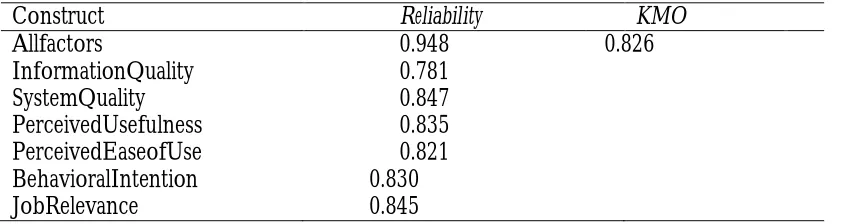
The research model was firstly tested for internal consistency using Cronbach’s alpha reliability measurement. Reliability analysis of the data was addressed from the viewpoint of both the entire construct model and each model variable individually. All of the constructs were found to be reliable measures for their respective constructs as the Cronbach’s alpha coefficients exceed 0.70, the lowest suggested limit (Ferketich, 1991).The study also adopts factor analysis to measure the construct validity of the questionnaire, applying KMO value. Hence, as Table 1 shows, KMO is 0.826, exceeding the recommended value of 0.6 (Kaiser,1974) and indicating that the construct model provide distinctive and trustworthy factors.
Table 1: Reliability & Validity Analysis
Construct Reliability KMO
Allfactors 0.948 0.826
InformationQuality 0.781
SystemQuality 0.847
PerceivedUsefulness 0.835
PerceivedEaseofUse 0.821
BehavioralIntention 0.830
JobRelevance 0.845
Characteristics of Construct
Table 2: Mean Analysis
Variables Item Mean
InformationQuality 4 4.146
SystemQuality 6 4.036
PerceivedUsefulness 4 3.939
PerceivedEaseofUse 4 4.043
BehavioralIntention 3 4.142
JobRelevance 3 3.925
Correlation Analysis
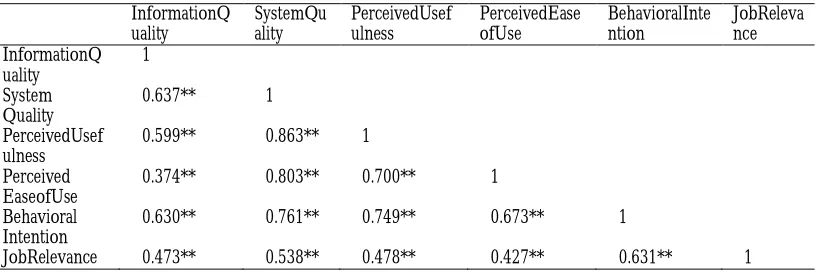
Matrices of Pearson correlation coefficients were used to measure the relationship between variables. Samples to be tested are based on the questions of every construct. Table 3 shows that all factors of the research model are correlated each other positively, with each Pearson correlation coefficient ranging from 0.374 to 0.863.
Table 3: Correlation Analysis
InformationQ uality
SystemQu ality
PerceivedUsef ulness
PerceivedEase ofUse
BehavioralInte ntion
JobReleva nce InformationQ
uality
1
System Quality
0.637** 1
PerceivedUsef ulness
0.599** 0.863** 1
Perceived EaseofUse
0.374** 0.803** 0.700** 1
Behavioral Intention
0.630** 0.761** 0.749** 0.673** 1
JobRelevance 0.473** 0.538** 0.478** 0.427** 0.631** 1
* p< 0.05, ** p < 0.001
Measurement Model
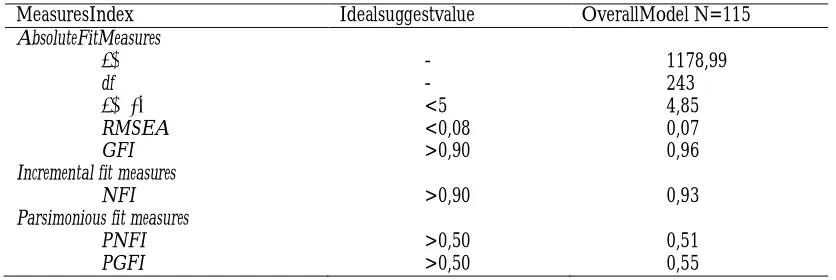
Following Hair, Blake, Babin & Tatham (2006), a number of adjusted fit measures were applied to demonstrate a reasonable fit for the model, including Chi-square/degrees of freedom, Root Mean Squared Error of Approximation (RMSEA), Normal Fit Index (NFI), Goodness-of-fit Index (GFI), Parsimonious Normal- Of-Fit Index (PNFI) and Parsimonious Goodness-Of-Fit Index (PGFI). Absolute fit indices
showed the following values: x2 = 1178.99 with 243 degrees of freedom, x2 / degrees
of freedom = 4.85, RMSEA = 0.07and GFI = 0.96, indicating that all indices are above minimum acceptable limits and that the research model has good explanatory power. Incremental fit measures valued as follows: NFI = 0.93, indicating that if all values are above acceptable minimum limits, the model has a good fit to the data. Finally, parsimonious fit measures resulted the following: PNFI = 0.51 and PGFI = 0.55, suggesting that there is not significant differences between the quality fit of the model with the number of the valued coefficients. The measurement analysis of the model is yielded at Table 4.
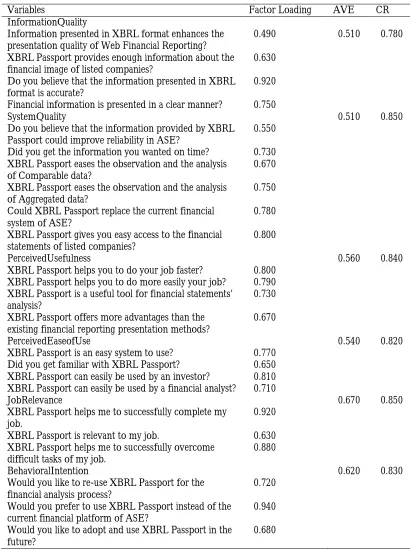
After measuring the goodness of fit of this model, it is important to examine the reliability of the potential variables of various indices as well as the significant differences among the estimated parameters of the model. The construct validity was judged by two measures: construct reliability (CR) and average variance extracted (AVE). The minimum accepted measurement level for CR is 0.70, and for AVE 0.50 (Fornell & Cha,1994; Hair, Blake, Babin&Tatham,2006). As the Table 5 Measurement Model demonstrates, the CR of IQ,SQ,PU,PEOU,JR and BI are0.780, 0.850, 0.840, 0.820, 0.850, and 0.830 respectively, while the AVE for each item is 0.510, 0.510, 0.560, 0.540, 0.670, and 0.620 respectively. All of these values exceed the marginally acceptable range, justifying good discriminant validity of the model.
Table 4: Measurement Model
MeasuresIndex Idealsuggestvalue OverallModel N=115
AbsoluteFitMeasures
χ2 - 1178,99
df - 243
χ2/df <5 4,85
RMSEA <0,08 0,07
GFI >0,90 0,96
Incremental fit measures
NFI >0,90 0,93
Parsimonious fit measures
PNFI >0,50 0,51
Table 5: Measurement Model
Variables Factor Loading AVE CR InformationQuality
Information presented in XBRL format enhances the presentation quality of Web Financial Reporting?
0.490 0.510 0.780
XBRL Passport provides enough information about the financial image of listed companies?
0.630
Do you believe that the information presented in XBRL format is accurate?
0.920
Financial information is presented in a clear manner? 0.750
SystemQuality 0.510 0.850 Do you believe that the information provided by XBRL
Passport could improve reliability in ASE?
0.550
Did you get the information you wanted on time? 0.730 XBRL Passport eases the observation and the analysis
of Comparable data?
0.670
XBRL Passport eases the observation and the analysis of Aggregated data?
0.750
Could XBRL Passport replace the current financial system of ASE?
0.780
XBRL Passport gives you easy access to the financial statements of listed companies?
0.800
PerceivedUsefulness 0.560 0.840 XBRL Passport helps you to do your job faster? 0.800
XBRL Passport helps you to do more easily your job? 0.790 XBRL Passport is a useful tool for financial statements’
analysis?
0.730
XBRL Passport offers more advantages than the existing financial reporting presentation methods?
0.670
PerceivedEaseofUse 0.540 0.820 XBRL Passport is an easy system to use? 0.770
Did you get familiar with XBRL Passport? 0.650 XBRL Passport can easily be used by an investor? 0.810 XBRL Passport can easily be used by a financial analyst? 0.710
JobRelevance 0.670 0.850 XBRL Passport helps me to successfully complete my
job.
0.920
XBRL Passport is relevant to my job. 0.630 XBRL Passport helps me to successfully overcome
difficult tasks of my job.
0.880
BehavioralIntention 0.620 0.830 Would you like to re-use XBRL Passport for the
financial analysis process?
0.720
Would you prefer to use XBRL Passport instead of the current financial platform of ASE?
0.940
Would you like to adopt and use XBRL Passport in the future?
Structural Model
After the confirmation of construct reliability and validity, the study examined the relationships between individuals’ intention to use XBRL Passport and IQ, SQ, PU, PEOU, with the moderating effect: Job Relevance. Hypotheses were tested, and the tested results are demonstrated into Table 6. Regarding the associations between IQ and PU, the standard coefficient is 0.149 with a p-value of 0.0000 which supports H1, reflecting that IQ positively affects individuals' PU of XBRL Passport. Additionally, the standard coefficient of IQ and PEOU is 0.236 with a p-value of 0.0000, thus, H2 is supported. This result indicates that IQ positively affects individuals' PEOU of XBRL Passport. In terms of the relationship between SQ and PU, the standard coefficient is 0.910 with a p-value of 0.0000, hence, H3 is supported. So, it is concluded that SQ positively affects individuals' PU of XBRL Passport. The standard coefficient of SQ and PEOU is 0.989 with a p-value of 0.0000, displaying that SQ positively affects individuals' PEOU of XBRL Passport. Therefore, H4 is accepted. Concerning the relation between PU and PEOU on BI, the standard coefficients are 0.534 and 0.161 respectively with a p-value of 0.0000, which proves that H5 and H6 are accepted. Thus, it is assumed that PU and PEOU of XBRL, as illustrated through XBRL Passport, positively affect individuals’ BI to use XBRL Passport.
As for the association between JR, PU and BI was found that JR is a significant moderator. Therefore, H7 is supported. More specifically, the results showed a strong positive correlation between PU and BI (standard coefficient = 0.534 and value = 0.0000) and between JR and BI (standard coefficient = 0.291 and p-value = 0.0000). Overall, the relationship PU * JR was statistically significant with a standard coefficient of 0.189 and a p-value of 0.005, suggesting that JR strengthens the relationship between PU and BI of XBRL, through the web application XBRL Passport. Thus, as individuals use XBRL Passport to perform their job, they feel that XBRL is useful, which affects their positive intention to use it.
Direct and Indirect Effects
The first path involves variables IQ-PU-BI and the indirect influence is 0.080 (by multiplying the path coefficients 0.149 * 0.534). The second path involves variables IQ-PEOU-BI and the indirect influence is 0.038 (by multiplying the path coefficients 0.236 * 0.161). As a result, the overall effect is 0.118. SQ indirectly affects individuals’ intention to use XBRL (through the financial application XBRL Passport) through two paths, according to hypotheses 3, 4, 5 and 6. The first path displays an indirect influence of 0.486 (by multiplying the path coefficients 0.910 * 0.534), involving variables SQ-PU-BI, and the second path displays an indirect influence of 0.159 (by multiplying the path coefficients 0.989 * 0.161) involving variables SQ-PEOU-BI. Thus, the overall effect is 0.645. The results of indirect effects indicate that SQ has the largest impact on individuals' intention to use, with an overall influence of 0.645, next to IQ, which has an overall influence of 0.118. The above results prove that SQ plays the most important role on individuals' intention to use XBRL, through XBRL Passport.
Table 6: Model Hypotheses Test
Hypothesis Path
Coefficient
Result
H1: XBRL Information Quality (IQ) will positively affect Perceived Usefulness (PU) of XBRL Passport.
0.149 Supported
H2: XBRL Information Quality (IQ) will positively affect Perceived Ease Of Use (PEOU) of XBRL Passport.
0.236 Supported
Η3: System Quality (SQ) will positively affect PU of XBRL Passport. 0.910 Supported
Η4: System Quality (SQ) will positively affect PEOU of XBRL Passport. 0.989 Supported
Η5: PU of XBRL, as illustrated through XBRL Passport, will positively affect Behavioral Intention (BI) to use XBRL Passport.
0.534 Supported
Η6: Perceived Ease Of Use (PEOU) of XBRL, as illustrated through XBRL Passport, will positively affect BI to use XBRL Passport.
0.161 Supported
Η7: Job Relevance (JR) moderates the effect of PU on BI to use XBRL Passport.
0.189 Supported
DiscussionandConclusion
Therefore, the findings of the research show that participants found XBRL Passport useful and easy to use, mainly because it provides meaningful and productive financial information. Examining the influence of SQ on PU and PEOU, a high correlation among the variables was observed. The findings are similar to previous studies which support that SQ has a significant positive relationship with PU and PEOU (Chiou & Fang, 2005; Ahn, Ryu & Han, 2007; Pai& Huang, 2011). As a result, this study asserts that XBRL Passport is an easy to use, flexible, useful and rapid web financial platform that offers many advantages to accountants. Regarding PU and PEOU, survey results demonstrated a positive correlation with users’ intention to use XBRL Passport. Similar results were presented in previous research, where the participants stated that they intend to implement XBRL in the future because they perceive a lot of benefits from it (Pinsker, 2008; Stergiaki, Stavropoulos & Lalou, 2013). Similarly, current study demonstrated that the use of XBRL can improve accountants’ work performance, productivity and efficiency. Additionally, the results indicated that PU has the most significant influence on BI, while PEOU presented a relatively low impact regarding the intention to use XBRL. These findings are similar to other empirical studies (Davis, 1989; Wu & Wang, 2005; Yi, Jackson, Park & Probst, 2006), which concluded that PEOU has less impact on BI than PU. The above resolves that users gave more emphasis on the usefulness of the financial information in XBRL format. Therefore, participants strongly express their interest to use XBRL, because it helps them to effectively improve their work and to make better and informed decisions. Furthermore, JR was also found to be a significant moderator that strengthens the relationship between PU and BI. The above result highlights the importance of Job Relevance in users’ intention to use specific technology. Moreover, the findings indicate that users adopt a technology if it is within their prior experience. Hence, in the current study participants found that the knowledge and the tools, provided by XBRL Passport ,a redirectly related to the accounting presentation of financial statements in accordance to IFRS and that a future application of the system will increase the efficiency of their accounting and financial work.
Even more, the application of XBRL Passport is a specific financial environment where accountants can easily and quickly find, parse, edit and exchange useful and meaningful financial information. Meanwhile, it is also concluded that XBRL Passport is an advanced web financial application, which offers many more benefits to end-users than the system currently adopted by ASE. The above argument holds that accountants have a positive attitude to the wider acceptance of XBRL through the future use of XBRL Passport.
This study suggested the development of a prototype web financial application that may become the start for the systematic examination of the impact of XBRL in web financial reporting and for the implementation of financial XBRL applications in Greece. Since, there has not been yet any attempt to adopt XBRL in Greek listed companies, the study specifically proposes the development of the XBRL Passport, which will automate the production process and submission of financial reports in accordance with IFRS. Moreover, the study integrates two major frameworks: TAM and IS Success Model to justify and extend the Technology Acceptance Theory to accounting information systems. Thus, this research may add a new dimension to those frameworks by emphasizing the interactions that occur between different factors in the acceptance and usage of new innovative technologies (IT). Although current study makes significant contributions to both academia and practice, there are several constraints which need further research. A major one is that the final presentation of financial information was presented in HTML files, and not in XBRL format, since the online tools applications for presentation of dynamic XBRL files were published recently and they were not available for educational and research purposes. Also, the standard model XBRL Passport does not provide financial details of all listed companies in ASE, but only those randomly selected. Future studies should further integrate XBRL Passport using XBRL files and having a database financial data for all listed companies in ASE. Finally, a new tool should be integrated to the model that will allow the extraction of financial data directly from the official businesses websites and their conversion into XBRL files.
References
Ahn, T., Ryu, S., & Han, I. (2004).The impact of the online and offline features on the user acceptance of Internet shopping malls. Electronic Commerce Research and Applications, 3(4), 405–420. doi:10.1016/j.elerap.2004.05.001.
Arnold, V., Bedard, J. C., Phillips, J., & Sutton, S. G. (2009).The impact of information tagging in the MD&A on investor decision making: Implications for XBRL. Working paper, 2009 Accounting, Behavior and Organizations Conference. Retrieved from
http://www.aicpa.org/InterestAreas/FRC/AccountingFinancialReporting/DownloadableDocuments/Info%20Tagging%20in%20the%20MDA.pdf.
Balaban, I., Mu, E., &Divjak, B. (2013).Development of an electronic Portfolio system success model: An information systems approach. Computers & Education, 60(1), 396–411. doi:10.1016/j.compedu.2012.06.013.
Blanas, G., Stavropoulos A.,&Stergiaki E.(2011a).Is it time for Greek companies to adopt XBRL?.In proceedings of the 1st International Symposium and 10th Balkan Conference on Operational Research.September. Thessaloniki. Greece.90-100.
Blanas, G., StavropoulosA.,&StergiakiE.(2011b).XBRL Passport: a pilot model for web financial reporting in Greek capital market. In proceedings of the 6th Management of International Business and Economics Systems conference. September 2011. Larissa.Greece.100-121. Retrieved from
http://mibes.teilar.gr/proceedings/2011/oral/9.pdf.
Bovee, M., Kogan, A., Nelson, K., Srivastava, R. P., &Vasarhelyi, M. A.(2005).Financial Reporting and Auditing Agent with Net Knowledge (FRAANK) and eXtensible Business Reporting Language (XBRL). Journal of Information Systems, 19(1), 19–41. doi:10.2308/jis.2005.19.1.19.
Chen, H.-J.(2010). Linking employees’ e-learning system use to their overall job outcomes: An empirical study based on the IS success model. Computers & Education, 55(4), 1628–1639. doi:10.1016/j.compedu.2010.07.005.
Chen, L., Gillenson, M. L., &Sherrell, D. L.(2002).Enticing online consumers: an extended technology acceptance perspective. Information & Management, 39(8), 705–719.
doi:10.1016/S0378-7206(01)00127-6.
Chiou, Y.W., &FangG.D.(2005).A study of web portal user behavior. Web Journal of Chinese Management Review, 8 (1), 43-60,
Cohen, S., &Karatzimas, S.(2013).Has IFRS adoption affected management accounting systems? Empirical evidence from Greece.International Journal of Accounting, Auditing and Performance Evaluation, 9(3), 268–285.
doi:10.1504/IJAAPE.2013.055897.
Daske, H., Hail, L., Leuz, C., & Verdi, R.(2008).Mandatory IFRS Reporting around the World: Early Evidence on the Economic Consequences. Journal of Accounting Research, 46(5), 1085– 1142. doi:10.1111/j.1475-679X.2008.00306.x.
Davis, F. D.(1989).Perceived Usefulness, Perceived Ease of Use, and User Acceptance of Information Technology. MIS Quarterly, 13(3), 319–340. doi:10.2307/249008.
Debreceny, R., Farewell, S., Piechocki, M., Felden, C., &Gräning, A.(2010).Does it add up? Early evidence on the data quality of XBRL filings to the SEC. Journal of Accounting and Public Policy, 29(3), 296–306. doi:10.1016/j.jaccpubpol.2010.04.001.
DeLone, W. H., & McLean, E. R. (1992, March 1). Information Systems Success: The Quest for the Dependent Variable [research-article]. Retrieved February 28, 2014, from
http://pubsonline.informs.org/doi/abs/10.1287/isre.3.1.60.
Dishaw, M. T., & Strong, D. M.(1999).Extending the technology acceptance model with task– technology fit constructs. Information & Management, 36(1), 9–21. doi:10.1016/S0378-7206(98)00101-3.
E Silva, A. C., & MacDonald, J.(2006).The role of artificial intelligence in democratising XBRL instance document creation.In European Accounting Association Annual Conference, Dublin, Ireland.Citeseer. Retrieved from
http://citeseerx.ist.psu.edu/viewdoc/download?doi=10.1.1.65.8003&rep=rep1&type=pdf. Ferketich, S.(1991).Focus on psychometrics. Aspects of item analysis. Research in Nursing & Health,
14(2), 165–168. doi:10.1002/nur.4770140211.
Fischer, H., & Mueller, D.(2011).Open Source & XBRL: the Arelle® Project. In Kansas University XBRL Conference, April (pp. 29–30). Retrieved from
http://eycarat.faculty.ku.edu/myssi/_pdf/4-Fischer%20-Mueller-Open-source-ArelleProject.pdf.
Fornell, C., & Cha J.(1994).Partial least squares. In R.P. Bagozzi (Ed.), Advanced Methods of Marketing Research.(pp. 52-78).Cambridge-MA: Blackwell.
Gao, L., &Bai, X.(2014).An empirical study on continuance intention of mobile social networking services: Integrating the IS success model, network externalities and flow theory. Asia Pacific Journal of Marketing and Logistics, 26(2), 168–189. doi:10.1108/APJML-07-2013-0086.
Ghani, E. K., &Jusoff, K.(2009).Determinants of Preferred Financial Digital Format by New Zealand Accounting Practitioners.International Education Studies, 2(1), P167. doi:10.5539/ies.v2n1P167.
Hair, J., Blake W., Babin W., &TathamR.(2006).Multivariate Data Analysis.(5th ed).Upper Saddle River: Prentice Hall.
Hodge, F. D., Kennedy, J. J., &Maines, L. A.(2004).Does Search-Facilitating Technology Improve the Transparency of Financial Reporting? The Accounting Review, 79(3), 687–703.
Hoffman, C., & Rodríguez, M. M.(2013).Digitizing Financial Reports, Issues and Insights: a Viewpoint. The International Journal of Digital Accounting Research, 13(19), 73–98. Hung, M., &Subramanyam, K. R.(2007).Financial statement effects of adopting international
accounting standards: the case of Germany. Review of Accounting Studies, 12(4), 623–657. doi:10.1007/s11142-007-9049-9.
Ilias, A., Razak, M. Z., &Razak, S. F. F.(2014).The Intention to Re-use the Internet Financial Reporting (IFR) in Malaysia. Review of Integrative Business & Economics Research, 3(1), 337–370.
Janvrin, D.J., PinskerR. &Mascha M.F.(2011).XBRL-Enabled, Excel or PDF? The Effects of Exclusive Technology Choice on the Analysis of Financial Information. Workingpaper. Iowa State University.
Jones,A., & Willis M.(2003).The challenge of XBRL: business reporting for the investor. Balance Sheet, 11(3), 29–37. doi:10.1108/09657960310491172.
Kaiser, H. F.(1974).An index of factorial simplicity.Psychometrika, 39(1), 31–36. doi:10.1007/BF02291575.
Kim, S.(2008).An empirical study of factors influencing organizational intention to use RFID technology and the moderating effect of presence of champions.Journal of Business Research, 23 (3), 139-171.
Kim, S., & Garrison, G.(2010).Understanding users’ behaviors regarding supply chain technology: Determinants impacting the adoption and implementation of RFID technology in South Korea. International Journal of Information Management, 30(5), 388–398.
doi:10.1016/j.ijinfomgt.2010.02.008.
Lee, Y.-C., Li, M.-L., Yen, T.-M., & Huang, T.-H.(2010).Analysis of adopting an integrated decision making trial and evaluation laboratory on a technology acceptance model. Expert Systems with Applications, 37(2), 1745–1754. doi:10.1016/j.eswa.2009.07.034.
Li, Y., Roge, J., Rydl, L., & Crews, M.(2006).Information technology addresses transparency: the potential effects of XBRL on financial disclosure. Issues in Information Systems, 7(2), 241– 245.
Lin, C.J. &Lu, H.(2000).Towards an understanding of the behavioral intention to use a web site.International Journal of Information Management,20 (3), 23-33,
doi:10.1016/S0268-4012(00)00005-0.
McGuire, B.L., OkessonS.J., &Watson, L.A.(2006).Second-Wave Benefits of XBRL. Strategic Finance,88 (6), 43-47.
Miyamoto, M., Kudo, S., &Iizuka, K.(2012).Measuring ERP Success: Integrated Model for User Satisfaction and Technology Acceptance: An Empirical Study in Japan. In International Conference on Business, Management and Governance (ICBMG2012) (pp. 86–91). Retrieved from
http://www.ipedr.com/vol57/016-ICBMG2012-B00036.pdf.
Nagoya, F.,&Kitagawa, T.(2013).An Application of SOFL for Rapid Prototyping. In S. Liu (Ed.),Structured Object-Oriented Formal Language and Method, Lecture Notes in Computer Science(pp. 104-115).Heidelberg: Springer Berlin.
Núñez, S., de Andrés SuárezJ.,GayoJ., &Pablosde P.(2008).A Semantic Based Collaborative System for the Interoperability of XBRL Accounting Information. InM.Lytras, J. Carroll, E. Damiani, & R. Tennyson (Eds.), Emerging Technologies and Information Systems for the Knowledge Society, Lecture Notes in Computer Science (pp. 593-599). Heidelberg: Springer Berlin.Retrieved from
http://link.springer.com/chapter/10.1007/978-3-540-87781-3_64.
Pai, F.-Y., & Huang, K.-I.(2011).Applying the Technology Acceptance Model to the introduction of healthcare information systems. Technological Forecasting and Social Change, 78(4), 650– 660. doi:10.1016/j.techfore.2010.11.007.
Pinsker, R. E.(2008).An empirical examination of competing theories to explain continuous disclosure technology adoption intentions using XBRL as the example technology [Article].Retrieved June 11, 2012, from
http://rabida.uhu.es/dspace/handle/10272/2169.
Prichard, J.J.,&RoohaniS. (2004).Development of a prototype public file repository for XBRL documents: challenges and opportunities. The International journal of digital accounting research, 4 (7), 57-79,
Ramayah, T., &Suki, N. M.(2006).Intention to use mobile PC among MBA students: implications for technology integration in the learning curriculum. UNITAR E-Journal, 1(2), 1–10.
Saeed, K. A., &Abdinnour-Helm, S.(2008).Examining the effects of information system characteristics and perceived usefulness on post adoption usage of information systems. Information & Management, 45(6), 376–386. doi:10.1016/j.im.2008.06.002.
Salimonu, R., Bt, W. R., Osman, S., Jaleel, A., Shittu, K., &Jimoh, R. G.(2013).Adoption of E-Voting System in Nigeria: A Conceptual Framework. International Journal of Applied, 5(5), 8–14. Selamat, M.H.,&Rawashdeh, A.A.(2010).Investigating XBRL diffusion: Toward establishing content
validity and pre-test of the questionnaire instrument. In International Conference on Communication and Media 2010 (i-COME’10). June, Melaka, Retrieved from
http://repo.uum.edu.my/3151/.
Stergiaki, E., Stavropoulos, A.,&Lalou, T.(2013).Acceptance and Usage of Extensible Business Reporting Language: An Empirical Review. Journal of Social Sciences, 9 (1),14-21,10.3844/jssp.2013.14.21.
Strohmeier, S.(2010).Electronic portfolios in recruiting?A conceptual analysis of usage. Journal of Electronic Commerce Research, 11(4), 268–280.
Troshani, I., &Doolin, B.(2005).Drivers and inhibitors impacting technology adoption: a qualitative investigation into the Australian experience with XBRL. In Proceedings of 18th Bled Conference Integration in Action Bled, Slovenia. Retrieved from
http://domino.fov.uni-mb.si/proceedings.nsf/Proceedings/9FFC83663C08EC2AC12570140049E31E/$File/24T roshani.pdf
Troshani, I.,&Lymer, A.(2010).Translation in XBRL standardization. Information Technology & People, 23(2), 136–164. doi:10.1108/09593841011052147 .
Tsai, C.H., ChihW.H., &HsuW.L.(2007).Using tam to study the personal motivations and social context factors influence the acceptance of knowledge management systems-based on high technology firms' samples. Electronic Commerce Studies, 5 (1), 81-108.
Tsalavoutas, I. &EvansL.(2010).Transition to IFRS in Greece: financial statement effects and auditor size. Managerial Auditing Journal, 25(8), 814–842.
doi:10.1108/02686901011069560.
Urbach, N., & Müller, B.(2012).The Updated DeLone and McLean Model of Information Systems Success.In Y. K. Dwivedi, M. R. Wade, & S. L. Schneberger (Eds.), Information Systems Theory (pp. 1–18).Springer New York. Retrieved from
http://link.springer.com/chapter/10.1007/978-1-4419-6108-2_1.
Venkatesh, V., & Davis, F. D.(2000).A theoretical extension of the technology acceptance model: Four longitudinal field studies. Management Science, 46(2), 186–204.
Venkatesh, V., Morris, M. G., Davis, G. B., & Davis, F. D.(2003).User acceptance of information technology: Toward a unified view. MIS Quarterly, 425–478.
Wang, R. Y., & Strong, D. M. (1996). Beyond Accuracy: What Data Quality Means to Data Consumers. Journal of Management Information Systems, 12(4), 5–33.
Williams, S. P., Scifleet, P. A., & Hardy, C. A.(2006).Online business reporting: An information management perspective. International Journal of Information Management, 26(2), 91–101. doi:10.1016/j.ijinfomgt.2005.11.004.
Wixom, B. H., & Todd, P. A.(2005, March 1). A Theoretical Integration of User Satisfaction and Technology Acceptance [research-article]. Retrieved February 28, 2014, from
http://pubsonline.informs.org/doi/abs/10.1287/isre.1050.0042
Wu, J.-H., & Wang, S.-C.(2005).What drives mobile commerce?: An empirical evaluation of the revised technology acceptance model. Information & Management, 42(5), 719–729. doi:10.1016/j.im.2004.07.001.
Yi, M. Y., Jackson, J. D., Park, J. S., &Probst, J. C.(2006).Understanding information technology acceptance by individual professionals: Toward an integrative view. Information & Management, 43(3), 350–363. doi:10.1016/j.im.2005.08.006.
Zhu, H.,& Fu, L.(2009).Towards Quality of Data Standards: Empirical Findings from XBRL. Inproceedings of International Conference on Information Systems. December 2009. Phoenix. Arizona. USA, Retrieved from