ISSN: 2279-087X (P), 2279-0888(online) Published on 20 November 2014
www.researchmathsci.org
111
A New Method for Computing the Inverses of
Anti-Tridiagonal and Anti-Pentadiagonal Matrices
Lele Liu1, Weiping Zhao and Haichao Gao
College of Science, University of Shanghai for Science and Technology Shanghai 200093, China. 1E-mail: [email protected]
Received 1 November 2014; accepted 17 November 2014
Abstract. In this paper, we present an efficient method for solving the inverses of anti-tridiagonal and anti-pentadiagonal matrices draw support from symmetric circulant matrices. In addition, we establish the connections between tridiagonal, anti-pentadiagonal matrices and symmetric circulant matrices Also some numerical examples are given.
Keywords: Anti-tridiagonal matrices; anti-pentadiagonal matrices; symmetric circulant matrices
AMS Mathematics Subject Classification (2010): 15A09, 15B05, 65F05 1. Introduction
It is well known that (anti-) tridiagonal and (anti-) pentadiagonal matrices are widely applied in applied mathematics and engineering mathematics. They are an effective tool in approximation theory, especially in the research of special functions and orthogonal polynomials [2,7]. Therefore, they also arise naturally in partial differential equations and numerical analysis [4,5,14,15]. In many of these areas, inverses of (anti-) tridiagonal and (anti-) pentadiagonal matrices are important, So a fast and efficient computational method to obtain the inverses of them is demanded. Of course, a large number of important methods have been posed, efficient algorithms [1,8] and explicit formula [3,6,12,15] for ( -) tridiagonal matrix inverse were presented. In [9] and [10], the authors presented recursive algorithm for inverting tridiagonal, ant-tridiagonal and pentadiagonal, anti-pentadiagonal matrices. In these methods, usually LU factorization is a main tool. What is new in our paper is to use symmetric circulant matrices for computing the inverse of them.
In this paper, we first consider the inverses of nonsingular ant-tridiagonal matrices with the following form
(1.1)
112
(1.2)
We expand ant-tridiagonal and ant-pentadiagonal matrices to symmetric circulant matrices, and establish the connections between them and symmetric circulant matrices respectively. Also the same considerations occur to tridiagonal and pentadiagonal matrices with constant diagonals. Finally, we give some numerical examples and make some concluding conclusions.
2. Inverses of ant-tridiagonal and ant-pentadiagonal matrices
In this section, we give an approach to compute the inverses of tridiagonal and ant-pentadiagonal matrices. We always assume that matrices discussed are nonsingular, unless otherwise stated. Suppose that and are ant-tridiagonal and ant-pentadiagonal matrices defined in (1.1), (1.2), respectively. We will assume and , , to avoid trivial conditions. Let be a symmetric circulant matrix with respect to , that is
(2.1)
we denote .
First we give the following lemma.
Lemma 2.1. Let be a symmetric circulant matrix of order defined in (2.1). Then is also a symmetric circulant matrix. Suppose that , then
(2.2)
Proof: For the sake of simplicity, we denote , and stands for the element of th row, th column of . Thus we need only to prove that
It is easy to verify that
113
According to the relevant result in Number Theory and , we have
Therefore
If , then
If , then
This fact show that scric scirc , as required. □
114
(2.3)
Clearly, is a symmetric circulant matrix. According to Lemma 2.1 we have the following corollary.
Corollary 2.1. Let be a symmetric circulant matrix of order and . Then
(2.4)
Theorem 2.1. Suppose that is a matrix defined in (2.3) is partitioned as
where , and . Then
(2.5)
Proof: For simplicity, we use to denote the zero matrix whose sizes will be clear from the context. Let denote the identity matrix of order . By the identity , we have
where . Then one can obtain that
Comparing the entries of the both sides, we have
115
Taking the determinant of both sides, then , which yields . By (2) and (3), we have
as required. □
According to Theorem 2.1, we give a relation between and the submatrices of . Concretely speaking, in order to compute the inverse of , we need only to obtain , , and which are submatrices of . Clearly
where symbol stands for the submatrix of that lies on the
intersection of rows with columns .
Combining with Corollary 2.1 and Theorem 2.1, we immediately have
(2.6)
Thus is given by (2.4), (2.5) and (2.6).
For an anti-pentadiagonal matrix with the form (1.2), we let
(2.7)
According to Lemma 2.1 and (2.7), we have the following corollary.
Corollary 2.2. Let be a symmetric circulant matrix of order defined in (2.7) and
, . Then
(2.8)
for
116
where , , , . Then
(2.9)
Proof: Suppose that
According to the equation , we have
Therefore we obtain that
Thus we have
.
Taking the determinant of both sides, then , which shows that is nonsingular. Since , then . It follows that
namely . This completes the proof. □
From Theorem 2.2, we readily obtain the inverse of by establishing a connection between and submatrices of . More specifically, in order to compute the inverse of , we need only to obtain and which are given by
117
(2.10)
Thus is determined by (2.8), (2.9) and (2.10).
3. Numerical examples and stability analysis
In this section, we give some numerical examples to support the theoretical analysis in Section 2.
Example 3.1. Now we consider the anti-tridiagonal matrix and anti-pentadiagonal matrix , respectively.
For the anti-tridiagonal matrix , , , , , .
According to (2.4), ( 2.5) and (2.6), one can obtain
Similarly, for the anti-pentadiagonal matrix , , , ,
118
Example 3.2. Consider the anti-pentadiagonal matrix and .
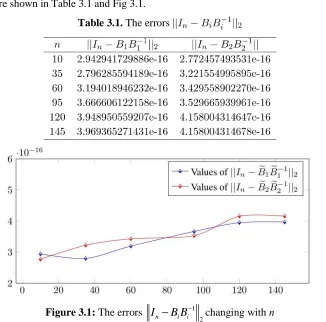
What the follows we computer the errors when , , ,
which are shown in Table 3.1 and Fig 3.1.
Table 3.1. The errors
Figure 3.1: The errors 1 2
n i i
I −B B− changing with n
4. Conclusion
119 REFERENCES
1. A.Driss, A.Hadj and M.Eloua, A fast numerical algorithm for the inverse of a tridiagonal and pentadiagonal matrix, Applied Mathematics and Computation, 202 (2008) 441-445.
2. A.Teles and M.Akbulak, Positive integer powers of certain complex tridiag-onal matrices, Applied Mathematics and Computation, 219 (2013) 10448-10455.
3. E.Kilic, Explicit formula for the inverse of a tridiagonal matrix by backward continued fractions, Applied Mathematics and Computation, 197 (2008) 345-357. 4. E.Kilic and D.Tasci, Factorizations and representations of the backward second-order
linear recurrences, Journal of Computational and Applied Mathematics, 201 (2007) 182-197.
5. G.D.Smith, Numerical Solution of Partial Differential Equations: Finite Difference Methods, 2ed edition. Oxford University Press, New York, 1978.
6. J.Jia, Tomohiro Sogabe and M. El-Mikkawy, Inversion of -tridiagonal matrices with toeplitz structure, Computers and Mathematics with Applications, 65 (2013) 116-125. 7. M.J.Cantero, L.Moral and L.Velzquez, Five-diagonal matrices and zeros of orthogonal polynomials on the unit circle, Linear Algebra and its Applications, 362 (2003) 29-56.
8. Moawwad El-Mikkawy, A fast algorithm for evaluating th order tridiagonal determinants, Journal of Computational andApplied Mathematics, 166 (2004) 581-584.
9. Moawwad El-Mikkawy and El-Desouky Rahmo, A new recursive algorithm for inverting general tridiagonal and anti-tridiagonal matrices, Applied Mathematics and Computation, 204 (2008) 368-372.
10. Moawwad El-Mikkawy and El-Desouky Rahmo, A new recursive algorithm for inverting general periodic pentadiagonal and anti-pentadiagonal matrices, Applied Mathematics and Computation, 207 (2009) 164-170.
11. Mohamed Eloua, On the powers and the inverse of a tridiagonal matrix, Applied Mathematics and Computation, 211 (2009) 137-141.
12. Wen-Chyuan Yueh, Explicit inverses of Several tridiagonal matrices, Applied Mathematics E-Notes, 6 (2006) 74-83.
13. Zhang Yi and Yu Baoman, The inverse of circulant matrix, J. Math, 5 (1989) 29-31. 14. A.K.Adak, M.Bhowmik and M.Pal, Intuitionistic fuzzy block matrix and its some
properties, Annals of Pure and Applied Mathematics, 1 (1) (2012) 13-31.