Correlations of Biomechanical Characteristics with Ball Speed in Penalty Corner Push-In
A Study on Problems of Farmers in Cultivation of Intercrops in Erode District – Factor Analysis
Dr.N.Sakthivel1 & K.R.Sindhuja2
1Associate Professor, PG and Research Department of Commerce, Gobi Arts and Science College (Autonomous), Gobichettipalayam, Erode, Tamilnadu,
India. ,
2Ph.D Part time Research Scholar, PG and Research Department of Commerce, Gobi Arts and Science College (Autonomous), Gobichettipalayam, Erode,
Tamilnadu, India.
Received 30th December 2018, Accepted 18th January 2019
Abstract
The green revolution is one of the greatest successes that the country has observed and resultantly achieved self-sufficiency and a good degree of stability in food grain production. However, the country still faces the challenges of comprehensive food security and malnutrition. It could be noted that higher their farm size, lower their overall problems of intercropping in farmers’. It is study that there intercropping yields additional income sometimes becoming major source of revenue for the farmers. It can be done for own purpose or for marketing purpose. Farmers cultivating intercrops face cultivation and marketing problems just like other crops too.
Keywords: Problems of Farmers, Cultivation of Intercropping, Cultivation Issues, Environment Issues.
© Copy Right, IJRRAS, 2019. All Rights Reserved.
Introduction
Intercropping is growing two or more crops together at the same time in the same space in a beneficial manner. Intercropping is the cultivation of two or more crops simultaneously on the same field. It also means the growing of two or more crops on the same field with the planting of the second crop after the first one has completed its development. The rationale behind intercropping is that the different crops planted are unlikely to share the same insect pests and disease-causing pathogens and to conserve the soil.
Row intercropping is working this arrangement with at least one of the components being planted in rows. Strip intercropping is a more industrialized version with rows of individual crops big enough to be harvested with machinery. Mixed intercropping is more like what we imagine as a guild, in which plants are bunched together more naturally but in purposeful ways. Relay intercropping is when the plants being intercropped are timed so that they are planted as the others are between flowering and harvesting. These are the basic four methods commonly employed. Sometimes they involve annual grains and vegetables, such as the mixed intercropping classic of corn, beans and squash. Sometimes there are perennial species with annual crops grown amongst them, say perennial garlic and basil with annual tomatoes. Perennials also work well with other
Correspondence
Dr.N.Sakthivel
E-mail: [email protected]: Ph. +9188103 30160
perennials. In parts of the tropics, bananas, papayas, coffee, vanilla and cacao make a crackerjack intercropping team. Sometimes these work in organized rows, other times in other patterns, but the main thought is to make thoughtful combinations. In essence these are all forms of companion planting, in which one plant provides some useful component for another. The technique can be small in scale, something seen in a home garden, but strip cropping is also becoming more common for progressive industrial models.
Statement of the Problem
Intercropping is a cropping system can be defined as a combination of crops in both time and space, and the basic biological requirement of a productive system is that it should provide a continuum of efficient crop growth for as much of the potential growing period as possible. This is a simple enough concept but actual practice can be complex where several crops are grown and interactions occur between them. This complexity is particularly great in the intercropping system where two or more crops are grown together on the same piece of land in competition with each other. At the same time, however, the intercropping system is perhaps the best example of how interactions between crops can be exploited to produce considerable yield benefits. Intercropping has many issues like difficulties in land preparation, high input Price, Scarcity of raw materials and trained labours, non-Suitable climatic condition and soil type, damages of crop while harvesting the other crop, difficulties in introducing new technologies, weeding and pest issues, environment and management issues etc. Against this background, the present study makes an attempt to examine the problems
International
Journal of Recent Research and Applied Studies
of farmers in cultivation of intercrops.
Objective of the Study
The objective of the study is as follows:
To examine the problems of farmers in cultivation of intercrops.
Area and Period of the Study:
The study on the problems of farmers in cultivation of intercrops is confined to Erode District only. The study was conducted from October 2017 to March 2018.
Collection of Data:
The study used both primary and secondary data. The required primary data are collected through well structured questionnaire. Secondary data are gathered through books, journals, magazines, websites and other research works.
Sampling Design
To achieve the objectives of the study, Erode district has been purposively selected as the study area. The population of the research consists of all the farmers who cultivate the intercrops in Erode district. The list of farmers cultivating intercropping could not be obtained. The method of sampling used for selecting sample respondents for the study is non-probability convenience sampling method. The sample size selected for the study is 500 farmers who cultivate intercrops.
Tools Used for Data Analysis
The statistical tools used for analysis are KMO test and Bartlett‟s test of Sphericity, Factor Analysis, Mean Score and Mean Rank Analysis.
Problems of Farmers in Cultivation of Intercrops – Factor Analysis
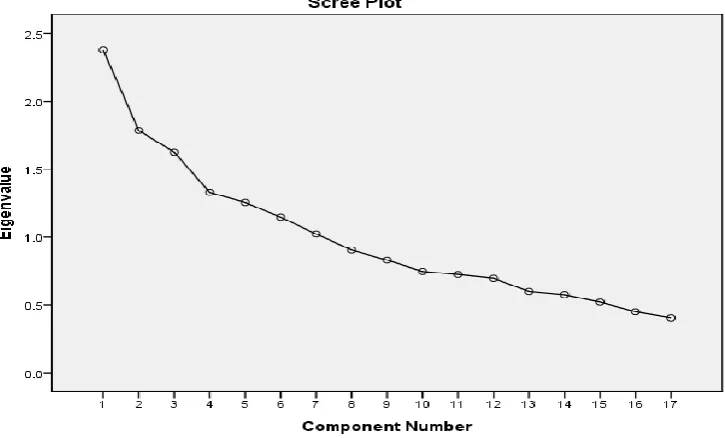
The problems of farmers in cultivation of intercrops are described here with the help of factor analysis. The technique of factor analysis provides a fascinating way of reducing the nature of variables in a research problem to a smaller and manageable number by combining related ones into factors. This relieves the confusion arising through overlapping measures of the variables. The cost of further research may be reduced by focusing efforts on fewer variables for study. Factor analysis has many alternative algorithms that can be used. The method used here is the principal component analysis. The primary decision in each stage of factor analysis is to decide how many factors are to be extracted from the data. The sample rule of them normally used says that all factors with an Eigen value of 1 or more should be extracted.
In order to explore the possibility of applying factor analysis to the data in hand, the inter-correlation matrix was first calculated by using Bartlett‟s test of Sphericity and Kaiser-Meyer-Olkin measure of sampling adequacy (KMO). The anti-image matrix was also
calculated and the findings suggest that there is no need to drop any item and all items should be included in the final factor analysis procedure. Principal component method, the most commonly used method, was used to find the initial solution. The initial solution suggests that the factors have an Eigen value greater than 1 and the factor pattern is consistent across the sample, which is easy to interpret since the items loaded heavily on a single factor.
Before applying factor analysis, it has been decided to use Kaiser-Meyer-Olkin (KMO) Measure and Bartlett‟s test. The KMO measure of sampling adequacy is an index used to examine the appropriateness of factor analysis. High values (between 0.5 and 1.0) indicate factor analysis is appropriate. Values below 0.5 imply that factor analysis may not be appropriate.
Bartlett‟s test of sphericity is a test statistic used to examine the hypothesis that the variables are uncorrelated in the population. In other words, the population correlation matrix is an identity matrix whereby each variable correlates perfectly with itself (r =1) but has no correlation with the other variables (r = 0). To be appropriate, this test should have a significance value less than 0.05.
Factor Analysis technique has been applied to find the underlying dimensions (factors) that exists in the original variables. Table 2.11 shows the findings of KMO and Bartlett‟s test.
Table 1
Problems of Farmers in Cultivation of Intercrops - KMO and Bartlett's Test
Kaiser-Meyer-Olkin Measure of Sampling Adequacy
0.680
Bartlett's Test of Sphericity
Approx. Chi-square 1019.805
Df 136
Sig. .000
Table 1 reveals that the calculated value of Kaiser-Meyer-Olkin measure of sampling adequacy is 0.680. It suggests that the factors extracted account for a substantial amount of variance. As this value is greater than 0.5, it has been decided to apply the factor analysis. KMO test yields a result of 0.680 which states that factor analysis can be carried out appropriately for these 17 variables which are taken for the study. The result of the test shows that with the significant value of .000 there is a significant relationship regarding the variables chosen. Furthermore, Bartlett‟s test of sphericity also suggests that the inter-correlation matrix is factorable and factor analysis can be applied to the current data as the correlation between different items is also statistically significant (p<0.01).
Factor Extraction
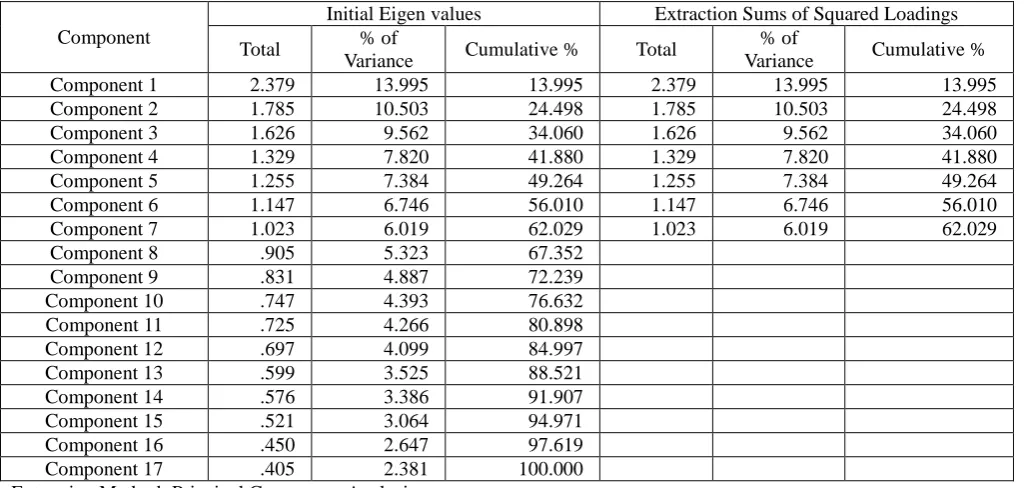
variance, cumulative percentage and the total variance of the variable identified for the study.
Principal Component Analysis
Principal component analysis was a factor model in which the factors are based on the total variance. Another concept in factor analysis is the rotation of factors. Varimax rotations are one of the most popular methods used in the study to simplify the factor structure by maximizing the variance of a column of pattern matrix. Another technique called latent root criteria is used. An Eigen value is the column sum of squares for a factor. It represents the amount of variance in data. After determination of the common factors, factor scores are estimated for each other. The common factors themselves were expressed as linear combinations of the observed variables.
There are various problems faced by the farmers in cultivation of intercrops. These ranges of factors begin with 1 to 7. Based on the review of previous studies and a detailed discussion with the farmers all the relevant variables are included in the study. Seventeen variables are generated for measuring the problems faced by the farmers in cultivation of intercrops on a Likert‟s 5 point scale.
The seven factors extracted together account for 62.03 per cent of the total variance (information contained in the original seventeen variables). This is pretty good, because it is easy to economize on the number of variables (from 17 it has been reduced to 7 underlying factors), while there is a loss only about 37.97 per cent of the information content (62.03 per cent is retained by the 7 factors extracted out of the 17 original variables).
Table 2
Problems of Farmers in Cultivation of Intercrops -Total Variance Explained
Component
Initial Eigen values Extraction Sums of Squared Loadings
Total % of
Variance Cumulative % Total
% of
Variance Cumulative %
Component 1 2.379 13.995 13.995 2.379 13.995 13.995
Component 2 1.785 10.503 24.498 1.785 10.503 24.498
Component 3 1.626 9.562 34.060 1.626 9.562 34.060
Component 4 1.329 7.820 41.880 1.329 7.820 41.880
Component 5 1.255 7.384 49.264 1.255 7.384 49.264
Component 6 1.147 6.746 56.010 1.147 6.746 56.010
Component 7 1.023 6.019 62.029 1.023 6.019 62.029
Component 8 .905 5.323 67.352
Component 9 .831 4.887 72.239
Component 10 .747 4.393 76.632 Component 11 .725 4.266 80.898 Component 12 .697 4.099 84.997 Component 13 .599 3.525 88.521 Component 14 .576 3.386 91.907 Component 15 .521 3.064 94.971 Component 16 .450 2.647 97.619 Component 17 .405 2.381 100.000 Extraction Method: Principal Component Analysis.
Chart 1
Screen Plot Showing Problems of Farmers in Cultivation of Intercrops
Rotated Component Matrix
Since the idea of factor analysis is to identify the factors that meaningfully summarize the sets of closely related variables, the rotation phase of the factor analysis attempts to transfer initial matrix into one that is easier to interpret.The rotated component matrix is used to assign variables to factors and to interpret factors. This matrix should be viewed column wise for each column (factor) the
variables which have high (close to 1) loading should be identified and a combined meaning for the factor found. This leads to a phrase which is the name given to the factor. The scores of the variable leading to problems of farmers in cultivation of intercrops have been included for the factor analysis. Varimax rotation method is used to extract meaningful factors. The rotated component matrixes for the influencing variables are given in Table 3.
Table 3
Problems of Farmers in Cultivation of Intercrops -Rotated Component Matrix
Problems Component
1 2 3 4 5 6 7
Large number of different crops in the field makes it difficult to weed
.540 -.233 .124 .325 -.200 .147 .113
Scarcity of raw materials .461 .031 -.280 .042 -.192 -.304 .389 More Difficulty in land
preparation .446 .363 .136 -.114 .141 -.363 -.366 Scarcity of trained labour .444 .020 -.369 .056 -.334 .203 -.143 Non-Suitable climatic
condition .268 .684 .030 .094 -.086 .313 .165
Lack of intercropping
knowledge .016 .652 .132 .142 .157 .326 -.132
Non-Suitable soil type .298 .515 -.117 .083 .024 .053 .310 Damages of crop while
harvesting the other crop .414 -.177 .592 -.145 .045 .271 .194 Harvesting is difficult .303 -.119 -.590 -.050 .271 .315 .227 Some cases yields are
lower .312 -.116 .540 -.289 .052 .048 -.338
New technologies such as row planting, modern weeding tools & improved varieties may be difficult to introduce
Irregular supply of
electricity .358 -.054 -.168 -.528 -.131 .063 -.195 Difficult to cultivate
between rows .413 -.064 -.366 -.519 -.075 .004 -.201 Exploitation of
environmental resources .432 -.195 -.043 .274 .632 .129 -.052 Complex and extra burden
to manage .240 -.328 -.237 .175 .503 -.144 .284
Yearlong crop some pests can shift from one crop to another crop
.356 -.243 .434 .034 -.137 -.485 .199
High input Price .422 .303 .187 .058 .142 -.055 -.614
Extraction Method: Principal Component Analysis. Rotation Method: Varimax with Kaiser Normalization.
Table 3 clearly discloses that the most important problems of farmers in cultivation of intercrops are „Non-Suitable climatic condition‟ „Lack of intercropping knowledge‟, „Exploitation of environmental resources‟, „High input Price‟, „Damages of crop while harvesting the other crop‟, „Harvesting is difficult‟, and „New technologies such as row planting, modern weeding tools & improved varieties may be difficult to introduce‟ as the correlation coefficients are very high for these variables.
It is also noted from Table 3 that variables „Large number of different crops in the field makes it difficult to weed‟, „Scarcity of raw materials‟, „More Difficulty in land preparations‟, and „Scarcity of trained labour‟, are with the loadings of 0.540, 0.461, 0.446 and 0.444 respectively on factor 1 and this suggests that factor 1 is a combination of these variables. At this point, a suitable phrase which captures the essence of the original variables to form the underlying concept, factor 1 could be named as „WEEDING, LAND PREPARATIONS AND SCARCITY‟.
In case of the factor 2 columns, the variables „Non-Suitable climatic condition‟, „Lack of intercropping knowledge‟ and „Non-Suitable soil type‟ are with the loadings of 0.684, 0.652 and 0.515 respectively on factor 2 andthis suggests that factor 2 is a combination of these variables. At this point, a suitable phrase which captures the essence of the original variables to form the underlying concept, factor 2 could be named as „CLIMATIC, INTERCROPPING AND SOIL TYPE‟.
In case of the factor 3 columns, the variables „Damages of crop while harvesting the other crop‟, „Harvesting is difficult‟, and „Some cases yields are lower‟ are with the loadings of 0.592, 0.590 and 0.540 respectively on factor 3 and this suggests that factor 3 is a combination of these variables. At this point, a suitable phrase which captures the essence of the original variables to form the underlying concept, factor 3 could be named as „CROP DAMAGE, HARVESTING AND LOWER YIELD‟.
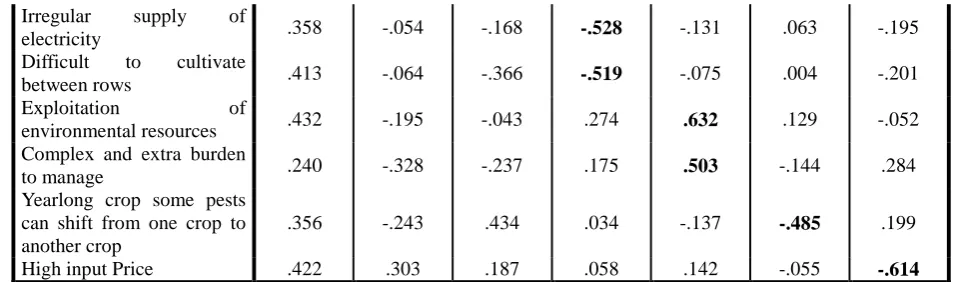
In case of the factor 4 columns, „New technologies such as row planting, modern weeding tools & improved varieties may be difficult to introduce‟, „Irregular supply of electricity‟ and „Difficult to cultivate
between rows‟ are with the loadings of 0.556, -0.528 and -0.519 respectively on factor 4 and this suggests that factor 4 is a combination of these variables. At this point, a suitable phrase which captures the essence of the original variables to form the underlying concept, factor 4 could be named as „TECHNOLOGY, ELECTRICITY AND CULTIVATION ISSUES‟.
In case of the factor 5 columns, „Exploitation of environmental resources‟ and „Complex and extra burden to manage‟ are with the loadings of 0.632 and 0.503 respectively on factor 5 and this suggests that factor 5 is a combination of these variables. At this point, a suitable phrase which captures the essence of the original variables to form the underlying concept, factor 5 could be named as „ENVIRONMENT AND MANAGEMENT ISSUES‟.
In case of the factor 6 columns, „Yearlong crop some pests can shift from one crop to another crop‟ is with the loadings of 0.485 on factor 6 andthis suggests that factor 6 is a combination of this variable. At this point, a suitable phrase which captures the essence of the original variables to form the underlying concept, factor 6 could be named as „PEST ISSUES‟.
In case of the factor 7 columns, „High input Price‟ are with the loadings of 0.614 on factor 7 and this suggests that factor 7 is a combination of this variable. At this point, a suitable phrase which captures the essence of the original variables to form the underlying concept, factor 7 could be named as „HIGH INPUT PRICE‟.
Table 4
Problems of Farmers in Cultivation of Intercrops - Principal Component Analysis
S.No. Name of the Factors No. of
Variables Mean Rank
Eigen Value
Per cent of Variation Explained
Cumulative Per cent of Variation Explained
1 Weeding Land Preparations and
Scarcity 4 3.41 3 2.379 13.995 13.995
2 Climatic Intercropping and
Soil Type 3 3.45 2 1.785 10.503 24.498
3 Crop Damage Harvesting and
Lower Yield 3 3.00 4 1.626 9.562 34.060
4 Technology Electricity and
Cultivation Issues 3 2.93 6 1.329 7.820 41.880
5 Environment and Management
Issues 2 2.97 5 1.255 7.384 49.264
6 Pest Issues 1 2.93 7 1.147 6.746 56.010
7 High Input Price 1 3.56 1 1.023 6.019 62.029
The most important problems of farmers in cultivation of intercrops are Weeding Land Preparations and Scarcity and Climatic Intercropping and Soil Type factors as their Eigen values are 2.379 and 1.785 respectively. The Weeding Land Preparations and Scarcity factor consists of 4 variables with the variation explained of 13.995 per cent. The Climatic Intercropping and Soil Type factor consists of 3 variables and explains the problems of farmers in cultivation of intercrops to the extent of 10.503 per cent. The third and fourth factors are Crop Damage Harvesting and Lower Yield and Technology Electricity and Cultivation Issues as their respective Eigen values are 1.626 and 1.329. The per cent of variation explained by these two factors are 9.562 and 7.820 respectively.
The highly correlated variable of the Weeding Land Preparations and Scarcity factor is Large number of different crops in the field makes it difficult to weed. It has the factor loading of 0.540. The variable Non-Suitable climatic condition is the highly correlated variable of the Climatic Intercropping and Soil Type factor as it has the highest factor loading of 0.684. „Damages of crop while harvesting the other crop‟ variable of the Crop Damage Harvesting and Lower Yield factor has the highest factor loading of 0.592. Regarding the Technology Electricity and Cultivation Issues factor, the variable „New technologies such as row planting, modern weeding tools & improved varieties may be difficult to introduce‟ has the highest factor loading of 0.556.
The highly correlated variable of the Environment and Management Issues factor is „Exploitation of environmental resources‟ which has the factor loading of 0.632. In case of Pest Issues factor, highest correlation is found in the variable Year long crop some pests can shift from one crop to another crop as it has the highest factor loading of 0.485. The highly correlated variable of the High Input Price factor is High Input Price. It has the factor loading of 0.614.
According to Mean Rank analysis, High Input Price factor is identified as the most important problems of farmers in cultivation of intercrops with the highest mean score of 3.56 and Climatic Intercropping and Soil Type is identified as the second most important problems of farmers in cultivation of intercrops with the second highest mean score of 3.45.
Conclusion
Results revealed that the most important problems of farmers in cultivation of intercrops are „Non-Suitable climatic condition‟ „Lack of intercropping knowledge‟, „Exploitation of environmental resources‟, „High input Price‟, „Damages of crop while harvesting the other crop‟, „Harvesting is difficult‟, and „New technologies such as row planting, modern weeding tools & improved varieties may be difficult to introduce‟ as the correlation coefficients are very high for these variables. The most important problems of farmers in cultivation of intercropsare Weeding Land Preparations and Scarcity and Climatic Intercropping and Soil Type factors as their Eigen values are higher.
Reference
1. Naresh, Malhotra and Sathyabygan Desh, (2009), “Marketing Research – An Applied Orientation”, Pearson Education, New Delhi, pp.610-635.
2. Indian Journal of Agricultural Economics, 40, 3. Bhatt, Bart,Minten, K.M Singh, and R.Sutradhar, 2013.
3. Branding and agricultural value chains in developing countries: Insights from Bihar (India). Food Policy (Elsevier, The Netherland),
38 (Feb 2013): 23-34
5. Dave, V. J. (1998), Economics of Export Oriented Horticultural Crops in Chiku (Sapota) in Gujarat, Agro Economic Research Centre, Vallabh Vidyanagar, Gujarat.
6. Dattatreyulu, M. (1997), Export Potential of Fruits, Vegetables and Flowers from India, National Bank for Agriculture and Rural Development, Mumbai.
7. Doshi, R.R (ed.) (1998), Agricultural Marketing in India: The Future Course, Department of Economics, Shivaji University, Kolhapur. 8. Naik Dibakar (1985), Marketing Costs and
Margins under Different Marketing Channels of Potato Trade in Cuttack District of Orissa, Indian Journal of Agricultural Economics, 40, 3. 9. Prasad Sivarama, A. (1985), Agricultural Marketing in India, Mittal Publishing Co., New Delhi.
Rajagopal (1995), Marketing of Fruits and Vegetables in Cooperative Sector, Institute of Rural Management, Anand.