International Journal of Modern Computer Science & Engineering
Journal homepage:www.ModernScientificPress.com/Journals/ijmcse.aspx
ISSN: 2325-0798
Florida, USA
Article
A Compendious Research on Big Data and Hadoop
Shireesh Pyreddy
Computer Science Engineering, Brindavan Institute of Technology and Science, Kurnool, India
E-Mail: [email protected]
Article history: Received 24 April 2016, Revised 16 June 2016, Accepted 20 July 2016, Published 27 July 2016.
Abstract: Big data is a term that describes the large volume of both structured and
unstructured data that inundates a business on a day-to-day basis. Due to the fact that the
database systems like RDBMS can process the unstructured data but RDBMS finds it
challenging to handle such huge data volumes. To deal with the challenges Hadoop is used.
It is software framework for distributed storage and distributed processing of very large data
sets. MapReduce is a back-end processing engine which is used to perform operations like
map and reduce and makes the data simple and stores it into HDFS.
Keywords: Keywords: RDBMS, Hadoop, MapReduce, HDFS, Big data, Spark.
1. Introduction
In the old days, we would utilize systems to extract, transform and load data (ETL) into giant
data warehouses that had business intelligence solutions built over them for reporting. Periodically, all
the systems would backup and combine the data into a database where reports could be run and everyone
could get insight into what was going on.
The problem was that the database technology simply couldn’t handle multiple, continuous
streams of data. It couldn’t handle the volume of data. It couldn’t modify the incoming data in real-time. And reporting tools were lacking that couldn’t handle anything but a relational query on the back-end.
Big Data solutions offer cloud hosting, highly indexed and optimized data structures, automatic archival
and extraction capabilities, and reporting interfaces have been designed to provide more accurate
Big data means really a big data, it is a collection of large datasets that cannot be processed using
traditional computing techniques. Big data is not merely a data, rather it has become a complete subject,
which involves various tools, techniques and frameworks.
Due to the advent of new technologies, devices, and communication means like social
networking sites, the amount of data produces by mankind is growing rapidly every year. The amount
of data produced by us from the beginning of time till 2003 was 5 billion gigabytes. If you pile up the
data in the form of disks it may fill an entire football field. The same amount was created in every two
days in 2011m and in every ten minutes in 2013. This rate is still growing enormously. Though all this
information produced is meaningful and can be useful when processed, it is being neglected. 90%of the
world’s data was generated in the last few years.
1.1. Traditional Approach
In this approach, an enterprise will have a computer to store and process big data. Here data will
be stored in an RDBMS like Oracle Database, MS SQL Server or DB2 and sophisticated software’s can
be written to interact with the database, process the required data and present it to the users for analysis
purpose.
1.2. Limitation
This approach works well where we have less volume of data that can be accommodated by
standard database servers, or up to the limit of the processor which is processing the data. But when it
comes to dealing with huge amounts of data, it is really a tedious task to process such data through a
traditional database server.
2. Benefits of Big Data
Big data is really critical to our life and its emerging as one of the most important technologies
in modern world. Using the information kept in the social network like Facebook, the marketing agencies
are learning about the response for their campaigns, promotions, and other advertising mediums. The
information in the social media like preferences and product perception of their consumers, product
companies and retail organizations are planning their production. The data regarding the previous
medical history of patients, hospitals are providing better and quick service.
Big data technologies are important in providing more accurate analysis, which may lead to more
concrete decision-making in greater operational efficiencies, cost reductions, and reduced risks for the
business. To harness the power of big data, you would require an infrastructure that can manage and
security. There are various technologies in the market from different vendors including Amazon, IBM,
Microsoft, etc., to handle big data. While looking into the technologies that handle big data, we examine
the following two classes of technology.
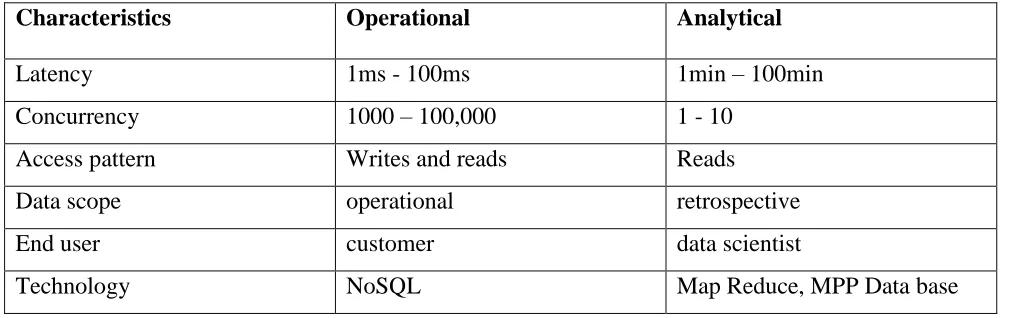
Table 1. Operational VS. Analytical Systems
Characteristics Operational Analytical
Latency 1ms - 100ms 1min – 100min
Concurrency 1000 – 100,000 1 - 10
Access pattern Writes and reads Reads
Data scope operational retrospective
End user customer data scientist
Technology NoSQL Map Reduce, MPP Data base
3. Hadoop
In this approach, an enterprise will have a computer to store and process big data. Here data will
be stored in an RDBMS like Oracle Database, MS SQL Server or DB2 and sophisticated software’s can
be written to interact with the database, process the required data and present it to the users for analysis
purpose.
This approach works well where we have less volume of data that can be accommodated by
standard database servers, or up to the limit of the processor which is processing the data. But when it
comes to dealing with huge amounts of data, it is really a tedious task to process such data through a
traditional database server.
Google solved this problem using an algorithm called Map Reduce. This algorithm divides the
task into small parts and assigns these parts to many computers connected over the network, and collects
the results to form the final result dataset.
Doug Cutting, Mike Cafarella and team took the solution provided by Google and started an open
source project call hadoop in 2005 and Daug named it after his son’s toy elephant. Now apache hadoop
is a registered trademark of the apache software foundation.
Hadoop runs applications using the Map Reduce algorithm, where the data is processed in
parallel on different CPU nodes. In short, hadoop framework is capable enough to develop applications
capable of running on clusters of computers and they could perform complete statistical analysis for a
4. Hadoop Distributed File System (HDFS)
The Hadoop Distributed File System (HDFS) is a distributed file system designed to run on
commodity hardware. It has many similarities with existing distributed file systems. However, the
differences from other distributed file systems are significant. HDFS is highly fault-tolerant and is
designed to be deployed on low-cost hardware. HDFS provides high throughput access to application
data and is suitable for applications that have large data sets. HDFS relaxes a few POSIX requirements
to enable streaming access to file system data. HDFS was originally built as infrastructure for the Apache
Nutch web search engine project. HDFS is now an Apache Hadoop subproject. HDFS is a Java-based
file system that provides scalable and reliable data storage, and it was designed to span large clusters of
commodity servers.
HDFS has demonstrated production scalability of up to 200 PB of storage and a single cluster of
4500 servers, supporting close to a billion files and blocks. Hadoop distributed file system was developed
using distributed file system design. It is run on commodity hardware. Unlike other distributed systems,
HDFS is highly fault tolerant and designed using low-cost hardware.
HDFS holds very large amount of data and provides easier access. To store such huge data, the
files are stored across multiple machines. These files are stored in redundant fashion to rescue the system
from possible data losses in case of failure. HDFS also makes applications available to parallel
processing.
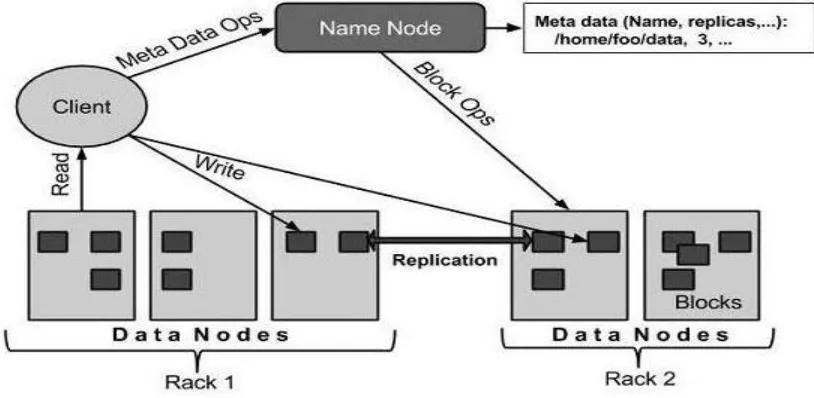
4.1. NameNode
The NameNode is commodity hardware that contains the GNU/Linux operating system and the
NameNode software. It is a software that can be run on commodity hardware. The system having the
Name Node act as the maser server and it does the following tasks like manages the file system
namespace, regulates the client’s access to the files and it also executes file system operations such as
renaming, closing, and opening files and directories.
4.2. DataNode
The DataNode is a commodity hardware having the GNU/Linux operating system and DataNode
software. For every node in cluster, there will be a data node. These nodes manage the data storage of
their system. Data nodes perform read-write operations on the file systems, as per client request. They
also perform operations such as block creation, deletion, and replication according to the instructions of
the NameNode.
Generally, the user data is stored in the file of HDFS. The file in a file system will be divided
into one or more segments and/or stored in individual data nodes. These files are called as blocks. In
other words, the minimum amount of data that HDFS can read or write is called a block. The default
block size is 64MB, but it can be increased as per the need to change in HDFS configuration.
Figure 1. HDFS Architecture
5. MapReduce
MapReduce is a framework using which we can write applications to process huge amounts of
data, in parallel, on large clusters of commodity hardware in a reliable manner.
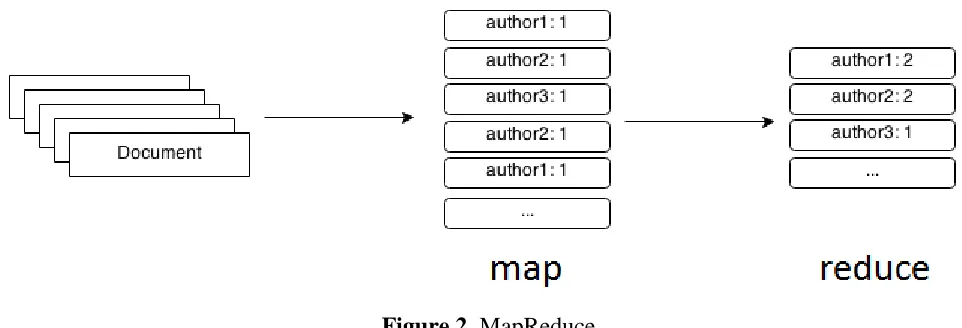
MapReduce is a processing technique and a program model for distributed computing based on
java. The mapreduce algorithm contains two important tasks, namely map and reduce. Map takes a set
of data and converts it into another set of data, where individual elements are broken down into tuples
(key/value pairs). Secondly, reduce task, which takes the output from a map as an input and combines
those data tuples into smaller set of tuples. As the sequence of the name mapreduce implies, the reduce
task is always performed after the map job.
The major advantage of mapreduce is that it is easy to scale data processing over multiple
computing nodes. Under the MapReduce mode, the data processing primitives are called mappers and
reducers. Decomposing a data processing applications into mappers and reducers is sometimes
nontrivial. But, once we write an application in the MapReduce form, scaling the application to run over
hundred, thousands, or even tens of thousands of machines in a cluster is merely a configuration change.
This simple scalability is what has attracted many programmers to use the MapReduce model.
The Job Tracker is the service within Hadoop that farms out MapReduce tasks to specific nodes
in the cluster, ideally the nodes that have the data, or at least are in the same rack. Client applications
submit jobs to the Job tracker. The Job Tracker talks to the NameNode to determine the location of the
data. The Job Tracker locates Task Tracker nodes with available slots at or near the data. The Job Tracker
submits the work to the chosen Task Tracker nodes.
The Task Tracker nodes are monitored. If they do not submit heartbeat signals often enough,
they are deemed to have failed and the work is scheduled on a different Task Tracker. A Task
Tracker will notify the Job Tracker when a task fails. The Job Tracker decides what to do then: it may
resubmit the job elsewhere, it may mark that specific record as something to avoid, and it may even
blacklist the Task Tracker as unreliable. When the work is completed, the Job Tracker updates its status.
Client applications can poll the Job Tracker for information.
Figure 2. MapReduce
5.2. Task Tracker
A Task Tracker is a node in the cluster that accepts tasks - Map, Reduce and Shuffle operations
- from a Job Tracker. Every Task Tracker is configured with a set of slots; these indicate the number of
tasks that it can accept. When the Job Tracker tries to find somewhere to schedule a task within
the MapReduce operations, it first looks for an empty slot on the same server that hosts
the DataNode containing the data, and if not, it looks for an empty slot on a machine in the same rack.
The Task Tracker spawns a separate JVM processes to do the actual work; this is to ensure that process
failure does not take down the task tracker.
The TaskTracker monitors these spawned processes, capturing the output and exit codes. When
the process finishes, successfully or not, the tracker notifies the Job Tracker. The Task Trackers also
send out heartbeat messages to the JobTracker, usually every few minutes, to reassure the Job
Tracker that it is still alive. These message also inform the Job Tracker of the number of available slots,
6. Spark
6.1. Why Spark, why not MapReduce?
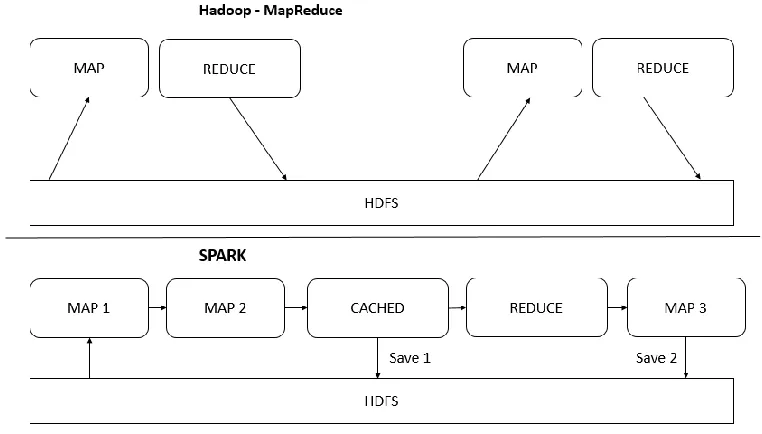
Figure 3. Why Spark, why not MapReduce?
Hadoop - MapReduce is parallel data processing framework that has traditionally been used to
run map/reduce jobs. These are long running jobs that take minutes or hours to complete. Spark has
designed to run on top of Hadoop and it is an alternative to the traditional batch map/reduce model that
can be used for real-time stream data processing and fast interactive queries that finish within seconds.
So, Hadoop supports both traditional map/reduce and Spark. We should look at Hadoop as a general
purpose Framework that supports multiple models and we should look at Spark as an alternative to
Hadoop MapReduce rather than a replacement to Hadoop.
Spark uses more RAM instead of network and disk I/O its relatively fast as compared to hadoop.
But as it uses large RAM it needs a dedicated high end physical machine for producing effective results.
It all depends and the variables on which this decision depends keep on changing dynamically with time.
Apache Spark is a lightning-fast cluster computing technology, designed for fast computation. It
is based on Hadoop MapReduce and it extends the MapReduce model to efficiently use it for more types
of computations, which includes interactive queries and stream processing. Spark uses Hadoop in two
ways – one is storage and second is processing. Since Spark has its own cluster management
computation, it uses Hadoop for storage purpose only. The main feature of Spark is its in-memorycluster
computing that increases the processing speed of an application.Spark is designed to cover a wide range
of workloads such as batch applications, iterative algorithms, interactive queries and streaming. Apart
from supporting all these workloads in a respective system, it reduces the management burden of
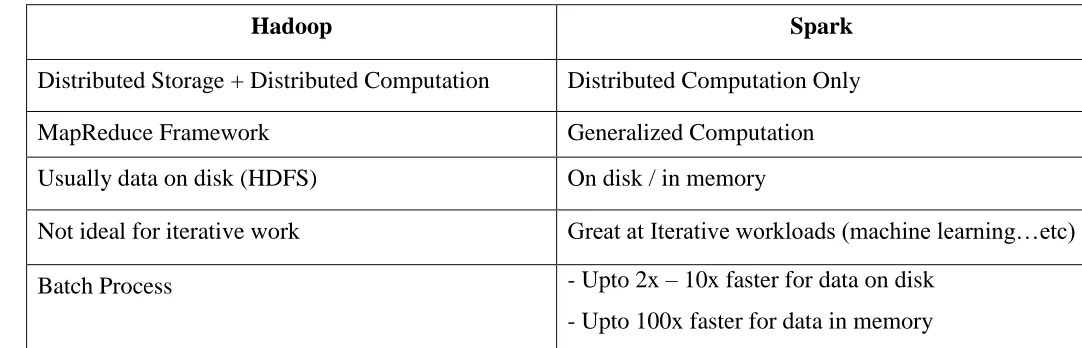
Table 2. Analyzation between Hadoop and Spark
Hadoop Spark
Distributed Storage + Distributed Computation Distributed Computation Only
MapReduce Framework Generalized Computation
Usually data on disk (HDFS) On disk / in memory
Not ideal for iterative work Great at Iterative workloads (machine learning…etc)
Batch Process - Upto 2x – 10x faster for data on disk
- Upto 100x faster for data in memory
Apache Spark is a cluster computing platform designed to be fast and general-purpose. On the
speed side, Spark extends the popular MapReduce model to efficiently support more types of
computations, including interactive queries and stream processing. Speed is important in processing
large datasets as it means the difference between exploring data interactively and waiting minutes
between queries, or waiting hours to run your program versus minutes. One of the main features Spark
offers for speed is the ability to run computations in memory, but the system is also faster than
MapReduce for complex applications running on disk.
Spark is designed to be highly accessible, offering simple APIs in Python, Java, Scala and SQL,
and rich built-in libraries. It also integrates closely with other big data tools. In particular, Spark can run
in Hadoop clusters and access any Hadoop data source, including Cassandra.
6.2. Spark SQL
Spark SQL is a Spark module for structured data processing. Unlike the basic Spark RDD API,
the interfaces provided by Spark SQL provide Spark with more information about the structure of both
the data and the computation being performed. Internally, Spark SQL uses this extra information to
perform extra optimizations. There are several ways to interact with Spark SQL including SQL, the
DataFrames API and the Datasets API. When computing a result, the same execution engine is used,
independent of which API/language you are using to express the computation. This unification means
that developers can easily switch back and forth between the various APIs based on which provides the
most natural way to express a given transformation. All of the examples on this page use sample data
included in the Spark distribution and can be run in the spark-shell.
One use of Spark SQL is to execute SQL queries written using either a basic SQL syntax or
to configure this feature, please refer to the Hive Tables section. When running SQL from within another
programming language the results will be returned as a DataFrame.
6.3. Spark Streaming
Spark Streaming is a Spark component that enables processing live streams of data. Examples
of data streams include log files generated by production web servers, or queues of messages containing
status updates posted by users of a web service. Spark Streaming provides an API for manipulating data
streams that closely matches the Spark Core’s RDD API, making it easy for programmers to learn the
project and move between applications that manipulate data stored in memory, on disk, or arriving in
real-time. Underneath its API, Spark Streaming was designed to provide the same degree of fault
tolerance, throughput, and scalability that the Spark Core provides.
Internally, it works as follows. Spark Streaming receives live input data streams and divides the
data into batches, which are then processed by the Spark engine to generate the final stream of results in
batches.
Spark Streaming provides a high-level abstraction called discretizedstreamor DStream, which
represents a continuous stream of data. DStreams can be created either from input data streams from
sources such as Kafka, Flume, and Kinesis, or by applying high-level operations on other DStreams.
Internally, a DStream is represented as a sequence of RDDs.
This guide shows you how to start writing Spark Streaming programs with DStreams. You can
write Spark Streaming programs in Scala, Java or Python (introduced in Spark 1.2), all of which are
presented in this guide. You will find tabs throughout this guide that let you choose between code
snippets of different languages.
7. Conclusion
As the data increases in a humongous fashion, normal databases like RDBMS struggle to handle
and process the huge data. To handle such huge data, big data came up with some tools and technologies
which can do the processing of large datasets of different data formats. One such technology is Hadoop
which is used to handle large datasets in distributed environment.
References
[1] N. Gershenfeld, R. Krikorian, and D. Cohen, The internet of things, Scientific American,
291(4)(2004): 76.
[3] D. E. O’Leary, Artificial intelligence and big data, IEEE Intelligent Systems, 28(2)(2013): 96–99, 2013.