Department of Mechanical Engineering Department of Mechanical Engineering Saintgits College of Engineering, Kottayam, India Saintgits College of Engineering, Kottayam, India
Abstract
Extended surfaces commonly known as fins, offer an economical and trouble free solutions in many situations demanding natural convection heat transfer. Heat sinks in the form of fin arrays horizontal and vertical surfaces used in variety of engineering applications, studies of heat transfer and fluid flow associated with such arrays are of considerable engineering significance. The main controlling variable generally available to designer is geometry of fin arrays. Considering the above fact natural convection heat transfer from triangular fin arrays have been investigated experimentally and theoretically. Fin optimization is useful to go through the exercise of optimizing a fin in order to achieve the high rate of heat transfer per volume of fin material. The result of this optimization provides general guidelines relative to the dimensionless characteristics of a well-designed fin.
Keywords: effectiveness, computational fluid dynamics
_______________________________________________________________________________________________________
I.
I
NTRODUCTIONFins are extended surfaces often used to enhance the rate of heat transfer from the engine surface. Fins are generally used on the surface which has very low heat transfer coefficient. Straight fins are one of the most common choices for enhancing better heat transfer from the flat surfaces. The rate of heat flow per unit surface area is directly proportional to the added heat conducting surface. The major heat transfer takes place in two modes i. e. by conduction or by convection. Heat transfer through fin to the surface of the fin takes place through conduction whereas from surface of the fin to the surroundings takes place by convection. Further heat transfer may be by natural convection or by forced convection.
Due to the high demand for lightweight, compact, and economical fins, the optimization of the fin size is of great importance. The removal of excessive heat from system components is essential to avoid the damaging effects of burning or overheating. Therefore, the enhancement of heat transfer is an important subject in thermal engineering. The study of convective heat transfer originates from human’s desire to understand and predict the amount of energy which is observed through any fluid flow as an energy transferring mediums. The science of convection is an interdisciplinary field which connects two earlier sciences, Heat Transfer and Fluid Mechanics.
The rectangular fin is widely used, probably, due to simplicity of its design and it’s less difficult in manufacturing process. However, it is well-known fact that the rate of heat transfer from a fin base diminishes along its length. The optimum profile has been determined which may be circular or parabolic depending upon the consideration of with or without the idealization of length of arc. On the other hand, a triangular fin is attractive, since, for an equal heat transfer, it requires much less volume (fin material) than a rectangular profile. Nevertheless, since heat transfer rate per unit volume for a parabolic profile is only slightly greater than that for the triangular profile, its use can scarcely be justified in view of its larger manufacturing costs.
II.
R
ESEARCH METHODOLOGYFig. 1: Isometric View of Single Fin
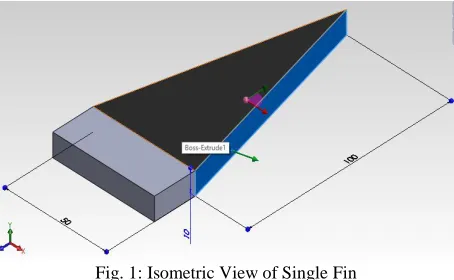
Figure 1 shows the isometric view of a Single Fin. A good model is a judicious tradeoff between realism and simplicity. Simulation practitioners recommend increasing the complexity of a model iteratively. An important issue in modeling is model validity.
Model validation techniques include simulating the model under known input conditions and comparing model output with system output. Generally, a model intended for a simulation study is a mathematical model developed with the help of simulation software.
Fig. 2: Array of Fins Showing the Pitch Selected
Meshing: A.
Fig. 3: Mesh of Array with l/d ratio = 1
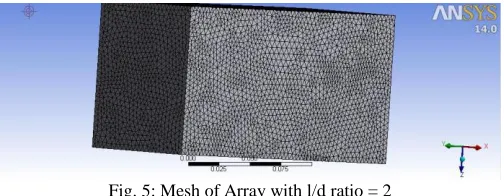
The figure 3 shows the updated mesh obtained for the array of triangular fins with l/d ratio = 1. In order to increase the accuracy of the convergence graph, the relevance centre was chosen of fine type instead of coarse type. The total number of nodes and elements are shown in Table 1 below.
Fig. 4: Mesh of Array with l/d ratio = 1.5
nodes and elements are shown in Table 1 below.
L/D Ratio Number of Nodes Number of Elements
1 35151 179456
1.5 35992 183262
2 36403 184240
III.
R
ESULT AND DISCUSSIONSAfter the generation of mesh and assigning of load and constraints next step is to run the simulation for the model. This proceeds for the analyzing the steady-state heat transfer process and finally obtain the required result contour of temperature.
Fig. 6: Temperature Contour for Single Fin with L/D Ratio = 1
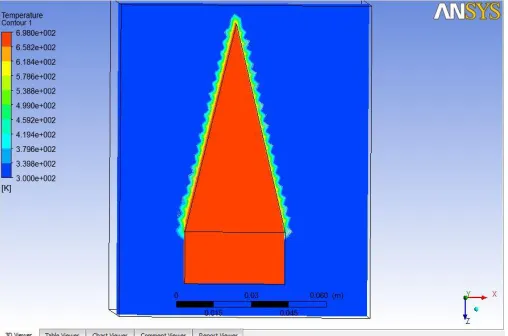
The resultant figure 6 shows the variations of temperature along length of fin with triangular extensions. It can be interpreted that the maximum value of temperature is found to be at 6.980×10² K; while the minimum value of temperature is found to be at 3.00×10² K. The source temperature from engine block was assumed to be 690K and the air temperature was taken as 300k.
Fig. 7: Pressure Contour for Single Fin with L/D Ratio = 1
Fig. 8: Temperature Contour for Single Fin with L/D Ratio = 1.5
The resultant figure 8 shows the variations of pressure along length of fin with triangular extensions. It can be interpreted that the maximum value of pressure is found to be at -1.466×101 Pa; while the minimum value of pressure is found to be at -9.902×101 Pa.
Fig. 9: Pressure Contour for Single Fin with L/D Ratio = 1.5
The resultant figure 9 shows the variations of pressure along length of fin with triangular extensions. It can be interpreted that the maximum value of pressure is found to be at -1.466×101 Pa; while the minimum value of pressure is found to be at -9.902×101 Pa.
Now we take single fin of L/D ratio = 2 (i.e. ratio of length of fin to width of fin is 1.5). We analyze the pressure and temperature contour formation of the fin when the source temperature is set as 690k and atmospheric pressure is taken as 1× Pa. Then we find the heat transfer rate from the fin.
Fig. 11: Pressure Contour for Single Fin with L/D Ratio = 2
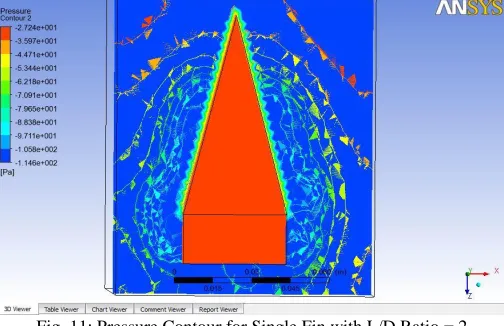
The resultant figure 11 shows the variations of pressure along length of fin with triangular extensions. It can be interpreted that the maximum value of pressure is found to be at -1.466×101 Pa; while the minimum value of pressure is found to be at -9.902×101 Pa.
Fig. 12: Temperature Contour for an Array of Fins with Pitch 50and L/D Ratio = 1.5
The resultant figure 12 shows the variations of pressure along length of array of fins with triangular extensions. It can be interpreted that the maximum value of pressure is found to be at -1.466×101 Pa and the minimum pressure is found to be at -9.902×101 Pa.
Now we analyze the heat transfer rate of an array of fins with pitch 50mm (i.e., distance between two corresponding points on adjacent fins is 50mm) and L/d ratio = 1.5 (i.e. ratio of length of fin to width of fin is 1.5). We analyze the pressure and temperature contour formation of these fins when the source temperature is set as 690k and atmospheric pressure is taken as 1× Pa.
The resultant figure 13 shows the variations of pressure along length of array of fins with triangular extensions. It can be interpreted that the maximum value of pressure is found to be at -1.466×101 Pa and the minimum pressure is found to be at -9.902×101 Pa.
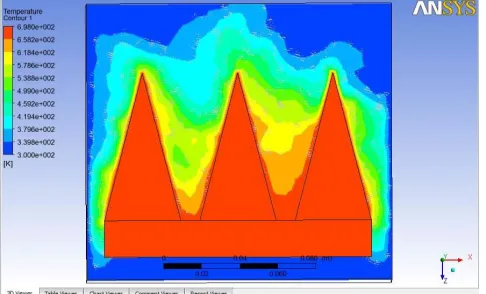
Fig. 14: Temperature contour for an array of fins with pitch 50and l/d ratio = 2
The resultant figure 14 shows the variations of temperature along an array of fins with triangular extensions. It can be interpreted that the maximum value of temperature is found to be at 6.980×10² K; while the minimum value of temperature is found to be at 3.00×10² K. The source temperature from engine block was assumed to be 690K and the air temperature which was taken as the input to measure convective heat transfer wsas given a value on 300 K.
Fig. 15: Pressure Contour for an Array of Fins with Pitch 50 and L/D Ratio = 2
The resultant figure 15 shows the variations of pressure along length of array of fins with triangular extensions. It can be interpreted that the maximum and minimum value of pressure is found to be at 1.000×10⁵ Pa.
Fig. 16: Residual graph for Single Fin with L/D Ratio = 1
The resultant figure 16 shows residual graph of convergence of temperature and pressure and values of continuity equation for single fin with L/D ratio = 1. The values converges after 1000 iterations to a value close to
Fig. 18: Residual graph for Single Fin with L/D Ratio = 2
The resultant figure 18 shows residual graph of convergence of temperature and pressure and values of continuity equation for single fin with L/D ratio = 2. The values converges after 1000 iterations to a value close to
Fig. 19: Temperature contour for an array of rectangular fins with pitch 50and l/d ratio = 2
The resultant figure 19 shows the variations of temperature along an array of fins with rectangular extensions. It can be interpreted that the maximum value of temperature is found to be at 6.980×10² K; while the minimum value of temperature is found to be at 2.98×10² K. The source temperature from engine block was assumed to be 690K and the air temperature which was taken as the input to measure convective heat transfer was given a value on 300 K.
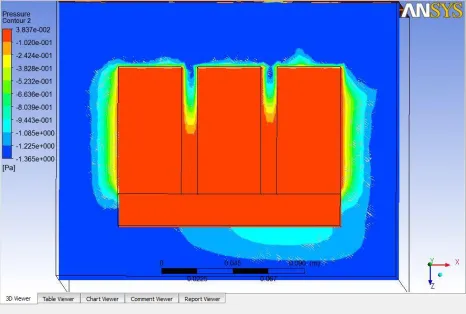
Fig. 20: Pressure contour for an array of rectangular fins with pitch 50and l/d ratio = 2
The resultant figure 20 shows the variations of pressure along length of fin with rectangular extensions. . It can be interpreted that the maximum value of pressure is found to be at 3.837×10⁻² Pa; while the minimum value of pressure is found to be at -1.365×100 Pa
IV.
C
ONCLUSIONSenhancement of heat transfer as compared to conventional fins. Heat transfer through fin with triangular extensions higher than that of fin with other types of extensions. The effectiveness of fin with triangular extensions is greater than other extensions.
A
CKNOWLEDGMENTThe authors would like to acknowledge the support of Mechanical Engineering Department of Saintgits College of Engineering for conducting the present investigation.
R
EFERENCES[1] Tri Lam Ngo et al, Heat transfer and pressure drop correlations of micro channel heat exchangers with S-shaped and zigzag fins for carbon dioxide
cycles.
[2] GiulioLorenzini et al, Constructed design of T–Y assembly of fins for an optimized heat removal.
[3] GiulioLorenzini et al,Numerical analysis on heat removal from Y -shaped fins: Efficiency and volume occupied for a new approach to performance