Tribology in Industry
www.tribology.rsStudying the Possibility of Using Complex Esters
as AW/EP Additives
I. Mukhortov
a, E. Zadorozhnaya
a, M. Кandeva
a,b, I. Levanov
aa South Ural State University, 76, Lenin prospekt, Chelyabinsk, Russia,
b Faculty of Industrial Engineering, Tribology Center, Technical University – Sofia, 1000 Sofia, Bulgaria.
Keywords:
Carboxylic esters Maleic ester Tartaric acid ester Aconitic acid esters Biodegradable lubricants Non-toxic AW/EP additives
A B S T R A C T
In this work, the possibility of using esters of organic acids as antiwear additives to lubricants has been investigated. Work has two targets. The first of these is the verification of theoretical statements about the mechanism of action of anti-wear additives. According to the authors ideas, the influence of additives on the formation and properties of a polymolecular adsorption layer is the predominant factor. These ideas are based on the general laws of liquids adsorption on the solid surface. In addition, they correspond to the properties of AW/EP additives used in modern lubricants. The second goal is to develop justified approaches to creating AW/EP additives for biodegradable lubricants based on vegetable oils and synthetic esters. Additives to these materials must meet several requirements. In particular, they must be chemically compatible with vegetable oils and not have bactericidal properties. For use in two-stroke internal combustion engines, additives must contain a minimum amount of sulfur, phosphorus and ash elements. Esters of dibasic and tribasic organic acids with higher alcohols were chosen as promising objects of study. Studies have been conducted on the example of the monoester of maleic acid, esters of tartaric and aconitic acids with hexadecyl alcohol. The results of measurements of the anti-wear properties of these substances when added to vegetable oil are given. As a result of these tests, a high AW/EP effectiveness of aconitic ester was found. This compound also showed efficacy when it was added to petroleum oil without additives and to standard gear oil. The measurements were simultaneously carried out in the SUSU laboratories, and at Sofia University in several stands under various friction conditions. The results showed that the use of new additives in hydrocarbon petroleum oil without additives gives AW effect, which is slightly lower than ZDDP. The investigated additive can be used in standard compositions of additives to motor and transmission oils. The results of the study indicate the prospects for the use of esters of polyatomic acids as AW/EP additives for lubricants of various origins.
© 2019 Published by Faculty of Engineering
Corresponding author:
E. Zadorozhnaya
South Ural State University, 76, Lenin prospekt, Chelyabinsk, Russia.
E-mail: [email protected]
R
ES
EA
R
1. INTRODUCTION
In connection with the increase in the negative impact of industrial production, electricity production and transport on the nature and environment of humans, considerable attention has recently been paid to the environmental aspects of the functioning of technical devices. Major source of environmental danger and anthropogenic impact on natural systems are vehicles with internal combustion engines. Pollution is generated not only in the processes of extraction and processing of natural hydrocarbons and fuel combustion. Lubricants and hydraulic fluids that enter the soil and water are also significant sources of pollution. This especially applies to agricultural machinery and water transport. This circumstance is the cause of attention to the development and use of biodegradable lubricants. Synthetic esters and products of chemical modification of vegetable oils are considered promising. But special attention is paid to vegetable oils, as environmentally friendly and renewable materials.
Replacing petroleum by vegetable in the lubricants composition has both advantages and disadvantages. From the tribological point of view, the advantage of vegetable oils is their higher initial lubricity compared with hydrocarbon fluids. From the point of view of physical chemistry, the adsorption energy of esters of organic acids and glycerin exceeds the adsorption energy of hydrocarbon molecules on the metal surface. This leads to more durable lubrication on friction surfaces, reduction of friction and wear of surfaces. The main disadvantage of vegetable oils is low oxidation stability. Unlike petroleum oils, the components that form the basis of vegetable oils, especially unsaturated acids, undergo oxidation [1]. The use of vegetable oils with a low content of unsaturated acids does not solve the problem, since it leads to a decrease in anti-wear properties.
Products of chemical modification of vegetable oils, for example, esters of fatty acids with monohydric alcohols, have a higher resistance to oxidation. Fully synthetic esters have even higher stability. Esters of diatomic acids, for example, adipic acid, are used most widely. However, the use of these liquids does not completely solve the problem, since the ability of synthetic esters to biodegrade in the natural environment decreases with increasing thermal stability of the esters. A
similar pattern is observed for anti-wear properties: they usually decrease with increasing thermal stability of esters [2-6].
Based on the foregoing, the preferred direction of improving biodegradable lubricants is to increase their thermo-oxidative stability with a simultaneous increase in anti-wear properties. Improvement of anti-wear properties should be achieved by adding synthetic additives to the oils composition, developed taking into account the chemical and tribological characteristics of esters. This direction is similar to the direction of lubricants development based on petroleum and synthetic hydrocarbon oils. The development of technologies for the purification of petroleum oils and the production of synthetic hydrocarbons took place with the simultaneous development of a multifunctional complex of additives, primarily antiwear and extreme pressure.
However, the use of these additives in vegetable oils faces a number of problems. The effectiveness of additives varies considerably in base oils of different composition. The most common types of additives, zinc dialkyldithiophosphates (ZDDP) and triphenyl phosphorothionates provide high antiwear, antifriction and antioxidant characteristics of hydrocarbon oils. But these additives can't be used in the composition of vegetable oils, as they are destroyed by chemical interaction with esters. Such types of anti-wear additives such as alkyl salicylates and alkyl triazoles are less effective in vegetable oils than in hydrocarbon oils. Furthermore, from the standpoint of environmental parameters and requirements for biodegradability, it is impractical to introduce into the composition of vegetable oils compounds of phosphorus, sulfur, chlorine, toxic metals and bactericidal substances. Thus, the requirements for additives for hydrocarbon and vegetable oils are different. And according to the bactericidal parameter they are opposite.
Consider other ways to improve anti-wear properties. These include the introduction of various solid lubricant components into lubricating oil, for example [7–11], chemical modification of vegetable oils, for example [12, 13], and the introduction of oil-soluble antiwear components, for example [14–20].
liquid lubricants in the form of nano-suspensions makes it difficult to filter the oils. Oil filtration is extremely important when operating internal combustion engines and hydraulic systems. One of the preferred applications of biodegradable oils is two-stroke engines of small vessels and agricultural machinery. Due to the fact that in these engines lubricating oil is added to the fuel, there are strict requirements for oil filtration. When using nano-suspensions in hydraulic oils and oils for four-stroke engines there is a problem of their resistance to operational impacts. Oxidation of the oil components and the presence of water can significantly reduce the stability of nano-suspensions.
Modification of vegetable oils by chemical action, for example, the formation of thioesters, to a greater extent reduces the ability to biodegradation. This enhances anti-wear properties. This is due to the possibility of the formation of aggressive products as a result of hydrolysis during the operation of such oils. The use of such oils is limited to open-type gearboxes for which the extreme pressure properties of the oil are important.
2. APPROACHES TO THE DEVELOPMENT OF
AW/EP ADDITIVES FOR BIODEGRADABLE OILS
When considering the composition, structure and chemical properties of effective AW / EP additives used in modern lubricants, certain conclusions can be made. Comparison of the effect on the antiwear properties of ZDDP and alkyl salicylates with long hydrocarbon radicals indicates a higher AW efficiency of alkyl salicylates. As an example, you can compare similar oils from the lines of Mobil DTE (DTE and DTE M) and Shell Tellus (Tellus and Tellus S). ZDDP have the advantage, because they increase the resistance of oils to oxidation. At the same time, alkyl salicylates are more resistant to hydrolysis, do not cause foaming and do not settle on oil filters. As a result, alkyl salicylates can be used in greater concentration than ZDDP. The properties of phosphorothionates, used in lubricants for high temperatures, and alkyl triazoles, which are used in the composition of motor oils for gasoline engines, together with ZDDP, are also correlated about the same.
These examples show that the effectiveness of additives is not related to their elemental composition and chemical activity. The ability of additives to adsorb on the metal surface and their surface activity is of primary importance. The last factor is to increase the wetting energy of the metal surface with a lubricating fluid. The physico-chemical description of the effect of surface-active substances on the adsorption of hydrocarbon liquids from the point of view of modern theories of polymolecular adsorption is not given here, since it is beyond the scope of the article. The following factors have the greatest impact on AW properties:
the heat of adsorption of the surfactant on the solid surface;
the ratio of the area occupied by one molecule on the solid surface and the number of hydrocarbon radicals;
energy of intermolecular interaction of hydrocarbon radicals of additive molecules with lubricating fluid molecules;
differences in the molar enthalpy and entropy of the lubricating liquid in the liquid and solid state.
In the case of substances such as ZDDP or alkyl salicylates dissolved in hydrocarbon oil, only the additive molecules are adsorbed on the metal surface. The resulting monomolecular layer forms a new surface consisting of hydrocarbon radicals that make up the ZDDP. Due to the relatively large area occupied by one molecule, these hydrocarbon radicals do not interact with each other. Thus, the surface coated with the monomolecular additive layer has the fairly high surface energy. At the same time, the thermal motion of the molecules of the adsorbed layer is limited. Hydrocarbon molecules of the base oil are adsorbed on the surface of this layer, forming normal dispersion links with hydrocarbon radicals. It reduces surface energy. At the same time, due to the limited thermal movement in the layer formed by the additive, the thermal movement of the adsorbed layer of oil molecules is also limited. Thus, this layer has a reduced entropy and increased enthalpy of intermolecular links compared with the base oil. Therefore, it has an increased surface energy, which leads to the adsorption of the next layer of base oil molecules.
adsorbed ZDDP layer and the hydrocarbon oil is smoothed when the polymolecular adsorbed layer is formed with a certain gradient of these parameters. Under tangential loads, the formed structure inevitably partially collapses. However, practice shows that the polymolecular layer of the certain thickness is resistant to both normal and tangential loads.
Triglycerides, which form the basis of vegetable oils, contain polar oxygen groups and sufficiently long hydrocarbon radicals of carboxylic acids. Dipole-dipole links make a significant contribution to intermolecular interactions. This somewhat weakens the interaction of triglycerides with hydrocarbon radicals additives. The adsorption of these molecules on the metal surface is also enhanced, which creates competition with the adsorption of additives. These features are due to the increased anti-wear properties and reduced sensitivity to AW additives compared to hydrocarbon oils, mentioned in the introduction.
Based on the foregoing, anti-wear efficacy should be expected from oil-soluble surfactants containing a massive polar group, exceeding triglycerides in adsorption activity. The additive must contain sufficiently long hydrocarbon radicals. In addition, the additive must be biodegradable and chemically compatible with triglycerides. One of the classes of chemicals that satisfy this requirement is esters of polybasic carboxylic acids and higher monohydric alcohols. Such substances are similar to triglycerides in their physical and chemical properties, but they are more intensively adsorbed on the metal surface.
In the present work, the antiwear properties of esters were determined using the example of three substances. Hexadecyl alcohol monoester and phthalic acid was chosen as the substance containing a free acid group capable of chemical adsorption. The diester of hexadecyl alcohol and tartaric acid is selected as an example of the complete dibasic ester. Hexadecyl alcohol and aconitic acid ester was chosen as an example of the complete tribasic ester. Thus, all the investigated substances contained the same hydrocarbon radicals: residues of linear hexadecyl alcohol С16H33.
Preliminary testing was carried out with the introduction of these substances into refined
vegetable oil and the measurement of the antiwear properties of the solutions by the four ball method. Further tests of promising samples were carried out with their introduction into standard lubricating oils: petroleum oil without additives and into transmission oil. The purpose of the test was to determine the possible scope and compatibility with standard additive packages.
3. EXPERIMENTAL RESEARCH
3.1Synthesis of additive samples
Phthalic anhydride, tartaric acid and citric acid were used for the synthesis of esters. Hexadecanol-1 was added to them in a molar ratio of 1:1, 2:1 and 3:1, respectively. The mixtures were heated in glass cups at a temperature of 150...190 C for 2...3 hours with occasional stirring. During this time, the reactions pass completely. Reactions do not require the use of catalysts. The resulting products are waxy low-melting substances soluble in hydrocarbons. Citric acid under the reaction conditions is substantially dehydrated to form aconitic acid. The final product of the reaction is aconitic acid ester (AAE).
To synthesize the ZDDP sample used for comparison, a round bottom flask equipped with a reflux condenser was filled with toluene at 1/3 of the volume. Hexadecanol-1 and phosphorus pentasulfide in a ratio of 8 moles of hexadecanol per 1 mole of P4S8 were placed there too. The
mixture was heated at a temperature of 80...90 C with occasional stirring by shaking. The reaction was carried out until cessation of hydrogen sulfide release and dissolution of phosphorus sulphide. After that, an excess amount of zinc oxide was added to the solution and heating continued for 1 hour. The resulting solution was cooled and the excess zinc oxide was removed in a centrifuge. The toluene was removed by distillation. The resulting ZDDP was mixed with petroleum oil in a 1:1 ratio by weight. The latter is necessary to prevent hydrolysis during storage in air.
3.2Determination of anti-wear properties of esters in vegetable oil
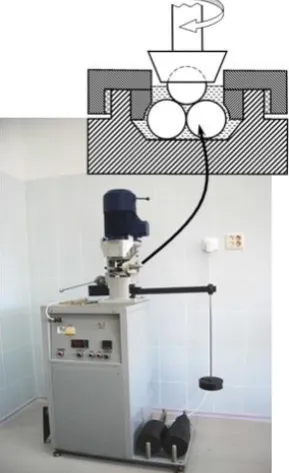
aconitic acid triester were added to the oil in an amount of 1 % by weight. Antiwear properties were determined by the four ball method on a standard ChMT-1 friction machine complying with the requirements of ASTM D 4172 [21] according to the ASTM D 4172 method at a rotation speed of 1200 rpm (0,46 m s). The normal load is 392 N, the temperature of the oil bath is 40 ±5 C. The balls were made of steel, the hardness is HRC 64-66, the diameter is 12.7 mm. An optical microscope with an accuracy of 0.01 mm was used to measure wear spots. A general view of the friction machine is presented in Fig. 1.
For the original oil and for each oil sample with additives, three measurements were taken. The measurement results were averaged. The measurement results are shown in Tables 1-4.
Table 1. Measurement results for original refined
sunflower oil.
№ 1 2 3
The wear trace diameter, mm
0.71 0,65 0,68
0.70 0,67 0,69
0.72 0,67 0,68
Average value, mm 0.68
The measurement results showed that aconitic ester exhibits the highest antiwear properties. Further studies were conducted only with this substance, as promising for use as the AW/EP additive.
Fig. 1. The view of the four-ball friction machine and the scheme of the friction unit.
Table 2. Measurement results for refined sunflower oil containing 1 % phthalic acid monoether.
№ 1 2 3
The wear trace diameter, mm
0.69 0,66 0,66
0.67 0,67 0,64
0.72 0,66 0,63
Average value, mm 0.66
Table 3. Measurement results for refined sunflower oil containing 1 % tartaric acid ester.
№ 1 2 3
The wear trace diameter, mm
0.5 0,52 0,59
0.53 0,5 0,55
0.51 0,46 0,57
Average value, mm 0.53
Table 4. Measurement results for refined sunflower oil containing 1% aconitic ester.
№ 1 2 3
The wear trace diameter, mm
0.35 0,4 0,46
0.33 0,41 0,44
0.33 0,39 0,46
Average value, mm 0.40
3.3Determination of AAE antiwear efficacy when introduced into the hydrocarbon base oil
As the base oil, oil industry oil without additives of viscosity class ISO 32 was used. Aconitic acid trihexadecyl ester (AAE) was introduced into the base oil in an amount of 3 % by weight. The effectiveness of AAE was evaluated by comparing similar results obtained using standard AW/EP ZDDP additive. The ZDDP additive prepared according to the procedure described in paragraph 3.1 was introduced into the base oil in an amount of 2 % by weight.
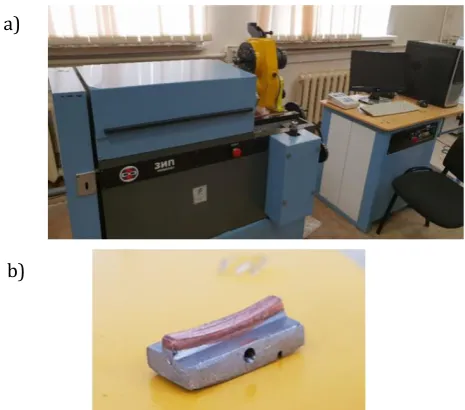
Determination of friction coefficient as a function of temperature in a conformal sliding friction unit was made. The tests were carried out on the machine friction II-5018. Unlike the universal friction machine MTU-1 [22], the friction machine II-5018 allows to carry out tests under the conditions of contact "roller block". The diameter of the roller is 90 mm, the material is steel. The block is made of the liner of the tractor bearing, the material is bronze, the dimensions of the working surface are 24 × 2 mm. Test conditions: roller rotation speed 500 min-1, load
The values of the friction coefficient µ were calculated based on the measured friction moment M at each load value F. The contact pressure P was calculated based on the load value and the contact area. Temperature T was measured by a thermoelectric transducer inserted into the side opening of the block. A general view of the friction machine II-5018, block image and contact assembly, is shown at Fig. 2.
Fig. 2. a) General view of the friction machine II 5018, b) block.
The measurement results are presented in Table 5 and in Fig. 3.
Table 5. Measurement results. The dependence of the coefficient of friction µ on the temperature when lubricated with oil without additives, the same oil with the addition of 3 % aconitic acid trihexadecyl ester and 2 % ZDDP.
Friction unit temp.,
°С
Friction coefficient µ Industrial Oil
ISO 32 ZDDP AAE
25 0.111 0.096 0.099
30 0.111 0.096 0.099
35 0.111 0.095 0.098
40 0.111 0.094 0.098
45 0.111 0.094 0.097
50 0.111 0.094 0.097
55 0.116 0.094 0.097
60 0.116 0.093 0.096
65 0.116 0.093 0.096
70 0.116 0.092 0.094
75 0.116 0.09 0.092
80 0.116 0.088 0.09
85 0.118 0.086 0.086
90 0.122 0.082 0.082
95 0.128 0.076 0.076
100 contact 0.074 0.075
105 - 0.072 0.074
110 - 0.07 0.074
115 - 0.070 0.072
120 - 0.068 0.072
125 - 0.068 0.074
130 - 0.068 0.074
Fig. 3. Effect of ZDDP and AAE on the dependence of the friction coefficient on temperature in a conformal slip contact.
At the next stage, the determination of the dependence of the friction coefficient on the load was performed. Due to the dependence of the friction coefficient on the temperature and the complexity of contact temperature control, the measurement of the dependence of the friction coefficient on the load was carried out at three load values. The load was constant during each measurement. The moment value was recorded when the temperature reached 80 C. Before performing each measurement, the surface of the roller was polished to achieve a roughness of Ra=0.02. The lubricant used was the same oil and the same additive concentrations as in the measurements described above. The measurement results are shown in Table 6.
Table 6. The dependence of the friction coefficient µ on the load when lubricating with oil without additives, the same oil with additives of 3 % AAE and 2 % ZDDP.
Load, N
Friction coefficient µ
Industrial Oil
ISO 32 ZDDP AAE
200 0.054 0.046 0.052
500 0.070 0.062 0.065
1000 contact 0.084 0.085
a)
3.4Determination of the anti-wear
properties of the AAE additive in gear oil
Transmission oil LUKOIL API GL-5, SAE 75W-90 was used as the base oil. This oil contains antiwear and extreme pressure additives. The additive ZDDP was administered in an amount of 2 % by weight, the additive AAE was introduced in an amount of 3 % by weight.
Table 7. The wear trace diameter for LUKOIL GL-5 SAE 75W-90 oil.
№ 1 2 3 4 5 6
The wear trace diam
eter, mm
0.44 0.46 0.46 0.45 0.46 0.43
0.44 0.47 0.46 0.45 0.46 0.43
0.45 0.46 0.46 0.45 0.46 0.44
0.44 0.46 0.45 0.45 0.46 0.44
0.43 0.42 0.45 0.45 0.44 0.41
0.43 0.42 0.45 0.45 0.47 0.42
0.44 0.43 0.45 0.45 0.44 0.43
Avera ge value,
mm
0.452
Table 8. The diameter of the wear trace for oil LUKOIL GL-5 SAE 75W-90, containing 2% ZDDP.
№ 1 2 3
The wear spot diameter, mm
0.335 0.346 0.335
0.342 0.344 0.325
0.348 0.345 0.329
0.35 0.345 0.331
0.345 0.34 0.339
0.347 0.332 0.353
0.348 0.332 0.357
Average value,
mm 0.344
Table 9. The diameter of the wear trace for oil LUKOIL GL-5 SAE 75W-90, containing 2 % ZDDP.
№ 1 2 3
The diameter of the wear trace,
mm
0.328 0.335 0.322
0.332 0.334 0.328
0.327 0.325 0.328
0.326 0.328 0.332
0.332 0.332 0.33
0.333 0.332 0.323
0.324 0.326 0.326
0.328 0.334 0.328
0.332 0.336 0.327
Average value,
mm 0.328
Table 10. Measurement results.
Lubricant
Average diameter of the
wear trace, mm
Average contact area, mm2
Minimum contact pressure,
MPa
The base oil 0.452 0.204 640
The base oil +
3% AAE 0.344 0.118 1110
The base oil +
2% ZDDP 0.328 0.108 1210
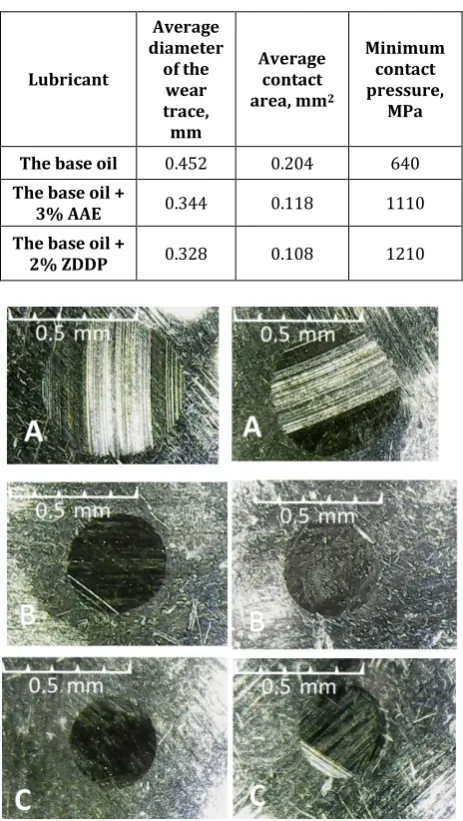
Fig. 4. Type of wear spots when tested according to the four ball method: A - when lubricated with LUKOIL GL-5 SAE 75W-90 oil, B - the same oil with 3 % AAE, C - the same oil with 2 % ZDDP.
Antiwear properties were determined by the four ball method on a standard ChMT-1 friction machine. Six measurements were made for the original gear oil and three measurements were made for the oil with ZDDP and AAE additives. The measurement results were averaged. The measurement results are shown in Tables 7–10. The wear trace diameters are shown in Fig. 4.
3.5Determination of AW / EP properties of AAE in technical rapeseed oil
oil was used. The AAE addition was added in an amount of 4 % by weight.
The measurements were performed on a laboratory device "Fixed Pin - Rotating Disk." The device is shown in Fig. 5. A pin is a cylindrical specimen made of BrO10F1 tin bronze. The diameter is 19 mm. The rotating disk is made of alloy steel with a hardness of HRC56,9. The pin is fixed in the device, which can move freely in a plane parallel to the disk plane and along the normal to the surface. The pressing force F to the disk is created by placing weights on the device for the pin fastening. A tensometric sensor attached to the fastening of the pin.
Fig. 5. Scheme of the device for measuring the friction coefficient when lubricated with rapeseed oil with or without additive.
Table 11. Parameters of the experiment
№ Parameters Value
1 Load F3 = 140 N, F4 = 220 N F1 = 60 N, F2 = 100 N,
2 Nominal contact area Аа = 283,3 mm2
3 Nominal contact pressure
ра1= 21,2 N/cm2,
ра2= 35,3 N/cm2,
ра3= 49,5 N/cm2,
ра4= 77,7 N/cm2
4 Speed of rotation n = 95 min-1
5 Sliding speed of the center contact VC = 0,89 m/s
6 Initial rape oil temperature Т = 21 оС
7 temperature Ambient Т = 21 оС
Using the device shown in Fig. 5, the friction force Ft acting on the pin from the disk was measured. The friction force was measured with an accuracy
of 0,1 N. Each experiment at each load value was performed at the same values of time (friction path), disk rotation speed, and ambient temperature. The lubricant was applied to the contact by drip method (drip lubrication) at a rate of 30 drops/min. The experiment parameters are shown in Table 11.
Table 12. The results of measurements of friction force Ft and friction coefficient µ.
№
lubricating oil
Load, F
F1 = 60 N F2 = 100 N ра1=21,2
N/cm2 ра2=35,3 N/cm2
Ft1, N µ Ft2, N µ
1 Rapeseed oil 4,5 0,075 6 0,06
2 Rapeseed oil+ AAE-Аdditive 2 0,03 4 0,04
№ lubricating oil
F3 = 140 N F4 = 220 N ра3=49,5
N/cm2 ра4=77,7 N/cm2
Ft3, N µ Ft4, N µ
1 Rapeseed oil 9 0,064 15 0,068
2 Rapeseed oil+ AAE-Аdditive 6 0,042 10 0,045
The friction coefficient was calculated as the ratio of the friction force to the normal load (the force of pressing the pin to the disk). Rapeseed oil and rapeseed oil containing 4 % aconitic acid trihexadecyl ester (AAE-additive) were used as a lubricant. The temperature of the lubricant supplied to the friction contact is equal to the ambient temperature 21 C. Table 12 presents the results of measurements of friction coefficients at four load values.
4. DISCUSSION
ester into the composition of vegetable oil reduces the amount of wear sufficiently strong to recognize it as an effective antiwear additive. When tested by the four balls method with a decrease in the diameter of the wear trace by 40 %, the area of the wear trace decreases by approximately 3 times, the volume of the worn spherical segment and the weight of the worn metal decrease by approximately 5 times. It is also necessary to take into account the slowing of the rate of wear with increasing contact patch and decreasing contact pressure. Thus, if the wear spot diameter is reduced by 40 % in contact with a constant area, the wear rate can be correspondingly reduced by an order of magnitude. However, the difference between lubricants, when using the four-ball method, appears only at high contact pressures. This is typical for gears. Thus, AAE can operate as an effective additive to biodegradable gear oils. As follows from the results given in Section 3.5, at low contact pressures, AAE exhibits moderate antifriction properties that are constant at contact pressures up to 1 MPa.
From the results in clause in paragraph 3.2, it follows that AAE can be used as an effective AW additive to hydrocarbon-based oils. When equal concentrations are used, the effect of the AAE additive is slightly lower than that of the ZDDP additive. However, AAE, due to its lower cost and greater chemical resistance, can be used in higher concentrations. From the results given in paragraph 3.3, it follows that the addition of 3% AAE to hydrocarbon oil is equivalent to the addition of 2 % ZDDP. In the conformal contact of sliding friction, imitating the bearing of the crankshaft of a tractor engine, the results of the introduction of the investigated additive are close to the results of the introduction of ZDDP with alkyl radicals of the same length and structure as in AAE. This can be explained by the adsorption mechanism of action of the additives. The effect of the adsorbed surfactant layer extends to an extremely thin layer of liquid. Under conditions of simulating a radial friction bearing with low surface roughness, hydrodynamic pressures provide a separating layer of lubricant even at high contact pressures.
It follows from the results given in paragraph 3.4 that AAE is compatible with standard additive packages and can be used both for addition to standard lubricating oils and for developing new
types of oils. A significant increase in gear oil properties (API GL-5 class) with the addition of AAE can be extremely useful when these oils are used in hypoid gears with a high degree of anti-slip teeth.
Another result is the confirmation of higher efficiency of AW additives in hydrocarbon oils than in vegetable oils. AAE is an ester and is chemically similar to vegetable oil. The main difference is the higher ability of AAE to adsorb onto metal surfaces. This confirms the assumption about the predominantly adsorption mechanism of action of this additive.
5. CONCLUSION
The results show that aconitic acid ester (AAE) exhibits anti-wear properties in both hydrocarbon and vegetable oils at high contact pressures. Aconitic acid ester can be used when it is necessary to enhance the AW / EP properties of lubricants based on hydrocarbon and vegetable oils in cases where low ash content, non-toxicity and biodegradability are particularly important. For example, in food processing equipment.
The results obtained confirm the productivity of the chosen approach to the development of AW / EP additives.
Acknowledgement
This work was supported by the Ministry of Education and Science of the Russian Federation (grant No 9.7881.2017/8.9).
REFERENCES
[1] N.J. Fox, G.W. Stachowiak, Vegetable oil-based lubricants - A review of oxidation, Tribology International, vol. 40, iss. 7, pp. 1035-1046, 2007, doi: 10.1016/j.triboint.2006.10.001 [2] Y.M. Shashidhara, S.R. Jayaram, Vegetable oils as
a potential cutting fluid – An evolution, Tribology International, vol. 43, iss. 5–6, pp. 1073-1081, 2010, doi: 10.1016/j.triboint.2009.12.065
Methyl Ester oil, Hydrotreated Rapeseed oil, Tribology International, vol. 109, pp. 529-540, 2017, doi: 10.1016/j.triboint.2017.01.030
[4] A. Rajendiran, A. Sumathi, K. Krishnasamy, S. Kabilan, D. Ganguli, Antiwear study on petroleum base oils with esters, Tribology International, vol. 99, pp. 47-56, 2016,
doi: 10.1016/j.triboint.2016.03.019
[5] S.H. Hamdanab, W.W.F. Chongcde, J.-H. Ngadf, M.J. Ghazalig, R.J.K. Woode, Influence of fatty acid methyl ester composition on tribological properties of vegetable oils and duck fat derived biodiesel, Tribology International, vol. 113, pp. 76-82, 2017,
doi: 10.1016/j.triboint.2016.12.008
[6] C.J. Reeves, P.L. Menezes, T.-C. Jen, M.R. Lovell, The influence of fatty acids on tribological and thermal properties of natural oils as sustainable biolubricants, Tribology International, vol. 90, pp. 123-134, 2015,
doi: 10.1016/j.triboint.2015.04.021
[7] G. Zhang, Y. Xu, X. Xiang, G. Zheng, X. Zeng, Z. Li, T. Ren, Y. Zhang, Tribological performances of highly dispersed graphene oxide derivatives in vegetable oil, Tribology International, vol. 126, pp. 39-48, 2018, doi: 10.1016/j.triboint.2018.05.004
[8] R. Padmini, P.V. Krishna, G.K.M. Rao, Effectiveness of vegetable oil based nanofluids as potential cutting fluids in turning AISI 1040 steel, Tribology International, vol. 94, pp. 490-501, 2016, doi: 10.1016/j.triboint.2015.10.006
[9] S.M. Alves, B.S. Barros, M.F. Trajano, K.S.B. Ribeiro, E. Moura, Tribological behavior of vegetable oil-based lubricants with nanoparticles of oxides in boundary lubrication conditions, Tribology International, vol. 65, pp. 28-36, 2013,
doi: 10.1016/j.triboint.2013.03.027
[10] M. Gulzar, H.H. Masjuki, M. Varman, M. Kalam, R. Mufti, N.M. Zulkifli, R. Yunus, R. Zahid, Improving the AW/EP ability of chemically modified palm oil by adding CuO and MoS2 nanoparticles, Tribology International, vol. 88, pp. 271-279, 2015, doi: 10.1016/j.triboint.2015.03.035
[11] F.L.G. Borda, S.J.R. de Oliveira, L.M. Seabra M. Lazaro, A. Leiróz, Experimental investigation of the tribological behavior of lubricants with additive containing copper nanoparticles, Tribology International, vol. 117, pp. 52-58, 2018, doi: 10.1016/j.triboint.2017.08.012
[12] B.K. Sharma, A. Adhvaryu, S.Z. Erhan, Friction and wear behavior of thioether hydroxy vegetable oil, Tribology International, vol. 42, iss. 2, pp. 353-358, 2009, doi: 10.1016/j.triboint.2008.07.004
[13] O.N. Anand, V.P. Malik, K.D. Neemla, Studies on extreme pressure films – reactions of sulphurized
vegetable oils and alkyl phenols with iron, Tribology International, vol. 19, iss. 3, pp. 128-132, 1986, doi: 10.1016/0301-679x(86)90018-6
[14] G. Zheng, T. Ding, Y. Huang, L. Zheng, T. Ren, Fatty acid based phosphite ionic liquids as multifunctional lubricant additives in mineral oil and refined vegetable oil, Tribology International, vol. 123, pp. 316-324. 2018, doi: 10.1016/j.triboint.2018.03.028
[15] J. Martín-Alfonso, F. López-Beltrán, C. Valencia, J. Franco, Effect of an alkali treatment on the development of cellulose pulp-based gel-like dispersions in vegetable oil for use as lubricants, Tribology International, vol. 123, pp. 329-336, 2018, doi: 10.1016/j.triboint.2018.02.027
[16] N.H. Jayadas, K.P. Nair, G. Ajithkumar, Tribological evaluation of coconut oil as an environment-friendly lubricant, Tribology International, vol. 40, iss. 2, pp. 350-354, 2007,
doi: 10.1016/j.triboint.2005.09.021
[17] B. Ozcelik, E. Kuram, M.H. Cetin, E. Demirbas, Experimental investigations of vegetable based cutting fluids with extreme pressure during turning of AISI 304L, Tribology International, vol. 44, iss. 12, pp. 1864-1871, 2011, doi: 10.1016/j.triboint.2011.07.012
[18] U.S. Choi, B.G. Ahn, O.K. Kwon, Y.J. Chun, Tribological behavior of some antiwear additives in vegetable oils, Tribology International, vol. 30, iss. 9, pp. 677-683, 1997, doi: 10.1016/S0301-679X(97)00039-X
[19] X. Zeng, J. Li, X. Wu, T. Ren, W. Liu, The tribological behaviors of hydroxyl-containing dithiocarbamate-triazine derivatives as additives in rapeseed oil, Tribology International, vol. 40, iss. 3, pp. 560-566, 2007, doi: 10.1016/j.triboint.2006.05.005
[20] L.A. Quinchia, M.A. Delgado, T. Reddyhoff, C. Gallegos, H.A. Spikes, Tribological studies of potential vegetable oil-based lubricants containing environmentally friendly viscosity modifiers, Tribology International, vol. 69, pp. 110-117, 2014, doi: 10.1016/j.triboint.2013.08.016
[21] ASTM D4172–94 Standard teste method for wear preventive characteristics of lubricating fluid (four ball method) ASTM International, West Conshohocken, PA, US, 2010.