http://www.sciencepublishinggroup.com/j/acm doi: 10.11648/j.acm.20170604.16
ISSN: 2328-5605 (Print); ISSN: 2328-5613 (Online)
New Orbital Free Simulation Method Based on the Density
Functional Theory
Victor Zavodinsky
1, Olga Gorkusha
21Institute for Material Science, Khabarovsk, Russia 2
Khabarovsk Department, Institute of Applied Mathematics, Khabarovsk, Russia
Email address:
[email protected] (V. Zavodinsky), [email protected] (O. Gorkusha)
To cite this article:
Victor Zavodinsky, Olga Gorkusha. New Orbital Free Simulation Method Based on the Density Functional Theory. Applied and Computational Mathematics. Vol. 6, No. 4, 2017, pp. 189-195. doi: 10.11648/j.acm.20170604.16
Received: July 17, 2017; Accepted: July 25, 2017; Published: August 4, 2017
Abstract:
A practical way to simulate multi-atomic systems without using of wave functions (orbitals) is proposed. Kinetic functionals for each type of atoms are constructed and then are used for complex systems. On examples of clusters containing Al, Si, C, and O it is shown that this method can describe structures and energies of multi-atomic systems not worse than the Kohn-Sham method but faster. Besides, it is demonstrated that the orbital-free version of the density functional theory may be used for finding equilibrium configurations of multi-atomic systems with covalent bonding. The equilibrium interatomic distances, interbonding angles and binding energies for Si3 and C3 clusters are found in good accordance with known data.Keywords:
Orbital-free, Density Functional, Hetero-Atomic Systems, Interatomic Distances, Interbonding Angles1. Introduction
The orbital-free (OF) approach is an alternative to the Kohn-Sham (KS) [1] method to simulate multi-atomic systems in the framework of the density functional theory (DFT) [2]. The OF approach operates with the electron density only (without wave functions) and being developed enough can be applied for simulation of very large systems: up to millions atoms [3]. Several groups [3-11] are working in this area with different success, and the calculation of the kinetic energy is noted as a main problem. In the previous papers [12, 13] it was suggested that there is no universal way to describe the kinetic energy of different atoms and
compounds. In the present work it is described how it is possible to extend this approach to systems with more large systems.
2. A General Description of the of
Approach
As it is known the DFT claims that the energy E of the ground state of any quantum system can be found by minimization of the some functional depending only on the electronic density of this system ρ(r):
r
r
r
r
V
d
d
d
d
E
ex c kin)
(
)
(
)
(
)
(
2
1
d
)
(
)
(
)
(
]
[
ρ
=
∫
ε
ρ
=
∫
r
ρ
r
r
+
∫
ϕ
ρ
ρ
r
+
∫
ε
−ρ
+
∫
ε
ρ
(1)where V(r) is an external potential,
|
|
r
r
r
r
r
′
′
−
′
∫
ρ(
)
d
=
)
(
ϕ
isthe electrostatic electron potential Hartree, εex-c and εkin are
exchange-correlation and kinetic energies (per electron). Minimization of (1) means solution the following equation:
0
)
)
]
[
]
[
V(
)
+
(
)
+
µ
(ρ
µ
(ρ
=
δρ
ρ
δε
F
ρ
≡
=
r
ϕ
r
kin+
ex−c (2)with the condition
∫
ρ(
r
)d
r
=
N
where N is the numberof electrons in the system, and µkin(ρ)= δεkin(ρ)
µ
ex−c(
ρ
)=
δε
ex−c(
ρ
)
δρ
.There are some realistic approximations for exchange-correlation potential µex−c(ρ) there; the potential Hartree
( )
φ r may be calculated using Fourier transformations or Poisson equations; the external potential V( )r usually consists of atomic potentials. The only real problem is the kinetic potential µkin.
Pseudopotential Approach for Dimers
In practice, the DFT calculations are simpler if one uses pseudopotentials instead of full electron potentials. Therefore let us rewrite the above equations in the pseudopotential approach, and, for simplicity, let us limit yourself by two-atomic systems and s- and p-components of pseudopotentials.
We present the total density
ρ
12 as a sum of partial densities:ρ
12=
ρ
12−s+
ρ
12−p.
The electron energy of this system
∫
− −=
d
r
E
12ε
12(
ρ
12 s,
ρ
12 p)
must be minimal with thecondition
∫
(
ρ
12−s+
ρ
12−p)
d
r
=
N
12 , whereε
12 is the electron energy per electron for the two-atomic system with the total number of electrons N12. In the other words we have to find the density ρ12 that satisfies the system of two equations:0
12 12=
δρ
δε
s − (3) 0 12 12 = δρ δε p − (4)Thus we may write:
0
12 12 12 12 21
(
)
+
V
(
)
+
(
)
+
µ
(ρ
)
+
µ
(ρ
)
=
V
excs kin s s s − − −
−
r
r
ϕ
r
(5)0 12 12 12 12 2
1 ( )+V ( )+ (r)+µ (ρ )+µ (ρ )=
V ex c
p kin p p p − − −
− r r
ϕ
(6)where где
V
1−s(
r
)
,V
2−s(
r
)
,V
1−p(
r
)
, andV
2−p(
r
)
ares and p components of pseudopotentials of the first and second atoms,
ϕ
12(
r
)
and 12(ρ
12)
c ex−
µ
are the electrostatic and exchange-correlation potentials calculated for the total electron densityρ
12 of a dimer, 12 12 s)
kin s
(ρ
µ
− − and)
1212 p
kin p
(ρ
µ
− − are partial kinetic potentials depending on corresponding partial densities ρ12-s and ρ12-p.It is useful to present
µ
12−s kin(
ρ
12−s)
andµ
12−p kin(
ρ
12−p)
in the form ofµ
12kin−s(
ρ
12−s)=
µ
12+
∆µ
12kin−s(
ρ
12−s)
andµ
12−p kin(
ρ
12−p)=
µ
12+
∆µ
12−p kin(
ρ
12−p)
and rewrite Eqs.(4-s), (4-p) for a two-atomic system as it follows below:
V
1−s(r
)+
V
2−s(r
)+
ϕ
12(r
)+
µ
12ex−c
(
ρ
12)+
∆µ
12−s kin(
ρ
12−s)
(7)V
1−p(
r
)+
V
2−p(
r
)+
ϕ
12(
r
)+
µ
12ex−c(
ρ
12)+
∆µ
kin12−p(
ρ
12−p)
(8)The electron energy
ε
12(ρ
12)
contains terms of electrostatic energy2
1 12 2 12 1 12 2 12 12 12
1
4 2
estat V s( ) s V s( ) s V p( ) p+V p( ) p ( ) b ac
ε = − r ρ − + − r ρ − + − r ρ − − r ρ − + φ r ρ − , exchange-correlation 12 12)
ex c
(ρ
ε
− andkinetic energies 12 12
)
12 12)
12 12)
kin kin kin
s s p p
(ρ
(ρ
(ρ
ε
=
ε
− −+
ε
− − .Namely:
12
(
12)
12 12)
12 12)
12 12)
ex c kin kin
estat
+
(ρ
s(ρ
s p(ρ
pε ρ
ε
ε
−ε
ε
− − − −
=
+
+
(9)Obviously, for two isolated atoms it possible to write equations similar to (7) and (8):
0
1 1 1 1 11 − −
=
−
−
(
)
+
(
)
+
µ
(ρ
)
+
µ
(ρ
)
V
a s kin s a c ex as
r
ϕ
r
(10)0
1 1 1 1 11 − −
=
−
−
(
)
+
(
)
+
µ
(ρ
)
+
µ
(ρ
)
V
a p kin p a c ex ap
r
ϕ
r
(11)0
2 2 2 2 22 − −
=
−
−
(
)
+
(
)
+
µ
(ρ
)
+
µ
(ρ
)
V
a s kin s a c ex as
r
ϕ
r
(12)0
2 2 2 2 22 − −
=
−
−
(
)
+
(r)
+
µ
(ρ
)
+
µ
(ρ
)
V
a p kin p a c ex ap
r
ϕ
(13)From which it is followed:
)
(ρ
µ
)
(ρ
µ
)
(
)
(
V
a s kin s a c ex as − −
−
−
=
−
1−
1 1−
1 11
r
ϕ
r
(14))
(ρ
µ
)
(ρ
µ
)
(
)
(
V
a p kin p a c ex ap − −
−
−
=
−
1−
1 1−
1 11
r
ϕ
r
(15))
(ρ
µ
)
(ρ
µ
)
(
)
(
V
a s kin s a c ex as − −
−
−
=
−
2−
2 2−
2 22
r
ϕ
r
(16))
(ρ
µ
)
(ρ
µ
(r)
)
(
V
a p kin p a c ex ap − −
−
−
=
−
2−
2 2−
2 22
r
ϕ
(17)Let us introduce notations:
)
(ρ
µ
)
(ρ
µ
)
(ρ
µ
)
(ρ
s kins s kins as kins a s kins − − − − − − −
−
=
−
−
∆
µ
12 12 12 12 1 1 2 2 (18)) (ρ µ ) (ρ µ ) (ρ µ ) (ρ a p kin p a p kin p p kin p p kin
p − − − − − − −
− = − −
∆
µ
12 12 12 12 1 1 2 2 (19))
(ρ
)
(ρ
)
(ρ
)
(ρ
ex c ex c a ex c ac ex 2 2 1 1 12 12 12 12 − − − −
=
−
−
)
(ρ
)
(ρ
)
(ρ
)
(ρ
12 12 12 1 1a 2 2a12
ϕ
ϕ
ϕ
ϕ
=
−
−
∆
(21)Now equations (5-s) and (5-p) can be transformed to simple forms:
0
12 s 12-12 1212
(
)
+
µ
(ρ
)
+
(ρ
s)
=
kin c ex − −∆
∆
∆
ϕ
r
µ
(22)0
12 p -12 12 1212
(
)
+
µ
(ρ
)
+
(ρ
p)
=
kin c ex − −∆
∆
∆
ϕ
r
µ
(23)It is possible to solve these equations using some probe functions for 12-s 12
kin s
(ρ )
µ −
∆ ,
∆
µ
12kin-p(ρ
12−p)
, 1kin a 1 s s
∆µ− (ρ− ) ,
∆µ
1pkin(
ρ
1a−p)
,∆µ
2kin−s(
ρ
2a−s)
,∆µ
kin2−p(
ρ
2a−p)
and then to calculate the total energy with 12
kin kin s 12 12 s
µ − = µ + ∆µ −
and
µ
12kin−p=
µ
12+
∆µ
12kin−p. The probe functions must leadto the equilibrium interatomic distances and binding energy for dimers.
The binding energy for a dimer (per one atom) would be calculated as follows:
E
b=
1
2
(
E
dim−
2
E
a)
, whereE
a is the atomic energy,|
1 2|
2 1 12
12
dim
[
]
R
R
r
r
−
∫
ε
ρ
(
)
d
+
Z
Z
=
E
. Dimers with identical atoms
Al, Si, and C were taken as test elements. The FHI98pp [14] package was used as a generator of pseudo-potentials and equilibrium partial electron densities. Exchange and correlation potentials were calculated in the local density approach [15, 16]. Studied atoms were located in a cubic cell of the L size (L=30 a.u.; 1 a.u. = 0.529 Å). The cell was divided on 150×150×150 elementary sub-cells for the integration with the step ∆L of 0.406 a.u. Results of calculations were compared with published data.
The same types of kinetic functions
∆µ
skin and∆µ
kinpfor isolated atoms and dimers and trimers were used, however they were found different for different types of atoms.
Obviously functions
(ρ
s)
kin −
∆
µ
12-s 12 must go to zero whenthe interatomic distance increases. Let our dimmer consists from atoms of an A type. Let us find
∆
µ
12kin-s(ρ
12−s)
and)
(ρ
p kin−
∆
µ
12-p 12 in the following form:) (ρ ) (ρ ) (ρ ) (ρ a s kin a s kin s kin s kin − − − − = − −
∆
µ
A12-s 12ν
A-s 12ν
A-s 1ν
A-s 2 (24)) (ρ ) (ρ ) (ρ )
(ρ a p
kin a p kin p kin p kin − − − − = − −
∆
µ
A12-p 12ν
A-s 12ν
A-p 1ν
A-p 2 (25),where A-s
(ρ
)
kin
ν
andν
Akin-p(ρ
)
are unknown functions of density, which must make the dimer binding energy and the equilibrium distance close to results of Kohn-Sham calculations.Namely, for Al they are:
1/ 4
1.2 0.3
kin
s s s
ν = ρ − ρ , kin 1.2 1/ 4 0.3
p p p
ν = ρ − ρ ;
for Si:
1 4
1.4 4.4
kin
s s s
ν = ρ + ρ , kin 1.62 1 4 4.4
p p p
ν = ρ + ρ ;
and for C:
1 4
1.9 0.6
kin
s s s
ν = ρ + ρ , kin 2.0 1 4 0.6
p p p
ν = ρ + ρ .
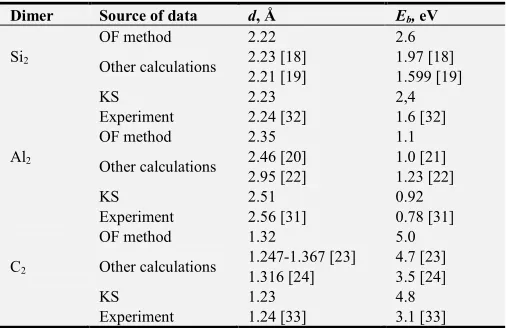
Calculated values of interatomic distances and binding energies for the Al2, Si2, and C2 dimers are collected in Table 1 in comparison with known published data. It is clear that agreement is rather good.
Table 1. Equilibrium distances d and binding energies Eb (absolute values,
per atom) for Si2, Al2 and C2 in comparison with known calculated data.
Dimer Source of data d, Å Eb, eV
Si2
OF method 2.22 2.6
Other calculations 2.23 [18] 2.21 [19]
1.97 [18] 1.599 [19]
KS 2.23 2,4
Experiment 2.24 [32] 1.6 [32]
Al2
OF method 2.35 1.1
Other calculations 2.46 [20] 2.95 [22]
1.0 [21] 1.23 [22]
KS 2.51 0.92
Experiment 2.56 [31] 0.78 [31]
С2
OF method 1.32 5.0
Other calculations 1.247-1.367 [23] 1.316 [24]
4.7 [23] 3.5 [24]
KS 1.23 4.8
Experiment 1.24 [33] 3.1 [33] Notation: “KS” means the calculations used the FHI96md package [17] based on the Kohn-Sham method.
Dimers with different atoms
As different atoms have different functions for kinetic energy, some procedure to calculate the total kinetic functions
∆µ
12kin in the space of the atomic system has to be developed. Near each atom it has to be approximately equal to its atomic function, but it has to be equal to mixture of the specific atomic functions between atoms. It seems that the simple way to construct this total function ∆µ12kin is tosummarize the specific atomic functions with some weights:
1 2 2
( ) ( ) ( )
kin kin kin
12 s s 1 s s s
∆µ − r =W ∆µ− r +W ∆µ− r ; (26)
1 2 2
( ) ( ) ( )
kin kin kin
12 p p 1 p p p
∆µ − r =W ∆µ− r +W ∆µ− r . (27)
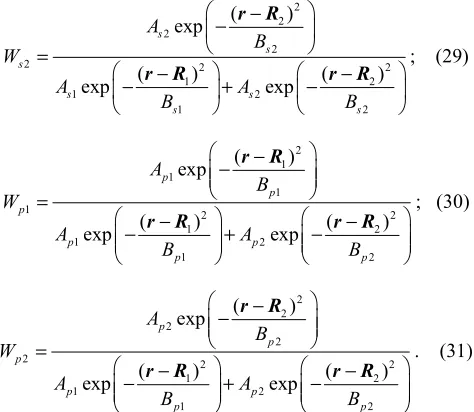
The weights have to be determined through gauss functions those are fitted to atomic densities:
2 1 1
1
1 2 2
1 2 1 2 1 2 ( ) exp ( ) ( ) exp exp s s s s s s s A B W A A B B − − = − − − + − r R
r R r R
2 2 2
2
2 2 2
1 2
1 2
1 2
( )
exp
( ) ( )
exp exp
s
s s
s s
s s
A
B W
A A
B B
−
−
=
− −
− + −
r R
r R r R ; (29)
2 1 1
1 1
2 2
1 2
1 2
1 2
( )
exp
( ) ( )
exp exp
p
p p
p p
p p
A
B W
A A
B B
−
−
=
− −
− + −
r R
r R r R
; (30)
2 2 2
2 2
2 2
1 2
1 2
1 2
( )
exp
( ) ( )
exp exp
p
p p
p p
p p
A
B W
A A
B B
−
−
=
− −
− + −
r R
r R r R
. (31)
An example of fitting of densities is demonstrated, Figure 1 the fitting of atomic densities for silicon and oxygen. Value A and B for Si, Al, C and O are collected in Table 2.
Figure 1. The s-densities and the weights Ws for oxygen (dash) and silicon
(solid) atoms.
Table 2. Value A and B for Si, Al, C and O.
Specie As Ap Bs Bp
Si 0.065 0.040 3.5 4.5
Al 0.045 0.009 4.0 7.5
С 0.200 0.160 1.5 1.5
O 0.300 0.450 1.0 1.5
Calculations for the SiC, SiAl, AlC, SiO, CO, and AlO dimers were fulfilled with parameters shown in Table 2. The kinetic functions for oxygen ( kin 0.5 1/ 4
s s
ν = ρ ;
ν
kinp=
0.6
ρ
1/ 4p )were constructed through simulation of the SiO dimer. Because of the high values of the electron density, the 200×200×200 grid was used for the cell integration for dimers contained oxygen. Results of calculations are presented in Table 3.
Table 3. Equilibrium distances d and energies of dissociation Ed (absolute
values) for SiC, SiAl, AlC, SiO, CO, and AlO in comparison with other data.
Dimer Source of data d, Å Ed, eV
SiC OF method 1.75 6.2
KS 1.69 6.66
SiAl OF method 2.35 3.3
KS 2.30 3.10
AlC OF method 1.93 4.0
KS 1.83 4.32
SiO OF method 1.55 15.4
KS 1.48 13.2
CO OF method 1.0 17.5
KS 1.15 18.6
AlO Our method 1.7 8.5
KS 1.55 9.0
Notation: “KS” means the calculations used the FHI96md package [17 based on the Kohn-Sham method.
It is clear from Table 3 that our calculated values for Si-C, Si-Al, Al-C, Si-O, C-O and Al-O are very close to KS-DFT results.
Interbonding angles
To describe the angle depending of interatomic bonding it is useful to analyze the reasons of this depending in the standard quantum-mechanical approach, which uses wave functions and electronic states. As it is specified in the work [25] the angle peculiarities of the cluster Si3 are defined by the Yang-Teller effect caused by existence of the energy gap between occupied and empty states. In other words, the difference of structures of semiconductor and metal small clusters is connected with the difference of their bond wave functions: namely, covalent atoms have localized functions orientated between nearest atoms, while metallic atoms have dispersed functions without orientation in the space.
In the orbital-free case wave functions are absent, electronic states are absent too, and, therefore, one cannot speak about any energy gap. In the OF approach there is only the electronic density which defines all energy and structure of the polyatomic system. However the main quantum-mechanical rules remain fair and in this case. Besides the Schrödinger's (or Kohn-Sham) equations out of which wave functions and electron states are brought, there is the Paulie's principle specifying that in one quantum state there can be only two electrons (without taking into account a spin). In the OF case this principle may be paraphrased by the following way: a covalent bond is formed by two electrons, the common wave function of which is localized in the space between two nearest atoms. It is obvious that the quantity of the electrons which are responsible for this bond doesn't change as the distance between atoms changes (if, of course, the bond isn't broken at all and the electronic structure isn't reconstructed completely). In case of metals the conduction states are close each other and electrons can easily "flow" from one state to another during the changing of the atomic geometry.
two electrons in each bond) has extremely clear energy gap between occupied and empty states.
Let us consider some multi-atomic system which density has local maximums ρij between the nearest neighbors i,j. Let
a part of these maximums overcome the value of ρ0 in some etalon system (for example, in dimer or trimer). Then the
excess of energy appears: 0 2
, 1
( / 1)
2 i j i j
E C ρ ρ
≠
∆ =
∑
− , whereC is an unknown coefficient.
The density between the nearest atoms may be changed by two ways: 1) changing the interatomic distance; 2) changing the interbonding angle. The first way is caused by quantum forces calculated from interatomic interactions described above. The second way may be characterized by some additional, so called Paulie forces.
The electronic density of the trimer ρtrim may be found as follows:
)
(
)
(
)
(
)
(
at A at B at Ctrim
=
ρ
r
−
R
+
ρ
r
−
R
+
ρ
r
−
R
ρ
r
, (32)where RA, RB, and RC are coordinates of points in which the A, B, and C atoms with densities ρat are situated. The binding
energy is
(
)
at trim
b E E
E 3
3
1 −
= , where
E Z Z
Z d
E E
C B
C C
A C B
A B trim
el
trim +∆
− + − + − + =
∫
R R
Z R R
Z R R
Z r
r 3 A A B
)] ( [ρ
,
ZA and ZB are the positive charges of atomic cores equal to absolute values to charges of valence electrons.
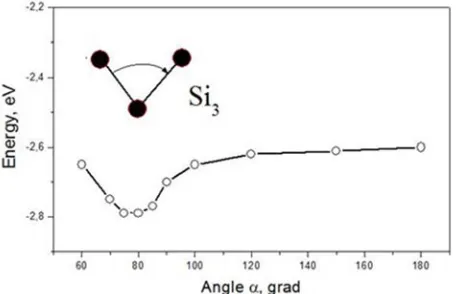
Figure 2. Dependence of the energy of the Si3 cluster on the angle between
bonds.
Figure 2 presents dependence of the energy of the Si3 cluster on the angle between bonds. It demonstrates a minimum at the angle of 78º. For C3 a minimum was found at 180º (a linear chain), and for Al3 (where covalent bonds absent) all angles were found of 60º (an equilateral triangle).
Equilibrium values of interatomic distances, angles α, and binding energies for the trimers Al3, Si3, and C3 are collected in Table 4 in comparison with known data and results of Kohn-Sham calculations. Parameter C of 25000 was used for silicon and carbon clusters; for aluminum C was equal zero.
Table 4. Equilibrium distances d, angles α and binding energies Eb (absolute
values, per atom) for Si3, Al3 and C3 in comparison with known calculated
data.
Trimer Source of data α, deg d, Å Eb, eV
Si3
OF method 78 2.27 2.8
Other calculations
77.8 [18] 78.10 [26] 79.6[28]
2.26 [19] 2.177 [26]
2.51 [19] 2.93 [27]
KS 79 2.17 3.48
Al3
OF method 60 2.5 1.6
Other calculations 60 [22] 60[29]
2.50 [22] 2.55 [29]
1.96 [22] 1.74 [21]
KS 60 2.48 1.69
С3
OF method 180 1.27 5.9 Other calculations 180 [30]
180 [23]
1.29 [30] 1.3 [23]
6.8 [30] 5.0 [24]
KS 180 1.25 6.78
Notations: “KS” means the calculations used the FHI96md package [17] based on the Kohn-Sham method.
To experience the OF approach for ability to describe correctly three-dimensional systems we investigated four-atomic clusters Si4, Al4 and С4 with structures of straight lines, rhombuses, and trigonal pyramids. It is known that the Si4 cluster is built in the form of a rhombus [18, 19]; and four carbon atoms form a straight linear chain [23, 24]. As for aluminum, there is no consensus [21, 22, 31]. Some authors claim that the most favorable configuration is rhombus, others favor pyramid. What gives our method?
Our Calculations show that for the four-atomic cluster the most favorable configuration is the linear chain with the interatomic distance of 1.27 Å and the binding energy of 6.3 eV per atom. The Kohn-Sham results are 1.30 Å and 6.76 eV. It had been found that the rhombus configuration is favorable for the Si4 cluster with the interatomic distance of 2.35 Å and the binding energy of 2.7 eV (the gain is 0.7 eV in comparison with a pyramid). The Kohn-Sham results are 2.32 Å and 4.1 eV (the gain is 0.6 eV).
In the Al case our calculations demonstrate benefit of the pyramid; however the difference with the rhombic configuration is only 0.2 eV per atom. The Kohn-Sham method yields the opposite results: 0.13 eV in favor of a rhombus.
3. Conclusions
dimers were found in good comparison with other data. Restriction principle for the interatomic density (following from Paulie's principle) allows us to describe angular dependences of the interatomic bonding in polyatomic clusters. In particular, it had been shown that for the Al3 cluster the equilateral triangle is favorable; the Si3 trimer is characterized by the isosceles triangle with angles of 80 and 50 degrees, and three atoms of carbon built the linear chain. Calculated equilibrium interatomic distances and the values of binding energy are well compared with known data.
As calculation of kinetic energy and interbonding angles are key points in modeling of polyatomic systems in the orbital-free approach, it is possible to consider that this work opens a direct way to design an effective method of modeling of complicated nanosystems and supermolecules with a high number of atoms.
References
[1] Hohenbeg H., Kohn W. Inhomogeneous electron gas, Physical Review, 1964, 136, B864-B871.
[2] Kohn W., Sham J. L. Self-consistent equations including exchange and correlation effects. Physical Review 1965, 140, A1133-A1138.
[3] Hung L., Carter E. A. Accurate simulations of metals at the mesoscale: Explicit treatment of 1 million atoms with quantum mechanics. Chemical Physics Letters, 2009, 475, 163-170.
[4] Wang Y. A., Carter E. A. Orbital-free kinetic-energy density functional theory. In: Progress in Theoretical Chemistry and Physics. Kluwer, Dordrecht. 2000, 117 p.
[5] Huajie Chen, Aihui Zhou. Orbital-free density functional theory for molecular structure calculations. Numerical Mathematics: Theory, Methods and Applications, 2008, 1, 1-28.
[6] Baojing Zhou, Ligneres V. L., Carter E. A. Improving the orbital-free density functional theory description of covalent materials. Journal Chemical Physics, 2005, 122, 044103-044113.
[7] Karasiev V. V., Trickey S. B. Issues and challenges in orbital-free density functional calculations. Computational Physics Communications, 2012, 183, 2519-2527.
[8] Karasiev V. V., Chakraborty D., Shukruto O. A., Trickey S. B. Nonempirical generalized gradient approximation free-energy functional for orbital-free simulations. Physical Review B, 88, 161108-161113(R).
[9] Wesolowski T. A. Approximating the kinetic energy functional Ts[ρ]: lessons from four-electron systems. Molecular Physics, 2005, 103, 1165-1167.
[10] Junchao Xia, Chen Huang, Ilgyou Shin, Carter E. A. Can orbital-free density functional theory simulate molecules? The Journal of Chemical Physics, 2012, 136, 084102(13).
[11] Lehtomäki J., Makkonen I., Caro M. A., Harju A. and Lopez-Acevedo O. (2014) Orbital-free density functional theory implementation with the projector augmented wave method. Journal of Chemical Physics, 141 234102(7).
[12] Zavodinsky V. G., Gorkusha O. A. Quantum-mechanical modeling without wave functions. Physics of the Solid States, 2014, 56(11), 2329-2335.
[13] Zavodinsky V. G., Gorkusha O. A. New orbital-free Approach for density functional modeling of large molecules and nanoparticles. Modeling and Numerical Simulation of Material Science, 2015, 5, 39-46.
[14] Fuchs M., Scheffler M. Ab initio pseudopotentials for electronic structure calculations of poly-atomic systems using density-functional theory, Computational Physics Communications, 1999, 119, 67-98.
[15] Perdew J. P., Zunger A. Self-interaction correction to density functional approximation for many-electron systems, Physical Review B, 1981, 23, 5048-5079.
[16] Ceperley D. M., Alder B. J. Ground state of the electron gas by a stochastic method, Physical Review Letters, 1980, 45. 566-569.
[17] Beckstedte M., Kley A., Neugebauer J., Scheffler M. Density functional theory calculations for poly-atomic systems: electronic structure, static and elastic properties and ab initio molecular dynamics. Computational Physics Communications, 1997, 107, 187-205.
[18] Raghavachari K., Logovinsky V. Structure and bonding in small silicon clusters. Physical Review Letters 1985, 55, 2853-2856.
[19] Mukhtarov A. P., Normurodov A. B., Sulaymonov N. T., Umarova F. T. Charge states of bare silicon clusters up to Si8 by non-conventional tight-binding method. Journal of nano- and electronic physics, 2015, 7, 01012(7).
[20] Nayak S. K., Khanna S. N., Jena P. J. Evolution of bonding in AlnN clusters: A transition from nonmetallic to metallic character. Physical Review B, 1998, 57, 3787-3790.
[21] Feng-Chuan Chuang, Wang C. Z., Ho K. H. Structure of neutral aluminum clusters Aln (2≤n≤23): Genetic algorithm tight-binding calculations. Physical Review B, 2006, 73, 125431(7).
[22] Matrínez A., Vela A. Stability of charged aluminum clusters. Physical Review B, 1994, 49, 17464(4).
[23] Karton A., Tarnopolsky A., Martin J. M. L. Atomization energies of the carbon clusters Cn (n=2-10) revisited by means of W4 theory as well as density functional, Gn, and CBS methods. International Journal of Interface between Chemistry and Physics, 2009, 107, 977-1003.
[24] Mahdi Afshar, Mahboobeh Babaei, Amir Hossein Kordbacheh. First principles study on structural and magnetic properties of small and pure carbon clusters (Cn, n = 2–12). Journal of Theoretical and Applied Physics, 2014, 8, 103-108. [25] Tomanek D., Schluter M. A. Structure and bonding of small
semiconductor clusters. Phys. Rev. B, 1987 36, 1208-1217. [26] McCarthy M. C., Thaddeus P. Rotational spectrum and
structure of Si3. Physical Review Letters, 2003, 90, 213003(4).
[28] Raghavachari K., Rohlfing C. M. Bonding and stabilities of small silicon clusters: A theoretical study of Si7–Si10. Journal of Chemical Physics, 1988, 89, 2219-2234.
[29] Tse J. S. Electronic structure of the dimer and trimer of aluminum. Theoretical Chemistry (Journal of Molecular Structures), 1988, 165, 21-24.
[30] Van Orden A., Saykally R. J. Small carbon clusters: spectroscopy, structure, and energetics. Chemical Review, 1998, 98, 2313-2357.
[31] G. Herzberg, Spectra of Diatomic Molecules (Van Nostrand, New York, 1950).
[32] X. L. Zhu, X. C. Zeng, Structures and stabilities of small silicon clusters: Ab initiomolecular-orbital calculations of Si7–Si11. J. Chem. Phys. 2003, 118, 3558.
[33] K. P. Huber and G. Herzberg. Molecular Spectra and Molecular Structure. IV. Constants of Diatomic Molecules (Reinhold, New York, 1979).