International Journal of Scientific Research and Engineering Development-– Volume 2 Issue 1, Mar-Apr 2019 Available at www.ijsred.com
ISSN: 2581-7175 ©IJSRED: All Rights are Reserved Page 40
Review on solution of Short Term Hydrothermal Scheduling
Problem by Using Flower Pollination Algorithm and Particle
Swarm Optimization Algorithm
1Jagjeet Singh,
2Er. Ravinder Kumar
1M.Tech (EE) , 2A.P (EE)
AIET Faridkot
---
************************
---Abstract:
Operation of a system having both hydro and thermal plants is more complicated than the hydro plants which have negligible operating cost but are required to operate under constraints of water available for hydro generation in a given span of time. The main objective of the Hydrothermal Scheduling (HTS) is to minimize the fuel cost of thermal plants with consideration of water availability of hydro plants and various other constraints over a given period of operation. Previously, a wide variety of optimization techniques have applied to solve the Hydrothermal scheduling problems such as simulated annealing (SA), dynamic programming (DP), gradient search differential evolution, evolutionary programming (EP), genetic algorithm (GA), but these methods has drawbacks such as large computation time, algorithm complexity etc. Now we applied particle swarm optimization and flower pollination algorithm to solve particular problem.
Keywords: Overview, Thermal and Hydro Generation, Hydrothermal Scheduling, Need of Hydrothermal Scheduling, Particle swarm optimization, Flower Pollination Algorithm, Objective Function/Cost Function.
---
************************
---1.1 Overview
Electric power plays a major role in modern society and in the development of various sectors of economy. This trend has led to increase in number of power stations, increase in number of transmission lines, expansion of existing power stations, development of new power stations and many other additions to power system. Even today, major portion of energy required for the world is supplied by fossil-fired units and hence the pollution caused by them is a matter of apprehension. Hence, in order to meet the future demand, immediate attention is to be paid to energy production from hydro, fossil and nuclear resources in the best possible technical, environmental and economic conditions. In the present set-up of large power systems with mainly hydro and thermal (hydro-thermal) system, the integrated operation of them is inevitable with due consideration to economic and environmental aspects. A hydro plant has higher reliability, greater speed of response and can take up fluctuating loads. Since the operating cost of a thermal plant is high but its capital cost is low and the operating cost of a hydro plant is low but its capital cost is high, hence it is economical and convenient to have both thermal and hydro plants on the same grid. Optimum scheduling of hydrothermal plants is more important due to its economical aspect in interconnected power system operation. The main aim of hydrothermal scheduling problem is to minimize the fuel cost of thermal plants as the operating cost of hydro plants is negligible. Thus, the problem of minimizing the operating cost of a hydrothermal system is to minimize the fuel cost of thermal plants subjected to various equality and inequality constraints offered by the operation of power system network. The stochastic nature of water’s availability and limited energy storing capacity of water reservoirs makes the solution more difficult for hydrothermal systems as compared to pure thermal systems [1].
International Journal of Scientific Research and Engineering Development-– Volume 2 Issue 1, Mar-Apr 2019 Available at www.ijsred.com
ISSN: 2581-7175 ©IJSRED: All Rights are Reserved Page 41
1.2 Thermal and Hydro Generation
Thermal power plants convert energy of fuels such as coal, petroleum products, domestic trash/waste, natural gas, agricultural waste, etc. into electricity. Other sources of fuel include biogases and landfill gas. Lignite and coal accounted for about 60% of India's total installed capacity. India's electricity sector consumes nearly about 72% of the coal produced in the whole country. India gestate its projected rapid growth in electricity generation ended the next couple of decades to be largely met by thermal power systems. The operating coal fired power stations required to invest nearly INR 12.5 million per MW capacity for installing pollution control equipment to fulfill the requirement of the latest emission norms notified by the Ministry of Environment and Forests in the year 2016. A large part of Indian coal reserve is similar to Gondwana coal. It is of low calorific value and high ash content. The central and state power generation companies are permitted by Government Of India with flexible coal linkage switch from inefficient plants to efficient plants and from plants situated away from coal mines to pit head to minimize the cost of coal transportation thus leading to decrease in cost of power. The central government has planned to shut down 11,000 MW of thermal power generation capacity that are at least 25 years old and replace with bigger size plants with super critical pressure technology totaling to at least 20,000 MW with the coal being consumed currently by these old and small units. India is the 7th largest hydroelectric power producer in the world.
1.3 Hydrothermal Scheduling
The hydrothermal scheduling is to meet the given load demand for the specified time horizon. The optimal scheduling of hydrothermal plant comprises generation of power from hydro as well as thermal plants so as to minimize the total fuel cost of thermal plant. Thus the scheduling problem can be solved by minimizing the fuel cost of thermal plant while considering the various hydro as well as thermal plant constraints. The main constraints of problem include: cascaded nature of the hydraulic network, the varying hourly reservoir inflows, turbine flow rate, the time coupling effect of the hydro sub problem where the water inflow of an earlier time interval affects the discharge capability at a later period of time, physical limitations on the reservoir storage the varying system load demand and the loading limits of both hydro and thermal plants [6] [7].
1.4 Need of Hydrothermal Scheduling
The idea of hydrothermal coordination is to utilize all energy resources in most economic and efficient manner. The scheduling of hydroelectric plant is more complex than the scheduling of thermal plants. The hydroelectric plants are associated with the water discharge (i.e. water outflow from one plant is the water inflow for one or more downstream plant) from one reservoir to other and plays very significant role for the optimal power generation. It is vital to use the amount of water available by water reservoirs of hydro systems to full extent in hydrothermal integration. In hydro system, there is no fuel cost associated with power generated i.e. the charges are fixed for hydropower regardless of the amount generated. In hydrothermal systems the optimal cost is achieved by utilizing the available water resources for a given time horizon and run the hydro generation units according to the forecasted load demand so that the fuel cost for thermal generation is minimized.
1.5 Particle swarm optimization
International Journal of Scientific Research and Engineering Development
ISSN: 2581-7175 ©IJSRED: All Rights are Reserved
programming. It is found that convergence characteristi
term of computation time and cost [3]. To maintain the diversity of population [4]. In multi objective Hydrothermal scheduling using PSO short
recognition of uncertainties in production cost, CO2, SO2 and NO2 technique provides efficient solution [8].
1.6 Flower Pollination Algorithm
In this technique various constraints like power balance constraints, r
discharge constraints, hydro and thermal generation limits are taken into consideration
operation capacity limits of thermal and hydro plant is considered. The main objective of hydrothermal scheduling is to minimize the total fuel cost of thermal plants with consideration of all the constraints and meet the load demand. Reservoir volume constraints and the inequality constraints in langrage multiplier techniques have more difficulties to calculate the sc
met heuristic technique which is used to solve the optimization problem. This technique is based on the pollination process in flowering plants. This technique is applied on
as thermal scheduling problem and results obtained are found to be better in comparison to GA in case of hydrothermal scheduling and PSO in case of thermal scheduling.
1.7 Objective Function/Cost Function
In the practical power system, it is expected to have losses inside the generator as the generator is placed at a location which has high fuel cost. For example, if the generator is situated at a location which is far away from the load then we may consider that the transmission loss will be
That’s why the fuel cost has to be considered as one of the most important part in the economic load dispatch problem compared to other factors [6
Figure
The fuel cost can be written in the form of quadratic equation as:
Where,
Ai; bi; ci Cost coefficients for the ith generator Ci Cost of generation
Pi Generation power of ith generator
International Journal of Scientific Research and Engineering Development-– Volume 2 Issue 1 Available
©IJSRED: All Rights are Reserved
programming. It is found that convergence characteristics of this technique are excellent and superior in ]. To maintain the diversity of population local version of PSO is used ]. In multi objective Hydrothermal scheduling using PSO short-range fixed head is consider with
roduction cost, CO2, SO2 and NO2 emissions and load demand. This ].
In this technique various constraints like power balance constraints, reservoir volume limit, and total water discharge constraints, hydro and thermal generation limits are taken into consideration
operation capacity limits of thermal and hydro plant is considered. The main objective of hydrothermal s to minimize the total fuel cost of thermal plants with consideration of all the constraints and meet the load demand. Reservoir volume constraints and the inequality constraints in langrage multiplier techniques have more difficulties to calculate the schedules and require some special process. FPA is a new met heuristic technique which is used to solve the optimization problem. This technique is based on the pollination process in flowering plants. This technique is applied on the short term hydrothermal
as thermal scheduling problem and results obtained are found to be better in comparison to GA in case of O in case of thermal scheduling.
expected to have losses inside the generator as the generator is placed at a location which has high fuel cost. For example, if the generator is situated at a location which is far away from the load then we may consider that the transmission loss will be significantly affecting the fuel cost. That’s why the fuel cost has to be considered as one of the most important part in the economic load
lem compared to other factors [6]. The incremental fuel cost as shown in fig. 1.1.
Figure 1.1(Incremental Fuel Cost Curve)
The fuel cost can be written in the form of quadratic equation as:
(1.1)
(1.2)
Cost coefficients for the ith generator
generator
2 Issue 1, Mar-Apr 2019
Available at www.ijsred.com
Page 42
cs of this technique are excellent and superior in local version of PSO is used range fixed head is consider with explicit emissions and load demand. This
eservoir volume limit, and total water discharge constraints, hydro and thermal generation limits are taken into consideration. The relative operation capacity limits of thermal and hydro plant is considered. The main objective of hydrothermal s to minimize the total fuel cost of thermal plants with consideration of all the constraints and meet the load demand. Reservoir volume constraints and the inequality constraints in langrage multiplier hedules and require some special process. FPA is a new met heuristic technique which is used to solve the optimization problem. This technique is based on the the short term hydrothermal [2] as well as thermal scheduling problem and results obtained are found to be better in comparison to GA in case of
expected to have losses inside the generator as the generator is placed at a location which has high fuel cost. For example, if the generator is situated at a location which is far away significantly affecting the fuel cost. That’s why the fuel cost has to be considered as one of the most important part in the economic load
International Journal of Scientific Research and Engineering Development
ISSN: 2581-7175 ©IJSRED: All Rights are Reserved
FC Total Fuel cost of generation
Figure 1.2 (Fuel Cost Curve)
1.7 Experimental Set Up
Objective min or max f(x), x = (x1,x2,...,xn) or f(x1, x2, x3…….xn) Initialize a population of n flowers/pollen gametes with random solutions
Find the best solution g∗ in the initial population (best value is the minimum value among all the solutions). Generated random number for switch probability p
For i = 1: n (all n flowers in the population) If rand < p,
Draw a (d- dimensional) step vector L which obeys a (xi)t + L(g∗ -(xi)t
Else
Draw € from a uniform distribution in [0,1] Randomly choose j and k among all the solutions Do local pollination via (xi) t+1= (xi)t +
End if
Evaluate new solutions
If new solutions are better, update them in the population end for Find the current best solution g∗
End for
Power balance equation
The total active power generation must balance the predicted power interval over the scheduling horizon i.e.
∑Psti(t) –PL(t) –PD(t) =0
Where PL (t) is total transmission losses at time t, PD(t) is total load
generation capacity. The generators have its own minimum and maximum limits as: Pstimin≤ Psti(t) ≤ Pstimax
Where;
N = number of thermal unit
Psti(t)= output power of thermal unit i at time t. ai, bi, ci are cost curve coefficients of thermal unit i. PL(t) = total transmission losses
PD (t) = total load demand.
Pstimax = lower and upper generation limit for thermal unit i. t =no. of hours during the study period.
International Journal of Scientific Research and Engineering Development-– Volume 2 Issue 1 Available
©IJSRED: All Rights are Reserved
Total Fuel cost of generation.
Figure 1.2 (Fuel Cost Curve)
Objective min or max f(x), x = (x1,x2,...,xn) or f(x1, x2, x3…….xn) Initialize a population of n flowers/pollen gametes with random solutions
in the initial population (best value is the minimum value among all the solutions). random number for switch probability p∈ [0,1] fort= 1: no. of hours or no. of intervals
For i = 1: n (all n flowers in the population)
dimensional) step vector L which obeys a Levy distribution Do Global pollination via (xi) t+1=
from a uniform distribution in [0,1] Randomly choose j and k among all the solutions
= (xi)t + €((xj)t − (xk)t
If new solutions are better, update them in the population end for
The total active power generation must balance the predicted power demand plus losses, at each time
Where PL (t) is total transmission losses at time t, PD(t) is total load demand at the time t. The generators have its own minimum and maximum limits as:-
Psti(t)= output power of thermal unit i at time t. coefficients of thermal unit i.
Pstimax = lower and upper generation limit for thermal unit i.
2 Issue 1, Mar-Apr 2019
Available at www.ijsred.com
Page 43
in the initial population (best value is the minimum value among all the solutions). [0,1] fort= 1: no. of hours or no. of intervals
evy distribution Do Global pollination via (xi) t+1=
demand plus losses, at each time
International Journal of Scientific Research and Engineering Development
ISSN: 2581-7175 ©IJSRED: All Rights are Reserved
1.8 Results
The FPA technique is used to solve the
of 3 thermal generator units and 6 thermal generator units [5
Case 1: 3 Unit Systems
The thermal generators minimum and maximum limits along with the cost curve coefficients of 3 units are shown in Table 5.1 are taken from [5
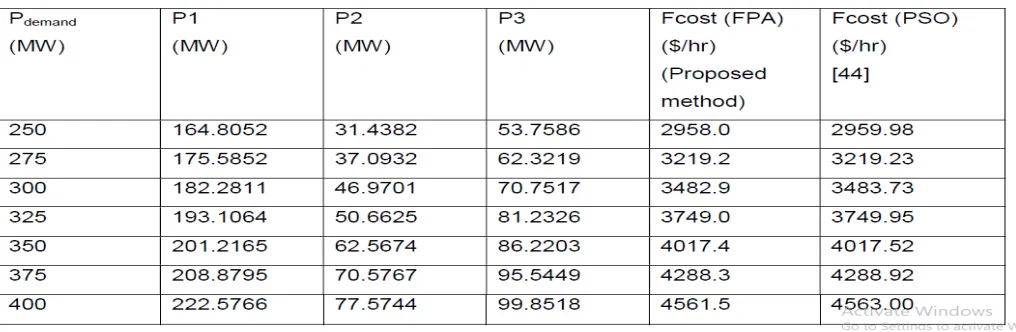
The results obtained using the FPA technique without considering the transmission losses are shown in Table-5.2. The results are calculated at different load demand ranging from 250MW to 400M.
Case -2: 6-units system
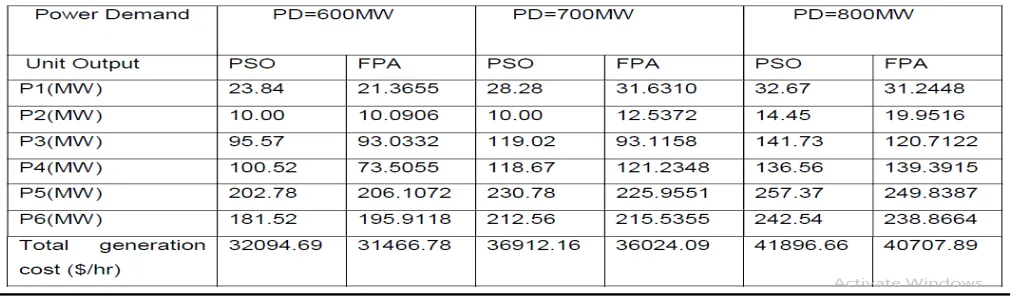
Here an IEEE 30 bus system with 6 generating units system is used to check the effectiveness of the proposed FPA technique. All the inputs i.e. cost coefficients of all thermal units and minimum and maximum power generation limits as shown
The results obtained are shown in Table
that the proposed FPA is effective in reducing the o equality and inequality constraints.
Below table with load demand of 600MW, 700MW and 800MW. It is found that the proposed FPA is effective in reducing the operating cost of thermal plants while satisfying all the equality and inequality constraints.
Table 5.2 Best Power Output for 3
International Journal of Scientific Research and Engineering Development-– Volume 2 Issue 1 Available
©IJSRED: All Rights are Reserved
The FPA technique is used to solve the economic load dispatch problem considering a test system consists nd 6 thermal generator units [5].
The thermal generators minimum and maximum limits along with the cost curve coefficients of 3 n Table 5.1 are taken from [5].
The results obtained using the FPA technique without considering the transmission losses are shown in 5.2. The results are calculated at different load demand ranging from 250MW to 400M.
Here an IEEE 30 bus system with 6 generating units system is used to check the effectiveness of the proposed FPA technique. All the inputs i.e. cost coefficients of all thermal units and minimum and
shown in Table-5.3 are taken from [5].
The results obtained are shown in Table-5.4 with load demand of 600MW, 700MW and 800MW.It is found that the proposed FPA is effective in reducing the operating cost of thermal plants while satisfying all the
with load demand of 600MW, 700MW and 800MW. It is found that the proposed FPA is effective in reducing the operating cost of thermal plants while satisfying all the equality and inequality
Best Power Output for 3-Unit system (without consideration of transmission loss)
2 Issue 1, Mar-Apr 2019
Available at www.ijsred.com
Page 44
economic load dispatch problem considering a test system consists
The thermal generators minimum and maximum limits along with the cost curve coefficients of 3 generating
The results obtained using the FPA technique without considering the transmission losses are shown in 5.2. The results are calculated at different load demand ranging from 250MW to 400M.
Here an IEEE 30 bus system with 6 generating units system is used to check the effectiveness of the proposed FPA technique. All the inputs i.e. cost coefficients of all thermal units and minimum and
5.4 with load demand of 600MW, 700MW and 800MW.It is found while satisfying all the
with load demand of 600MW, 700MW and 800MW. It is found that the proposed FPA is effective in reducing the operating cost of thermal plants while satisfying all the equality and inequality
International Journal of Scientific Research and Engineering Development
ISSN: 2581-7175 ©IJSRED: All Rights are Reserved
Table 5.3 (Generating unit capacity of six thermal units and their coefficients)
Table 5.4 (Best Power Output of 6 unit
Conclusion
In short term hydrothermal scheduling , the complexity is introduced by cascaded nature of the hydraulic network, nonlinear relationship among the hydro power generation, water transport delay time, varying hourly reservoir inflows, varying load demand and loading limits of both hydro and thermal power plants. These factors have made the system more complex and are difficult to solve with the help of conventional technique. So hybrid intelligence technique is used to solve this problem and ef
constraints. Flower Pollination Algorithm (FPA) technique provide better result as comparison GA. The test performed on one thermal and four cascaded hydro power plants with multi reservoir and scheduling horizon has been kept on twenty four hours with one hour time interval. Algorithm is applied for each and every time intervals and results are demonstrated.
International Journal of Scientific Research and Engineering Development-– Volume 2 Issue 1 Available
©IJSRED: All Rights are Reserved
Generating unit capacity of six thermal units and their coefficients)
Power Output of 6 unit-systems (without consideration of transmission loss
In short term hydrothermal scheduling , the complexity is introduced by cascaded nature of the hydraulic network, nonlinear relationship among the hydro power generation, water transport delay time, varying load demand and loading limits of both hydro and thermal power plants. These factors have made the system more complex and are difficult to solve with the help of conventional technique. So hybrid intelligence technique is used to solve this problem and effectively handling the Flower Pollination Algorithm (FPA) technique provide better result as comparison GA. The test performed on one thermal and four cascaded hydro power plants with multi reservoir and scheduling nty four hours with one hour time interval. Algorithm is applied for each and
are demonstrated.
2 Issue 1, Mar-Apr 2019
Available at www.ijsred.com
Page 45
Generating unit capacity of six thermal units and their coefficients)
systems (without consideration of transmission loss)
International Journal of Scientific Research and Engineering Development-– Volume 2 Issue 1, Mar-Apr 2019 Available at www.ijsred.com
ISSN: 2581-7175 ©IJSRED: All Rights are Reserved Page 46
REFERENCES
[1] E. Gil, J. Bustos, and H. Rudnick, “Short-term hydrothermal generation Scheduling model using a genetic algorithm” IEEE Transactions on power Systems, 18(4):1256–1264, 2003.
[2] Hari Mohan Dubey, B.K. Panigrahi, and Manjaree Pandit: “Improved Flower Pollination Algorithm for Short Term Hydrothermal Scheduling”Springer International Publishing Switzerland 2015.
[3] K. Iba, “Reactive power optimization by genetic algorithm,” IEEE Trans. Power Syst., vol. 9, pp. 685–692, May 1994.
[4] K. Y. Lee, X. Bai, and Y.-M. Park, “Optimization method for reactive power planning by using a modified simple genetic algorithm,” IEEE Trans. Power Syst., vol. 10, pp. 1843– 1850, Nov. 1995. [5] S. J. Wang, D. S. Kirschen, S. Mokhtari, G. D. Irisarri, “Short-Term Generation Scheduling with Transmission Constraints Using Augmented Lagrangian Relaxation,”IEEE trans on Power systems, vol 10, no 3, Aug 1995, pp.1294-1301.
[6] S.O. Orero and M.R. Irving, “A genetic algorithm modeling framework and solution technique for short-term optimal hydrothermal scheduling” IEEE transactions on power systems, vol. 13, no. 2, may 1998
[7] V.H. Hinojosa and C. Leyton, “Short-term hydrothermal generation scheduling solved with a mixed-binary evolutionary particle swarm optimizer”, Electrical Power Systems Research, 92:162– 170, 2012.
[8] Wong, K. P., & Wong, Y. W. (1994, September), “Short-term hydrothermal scheduling part. I.
Simulated annealing approach”, In Generation, Transmission and Distribution, IEEE Proceedings-