ISSN: 2306-9007 Heidarzadegan, Rowshan & Koochakzaei (2013) 893
Investigating the Level of Readiness for the Implementation of
Re-engineering in Education System
ALIREZA HEIDARZADEGAN
Assistant Professors, Faculty of Education and Psychology, University of Sistan and Baluchestan, Iran
Email: [email protected]
SEYED ALIGHOLI ROWSHAN
Assistant Professors, Faculty of Education and Psychology, University of Sistan and Baluchestan, Iran
MARYAM KOOCHAKZAEI
Master of Educational Management, University of Sistan and Baluchestan, Iran
Email: [email protected]
Abstract
The current study aims to investigate the level of readiness to implement re-engineering in education system of Sistan and Baluchestan province. It is a survey research whose target population is consisting of 299 staffs in general administration of education in Sistan and Baluchestan province. 169 employees were chosen among the staffs on the basis of Morgan table and random sampling. Required data were achieved based on three following questionnaires: 1) the questionnaire designed by Abdolrahman et al. (2008), mention should be made though that several changes were made and some questions added to it, 2) the organizational structure questionnaire designed by Frank (2006) and 3) author’s questionnaire which has been planned based on customer-oriented culture and information technology. The obtained data were analyzed by means of one-group T test and Friedman analysis of variance. Findings of the study indicated that education system of Sistan and Baluchesan province is averagely ready to implement re-engineering. Moreover, Friedman test’s results of ranking showed that information technology is the most important element, and supporter management is the least important one among infrastructural elements.
Key Words: Establishing re-engineering, successfully factors, Egalitarian leadership, Collaborative working environment, Management commitment, supportive management, Customer orientation culture, Resistance to change, Information Technology, Organizational structure.
Introduction
The education system is one of the largest and most complex social systems and today it is the corner-stone of the social, political and cultural development of every society (Safy, 2003). Analysis of effective factors in advanced society's development indicates that all these countries had capable and efficient education system(Sadri, 2001) as agust kont the father of sociology stated accordance with education system" Human development thoroughly Depends on a Proper Education Because Proper education can fosters a sense of mutual understanding among the people (quoted by Shaverdy, 1993) and also Adam Smith the known classic economist believes that: in fact individuals education is something like investment on them. Through education, people will be more capable and their susceptibility growth not only caused they earn more money, but also the community will be benefit in investment on them. According to Smith, education made people as asset and community can better benefit from their production ability (Emadzade, 1995,p6) and also Teodor Sholtez who is one of the most important current economist and the pioneer of human capital emphasized on importance and necessity of attention on human capital in economic analysis.
ISSN: 2306-9007 Heidarzadegan, Rowshan & Koochakzaei (2013) 894 Sholtez believed that individuals acquisitive abilities is the most importance source of efficiency growth and recent years economic development and education system as the most important investment on people is the most efficient role in society development increase(Emadzade, 1995,p16)
Then the education systems as development pioneer should be able to meet the needs of their time and consistent with international shifting conditions. But evidence indicates Iran's education system faced with many problems as it is necessary to make change in structure, plans, aims and methods. Our education system to meet the third millennium needs inevitably have to adapt to domestic and international shifting conditions (Tallebian & Tasdiqi,2006). One of the most important problems facing Iran's education system is its functional and mechanical structure. As Hassanpor( 2009) states the structural problems in the ministry of education not only causing enormous human and financial resources waste, but also sometimes causing deviation from goals and objectives of the education system. In other words, we can say inefficient and unnecessary structures with occupying education system capacity hinder the necessary structure making. Niknami (2002) emphasized that current structures and organizations have main problems especially in staffing and executing department which are inhibit the present of innovations in lower level and school and so hinder the efficient goals and educations ideals. And also figures of academic decline in recent years present that enormous part of the national capitals has been perished because of inefficient and incapability of recent structures whilst no one have accepted this problems both official and unofficial. Educational loss must be as a motivation in every extent not only in financial dimension but also in physical, human and time dimensions and of political viewpoint to desistance former methods and to proceed on new methods.
In such conditions the most importance approach to reform education system structure and performance and to restrain education loss and to increase effectiveness is systematical attention to education system and to choose an optimum way. To achieve this goal Reengineering is suitable method. Reengineering is organizational redesign and re start and root evaluation in organization's activities and another chance to remake organization structure and performance processes and methods (Kermanshah, Sepehry, 2006).This theory designer is Michael Hammer who proffered the basic concepts and dissidence organization to the management world in his article which was published in Harvard university publication in1999. According to this approach we should reappraisal the basis of activity and using IT science and specially databases to assemble distinct traditional parts and to prevent time and cost consuming among processes(Esmailpor and Ramzaninan, 2010) Maull Tranfield & Maull (2003) has introduced salient improvements in process cycle time, operating costs and stakeholders satisfaction as advantages of reengineering. Motwani, Subramanian & Gopalakrishna(2005) stated that reengineering leads to increase the effectiveness. They also believed that reengineering have removed all activities, reviews, stops and monitors which don’t have any role to meet stakeholders' needs. The Reengineering make clear understanding to organization of all its processes not just those that are required for the quality management system (Esmaiilpor et al, 2010).
Process
Output Input
Feed back
Feed back
Figure 1: Model of the educational system components
Education, management and organization
Graduates (those who have society's required knowledge, skills and values)
-New knowledge production
The result of output valuation (its function is system reformation and to maintain its dynamic . . Students, teacher
(Schoolmaster and personnel)
-Curriculum (book) -Equipment -the physical space -Budget
-Goals -Criteria
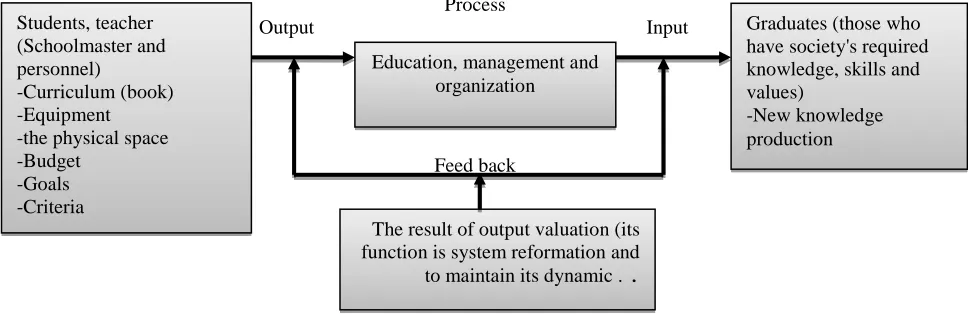
ISSN: 2306-9007 Heidarzadegan, Rowshan & Koochakzaei (2013) 895 However this approach is applicable when organization was ready to implement and change its stereotypical mechanisms. These changes includes decentralization, process redesigning, rules and methods set, manpower combining and in other term organization systematic structures (Rabie,2008) A strong and successful manager in addition to attention on system input should be most focused on improving organizational processes and to seek optimum methods. Figures1 shows the educational system components.
As has been shown in figure1 the approach of process oriented and systematic attitude corresponding to the traditional management based on input (input oriented) using each process input and output recognition make it possible to specify a position for that process in specific system and organizations and to clarify each elements interaction with others and at least with proper feedback to predispose staffs and organization improvement (Esmaiilpor et al, 2010) input oriented traditional attitude seek problems solution in system inputs. Whereas, process oriented and result oriented approach believes with quality assurance and along with its process and strategies improvement we can meet many expectations and needs. In traditional methods flaws will be finally distinguished in throughput valuation but due to students training who are the most importance society fund, it is too late to reform it in the end point. Maybe in products quality control we can find the defective products and aside them but is it a good way for growing mans? If a mistake or an error has been made in learning process and couldn’t be recognized and eliminated timely, it is not lead to society human capital loss? (Rabiei, 2008) then it is necessary to utilize reengineering advantages for performance improvement and efficiency increase and education effectiveness and to improve its function in society economic, social and cultural development. And also due to positive effects of reengineering usage in education, one of the most necessary steps is to create required substructure. So based on considered cases, this research is intended to assess the reengineering performance in the education system headquarter of the Sistandbalochestan province based on the presented conceptual model. If necessary, the results of this research provides the Department of Education of Sistan and Baluchistan with the opportunity to prevent possible damages from project failure caused by weakness in each of these factors.
Figure 2: Conceptual Model of the Research
I
Egalitarian leadership
Management commitment
supportive management
customer orientation culture
information technology
Resistance to change
organizational structure Collaborative working
environment
Re-engineering the Educational
System Department
of Education of Sistan and Baluchestan
ISSN: 2306-9007 Heidarzadegan, Rowshan & Koochakzaei (2013) 896 The Research theoretical basis
Egalitarian Leadership
One of the critical factors to success in reengineering projects is egalitarian leadership which is includes: shared vision/ information, open communication, creating trust in subordinates and Constructive use of subordinates' idea ( Abdolvand, Albadvi & Ferdowsi, 2008; Lee, 1995 ; Motwani et al ,2005 ). Grant (2002) and Tatsiopoulos & Panayiotou (2000) believe that managers should pave the way for organization changing by presenting information and perspective to staffs. Thus, they should establish channels for staffs' communications and prepare the ground for better interaction among staffs (Grant, 2002) the effective communications help managers to know better about organization potential problems (Ferris el al, 2008) and also make an environment full of trust and confidence and increase staffs participation in changing process. Figure 3 summarize the relationship between egalitarian leadership dimensions and the education system reengineering.
Re-engineering
the Educational
System Shared
vision/ informati
on
Creating trust in subordin ates Open
commu nication
Construct ive use of subordina
tes' idea Egalitarian
leadership
Figure3 the relationship between egalitarian leadership dimensions and the education system reengineering
Collaborative Working Environment
Crowe, Fong & Zayas-Castro (2002) states the collaborative working environment is one of the critical success factor in reengineering projects.
As staffs have adequate understanding about performance procedure and touch problems tangibly, then their participation may leads to present the innovative ideas about process new designing and performance procedures and to decrease their stability against changes and tend them to accept changes (Iisakhani & Mirqaderi, 2005).
So to activities' reengineering and especially the correlation activities, we should establish the working groups which their members to work correlatively with each other and to manage by a senior manager. In fact, as using group work you may decrease analyzing process costs and time, and enjoy staffs' viewpoints and different levels engaging, group work has been considered as one of the key factors to success in reengineering ( quoted by :Ferdowsi, Abdolvand & Albadvi, 2007).
Figure4 summarizes the relationship between the collaborative working environment dimensions and the education system reengineering.
ISSN: 2306-9007 Heidarzadegan, Rowshan & Koochakzaei (2013) 897
Collaborative working environment
Friendly interactions
Confidence and trust
Teamwork
Cooperative environment
Re-engineering the Educational
System
Figure 4 : the relationship between collaborative working environment dimensions and the education system reengineering
Management commitment
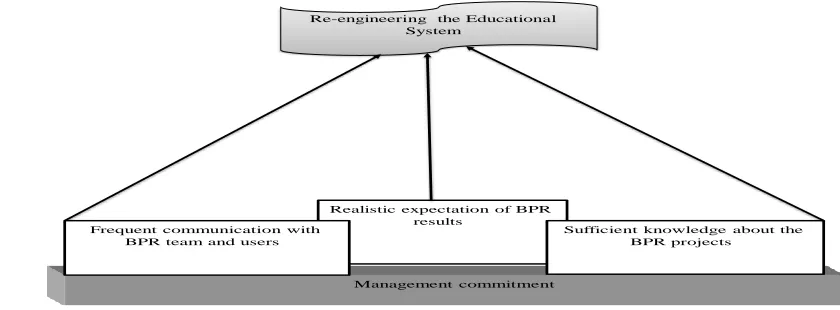
Management capability and commitment is a major factor in reengineering success (Jaafari & Akhavan, 2002) Management as the organizational first water in credits allocation and macroeconomic policies plays a main role in organizational changes success (Shadmehry, Jahanpor & Tabrizian, 2009) As reengineering make a tremendous evolutions, its results may deeply turn activities and old and longtime working relations. In order to withstand on such changes, an organization required that staffs finds management as well as guides them in the right direction, has been seriously support them. Mangers may support organization reengineering through project commitment, and allocating time and the best personnel and the necessary resources (time and budget) (Nasery & Birjandi Fariz, 2010) Doubtless manager's failure to justify the advantages and reengineering profits may leads to his non-supporting of project and then it is one of the fiasco factors (Shadmehry et al, 2009) Figure 5summarizes the relationship between management commitment and the education system reengineering.
Management commitment Realistic expectation of BPR
results
Sufficient knowledge about the BPR projects
Re-engineering the Educational System
Frequent communication with BPR team and users
Figure 5 : the relationship between management commitment dimensions and the education system reengineering
ISSN: 2306-9007 Heidarzadegan, Rowshan & Koochakzaei (2013) 898 Supportive management
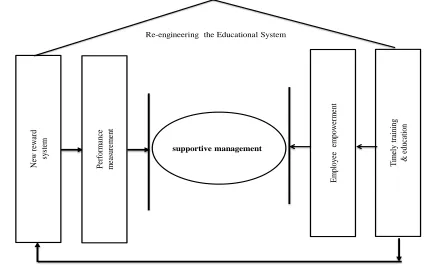
The other necessary factors to successful reengineering performance is the supportive management which indicates changes in the human resources structure to support organization information sharing and decision making improvement ( Mansar, Marir & Reijers, 2003; Vakola & Rezgui, 2000) Abdolvand et al (2008) new reward system , performance measurement , employee empowerment and timely training & education as the most importance aspects of the supportive management. As reengineering meanwhile the required decisions adoption to perfume the project is relegated to lower level, the group capability making and also all individuals to success the reengineering efforts is the critical factor (Bashein, Markus, & Riley, 1994) because this lead to a culture which is all staffs in all levels will have more responsibility and to improve self-management and teamwork. The performance valuation as the other parts of supportive management needs to change for successful reengineering performance. In the performance valuation reengineering about payments, must focus on results rather than activities and criteria must change from performance to ability (Hamer & Champi, 2000).Another aspects of the supportive management is needed to be changed is reward system. To perform reengineering the reward system must rewarded staffs for the organization adding value which is developed by staffs. In addition, in the reengineering projects the empirical payment methods must be boldly and sagaciously to be as a management tool to boost the changes (Mohaqar & Shafiqzade, 2010) the other dimension of the supportive management is to organize the educational courses that the most of researcher enumerates it as the important factor to perform the successful reengineering project (Bashein & et al, 1994; Dawe, 1996). The related concepts of reengineering and required skills, process analysis technics and TQM skills performance, all are the important dimensions for required educations to reengineering (Dixon, Arnold, Heineke, Kim & Mulligan, 1994). It is also necessary to provide Figure 6 summarizes the relationship between the supportive management dimensions and the education system reengineering.
Ne
w
re
wa
rd
sy
stem
T
im
ely
tr
ai
ning
&
edu
ca
ti
on
supportive management
Re-engineering the Educational System
P
er
for
m
an
ce
m
ea
su
re
m
en
t
E
m
pl
oy
ee
em
powe
rm
en
t
Figure 6 : the relationship between supportive management dimensions and the education system reengineering
ISSN: 2306-9007 Heidarzadegan, Rowshan & Koochakzaei (2013) 899 Customer orientation culture
Reengineering will achieve the expected results only when it is customer oriented (Sepehri & Ekhlasi, 2007). The concept of customer orientation is the most important part of the process of reengineering. Moreover, reengineering tries to bring the employees closer to the customers in a way that only the employees increase the effectiveness of this process (Notash, 2002). According to Escher, the goal of reengineering is to find new methods to create added value for the customer. Without focusing on customers, organizational costs increase significantly. Hall et al believe that reengineering should be focused on areas that have the most severe impact on cost and customer value so that the reengineering of processes is successful (Shahabi Kargar, 2009).
Resistance to change
The reengineering tends to establish a new organization and not to reform, modify and improve the existing situation. To achieve this aim we need the organization humanpower cooperation as the most effective elements (Khon siavush, mohamadi, 2009) usually individuals resists against changes for the reasons such as: the risk of job security loss, loss of power, lack of knowledge or required skills and uncertainty about the project results. Many researchers considered such resistance as the most importance factors of open reengineering projects failure, such as: Stanton Hammer & Power, 1992; Venkatraman, 1994; Bashien et al, 1994 and Dawe, 1996. Then to check and prevent barriers to open performance of processes engineering is necessary to be ensured of its successful performance. Figure 7 summarizes the relationship between the resistance dimensions against changes and the education system reengineering.
danger of losing job security
loss of power
skill or knowledge requirement
Resistance to change skepticism
about results Re-engineering the
Educational System
Figure 7 : the relationship between resistance to change dimensions and the education system reengineering
Information Technology
Information technology (IT) has always been considered as an important element in reengineering projects .It plays a continuous and important role in reengineering projects( Attaran , 2003 ). Many researchers expressed that the use of IT is effective in the success of reengineering projects and ignorance of it will be followed by failure (Gunasekaran & Kobu , 2002 ; Shin & Jemella , 2002 ; Motwani et al , 2005 ) . IT covers several areas including hardware, information systems and communication technologies through which the required information is available to people( Al-Mashari & Zairi , 2000 ). IT will cause to improve the effectiveness through integration of human activities, businesses and organizations ( Mansar, et al,2003 ) .
ISSN: 2306-9007 Heidarzadegan, Rowshan & Koochakzaei (2013) 900 Organizational structure
Dubrin & Porter (1990) define organizational structure as “the framework of relations, duties and authorities among the various units of the organization”. Also Bird ,Edga ,& James (1990) define organizational structure as “the series of specific relations between each unit, sections and the managers of an organization including the specific responsibilities of each unit and section”. Research literature shows that the organizational structure variable inhibits or encourages organizational change and concentration, formality and the hierarchy of authority are its key and infrastructural variables. Different combinations of these dimensions create different organizations. The formality dimension is related to the official laws and regulations governing decisions and working relations (Gold, Malhotra, & Segars, 2001). If the degree of formality is high in the organization, the employees’ decision making and innovation will decrease. As a matter of fact, the employees of formal organizations should take actions in the framework of what has been formulated (Najaf Beygi, 2007: 152). Some believe that flexibility and less emphasis on working regulations develops the formation, transfer and deployment of ideas (Damanpour, 1991) and increased flexibility in the organizational structure can contribute to the success of reengineering. Employee behavior can be relatively unplanned when formality is low. In this case, the employees have more discretion in applying their opinions (Jamshidi, 2008). The idea of overlooking obsolete laws and regulations exists in the heart of reengineering. As long as we don’t change these regulations, we have merely rearranged the seats in RMS Titanic while it is sinking. As a matter of fact, reengineering is like housecleaning for the regulations (Mousavi Doust, 2002). The implementation of reengineering is connected to decision making authority in the organization in the concentration dimension.
In concentrated organizations, senior managers and those at the helm of the organization have the authority to make decisions. They are completely in charge in most organizations (Daft, 2006: 187). Reengineering requires empowerment of the lowers, meaning granting lower level employees who are closer to the customers the permission to make decisions and breaking the traditional power structure (Kermanshah & Sepehri, 2006). The next dimension is the hierarchy of authority. The controlling and monitoring domain of each manager is determined by the hierarchy of authority. When the manager has a limited controlling domain, the hierarchy of authority is longer in the organizational chart and when he has an extensive controlling domain, the hierarchy of authority is shorter (Akhavan, 2004).
Research questions
In this study, we have addressed this question that whether the Education Department of Sistan and Baluchestan province is well prepared for implementing a business process re-engineering? This question is discussed in the following sub-questions:
1- Does the Egalitarian leadership factor for the implementation of re engineering in the general office of Department of Education in Sistan and Baluchestan Province experience an optimal status?
2- Does the Collaborative working environment factor for the implementation of re engineering in the general office of Department of Education in Sistan and Baluchestan Province experience an optimal status?
3- Is the level of organization’s management commitment for the implementation of re-engineering in the general office of Department of Education in Sistan and Baluchestan Province in a good situation? 4- Is the supportive management factor for implementation of reengineering in the general office of
Department of Education in Sistan and Baluchestan Province in a good situation?
5- Does the customer orientation culture factor for the implementation of re engineering in the general office of Department of Education in Sistan and Baluchestan Province experience an optimal status? 6- Does the Information Technologyfactor for the implementation of re engineering in the general office of
Department of Education in Sistan and Baluchestan Province experience an optimal status?
7- Is the level of Resistance to change for the implementation of re-engineering in the general office of Department of Education in Sistan and Baluchestan Province in a good situation?
8- Does the organizational structure factor for the implementation of re engineering in the general office of Department of Education in Sistan and Baluchestan Province experience an optimal status?
ISSN: 2306-9007 Heidarzadegan, Rowshan & Koochakzaei (2013) 901 9- Are there any significant differences regarding the possibility of re-engineering establishment in the general office of Department of Education in Sistan and Baluchestan Province in terms of eight aspects, including Egalitarian leadership, Collaborative working environment, management commitment, supportive management, customer orientation culture, information technology, Resistance to change and organizational structure?
Research methodology
The current research is an applied study. Due to the nature of topic and the research objectives, a descriptive - surveying research methodology was used. The research statistical population consisted of all staff employees of the general office of Department of Education in Sistan and Baluchestan Province that were 299 people. Random simple sampling was used in this study. The sample size was estimated as 169 subjects based on Morgan Table. The research statistical sample specifications are seen in the following table:
Table 1: Frequency distribution and percentage of respondents of the statistical sample on status of gender, age, education, work experience and organizational post
Respondents' Characteristics
Gender Age Education Work
Experience
Organizational Post
Male Female 35-25
45-36
50-46
Associate Degree
Bachelor Degree
Master Degree
Ph D
10-20
21-30
Expert Assistant Director
Direct or Frequency 149 20 26 110 30 20 127 21 1 56 113 148 7 14 Percentage 88/2 11/8 15/
4 65/ 1
19/5 11/8 75/2 12/4 0/6 31/ 1
66/ 9
87/6 4/1 8/3
The data gathering tool was questionnaire, which was made of a combination of Abdolvand et a.
questionnaire (2008) with some changes and adding some items, Frank’s organizational
structure questionnaire (2006) and the researcher-made questionnaire of information technology and customer-oriented that was modified and reviewed according to the relevant experts’ and scholars’ opinions, and finally, a questionnaire was developed suitable and approved by experts.
The research questionnaire consisted of two parts. The first part with demographic questions included questions about age, gender, education, work experience and organizational post. The second part consisted of 75 questions introduced in eight areas, including " Egalitarian leadership " (9 items), "organizational structure " (12 items), "information technology"(20 items), "Collaborative working environment "(9 items), " management commitment"(7 items)," supportive management " (4 items)," Resistance to change " (5 items), " customer orientation culture "(9 items).
In this study, a preliminary sample was used to obtain an appropriate reliability for the questionnaire. Thus, following the design of initial questionnaire, 25 questionnaires were experimentally distributed that its validity was estimated through SPSS software and using alpha Cronbach's formula as 0.96 indicating the questionnaire high reliability. Also, as the questionnaire had been designed in 8 sections for questions to be answered, the alpha coefficients were calculated for each of these sub-sections.
The coefficient for " Egalitarian leadership" was equal to 0.89 , " organizational structure " was equal to 0.83 , " information technology " was equal to 0.96 , " Collaborative working environment " was equal to 0.90 , " management commitment " was equal to 0.90 , " supportive management " was equal to 0.71 , " Resistance to change " was equal to 0.76 , " customer orientation culture " was equal to 0.92 . Descriptive statistics methods (mean, standard deviation, variance and calculating the percentages) and inferential statistics methods (T-test and Friedman ANOVA) were used for data analysis and the calculations were performed using SPSS software.
ISSN: 2306-9007 Heidarzadegan, Rowshan & Koochakzaei (2013) 902
Research Findings
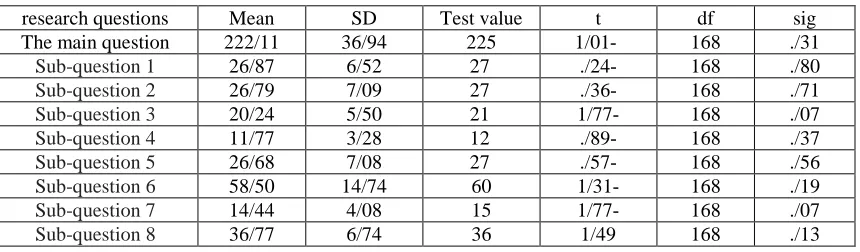
For answers to questions 1 to 8 of univariate t-test was used as shown in Table 2.
Table 2: T-test assumptions related to the research questions
sig df t Test value SD Mean research questions ./31 168
1/01 - 225
36/94 222/11
The main question
./80 168 ./24- 27 6/52 26/87 Sub-question 1 ./71 168 ./36- 27 7/09 26/79 Sub-question 2 ./07 168 1/77- 21 5/50 20/24 Sub-question 3 ./37 168 ./89- 12 3/28 11/77 Sub-question 4 ./56 168 ./57- 27 7/08 26/68 Sub-question 5 ./19 168 1/31- 60 14/74 58/50 Sub-question 6 ./07 168 1/77- 15 4/08 14/44 Sub-question 7 ./13 168 1/49 36 6/74 36/77 Sub-question 8
The main question : Table 2 results suggest that the re-engineering has an average of 222/11, which is smaller than the test mean (225) and such a difference is not significant at the 95% level with t = -1/01, df = 168 and P > 0/05. Therefore, we can say that the readiness rate of general office of Department of Education in Sistan and Baluchestan Province to implement the reengineering in aspects of uniformly oriented leadership, collaborative work environment, management commitment, support management, customer-oriented culture, information technology, Resistance to change and organizational structure is at moderate level.
Sub-question 1 : Table 2 results show that the Egalitarian leadership aspect has a mean value as 26/87, which is smaller than the test mean (27), and such a difference is not significant at the 95% level with t = -0/24, df = 168 and P >0/05. Therefore, we can say that the readiness rate of general office of Department of Education in Sistan and Baluchestan Province to implement the reengineering business process regarding the Egalitarian leadership aspect is at moderate level.
Sub-question 2: Table 2 results show that the Collaborative working environment aspect has a mean value as 26/79, which is smaller than the test mean (27), and such a difference is not significant at the 95% level with t = -0/36, df = 168 and P >0/05. Therefore, we can say that the readiness rate of general office of Department of Education in Sistan and Baluchestan Province to implement the reengineering business process regarding the Collaborative working environment aspect is at moderate level.
Sub-question 3: Table 2 results show that the management commitment aspect has a mean value as 20/24, which is smaller than the test mean (21), and such a difference is not significant at the 95% level with t = -1/77, df = 168 and P >0/05. Therefore, we can say that the readiness rate of general office of Department of Education in Sistan and Baluchestan Province to implement the reengineering business process regarding the management commitment aspect is at moderate level.
Sub-question 4: Table 2 results show that the supportive management aspect has a mean value as 11/77, which is smaller than the test mean (12), and such a difference is not significant at the 95% level with t = -0/89, df = 168 and P >0/05. Therefore, we can say that the readiness rate of general office of Department of Education in Sistan and Baluchestan Province to implement the reengineering business process regarding the supportive management aspect is at moderate level.
Sub-question 5: Table 2 results show that the customer orientation culture aspect has a mean value as 26/68, which is smaller than the test mean (27), and such a difference is not significant at the 95% level with t = -0/57, df = 168 and P >0/05. Therefore, we can say that the readiness rate of general office of
ISSN: 2306-9007 Heidarzadegan, Rowshan & Koochakzaei (2013) 903 Department of Education in Sistan and Baluchestan Province to implement the reengineering business process regarding the customer orientation culture aspect is at moderate level.
Sub-question 6: Table 2 results show that the Information Technology aspect has a mean value as 58/50, which is smaller than the test mean (60), and such a difference is not significant at the 95% level with t = -1/31, df = 168 and P >0/05. Therefore, we can say that the readiness rate of general office of Department of Education in Sistan and Baluchestan Province to implement the reengineering business process regarding the Information Technology aspect is at moderate level.
Sub-question 7: Table 2 results show that the Resistance to change aspect has a mean value as 14/44, which is smaller than the test mean (15), and such a difference is not significant at the 95% level with t = -1/77, df = 168 and P >0/05. Therefore, we can say that the readiness rate of general office of Department of Education in Sistan and Baluchestan Province to implement the reengineering business process regarding the Resistance to change aspect is at moderate level.
Sub-question 8: Table 2 results show that the organizational structure aspect has a mean value as 36/77, which is smaller than the test mean (36), and such a difference is not significant at the 95% level with t = 1/49, df = 168 and P >0/05. Therefore, we can say that the readiness rate of general office of Department of Education in Sistan and Baluchestan Province to implement the reengineering business process regarding the organizational structure aspect is at moderate level.
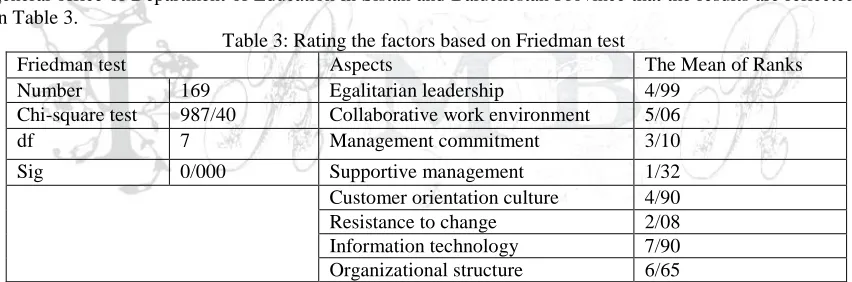
Sub-question 9: Friedman test was used for ranking the essential infrastructures of reengineering in the general office of Department of Education in Sistan and Baluchestan Province that the results are reflected in Table 3.
Table 3: Rating the factors based on Friedman test
Friedman test Aspects The Mean of Ranks
Number 169 Egalitarian leadership 4/99
Chi-square test 987/40 Collaborative work environment 5/06
df 7 Management commitment 3/10
Sig 0/000 Supportive management 1/32
Customer orientation culture 4/90
Resistance to change 2/08
Information technology 7/90
Organizational structure 6/65
As shown in Table 3, there are significant differences between average rating scales related to the deployment of reengineering (Egalitarian leadership, Collaborative working environment, management commitment, supportive management, customer orientation culture, information technology, Resistance to change and organizational structure). Hence, the highest ranking is related to the IT aspect and the lowest ranking is of the supportive management aspect. It should be noted that with higher average ratings, the variables would be more important, and a variable with higher average rating will be more important. Here, the highest average ranking is of IT, and thus, it can be said that establishment of re-engineering in terms of IT will be more possible.
Discussion and Conclusion
Today's era is called as knowledge and information oriented era. What redoubles this era's importance is human capital development through accurate and proportionate educational investment with knowledge era which may lead to societies' development. Today any country desiring to economic and social development must had the utmost efficiency of manpower that is the origin of opinion and idea and the most crucial elements of value creation. Thus, the educational systems as the development pioneers must be able to meet present needs and to adapt with international shifting conditions.
ISSN: 2306-9007 Heidarzadegan, Rowshan & Koochakzaei (2013) 904 But at present the education system to achieve these goals is faced with some problems that most of them emanated from performance disharmonic processes. Processes as like veins are functions to flow activity in organization body. While in the executive system these processes were became severely inefficient because of the lack of performance reviewing and organizations diversity and complexity. Then as the first step the education system for being efficient is required the reengineering. Reengineering is one of the importance solutions to improve the education system performance and efficiency. As stated before, the successful reengineering performance leads to processes improvement and to increase stakeholders service presenting. Nevertheless, as to perform a successful reengineering we must established the required context in the organization to decrease as possible the failure and defeat probability, thus it is necessary that each organization before implementation proceeds to identify its main factors and preparation assessment. The preparation assessment of reengineering is includes strength and weakness points, risks as well as the organization preparation level. In other words, the reengineering projects be started if they were prepared and this preparation will be insured the successful of reengineering projects. Otherwise the project has to be postponed until the organization will be obtains the necessary preparation. In this research, initially using the accomplished researches the preparation factors of reengineering were elicited which includes: egalitarian leadership, collaborative working environment and then based on these factors the preparation of the whole Sistan Balochestan province education system were assessed to perform reengineering, results of research questions are as follow:
The analysis of the related results with research questions indicates that from the case study view
point the reengineering performance conditions of all 8 dimensions of egalitarian leadership and collaborative working environment has been evaluated as the middle level. As the reengineering is a time and cost consuming project then it needs the high organizational preparation. Thus we can eventuate that the conditions of study case organization was not proper in any dimensions.
Also, factor's ranking results indicates that in sequence the highest rank belongs to IT and then organizational structure, collaborative working environment, egalitarian leadership, customer oriented culture, management commitment, resistance to change, and at least supportive management are at further ranks.
Therefore, the following suggestions are presented based on research findings:
- Embracing new ideas and solutions in the organization and using them in order to redesign working processes and methods.
- Identification and elimination of the causes of mistrust among employees
- Providing the ground for employee participation in decision making so that the superiors are always ready to hear the new ideas and methods of subordinates and encourage them to express their thoughts.
- Development and enhancement of cooperative spirit, collaboration and teamwork among
individuals
- Improving the awareness of managers and employees of the advantages, principles and concepts
of reengineering; we can take advantage of training courses for this purpose.
- Enabling individuals by delegation
- Developing the capabilities and skills of individuals by training
- Continuous education of the employees as an important investment to increase their
communication skills with clients and also increasing their professional knowledge for providing high quality services
- Creating the culture for using information technology in the organization because as long as it doesn’t exist in the organization, information technology cannot be used for achieving the goals of reengineering.
- Increasing investment to expand information technology infrastructures
- Holding specialized courses to familiarize employees with ICT and providing the required
facilities for using this technology.
ISSN: 2306-9007 Heidarzadegan, Rowshan & Koochakzaei (2013) 905 - Managers should consider the emotions of employees in making changes and reduce their fear
about the fact that changes can put their position in danger
- Reducing the number of organizational hierarchy
- Increasing flexibility in the regulations and procedures which govern organizations
- Expanding network relations among employees and managers to reduce concentration in the
structure of the organization
References
Abdolvand, N., Albadvi, A ., Ferdowsi, Z. (2008 ).Assessing readiness for business process
reengineering.Business . Process Management Journal, 14(4) , 497-511 .
Akhavan, P. (2005). Organizational restructuring methodologies in order to fulfill the priority strategies.
Tomorrow Management Journal, 5(6) ,71-86.
Al-Mashari, M., Zairi, M. (2000 ).Revising BPR: A Holistic Review of Practice and Development.
Business Process Management Journal, 6(1) , 10-42 .
Attaran, M. (2003). Information technology and business-process redesign .Business Process Management
Journal, 9(4) , 440 – 458 .
Bashein , B., Markus , M .,& Riley , P . ( 1994 ) . Precondition for BPR success and how to prevent failures .Information Systems Management , 11(2) , 7-13 .
Bird,P .,Edgar, H,. James L .(1990).Coming to a new organization .Sloan Management Review . 74.
Crowe,T.J., Fong,P.M., Zayas-Castro,J.L.(2002). Quantitative risk level estimation of businessn Process
reengineering efforts. Business Process ManagementJ Ournal, 8(5) , 490-511 .
Daft, R.L.(2007). Organization theory; Translation: Alvani, Seyed Mehdi & Danayeefar, Hassan., Tehran, Safar Ashraghi Publication, fourteenth edition.
Damanpour, F. (1991). Organizational innovation: a meta-analysis of effect of determinations and
moderators. Academy of Management Journal, 34(3), 555- 590.
Dawe , R. ( 1996 ) . Systems are people too .Transportation and Distribution, 37(1),86-90.
Dixon J. R., Arnold P., Heineke J., Kim J. S. and Mulligan P. (1994) .Business Process Re-engineering:
Improving in New Strategic Directions .California Management Review, 36( 4), 93-108.
Dubrin , M ., Porter, L. (1990). Service Quality in Hospitality Organizations. Cassell,New York, 69–70.
Eiisa Khani, A. Mirqaderi ,H. (2005). the business processes reengineering: an analytic-executive model.
Tadbir Monthly Journal, 165, 30-36.
Ekhlasi,A. Sepehri, M. (2008). Coexistence and integration of the processes reengineering and
comprehensive quality management; Business Analyses, 26, 33-38.
Emadzade, M. (1995) . A discussion of the education system economic. City: Esfahan, Esfahan University's University Jihad.
Esmaiilpor, R , Ramzanian , M, R.(2010) .process management. Rasht: Gilan university press.
ISSN: 2306-9007 Heidarzadegan, Rowshan & Koochakzaei (2013) 906 Farris, J. A., Van Aken, E. M., Doolen, T. L. & Worley, J. (2008). Learning from less successful kaizen
events: a case study. Engineering Management Journal, 20(3), 10-20.
Ferdowsi ,Z. Abdolvand ,N & Albadvi, A. (2007) presenting the similar structure to process reengineering
methodology. The Evolution and improvement management studies, 54, 29-44.
Frank ,S.(2006). ofssetting the negative effect of organizational structur on socialrelation: structur, social exchange and justice bucaria.
Gold, A., Malhotra, A., Segars, A.H. (2001). Knowledge management: an organization capabilities
perspective. Journal of Management Information System, 18(1), 185-214.
Grant, D.( 2002) . A Wider View of Business Process Reengineering. Communications of the ACM, 45(2) , 84-92 .
Gunasekaran, A., Kobu, B. (2002) .Modelling and Analysis of Business Process Reengineering .International Journal of Production Research, 40(11) , 2521-2546.
Hammer , M. Champy, J. (2000) .the company's reengineering: the organizational revolution charter. Translated by: Rezaiinejad Abdolreza, third edition, City: Tehran: Rassa educational services.
Hassanpor, F. ( 2008) .The structural reform of the education system a cure for an old pains. http//9431-2531.blogfa.com/post-47.aspx
Jafari , M., Akhavan, P .(2005) .overviewing of organizations reengineering. Future Management,11-12, 129-149 .
Kermanshah,A.Sepehri,M.(2007). Strategic management of reengineering in the organization. Sharif
Journal,34, 31-42.
Khon Siavosh, M . Mohamady, M. (2009) .The analysis of BRP implanting challenges (Reengineering of business process) in the Iranian governmental organizations. Management Development & evolution Journal, 2, 63-37.
Lee,J.( 1995 ) . An exploratory study oforganizational/managerial factorsinfluencing business process
re-engineerin implementation .InternationalJournal of Management Science , 22 ( 4 ) , 425-441.
Mansar, S.L., Marir, F.,& Reijers, H.A. ( 2003 ).Case-based reasoning as a technique for knowledge
management in business process redesign .Electronic Journal on Knowledge Management, 1 (2)
,113-24.
Maull, R.S., Tranfield, D.R., & Maull, W .( 2003 ) .Factors Characterising the Maturity of BPR
Programmes .International Journal of Operations & Production Management, 23(6) , 596-624.
Mohqer, A. Shafiq ,M.(2010) .the role of organizational capability making to perform the successful reengineering(case study: the Iranian chosen organizations). Knowledge & Technology Journal, 1 (2), 97-116.
Motwani, J., Subramanian, R.,& Gopalakrishna, P.( 2005) .Critical Factors for Successful ERP
Implementation: Exploratory Findings from Four Case Studies. Computers in Industry, 56, 529-544 .
Mousavi doost, R.A.(2003) .Reengineering . Journal of Management Development, 39, 33-35.
ISSN: 2306-9007 Heidarzadegan, Rowshan & Koochakzaei (2013) 907 Najaf Beigi, R. (2008). Organization and Management . Azad University Press, fourth edition.
Nasery , A. Biirjandifariz , M.(2010). prevent of re errors in the reengineering projects. Tadbir Mounthly
Journal, 216, 52-56.
Niknami, M.(2002) .Participatory Decentralization & decision making an effective approach to improve efficiency, school's effectiveness & replication system. The symposium of national conference reformation engineering in the education system. City: Tehran, Publication of the breeding institute.
Notash, M.R. (2003) .Reengineering of public affairs management .Tadbir Journal; 123, 61-66.
Rabiee ,M. (2008) .The process oriented management in school. Schools Journal, 4, 80-38 .
Sadri , F.(2001) .ways to expand teachers' participation in policy making, Management & planning, and the education system technology, teachers' congress, culture & development.
Safi, A. (2003). change and innovation in Iran's education system and future prospective . Educational Innovations, 3, 109-126 .
Shadmehry, S. Jahanpor ,E . & Tabrizian , M. (2009). presenting the value engineering model in the reengineering projects service agencies .The Automotive Engineering Corresponding Industries,1 (9), 34-41.
Shahbi Kargar, M. (2010) .Analysis of educational processes of the University of Sistan and Baluchestan and their improvement by re-engineering approach .MS Thesis, University of Sistan and Baluchestan.
Shin, N., Jemella, D.F.( 2002 ) .Business process reengineering and performance improvements – the case
of Chase Manhattan Bank .Business Process Management Journal, 8 ( 4 ) ,351-63.
Stanton, S., Hammer, M., &Power B. (1992). 'From resistance to results'', Insights Quarterly. The Executive Journal of Business Reengineering,4(2) , 6-16.
Talebian, M.H. Tasdiqi, M.(2006) .the Facing problems in Iran's breeding structure in the third millennium and its solutions. Knowledge & Research in training science, 9, 99-120.
Tatsiopoulos, I.P., Panayiotou,N.(2000). The integration of activity based costing and enterprise modeling
for reengineering purposes. International Journal of Production Economics, 66 :33-44.
Vakola,M., Rezgui,Y.,(2000). Critique of existing business process re-engineering methodologies: The
development and implementation of a new methodology. Business Process Management Journal, 6(3) ,
238-250.
Venkatraman, N. (1994).IT-enabled business transformation: from automation to business scope
redefinition .Sloan Management Review,35(2) , 73-87 .