http://www.sciencepublishinggroup.com/j/sjbm doi: 10.11648/j.sjbm.20180601.11
ISSN: 2331-0626 (Print); ISSN: 2331-0634 (Online)
The Mediating Effect of Exploitative and Explorative
Learning on the Relationship Between Job Embeddedness
and Innovative Work Behavior
Annam Bibi, Bilal Jadoon
Department of Management Sciences, Hazara University, Mansehra, Pakistan
Email address:
To cite this article:
Annam Bibi, Bilal Jadoon. The Mediating Effect of Exploitative and Explorative Learning on the Relationship Between Job Embeddedness and Innovative Work Behavior. Science Journal of Business and Management. Vol. 6, No. 1, 2018, pp. 1-8.
doi: 10.11648/j.sjbm.20180601.11
Received: November 10, 2017; Accepted: November 21, 2017; Published: February 1, 2018
Abstract:
It is the people and not the organizations that innovate and make a difference. Research has shown that thinking and implementing novel and useful ideas is one of the most difficult tasks for the employees and among many factors contributing to foster it, the role of job embeddedness has received little attention. This study draws on Organizational Ambidexterity Learning theory and Job Embeddedness Theory to conceptualize and confirm the relationship between job embeddedness, innovative work behaviour, and employee learning in the setting of frontline service employees. Data were collected from 437 frontline service employees in Pakistan. Consistent with the study’s predictions, both on- and off-the-job embeddedness were related with explorative learning, and innovative work behaviour. Furthermore, an employee’s learning mediated the effects of on- and off-the-job embeddedness on innovative work behaviour whereas explorative learning showed non-significant effects on innovative work behaviour. These findings provide several meaningful insights for future research and managerial practices.Keywords:
Service Innovation, Innovative Work Behaviour, Job Embeddedness, Ambidexterity Learning, Hotel Industry, Pakistan1. Introduction
There has been a burgeoning interest by academicians in understanding the predictors that foster or constrain employee’s innovative work behavior [1]. Whilst there has been a large volume of studies that examined antecedents of innovative work behaviour [2] [3] [4], researchers could scarcely find a study that investigated the impact of the fit components of job embeddedness on innovative work behavior. Except for the study by [5], who examined social side of employee creativity and posited that relationship strength, network position, and connections outside of one’s organizations explain the cognitive processes through which employee displays creative outcomes. Innovation and learning are critical factors for organizational long-term prosperity, competitiveness, and survival. This study extends on [6] work to further explain the role of job embeddedness on learning and innovativeness of an employee.
An employee’s innovative work behavior (IWB) implies going beyond the scope of basic job requirements and responsibilities. In line with other researchers [7] [2], IWB in this research comprises idea initiation and idea implementation. It is different from employee creativity, which relates only to idea initiation. As IWB involves building social support in favor of the initiated novel and new ideas, it is difficult for individuals to implement ideas without strong links with the organization, co-workers, and community. Therefore, in order for creative ideas to take place and be implemented, the social connections of employees within as well as outside the organization are absolutely critical [8].
capability [2] [3]. Despite a vast amount of research linking social side of work environment and innovation in organizations [7], one may notice the following. First, although individual employees propose innovative ideas, develop them, and advocate their implementation, most of the research into innovation and learning has been conducted at the individual and organizational level of analysis, which to some extent ignores social linkages [2] [5]. Second, most available behavioral research on individual innovation has focused on employee creativity, while the implementation of ideas is explored far less often [7].
Job embeddedness refers to the connections employees have to their jobs, co-workers, and the community which keep individual from leaving their jobs [11]. Companies want to retain their employees to innovate consistently, frequently, and continually [12]. When doing business in Pakistan, both local enterprises and MNEs are facing difficult challenges related to high employee turnover [13]. Among factors that affect employee retention, job embeddedness is a much more effective predictor of employee turnover behaviour than previous factors, such as job satisfaction, job design, organizational settings, organizational commitment, and job salary [14]. Job embeddedness fosters an employee’s sense of belonging to the organization which is then translated into positive work behaviours and outcomes. Employees with higher levels of job embeddedness are motivated to demonstrate higher levels of job performance, organizational citizenship, creativity, and innovation-related behaviours.
Although empirical evidence has shown that job embeddedness increases employee creativity, how this mechanism works remains unclear. [15] provided some explanations from a motivational perspective; however, they only referred to on-the-job embeddedness. Given that there are different patterns between on- and off-the-job embeddedness, alternative theories are needed to explain how off-the-job embeddedness influences employee creativity and innovation; in other words, how off-the-job embeddedness affects employee innovative work behaviour remains a puzzle to human resource managers and researchers. The unpredictable, global and dynamic working environment requires organization to focus on employee learning to cope with these conditions [1].
Due to the differences in job characteristics, service innovation among frontline staff may be quite different from that of managers [16]. Because frontline employees are able to listen and respond to customers’ demands directly, they can initiate and implement new ideas in the service innovation process as well. Therefore, this study aims to figure out how frontline employee’s job embeddedness (namely, on-the-job embeddedness and off-the-job embeddedness) affects learning and innovation performance.
In short, the present study attempts to add value to the current stream of research in two ways: (1) analyzing how frontline employees’ job embeddedness affects their innovative work behaviours and innovation performance; (2) exploring how the relationship between job embeddedness and innovative work behaviour is mediated by employee learning.
2. Conceptual Framework and
Hypotheses
2.1. Job Embeddedness and Innovative Work Behaviour
Job embeddedness has been defined as “the combined forces that keep a person from leaving his or her job” [17] and includes factors such as family, friends and coworkers, marital status, community involvement, health care and other fringe benefits, promotional opportunities and job tenure. Job embeddedness has been found to be a reliable predictor of intention to leave and to reliably account for actual turnover [8]. An employee’s job embeddedness is understood to have two dimensions. First, the employee has a set of attachments to their job and the employers – on-the-job embeddedness. This form of embeddedness relates to the set of attachments an employee has with their job, their work colleagues, work environment as well as the organization.
The second dimension of employee job embeddedness is off-the-job embeddedness. This relates to the attachment the employees have with their life out of work: their family, their social networks and their local community. Hence, job embeddedness can be work-related (e.g., positive relationships with supervisors and coworkers, good health benefits), namely, on-the-job embeddedness, or non-work-related (e.g., spouse works in the same area, parents live in the same community), namely, off-the-job embeddedness. Employees’ innovative work behaviour refers to the development of novel and useful ideas by employees in the organization and it includes the process of implementing and converting these ideas into new and improved products, services, or ways of doing things [7]. This is in line with previous research, which differentiated between idea generation phase and the implementation phase and combined these two phases in one construct named innovation [7], [5].
Job embeddedness is aimed at employee retention instead of employee turnover [18], [19]. Thus, the central focus is how to retain people in an organization for a long term, rather than how to keep them from moving to a different organization. The congruence between an employee’s values and that of an organization he or she works for is a paramount motivator to perform better and creative. [18] suggested that flight attendants high in JE are motivated to generate new ideas for service improvements, display novel behavior in the service delivery process, try to solve passengers’ problems successfully. Job embeddedness has numerous strands that tie an employee and his or her family in a social, psychological, and financial web that includes work and non-work friends, coworkers and groups, the community, and the physical environment in which he or she lives. This connection helps an employee to engage in extra role behaviours as he/she thinks that the prospects for continuing employment with this company are excellent which leads employee to reciprocate what the organization has given him/her [20], [18].
fact that people in organization are afraid to speak because they believe that if the idea is a failure, everyone would blame them and in case of the idea being successful, the credit would be taken by supervisors and others in the organization. In such uncertain and risky circumstances, job embeddedness might play an effective role in explaining why individuals display innovative work behaviors. First, creative behaviors are dependent on high level of trust between subordinate and supervisor. Research has shown that trusting relationships are important because no one is sure about the outcome of the initiated idea [21]. The effects of uncertain situation aggregated by the amount of risk involved can only be lessened if employees trust that their leaders would come to save their skins in case of failures and would be there to appreciate in case of successes. Second, having a detailed level of knowledge and information is necessary to think out of the box solutions to the current as well as potential problems of the organization. Employees with better networking relationships with as many stakeholders as possible along with more sources of knowledge acquisition are expected to initiate greater number of successful ideas. Job embeddedness implies stronger fit to community and due to socialization with the community which is an important stakeholder in the contemporary world, the emergence of divergent thinking rises to the point where creative ideas start flourishing [22]. Third, work engagement, involvement in the job settings, and stronger fit with the job itself, are seen as potential reasons of fulfillment at workplace. Research suggests that people who feel fulfilled at their workplaces tend to display higher level of discretionary and extra-role behaviors and one such behavior is innovative work.
The literature has routinely found that an employee’s off-the- job embeddedness influences employee retention [23], [21]. This finding, however, seems influenced by ethnicity and geography. [24] demonstrated that off the- job embeddedness is a more important factor in determining positive behaviors at workplaces for Indian and Hispanic employees compared to American employees. The possible explanation for these results might be that in collectivist societies, job embeddedness becomes more important due to the fact that people prefer to connect with others and their decisions are mostly surrounded by so many factors out of which opinions of others and collective interest in most of the cases superimposes individual or personal interest. On the contrary, individualist societies do not take in to account group interest over personal interests. People tend to make decisions about their jobs independent of what the society thinks or opines about them.
The emerging research on job embeddedness demonstrates that job embeddedness positively affects employee performance [25], [22]. Although some researchers have expressed concern that low turnover rates inhibit employee creativity and innovation related outcomes [26] [27], recent empirical studies indicate that job embeddedness significantly increases innovation [15]. [28] argued that highly embedded employees might be more motivated to engage in innovation because creativity is often a key
criterion of pay raises and promotions. [15] empirically suggested that on-the-job embeddedness has a positive influence on employees’ innovation-related behaviours. Highly embedded employees are more likely to perform well because they have favorable feelings, a strong sense of responsibility, and attractive rewards associated with their current jobs.
On the other side, off-the-job embeddedness, which predicts absences, satisfaction, and commitment with the community, describes employees’ fit, sacrifice, and links to their embedded community network [1]. An employee who perceives high off-the-job embeddedness will communicate with their neighbors frequently. Normally, the people who live in the same community as the communication companies' service employees are also the customers they serve. Employees who are linked with the various aspects of their lives in the community will get to know their customers' needs through communication with their neighbor. Therefore, the higher number of links between an employee and his/her community network, the higher chance to she or he has to obtain knowledge of customer needs, which will lead to an innovative service delivery process or customized service [28].
2.2. The Mediating Effect of Employee Learning
In today’s uncertain, technologically advanced, and fiercely competitive world, organizations must be able to cope with increasing complexity and high-velocity change [29]. Knowledge learning and innovation have been one of the hottest topics of organizational research for decades [30], [31]. Previous studies demonstrate that both organizational learning and innovation [30] play an enhancing role in stimulating a firm’s competitive advantage. Innovation requires individual involvement in acquiring existing knowledge and developing new knowledge. Knowledge acquisition is based on perception of a positive social interaction culture and obligation to reciprocate [32]. The positive association between job embeddedness and innovative work behaviour holds for employees who show high level of knowledge acquisition and sharing behaviour, because these are subject to socialization and frequent interaction with each other. By offering extensive knowledge, employees entail improved friendly relationships, and adapt to the social dynamics of the workplace [33].
Exploitative learning refers to the enhancement and augmentation of existing competences, technologies, and paradigms with positive, proximate, and predictable returns, while explorative learning is the experimentation with new alternatives resulting in uncertain, distant, and often negative returns [36]. Thus, both exploitative learning, which uses existing knowledge to create new ideas, and explorative learning, which is devoted to developing totally new ideas from external knowledge, will help employees to perform well and is critical to an organization’s success [34], [37].
In the community network, an employee can learn knowledge from others. Both the on-the-job and off-the-job networks can lead to exploitative learning. Based on the organization inertia theory [38] and structure hole theory [39], the employee who is linked in a redundancy network will lose his/her motive and capacity to generate new ideas. [37] also emphasized that employees have to learn existing or new knowledge from the network in which they are embedded to perform well. They empirically illustrate how embeddedness maps new knowledge through explorative and exploitative learning. Therefore, on the basis of above arguments, we propose the following hypotheses:
Hypothesis 1: On-the-job embeddedness is positively related to innovative work behaviour.
Hypothesis 2: Off-the-job embeddedness is positively related to innovative work behaviour.
Hypothesis 3: The impact of job embeddedness on innovative work behaviour is mediated by exploitative learning. Specifically, the impact of on-the-job embeddedness (H3a) and off-the-job embeddedness (H3b) on innovative work behaviour is mediated by exploitative learning.
Hypothesis 4: The impact of job embeddedness on innovative work behaviour is mediated by explorative learning. Specifically, the impact of on-the-job embeddedness (H4a) and off-the-job embeddedness (H4b) on innovative work behaviour is mediated by explorative learning.
3. Method
3.1. Sample
This research studied the relationships among job embeddedness, learning, and innovative work behaviour. The respondents for this study were randomly drawn from nine different hotels in Pakistan. All the hotels were based in Islamabad. We collected data from frontline service employees. We contacted administration of 17 hotels out of which nine replied positively. We told them about the purpose of this research and requested them to provide email addresses of the front line service employees working in various branches based in Islamabad. Once we received the email addresses of the respondents, random sampling technique was used to select the sample. The employees were given questionnaire to record their responses about the job embeddedness, learning orientation, and innovative work behaviour. Of the 430 surveys distributed to employees of these hotels, 216 surveys were completed. The response rate
was approximately 50 percent. Of the employees in the final sample, 46 percent were men and 54 were women; the average age was 27.4 years (s.d. = 6.8), and average tenure at the organization was 3.4 years (s.d. = 2.9).
3.2. Measures
Innovative work behaviour. The 10-item scale measuring innovative work behaviour (e.g., “The employee pays attention to issues that are no part of his daily work.”) used the studies by [40]. The items were assessed on a 5-point Likert scale anchored by 1 “never” and 5 “always”. To remove biasness, both self assessment and supervisor assessment of innovative work behaviour were taken. The items were averaged to form a scale with a reliability of 0.84.
Employee Learning. We focus on two types of employee learning: explorative learning and explorative learning. We adapted the measure of exploitative learning from [41] to examine the refinement and extension of existing knowledge, which produces positive and predictable returns, and adapted the measure of explorative learning from [41] to examine the experimentation with new alternatives that produce uncertain and often negative returns.
Job embeddedness. We examine two types of job
embeddedness: on-the-job embeddedness and off-the-job embeddedness. Our measure of on-the-job embeddedness comes from [42] and captures the forces in the workplace that keep employees tethered to their positions. We also adapted a measure of off-the-job embeddedness from [42] to examine the forces in employees’ personal lives and communities that keep them geographically stable.
3.3. Procedures
4. Result
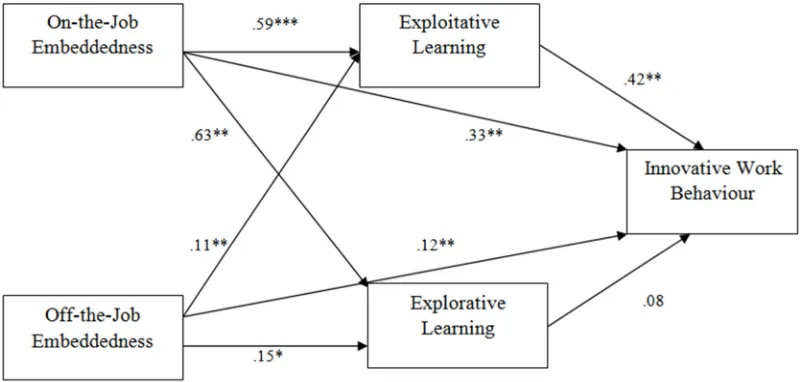
Table 1 presents means, standard deviations, and correlations among the study variables. As expected, on-the-job embeddedness is significantly correlated with explorative learning, exploitative learning, and innovative work behaviour (r=0.39, p<0.001; r=0.54, p<0.01; r=0.25, p<0.01), respectively. Both explorative and exploitative learning are also significantly correlated with innovative work behaviour (r=0.68, p<0.01; r=0.44, p<0.05). Given the nature of our data, structural equation modeling was performed to test our hypotheses. The hypothesized structural equation model fit indices suggest that the model fits the data well.
Hypothesis 1 addressed the impact of on-the-job embeddedness on innovative work behaviour. The effect of on-the-job embeddedness on innovative work behaviour was significant (β= 0.13, p<0.05), supporting Hypothesis 1.
Hypothesis 2 addressed the impact of off-the-job embeddedness on innovative work behaviour. The effect of off-the-job embeddedness on innovative work behaviour was also found significant (β= 0.33, p<0.05), supporting Hypothesis 2. Hypothesis 3 stated that the relationship between on-the-job embeddedness and innovative work behaviour was mediated by employee exploitative learning. The results showed that indirect positive effects existed between on-the-job embeddedness and innovative work behaviour through exploitative learning. On-the-job embeddedness had a positive influence on exploitative learning (β= 0.59, p<0.01), while exploitative learning also positively affected innovative work behaviour (β= 0.42, p<0.05), and off-the-job embeddedness had a positive influence on exploitative learning (β= 0.11, p<0.05), while exploitative learning also positively affected innovative work behaviour (β= 0.28, p<0.05).
Table 1. Correlation Matrix.
Variables 1 2 3 4 5 6 7 8 9 10
1 Innovative work behaviour 1
2 On-the-Job Embeddedness .25** 1
3 Off-the-Job Embeddedness .40** .62** 1
4 Exploitative learning .44* .54** .40** 1
5 Explorative learning .68** .39*** .32** .68** 1
6 Age .03 -.05 .01 .03 .05 1
7 Gender .18* .12* .17* .04 .05 .02 1
8 Education .21** .18* .15* .05 .02 .23* .27** 1
9 Experience .06 .02 .03 .05 .04 .08 .19* .07 1
10 Job position .16* .12 .17* .19 .05 .03 .14* .04 .27* 1
*p<.05; **p<.01; ***p<.001
Table 2. Measurement model results from the confirmatory factor analysis.
Constructs Mean SD CR AVE Cronbach’s α
Innovative work behaviour 3.78 .65 .83 .76 .84
On-the-Job Embeddedness 3.46 .78 .88 .79 .91
Off-the-Job Embeddedness 3.68 .94 .84 .77 .85
Exploitative learning 4.1 .33 .86 .76 .87
Explorative learning 3.89 .72 .89 .81 .90
Model fit: chi-square = 467.5, df = 237 (chi-square/df =1.97), CFI = 0.93, RMR = 0.021, RMSEA = 0.057, IFI = 0.94, NFI =0.94, GFI=0.95
***p<0.01, **p < 0.05, *p < 0.1, Standardized coefficient
When indirect effect of exploitative learning was included in the equation, the positive impact of on-the- job embeddedness as well as off-the-job embeddedness on innovative work behaviour 0.25(0.59 × 0.42), reduced than the direct impact (0.25 < 0.33), respectively. However, explorative learning does not mediate the relationship between off-the-job embeddedness and innovative work behaviour. Explorative learning could not lead to innovative work behaviour in the study. Hypothesis 4 was not supported. We also used the bootstrap method (Preacher & Hayes, 2008) to test the mediation role of exploitative learning. The bootstrapping results showed that the indirect effect of off-the-job embeddedness →exploitative learning →innovative work behaviour is statistically significant (β = 0.14, with a 95% BC bootstrap CI of 0.202-0.506, SE=0.088, p=0.00). The interval between LLCI and ULCI does not include 0. Hence, hypothesis 3 was supported.
5. Discussion
This paper used [42] model of job embeddedness and [36] organizational ambidexterity learning theory to conceptualize and confirm the relationship between job embeddedness, innovative work behaviour, and employee learning in the Pakistani hotel industry. Consistent with the study’s predictions, both on- and off-the-job embeddedness foster innovative work behaviour. Further, the effects of on- and off-the-job embeddedness on innovative work behaviour are mediated by employee learning. Both types of job embeddedness are positively related to explorative learning, but explorative learning shows non-significant effects on innovative work behaviour. These findings provide several meaningful insights for future research and managerial practice. Our findings help to understand deeper the drivers of innovative work behaviour among employees through focus on job embeddedness and employee learning. According to our finding, this study extends the existing theory in two ways: first, our study contributes to the job embeddedness literature by examining the impacts of both on and off-the-job embeddedness on innovative work behaviour of employees working in Hotel industry.
There are several practical implications that can be derived from our findings. It is practically important for managers to understand what fosters innovative work behaviour among employees. To promote innovative work behaviour from frontline staff, companies can apply the job embeddededness framework in human resources management. The employees should obtain frequent feedbacks from their supervisors about organization because individuals who obtain less direct feedback begin to feel they fit less well into their organization [26]. The supervisors should communicate regularly with their employees about the latest developments in the organization, expectations from individuals, and values of organization. This study confirmed that employees are more likely to engage in innovative work behaviour if they feel they have a greater match with their organizations.
Even though managers have limited control over off-the-job embeddedness, they can select and arrange high community-embedded employees to those positions that require strong ties with local community. Similarly, to embed the existing workforce of the organization into their jobs, they can arrange work parties and informal get-togethers that promote community attractions augmenting the level of attachment of employees and leisure activities may help people bond to the community, thereby involving socially into the web of closeness and retention. Organizations that offer flexible scheduling and family friendly programs may further enhance employee embeddedness by strengthening employees’ social bonds to others within the community which also helps managers to address a critical issue of employee turnover.
6. Limitations and Future Research
The current study in not without limitations. First, we were unable to establish causality due to the cross-sectional nature of data. Second, innovative work behaviour in the present study was assessed by employees, thus, self-reporting bias may exist. Third, we relied on a questionnaire study and convenience samples. Although convenience samples were used and data was collected from one country, the emergence of similar results across studies helps reduce concerns of limited generalizability and future research is needed to replicate results across Western cultures (e.g. North America, Western Europe), work contexts, and study designs. Finally, only the frontline service employees were investigated in the present study, and further study is needed to confirm the external validity of our findings.
7. Conclusion
This study found that both on- and off-the-job embeddedness foster innovative work behaviour. Further, the effects of on- and off-the-job embeddedness on innovative work behaviour are mediated by employee learning. Both types of job embeddedness are positively related to explorative learning, but explorative learning shows non-significant effects on innovative work behaviour. The present study attempts to add value to the current stream by analyzing how frontline employees’ job embeddedness affects their innovative work behaviours and innovation performance and exploring how the relationship between job embeddedness and innovative work behaviour is mediated by employee learning.
References
[2] Afsar, B. (2016). The impact of person-organization fit on innovative work behavior: the mediating effect of knowledge sharing behavior. International Journal of Health Care Quality Assurance, 29(2), 104-122.
[3] Haider, M. H., & Akbar, A. (2017). Internal Marketing and Employee's Innovative Work Behavior: The Mediating Role of Job Embeddedness. Bulletin of Education and Research,
39(1).
[4] Černe, M., Hernaus, T., Dysvik, A., & Škerlavaj, M. (2017). The role of multilevel synergistic interplay among team mastery climate, knowledge hiding, and job characteristics in stimulating innovative work behavior. Human Resource Management Journal, 27(2), 281-299.
[5] Perry-Smith, J. E. (2006). Social yet creative: The role of social relationships in facilitating individual creativity.
Academy of Management Journal, 49(1), 85-101.
[6] Kiazad, K., Holtom, B. C., Hom, P. W., & Newman, A. (2015). Job embeddedness: A multifoci theoretical extension.
Journal of Applied Psychology, 100(3), 641-659.
[7] De Jong, J. P., & Den Hartog, D. N. (2007). How leaders influence employees' innovative behaviour. European Journal of Innovation Management, 10(1), 41-64.
[8] Pasricha, P., & Rao, M. K. (2016). Reviewing the relationship between ethical leadership and proactive CSR and their impact on social innovation: towards a multilevel mediation model. International Journal of Social Entrepreneurship and Innovation, 4(3), 183-201.
[9] Hahn, M. H., Lee, K. C., & Lee, D. S. (2015). Network structure, organizational learning culture, and employee creativity in system integration companies: the mediating effects of exploitation and exploration. Computers in Human Behavior, 42, 167-175.
[10] Sarooghi, H., Libaers, D., & Burkemper, A. (2015). Examining the relationship between creativity and innovation: A meta-analysis of organizational, cultural, and environmental factors. Journal of business venturing, 30(5), 714-731. [11] Halbesleben, J. R., & Wheeler, A. R. (2008). The relative
roles of engagement and embeddedness in predicting job performance and intention to leave. Work & Stress, 22, 242-256.
[12] Jang, J., & George, R. T. (2012). Understanding the influence of polychronicity on job satisfaction and turnover intention: A study of non-supervisory hotel employees. International Journal of Hospitality Management, 31(2), 588-595.
[13] Kim, H. J., Tavitiyaman, P. & Kim, W. G. (2009). The effect of management commitment to service on employee service behaviours: the mediating role of job satisfaction. Journal of Hospitality and Tourism Research, 33, 369-90.
[14] Mitchell, T. R., Holtom, B., Lee, T., Sablynski, C., & Erez. M. (2001). Why People Stay: Using Job Embeddedness to Predict Volunary Turnover. Academy of Management Journal, 44,
1102-1121.
[15] Ng, T. W. H., & Feldman, D. C. (2014). Community embeddedness and work outcomes: The mediating role of organizational embeddedness. Human Relations, 67, 71–103. [16] Cadwallader, S., Jarvis, C. B., Bitner, M. J., & Ostrom, A. L.
(2010). Frontline employee motivation to participate in
service innovation implementation. Journal of the Academy of Marketing Science, 38, 219-239.
[17] Yao, X., Lee, T. W., Mitchell, T. R., Burton, J. P., & Sablynski, C. S. (2004). Job embeddedness: Current research and future directions. In R. Griffeth & P. Hom (Eds). Understanding employee retention and turnover: 153-187. Greenwich, CT: Information Age.
[18] Karatepe, O. M. (2013). High-performance work practices, work social support and their effects on job embeddedness and turnover intentions. International Journal of Contemporary Hospitality Management, 25(6), 903-921.
[19] Peltokorpi, V., Allen, D. G., & Froese, F. (2015). Organizational embeddedness, turnover intentions, and voluntary turnover: The moderating effects of employee demographic characteristics and value orientations. Journal of Organizational Behavior, 36(2), 292-312.
[20] Yang, Y., Lee, P. K., & Cheng, T. C. E. (2016). Continuous improvement competence, employee creativity, and new service development performance: A frontline employee perspective. International Journal of Production Economics, 171, 275-288.
[21] Jeon, J. H., & Yom, Y. H. (2014). Roles of empowerment and emotional intelligence in the relationship between job embeddedness and turnover intension among general hospital nurses. Journal of Korean Academy of Nursing Administration, 20(3), 302-312.
[22] Karatepe, O. M., & Vatankhah, S. (2014). The effects of high-performance work practices and job embeddedness on flight attendants' performance outcomes. Journal of Air Transport Management, 37, 27-35.
[23] Yang H., Phelps C., & Steensma H. (2010). Learning from What Others Have Learned from You: The Effects of Knowledge Spillovers on Originating Firms. Academy of Management Journal, 53, 371-89.
[24] Mallol, C. M., Holtom, B. C., & Lee, T. W. (2007). Job embeddedness in a culturally diverse environment. Journal of Business and Psychology, 22, 35-44.
[25] Robinson, R. N., Kralj, A., Solnet, D. J., Goh, E., & Callan, V. (2014). Thinking job embeddedness not turnover: Towards a better understanding of frontline hotel worker retention.
International Journal of Hospitality Management, 36, 101-109.
[26] Eskiler, E., Ekici, S., Soyer, F., & Sari, I. (2016). The Relationship between Organizational Culture and Innovative Work Behavior for Sports Services in Tourism Enterprises.
Physical Culture and Sport. Studies and Research, 69(1), 53-64.
[27] Valentine, S., Godkin, L., Fleischman, G. M., & Kidwell, R. (2011). Corporate ethical values, group creativity, job satisfaction and turnover intention: The impact of work context on work response. Journal of Business Ethics, 98(3), 353-372.
[28] Mai, Y., & Zheng, Y. (2013). How On-the-Job Embeddedness Influences New Venture Creation and Growth. Journal of Small Business Management, 51(4), 508-524.
[30] Fraj, E., Matute, J., & Melero, I. (2015). Environmental strategies and organizational competitiveness in the hotel industry: The role of learning and innovation as determinants of environmental success. Tourism Management, 46, 30-42. [31] Leong, C. T., & Rasli, A. (2014). The Relationship between
innovative work behavior on work role performance: An empirical study. Procedia-Social and Behavioral Sciences, 129, 592-600.
[32] Connelly, C. E., & Kelloway, E. K. (2003). Predictors of employees’ perceptions of knowledge sharing cultures.
Leadership & Organization Development Journal, 24(5), 294-301.
[33] Shih, H. A., & Susanto, E. (2016). Perceived identifiability, shared responsibility and innovative work behavior. The International Journal of Human Resource Management,23, 1-19.
[34] Piansoongnern, O. (2015). Chinese Leadership and Its Impacts on Innovative Work Behavior of the Thai Employees. Global Journal of Flexible Systems Management, 17, 1-13.
[35] Ahammad, M. F., Tarba, S. Y., Liu, Y., & Glaister, K. W. (2016). Knowledge transfer and cross-border acquisition performance: The impact of cultural distance and employee retention. International Business Review, 25(1), 66-75. [36] March, J. (1991). exploration and exploitation in
organizational learning. Organization Science, 2, 71-87.
[37] Moustaghfir, K., & Schiuma, G. (2013). Knowledge, learning, and innovation: research and perspectives. Journal of knowledge management, 17(4), 495-510.
[38] Shimizu, K., & Hitt, M. A. (2005). What constrains or facilitates divestitures of formerly acquired firms? the effects of organizational inertia. Journal of Management, 31, 50-72. [39] Burt, R. S. (2004). Structural holes and good ideas. American
Journal of Sociology,110, 349-399.
[40] De Jong, J., & Den Hartog, D. (2010). Measuring innovative work behaviour. Creativity and Innovation Management,
19(1), 23-36.
[41] Uzzi, B., & Lancaster, R. (2003). Relational embeddedness and learning: The case of bank loan managers and their clients. Management Science, 49, 383-399.
[42] Lee, T. W., Mitchell, T. R., Sablynski, C. J., Burton, J. P., & Holtom, B. C. (2004). The effects of job embeddedness on organizational citizenship, job performance, volitional absences, and voluntary turnover. Academy of Management Journal, 47(5), 711-722.