Volume 4 - January 2015
International Journal
of Sciences
Alkhaer Publications
ijSciences [ ISSN 2305-3925 ] is an open access journal having expertise in
delivering high-quality and rapid publications, from online submission systems
and in-depth peer review to an efficient, author-friendly production process.
Allen D. Parks (Correspondence)
[email protected]
+
1Electromagnetic and Sensor Systems Department , 18444 Frontage Road Suite 327, Naval Surface Warfare Center
Dahlgren Division, Dahlgren, VA 22448-5161, USA
Abstract: For every graph that is clique equivalent to a connected chordal graph, it is shown that the associated dependence polynomial has a unit root and that the associated clique and independence polynomials have negative unit roots. The dependence polynomial for a graph that is the join of two graphs is also shown to have a unit root when at least one of the two joined graphs is clique equivalent to a connected chordal graph. A condition satisfied by the eigenvalues of graphs that are clique equivalent to connected chordal graphs with clique numbers less than four is identified.
Keywords: chordal graph; graph polynomial; dependence polynomial; clique polynomial; independence
polynomial; graph eigenvalues
1. Introduction
Because of their intrinsic graph theoretic properties and their utility when applied to certain aspects of biology, genetics, scheduling, psychology, database design, and computer science, chordal graphs have been studied extensively during the last several decades, e.g., [1, 2]. The dependence polynomial of a graph has also been the focus of attention in recent years, e.g., [3], in large part due to its relationship to the word problem for partially Abelian monoids [4]. Clique polynomials and independence polynomials of graphs have also been studied and their roots applied to providing bounds for certain graph invariants, as well as used to generate special fractal sets associated with graphs, e.g., [5-8].
This short paper shows that the dependence polynomial for graphs that are clique equivalent to connected chordal graphs – or for graphs that are the join of two graphs, at least one of which is clique equivalent to a connected chordal graph - has a unit root. It necessarily follows that clique polynomials for graphs that are clique equivalent to connected chordal graphs and independence polynomials for complements of graphs clique equivalent to connected chordal graphs have a negative unit root.
This unit root property is applied to provide a condition that must be satisfied by the eigenvalues of graphs that are clique equivalent to connected chordal graphs with clique numbers less than four.
The remainder of this paper is organized as follows: relevant definitions and terminology are introduced in Section 2. Preliminary lemmas are provided in Section 3 and the main results are established in Section 4. Illustrative examples are presented in Section 5. Closing remarks comprise the final section of this paper.
2. Definitions and Terminology
A graph 𝐺 is a pair (𝑉(𝐺), 𝐸(𝐺)), where 𝑉(𝐺) is a finite non-empty set of vertices and 𝐸(𝐺) is either a set of doubleton subsets of 𝑉(𝐺) called edges or the empty set. The order of 𝐺 is the cardinality |𝑉(𝐺)| of 𝑉(𝐺) and the size of 𝐺 is the cardinality |𝐸(𝐺)| of 𝐸(𝐺). The complement 𝐺̅ of 𝐺 is the pair
(𝑉(𝐺̅), 𝐸(𝐺̅)) with 𝑉(𝐺̅) = 𝑉(𝐺) and 𝐸(𝐺̅) =
{{𝑢, 𝑣} 𝑉(𝐺): {𝑢, 𝑣} 𝐸(𝐺)}. The join of graphs 𝐺1 and 𝐺2 is the graph 𝐺1+ 𝐺2 with 𝑉(𝐺1+ 𝐺2) =
𝑉(𝐺1) 𝑉(𝐺2) and
Two vertices 𝑢, 𝑣 ∈ 𝑉(𝐺) are adjacent when 𝑒 = {𝑢, 𝑣} ∈ 𝐸(𝐺) in which case 𝑒 is said to connect 𝑢 and 𝑣. A 𝑢 − 𝑣 walk is an alternating sequence of vertices and edges beginning with 𝑢 and ending with 𝑣 such that every edge connects the vertices immediately preceding and following it. A 𝑢 − 𝑣
path is a 𝑢 − 𝑣 walk in which no vertex is repeated. In this case 𝑢 is said to be connected to 𝑣. 𝐺 is
connected if its order is one or if every two vertices in 𝐺 are connected. A 𝑢 − 𝑣 path for which 𝑢 = 𝑣 and which contains at least three edges is a cycle. The
Observations Concerning Chordal Graph Polynomials
http://www.ijSciences.com Volume 4 – January 2015 (01)
37
two nonconsecutive vertices in the cycle. The number of 3-cycles (i.e., triangles) in 𝐺 is |𝑇(𝐺)|.
𝐺 is a chordal graph if every cycle of length at least four has a chord. A tree is a connected chordal graph which has no cycles. A complete graph is a connected chordal graph in which every two of its vertices are adjacent. A graph 𝐹 is a subgraph of 𝐺 if 𝑉(𝐹) 𝑉(𝐺) and 𝐸(𝐹) 𝐸(𝐺). A clique in 𝐺 is either a vertex or a complete subgraph of 𝐺 and is
maximal if it is not a proper subgraph of another clique. The order of a clique is the cardinality of its vertex set and the clique number 𝜔(𝐺) of 𝐺 is the maximum order among the maximal cliques of 𝐺. Let 𝑐𝑛 be the number of cliques of order 𝑛 in 𝐺 and 𝒩𝐺≡
(𝑐1, 𝑐2, ⋯ , 𝑐𝜔(𝐺)) be the ordered 𝜔(𝐺)-tuple of the numbers of cliques of each order in 𝐺. Graphs 𝐺 and 𝐺ˊ are clique equivalent graphs (denoted 𝐺~𝐺ˊ) when
𝒩𝐺 = 𝒩𝐺ˊ. Clearly, 𝐺~𝐺.
An independent set of vertices in 𝐺 is a nonempty subset of 𝑉(𝐺) whose elements are pairwise non-adjacent. The maximum cardinality among the independent sets of 𝐺 is the independence number
𝛼(𝐺) of 𝐺. Let 𝑠𝑛 be the number of independent sets of cardinality 𝑛 in 𝐺 and 𝒥𝐺= (𝑠1, 𝑠2, ⋯ , 𝑠𝛼(𝐺)) be the ordered 𝛼(𝐺)-tuple of the numbers of independent sets of each order in 𝐺. Observe that 𝑐𝑛 is a clique in 𝐺 if and only if 𝑠𝑛 is an independent set in 𝐺̅ so that 𝒩𝐺= 𝒥𝐺̅.
The dependence polynomial [3] of a graph 𝐺 is the clique polynomial [5] of 𝐺 is
and the independence polynomial [7] of 𝐺 is
Recall from Descartes’ Rule of Signs that - because there are no sign changes in 𝑓𝐺(−𝑥) - all real roots of
𝑓𝐺(𝑥) are positive, whereas – since there are no sign changes in 𝐶𝐺(𝑥) and 𝐼𝐺(𝑥) – all real roots for these polynomials are negative.
3. Preliminary Lemmas
The following five lemmas are well known (e.g., [4]) and are used below. They are stated here as lemmas for the reader’s convenience.
Lemma 1. 𝑓𝐺(𝑥) = 𝐶𝐺(−𝑥) =
𝐼𝐺̅(−𝑥) .
Lemma 2.If 𝐺 is a tree of order m, then
𝑓𝐺(𝑥) = 1 − 𝑚𝑥 + (𝑚 − 1)𝑥2.
Lemma 3.𝐺 is a complete graph of order m if and only if
𝑓𝐺(𝑥) = (1 − 𝑥)𝑚 .
Lemma 4. If 𝐺 = 𝐺1+ 𝐺2, then
𝑓𝐺1+𝐺2(𝑥) = 𝑓𝐺1(𝑥)𝑓𝐺2(𝑥) .
Lemma 5 [9]. If 𝐺 is a connected chordal graph, then
The next two results are required for proofs developed in the next section.
Lemma 6. 𝐺~𝐺ˊ if and only if 𝑓𝐺(𝑥) =
𝑓𝐺ˊ(𝑥) [ 𝐶𝐺(𝑥) = 𝐶𝐺ˊ(𝑥)] { 𝐼𝐺̅(𝑥) = 𝐼𝐺̅̅̅ˊ(𝑥)}.
Proof. 𝐺~𝐺ˊ ⟺ 𝒩
𝐺 = 𝒩𝐺ˊ ⟺ 𝑓𝐺(𝑥) =
𝑓𝐺ˊ(𝑥) [𝐶𝐺(𝑥) = 𝐶𝐺ˊ(𝑥)]{ 𝒥𝐺̅= 𝒥𝐺̅̅̅ˊ ⟺ 𝐼𝐺̅(𝑥) =
𝐼𝐺̅̅̅ˊ}. ∎
Lemma 7. If 𝐺~𝐺ˊand 𝐺 is a connected chordal
graph, then (𝜕) holds for 𝐺ˊ.
Proof. This is an obvious consequence of the fact that 𝒩𝐺ˊ = 𝒩𝐺. ∎
4. Main Results
Theorem 8. If 𝐺 is clique equivalent to a connected chordal graph, then𝑥 = 1is a root of 𝑓𝐺(𝑥).
Proof. From (*) it is always the case that 𝑓𝐺(1) =
1 − ∑ (−1)𝑛−1𝑐
𝑛 𝜔(𝐺)
𝑛=1 . Since 𝐺 is clique equivalent to a connected chordal graph, then it follows from lemmas 6 and 7 that 𝑓𝐺(1) = 0. ∎
Corollary 9.𝑓𝐺(𝑥) = (𝑥 − 1)𝑄𝐺(𝑥).
Proof. Since 𝑥 = 1 is a root of 𝑓𝐺(𝑥), then 𝑓𝐺(𝑥) =
(𝑥 − 1)𝑄𝐺(𝑥). ∎
Corollary 10. 𝑄𝐺(0) = −1 .
Proof. 𝑓𝐺(𝑥) = (𝑥 − 1)𝑄𝐺(𝑥) ⇒ 𝑓𝐺(0) = −𝑄𝐺(0). However, from (*) it is always the case that 𝑓𝐺(0) =
1. Thus, 𝑄𝐺(0) = −1. ∎
Theorem 11.If either of 𝐺1 or 𝐺2 is clique equivalent
to a connected chordal graph, then 𝑥 = 1 is a root of
𝑓𝐺1+𝐺2(𝑥).
Proof. From lemma 4 it follows that 𝑓𝐺1+𝐺2(1) =
𝑓𝐺1(1)𝑓𝐺2(1). If 𝐺𝑖 , 𝑖 ∈ {1,2}, is clique equivalent to a connected chordal graph, then – from Theorem 8 - 𝑓𝐺𝑖(1) = 0 so that 𝑓𝐺1+𝐺2(1) = 0. ∎
Theorem 12. Let 𝜆1, 𝜆2, ⋯ , 𝜆𝑛 be the eigenvalues of
http://www.ijSciences.com Volume 4 – January 2015 (01)
38
where use has been made of the fact that |𝐸(𝐺)| =
1 2∑ 𝜆𝑖
2 𝑛
𝑖=1 and |𝑇(𝐺)| =16∑ 𝜆𝑖
3 𝑛
𝑖=1 . Since 𝐺 is clique equivalent to a connected chordal graph, then – from lemma 7 - 𝑓𝐺(1) = 0 so that
Upon rearrangement and after factoring, this yields the required result. ∎
Theorem 13.If 𝐺 is clique equivalent to a connected
chordal graph, then 𝑥 = −1 is a root of 𝐶𝐺(𝑥) and
𝐼𝐺̅(𝑥).
Proof. If 𝐺 is clique equivalent to a connected chordal graph, then it follows from lemmas 1 and 6, that 𝐶𝐺(−1) = 𝐼𝐺̅(−1) = 𝑓𝐺(1) = 0. ∎
Corollary 14. 𝐶𝐺(𝑥) = (𝑥 + 1)𝑃𝐺(𝑥) and 𝐼𝐺̅(𝑥) =
(𝑥 + 1)𝑅𝐺̅(𝑥).
Proof. This is an obvious consequence of the fact that 𝑥 = −1 is a root of 𝐶𝐺(𝑥) and a root of 𝐼𝐺̅(𝑥). ∎
Corollary 15.𝑃𝐺(0) = 1 = 𝑅𝐺̅(0).
Proof. From (ℵ) and (ℶ) it is always the case that 𝐶𝐺(0) = 1 = 𝐼𝐺̅(0). If 𝐺 is clique equivalent to a connected chordal graph, then 𝐶𝐺(0) = 𝑃𝐺(0) and
𝐼𝐺̅(0) = 𝑅𝐺̅(0) so that 𝑃𝐺(0) = 1 = 𝑅𝐺̅(0). ∎
5. Examples
As examples which validate theorem 8 and corollaries 9 and 10, consider a tree 𝐺 of order 𝑚 and a complete graph 𝐻 of order 𝑚. From lemmas 2 and 3 it is easily seen that
𝑓𝐺(1) = 0 = 𝑓𝐻(1) (thereby validating
theorem 8); and (ii) 𝑄𝐺(0) = −1, where
𝑄𝐺(𝑥) =
1−𝑚𝑥+(𝑚−1)𝑥2
𝑥−1 = (𝑚 − 1)𝑥 − 1
and 𝑄𝐻(0) = −1, where 𝑄𝐻(𝑥) = (1−𝑥)𝑚
(𝑥−1) =
−(1 − 𝑥)𝑚−1 (thereby validating corollaries 9 and 10).
If 𝐺 is a complete graph of order 3, then its eigenvalues are −1 with multiplicity 2 and 2 with multiplicity 1. Substituting this into (♠) yields
2(−1)2(3 + 1) + (2)2(3 − 2) = 6(3 − 1)
or 12 = 12
(thereby validating theorem 12).
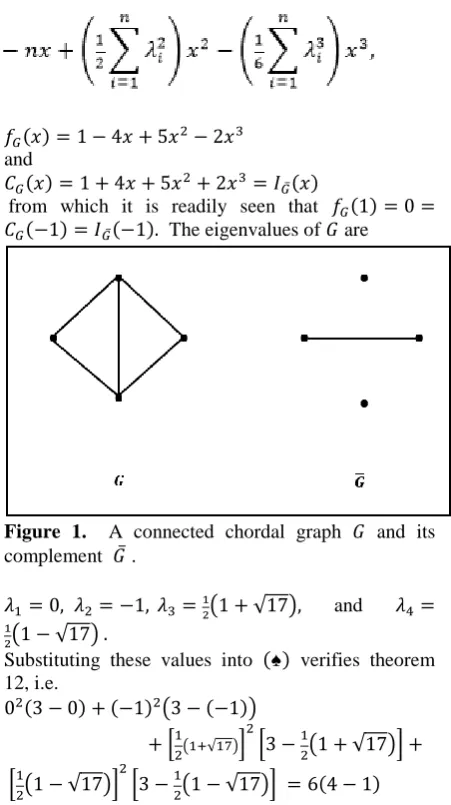
Consider the connected chordal graph 𝐺 and its complement 𝐺̅ shown in Figure 1. By inspection it is determined that
𝑓𝐺(𝑥) = 1 − 4𝑥 + 5𝑥2− 2𝑥3 and
𝐶𝐺(𝑥) = 1 + 4𝑥 + 5𝑥2+ 2𝑥3= 𝐼𝐺̅(𝑥)
from which it is readily seen that 𝑓𝐺(1) = 0 =
𝐶𝐺(−1) = 𝐼𝐺̅(−1). The eigenvalues of 𝐺 are
Figure 1. A connected chordal graph 𝐺 and its complement 𝐺̅ .
𝜆1= 0, 𝜆2= −1, 𝜆3=12(1 + √17), and 𝜆4=
1
2(1 − √17) .
Substituting these values into (♠) verifies theorem 12, i.e.
02(3 − 0) + (−1)2(3 − (−1))
+ [1
2(1+√17)] 2
[3 −1
2(1 + √17)] +
[1
2(1 − √17)]
2
[3 −1
2(1 − √17)] = 6(4 − 1)
or 18 = 18 .
6. Closing Remarks
The primary objective of this paper has been to show that the dependence polynomials of graphs that are clique equivalent to connected chordal graphs have 𝑥 = 1 as a root. This result was used to provide a condition that must be satisfied by the eigenvalues of all graphs with clique numbers less than four that are clique equivalent to connected chordal graphs. Accordingly, the contrapositive version of this condition serves to identify graphs with clique numbers less than four which are not clique equivalent to connected chordal graphs.
Observations Concerning Chordal Graph Polynomials
http://www.ijSciences.com Volume 4 – January 2015 (01)
39
It is interesting to note that when applied to trees for which 𝜔(𝐺) = 2, the cubic term in the eigenvalue condition of theorem 12 vanishes and (♠) becomes
∑ 𝜆𝑖2 𝑛
𝑖=1
= 2(𝑛 − 1).
Observe that - when divided by 2 - this expression simply states the well-known fact that the size of a tree is one less than its order. Furthermore, for graphs with zero size, the left hand side of (♠) vanishes yielding
𝑛 = 1 .
This is consistent with the fact that the only connected chordal graph with 𝜔(𝐺) = 1 is the graph of order one and size zero.
As a final observation, it is noted that if 𝐺 is an order 𝑛 graph with eigenvalues 𝜆1, 𝜆2, ⋯ , 𝜆𝑛 and 𝜔(𝐺) = 4 that is also clique equivalent to a connected chordal graph, then an obvious consequence of Theorem 8 is the fact that the number 𝑐4 of cliques of order 4 in 𝐺 is given by
𝑐4=
1
6∑ 𝜆𝑖
3 𝑛
𝑖=1
−1
2∑ 𝜆𝑖
2 𝑛
𝑖=1
+ 𝑛 − 1.
As a simple illustration of this consider the complete graph of order 4. Since the associated eigenvalues are 3 of multiplicity 1 and −1 of multiplicity 3, then application of the last expression readily yields 𝑐4=
1 as the required result.
Acknowledgments
This work was supported by a grant from the Naval Surface Warfare Center Dahlgren Division’s In-house Laboratory Independent Research program. The author thanks Dr. V. Rosenfeld for pointing out connections between graph polynomials and the results developed in [9].
References
[1] McKee, T.; McMorris, F. Topics in Intersection Graph Theory; Society for Industrial and Applied Mathematics: Philadelphia, PA, USA, 1999.
[2] Roberts, F. Discrete Mathematical Models with Application to Social, Biological, and Environmental Problems; Prentice-Hall, Inc.: Englewood Cliffs, NJ, USA, 1976.
[3] Fisher, D.; Solow, A. Dependence Polynomials Discrete Mathematics 1990,82,pp. 251-258.
[4] Goldwurm, M.; Saporiti, L. Clique polynomials and trace monoids Rapporto Interno n.222-98 Departimento di Scienze dell’Informazione; Universitá degli Studi di Milano, Milano, Italy, 1998.
[5] Hajiabolhassan, H.; Mehrabadi, M. On clique polynomials
Australasian Journal of Combinatorics 1998, 18, pp. 313-316. [6] Brown, J.; Hickman, C.; Nowakowski, R. The independence fractal of a graph Journal of Combinatorial Theory, Series B2003, 87, pp. 209-230.
[7] Levit, V.; Mandrescu, E. The independence polynomial of a graph-a survey Proceedings of the 1st International Conference on
Algebraic Informatics2005, 233254.
[8] Rosenfeld, V. The independence polynomial of rooted products of graphs Discrete Applied Mathematics 2010, 158, pp. 551-558.