The Effect Of Digital Teaching Material
(Public Service Ad) Development
Process On Preservice Teachers’
Creative Thinking Skills
Uğur BAŞARMAK [1]
http://dx.doi.org/10.17220/mojet.2019.04.009
[1] [email protected], Kirsehir Ahi Evran University, Faculty of Education, Kirsehir
ABSTRACT
This research was aimed at finding answers to the question how preservice teachers use creative thinking skills in a digital teaching material development process. The mixed method using both quantitative and qualitative methods was preferred in the research. The Torrance Tests of Creative Thinking (TTCT) Figural Form A was applied to the preservice teachers at the beginning and the end of the research. The SPSS software was used for analyzing the quantitative data. According to the pretest and posttest results of TTCT Figural Form A, the preservice teachers had significantly higher scores in the fluency, originality and elaboration factors in the posttest but no significant difference was observed in favor of the posttest scores in the abstractness of titles and resistance to premature closure factors. Interviews with the preservice teachers, observations and video records constitute qualitative data sources. It was aimed with the qualitative data triangulation to examine the effect of digital teaching material development process on preservice teachers’ creative thinking skills. Descriptive analysis and content analysis methods were used for analyzing the qualitative data. The results showed that the preservice teachers had positive opinions of the course in general, and they reported that they had fun and spent productive time as they did something practical.
Keywords: Creative thinking, digital teaching material, public service ad, mixed method
INTRODUCTION
2016). Technology‐aided learning environments enriched with digital materials appeal to today's teachers and students who want to use digital transition to improve education (Fletcher, Levin, Lipper & Leichty, 2014). With the integration of technology into education, the development of digital publishing has been achieved (Chao, 2017) and the diversity of digital teaching materials has increased.
Digital teaching materials combine text, images, cartoon animations and transfer data into digital format (Yang, Weng, Yang & Wu, 2014). Digital teaching materials that combine numerical data form multimedia contents (Mtebe, Mbwilo & Kissaka, 2016). Digitalized and accessible from any environment, digital teaching materials make teaching environments more effective and enjoyable. The use of fun and interesting teaching material in the learning process offers a positive impact on children (Başarmak & Mahiroğlu, 2015). It is stated in the research conducted by the State Educational Technology Directors Association (SETDA) that many governments have made major changes in their education policies and digital teaching materials should be implemented in the next five years. The United States policies emphasize that digital teaching materials in the classroom environment facilitate and guide learning (SETDA, 2015). The transition from printed media to digital environment and innovations in design further support learning through digital teaching materials (Johnson, Becker, Cummins, Estrada & Freeman, 2015). Digital technologies have been adopted and have started to be used in various media services by people. Recognized within the scope of digital media, the public service ad comes across as a digital teaching material and involves components such as text, graphics, sound, video, animation.
In this study, public service ad applications were created as digital teaching materials. Children in interaction with digital environments are constantly encountering entertaining media messages such as cartoons and computer games, instructive messages such as documentaries and public ads and convincing messages such as advertisements. The public service ad is different from other types of advertising. Apart from the marketing role, there is an interesting and artistic aspect to public service ad (Zhang, 2017). Public service ads do not seek profit, do deliver information about public issues to the masses and try to promote the moral concept, code of conduct and consciousness of thinking for the benefit of society (Lynn, 1974; Ling, 2011; Zhang, 2017; Hong, 2018). According to Article 3 (b) of Public Service Ads Directive of Radio Television Supreme Council (RTÜK), public service ad means “informative and educative films and audios and lower thirds which are prepared or commissioned to be prepared by public agencies and institutions and organizations and non‐governmental organizations such as associations and foundations and of which broadcast is decided to be of public interest by the Supreme Council (RTÜK, 2012). Public service ads inspire the morale of the people and promotes social values. With the development of society and economy and the emergence of certain problems regarding sources, environment, cultural continuity and protection of personal rights, public service ads have become even more important (Huang, 2015). This is due to the use of public service ad as a teaching tool. The more creative the public service ads are, the more attention is drawn, and therefore, many people find themselves in the educational process without even noticing (Hong, 2018). The creativity of the Public Service Ad varies from person to person, and skill of creativity requires some training (Shi‐zhong, 2008).
and multimedia are instructional strategies that affect creativity (Trnova, 2014). Creativity is an important educational objective in all curricula (Rawat, Qazi & Hamid, 2012). The change in the curriculum and teachers is essential in the development of creativity, and improving student creativity is considered to be a desired result of education (Spector, 2016; Rahman, Azmi, Surat, Yusoff & Marzuki, 2017; Wyse, 2014). Production of digital teaching materials requires deep thinking and creative practices (Johnson et al., 2015). Trying to uncover students’ creativity should be part of the higher education experience (Jackson, 2006).
SETDA (2015), the primary association of the educational technology leaders in the United States (2015), argue that government policies need to further support digital teaching materials and all students should have attention‐grabbing experiences while TUBİTAK (Scientific and Technological Research Council of Turkey) Vision 2023 report states that it is necessary to have a human‐oriented education system that raise individuals with the power of creative thinking and can create digital teaching contents. According to the primary, secondary and high school curricula of the Ministry of National Education (MEB) updated in 2018, the basics of originality and creativity expected from the teachers support these reports. Although the benefits provided by creativity in higher education to society and individuals are recognized, little research has been done to discover creativity in postgraduate courses recently (De Alencar & De Oliveira, 2016).
The Aim and Importance of the Study
It is extremely important that to learn the thinking skills for awaring of the problems, and producing solution to these problems in our lives. One of these thinking skills is “creative thinking skill” (Karaduman and Yıldırım, 2017). It can be said that existing products and ideas put forward by this skill will provide institutional and social benefit when creative thinking skill is supported by cognitive, affective and psychomotor approaches. In this context, it can be thought that a teacher who has creative thinking skills will be able to transfer this skill to her/his students by creating content and learning environment which is suitable for educational objectives. In addition to this, delivering “public service ads” which is produced in digital platforms as an educational learning material very easily to a wide community is very important development considering the advantages of technology. Considering the main purpose of training and supporting youngs in terms of educational objectives, it is possible to say that these digital materials could be designed and developed based on pedagogical approaches and design principles. The “public service ads”, can be presented on all kinds of digital platforms, are thought to be important for informing young people and their families in terms of providing social and individual benefits, and raising their awareness. Hence, in this study it is aimed to investigate the preservice teachers’ creative thinking skills in terms of different dimensions, and to reveal the social benefits of “public service ads”, designed and developed as a product of creative thinking skills by preservice teachers. Based on, this study attempted to examine how preservice teachers use creative thinking skills in the process of developing “Public Service Ad” as a digital teaching material. To this end, the effect of fluency, originality, elaboration, abstractness of titles, and resistance to premature closure factors on the preservice teachers’ creative thinking skills were investigated. In addition, opinions of the preservice teachers on their creative thinking skills in the process of digital teaching material development were discussed.
R
ESEARCHM
ETHODin Figure 1.
Figure 1. Sequential explanatory design
During the quantitative data collection phase, the single‐group pretest‐posttest model, which is a weak experimental design, was utilized to measure the effect of the experimental procedure on a single group within the scope of “Media Literacy” and “Graphic and Animation in Education” courses for identifying preservice teachers’ creative thinking skills at different levels in the process of digital teaching material development. Measurements were made with the same subjects and the same instrument to observe the change in creative thinking skills of the preservice teachers before and after the application (Büyüköztürk, Çakmak, Akgün Karadeniz & Demirel, 2012). Data triangulation was carried out in regard to the examination of the interview form, observations and video records with the same participants for contributing to the quantitative data when collecting the qualitative data. Triangulation is the process of increasing the credibility of the research result with different data collection and analysis methods (Yıldırım & Şimşek, 2008).
Study Group
The study group of the research was composed of 21 female and 19 male preservice teachers (40 in total) attending the 2nd grade of the Computer Education and Instructional Technologies (CEIT) Department in the Faculty of Education of a public university in Turkey in the academic year of 2017‐2018. 14 of the preservice teachers had graduated from an Anatolian High School, 20 from a Vocational and Technical Anatolian High School, 3 from a Girls’ Technical and Vocational High School and 3 from a Vocational High School, and the average age was 𝑋=21.43. The study group was formed with criterion sampling which is a purposive sampling method. Although the purposive sampling method emerged in the tradition of qualitative research, it has been also developed for the quantitative research tradition (Yıldırım & Şimşek, 2008). The research was carried out by the researcher who was instructing both courses of “Media Literacy” for 14 weeks (42 class hours) and “Graphic and Animation in Education” for 14 weeks (56 class hours) during the same term.
Environment
The research was performed in the computer laboratory of the CEIT department at the public university which hosts 40+1 notebook computers, does not cause any hardware and software problems and have fixed cameras recording for 24 hours for security purposes.
Data Collection Instruments
Torrance Tests of Creative Thinking Figural Form A as the quantitative instrument and interview form and observation as qualitative instruments were used in the research.
Quantitative Data Collection Instruments
Torrance Tests of Creative Thinking (TTCT): Torrance tests were first developed in 1966 and revised five times in 1974, 1984, 1990, 1998 and 2008. TTCT consists of two different tests, verbal and figural, with two alternative forms (Kim, 2011). Fluency, flexibility, originality and elaboration are considered the basis of creativity (Torrance, 1990; Chamberlin & Mann, 2014; Mann, Chamberlin & Graefe, 2017). While the TTCT figural form is composed of fluency, originality, flexibility and elaboration factors (Kim, 2007), flexibility was excluded from TTCT figural form due to being too associated with fluency in 1984, and abstractness of titles
Quantitative Data Collection and
Analysis (Torrance Tests of Creative Thinking)
Qualitative Data Collection and Analysis
(Interview Form) (Observation) (Video Records)
and resistance to premature closure were added to the factors of fluency, originality, and elaboration (Hebert, Cramond, Spiers Neumeister, Millar & Silvian, 2002). Torrance Tests of Creative Thinking Figural Form A was applied as pretest and posttest to measure the preservice teachers’ creative thinking skills. The test in question consists of three activities:
1. Picture Generation: There is a curved shape on the page. Try to draw a picture with this shape that no one can think of. Keep adding new ideas to tell an interesting story. Give the picture a clever and unusual title when you are done.
2. Picture Completion: You can draw interesting objects and pictures by adding lines to 10 incomplete digits. Again, draw a picture that no one can think of. Give each of your drawings an interesting title.
3. Parallel Lines: The lines activity is composed of a set of 30 parallel lines in three pages. Within 10 minutes, create pictures from straight lines. Try to think of things that no one can think of. Give the specified space a title.
These three activities indicate three different creativity. Picture generation activity allows for the configuration of single object and in‐depth presentation. Picture completion helps create different things each time by the repetition of the single stimulus to disrupt the mental structure. The activity of parallel lines provide a tendency to find a purpose for developing a purpose, even if it does not have a specific purpose. The TTCT was assessed with the total scores taken from the factors of fluency, originality, elaboration, abstractness of titles and resistance to premature closure which are the norm‐referenced criteria of creativity. Scoring process is performed in accordance with five norm references (fluency, originality, elaboration, abstractness of titles and resistance to premature closure) and thirteen criterion references (emotional expressiveness, storytelling articulation, movement or action, expressiveness of titles, synthesis of incomplete figures, synthesis of lines, unusual visualization, internal visualization, expanding or breaking the boundaries, humor, richness of imagery, colorfulness of imagery and fantasy). The norm‐referenced factors and the scoring procedure used in this study are as follows (Torrance & Ball, 2008).
1. Fluency: It is the ability to produce a number of figures. Scoring is performed for Activity 2 and 3 according to the fluency factor. Activity 2 is given points as much as the number of relevant stimuli is given while Activity 3 as much as the number of double line stimuli. The fluency scoring is based on the number of ideas expressed by interpretable responses with a meaningful stimulus. 2. Originality: It is the use of more than one stimulus to create non‐similar figures. Three activities
are graded in the originality factor. Strong originality indicators are rewarded bonus points for Activity 2 and 3. The originality score is based on the specific use of the stimulus.
3. Elaboration: It is the shape obtained by detailing the stimulus. It expresses individual’s creativity skill. All three activities are graded in the elaboration factor. Each of the shading, coloring and decoration is given 1 point. Repetitions are not graded. There are elaboration points in certain categories for each activity. For example, the scoring is as follows for Activity 1: 1 point for (0‐5), 2 points for (6‐12), 3 points for (13‐19), 4 points for (20‐26), 5 points for (27‐33) and 6 points for (34+). The total score is calculated for all the activities.
4. Abstractness of Titles: It is the ability and process to produce and think of a good title. It makes the figure look better and richer. Scoring is performed for Activity 1 and 2 in the abstractness of titles factor. Titles are graded between 0 and 3 points according to the specified criteria.
5. Resistance to Premature Closure: It is the tendency to come to a premature conclusion without considering the available information. Immediately closing the incomplete figures with straight or curved lines prevents the formation of more powerful shapes. Scoring is for Activity 2 only. In this factor, scoring is between 0 and 3 points in accordance with the specified criteria.
Interview Form: Opinions on the process were taken with the interview form completed by the preservice teachers at the end of the digital teaching material development process. An interview is the shortest way to learn the possible reasons for the participants’ knowledge, opinions, attitudes and behaviors in various subjects (Karasar, 2005). Participants who are going to be interviewed should be willing to be interviewed and be accessible to us (Griffee, 2005). The draft interview form used in the study was prepared on the basis of the studies on creative thinking in the literature (Torrance, 1977; Torrance, 1969; Rawat et al., 2012; Jackson, 2004). Two experts with experience in this field were consulted for the draft interview form. The experts were asked to assess the convenience of each question. Following the preparation of the semi‐structured interview form, a pilot study was conducted with two preservice CEIT teachers who were out of the study group, and the interview form was finalized with the necessary adjustments and the agreement coefficient was calculated to be .840.
Observation: In the study, observations were made about how the preservice CEIT teachers used creative thinking skills in digital teaching material development process. The researcher was present during preparation and at all stages of the application and also received support from field experts at some stages. Notes were kept on the environment at the observation stage. The researcher notes are taken for collecting and reflecting data (Ersoy, 2015). These notes include individual observations, the responses of researcher and preservice teacher in the process, and the definitions related to the process. In the observation process, the observer should take detailed and descriptive notes on the basic behavior and process formed in the environment (Yıldırım and Şimşek, 2008). Furthermore, records of the fixed camera in the laboratory were used to reinforce the researcher notes.
Research Process
The research was carried out with the participation of the preservice CEIT teachers who were taking the courses of Media Literacy and Graphic and Animation in Education and were directly related to the environment.
Pre‐Application
● In the context of the “Graphic and Animation in Education” course, Adobe Flash CS6 was taught as an animation software to the preservice teachers for 8 weeks (32 class hours). The following topics were addressed in the content of Graphic and Animation in Education course: Design process and principles; history of graphic design; application areas of graphic design; basic concepts of graphics; image formats; general features of graphic processing program; tools panel; vector tools; working with layers; text operations; advanced techniques and filters; preparing web tools with pictures; button creation; slices and active regions; optimization and transfer to web environment; creating gif animations; masking; creating drop‐down menus; basics of animation; graphics; text processing, symbols, creating animation, sound and video operations; multimedia operations; advanced interaction; principles pf educative animation development and usage; developing educative animation; developing an educational software using the animation software.
● With questions such as “What is creative thinking? What can you do by using your imagination? What do you think before designing a product? What does producing a useful product bring you?” in the scope of “Media Literacy”, it was ensured that the preservice teachers expressed their thoughts and a motivational environment was created for them. Then, the preservice teachers were informed of the application process.
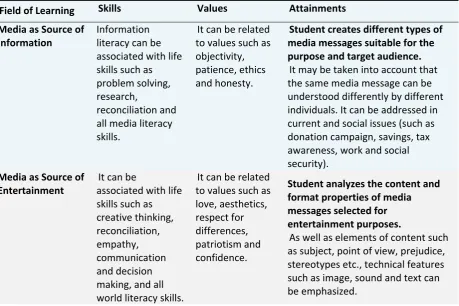
were taken, and necessary adjustments were made in line with the recommendations of the field experts. It was thought that digital teaching materials to be developed in regard to the topics would contribute to the creative thinking skills of the preservice teachers. The topics are ”Traffic Rules”, “Technology Addiction”, “Resource Saving”, “Children’s Rights”, “Balanced Nutrition”, “I Read Book”, “Productive Time”, “Social Activity”, “Sleep Time”, “Emergency”, “Etiquette”, “Cleaning”, “Children's Games”, and “Animal Love”. Attainments and descriptions by fields of learning are shown in Table 1.
Table 1. Attainments and descriptions regarding the media literacy curriculum
Field of Learning Skills Values Attainments
Turkish form measured the creative thinking factors expected from verbal and figural creativity subtests. In the qualitative research process, it was checked whether sufficient evidence was available to see to what extent learning had occurred. The strategies used to ensure validity and reliability in this study are as follows (Merriam & Tisdell, 2015; Creswell, 2014);
● Data triangulation: Data triangulation was achieved by using different data sources (interview, observation and video records). A researcher specialized in the field was asked for support to confirm the findings achieved in the research. It can be argued that working with different data sources and participant perspectives contributed to the validity of the study.
● Participant confirmation: Participants are asked for a follow‐up interview and to comment on the findings. Hence, the provisional comments of the results obtained from the interview form were shown to the preservice teachers, and they were asked whether the comments were reasonable. ● Adequate time spent in the research process: The time spent by a researcher in the same
environment together with the participants will make the findings more accurate and valid. The researcher was present as “participant observer” during the preparation and at all stages of application. It is thought that sufficient time was taken to collect data.
● Researcher's position and ability to reflect: A researcher should make a critical self‐assessment with assumptions, prejudices regarding the study and world views. The researcher in this study has 22 years of experience as an educator in both high school and university.
● Expert evaluation/view: The interpretation of a person other than the researcher and the agreement between the findings and the raw data validate the study. The qualitative data were analyzed independently by the researcher and the field expert. The themes and code lists were compared to achieve internal validity upon necessary adjustments.
● Supervision process: The method, process and decision points used in the conduct of the study were determined in detail.
● Rich and broad descriptions: The detailed explanation of the environment through the researcher notes and many different perspectives of a theme can increase the validity of the findings. The researcher was present at each stage of the process as a participant observer and took notes on the process.
Data Analysis
The SPSS software was used for analyzing the quantitative data. The total scores obtained from the fluency, originality, elaboration, abstractness of titles and resistance to premature closure factors of TTCT Figural Form A were transferred to the SPSS platform. Kolmogorov‐Smirnov and Shapiro‐Wilk tests were performed to see whether the data were distributed normally in SPSS. Related samples t‐test was used for determining whether there was a significant difference between the scores as all factors had normal distribution. For explaining and discussing the quantitative results in a better manner, the qualitative data obtained through interviews, observations and video records were subjected to descriptive and content analyses. In the content analysis, similar data were brought together under certain concepts and interpreted in a way that the reader would understand.
FINDINGS
Findings on the First Research Question
in the factors of fluency, originality, elaboration, abstractness of titles and resistance to premature closure, dependent groups t‐test, which is a parametric test method, was conducted. Table 2 shows the results of the dependent groups t‐test performed to understand whether there was a significant difference between the pretest and posttest mean scores.
Table 2. Results of the dependent groups t‐test by creative thinking scores of fluency, originality, elaboration, abstractness of titles and resistance to premature closure
Factors N 𝑿 SD Sd t p
Fluency Pretest 40 20.48 11.22 39 4.84 .000
Posttest 40 26.68 11.70
Originality Pretest 40 17.73 8.95 39 2.65 .011
Posttest 40 19.93 9.29
Elaboration Pretest 40 7.68 2.96 39 3.90 .000
Posttest 40 8.75 2.86
Abstractness of Titles Pretest 40 7.20 6.87 39 1.42 .165
Posttest 40 5.65 5.61
Resistance to Premature Closure
Pretest 40 8.15 3.74
39 .86 .396
Posttest 40 8.45 3.83
According to the the t‐test results in Table 2, the preservice teachers’ posttest scores were significantly higher in the factors of fluency [t (39)=4.84, p<.05], originality [t (39)=2.65, p<.05] and elaboration [t(39)=3.90,
p<.05]. No significant difference was observed in the preservice teachers’ posttest scores in the factors of abstractness of titles [t(39)=1.42, p>.05] and resistance to premature closure [t(39)=.86, p>.05].
Findings on the Second Research Question
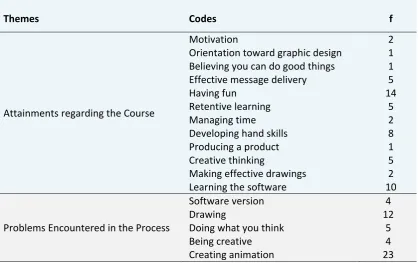
Interviews with the preservice teachers, observations and video records were subjected to the content analysis. At the end of the analysis, four main themes were reached: attainments regarding the course, problems encountered in the process, process evaluations, creative thinking skills. The themes and codes are presented in Table 3.
Table 3. Themes and codes achieved within the scope of the research
Themes Codes f
Attainments regarding the Course
Motivation
Orientation toward graphic design Believing you can do good things Effective message delivery Having fun
Retentive learning Managing time Developing hand skills Producing a product Creative thinking
Making effective drawings Learning the software
2 1 1 5 14
5 2 8 1 5 2 10
Problems Encountered in the Process
Software version Drawing
Doing what you think Being creative Creating animation
4 12
Managing time 3
Process Evaluations
Appreciation Improvement Being disciplined
Influencing the learning process Seeing and troubleshooting deficiencies
Improving the creativity On‐time delivery
1 6 10
4 14
4 1
Creative Thinking Skills
Generating ideas Drawing ability Dreaming Creative thinking Interpretation
Producing an original product
9 5 10 16 1 1
According to the theme “attainments regarding the course”, the preservice teachers reported that they had seen such a course content for the first time, they had learned to use the software after a while, they had fun and a productive time as they did something practical. The preservice teachers stated that they were happy to have learned to use software about their field, and therefore, their drawing skills improved and they tried to convey an effective message through their drawings. Some of the quotations from the preservice teachers are as follows:
“…The course was fun and productive. We did not get bored during the course... It enabled me to improve my drawing skills while doing the applications... We learned the basic information...”
“…Bringing the important information into animation made our job easier... The message we conveyed to the audience in the short public service ad we had created is thanks to the animation... We can create various and useful animations in the graphic course…”
“…It was good for me to take this course. I think it is a fun and useful course... I think it contributed some nice things to me while doing the animation...”
“...We learned to use software related to our field. In this course, we learned how to make difficult‐looking animations easily... We even made things that we thought we could not...”
According to the theme “problems encountered in the process”, the preservice teachers reported in the application phase that they had not used this software before and had difficulty in performing some operations within the software. They stated that they did not have the ability to draw on the software, they made much effort for the drawings, a long time should be allocated for this and they failed to do what they thought of. The preservice teachers also reported that they were afraid not to be able to deliver their homework on time and that was why they had difficulty. Some of the quotations from the preservice teachers are as follows:
“…When creating animation, the point that I found difficult was to make a drawing... I had difficulty because my imagination was not that broad and I was not capable of drawing... But I realized that if I put effort into this course, I could do something by myself…”
“…It was very hard to find objects because my imagination is very limited... Using the same shape all the time narrowed down my horizon...”
provided insight to see their own deficiencies and to correct the deficiencies, and thus, they could improve themselves. They also stated that their performance increased, they worked in a more disciplined way and strived to do something every week. Some of the quotations from the preservice teachers are as follows:
“...Because the in‐course evaluation was process‐oriented, the difference between those who did and did not study was identified, and more importantly, how you noticed my efforts, warned me about my mistakes and appreciated me for the good things without being result‐ oriented improved me further...”
“...The fact that we were told about our mistakes at the end of the evaluation and doing research to correct these mistakes contributed to us...”
“...In‐course evaluation compels us to do studies all the time... If it is not for the in‐course evaluation, everyone can leave it to the final week... It helped us study in a planned way...”
“...When I look at my drawing and handicraft, my present status is quite advanced... Although I do not have a special interest, I feel like dealing with it as I improve myself...”
“...It was important for us to understand our deficiencies and mistakes and to correct them until the next in‐course evaluation...”
“It helped us see in which subjects we had deficiencies and where we made mistakes. It was easier for us to correct these deficiencies and investigate them to learn about them...”
According to the theme “creative thinking skills”, the preservice teachers expressed that they compelled themselves to think more extensively for creating an original product, created different patterns of events, thus expanding their imagination. They stated that the course content enabled them to think on a wide scale and improve their drawing skills. Some of the quotations from the preservice teachers are as follows:
“...I got to gain drawing skills in this course. Because while I could not make productive, nice drawings either on the computer or the paper, I think I can do it now... I created beautiful projects thanks to the animations...”
“...I think my horizon is expanding as I draw... If I were a little fonder of drawing, there could be something really different...”
"...I am convinced that it strengthened my thinking and our creativity because we constantly thought during the process...”
“I did not use to have a special drawing skill or an advanced imagination... As I deal with this course, I can realize what I can do more differently...”
“When drawing and editing, it makes you think and allows you to imagine things...”
DISCUSSION, CONCLUSION AND RECOMMENDATIONS
scope of the research, five factors (fluency, originality, elaboration, abstractness of titles and resistance to premature closure) of Torrance and Ball’s (2008) figural test were used for measuring the preservice teachers’ creative thinking skills.
The first factor examined in the research, fluency, is about creating a meaningful and interpretable figure. The fluency factor is formed by activities of picture completion and parallel lines. It was understood from the findings that the posttest scores of the preservice CEIT teachers were significantly higher than their pretest scores in the fluency factor [t(39)=4.84, p<.05]. Regarding the research on fluency in the literature, it
was observed that the students’ creative thinking (Firdaus, Widodo & Rochintaniawati, 2018; Hu, Wu & Shieh, 2016), their creative skills (Hokanson & Bart, 2016) and their academic achievements (Stolaki & Economides, 2018; Yuniarti, Kusumah, Suryadi & Kartasasmita, 2017) were found to be higher than in other factors. As for the qualitative findings of the research, in the light of quantitative findings, the fluency factor can be related to the themes of attainments regarding the course and creative thinking skills according to the preservice teacher opinions. Codes such as “effective message delivery, making effective drawings, generating ideas” were used by the preservice teachers in regard to the fluency factor. The frequency of the codes shows that the “generating ideas” code was among recurring descriptions.
The second factor, originality, is about the creation of dissimilar shapes and specific use. The originality factor also includes three activities: picture completion, picture generation, and parallel lines. According to the findings, the preservice CEIT teachers had significantly higher posttest scores than the pretest scores in the originality factor [t(39)=2.65, p<.05]. Among the studies on this factor, a study which attempted to identify
the effect of problem‐based learning method on students’ creative thinking skills observed that no significant difference between the pretest and posttest fluency scores whereas a significant difference was found in the originality scores (Ersoy, 2014). It has been seen that students who take creative thinking education (Lin & Wu, 2016) and comprehensive thinking education (Chiu, 2015) have higher performances in originality; however, another study analyzing the variables which measure creative thinking emphasizes that originality is the greatest determinant of the stress (Webster, Holliday & Williams, 2016). As for the qualitative findings of the research, opinions of the preservice teachers can be associated with the creative thinking skills theme In relation to the originality factor, the preservice teachers used codes such as “producing an original product, dreaming”. It is thought that the preservice teachers were motivated to think creatively and use their imagination through the ideas exchanged on creativity before the application. The topics of digital teaching materials related to the attainments were associated with everyday life, and it was attempted to determine them in accordance with the preservice teacher opinions. It is thought that this approach made them feel confident, encouraged them to develop a new product and a meaningful step was taken. Although it was difficult to make drawings for the first time in a digital environment, it was observed that they enjoyed this course and the course was fun. The preservice teachers reported that their imagination improved and had creative thinking skills when developing storyboards and digital teaching materials. In parallel with these findings, academicians described being creative as seeing the world in different ways, taking risks and doing things that no one has done before (Jackson, 2006). Byrge & Tang (2015) stated that the biggest impact in product development is the exercises in the creative education program. It is argued that creative individuals are courageous, imaginative and curious when it comes to taking risk (Stojanova, 2010). Creative activities involve more skills and productivity in artistic fields (Cropley, 2012).
The third factor, elaboration, is the shape obtained by elaborating the stimulus. It expresses individual’s creativity skill. Elaboration includes all three activities. The findings showed that the preservice CEIT teachers had significantly higher posttest scores than the pretest scores in the elaboration factor [t(39)=3.90, p<.05]. Similarly to this finding, a significant change was observed in a project study examining the
learning environments in favor of education using creative lesson activities. Concerning the qualitative findings, the preservice teacher opinions can be associated with the themes of attainments regarding the course and process evaluations. The preservice teachers used codes such as “making effective drawings, improving the creativity” in regard to the elaboration factor. In studies based on qualitative findings, the preservice teachers stated that creativity can be revealed when a free environment is offered (Zeteroğlu, Doğan & Derman, 2012). It is necessary to support the trainings related to increasing the creative thinking skills of students and ensuring the use of metacognitive strategies (Rahman et al., 2017).
The fourth factor, abstractness of titles refers to the ability and process to produce and think of a good title. It makes the figure look better and richer. Abstractness of titles is formed by the activities of picture generation and and picture completion. The findings indicated no significant difference in the preservice teachers’ posttest scores in the abstractness of titles factor when compared to their pretest scores [t(39)=1.42,
p>.05]. As for the qualitative findings, the preservice teacher opinions can be associated with the themes of attainments regarding the course and creative thinking skills. The preservice teachers used codes such as “effective message delivery, creative thinking, interpretation” in regard to the abstractness of titles factor. The inclusion of creative activities in the curriculum will allow students to use their strengths and achieve success in creative activities (Torrance, 1969). Teachers state that the creativity of the students is not hereditary and the creative thinking process can be improved in the classroom (Turner, 2013).
The final factor, resistance to premature closure, refers to the tendency to come to a premature conclusion without considering the available information. Immediately closing the incomplete figures with straight or curved lines prevents the formation of more powerful shapes. This factor is only evaluated according to the picture completion activity. No significant difference was observed in the preservice teachers’ posttest scores in the resistance to premature creative thinking factor when compared to their pretest scores [t(39)=.86, p>.05]. The preservice teacher opinions can be related to the problems encountered
in the process regarding the factor of resistance to premature closure. The preservice teachers used codes such as “drawing, doing what you think, being creative, managing time” in regard to the resistance to premature closure factor. According to the preservice teachers, primary negative aspect of the course are that the applications is very time consuming and challenging. However, it was observed that preservice teachers’ drawing skills improved after a while. They stated that the evaluations made in the process contributed to them. It was observed that the mistakes were corrected in a short time and the performance increased rapidly with the instant evaluations performed on‐site. According to the National Advisory Committee on Creative and Cultural Education, creativity is possible in every area of everyday life. All young people and adults have the creative capacity. Individuals need to be encouraged and take risks to improve their capacities (NACCCE, 1999).
● The skills in the field of learning available the Media Literacy curriculum (such as information literacy, problem solving, creative thinking, communication and decision making) and digital teaching materials (such as cartoons, animation, posters, concept cartoons, story) can be utilized for identifying the creative thinking of different student groups.
● The evaluation process of TTCT can be also performed in accordance with thirteen criterion references (emotional expressiveness, storytelling articulation, movement or action, expressiveness of titles, synthesis of incomplete figures, synthesis of lines, unusual visualization, internal visualization, expanding or breaking the boundaries, humor, richness of imagery, colorfulness of imagery and fantasy) in addition to the norm references of creativity (fluency, originality, elaboration, abstractness of titles and resistance to premature closure).
R
EFERENCESAhmadi, N., Peter, L., Lubart, T., & Besançon, M. (2019). School Environments: Friend or Foe for Creativity Education and Research?. In Creativity Under Duress in Education? (pp. 255‐266). Springer, Cham. Anderson, H. H. (1961). Creativity and Education. Educational Horizons, 40(2), 123‐129.
Aslan, A.E. (2001). Torrance Yaratıcı Düşünce Testi’nin Türkçe Versiyonu. M.Ü. Atatürk Eğitim Fakültesi Eğitim Bilimleri Dergisi, 14, 19‐40.
Başarmak, U., & Mahiroğlu, A. (2015). Student Opinion On The Animated Cartoons Used In Online Learning Environment. International Journal Of Eurasia Social Sciences, 19, 234‐253.
Byrge, C., & Tang, C. (2015). Embodied creativity training: Effects on creative self‐efficacy and creative production. Thinking Skills and Creativity, 16, 51‐61.
Büyüköztürk, S., Kılıç Cakmak, E., Akgün, O. E., Karadeniz, S., & Demirel, F. (2012). Bilimsel Araştırma Yöntemleri. Ankara: Pegem Akademi.
Chamberlin, S. A., & Mann, E. (2014). A New Model of Creativity in Mathematical Problem Solving. Proceedings of the 8th conference of MCG: International Group for Mathematical Creativity and Giftedness.
Chiu, F. C. (2015). Improving your creative potential without awareness: Overinclusive thinking training. Thinking Skills and Creativity, 15, 1‐12.
Cho, H., Pemberton, C. L., & Ray, B. (2017). An Exploration of the Existence, Value and Importance of Creativity Education. Current Issues in Education, 20(1).
Creswell, J. W., & Clark, V. L. P. (2015). Karma yöntem araştırmaları: Tasarımı ve yürütülmesi. Anı.
Creswell, J. W., & Garrett, A. L. (2008). The “movement” of mixed methods research and the role of educators. South African journal of education, 28(3), 321‐333.
Cropley, A. (2012). Creativity and education: An Australian perspective. IJCPS‐International Journal of Creativity and Problem Solving, 22(1), 9.
Çiçek, I. (2011). Teknoloji geliştirmede yaratıcılığı yönetmek. Organizasyon ve Yönetim Bilimleri Dergisi, 3(1). De Alencar, E. M. L. S., & De Oliveira, Z. M. F. (2016). Creativity in higher education according to graduate
programs' professors. Universal journal of educational research, 4(3), 555‐560.
Dennen, V. P., & Spector, J. M. (2016). The flipped K‐12 classroom: Implications for teacher preparation, professional development, and educational leadership. In Revolutionizing K‐12 Blended Learning through the i²Flex Classroom Model (pp. 38‐51). IGI Global.
Dikici, A. (2006). Sanat eğitimi ve öğrencilerin yaratıcılık düzeyleri. Eğitim ve Bilim, 31(139).
Ersoy, E. (2014). The effects of problem‐based learning method in higher education on creative thinking. Procedia‐Social and Behavioral Sciences, 116, 3494‐3498.
Ersoy, A. (2015). Doktora öğrencilerinin ilk nitel araştırma deneyimlerinin günlükler aracılığıyla incelenmesi. Pegem Eğitim ve Öğretim Dergisi, 5(5), 549‐568.
Firdaus, H. M., Widodo, A., & Rochintaniawati, D. (2018). Analysis of creative thinking ability and process of creative thinking ability development of junior high school students on biology learning. Assimilation: Indonesian Journal of Biology Education, 1(1), 21‐28.
Fletcher, G., Levin, D., Lipper, K., & Leichty, R. (2014). The Accessibility of Learning Content for All Students, Including Students with Disabilities, Must Be Addressed in the Shift to Digital Instructional Materials. SETDA Policy Brief. State Educational Technology Directors Association.
Gencer, A. A., & Gonen, M. (2015). Examination of the effects of reggio emilia based projects on preschool children's creative thinking skills. Procedia‐Social and Behavioral Sciences, 186, 456‐460.
Griffee, D. T. (2005). Research tips: interview data collection. Journal of Developmental Education, 28(3), 36‐ 37.
Hebert, T. P., Cramond, B., Spiers Neumeister, K. L., Millar, G., & Silvian, A. F. (2002). E. Paul Torrance: His Life, Accomplishments, and Legacy. National Research Center on the Gifted and Talented.
Henriksen, D., Mishra, P., & Fisser, P. (2016). Infusing creativity and technology in 21st century education: a systemic view for change. Journal of Educational Technology & Society, 19(3).
Hokanson, B., & Bart, W. (2016). Creativity Testing, Achievement, and Higher‐Order Thinking in Schoolchildren.
Hong, Y. (2018). The Optimization of Public Service Advertising to the Construction of Enterprise Culture. DEStech Transactions on Social Science, Education and Human Science, (emss).
students' creative thinking abilities. Eurasia Journal of Mathematics, Science & Technology Education, 12(3).
Huang, Y. (2015). Discussion on the Influence of Public Figures in the Dissemination of Public Service Advertising. In International Conference on Arts, Design and Contemporary Education.
Jackson, N. J (2004). How can creativity be taught? Personal accounts of teaching to promote students’ creativity.
Jackson, N. (2006). Creativity in higher education. International Education
Johnson, L., Becker, S. A., Cummins, M., Estrada, V., & Freeman, A. (2015). Course Apps: An NMC Horizon Project Strategic Brief (pp. 1‐13). The New Media Consortium.
Karaduman, G. B., & Yıldırım, E. (2017). Sınıf öğretmeni Adaylarının Yaratıcı Düşünme Becerisi Hakkındaki Görüşlerine Ait Nitel Bir Çalışma. Üstün Zekâlılar Eğitimi ve Yaratıcılık Dergisi, 4(3), 16‐32.
Karasar, N. (2008). Bilimsel Araştırma Yöntemi: Kavramlar‐İlkeler‐Teknikler. Nobel Yayın Dağıtım.
Keh, L. K., Ismail, Z., & Yusof, Y. M. (2017). Creativity among geomatical engineering students. International Education Studies, 10(4), 43.
Khodabakhshzadeh, H., Hosseinnia, M., Moghadam, H. A., & Ahmadi, F. (2018). EFL teachers' creativity and their teaching's effectiveness: a structural equation modelling approach. International Journal of Instruction, 11(1), 227‐238.
Kim, K. H. (2007). The two Torrance creativity tests: The Torrance Tests of Creative Thinking and thinking creatively in action and movement. In Creativity: A handbook for teachers (pp. 117‐141).
Kim, K. H. (2011). The creativity crisis: The decrease in creative thinking scores on the Torrance Tests of Creative Thinking. Creativity Research Journal, 23(4), 285‐295.
Lin, C. S., & Wu, R. Y. W. (2016). Effects of web‐based creative thinking teaching on students' creativity and learning outcome. Eurasia Journal of Mathematics, Science & Technology Education, 12(6).
Ling, Z. (2011). The Originality of Public Service Advertisement and Its Design Strategy [J]. Value Engineering, 32, 233.
Lynn, J. R. (1974). Effects of persuasive appeals in public service advertising. Journalism Quarterly, 51(4), 622‐ 630.
Ma, H. (2017). So, What is Creativity?: Animation Students and Teachers' Conception of Creativity in China. In Design Education for Fostering Creativity and Innovation in China (pp. 78‐101). IGI Global.
Merriam, S. B., & Tisdell, E. J. (2015). Qualitative research: A guide to design and implementation. John Wiley & Sons.
Mishra, P., & Henriksen, D. (2018). Creativity, Technology & Education: Exploring their Convergence. Springer International Publishing.
Mtebe, J. S., Mbwilo, B., & Kissaka, M. M. (2016). Factors influencing teachers’ use of multimedia enhanced content in secondary schools in Tanzania. The International Review of Research in Open and Distributed Learning, 17(2).
Muldner, K., & Burleson, W. (2015). Utilizing sensor data to model students’ creativity in a digital environment. Computers in Human Behavior, 42, 127‐137.
NACCCE (1999). All Our Futures: Creativity, Culture and Education.London:Department for Education and Employment.
Nurmi, S., & Jaakkola, T. (2006). Effectiveness of learning objects in various instructional settings. Learning, Media and Technology, 31(3), 233‐247.
Orr, K. L., Golas, K. C., & Yao, K. (1994). Storyboard development for interactive multimedia training. Journal of Interactive Instruction Development, 6(3), 18‐31.
Öncü, T. (2003). Torrance yaratıcı düşünme testleri‐şekil testi aracılığıyla 12‐14 yaşları arasındaki çocukların yaratıcılık düzeylerinin yaş ve cinsiyete göre karşılaştırılması. Ankara Üniversitesi Dil ve Tarih Coğrafya Fakültesi Dergisi, 43(1), 221‐237.
Park, J., Kim, M., & Jang, S. (2017). Analysis of Factors Influencing Creative Personality of Elementary School Students. International Education Studies, 10(5), 167‐180.
Pecheanu, I. S. E., & Tudorie, C. (2015). Initiatives towards an education for creativity. Procedia‐Social and Behavioral Sciences, 180, 1520‐1526.
Preti, A., & Miotto, P. (1997). Creativity, Evolution and Mental Illnesses. Journal of Memetics‐Evolutionary Models of Information Transmission, 1.
Rahman, S., Azmi, N. H., Surat, S., Yusoff, A. N., & Marzuki, M. A. (2017). Idea generation training: Impact on originality, fluency, flexibility, and elaboration among university students. International Journal of Economic Research, 14(16), 19‐28.
Rawat, K. J. Qazi, W., & Hamid, S. (2012). Creativity and education. Academic Research International, 2(2), 264.
RTÜK (2012). Kamu Spotları Yönergesi. Retrieved August 15, 2018, from https://www.rtuk. gov.tr/kamu‐ spotlari/5029/ 3985/kamu‐spotlari‐yonergesi.html
digital‐
Shen, T. L., & Lai, J. C. (2018). Instructional Design of Creating Creative and Imaginative Works. Eurasia Journal of Mathematics, Science and Technology Education, 14(4), 1509‐1517.
Shi‐zhong, L. I. U. (2008). Creative thinking of advertisement [J]. Journal of Southwest Agricultural University (Social Sciences Edition), 2, 011.
Sitar, A. S., Černe, M., Aleksić, D., & Mihelič, K. K. (2016). Individual learning styles and creativity. Creativity Research Journal, 28(3), 334‐341.
Spector, J. M. (2016). Thinking about educational technology and creativity. Educational Technology, 5‐8. Stojanova, B. (2010). Development of creativity as a basic task of the modern educational system. Procedia‐
Social and Behavioral Sciences, 2, 3395‐3400.
Stolaki, A., & Economides, A. A. (2018). The creativity challenge game: An educational intervention for creativity enhancement with the integration of Information and Communication Technologies (ICTs). Computers & Education, 123, 195‐211.
Torrance, E. P. (1969). Creativity Research and Higher Education.
Torrance, E. P. (1977). Creativity in the Classroom; What Research Says to the Teacher.
Torrance, E. P., & Goff, K. (1990). Fostering academic creativity in gifted students. ERIC Clearinghouse Torrance, E. P. (1990). Torrance Tests of Creative Thinking (Beaconville, IL: Scholastic Testing Services). Torrance, E. P., & Ball, O. E. (2008). Safter HT Torrance Tests of Creative Thinking: Streamlined Scoring Guide
for Figural Forms A and B. Bensenville, IL: Scholastic Testing Service.
Trnova, E. (2014). IBSE and Creativity Development. Science Education International, 25(1), 8‐18.
Turner, S. (2013). Teachers' and pupils' perceptions of creativity across different key stages. Research in Education, 89(1), 23‐40.
Wands, B. (2007). Art of the digital age. Thames & Hudson.
Webster, P., Holliday, L. A., & Williams, B. M. (2016). Student‐life stress: Its relationship with creative thinking (Doctoral dissertation, Brenau University).
Wyse, D. (2014). Creativity and the Curriculum. Inaugural Professorial Lecture. Trentham Books. Available from: IOE Press, Institute of Education, 20 Bedford Way, London, WC1H 0AL, UK.
Yang, L., Weng, T., Yang, D., & Wu, P. (2014). The Effectiveness of Digital Teaching Materials on Introduction Statistics. In 2014 International Conference on Education Reform and Modern Management (ERMM‐ 14). Atlantis Press.
Yıldırım, A., & Şimşek, H. (2005). Qualitative research methods in social. Ankara: Seçkin.
Yin, Y. (2018). Punya Mishra and Danah Henriksen: Creativity, technology & education: exploring their convergence. International Entrepreneurship and Management Journal, 1‐4.
Yuniarti, Y., Kusumah, Y. S., Suryadi, D., & Kartasasmita, B. G. (2017). The effectiveness of open‐ended problems based analytic‐synthetic learning on the mathematical creative thinking ability of pre‐service elementary school teachers. International Electronic Journal of Mathematics Education, 12(3), 655‐ 666.
Zeteroglu, S., Doğan, Y., & Taner‐Derman, M. (2012). Determining the opinions of preschool and primary school teacher candidates on creativity and metaphorical perception. Educational Sciences: Theory and Practice, 12(4), 3135‐3152.
Zhang, L. (2017). Research on the Color Expression of Public Service Advertisement. 2017 International Conference on Social Sciences, Arts and Humanities (SSAH 2017)
Zhou, K. (2018). What cognitive neuroscience tells us about creativity education: A literature review. Global Education Review, 5(1), 20‐34.