INTEGRATED WATER RESOURCES
MANAGEMENT
LAND USE DYNAMICS AND BIODIVERSITY
ENERGY EFFICIENCY AND RENEWABLE
RESOURCES
REGIONAL MANAGEMENT AND
SUSTAINABLE LIVELIHOODS OF THE POOR
VOLUMEN 1 - 2011
Journal of Natural Resources and Development 2011; 01: 1- 28
Volume I
Contents
Agrobiodiversity of cactus pear (Opuntia, Cactaceae) in the Meridional Highlands Plateau of Mexico
Authors: Juan Antonio Reyes-Agüero, Juan Rogelio Aguirre Rivera DOI: 10.5027/jnrd.v1i0.01
1
Climate responsive and safe earthquake construction: a community building a school
Authors: Hari Darshan Shrestha, Jishnu Subedi, Ryuichi Yatabe, Netra Prakash Bhandary DOI: 10.5027/jnrd.v1i0.02
10
Analysis of water footprints of rainfed and irrigated crops in Sudan
Authors: Shamseddin Musa Ahmed, Lars Ribbe DOI: 10.5027/jnrd.v1i0.03
JOURNAL OF
NATURAL RESOURCES
AND DEVELOPMENT
Agrobiodiversity of cactus pear (Opuntia, Cactaceae)
in the Meridional Highlands Plateau of Mexico
Juan Antonio Reyes-Aguero
ab*, Juan Rogelio Aguirre Rivera
aa Instituto de Investigación de Zonas Desérticas, Universidad Autónoma de San Luis Potosí. Mexico.
b Center of Natural Resources and Development, Cologne University of Applied Sciences. Betzdorfer Straße 2. 50679 Cologne, Germany.
*Corresponding author: [email protected]
Article history
Abstract
Received 13.04.2011 Accepted 09.07.2011 Published 22.08.2011
Mexico is characterized by a remarkable richness of Opuntia, mostly at the Meridional Highlands Plateau; it is also here where the greatest richness of Opuntia variants occurs. Most of these variants have been maintained in homegardens; however, the gathering process which originated these homegardens has been disrupted over the past decades, as a result of social change and the destruction of large wild nopaleras. If the variants still surviving in homegardens are lost, these will be hard to recover, that is, the millenary cultural heritage from the human groups that populated the Mexican Meridional Highland Plateau will be lost forever. This situation motivated the preparation of a catalogue that records the diversity of wild and cultivated Opuntia variants living in the meridional Highlands Plateau. To this end, 379 samples were obtained in 29 localities, between 1998 and 2003. The information was
processed through Twinspan. All specimens were identified and preserved in herbaria. Botanical keys
and descriptions were elaborated. The catalogue includes information on 126 variants comprising 18 species. There were species with only one variant (Opuntia atropes, O. cochinera, O. jaliscana, O. leucotricha, O. rzedowskii and O. velutina), two (O. durangensis, O. lindheimeri, O. phaeacantha and
O. robusta), five (O. joconostle and O. lasiacantha), seven (O. chavena), 12 (O. hyptiacantha and O. streptacantha), 15 (O. ficus-indica), 22 (O. albicarpa), and up to 34 (O. megacantha). Additionally, 267 common cactus pear names were related to those variants.
Keywords
Agrobiodiversity
Ex situ In situ
Opuntia streptacantha Opuntia ficus-indica
Introduction
In Mexico there are78 wild species of the genus Opuntia (sensu stricto) (Guzmán et al., 2003), several of them prosper in Meridional Highland Plateau of Mexico (Reyes-Agüero and Aguirre, 2006) (Figure 1); relicts of the cactus shrubland, also known as nopaleras for the prevalence of Opuntia populations, still exist in this region (Rzedowski, 1978); furthermore, it is here where the greatest richness of Opuntia variants is found (Barbera, 1995). Many of these variants have become cultivars and have been preserved in homegardens (Figueroa et al., 1980), and in Mexico only less than ten of them have been grown in over 51,112 ha for the production of cactus pear, and in over 10,200 ha to produce nopalito (Gallegos et al., 2009).
Cactus pear cultivars have evolved from a long relationship between
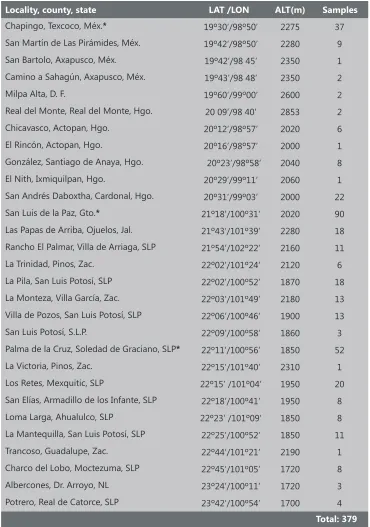
Field collections were carried out in 29 localities (Table 1) across the Meridional Highland (Figure 1). Opuntia specimens were collected: (1) if variant was valued and grown for the cladode, nopalito or fruit; (2) if the variant was given a clear and unmistakable common name; and (3) if the variant grew preferentially in a homegarden or commercial plantation, although specimens were also collected from wild populations and experimental plantations. A total of 379 variants were sampled, obtaining six replicates from each. Morphological features were recorded using a descriptor(Reyes-Agüero and Aguirre, 2000). One two-year cladode, one nopalito and one fruit were assessed from each replica, and information on 118 traits was recorded. Specimens were processed for preservation (Reyes-Agüero et al., 2007) and deposited in the SLPM, MEXU and CHAP herbaria.
For the statistical analyses, a basic matrix was elaborated followed
by a multivariable analysis of classification, using Twinspan program
(McCune & Mefford, 1999). All the specimens collected were
previously identified based mostly on the keys by Britton & Rose (1919) and Bravo (1978). Afterwards, these identifications were
matched to the Twinspan output. Both dichotomous keys and poly-keys were elaborated, based primarily on indicator traits revealed by the Twinspan In most cases, the botanical descriptions comprised the 118 morphological traits. Each description was elaborated according to a standard sequence: starting with the life form and ending with seed characteristics; was described based on mean and modal values from the six replicates; in turn, the description of each species was prepared based on their variants, and the description of the genus was prepared based on its species.
Material and Methods
Figure 1. Orogenic units and geomorphic regions of Mexico. Highlighting the Meridional Highland Plateau (Tamayo 1988).
Results and Discussion
The information derived from the 379 samples was used to prepare a catalogue in a book format (Reyes-Agüero et al. 2009); into the
catalog the arrangement of species and its cultivars (Table 2) reflect
the Twinspan analysis; a complementary multivariate ordination analysis was made in order to review the relationship of morphological variation and process of domestication (Reyes-Agüero et al., 2005a);
the core of catalog consists of identification keys and botanical
descriptions, including photographs for 126 resulted variants, most
of them as cultivars. Almost fifty percent, 197 samples, were carried
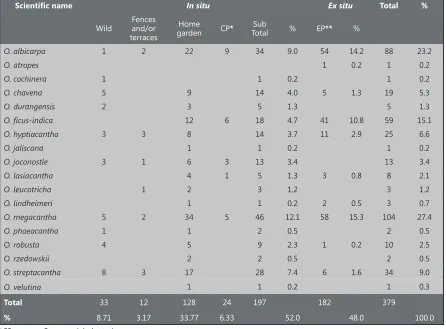
out from in situ and 182 from ex situ localities (Table 3). About in situ, is important to note that there are cultivars in wild environments and other few are in cropland as fences and/or on agricultural terraces,
to give them firmness. The most high percent of samples were from
home gardens; this environment is a crucial space for the in situ
conservation in order to protect and use the genetic diversity, but also for to develop new variants (Engels 2002; Galluzi et al. 2010), and in this process is important to maintain the link between home gardens and wild environment, from one side and the same time home gardens with commercial croplands, from the other side (Engels 2002).There are 18 Opuntia species with 126 cultivars appreciated for their cladodes, nopalitos or fruits. There were species with only one cultivar (Opuntia atropes, O. cochinera, O. jaliscana, O. leucotricha, O. rzedowskii and O. velutina), two (O. durangensis, O. lindheimeri, O. phaeacantha and O. robusta), five (O. joconostle and O. lasiacantha),
seven (O. chavena), 12 (O. hyptiacantha and O. streptacantha), 15 (O.
ficus-indica), 22 (O. albicarpa), and up to 34 (O. megacantha)(Table 2). This richness of cultivars is high if is comparable with Zea mays, with 59 landraces in Mexico (Bellón et al. 2008) and 52 in Peru (Tapia
2000) or Persea americana and its three landraces in Mexico (Bellón et al. 2008); but in comparation with Solanum tuberosum with its 1000 landraces also in Peru (Tapia 2000), the richness of Opuntia is very low.
Locality, county, state LAT /LON ALT(m) Samples
Chapingo, Texcoco, Méx.* 19º30’/98º50’ 2275 37
San Martín de Las Pirámides, Méx. 19º42’/98º50’ 2280 9
San Bartolo, Axapusco, Méx. 19º42’/98 45’ 2350 1
Camino a Sahagún, Axapusco, Méx. 19º43’/98 48’ 2350 2
Milpa Alta, D. F. 19º60’/99º00’ 2600 2
Real del Monte, Real del Monte, Hgo. 20 09’/98 40’ 2853 2
Chicavasco, Actopan, Hgo. 20º12’/98º57’ 2020 6
El Rincón, Actopan, Hgo. 20º16’/98º57’ 2000 1
González, Santiago de Anaya, Hgo. 20º23’/98º58’ 2040 8
El Nith, Ixmiquilpan, Hgo. 20º29’/99º11’ 2060 1
San Andrés Daboxtha, Cardonal, Hgo. 20º31’/99º03’ 2000 22
San Luis de la Paz, Gto.* 21º18’/100º31’ 2020 90
Las Papas de Arriba, Ojuelos, Jal. 21º43’/101º39’ 2280 18
Rancho El Palmar, Villa de Arriaga, SLP 21º54’/102º22’ 2160 11
La Trinidad, Pinos, Zac. 22º02’/101º24’ 2120 6
La Pila, San Luis Potosí, SLP 22º02’/100º52’ 1870 18
La Monteza, Villa García, Zac. 22º03’/101º49’ 2180 13
Villa de Pozos, San Luis Potosí, SLP 22º06’/100º46’ 1900 13
San Luis Potosí, S.L.P. 22º09’/100º58’ 1860 3
Palma de la Cruz, Soledad de Graciano, SLP* 22º11’/100º56’ 1850 52
La Victoria, Pinos, Zac. 22º15’/101º40’ 2310 1
Los Retes, Mexquitic, SLP 22º15’ /101º04’ 1950 20
San Elías, Armadillo de los Infante, SLP 22º18’/100º41’ 1950 8
Loma Larga, Ahualulco, SLP 22º23’ /101º09’ 1850 8
La Mantequilla, San Luis Potosí, SLP 22º25’/100º52’ 1850 11
Trancoso, Guadalupe, Zac. 22º44’/101º21’ 2190 1
Charco del Lobo, Moctezuma, SLP 22º45’/101º05’ 1720 8
Albercones, Dr. Arroyo, NL 23º24’/100º11’ 1720 3
Potrero, Real de Catorce, SLP 23º42’/100º54’ 1700 4
Total: 379 Table 1. Locations where samples Opuntia variants were collected
The automated classification enabled to confirm the great Opuntia
variant richness previously documented by Figueroa et al. (1980) and Rodríguez and Nava (1998) for Meridional Highlands Plateau of
Mexico, but at the same time confirmed the need to use multivariate
methods to demonstrate this agrobiorichness in a formal way. This variant richness of wild and cultivated Opuntia valued by the Meridional Highlands inhabitants reveals that the cactus pear has been an important plant for both ancient and current populations. The continued and systematic gather of cactus pear favored that
some plants with outstanding traits (fruit shape and size; flavor and
texture of pulp or peel; seed hardness and amount; peel thickness and glochid density; and nopalitos shape, color, abundance,
precocity, flavor, tenderness and fiber content) were subjected to
different degrees of tolerance, favored or planting, and they began to be taken to the homegardens (Colunga et al. 1986, Figueroa et al. 1980). In homegardens, the cactus pear selected found the conditions needed to prosper. In this way, homegarden cactus pear plantations summarize the efforts by generations of collectors to gather the most useful traits out of the genetic diversity of Opuntia
in their respective gathering territories, coupled with hundredths of years of care to preserve these cultivars (Reyes-Agüero et al., 2005a).
Seventy six percent of cultivars most of them are related to eight species of the series or section Streptacanthae, with rise to 88% if the O. ficus-indica cultivars are added. This richness of the section Streptacanthae makes of it the likely source of numerous “… horticultural varieties and forms” (Bravo 1978). O. megacantha stands out as the species with the largest amount of variants. There are only 15 O. ficus-indica cultivars which, along with another 22 for O. albicarpa, are the most extensively cultivated in commercial plantations and home gardens; from this two species only O. ficus-indica is absent in wild populations (Bravo 1978; Reyes-Agüero et al. 2004, 2005a, b)
and only one sample of O. albicarpa was located in wild environment.
From the cultivars, 31 were obtained only in one in situ locality, without representatives samples in ex situ localities; on the contrary, 32 were only in ex situ localities without representatives samples in
in situ localities and 63 were in both kinds of spaces. About this 63, 71.4 % are in one or two in situ localities, 25.4 % are from three to
five localities and only 3.17 % are in six or seven localities. During
the development of this work, live samples of several cultivars were sent to the three ex situ localities and also to one fourth scientific
collection in the Centro Regional Universitario Centro Norte, from the Universidad Autónoma Chapingo in El Orito, Zacatecas,
where is the national official depository of the Opuntia cultivars.
As regards the cladode, the Twinspan revealed indicator traits included: shape, length, width, thickness and texture; for areoles: width and length, amount in each cladode side, and the number of areoles with spines, distance between areoles, distribution of spiny areoles in the cladode, and amount of areole rows in each cladode side; for spines: color, texture and form, length of the largest and smallest spine in each areole, average number of erect, radial or diffuse spines per areole, mean number of spines < 1.0 cm, between 1.0 and 3.0 cm and > 3.0 cm per areole. For the fruit, the indicator traits were weight, shape, width and length, depth and diameter of
the floral scar; as regards peel: color, weight, diameter and amount
of areoles; for the pulp: dimensions (length and diameter), weight, color and sweetness in Brix degrees; for the seed: number of normal and sterile seeds, weight of sterile seeds, width, thickness and hardness of normal seeds. The supplementary indicator traits were
tepal apex shape, perianth color at flowering and pericarpel length;
and, last nopalito leaf length and its number of spines per areole.
Scientific name
Cultivars Common names
O. albicarpaScheinvar
O.albicarpa cv. Mango B7 INIFAP & Mango
O.albicarpa cv. Burro Copena 18K & Burro
O.albicarpa cv. Cristalino Cristalino, Cascarón, Blanca papa, San migueleño & Nopal calabaza
O.albicarpa cv. Reina Chapeada, Reina & Cristalina
O.albicarpa cv. Blanca Blanco manso, Cristalino, Cañatierra & Blanca.
O.albicarpa cv. Reinita Reinita
O.albicarpa cv. Fafayuco Fafayuco, Blanco & Reina
O.albicarpa cv. Blanca chapeada B6 INIFAP, Blanca chapeada & Clavijudo
O.albicarpa cv. Amarillo pera Chapeada, Amarilla, Plátano, Amarillo tardío & Amarillo pera
O.albicarpa cv. Anaranjado Anaranjado & Fafayuco
O.albicarpa cv. Amarilla olorosa Sandía, 153 INIFAP & Amarilla olorosa O.albicarpa cv. Copa de oro Copa de oro, Fafayuco & Blanco
O.albicarpa cv. Gavia Mango, Esmeralda, Burrona & Gavia
O.albicarpa cv. Bola de masa Bola de masa & Chapeada
Table 2. Check-list of the agrobiodiversity of Opuntia in Meridional High Land Plateu of Mexico
Scientific name
Cultivars Common names
O.albicarpa cv. Octubreña Octubreña, Virginia & Fafayuco
O.albicarpa cv. Pepino Pepino & Chapeada SJZ
O.albicarpa cv. Esmeralda Esmeralda, Forrajera, Tuna blanca, Blanca tipo & Alfajayucan
O.albicarpa cv. Copena T12 Copena T12 & Tuna blanca
O.albicarpa cv. Burrona Alfajayucan, Amarillo aguado, Blanco de Castilla, Burrona & Copena T15 O.albicarpa cv. Papantón Papantón, Reina, Copena 12, Copena 1-A, Calabazona tardía, Copena G14,
Co-pena 2-B, Pepino, Burrona & Fafayuco
O.albicarpa cv. Cristalina Burrona, Cristalina, Blanca suave & Promotora 3
O.albicarpa cv. Dadokäjä Blanca E Z, Dadokäjä & Promotora 8
O. atropes Rose
O. atropes cv. Blanco espinoso Blanco espinoso
O. chavena Griffiths
O. chavena cv. Cascarón Cascarón & Rebusco
O.chavena cv. Cimarrón Cimarrón, Güeras & Mión
O.chavena cv. Forrajera Forrajera S
O.chavena cv. Pachona Pachona
O.chavena cv. Hartón Hartón & Cascarón
O.chavena cv. Chiquihuitillo Cochinillo, Chiquihuitillo, Tempranillo, Pachoncilla, Pachón, Negrito, Camueso con espinas & Galarzo
O.chavena cv. Negrito Negrito
O.cochinera Griffiths
O.cochinera cv. Cacalote Cacalote
O.durangensis Britton & Rose
O.durangensis cv. Xoconostle moro Xoconostle, Xoconostle chivo & Xoconostle moro
O.durangensis cv. Iskäjä Iskäjä & Coconoixtle
O.ficus-indica (L.) Mill.
O. ficus-indica cv. Copena V1 CopenaV1 & Telokäjä
O. ficus-indica cv. Copena F1 CopenaF1, Milpa Alta & ACNF-INIFAP O. ficus-indica cv. Amarillo huevo Amarillo huevo & 33 INIFAP
O. ficus-indica cv. Liso blanco Liso blanco
O. ficus-indica cv. Atlixco Amarillo (Tipo Atlixco) O. ficus-indica cv. Tlaxcalancingo Tlaxcalancingo & A3 INIFAP O. ficus-indica cv. Camuesa Lisa-34 & Camuesa 58
O. ficus-indica cv. Amarilla Milpa Alta Amarilla Milpa Alta, Atlixco, Plátano & Verdulero de Don Erasmo O. ficus-indica cv. Doctor Mora Doctor Mora, Amarillo grande, RDR-INIFAP & Cristalino O. ficus-indica cv. Liso Rojo vigor, Copena V1, Liso & Liso de Milpa Alta
O. ficus-indica cv. Telokäjä Telokäjä, Verdulero de María Durán, B10 INIFAP, Copena F1, Amarilla UACH, At-lixco, Celaya, Forrajero & Copo de nieve
O. ficus-indica cv. Solferino Amarilla, Solferino, RSB-INIFAP, Roja, Pelón & Rojo 8
Most of the indicator traits are related to the Opuntia general domestication process (Colunga et al. 1986; Reyes et al. 2005a); these include fruit color and length, and pulp weight, followed by areole and spine traits (Reyes et al. 2005a). However, in cultivars characterized by large fruits, spine abundance displays three modalities: total absence, reduced or minimal presence, and persistence of the normal
number per areole, that is, the amount of spines normally present in wild species, in dependence of domestication environment. The variants described in the catalog (Reyes-Agüero et al. 2009) represent only a fraction of the Opuntia richness in Mexico. This effort is only a
first approximation. Further in depth botanical exploration is required,
both in the Meridional Plateau Highland and in the rest of the country.
Scientific name
Cultivars Common names
O. ficus-indica cv. Promotora Promotora&Promotora 6
O. ficus-indica cv. Telokäjä rojo Amarilla Milpa Alta, Copena CE, Tuna roja lisa & Telokäjä rojo
O. ficus-indica cv. Liso forrajero Liso forrajero, Promotora 7, RSA-INIFAP, Rojo liso, Rojo 72, Telokäjä, Rojo pelón, Guanajuato, Rojo pelón de Zacatecas, Rojo 3509 & Liso-V, Tlaconopal
O.hyptiacantha A. Web.
O.hyptiacantha cv. Ladrillo Ladrillo
O.hyptiacantha cv. Jaqueña Granada roja, RCH-INIFAP, Nopal blanco, Jaqueña-29 & Morado
O.hyptiacantha cv. Camueso Cardón & Camueso
O.hyptiacantha cv. Amarilla 24 Amarilla 24
O.hyptiacantha cv. Pachón Tempranillo, Charol, Pachón, Camueso & Cardón O.hyptiacantha cv. Cardón de Las Papas Cardón de Las Papas
O.hyptiacantha cv. Roja rubí Roja rubí
O.hyptiacantha cv. Jokjä Jokjä
O.hyptiacantha cv. Cardón blanco Rojo 9, 79 INIFAP & Cardón blanco O.hyptiacantha cv. Blanca Victoria Blanca Victoria
O.hyptiacantha cv. Nistokäjä Nistokäjä & RSD-INIFAP
O.jaliscana Bravo
O.jaliscana cv. Chamacuero Chamacuero
O.joconostle A. Web.
O.joconostle cv. Xoconostle colorado Xoconostle colorado
O.joconostle cv. Xoconostle de Las Pirámides Xoconostle de San Martín de Las Pirámides & Iskäjä de burro. O.joconostle cv. Xoconostle blanco Xoconostle blanco
O.joconostle cv. Xoconostle agrio Xoconostle agrio
O.joconostle cv. Huevo de gato Huevo de gato rojo, Huevo de gato rojo blanco, Duraznillo & Xoconostle O.joconostle cv. Xoconostle blanco Xoconostle blanco, Coyonostle & Xoconostle
O.lasiacantha Pfeiff
O.lasiacantha cv. Sanjuanero Sanjuanero
O.lasiacantha cv. Blanca cristalina Blanca cristalina or Cuero de rata
O.lasiacantha cv. Nopal del Real Nopal del Real
O.lasiacantha cv. Madokäjä Madokäjä
O.lasiacantha cv. Tuna Iris Tuna Iris
O. leucotricha DC.
O. leucotricha cv.Duraznillo Duraznillo & Duraznillo-xoconostle
O.lindheimeri Engelm.
O.lindheimeri cv. Oreja de elefante Oreja de elefante
O.lindheimeri cv. Guilanchi Guilanchi or Arrastrerilla
O.megacantha Salm-Dyck
O.megacantha cv. Cuervo tuna Cuervo tuna & Hartón
O.megacantha cv. Jarrilla Piniche & Tuna jarrilla
O.megacantha cv. Sgt-INIFAP Sgt-INIFAP
O.megacantha cv. Juanita käjä Juanita käjä
O.megacantha cv. Chirriona Chirriona, Revilla & Pastosa O.megacantha cv. Chamacuero Monteza Chamacuero Monteza
O.megacantha cv. Naranjona Mango, Naranjona & Promotora 2
O.megacantha cv. Sangre de toro Sangre de toro
Table 2 continuation. Check-list of the agrobiodiversity of Opuntia in Meridional High Land Plateu of Mexico
Scientific name
Cultivars Common names
O.megacantha cv. Manso apastillada Anaranjada, Amarilla, Manso apastillada & Anaranjada 33
O.megacantha cv. Mieluda Mieluda & Tuna perra
O.megacantha cv. Ushikäjä Ushikäjä
O.megacantha cv. Reventón Morado, Sangre de toro, Apastillada, Nopal chiva, Reventón, Morada, Trompa de cochino, Tazaja, Nopal duro & Jarrillo.
O.megacantha cv. Jagüeño Amarillo de tuna chica, Jagüeño, Camueso & Mieludo
O.megacantha cv. Bola de masa Bola de masa,Redonda, Chapeada, Nopal ligero, Morado & Nopal loco O.megacantha cv. Amarilla raleña Camuesa Matancillas, Amarilla raleña
O.megacantha cv. Apastillada anaranjada Apastillada anaranjada
O.megacantha cv. Tzebekäjä Tzebekäjä & Jarrillo
O.megacantha cv. Roja saeta Roja saeta
O.megacantha cv. Pico chulo Tuna sabina, Amarilla, Morada, Morado, Pico chulo & Naranja
O.megacantha cv. Torreoja Torreoja
O.megacantha cv. Naranjona dulce Naranjona dulce
O.megacantha cv. Amarilla Monteza Amarillo Monteza o Huesos, Amarillo de Tuna grande & Amarilla Monteza
O.megacantha cv. Sangrita Sangrita
O.megacantha cv. Amarilla naranjona Amarilla naranjona & Amarilla redonda
O.megacantha cv. Rojo 10 Naranjona, 25 INIFAP & Rojo 10.
O.megacantha cv. Naranjona Helia Naranjona Helia,26 INIFAP & 25 INIFAP
O.megacantha cv. Astikäjä Astikäjä
O.megacantha cv. Rubí reina Amarillo con espinas, Colorada, Monteza & Rubí reina
O.megacantha cv. Amarilla mansa Amarilla mansa
O.megacantha cv. Amarilla china Amarilla china
O.megacantha cv. Jarrilla grande Juanita käjä, Pico chulo, Amarilla, Jarrilla grande & Jokjä
O.megacantha cv. Sangre Sangre
O.megacantha cv. Tenikäjä Tenikäjä, Apastillada & Amarilla
O.megacantha cv. Morada de San Martín Solferino, Morada de San Martín & Tuna roja
O.phaeacantha Engelm.
O.phaeacantha cv. Pintadera Pintadera
O.phaeacantha cv. Pintadera de Daboxtha Pintadera de Daboxtha
O.robusta Wendl.
O.robusta cv. Tapón Bonda, Tapona de mayo, Tapón macho, Tapón (macho), Tapón hembra & Tapona
O.robusta cv. Tapón pelón Tapón pelón
O.rzedowskii Scheinvar
O.rzedowskii cv. Cenizo Cenizo & Cuatroalbo
O.streptacantha Lem.
O.streptacantha cv. Cardoncillo Cardoncillo&66 INIFAP
O.streptacantha cv. Burra Burra & Masona
O.streptacantha cv. Sandía Sandía & Pachón rojo.
O.streptacantha cv. Amarilla Cardona Amarilla cardona
O.streptacantha cv. Isbini Isbini, Madokäjä & Cardón
O.streptacantha cv. Dojä Dojä,Tomatillo & Redondilla
O.streptacantha cv. Santo Tomás Jarrillo, Cardón & Santo Tomás O.streptacantha cv. Cardón potosino Cardón potosino
Scientific name Cultivars
Common names
O.streptacantha cv. Jocoquillo Cardón, Cardona, Color de rosa, Chino & Jocoquillo
O.streptacantha cv. Cardón Cardón
O.streptacantha cv. Trompa de cochino Trompa de cochino
O.streptacantha cv. Demshikäjä Cayahual, Isbini, Tomatillo o Demshikäjä, Cardón, Colorada & Cardón blanco O.streptacantha ssp. aguirrana Scheinvar & Rodr. Apalillo, Chiquihuitillo, Nopal del monte, Zarco & Charola
O. velutina Scheinvar
O. velutina cv. Ukäjä Ukäjä
Table 2 continuation. Check-list of the agrobiodiversity of Opuntia in Meridional High Land Plateu of Mexico
Conclusion
A total of 126 variants were identified in association with 18 species of
cactus pear; most of them preserved in homegardens, but several are also present in wild populations and commercial plantations. Seventy six percent of variants are associated with eight species of the series Streptacanthae, rising to 88% if the O. ficus-indica cultivars are also considered. O. megacantha stands out as the species with
the largest number of cultivars and for being the most broadly distributed species in the study area (wild populations, homegardens and plantations). Most of the morphological characteristics that turn out to be indicator traits are related to the Opuntia domestication process.
08
Journal of Natural Resources and Development 2011; 01: 01-09 DOI number: 10.5027/jnrd.v1i0.01Scientific name In situ Ex situ Total %
Wild Fences and/or terraces
Home
garden CP* TotalSub % EP** %
O. albicarpa 1 2 22 9 34 9.0 54 14.2 88 23.2
O. atropes 1 0.2 1 0.2
O. cochinera 1 1 0.2 1 0.2
O. chavena 5 9 14 4.0 5 1.3 19 5.3
O. durangensis 2 3 5 1.3 5 1.3
O. ficus-indica 12 6 18 4.7 41 10.8 59 15.1
O. hyptiacantha 3 3 8 14 3.7 11 2.9 25 6.6
O. jaliscana 1 1 0.2 1 0.2
O. joconostle 3 1 6 3 13 3.4 13 3.4
O. lasiacantha 4 1 5 1.3 3 0.8 8 2.1
O. leucotricha 1 2 3 1.2 3 1.2
O. lindheimeri 1 1 0.2 2 0.5 3 0.7
O. megacantha 5 2 34 5 46 12.1 58 15.3 104 27.4
O. phaeacantha 1 1 2 0.5 2 0.5
O. robusta 4 5 9 2.3 1 0.2 10 2.5
O. rzedowskii 2 2 0.5 2 0.5
O. streptacantha 8 3 17 28 7.4 6 1.6 34 9.0
O. velutina 1 1 0.2 1 0.3
Total 33 12 128 24 197 182 379
% 8.71 3.17 33.77 6.33 52.0 48.0 100.0
Table 3. Number of in situ and ex situ localities of the samples of Opuntia cultivars in Meridional High Land Plateau of Mexico
*CP = Commercial plantations
The authors wish to thank SAGARPA, CONACYT and INIFAP for
financing most of the field work. SNICS and SINAREFI funded the final stages of field work. The universities UNAM and UASLP also
provided resources. Thanks also to all informers, technicians, people in charge and owners of nopaleras, homegardens and plantations, who uninterestedly shared their knowledge, time, stories and cactus pear variants.
Barbera G, Inglese P, PimientaE. 1995. Agroecology, cultivation and uses of cactus pear. Food and Agriculture Organization of the United Nations. Rome. Italy. 1-11. Bellón MR, Barrientos-Priego AF, Colunga-GarcíaMarín P, Perales H, Reyes-Agüero JA,
Rosales SR, Zizumbo-Villarreal D. 2009. Diversidad y conservación de recursos genéticos en plantas cultivadas. In Sarukhán J, Dirzo R, González R, March I. Capital natural de México. Vol II. Comisión Nacional para el Conocimiento y Uso de la Biodiversidad. México DF. 355-382.
Bravo HH. 1978. Las cactáceas de México. Universidad Nacional Autónoma de México. Britton NL, Rose JN. 1919. The Cactaceae. Vol I. Carnegie Institution of Washington.
Washington DC.
Colunga-GarcíaMarín P, Hernández XE, Castillo MA. 1986. Variación morfológica, manejo agrícola tradicional y grado de domesticación de Opuntia spp en el Bajío guanajuatense. Agrociencia. 65: 7-49.
Esparza SS. 2010. Distribución geográfica del género Opuntia en México. Tesis de maestría. Programa Multidisciplinario de Posgrado en Ciencias Ambientales. Universidad Autónoma de San Luis Potosí. 85 p.
Engels J. 2002. Home gardens, a genetic resources perspective. In Watson JW, Eyzaguirre PB. Home gardens and in situ conservation of plant genetic resources in farming systems: Proceedings of the second international home gardens workshop. Witzenhausen, Germany. 3–10.
Figueroa HF, Aguirre RJR, García ME. 1980. Estudio de las nopaleras cultivadas y silvestres sujetas a recolección para el mercado en el altiplano potosino-zacatecano. Avances en la Enseñanza e Investigación. Chapingo México. 31-32.
Galluzzi G, Eyzaguirre P, Negri V. 2010. Home gardens: neglected hotspots of agro-biodiversity and cultural diversity. Biodiversity and Conservation. 19: 3635–3654. Gallegos-Vázquez C, Mondragón JC, Reyes-Agüero JA. 2009. An update on the evolution
of the cactus pear industry in Mexico. Acta Hort. 811: 69-76.
Guzmán U, Arias S, Dávila P. 2003. Catálogo de cactáceas mexicanas. Universidad Nacional Autónoma de México y Comisión Nacional para el Conocimiento y Uso de la Biodiversidad. México.
McCune B, Mefford MJ. 1999. PC-ORD. Multivariate analysis of ecological data, version 4. MjM Software Design. Gleneden Beach, Oregon.
Reyes-Agüero JA, Aguirre JR. 2000. Formato para la descripción morfológica de variantes silvestres y cultivadas de Opuntia. Proc. Congreso Nacional de Fitogenética. Irapuato, Gto. 15-20.
Reyes-Agüero JA, Aguirre JR, Carlín CF. 2004. In Esparza FG, Valdez ZRD, Méndez GSJ. El nopal, tópicos de actualidad. Universidad Autónoma Chapingo y Colegio de Postgraduados. Chapingo, México. 21-47.
Reyes-Agüero JA, Aguirre JR, Carlín CF, González DA. 2009. Catálogo de las principales variantes silvestres y cultivadas de Opuntia en la Altiplanicie Meridional de México. UASLP, SAGARPA y CONACYT. San Luis Potosí, México.
Reyes-Agüero JA, Aguirre JR, Flores JL. 2005a. Variación morfológica de Opuntia
(Cactaceae) en relación con su domesticación en la Altiplanicie Meridional de México. Interciencia. 30: 476-484.
Reyes-Agüero JA, Aguirre JR, Hernández H. 2005b. Systematic notes and detailed description of Opuntia ficus-indica (L.) Mill. (Cactaceae). Agrociencia 39: 395-408. Reyes-Agüero JA, Carlín CF, Aguirre JR, Hernández H. 2007. Preparation of Opuntia
herbarium specimens. Haseltonia. 13: 76-82.
Rodríguez E, Nava CA. 1998. Nopal, riqueza agroecológica de México. Secretaría de Educación Pública. México.
Rzedowski J. 1978. La vegetación de México. Limusa. México. Tamayo J l. 1988. Geografía moderna de México. Trillas. México.
Tapia M. 2000. Mountain agrobiodiversity in Peru. Mountain Research and Development. 20: 220-225.
Acknowledgements
JOURNAL OF
NATURAL RESOURCES
AND DEVELOPMENT
Climate responsive and safe earthquake construction:
a community building a school
Hari Darshan Shrestha
a,, Jishnu Subedi
a, Ryuichi Yatabe
b, Netra Prakash Bhandary
ba Department of Civil Engineering, Pulchok Campus, Institute of Engineering, Tribhuvan University, Pulchowk Nepal.
b Graduate School of Science and Engineering, 3 Bunkyo, Matsuyama 790 - 8577, Ehime University Japan.
*Correponding author: [email protected]
Article history
Abstract
Received 04.07.2011 Accepted 26.08.2011 Published 26.10.2011
This article outlines environment friendly features, climate responsive features and construction features of a prototype school building constructed using green building technology. The school building has other additional features such as earthquake resistant construction, use of local materials and local technology. The construction process not only establishes community ownership, but also facilitates dissemination of the technology to the communities. Schools are effective media for raising awareness, disseminating technology and up-scaling the innovative approach. The approach is cost effective and sustainable for long-term application of green building technology. Furthermore, this paper emphasizes that such construction technology will be instrumental to build culture of safety in communities and reduce disaster risk.
Background
Schools provide the space to produce human resources which are required for betterment of the future of the world in all walks of life such as peace, safety, quality of living, technology, knowledge and philosophy. In addition to its central role as an education facility,
schools also have a significant contribution to the community as
they provide space for public purpose in a normal situation and it is also used as shelter in emergencies. Schools should be the model providing examples of quality education, better environment, safer physical facilities, and of social advancement and development. Activities in schools are the most contributing factors on children
and their contributions are, in turn, reflected on the whole society.
Schools facilities not only provide formal education or knowledge but also contribute to the social development, impartment of livelihood skills and nourishment of social norms. Schools should be like the
field laboratory where children can see, explore, learn and implement.
School is not only a provider of safer spaces for learning, but it also can act as a center to disseminate culture of safety and how
to make environment friendly physical facilities to the communities. “School facilities, whether functioning well or not, serve as powerful
pedagogical instruments‘. If the power of these attributes as
―three-dimensional text books was harnessed the impact on learning for the next generation of students would be limitless (Barr, 2011).”
Nepal’s current literacy rate below 65 percent and Nepal needs to build 10,000 classrooms each year in order to meet the Millennium Development Goal of education for all. Nepal has net enrollment rate at primary level at 93.7 percent, net enrollment rate at lower secondary level at 63.2 percent and net enrollment rate secondary level i.e. grade 9-10 at 40.8 percent. By the year 2013, Nepal has target to increase the net enrollment rate at primary level to 97 percent, net enrollment at lower secondary level to 72 percent and net enrollment rate at secondary level at 46 percent (GoN, 2010). One of the major challenges of imparting education in Nepal has been observed as fewer enrollments in higher grades.
Journal of Natural Resources and Development 2011; 01: 10-19
10
One of the main factors which force the students to be absent from school is extreme indoor climate – hot and cold. The study in school of Bardiya, a district in southern plains of Nepal, on January 2007 observed very thin attendance in almost all the primary schools. It was observed that the main reason behind absentia is mainly due to cold in the class rooms. While the teachers used layers of warm clothes to protect themselves from cold and to attend the school the students stayed in their homes as they were hardly able to afford the warm clothes (Wangchuk, 2009-(Sonam Wangchuk, Green School to Promote Education for all in Nepal, report submitted to DOE Feb 2009). The situation is equally true in the summer as well. The hot classrooms in summer are a deterrent for the children to join the school, because their own traditional dwellings with thick thatched roof often covered with the foliage of creepers plants and cool
earthen floors are many times cooler than the school with Corrugate
Galvanized Iron (CGI) sheet roof (Figure 1).
It has to be noted that a comfortable indoor climate in school not only helps to retain students in the school but also contributes towards better performance of the students. Research has shown that the best temperature range and humidity for reading and learning is between
68 F and 74 F and 40-60%, respectively (Johnson et al, 2005).
Issa et al. (2011) conducted a study aimed to compare a number of quantitative and qualitative aspects of usage across a sample
of 10 conventional, 20 energy-retrofitted and three green Toronto
schools. The statistical analysis to investigate satisfaction of teachers with the indoor air quality, lighting, thermal comfort and acoustics of their schools buildings showed that “teachers in green schools
were in general more satisfied with their classrooms and personal
workspaces’ lighting, thermal comfort, indoor air quality, heating, ventilation and air conditioning than teachers in the other schools.
Nevertheless, they were less satisfied with acoustics. Student, teacher and staff absenteeism in green schools also improved by 2–7.5%, whereas student performance improved by 8–19% when compared
with conventional schools. However, these improvements were not
statistically significant and could not therefore be generalized to
all Toronto public schools. Whether these marginal improvements justify the extra cost premium of green buildings remains an active contentious topic that will need further investigation (Issa et al. 2011).” Recent academic research in Denmark, indicates that a temperature
reduction from 25°Celsius (considered hot in Denmark) to 20° Celsius resulted in an improved academic performance of primary level
students of between 10% and 20% - all being equal and with other
necessary educational resources available and good air circulation in place (Figure 2).
These studies underscore the fact that without proper intervention to make schools child friendly, comfortable, functional, safe and climate responsive, the notion of quality education remains as dream.
Figure 2. Classroom temperature directly influence students academic
performances.
Source: HVAC bladet nummer 8, 2006 - http://www.techmedia.dk
Despite of this fact, design and construction of school buildings in the whole subcontinent of Asia - whether it is India, Pakistan, Nepal or Bangladesh - has been a highly neglected area. Nepal has an elevation difference from 70 meter to 8848 meter from Mean Sea Level (MSL) in a short stretch of 200 KM in north-south direction. At present, existing school buildings in the Hill and Himalayan areas (elevation > 2000 meter from MSL) are terribly cold and unusable during winter season (four month), schools in the terai (elevation about 70 meter from MSL) on the other hand are very hot in summer season (four month).
Figure 1. A snapshot of a classrom and teachers room in a cold winter day in Bardiya, Nepal and a house of a poor villager (All images by Sonam Wangchuk).
Ab
ilit
y t
o p
er
fo
rm
12
Journal of Natural Resources and Development 2011; 01: 10-19
Material and Methods
Compressed stabilized earth blocks and environment friendly features
Most of the materials used in the construction of prototype - CSEB,CSET, timber, bamboo, straw, cow dong etc - are locally available and reduce
the vehicular transportation significantly. The CSEB blocks need only curing in water and no firing is required. Therefore, the production of CSEB emitted eight times less carbon compared to fired bricks. Very little (6%) cement is added in CSEB for stabilizing and even this can
be replaced by lime which is easily available in Nepal. Lime is carbon neutral and together with earth we get a very clean building material which is healthy for the environment. The comparative advantages
of use of CSEB over commonly used fired bricks are listed in Table
1 below. Furthermore, the energy consumption during operation of such buildings is far less because of the climate responsive features listed in section beside.
Production of CSEB
Soil earthen block are not a new material, it has been used as construction material since 18th century and is in practice all over the world.
Table 1. CSEB has these advantages compared to fired bricks.
Note: Wire Cut bricks are also called Kiln fired bricks.(Source: Development
Alternatives 1998) The existing school buildings in terai are mainly of brick masonry
having opening on most sides and a corrugated galvanized iron roof on top, which makes inside class room terribly hotter than outside during the summer. This forces the school authorities to change the normal school times and the school hours start early morning and close before mid day. The shift of school hours is not considered child friendly as children have to wake up in early morning and walk long distance to reach the school before they are even fully awake. Additionally, they have to walk back to home in the hottest hour. Climate responsive design is the one that would provide a comfortable indoor environment in response to the seasonal variations of the climate (Dili eat al). In National Environmental Guidelines for School Improvement and Facility Management in Nepal (NEGSIFM), 2004 listed indoor climate and comfort as main criteria.
Therefore, there is an urgent need to create a greater awareness of safer and climate responsive schools. At the same time, the schools in Nepal must be earthquake safe as the country lies in highly earthquake
risk prone zone. The new schools need to have all five components of
a school: Child friendly, safe against disasters, hygienic, environment friendly, fast to construct, economical and climate responsive.
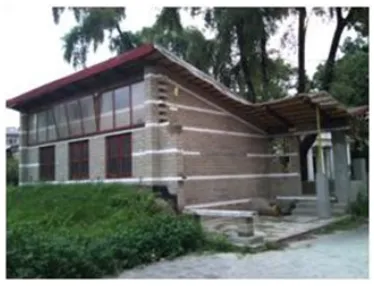
In collaboration with Department of Education (DoE), Institute of Engineering (IoE) prepared a model prototype school building suitable for warm regions of southern Nepal (Figure 3). The project was supported by MS Nepal. This paper is based on the prototype class room school buildings built in the premises of IOE, Kathmandu, Nepal as a pilot project. Prototype class room building is built with
Compressed Stabilized Earth Blocks (CSEB) and green roofing with
bamboo and Compressed Stabilized Earth Tile (CSET) is used to
enhance its environment friendly and climate responsive features. The building is expected to be climate responsive (cool in summer and warm in winter), environment friendly, cost effective and earthquake resistant. The labor intensive techniques and use of local materials not only make the project cost effective and generate employment in the villages but also ensures community participation and empowerment in the vicinity. The construction approach and sequence is such that it also helps to raise awareness about environment and transfer the knowledge on green building technology to the communities. Additionally, the green and earthquake safer school buildings serve as three-dimensional textbooks to the students and “the school facility, including building and grounds, plays a large role in the curriculum program and culture of a school (Barr, 2011).”
Figure 3. The completed prototype climate responsive school building at the premises of IoE.
Pollution emission (Kg of CO2/m2)
Energy consumption (MJ)
7.9 times less than
country fired bricks 15.1 times less than country fired bricks
Ecological comparison of building materials
Product and
thickness No of Units (per m2)
Energy consumption
(NJ per m2)
CO2 emission (Kg per m2)
Dry compressive
strength (Kg/cm2)
CSEB-24 cm 40 110 16 40 - 60
Wire Cut Bricks-22
cm 87 539 39 75 - 100
Country Fired
bricks-22cm 112 1657 126 30 - 100
Concrete blocks-20
cm 20 235 26 75 - 100
Figure 4. CSEB production: Mixing of soil, compression in the Auram3000 machine, laying for curing and laying the blocks in the wall Since its emergence in the ‘50s, compressed earth block (CEB)
production technology and its application in building has
continued to progress and to prove its scientific and technical worth. CEB production meets scientific requirements for product quality control, from identification, selection and extraction of the earth used, to quality assessment of the finished block,
procedures and tests on the materials which are now standardized. The setting up of compressed earth block production units, whether on a small-scale or at industrial level, in rural or urban contexts, is linked to the creation of employment generating activities at each production stage, from earth extraction in quarries to building work itself.
The production of CSEB involves selection of soil, mixing of soil with proper composition of different percentages of clay, sand and gravel, silt and cement, pressing the mix in compressor machine and curing the pressed block for at least 28 days (Figure 4).
As the soil in the vicinity of IoE premises was found not suitable for construction of blocks, soil was transported from nearby areas (it should, however, be noted that in the real construction site this should be avoided as far as practicable). The soil had following composition as obtained from soil report: gravel 1.12 percentage, sand 78.16 percentages, silt 19.72 percentages and clay 1 percentage. About 15 percent clay was added from another soil as clay percentage was very low in the soil and another 5 percent of cement was added as stabilizer.
CSEB in Nepal
Attempts were made to introduce it in Nepal decades ago; however it did not seem to have picked up. The reasons seem to be partly the prejudice in our minds against earth as an inferior and ‘backward’ material as compared to cement, which is considered an ‘advanced’ material. Recently, in Bardiya, for the construction of green school (Action Aid program) established the production unit and produces blocks of different forms, from plain blocks for normal walls to hollow blocks for earthquake resistant construction, U blocks for lintel and ring beams, coping blocks for the top of a wall and even tiles for the
floor and roof.
Green and climate responsive buildings
The design and construction of building should be based on Bioclimatic Design or Climatic Responsiveness, use of local material and technology, and community participation as far as practicable. The main criteria that make architecture green are:
• Use of material and constructional technology that is indigenous, has less embodied energy, and environment friendly
• Architectural design that assures comfort and human health with utilization of natural forces such as use of passive solar features and less use of active energy system such as HVAC
• Incorporation of renewable Energy System in the building to get high quality energy (such as water heating and electricity)
14
Journal of Natural Resources and Development 2011; 01: 10-19• Self incorporated storm water management system so that it harms the environment less and assures ground water recharge
• Self incorporated waste management system that reduces, reuses and recycles waste to make less waste-burden to the environment
• Healthy indoor air quality through use of healthy constructional material and proper natural ventilation
There are many features in a building that contribute to the comfort. “Elements impacting thermal comfort are building envelope, outside air treatment, temperature and humidity control, and air distribution.
A preferred air distribution system for a classroom is under floor
supplies with high exhaust / return grilles. Unfortunately preliminary
studies or the first value engineering session typically try to rule this
option out due to higher construction costs. Hence, distributing from the ceiling and returning low is sometimes utilized as a compromise (Johnson et al, 2005).” The prototype construction was planned, developed and constructed in order to realize most of the above features. Special attention was given so as to ensure that the process is simple, replicable and environment friendly. The school is designed to be relatively more functional and comfortable in all seasons. This is expected to have effect not only on the comfort and health of the children but also on their attendance, academic performance and
efficiency.
The main components of the prototype which makes the building climate responsive are: solar orientation, passive solar gain, light shelf, earth berming and evaporative cooling. The designs considering above mentioned issues are relatively more comfortable and functional in all seasons.
Solar orientation
The orientation of building is such as to maintain indoor temperature suitable both in winter and summer. The orientation of long walls is towards south, i.e. long axis stretching along east-west is favorable feature for both hot and cold seasons. In hot season (or region), short east and west walls reduces skin dominated heat load due to low-angle east and west suns that are extremely irritating. In cold season (or region), long south wall provides maximum exposure to the low angle south sun that allows solar gain through wall and fenestrations.
Passive solar gain (for cold regions)
The roof has been designed and constructed in such a way that it slopes downwards in the north so that the wall area is maximum in the south. In cold regions (Figure 5), addition to normal fenestration, there are corresponding sets of fenestrations above, the whole stretch of extra fenestration and wall being covered with polycarbonate sheet for maximizing radiant heat gain. The extra fenestration allows direct gain as well as light that provide diffuse natural light inside. The natural and passive climate control system of traditional housing style provides a comfortable indoor environment irrespective of the outdoor climatic conditions (Radhakrishnan. et al, 2011).
Figure 5. Direct gain of sun light in cold regions
The covered wall increases solar gain through solar entrapment that increases radiant temperature of wall inside. Though the radiant heat from wall is not directly used for increasing Mean Radiant Temperature (MRT) for thermal comfort as the wall in doesn’t face occupants, the stored heat reduces heating requirement that would otherwise be needed to heat up cold walls by the sun, which would loss the
credibility of the first hour sun. The U-value (thermal transmissivity)
of CSEB is more than the normal U-value demanded for the light weighted insulative envelope. So somehow capacitive insulation is desirable than resistive insulation. This is possible as the same quality that becomes reason for the decrease of insulative resistance of CSEB is also the reason for the increase in capacitive resistance because high density compact materials are poor resistance but good thermal mass.
Light shelf
There is contradiction, especially in colder region, between the direct solar-gain that favors direct contact of human body with the solar radiation, with the glare created due to the same reason. Glare should be avoided not because it is just uncomfortable but because it is adverse to human eyes. The continuous exposure to glare can contribute in impairment of human vision. This can be solved by using curtain on the window that converts ‘hole allowing direct beam radiation’ to ‘uniformly lit light source’ analogous to ‘plane’ source of light. It is usually good to get diffused light from the left in the school as students are usually right handed. However, the students closer to the window shadow the students further. It is better if light is provided from the ceiling because there is less chance of obstructed light. Carefully designed sun shading can provide visual comfort, minimise heat gains and maximise thermal comfort whilst reducing plant requirements, energy consumption and carbon emissions (Clare et al, 2009). So the concept of light shelf is to provide diffuse light out
of direct solar beam radiation by twofold reflection: one on the shelf
and the other on the ceiling.
Earth berming
The constant temperature of the earth few meters below the surface can be used to create thermal comfort condition on the account of the fact that human acclimatized comfort temperature is closely related
Figure 6. Combined evaporative cooling cum solar chimney to the mean annual temperature that is retained inside the earth due
to its large specific heat capacity. This fact is fully utilized only when
the building is completely sheltered below the earth (called as Earth Sheltered House). However, some advantages can be taken by earth berming at least taking advantage of perimeter earthen insulation
that prevents heat loss from perimeter of floor slab in case of cold
regions or conductive heat transfer to the cool earth in the hot region. The earth berming also provides lateral support to the outgoing walls and acts as extra tie to the walls.
Evaporative cooling (for hot regions)
The same extra fenestration on the top of the southern wall used for the radiant solar gain in the cold region can be made open (of course protecting from rain) to allow hot air accumulated due to heat of sun and internal gain to escape out to draw air from the opposite side. This is what we call as solar chimney effect (Figure 6). The opposite side, here the north, is shaded and so air is relatively cooler and so natural convection takes place. In order to ensure the air entering the building really sensitively cooled down, the concept of cooling bench is devised, which underneath cools the air drawn from outside in the north through dissipation of heat as latent heat of evaporation of water. The cooling bench consists of wetted U-blocks that hold and distribute wetness to the support of bench. However, contact with structural wall is avoided. The Dear & Brager of the Center for the Built Environment at the University of California show that natural ventilation can also improve indoor environment quality compared to air conditioned systems as a result of higher levels of fresh air and greater occupant control (Dear et al, 1998).
This combination of evaporative cooling cum solar chimney effect for convection provides comfort condition in hot regions.
Safer and earthquake resistant design
Nepal lies on earthquake prone zone and entire Himalayan belt falling in Zone IV, highest hazard, of earthquake risk. Therefore, it is essential that the design and construction of school buildings should
be earthquake resistant. The recent experience in Pakistan and China earthquakes, in 2005 and 2008, respectively, where an unusually large number of children were killed by collapse school buildings once again underscored the urgent need to build safer schools. The large number of people killed in different earthquakes around the globe is a reminder of the possible scale of disaster in Nepal. The children and people killed are not due to earthquake but due to poor design and construction practices - mostly due to construction of RCC structure without proper engineering input in design and construction.
The prototype building is designed as per earthquake resistant criteria for masonry structure. It has six horizontal tie beams starting from the foundation level ring beam (Figure 7). The others are at plinth level,
window sill level, lintel level, roof level and finally at rooftop level.
These are made of Reinforced Cement Concrete (RCC) cast inside U shaped CSEB blocks. It also has numerous vertical reinforcements - one at every 1.5 meters length of wall, each corner and also on each side of all openings like doors and windows. The six horizontal ring beams are tied together by the vertical ties make a structure a skeleton like mesh of reinforcement (Figure 7).
The idea is that the metal reinforcements bring ductility (flexibility)
to the building and the building is able to absorb a lot of energy before a major damage. In the event of an earthquake it should get cracks but should not collapse completely. The collapse prevention feature in buildings is essential to save lives of the people inside the building. Apart from this, the CSET roof in bamboo mesh and timber rafter is lighter than a conventional concrete (RCC) slab roof which is advantaged as it decreases the amount of force coming in the structure and also will cause less fatality in case of collapse.
Fast to build
Figure 7. Horizontal and vertical ties along with roofing rafters as a cage system in the building design.
16
Journal of Natural Resources and Development 2011; 01: 10-19construction of the prototype from foundation to final finish took 20
days. It was carried out by 17 masons roughly 30.labour/volunteers each day and 2 supervisors. This does not include time for production of CSEB, CSET , door and window frame and truss, which were made in advance or supplied by manufacturer. The making of blocks and tiles were carried out by an average of 4 masons and 20 labour/ volunteers in roughly 20 days. When the processes are mainstreamed for mass
application, this can easily be reduced significantly.
Cost effective
The cost of a CSEB block with CSET roof of 100 square meter plinth area comes to roughly NRs 0.9 million on 2008, which is comparable to the Department of Education cost for a conventional brick masonry
CGI roof school. In fact a significant part of the cost of this building
goes towards the steel and cement used for earthquake safety features, otherwise with lower earthquake safety features it would easily be cheaper than the conventional school design. Furthermore as the construction is labour intensive is possible for the villagers to contribute voluntary labour and some wood, locally made CSEB thus the actual cash requirement might be less than in a conventional school.
According to Auroville Earth Institute CSEB blocks are most of the
time cheaper than fired bricks. This varies from place to place and specially according to the cost of cement. The cost break up of a 5 %
stabilised block would be roughly as follows, for manual production
with an AURAM press 3000: Labour: 20 - 25 % Soil & sand: 20 - 25% Cement: 40 - 60 % Equipment: 3 - 5 % In the context of Auroville the following cost comparison was found— A finished meter cube of CSEB masonry is always cheaper than fired bricks: 19.4% less than country fired bricks and 47.2 % less than wire cut bricks (Auroville,
2004).
On other hand, the green school construction will contribute
significantly on economy of country. The construction material such as roofing material CGI sheets or UPVC sheets are imported either
from India or China required lot foreign currency. Apart from being an environmental challenge and a big drain on Nepal‘s economy, the life of both the UPVC sheets and GI Sheets is only 30 years. On the other hand the life of a CSET roof is many more years and also sustainable. This will help to save its precious foreign currency reserve by reducing the import of CGI sheet from India and UPVC sheet from China.
Technology transfer through proper use of local material and appropriate technique
Most of the materials of prototype class room building are available or can be produced in Southern belt and hill. Both the construction material and technique are known to people of Nepal for many years.
Participation, empowerment, employment
The construction technique of green school is labor intensive and it offers the possibility of creating employment for thousands of masons and skilled labor provided the project is implemented at a large scale. In this regard the school buildings later could inspire the local population to switch over from polluting and costly materials and that could generate thousands of green jobs for rural youth in their own regions. Due to the known material and technology, maintenance will not be a challenge to the local communities as in other type of construction.
From the educational point of view it could be a process of engaging
the community to participate in education - first in the construction
and then the resulting sense of ownership is expected to encourage the community to participate in the management of the school thereby ensuring accountability in the education system itself.
Community contribution is encourage mainly to make community to
fill ownership and also reduce the overall cost of construction. For this
reason the process of this participatory school construction involved meetings, gatherings and orientation sessions with the community at various stages of construction.
The process of community engagement
The engagement of the community is a key to this participatory school construction movement. Engaging community from the conceptualization and planning phase of the schools is essential for their sustainability. A review report of high performance school in the US suggests that “community planning process has yielded an increased emphasis on sustainability that is evident in several new school buildings (Bernstein et al. 2003).” Although the prototype school building didn’t require community participation, school planning process in real situation requires community participation. At least four formal meetings with the village leaders and communities
is essential. In the first meeting, mainly village leaders and teachers
are invited to present basic features of the green building and how it can be used to improve the educational status of the village. Usually this meeting is a bit challenging with many questions, doubts and sometimes misunderstandings as people are not aware about the CSEB and green construction technique. After convincing to the village leaders and teachers, second meeting to be carried out to present the
basic concept and benefit to the community and also discuss on plan,
elevation, location and possible community participation.
The third and fourth meetings to be carried out closer to the time of the construction; leader level meeting followed by a general public level meeting to discuss the design and the logistical and technical issues of construction. At this time the villagers to establish the School Construction Committee (SMC) and take the responsibility of volunteer mobilization and organization as well as the arrangements for the visiting masons.
Disaster risk reduction through schools
The outcome of investing in green and safer schools may have broader impact in the communities. The construction of disaster resilient school will provide an opportunity to raise awareness among the communities for culture of safety. The notion attached with the school project is that the buildings must be safer, user friendly, affordable and simple to construct. In most part of the country, access to technology is very much limited and large multi story construction is beyond the reach of the people. Therefore, simple and affordable technology is recommended.
The people killed in West Sumatra earthquake and Haiti earthquake had huge difference although the magnitude and epicenter distance are more or less same. As shown in table 2, in West Sumatra earthquake about 250000 building collapsed and only 1100 people were killed where as in Haiti earthquake about 900000 building collapsed/damaged but 2400000 people were killed.
Table 2. People killed and building collapsed/damaged in different earthquake
Earthquake Magnitude and time Building/damaged
collapsed People Killed
Sumatra 7.6 Richter Scale, Sept 30, 2009, at 5:16 pm 115000 houses collapsed & 135000
damaged 1100
Haiti 7 Richter Scale, January 12, 2010, at 16:53 pm 900000 – 1100000 shelter required 240000
The main reason of less number of death in West Sumatra was the typology of building as the majority of buildings collapsed were simple one storey rectangular buildings with light roof. Which shows the simple rectangular one storey building with light roof reduces
significantly the death toll in the event of earthquake mainly because
of light structure. The green school building with CSEB material will
reduced death toll significantly in the school and the notion of one
storey school building with local technology will be instrumental to increase awareness about building safer houses in the community.
Construction features
The design and construction of prototype building construction is based on Bioclimatic Design or Climatic Responsiveness, safe, and cost effective. The building is single storey with consist of 2 classroom. The built school in the prototype has only one usable room and other room is partly exposed for visitors to see the built-in features (Fig 8).
The main constructional features of prototype classroom building are as follows:
Foundation
Initially, four different options of foundation as in below were discussed in the Advisory Panel Meeting.
• Rammed Earth, developed by Auroville • CSEB in stabilized soil mortar 1:4:8
• RCC strip
• Stone work in stabilized soil mortar 1:19
The analysis on selection of foundation type carried out mainly with
the consideration of influencing factors; cost, cement requirement,
possibility of unequal settlement, moisture penetration control, workmanship control, sturdy formwork and construction period. On the basis of above mentioned factors and also due to special consideration of the site being in doubt of water logged, it was decided to use stone work in Stabilized Soil Mortar 1:19. The foundation sized 70 cm depth and 75 cm width.
Wall
The wall was decided to construct out of CSEB blocks applying Auroville’s technology. It consists of wall built out of 24 cm X 24 cm X 9 cm Compressed Stabilized Earth Blocks made out from Auram 3000 Press. The wall system has vertical ties at every corner: L-joints and T-joints. Also these are provided on the sides of each fenestration. The continuous wall has vertical tie in every level less than 1.5 meters. This is meant for avoiding lateral buckling due to long continuous wall.
Bands – vertical and horizontal
18
Journal of Natural Resources and Development 2011; 01: 10-19
Figure 8. Drawing showing different elements of the prototype school building The vertical ties and the ring beams consist of reinforcement of 2-10
mm diameter bars whereas the lintel consists of reinforcement of 2-12
mm diameter bars owing to more flexure that it has to bear from the
above wall. The bands, at corners and T-joints, consist of extra bars of 10 mm extending 50 cm along each adjacent wall for additional
reinforcement. The details can be seen in the figure. The stirrups of 8
mm bars are arranged in all case at spacing of 25 cm.
Roof
The roof has challenge to span 5.5 meters without use of truss that would otherwise invite costly non-green steel truss or heavy timber-consuming wooden truss. The solution to this problem was solved with design trussed beam section. A Trussed Beam consists of rafter sizing 7.5 cm X 12.5 cm with 12 mm diameter rod or high tensile steel wire pulling the rafter ends to be supported in form of triangle at the middle by 60 cm long and 7.5 cm X 15 cm section timber strut. The structural concept behind this is: the timber takes only compression
and the steel takes tension. So small cross-section of rafter is sufficient; otherwise flexure beam has to take both compression and tension
that demands large cross section. There are several Trussed Beams spaced 120 cm center to center that would support bamboo purlins
above without deflection. Architecturally this gives single pitched roof.
The purlins are spaced 35 cm center to center above which layed the bamboo strips transverse direction touched to one another. On the top of bamboo strip placed layer of plastic sheet for water
proofing. This is followed by bamboo mesh that supports thick layer
of mixture composed out of soil, cow-dung and straw that provides insulation to the roof. Then thin slurry of stabilized mud is layed that supports Compressed Stabilized Earth Tiles (CSET) made from the same machine.
Windows and doors
Windows and doors frame are of timber of 3 inch x 5 inch section. Timber is preferable as it is in common practice and available locally.
Verandah
Verandah is independent structure that stands in front of class rooms. There is no tie beam below as no severity was realized from earthquake viewpoint. The pillars of the verandah are two-third CSEB and one-third bamboo (or timber) with strut that supports the roof verandah above. Verandah can be used for outdoor classroom activities.
Rain water harvesting and low cost solar water heating
The roof of class room faces north and the roof of verandah faces south to meet at the notch of ‘V’. This notch can be used to harvest rain water that can be supplied to the low-cost solar water heater. The solar water heater lies on the verandah roof that faces south.
As the school in this part of the world is common to all and also the centre of community activities, school may become learning center for environment friendly, disaster resilient and green house design and construction. In the same time with many environment friendly features the school building can provide a comfortable learning space in itself for the students and communities to grow up with and learn about ecological issues, climate change and sustainable development. Nepal, which is in high earthquake risk zone, needs to building additional 50,000 classrooms in order to meet the Millennium Development Goal of education for all.
Because of high earthquake risk in almost all the country, the priority should be given on proper design and construction to ensure the school buildings are safe and disaster resilient. Similarly, most of the places in Nepal have extreme climate condition both cold and hot, there is a need of design and construction technique on cost effective climate responsive structure.