Evaluation of drinking water quality indices (case study:
Bushehr province, Iran)
Nematollah Jafarzadeh1,2, Maryam Ravanbakhsh3,4*, Kambis Ahmadi Angali5, Ahmad Zare Javid6,7, Darioush Ranjbar Vakil Abadi8, Shirin Ardeshirzadeh9
1Professor of Environmental Health Engineering, Department of Environmental Health Engineering, School of Public Health, Ahvaz Jundishapur University of Medical Sciences, Ahvaz, Iran
2Professor of Environmental Health Engineering, Environmental Technologies Research Center, Ahvaz Jundishapur University of Medical Sciences, Ahvaz, Iran
3PhD Student of Environmental Health Engineering, Student Research Committee, Ahvaz Jundishapur University of Medical Sciences, Ahvaz, Iran
4PhD Student of Environmental Health Engineering, Department of Environmental Health Engineering, School of Public Health, Ahvaz Jundishapur University of Medical Sciences, Ahvaz, Iran
5Associated Professor of Biostatistics, Department of Biostatistics, Ahvaz Jundishapur University of Medical Sciences, Ahvaz, Iran 6Assistant Professor of Nutrition Sciences, Nutrition and Metabolic Diseases Research Center, Ahvaz Jundishapur University of Medical Sciences, Ahvaz, Iran
7Assistant Professor of Nutrition sciences, Hyperlipidemia Research Center, Ahvaz Jundishapur University of Medical Sciences, Ahvaz, Iran
8Assistant Professor of Environmental Health Engineering, Department of Environmental Health Engineering, School of Public Health, Bushehr University of Medical Sciences, Bushehr, Iran
9Medical Practice, Observer at Cleveland Clinic Foundation, Family Medicine Department, Ohio, USA
Abstract
Background: Internal corrosion and the formation of scale in water distribution pipes are the most important problems for an urban water distribution system. Physical, chemical, or biological factors can lead to these two processes. Internal corrosion and scale formation can impact health, economy, and aesthetics. This study assessed the physicochemical quality parameters and evaluated the potential for corrosion and scale formation in drinking water at the distribution systems of 5 selected cities in Bushehr province (Kangan, Dashtestan, Dashti, Bushehr, and Ganaveh) from 2009-2012.
Methods: This study was carried out based on laboratory data collected from monthly samplings of tap water in the Water and Wastewater Company of Bushehr province during the years 2009-2012. Internal corrosion and scale formation rates were calculated using the Ryznar, Langelier, Aggressive, and Puckorius indices.
Results: The results of the Ryznar, Puckorius, Aggressive and Langelier indices indicated that the drinking water in the 5 selected cities of Bushehr province was corrosive. Moreover, the majority of parameters used to determine water quality exceeded Iran’s national standards.
Conclusion: It is concluded that there is problem of water corrosion and scaling in drinking water of distribution systems in selected cities.
Keywords: Bushehr, Water corrosiveness, Scale formation, Saturation index
Citation:Jaafarzadeh N, Ravanbakhsh M, Ahmadi Angali K, Zare Javid A, Ranjbar Vakil Abadi D, Ardeshirzadeh S. Evaluation of drinking water quality indices (case study: Bushehr province, Iran). Environmental Health Engineering and Management Journal 2017; 4(2): 73–79. doi: 10.15171/EHEM.2017.11.
*Correspondence to:
Maryam Ravanbakhsh
Email: [email protected]
Article History: Received: 16 October 2016 Accepted: 8 January 2017
ePublished: 5 March 2017
Environmental Health Engineering and Management Journal 2017, 4(2), 73–79
Introduction
A sufficient quantity of drinking water with an appropriate quality is vital for human life. Social, agricultural, and industrial developments have led to the contamination of water resources and reduced water quality. In addition, population growth and increasing living standards in communities have increased the need for water (1). The World Health Organization (WHO) considers the provision of clean water an indicator of health
development in developing countries (2). Therefore, an urban water supply system should provide an adequate amount and desirable quality of water (2). The quality of urban drinking water is affected by its chemical stability, which can cause corrosion and scale formation in water pipes.
According to the ISO (8044), corrosion is defined as the chemical and physical interactions between metal and its surrounding environment affecting the characteristics
Environmental Health Engineering and Management Journal
HE M J
© 2017 The Author(s). Published by Kerman University of Medical Sciences. This is an open-access article distributed under
Original Article
of metal and causing damage to it, its surrounding environment, and its technical system (3). Generally, this environment involves either a liquid medium, such as water flow in pipes, or a solid medium, such as soil contact with buried pipes (4). Water’s potential for corrosion is affected by physical, chemical, and biological factors. Physical factors include flow rate and temperature; chemical factors include alkalinity, hardness, conductivity, dissolved oxygen, presence of sulfate and chloride ions, dissolved gases, and pH (5,6).Biological corrosion, which is generally created by iron and sulfate reducing bacteria, is resistant to high amounts of chlorine in a distribution system (6). White et al in 2011 indicated that bio-films grown in the distribution system can impact corrosion in a drinking water distribution system. Moreover, they introduced some other microorganisms influencing corrosion, which can grow in heavy metal-rich environments (7). Scale formation can harm treatment plant equipment and fixtures. Scaling is problematic as it forms inside the pipes and reduces the area available for carrying water. Corrosion can lead to economic, health, and aesthetic problems. Corrosion in distribution pipes can cause perforation, the loss of large volumes of water, and it can reduce the space available for carrying water (8). Water with high corrosion potential can dissolve the initial materials in metal pipes and fittings and cause health problems. Corrosion may also allow heavy metals such as cadmium, copper, lead, and other pollutants to enter the water. Industry spends billions of dollars because of corrosion. According to 2002 reports, the expenses associated with corrosion in Australia, the United Kingdom, Japan, and some other countries were several times greater than the respective country’s gross national product (9). There are no exact statistics available regarding the expenses caused by corrosion and scaling in Iran; however, it has been indicated that greater than 30% of the distributed water is lost because of corrosion in the distribution systems (10).
In Iran, similar studies have been conducted to evaluate the stability of drinking water. Ebrahimi et al in 2012 investigated the potential for corrosion and scale formation in the drinking water distribution system of Koohdasht city using indices of corrosion and scale formation. Their results indicated that the drinking water in Koohdasht tends to be corrosive (11). Similarly, Jaafarzadeh et al found that the drinking water in Ahwaz city is corrosive and contains high concentrations of metals (exceeding EPA standards) including lead, iron, cadmium, copper, and manganese (12). Furthermore in 2012, Malakootian and Fatehizadeh evaluated the quality of drinking water in Bardsir city, Iran using the Langelier, Ryzener, and Aggressive indices and found that it is scaling (5). Paseban et al assessed the drinking water distribution system of Bojnoord, Iran in 2012 and found that the drinking water distribution system in Bojnoord had a scaling tendency. They suggested that scaling may lead to reductions in flow and pressure in the water system (13). In another study in 2011, Mokhtari et al indicated that the drinking water in
Ardabil city was slightly corrosive (14).Zazouli et al found similar results in Yasooj city (15).
According to the statistics obtained from the Water and Wastewater Company in Bushehr province, the amount of water produced for the province in the first 6 months of 2011 was 1 118 507 cubic meters from underground reservoirs and 37 761 285 cubic meters from surface water, of which the total amount of 23 146 177 cubic meters was consumed. Considering the high levels of water lost from the distribution system, the evaluation of reasons for such losses seems to be essential. The water pipes used in the distribution networksof these cities are galvanized metal with a lifetime of usually about 20 years. One important factor involved in water loss in distribution systems is corrosion. Therefore, it is necessary to study all factors involved in the corrosion potential of water resources and its trend in distribution systems. The potential of water to corrode and scale is characterized by its stability. Instability and low quality water in pipes can lead to corrosion and scaling in them (16,17).
Methods
This study aimed to determine the corrosion and scaling potential of drinking water in 5 selected cities in Bushehr province (Bushehr, Kangan, Dashtestan, Ganaveh, and Dashti) using the Ryzener, Puckorius, Aggressive, and Langelier water stability indices.
Bushehr has a latitude of 27°14′N and a longitude of 50°6′, 52°58′E from the Greenwich meridian and is surrounded by Khuzestan, Kohkiloye, and Boyer Ahmad provinces from the north, the Persian Gulf and Hormozgan province from the south and west, and Fars province from the east. It has an area of about 27 653 km2 and population
of over 886 000 people. According to political divisions, this province consists of nine cities, 5 of which (Kangan, Dashtestan, Dashti, Bushehr, and Ganaveh) were selected for the present study. The geographic location of this province is shown in Figure 1. The main sources of drinking water in this province are rivers, springs, groundwater wells, and the Kowsar Dam reservoir. Data used in this study was obtained from the Bushehr Water and Wastewater Company and included water quality parameters such as the concentrations of anions (chloride, sulfate, ammonium, nitrate, nitrite, fluoride), cations (calcium, magnesium, iron), total hardness, total alkalinity, pH, and total dissolved solids (TDS) that were determined regularly from drinking water distribution systems in the selected cities. Samples were taken in Bushehr, Dashtestan, and Dashti from 2010 to 2011, in Kangan from 2008 to 2012, and in Ganaveh from late 2007 to late 2010. The total number of samples used in this study was 228. Processes including sterilization of containers, sampling, and transportation and storage of samples in the lab were performed according to standard procedures (18).
t test was used to compare the means of water quality parameters with the standard limitations, applying P < 0.05 as the minimum level of significance.
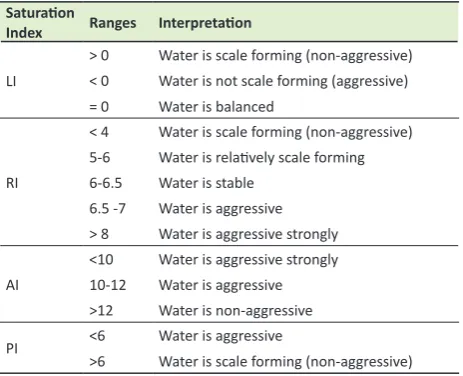
To determine the corrosion and scaling potential of the water distribution systems in the 5 selected cities, the Langelier (LI), Ryzener (RI), Puckorius (PI) and corrosivity (AI) indices were used with equations 1 to 6. pHs = 9.3 + A + B – (C + D) (11) Eq. 1
A = (Log10 (TDS)-1)/10 (14)
B = -13/12Log10 (°C + 273) + 34.5 (14) C = Log10 (Ca2+ as CaCO3)- 0.4 (14) D = Log10 (Total Alkalinity as CaCO3 )Eq. 2 RI = 2 pHs – pH (11) Eq. 3
LI= pHs – pH (11) Eq. 4 PI = 2 pHs - pHeq (11) Eq. 5
pHeq = 1.465 Log (Total Alkalinity as mg/l)+ 4.54 (11) Eq. 6
Results
The results (Tables 1 and 2) of the Langelier saturation index showed that the drinking water in Ganaveh (0.38) and Bushehr (0.18) was unstable and had a slight scaling tendency. The drinking water of Dashtestan (-0.062), Dashti (-0.23), and Kangan (-1.09) was shown to be corrosive. In comparison, the water of Ganaveh had the
highest potential for scaling, and that of Kangan and Dashtestan had the maximum and minimum corrosion potential, respectively.
The results of Aggressive index indicated that the water quality of Bushehr (12.21) and Ganaveh (12.3) cities were sever aggressive and Dashti (11.75), Dashtestan (11.91), and Kangan (10.96) were low aggressive.
Results of the Ryznar stability index indicated that the aggressiveness of the drinking water was low in Bushehr (7.01) and Ganaveh (7.04), medium in Dashtestan (7.51) and Dashti (7.78), and severe in Kangan (9.78).
According to the Puckorius Scaling Index (PSI), the 5 selected cities had a tendency for corrosion. The highest tendency was observed in Kangan (11.21).
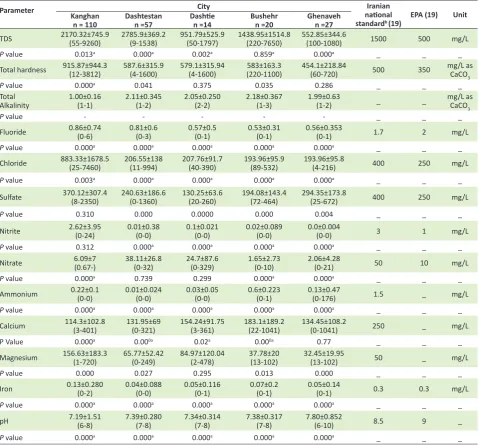
Table 3 summarizes the results of the water quality parameter analysis. The results showed that the mean concentrations of water quality parameters in some cases were higher than Iran’s national allowable limits. In Kangan, there were no significant differences between mean concentrations of No-2 and SO-4 and the Iranian
national standard. TDS, total hardness, Mg+2, and Cl-
concentrations showed positive significant differences with Iranian national standards, because they exceeded the national allowable limitations. The parameters of F-, NO-3, NH
3, Ca+2, Fe+2, and pH had no significant
differences with national standards.
Assessing the water quality parameters in the selected cities revealed that the mean concentration of TDS in Kanghan and Dashtestan exceeded the national allowable limits. Total hardness of water in Kanghan, Dashtestan, Dashti, and Bushehr also exceeded national limits. The water in Kangan had the highest chloride concentration among the selected cities which was significantly different from national standards in that it exceeded national limits. The results in Kangan and Dashti revealed that the mean concentrations of total hardness and Mg+2 had positive
significant differences with Iranian national standards. The evaluation of total water hardness in Bushehr and Ganaveh cities showed a positive significant difference with national standards. Ca+2 concentration in Ganaveh
had no significant difference with national standards. The rest of the assessed data showed no significant differences Figure 1. Geographical situation of Bushehr province.
Table 1.The interpretation of indices (11)
Saturation
Index Ranges Interpretation
LI
> 0 Water is scale forming (non-aggressive)
< 0 Water is not scale forming (aggressive)
= 0 Water is balanced
RI
< 4 Water is scale forming (non-aggressive)
5-6 Water is relatively scale forming
6-6.5 Water is stable
6.5 -7 Water is aggressive
> 8 Water is aggressive strongly
AI
<10 Water is aggressive strongly
10-12 Water is aggressive
>12 Water is non-aggressive
PI <6 Water is aggressive
Table 2. Interpretation of water quality Indices in selected cities
Index Selected city Kangan Dashtestan Dashti Bushehr Genaveh
n 110 57 14 20 27
LSI
Mean± SD
(min-max) (-3.14-0.39)-1.09±0.7 (-4.89-1.30)-0.062±0.9 -0.23±0.99(-2.56-.58) 0.18±0.44(-.82-0.9) 0.38±1.25(-2.4-2.9)
Interpretation Aggressive Aggressive Aggressive Scale formation Scale formation
AI
Mean± SD
(min-max) 10.96±0.78(8.7-12.4) 11.91±0.92(6.98-13.3) 11.75±1.03(9.31-12.6) (11.18-12.94)12.21±0.45 (9.57-14.94)12.3±1.2
Interpretation Median aggressive Low aggressive Low aggressive Not aggressive Not Aggressive
RI
Mean± SD
(min-max) (7.41-13.77)9.78±1.27 (5.41-16.98)7.51±1.7 (6.64-11.93)7.78±1.70 7.01±0.77(5.7-9.16) (4.12-11.26)7.04±1.74
Interpretation Median aggressive Median aggressive Median aggressive Low aggressive Low aggressive
PSI
Mean± SD
(min-max) (9.02-16.29)11.21±1.4 (5.32-18.5)7.23±2.1 (5.82-11.84)7.63±1.8 ()4.75-10.566.62±1.3 (5.37-11.46)7.39±1.46
Interpretation Sever aggressive Aggressive Aggressive Aggressive Aggressive
Parameter City national Iranian
standardb (19) EPA (19) Unit
Kanghan
n = 110 Dashtestann =57 Dashtien =14 Bushehrn =20 Ghenavehn =27
TDS 2170.32±745.9(55-9260) 2785.9±369.2(9-1538) 951.79±525.9(50-1797) 1438.95±1514.8(220-7650) 552.85±344.6(100-1080) 1500 500 mg/L
P value 0.013a 0.000a 0.002a 0.859a 0.000a _ _ _
Total hardness 915.87±944.3(12-3812) 587.6±315.9(4-1600) 579.1±315.94(4-1600) (220-1100)583±163.3 454.1±218.84(60-720) 500 350 mg/L as CaCO
3
P value 0.000a 0.041 0.375 0.035 0.286 _ _ _
Total
Alkalinity 1.00±0.16(1-1) 2.11±0.345(1-2) 2.05±0.250(2-2) 2.18±0.367(1-3) 1.99±0.63(1-2) _ _ mg/L as CaCO3
P value - - - _ _ _
Fluoride 0.86±0.74(0-6) 0.81±0.6(0-3) 0.57±0.5(0-1) 0.53±0.31(0-1) 0.56±0.353(0-1) 1.7 2 mg/L
P value 0.000a 0.000a 0.000a 0.000a 0.000a _ _ _
Chloride 883.33±1678.5(25-7460) 206.55±138(11-994) 207.76±91.7(40-390) 193.96±95.9(89-532) 193.96±95.8(4-216) 400 250 mg/L
P value 0.003a 0.000a 0.000a 0.000a 0.000a _ _ _
Sulfate 370.12±307.4(8-2350) 240.63±186.6(0-1360) 130.25±63.6(20-260) 194.08±143.4(72-464) 294.35±173.8(25-672) 400 250 mg/L
P value 0.310 0.000 0.0000 0.000 0.004 _ _ _
Nitrite 2.62±3.95(0-24) 0.01±0.38(0-0) 0.1±0.021(0-0) 0.02±0.089(0-0) 0.0±0.004(0-0) 3 1 mg/L
P value 0.312 0.000a 0.000a 0.000a 0.000a _ _ _
Nitrate 6.09±7(0.67-) 38.11±26.8(0-32) 24.7±87.6(0-329) 1.65±2.73(0-10) 2.06±4.28(0-21) 50 10 mg/L
P value 0.000a 0.739 0.299 0.000a 0.000a _ _ _
Ammonium 0.22±0.1(0-0) 0.01±0.024(0-0) 0.03±0.05(0-0) 0.6±0.223(0-1) 0.13±0.47(0-176) 1.5 _ mg/L
P value 0.000a 0.000a 0.000a 0.000a 0.000a _ _ _
Calcium 114.3±102.8(3-401) 131.95±69(0-321) 154.24±91.75(3-361) 183.1±189.2(22-1041) 134.45±108.2(0-1041) 250 _ mg/L
P Value 0.000a 0.000a 0.02a 0.000a 0.77 _ _ _
Magnesium 156.63±183.3(1-720) 65.77±52.42(0-249) 84.97±120.04(2-478) 37.78±20(13-102) 32.45±19.95(13-102) 50 _ mg/L
P value 0.000 0.027 0.295 0.013 0.000 _ _ _
Iron 0.13±0.280(0-2) 0.04±0.088(0-0) 0.05±0.116(0-1) 0.07±0.2(0-1) 0.05±0.14(0-1) 0.3 0.3 mg/L
P value 0.000a 0.000a 0.000a 0.000a 0.000a _ _ _
pH 7.19±1.51(6-8) 7.39±0.280(7-8) 7.34±0.314(7-8) 7.38±0.317(7-8) 7.80±0.852(6-10) 8.5 9 _
P value 0.000a 0.000a 0.000a 0.000a 0.000a _ _ _
a One sample test used to mean comparison between cities data and Iranian national standards, applying P < 0.05 as the minimum level of significance. b Maximum allowable limits: the maximum ions concentrations in the water that Its continued consumption will not be hazardous for human health with weight of 76 kg and daily water consumption of 2 L.
with national standards.
Discussion
The present study has shown that the drinking water of distribution systems in 4 of the studied cities had a tendency to corrode, and in Bushehr the tendency of scale formation was predominant. pH is an important parameter for predicting corrosion. Normally, a higher pH indicates a lower corrosion rate. A high pH contributes to protective film formation by reducing the film-free corrosion rate and increasing the precipitation rate. pH influences FeCO3, and, under certain circumstances, increasing pH decreases FeCO3 solubility and increases super saturation (20). According to the current findings, the concentrations of totally dissolved solids, chloride, and sulfate ions in drinking water are high in most of the cities studied, and this can lead to increased corrosion tendency in water. pH and total alkalinity can determine the distribution of CO2, HCO3, and CO32- fractions in water.
Species distribution depends on pH value, temperature, and ionic strength. This finding is consistent with the findings of other similar studies (21, 22).
Some studies have found that low pH (23) and high concentrations of chloride and sulfate ions (24) can lead to water being more aggressive. Husband et al showed that perforation of a copper pipe is related to cold and chlorinated waters with high pH and sulfate and low alkalinity (25). Moreover, a high correlation was found between the severity of corrosion in metal pipes and the ratio of sulfate and chloride ions to bicarbonate (26,27). These results suggest that high metal concentrations associated with low bicarbonate concentrations in water may increase its corrosion tendency. Furthermore, a low concentration of bicarbonate ions can increase the corrosivity of water, and high concentrations of dissolved solids and oxygen can increase the severity of corrosion. Dissolved solids may lead to increased water conductivity and result in increasing corrosion potential, which would be intensified with the predominance of sulfate and chloride ions and would be reduced with the predominance of bicarbonate ions (23).
In the present study, Kanghan had the most aggressive water among all the studied cities, followed by Dashtestan, Dashti, and Ganaveh. According to the results (Tables 1 and 3), the drinking water in Kanghan had the highest concentrations of chloride, sulfate, nitrite, ammonium, iron, magnesium, fluoride, and total hardness. Moreover, the lowest pH and alkalinity and the highest concentration of TDS which may contribute to causing severe corrosivity of drinking water were observed in this city. Ammonia is responsible for the rapid consumption of oxygen and chlorine in water (28). Furthermore, low alkalinity and high ionic concentrations of sulfate, chloride, iron, magnesium, and total hardness could accelerate the corrosivity of water (29). It has been suggested that high concentrations of iron in drinking water may result in a severe corrosion potential for the water distribution network of Kangan (17,30). A high TDS concentration is
usually associated with high concentrations of ions which increases the conductivity of water. The water’s ability to conduct a corrosive current has a direct relationship with conductivity (31). In contrast, the water quality indices showed that Bushehr had the best water quality parameters and a mild tendency to scaling formation. Compared with Iran’s national standards, the parameter values were in accordance with allowable limits, suggesting a more desirable water quality. It is suggested that the intensity of a lower corrosion potential can be attributed to a better quality of water in the pipes of a distribution system. Similarly, the other cities which have a higher water quality may have less aggressive drinking water. According to the findings of this study and other similar studies, the drinking water in some provinces of Iran does not have appropriate chemical stability; it seems that there are corrosion and scale formation problems in the distribution systems of these provinces. Other studies have been carried out in Shahroud (32), Kian (33), Kerman (2), Shahrood (34), Zanjan (3), Ahvaz (35), Kashan (36) and other cities to assess the quality of drinking water using aggressive and scaling indices. According to these studies, the drinking water in Shahroud, Kian, Ardebil, Zanjan, Ahvaz, and Kashan has a tendency to be aggressive, and in Kerman, there is a scaling potential. Selvam et al (37) evaluated the water quality index of groundwater resources around the coastal city of Tuticorin in southern India and concluded that the groundwater quality was impaired by man-made activities. Ravikumar et al studied the water quality index to determine the quality of surface water of Mallathahalli Lake in India and showed that the lake water fell into the poor water category (38).
Conclusion
According to the findings of the present study, the majority of water quality parameters of the drinking water in distribution pipes of the 5 studied cities exceeded Iranian national and EPA standards. Therefore, it seems there is a problem with the usage of water in some specific industries. Moreover, the drinking water in the selected cities was not chemically stable, and thus it seems there is a problem of water corrosion and scaling in the drinking water distribution systems. Corrosion byproducts and leakage of heavy metals and iron in drinking water pipes are common results of aggressive waters. Therefore, it is recommended that corrosion and scaling indices be used in future studies to attain the information needed by water operators to predict the extent of corrosion and metal leakage in water distribution networks and to enable the continuous monitoring of water quality.
Acknowledgments
This research was supported by the Deputy of Research and Technology, Ahvaz Jundishapur University of Medical Sciences. The authors hereby express their gratitude.
Ethical issues
is presented in this manuscript, and no data from the study has been or will be published separately.
Competing interests
The authors declare that they have no competing interests.
Authors’ contributions
All authors contributed equally and were involved in designing the study, data collection, and article approval.
References
1. Samaei MR, Ebrahimy A, Ehrampoosh MH, Talebi P, Khalili MH, Morovati R. A study of the physical and chemical quality of potable water in yazd. Journal of Toloo-e-Behdasht 2008; 6(2): 50-7. [In Persian].
2. Malakootian M, Fatehizadeh A, Meydani E. Investigation of corrosion potential and precipitation tendency of drinking water in the Kerman distribution system. Toloo-e-Behdasht 2012; 11(3): 1-10. [In Persian].
3. Sarin P, Snoeyink VL, Bebee J, Jim KK, Beckett MA, Kriven WM, et al. Iron release from corroded iron pipes in drinking water distribution systems: effect of dissolved oxygen. Water Res 2004; 38(5): 1259-69.
4. Teimouri F, Sadeghi M, Drees F, Hashemi H, Shakeri K, Rezaei S. Survey of corrosion or scaling potential of resources, storage and distribution of waste supply system in Kian by using Langelier and Ryznar indexes. Journal of Health System Research 2012; 8(1): 78-84. [In Persian]. 5. Malakootian M, Momeni J. Quality survey of drinking
water in Bardsir, Iran 2009-2010. Scientific Journal of Rafsanjan University 2012; 11(4): 403-10. [In Persian]. 6. Mahvi AH, Dindarlou K, Jamali HA, Alipour V. Corrosion
and scaling in Bandar Abbas Pipe water network. Hormozgan Medical Journal 2011; 14(4): 335-40. [In Persian].
7. White C, Tancos M, Lytle DA. Microbial community profile of a lead service line removed from a drinking water distribution system. Appl Environ Microbiol 2011; 77(15): 5557-61. doi: 10.1128/AEM.02446-10.
8. Dietrich AM, Glindemann D, Pizarro F, Gidi V, Olivares M, Araya M, et al. Health and aesthetic impacts of copper corrosion on drinking water. Water Sci Technol 2004; 49(2): 55-62.
9. Koch GH, Brongers MP, Thompson NG. Cost of Corrosion Study Unveiled. Houston: NACE International; 2002. 10. Ghaneian M, Ehrampoush M, Ghanizadeh G, Amrollahi
M. Survey of corrosion and precipitation potential in dual water distribution system in Kharanagh district of Yazd province. Toloo-e-Behdasht 2008; 7(3-4): 65-72. [In Persian].
11. Ebrahimi A, Kamarehie B, Asgari G, Seid Mohammadi A, Roshanaei G. Drinking water corrosivity and sediment in the distribution network of Kuhdasht, Iran. Health System Research 2012; 8(3): 480-6. [In Persian].
12. Jaafarzadeh Haghighi Fard N, Maraghie S, Marashi S, Mobad P. Assessment of bacterial, chemical and physical parameters in water treatment intake of Ahvaz. Journal of Jundishapour University of Medical Sciences 2008; 6(2): 227-34. [In Persian].
13. Motesaddi Zarandi S, Paseban A, Atamaleki A, Ahmadabadi M, Yanegh O, Ghorbanpoor R, et al. Corrosion and scaling potential of Bojnurd drinking. Journal of North Khorasan
University of Medical Sciences 2015; 6: 913-24.
14. Mokhtari SA, Aalighadri M, Hazrati S, Sadeghi H, Gharari N, Ghorbani L. Evaluation of corrosion and precipitation potential in Ardebil drinking water distribution system by using Langelier & Ryznar indexes. Journal of Health 2010; 1(1): 14-23. [In Persian].
15. Zazouli M, Barafrashtehpour M, Sedaghat F, Mahdavi Y. Assessment of scale formation and corrosion of drinking water supplies in Yasuj (Iran) in 2012. Journal of Mazandaran University of Medical Sciences 2013; 22(2):100-8. [In Persian].
16. Rabbani D, Miranzadeh MB, Motlagh AA. Study for determination of industrial water corrosivity in Kashan Fajre Sepahan Galvanizing Mills during 2005-2006 Iran. Pak J Biol Sci 2008; 11(1): 131-4.
17. Savari J, Jaafarzadeh Haghighi Fard N, Hassani AH, Shams Khoramabadi G. Heavy metals leakage and corrosion potential in Ahvaz drinking water distribution network. Water and Wastewater 2007; 18(4): 16-24. [In Persian]. 18. APHA. Standard Methods for the examination of water
and wasfewater. 20th ed. Washington DC, USA: American Public Health Association/American Water Works Association/Water Environment Federation; 1998. 19. Shabankareh Fard E, Hayati R, Dobaradaran S. Evaluation
of physical, chemical and microbial quality of distribution network drinkingwater in Bushehr, Iran. Iranian South Medical Journal 2015; 17(6): 1223-35.
20. Al-Rawajfeh AE, Al-Shamaileh EM. Inhibition of corrosion in steel water pipes by ammonium pyrrolidine dithiocarbamate (APDTC). Desalination 2007; 206(1–3): 169-78. doi: 10.1016/j.desal.2006.02.065.
21. Al-Rawajfeh AE, Al-Shamaileh EM. Assessment of tap water resources quality and its potential of scale formation and corrosivity in Tafila province, South Jordan. Desalination 2007; 206(1): 322-32. doi: 10.1016/j.desal.2006.01.039. 22. Atasoy AD, Yesilnacar MI. Effect of high sulfate
concentration on the corrosivity: a case study from groundwater in Harran Plain, Turkey. Environ Monit Assess 2010; 166(1-4): 595-607. doi: 10.1007/s10661-009-1026-2. 23. Schock M. Internal corrosion and deposition control. In: American Water Works Association. Water Quality and Treatment: A Handbook of Community Water Supplies. New York: McGraw-Hil; 1999. p. 1-17.
24. Agatemor C, Okolo PO. Studies of corrosion tendency of drinking water in the distribution system at the University of Benin. Environmentalist 2008; 28(4): 379-84. doi: 10.1007/s10669-007-9152-2.
25. Husband PS, Boxall JB. Asset deterioration and discolouration in water distribution systems. Water Res 2011; 45(1): 113-24. doi: 10.1016/j.watres.2010.08.021. 26. Zhang Z, Stout JE, Yu VL, Vidic R. Effect of pipe corrosion
scales on chlorine dioxide consumption in drinking water distribution systems. Water Res 2008; 42(1-2): 129-36. doi: 10.1016/j.watres.2007.07.054.
27. Vermilyea DA. Stress corrosion cracking of iron and nickel base alloys in sulfate solutions at 289 C. Corrosion 1973; 29(11): 442-50. doi: 10.5006/0010-9312-29.11.442. 28. Nawrocki J, Raczyk-Stanislawiak U, Swietlik J, Olejnik A,
Sroka MJ. Corrosion in a distribution system: Steady water and its composition. Water Res 2010; 44(6): 1863-72. doi: 10.1016/j.watres.2009.12.020.
30. Sarin P, Snoeyink VL, Bebee J, Jim KK, Beckett MA, Kriven WM, et al. Iron release from corroded iron pipes in drinking water distribution systems: effect of dissolved oxygen. Water Res 2004; 38(5): 1259-69. doi: 10.1016/j. watres.2003.11.022.
31. Roberge PR. Handbook of Corrosion Engineering. New York: McGraw-Hill; 1999.
32. Nazemie S, Fadaie H. Survey of corrosion and precipitation potential in water distribution system in Shahrod city using water corrosivity index. 16th National Environmental Health Conferences; Oct 1-3, 2013. Tabriz: Tabriz University of Medical Sciences; 2013. [In Persian].
33. Singley JE, Beaudet BA, Markey PH, DeBerry DW, Kidwell JR, Malish DA. Corrosion Prevention and Control in Water Treatment and Supply Systems. Park Ridge: Noyes Publications; 1985.
34. Azari A, Nazemi S, Kakavandi B, Rastgar A. Survey of scaling and corrosion potential in drinking water resources of Shahrood city by using stability indexes in 2013. Journal of Sabzevar University of Medical Sciences 2016; 22(6):
944-54. [In Persian].
35. Savari J, Jaafarzadeh Haghighifard N, Hassani AH, Shams Khoramabadi GH. Heavy metals leakage and corrosion potential in Ahvaz drinking water distribution network. Water Wastewater J 2008; 18(4): 16-24.
36. Rabbani D, Miranzadeh MB, Paravar A. Evaluating the corrosive and scale-forming indices of water in the villages under the coverage of Kashan Rural Water and Wastewater Company During 2007-9. Feyz 2011; 15(4): 382-8. [In Persian].
37. Selvam S, Manimaran G, Sivasubramanian P, Balasubramanian N, Seshunarayana T. GIS-based evaluation of water quality index of groundwater resources around Tuticorin coastal city, south India. Environ Earth Sci 2014; 71(6): 2847-67. doi: 10.1007/s12665-013-2662-y.