OPEN A
CCE
SS
JZ
AR R
esearch article
OPEN A
CCE
SS
and their effect on suspected vitamin D3 deficiency
Gabby J. Drake1*, Robyn L. Shea2, Andrea Fidgett3, Javier Lopez1 and Robert M. Christley4
1North of England Zoological Society, Caughall road, Upton, Chester, CH2 1LH, U.K.
2Sandwell and West Birmingham Hospital NHS Trust, Vitamin Laboratory, Sandwell General Hospital, Lyndon, West Bromwich, B71 4HJ, U.K. 3San Diego Zoo Global, PO BOX 120551, San Diego, CA 92112-0551, United States
4Institute of Infection and Global Health, University of Liverpool, Leahurst Campus, CH64 7TE, U.K.
*Correspondence: Dr. Gabby Drake; [email protected]
Keywords: avian, MBD, osteodystrophy, tropical birds, ultraviolet light, UVB, vitamin D
Article history: Received: 16 Dec 2016 Accepted: 9 Aug 2017 Published online: 31 Oct 2017
Abstract
Vitamin D deficiency (measured as 25(OH)D3) can occur if birds are fed a vitamin D deficient diet and do not have access to ultraviolet B light (UVB). This can result in eggs with deficient yolks and ultimately to metabolic bone disease (MBD) in chicks. In this study, hypovitaminosis D was suspected in 31 adult birds, from five orders, housed indoors long-term without prior access to UVB light. The study aimed to assess the effect of providing UVB basking lights on vitamin D status and the incidence of MBD in chicks. It also aimed to assess whether the birds would access the UVB provided. Breeding and pathology records were analysed, and birds were blood tested for 25(OH)D3 before, and 12 months after, being provided with access to UVB basking lights. The area of perching with UVB irradiance was filmed before and after the UVB basking lights were switched on. There was a significant increase in 25(OH)D3 after 12 months of UVB provision from a mean of 9.3 nmol/L to 14.2 nmol/L (P=0.001, CI=2.35 to 9.47). Annual incidence of metabolic bone disease in chicks dropped from an average of 14.3% over the three years prior to UVB provision to 3.2% in the two years afterwards. Birds appeared to actively seek the basking spots and significantly increased the proportion of time spent in the area of UVB irradiance (P=0.02). No correlation was found between the total amount, or change, in time spent in the UVB area and the final, or change, in number of individual birds with circulating 25(OH)D3 levels. These results show that indoor-housed birds will bask in UVB light if provided and that this radiation can increase vitamin D levels of the birds, which may prevent MBD in their offspring.
Introduction
Vitamin D is a steroid hormone essential for calcium and bone metabolism in most vertebrates, including birds (Bauck, 1995, Watson, 2014). Adequate vitamin D, calcium and phosphorus are required for normal growth. Vitamin D deficiency can cause metabolic bone disease (MBD), characterised by low bone density, bowing of long bones and pathological fractures (Adkesson and Langan 2007; Cousquer et al. 2007; Stanford 2006; Tangredi and Krook 1999; Van Wyk 1993).
Vitamin D precursors are either obtained through the diet or endogenously produced in the skin or uropygial gland secretions through photo-conversion by ultraviolet B (UVB) light found in sunlight, wavelengths 290–315 nm. The major circulating vitamin D metabolite is 25-hydroxycholecalciferol (25(OH)D3) which represents the sum of dietary and sunlight/ UVB sources (Lupu and Robins 2013; Watson 2014). 25(OH) D3 has the longest half-life of the metabolites, and serum or plasma levels provide the most stable indicator of vitamin D status (Bar 2008); thus, it is the most commonly used metabolite for measuring vitamin D. 25(OH)D3 is converted to calcitriol (1,25-dihydroxyvitamin D), the active vitamin D metabolite, in the kidneys.
Production of 25(OH)D3 via the UVB pathway is self-regulating due to build-up of inert metabolites in the cutis (Lupu and Robins 2013). However, oral supplementation of 25(OH)D3 is poorly regulated via negative feedback (Bar 2008), and can result in an excess, which could be harmful to the bird (Watson 2014; Scott Echols 2006). For this reason, exposure to UVB light is a safer alternative to dietary supplementation (Stanford 2006; Lupu and Robins 2013), especially if species requirements are unknown. Domestic poultry given UVB via natural sunlight significantly increased the 25(OH)D3 content of their egg yolks (Kuhn 2014), suggesting that the provision of UVB light in sufficient quantities to the hens in this study should be a way to increase yolk vitamin D3 to provide for the chick in the first three weeks of life.
At Chester Zoo, osteodystrophy and pathological fractures consistent with MBD were identified in the chicks of multiple tropical bird species breeding in an indoor aviary. The affected chicks and their parents had no access to either sunlight or UVB radiation in the wavelengths 290–315 nm. Since dietary calcium and calcium to phosphorus ratios were known to be adequate, vitamin D deficiency in parents was hypothesised to be the cause of the MBD in chicks. This study was designed in response to these clinical issues and addressed the following objectives: to investigate whether this population of birds would utilise artificial UVB basking spots; and to assess the effect of this method of UVB light supplementation on the circulating vitamin D levels (measured as 25(OH)D3) of the adult birds and on the incidence of MBD in chicks.
Materials and methods
This study was opportunistic as UVB lighting was being installed in the study aviaries as part of ongoing husbandry improvements. Study design was longitudinal, each bird was its own control, thus ensuring no bird was denied UVB light. The study was approved by the Ethical Committee of both Chester Zoo and the University of Liverpool. Samples were taken during clinical investigation and followed up by a qualified veterinary surgeon.
Animals and husbandry
Birds were housed in five large aviaries (minimum 15 m2 to
maximum 25 m2) within a tropical house. Thirty-one adult birds
of five orders (Table 1) had been living in these aviaries for more than one year at the start of the study in January 2012, and were thus eligible for inclusion. A calculation using Altman’s nomogram revealed a sample size of 25 birds should be sufficient to identify biologically significant changes in vitamin D (Sabin and Petrie 2011). Aviary groups remained stable, with the exception of birds added through breeding (n=25), or removed by death (n=3 adults) or removed as young stock (fully grown) once independent from their parents (n=16). A singe male was briefly moved to the neighbouring study aviary due to aggression. Pathology and breeding records for all birds housed in these aviaries were reviewed for breeding activity and cases of metabolic bone disease between 2009 and 2014 inclusive.
Birds were fed species-appropriate diets formulated by a nutritionist, comprising a combination of commercial pellets, fresh chopped fruit and live invertebrates, and blends made with pellets, crushed egg shell, vegetables and cooked egg as appropriate. Diets had a mean calcium content of 1.36% dry matter. Diets contained suitable calcium to phosphorus ratios (mean 5.7:1) and remained unchanged throughout the study period.
Husbandry alterations
Two UVB spot-lights (Arcadia 160W Basking lamps, Arcadia Products plc, Redhill, UK), producing light in the wave lengths 290–315 nm, were installed in each aviary. In each aviary, one light was positioned high, above the branches used for perching, to give tree dwelling birds UVB access—subsequently referred to as the high resource area; and the second was located at a height to provide ground dwelling birds with an area of UVB, subsequently referred to as the low resource area. Lights were situated a mean distance of 66.3 cm (range 60–90 cm) from the perch or ground. Lights and perches were fitted for at least three weeks prior to light illumination, to allow the birds to acclimatise to the new aviary furniture. Basking lights were then switched on (Day 0 for study timings) from 10:00 to 14:00 every day from Day 0 to Month 4,
Order Species (Common name) Scientific name Number in study MBD seen
Galliformes Congo peafowl Afropavo congensis 1 Yes
Cuculiformes White-crested turaco Tauraco leucolophus 3 Yes
Passeriformes Snowy-headed robin chat Cossypha niveicapilla 2 Yes
White-rumped shama Copsychus malabaricus 2 Yes
Chestnut-backed thrush Zoothera dohertyi 1
Montserrat oriole Icterus oberi 2 Yes
Fairy bluebird Irena puella 2
Brazilian tanager Ramphocelus bresilius 2
Columbiformes Mindanao bleeding heart dove Gallicolumba criniger 4 Yes
Luzon bleeding heart dove Gallicolumba luzonica 1 Yes
Socorro dove Zenaida macroura graysoni 4
Green-naped pheasant pigeon Otidiphaps nobilis nobilis 2 Yes
White-naped pheasant pigeon Otidiphaps nobilis aruensis 3 Yes
Piciformes Brown-breasted barbet Lybius melanopterus 2
Total 31
then from 06:00 to 14:00 for the rest of the study (Months 5–12). The output of the lights was monitored throughout the study using a UVB meter (Solarmeter® Model 6.2, SOLAR LIGHT COMPANY INC. Glenside, PA, USA, measuring µw/cm2 UVB light).
Bulbs were tested at 30 cm and gave readings between 90 and 134 µw/cm2 when new. They were replaced if their output dropped by more than 50% from the initial reading. There was no other source of UVB in the study aviaries.
Health assessment and vitamin D3 sampling
All birds were examined prior to the main breeding season in 2012, which was prior to Day 0. The birds were weighed, clinically examined, radiographed and blood sampled. Where a sufficient sample was obtained, blood biochemistry was checked as well as vitamin D (measured as 25(OH)D3). The birds were re-examined and blood sampled again 12 months after illumination of the basking lights. At the initial examination, radiographic bone density and conformation was considered normal for all birds and plasma ionised calcium, where measured, was within normal avian limits (>1.00 mmol/L) (data not shown), so these tests were not repeated.
Blood samples for 25(OH)D3 analysis were taken from the jugular, ulnar or metatarsal vein (as appropriate) and placed in heparinised blood tubes (Microvette 500 lithium heparin, Sarstedt, Numbrecht, Germany). Sample volume never exceeded 1% of body weight as per avian guidelines (Best 2008). Heparinised samples were centrifuged at 11,800 rpm for three minutes and separated plasma samples were placed in Eppendorf tubes and either sent directly to the laboratory or frozen at –20°C until batches could be sent for analysis. The drops remaining in the syringe hub were placed on filter paper (Whatman 903 filter paper, GE Healthcare, Whatman Plc, Maidstone, UK) and air-dried for blood spot analysis. In some birds, small sample volume allowed only one technique to be used (blood spot, n=4; plasma, n=5).
At Sandwell & West Birmingham Hospitals NHS Trust Vitamin Laboratory, UK, blood spots were analysed for 25(OH)D3 as 3 mm punches from the filter paper on a Waters TQS Tandem Mass spectrometer using an electro-spray ionisation interface with a Water’s i-Class UPLC, following liquid/liquid extraction with a derivatisation step enhancing small volume analysis.
Plasma 25(OH)D3 was assayed using a Waters ACQUITY UPLC and Quattro Premier XE MS/MS mass spectrometer (Hertfordshire, England) with an electro-spray ionisation interface following liquid/liquid extraction of the sample. Both methods are linear to 1,100 nmol/L with a limit of quantitation of 7.5 nmol/L for 25(OH)D3. The plasma assay is accredited by the Vitamin D External Quality Assessment Scheme (DEQAS) and the laboratory is accredited by the Clinical Pathology Accreditation (CPA) UK Ltd. Using human samples, the blood spot assay had been aligned with the plasma assay so that blood spot and plasma results were comparable.
UVB resource use
UVB meter readings were used to map out the area of UVB radiation produced by each bulb (high and low) and the intensity of radiation at bird level. In each aviary, a “UVB resource area” was defined as the basking areas at bird level where >10 µw/cm2 UVB
irradiance was detected. This constituted a radius of between 60 and 80 cm in each case. The peak UVB reading at bird level was also recorded, with an average of 31 µW/cm2 (24–65 µW/cm2).
A webcam (Logitech Webcam HD C270, Logitech Europe S.A., Lausanne, CH) was used to film the UVB resource areas in each aviary, as the presence of an observer could alter bird behaviour. Footage was recorded on a laptop outside the aviary using movement recognition software (iSpy freeware, http://www. iSpyconnect.com). Each resource area was filmed in each aviary
(n=6) for five to seven consecutive days between 06:00 and 14:00 during the six-week period prior to UVB light illumination (baseline data). Filming was repeated at least four weeks after light illumination (UVB data).
Mpeg video clips were reviewed by a single observer using QuickTime Player (QuickTime 7.0, Apple Inc., Cupertino, CA, USA) and the time stamp was used to record the time and duration of a visit by any bird accessing the UVB resource during the observations. Birds were identified to species level in all cases and individually where possible. Where two indistinguishable birds were present in an aviary their UVB resource use was recorded as the average of the total time one or both birds were visible in the UVB resource. Aviaries were not filmed if birds were breeding, as brooding could restrict access to the UVB resource.
Statistics
All data analyses were performed using Microsoft Excel (2010, Microsoft Corporation, Redmond, WA, USA) and R (R core team, 2013).
Annual incidence of MBD in chicks before and after provision of UVB supplementation was compared using Fisher’s exact test due to small sample size in the post treatment group. This test was performed excluding the first treatment year (2012) as initiation of supplementation coincided with the start of the breeding season, thus there would have been insufficient time for circulating 25(OH)D3 levels in the hen birds to change.
25(OH)D3 levels obtained by each method (blood spot and plasma) were averaged between the methods for each sampling point to minimise missing data, as some samples only provided enough volume for one method. The lower limit of the assay was 7.5 nmol/L; thus, values reported as <7.5 nmol/L were given a nominal value of 7.5 nmol/L for statistical analysis. A Wilcoxon-signed ranks test for non-parametric paired data was used to compare values from pre-supplementation and 12 months after UVB supplementation.
Behavioural data were only available from three of the six aviaries holding a total of 15 birds due to issues with the video footage. Data were analysed for time spent in the resource area
Year Number chicks
bred Number chicks with MBD Annual incidence of MBD in chicks at risk (%) No UVB provision
2009 23 4 17.4
2010 27 3 11.1
2011 41 6 14.6
Total 91 13 14.3
Partial UVB provision
2012 25 4 16.0
UVB provision
2013 13 0 0.0
2014 18 1 5.6
Total 31 1 3.2
Table 2. Number of birds bred and cases of metabolic bone disease (MBD) identified per year.
for baseline and UVB access. For each bird, the total time (sec), spent in the resource area was calculated. Total time observed was calculated. As not all observation periods were the same length, the proportion of time spent in the resource area during observation was used for comparison.
UVB radiation doses (mJ/cm2) were calculated from the
irradiance received by each bird (mW/cm2) multiplied by the
exposure time (sec) (Lupu and Robins 2013).
It was noted during video analysis that some birds roosted overnight on the UVB resource perches. As light intensity is the trigger for birds to rise in the mornings, birds were frequently still roosting during the first hour of data collection during the baseline data collection period, but roused immediately once the UVB basking lights came on during the UVB data collection period. In order to allow a comparison of baseline and UVB data, only activity between 10:00 and 14:00 was compared to avoid this “roosting effect”. A Wilcoxon-signed ranks test was used to compare the proportion of time spent in the UVB resource pre- and post-UVB supplementation.
Spearman’s rank correlation tests were used for all correlation assessments. The full data set from 06:00 to 14:00 was used to compare time spent accessing the UVB basking light with final 25(OH)D3 concentration and changes in 25(OH)D3, as baseline observation data were not required. The data from 10:00 to 14:00 were used to assess for correlation between change in UVB resource use and the final 25(OH)D3 and changes in 25(OH)D3 concentrations.
Results
MBD cases
Annual incidence of MBD appeared to decrease from a range of 11.1–17.4% before UVB supplementation to a range of 0–5.6% in the years after UVB supplementation was initiated (Table 2). However, this difference was not statistically significant (P=0.19).
Vitamin D3
There was a significant increase in circulating 25(OH)D3 levels after 12 months of UVB supplementation (P=0.001, CI=2.35 to 9.47; Figure 1, full data set Appendix 1). However, there was individual variation with some birds showing a marked increase, while little change was observed in others. The mean pre-supplementation circulating 25(OH)D3 was 9.3 nmol/L and the mean after 12 months was 14.2 nmol/L, thus exhibiting a mean increase of 4.9 nmol/L across all birds. The pre-supplementation range was 7.5 to 27.7 nmol/L, interquartile range (IQR) 7.5 to 8.25 nmol/L. Twelve months after UVB supplementation the range was 7.5 to 48.1 nmol/L, IQR 7.5 to 15.2 nmol/L.
25(OH)D3 levels were reported as <7.5 nmol/L in a number of birds since this was the lower limit of quantitation of the assay. As a result, actual levels in these birds may have been anywhere between 0 and 7.4 nmol/L. Therefore, actual increases could be larger than identified for 12 of the birds whose baseline values were at 7.5 nmol/L and increased above this threshold after 12 months, which could mean a biologically significant increase for the individual. Six of the birds remained below 7.5 nmol/L, so it is unknown whether their levels increased or decreased between 0 and 7.4 nmol/L. The measures of three out of four birds with levels that dropped, went below 7.5 nmol/L, so there may actually have been larger decreases than could be detected by the assay.
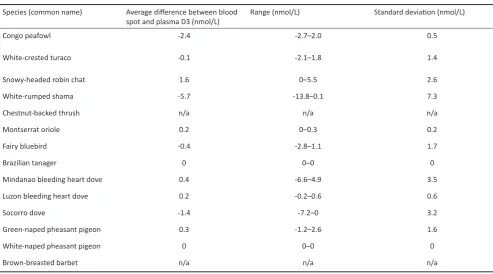
Seven hens bred in 2012, and three of these were birds with circulating 25(OH)D3 levels which dropped after supplementation. Table 3 shows the mean difference between blood spot and plasma methods, range and standard deviations for these results by species.
Use of UVB resource area
Baseline observations compared to UVB provision
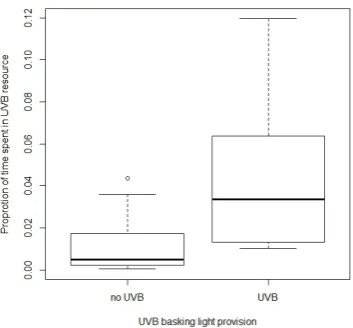
The proportion of time spent in the UVB resource area increased significantly after the basking lights were illuminated (P=0.02; point estimate of mean 0.0272 ± 0.0204; Figure 2, full data set
Species (common name) Average difference between blood
spot and plasma D3 (nmol/L) Range (nmol/L) Standard deviation (nmol/L)
Congo peafowl -2.4 -2.7–2.0 0.5
White-crested turaco -0.1 -2.1–1.8 1.4
Snowy-headed robin chat 1.6 0–5.5 2.6
White-rumped shama -5.7 -13.8–0.1 7.3
Chestnut-backed thrush n/a n/a n/a
Montserrat oriole 0.2 0–0.3 0.2
Fairy bluebird -0.4 -2.8–1.1 1.7
Brazilian tanager 0 0–0 0
Mindanao bleeding heart dove 0.4 -6.6–4.9 3.5
Luzon bleeding heart dove 0.2 -0.2–0.6 0.6
Socorro dove -1.4 -7.2–0 3.2
Green-naped pheasant pigeon 0.3 -1.2–2.6 1.6
White-naped pheasant pigeon 0 0–0 0
Brown-breasted barbet n/a n/a n/a
four birds which bred in 2013, and four of five birds which bred in 2014, had previously produced chicks with MBD, supporting the possibility of a true reduction following UVB provision. The annual incidence of 5.6% in 2014 represents a single case of MBD from the snowy-headed robin chats. Physiologically, we find the reduction in MBD in offspring following provision of UVB basking light to adults and increased 25(OH)D3 in adults to be consistent with other more-studied avian species. Sub-clinical vitamin D deficiency in chickens can result in deficiency in their egg yolks and in the developing chicks, leading to MBD, which can be resolved by addressing the vitamin D3 levels of the adults (Coto et al. 2010b).
No clinical issues were found in the adult birds in this study, despite hypothesised vitamin D deficiency. This is consistent with work on domestic poultry where hens with vitamin D deficiency, but ample calcium, show no clinical signs of hypovitaminosis D (Nascimento et al. 2014). The diet provided was adequate for calcium. Although offered zoo diets are formulated complete, it is well documented from intake studies there may be differences in nutritional balance compared to the actual diet eaten (Fidgett and Robert 1993). Therefore, we cannot be certain of nutrient bioavailability from the data available and cannot rule out a dietary component of the MBD seen in chicks. However, the diets offered did not change during the study and we have no reason to suspect the birds altered their intake during this time, therefore diet is unlikely to be the cause of the reduction in MBD.
Artificial provision of UVB basking lights had a positive effect on vitamin D3 levels in the birds in this study, with a statistically significant increase in circulating 25(OH)D3 following 12 months of eight hours per day ad libitum UVB basking light access. As there is believed to be effective feedback to prevent excess levels of vitamin D3 accumulating from UVB exposure (Lupu and Robins 2013), this suggests that some of the birds could have been sub-clinically deficient at the start of the study, as their levels were physiologically able to rise.
Average pre-supplementation circulating 25(OH)D3 concentration was 9.3 nmol/L in this study, which appears low when compared to some other avian taxa. In experimental work with African grey parrots (Psittacus e. erithacus), Stanford (2005) reported a mean pre-UVB plasma 25(OH)D3 concentration of 23.1 nmol/L in captive birds. In budgerigars (Melopsittacus
undulatus) given no UVB access, 25(OH)D3 levels of 7.93–16.03
nmol/L have been reported (Lupu and Robins 2013). In other avian orders, cases of metabolic bone disease have been reported in Appendix 1). This corresponds to an average increase of 6 min 32
sec per bird, per four hour observed window per day (CI 1 min 39 sec to 11 min 25 sec) in the UVB resource area.
The pre-supplementation minimum proportion was 0.000360, corresponding to 5 sec, median 0.005008 (1 min 12 sec), IQR 0.002644 to 0.017090 (38 sec to 4 min 6 sec) and maximum 0.043700 (10 min 29 sec) per bird per four hour observed window per day. After 12 months of UVB supplementation this had increased to a minimum proportion of 0.01010 (2 min 25 sec), median 0.03360 (8 min 4 sec), IQR 0.01360 to 0.05805 (3 min 15 sec to 13 min 56 sec) and maximum 0.11950 (28 min 41 sec) per bird per four hour observed window per day. However, within each of the aviaries, some birds dramatically increased their usage of the UVB resource area while others reduced their usage.
Estimated UVB doses
When the lamp was in use, the daily average time spent in the UVB resource area (>10 uW/cm2) was 18 min 35 sec (range 2 min 46 sec to 40 min 17 sec). Minimum average daily UVB doses were therefore 11.15 mJ/cm2 (range 1.66 to 24.17 mJ/cm2). Maximum average calculated daily doses based on the average maximum irradiance of 31 µW/cm2 were 34.57 mJ/cm2 (5.15 to 74.93 mJ/ cm2) if the birds remained in the peak area of UVB emitted by the
basking light.
Correlations between UVB resource use and average 25(OH)D3
Final, and change in, circulating 25(OH)D3 concentration after 12 months was not associated with the proportion of time spent in the UVB resource (rho=0.08, P=0.8 and rho=0.17, P=0.59, respectively). The final, and change in, circulating 25(OH)D3 concentration was not associated with the change in proportion of time spent in the UVB resource before and after the basking lights were illuminated (rho=0.12, P=0.7 and rho=0.23, P=0.47, respectively).
Discussion
The incidence of MBD in chicks appeared to reduce following UVB basking light provision to the adults from 14.3% to 3.2% subsequently. However, the small numbers involved, combined with the limited number of years of follow up, may have contributed to the lack of statistical significance. Fewer chicks were bred in 2013 and 2014, compared to previous years. However, three of Figure 1. Box and whisker plot of vitamin D (25(OH)D3) concentrations
growing wild birds with vitamin D3 levels this low. In American crows (Corvus b. brachyrhynchos), plasma 25(OH)D3 values of 8.0 (± 2.65) nmol/L were found in young wild birds with MBD compared to 20.0 (± 6.04) nmol/L in unaffected birds (Tangredi and Krook 1999). In Columbiformes, values of 3.90 nmol/L were reported for three clinical MBD cases in young wild collared doves
(Streptopelia decaocto) and a range of 10.0–25.0 nmol/L is quoted
as normal, although this is unreferenced (Cousquer et al. 2007). If this ‘normal’ range is accurate, then 83% (25/30) of the birds in this study were deficient in vitamin D3 at the start, falling to 44% (12/27) by the end of the study.
Average 25(OH)D3 concentration after 12 months of UVB supplementation in this study was 14.2 nmol/L; an average increase of 4.9 nmol/L. These are considerably lower levels and smaller changes than those identified in African grey parrots by Stanford (2005) who reported a mean increase in plasma 25(OH) D3 concentration of 77.9 nmol/L after one year of 12 hours per day of direct UVB light. However, the same study also found mean concentrations of 33.68 nmol/L (95% CI 8.00–59.63) in 19 wild African grey parrots, suggesting such high 25(OH)D3 concentrations, although not detrimental to the birds, may not be physiologically required. In budgerigars, increases in 25(OH) D3 of 1.61–11.31 nmol/L, to 9.54–27.34 nmol/L, occurred after short duration UVB exposure experiments (Lupu and Robins 2013); changes which are comparable with those observed in the present study. Despite there being considerable variability in response to UVB provision in this study, the overall tendency was for circulating 25(OH)D3 levels to increase with UVB basking light provision. This is especially significant as birds were not forced to remain under the UVB basking lights, unlike in the experimental work discussed, but were free to access the resource, suggesting provision of UVB basking lights for indoor housed birds does not have to be ubiquitous to have an effect. In addition, the spectrum of the lights used in this study is more akin to natural sunlight than those used by Lupu and Robins (2013), which contained proportionally higher levels of very short wavelength UVB light which can cause damage to the skin and eyes of birds.
Blood spot and plasma results were averaged to minimise missing data where only one method was possible in this study. The blood spot assay was aligned with the plasma assay using human samples, not avian samples. There is evidence that these two methods may not be comparable in reptiles, likely due to issues with lower haematocrits significantly altering the spreading characteristics of reptilian blood compared to mammals (Whitehead and Foggett 2016); however, bird haematocrits are more similar to those of mammals and our data suggest that the two methods are acceptably similar. This is concurred by Michaels (2015) who states that results for these two methods should be comparable within the same study, as applies here.
Multiple species were used in this study, and despite the mechanism for production of vitamin D3 appearing to be well conserved throughout the taxonomic groups (Dacke 2000; Bar 2008), species variation, both physiologically and in feeding and basking behaviours, may have affected conversion efficiency and therefore influenced these results. In a zoological collection, it is rare to have large numbers of the same species to study, and therefore when an opportunity arises to perform a study such as this, even with multiple species, the generated data are valuable. Some of the birds’ circulating 25(OH)D3 levels did not change detectably post-supplementation (n=6) and some actually reduced (n=4). Some birds may not have received adequate doses because in a mixed aviary, there may be competition for the UVB resource. In addition, birds were given the freedom to voluntarily access the resource, and the UVB provided by a bulb is weak compared to sunlight. Doses of 180 mJ/cm2 (0.012 mW/ cm2 over 6 hr for 5 d) have been reported to produce a significant
increase in plasma 25(OH)D3 in budgerigars, while doses of 65 mJ/ cm2 (0.012 mW/cm2 for 2 hr) resulted in no significant increase (Lupu and Robins 2013). These are considerably larger doses and of shorter wavelengths—due to differences in the lamps used— than the birds in this study received, but this perhaps suggests that the UVB dose could have been inadequate for some study birds. However, the experiments of Lupu and Robins (2013) lasted only five days, unlike the present study in which long-term exposure was provided. This may be why, in the majority of birds, circulating 25(OH)D3 increased through bioaccumulation, despite the low doses. In chickens, circulating 25(OH)D3 has a half-life of approximately 21 days (Coto et al. 2010a) and changes in circulating 25(OH)D3 may occur more slowly than accounted for by Lupu and Robins (2013).
Three of the four birds whose circulating 25(OH)D3 levels decreased after 12 months of UVB provision were breeding hens, raising the possibility that their starting levels were either artificially elevated as serum stores transferred to yolk at the time of first sampling, or were depleted by egg laying by the time of the second sample. One of these hens was the snowy-headed robin chat hen, which produced a MBD-affected chick- following provision of UVB light. In domestic poultry, increases and decreases in yolk vitamin D have been shown to occur in line with both circulating vitamin D levels and UVB access (Narbaitz et al. 1987; Kuhn 2014). Values from wild birds would also aid in the understanding of normal ranges for each species, to truly define deficiency in these hens.
The differences in effect may also be due to interspecific variation in the efficiency of conversion of 7-dehydrocholesterol to pre-vitamin D3 in the skin. For example, canopy-dwelling species, where UVB exposure should be high in the wild, might have received insufficient doses compared to naturally-reclusive species which may be better adapted to photoconvert at lower light levels. This hypothesis is consistent with the poor responses seen in this study in the Brazilian tanagers, fairy bluebirds and white-crested turacos, all of which are canopy species; this effect warrants further investigation.
The indoor housed tropical birds in this study chose to access UVB basking lights when given the opportunity, with a statistically significant increase in the proportion, and amount, of time spent in the UVB resource area observed after the lights were illuminated. This finding is consistent with another study in which various birds showed a preference for an area of ultraviolet spectrum lighting (Ross 2013). Not all birds showed increased usage in each aviary. The variation in use could represent competition from dominant species preventing access by the shyer ones. For instance, the snowy-headed robin chats were observed competing with the white -rested turacos (which are much larger and more aggressive birds) for access, and the proportion of time spent in the resource by the robin chats decreased as that of the turacos increased. This competition effect would be worth investigating further, as it could have a significant impact on the effectiveness of UVB basking light provision in mixed species exhibits.
It is unclear why the birds chose to spend more time under the lights. They may be instinctively basking in the “sunlight”; indeed, many birds were observed preening while sitting under the lights. Equally, the birds may be seeking the heat produced by the lights, or the UVA light emitted by the bulbs, as birds can see into this spectrum (Rajchard 2009). Additional experiments substituting the UVB bulbs with basking lamps which produce different combinations of heat, UVA and UVB would be required to disentangle these possible influences and determine the best conditions to attract birds to a therapeutic source of UVB.
area. However, data for both circulating 25(OH)D3 levels and behavioural observations were only available from 13 birds for this comparison. Hence, the sample size is small in these analyses, and a weak correlation may have been missed. The results could also have been influenced by interspecies variation, the species mixes and the necessity to average data between birds which could not be individually identified. Some females in this comparison bred in the 2012 season and depletion to yolk may have affected circulating 25(OH)D3 levels. Finally, the behavioural data collection period constituted one week, which equates to only a fraction of the study time, and so may not truly represent the birds’ activity.
In conclusion, provision of UVB basking light in the wavelengths 290–315 nm to indoor housed tropical birds on an ad libitum basis can result in increases in circulating vitamin D3, levels which may be biologically significant. Therefore, UVB basking light access could be used to reduce vitamin D3 deficiency in a variety of species without restricting aviary sizes. Importantly, the incidence of metabolic bone disease in chicks appeared to be reduced following UVB provision for the adult birds. Birds appeared to actively choose to access the ultraviolet basking spots and showed a significant increase in the proportion of time spent in an area where this resource was provided. Whether this preference was due to the UVB, UVA or increased heat from the lamps could not be determined from the data available. Particular care should be taken when providing UV to mixed species aviaries, as interspecies competition may prevent some species from accessing the resource.
Acknowledgements
The authors would like to thank the Bird Team of Chester Zoo, with special acknowledgment to Andrew Owen, Wayne Mcleod and Clare Wylie for their support of this work and the veterinary team, with special thanks to Alison Kelsall and Tanya Grubb for help with the diagnostic sampling.
References
Adkesson M.J., Langan J.N. (2007) Metabolic bone disease in juvenile Humboldt penguins (Spheniscus humboldti): Investigation of ionized calcium, parathyroid hormone, and vitamin D3 as diagnostic parameters. Journal of Zoo and Wildlife Medicine 38(1): 85–92. Bar A. (2008) Review: ‘Calcium homeostasis and vitamin D metabolism
and expression in strongly calcifying laying birds. Comparative Biochemistry and Physiology Part A 151: 477–490.
Bauck L. (1995) Nutritional Problems in Pet Birds. Seminars in Avian and Exotic Pet Medicine 4(1): 3–8.
Best J.R. (2008) Passerine birds: approach to the sick individual. In: Chitty, J. and Liertz, M. (eds). BSAVA Manual of Raptors, Pigeons and Passerine birds, Gloucester, UK: British Small Animal Veterinary Association, 356–364.
Calvert I. (2004) Nutritional problems. In: Girling, S.J. and Raiti, P. (eds).
BSAVA Manual of Reptiles (2nd Edition), Gloucester, UK: British Small Animal Veterinary Association, 289–308.
Coto C., Cerate S., Wang Z., Yan F., Min Y., Costa F.P., Waldroup P.W. (2010a) Effect of source and level of vitamin D on the performance of breeder hens and the carryover to the progeny. International Journal of Poultry Science 9: 623–633.
Coto C., Cerate S., Wang Z., Yan F., Waldroup P.W. (2010b) Effect of source and level of maternal vitamin D on carryover to newly hatched chicks.
International Journal of Poultry Science 9: 613–622.
Cousquer G.O., Dankoski E.J., Patterson-Kane J.C. (2007) Metabolic bone disease in wild collared doves (Streptopelia decaocto). Veterinary Record 160: 78–84.
Dacke C.G. (2000) Chapter 18 – The Parathyroids, Calcitonin, and Vitamin D In: Causey Whittow G. (ed). Sturkie’s Avian Physiology (5th Edition), Cambridge, Massachusetts: Academic Press, 473–488.
Fidgett, A.L. and Robert, J.N. (1993) An investigation into nutrition and mortality in captive St. Lucia parrots (Amazona versicolor). Dodo, Journal of the Wildlife Preservation Trusts 29: 103–125.
Lupu C. and Robins S. (2013) Determination of a safe and effective ultraviolet B radiant dose in budgerigars (Melopsittacus undulatus): A pilot study. Journal of Avian Medicine and Surgery 27(4): 269–279. Mattila P., Valaja J., Rossow L., Venalainen E., Tupasela T. (2004) Effect
of vitamin D2- and D3-enriched diets on egg vitamin D content, production, and bird condition during an entire production period.
Poultry Science 83(3): 433–440.
Michaels C.J., Antwis R.E., Preziosi R.F. (2015) Impacts of UVB provision and dietary calcium content on serum vitamin D3, growth rates, skeletal structure and coloration in captive oriental fire-bellied toads (Bombina orientalis). Journal of Animal Physiology and Animal Nutrition 99: 391–403.
Narbaitz R., Tsang C.P.W., Grunder A.A. (1987) Effects of vitamin D deficiency in the chicken embryo. Calcified Tissue International 40: 109–113.
Nascimento G.R., Murakami A.E.I., Guerra A.F.Q.M.I., Ospinas-Rojas I.C.I, Ferreira M.F.Z.I., Fanhani J.C.I. (2014) Effect of different vitamin D sources and calcium levels in the diet of layers in the second laying cycle. Brazilian Journal of Poultry Science 16(2): 37–42.
R Core Team (2013). R: A language and environment for statistical computing. R Foundation for Statistical Computing, Vienna, Austria. [online] ISBN 3-900051-07-0. Available from http://www.R-project. org/.
Ross M.R., Gillespie K.L., Hopper L.M., Bloomsmith M.A., Maple T.L. (2013) Differential preference for ultraviolet light among captive birds from three ecological habitats. Applied Animal Behaviour Science 147: 278–285.
Sabin A., Petrie C. (eds) (2011) Medical Statistics at a Glance (3rd Edition), Hoboken, NJ: Wiley Blackwell.
Scott Echols, M. (2006) Evaluating and treating the kidneys. In: Harrison G.J. and Lightfoot T.L. (eds). Clinical Avian Medicine: Volume 2. Palm Beach, Florida: Spix Publishing Inc., 451–492.
Stanford M.D. (2005) Calcium metabolism in grey parrots: the effects of husbandry. Fellowship Thesis London, UK: Royal College of Veterinary Surgeons.
Stanford M.D. (2006) Calcium Metabolism. In: Harrison G.J. and Lightfoot T.L. (eds). Clinical Avian Medicine: Volume 1. Palm Beach, Florida: Spix Publishing Inc., 141–151.
Tangredi B.P and Krook L.P. (1999) Nutritional secondary hyperparathyroidism in free-living fledgling American crows (Corvus brachyrhynchos brachyrhynchos) Journal of Zoo and Wildlife Medicine
30(1): 94–99.
Thornton S.M. (2002) Primates. In: Meredith A. and Johnson Delaney C.
BSAVA Manual of Exotic Pets (4th Edition), Gloucester, UK: British Small Animal Veterinary Association, 127–137.
Van Wyk E., Van der Bank F.H., Verdoorn G.H. (1993) Blood plasma calcium concentrations in captive and wild individuals of the cape griffon vulture (Gyps coprotheres). Comparative Biochemistry and Physiology Part A 104(3): 555–559.