Online and Face-to-Face Teaching: How Do Student Ratings Differ?
Suzanne Young Professor and Associate Dean
College of Education University of Wyoming
Heather E. Duncan Professor and Dean Faculty of Education Brandon University [email protected]
Abstract
This paper reports on a study whose purpose was to compare student ratings of instruction in online and face-to-face (F2F) higher education courses in an effort to better understand how faculty can strengthen their teaching in the online environment. Student ratings of instruction in online and on-campus courses were examined in two different ways that yielded similar findings. First, more than 8,000 student ratings of online and on-campus, traditional courses were compared. The ratings were based on 172 online courses and 470 on-campus courses. Results indicated that on-campus courses were rated significantly higher than online courses in Communication, Faculty/Student Interaction, Grading, Instructional Methods, and Course Outcomes; effect sizes were small. Student Effort was rated significantly higher for online courses than for F2F courses, also with a small effect size. A second analysis, using 11 pairs of the same course and same instructor, yielded similar findings. Students rated on-campus courses significantly higher than online courses in Communication, Faculty/Student Interaction, Grading, Course Outcomes, and Overall Evaluation; effect sizes were large. Overall, both analyses indicated that students are more satisfied with traditional, F2F courses compared to online courses. General recommendations include increased support and professional development for online instructors.
Keywords: student ratings of instruction, course evaluations, distance courses, face-to-face courses, traditional courses
Introduction
How can faculty in higher education find ways to enhance their teaching effectiveness in learning environments that are becoming increasingly diverse? In the current environment that includes more and more online courses, many faculty are expected to be master teachers in both face-to-face (F2F) and online environments. The overall goal of this study was to examine differences of student ratings of instruction in online and F2F higher education courses.
of the traditional classroom (Allen & Seaman, 2013), online teaching may become an expectation rather than a choice for university faculty.
In the absence of F2F contact present in traditional courses, embedding the affective components of online education has become recognized as key to its success (Reilly, Gallagher-Lepak, & Killion, 2012). Instructors have to find new ways to communicate, to establish strong and trusting relationships with students, to develop fair ways to assess tasks in the course, and to find engaging ways to deliver course material.
Although many studies have been conducted to examine effective teaching in higher education during the past half century (Pascarella & Terenzini, 2005), studies taking place in the distance environment are relatively recent. It may be that effective online teaching differs from effective F2F teaching and that traditional approaches to teaching may be less beneficial for online instructors (González, 2009; Horspool & Lange, 2012; Mayne & Wu, 2011).
Background
Student ratings of instruction are widely used in universities as a measure of teaching effectiveness (Dresel & Rindermann, 2011). Although some faculty may question their validity, a great deal of research has supported the use of student ratings to measure teaching quality (Marsh, 2007). While reinforcing the validity of student ratings, Galbraith, Merrill, and Kline (2012) caution that the relationship between student ratings of their instructors and student learning may not be linear, especially in traditional F2F environments where there is increased opportunity for more "direct student assessment of instructor 'likability' and 'charisma'" (p. 368).
Teaching effectiveness involves a complexity of variables and student evaluation of instructors is a subjective process (Galbraith et al., 2012). For example, studies have shown that instructors of upper level courses are consistently rated higher than those teaching lower level courses; elective courses receive higher marks than required courses; and instructors in humanities and education are rated as more effective than those in disciplines such as mathematics and engineering (Young & Bruce, 2011). There are numerous studies examining learning outcomes (Means, Toyama, Murphy, & Baki, 2013), student satisfaction (González, 2009; Karatas & Simsek, 2009; Mayne & Wu, 2011), and student motivation (Leen & Lang, 2013; Roseth, Saltarelli, & Glass, 2011; Shroff & Vogel, 2009) of students in online and F2F courses. However, few of these studies control for instructor effects or effects of different outcome measures and many of the studies use small samples.
Research in the area of online teaching has included surveys of online students and instructors and case studies of individual classes and students. According to Mentzer, Cryan, and Teclehaimanot (2007), Summers, Waigandt, and Whittaker (2005), and others, online students and F2F students achieve similar learning outcomes when examination results are used as indicators but differ on affective measures such as satisfaction (Allen & Seaman, 2011; Hauck, 2006; Horspool & Lange, 2012; Karatas & Simsek, 2009; Mentzer et al., 2007; Summers et al., 2005; Zacharis, 2010).
Mentzer et al. (2007) conducted a study comparing online and F2F learning and satisfaction. In their study, 36 undergraduate students were randomly assigned to either an online section or a F2F section of the same course, with the same instructor and with course materials carefully matched. Overall, students' mid-term and final examination scores were similar regardless of the delivery format; however, when course assignment points were included to derive final grades, students in the F2F section had a significantly higher average course grade compared to students in the online section. More detailed examination indicated that online students who submitted course assignments did not earn lower grades on these assignments; however, larger numbers of online students failed to submit some of these assignments, suggesting that personal, F2F contact with the instructor may influence and motivate students to turn in assignments. Finally, the researchers used the end-of-course evaluation to determine student satisfaction. They found that the instructor was rated significantly higher in the F2F course, although student ratings of the instructor were very high for both groups.
Horspool and Lange (2012) conducted a study of 152 students and they also controlled for course instructor, teaching methods, and teaching materials. In their study, student grades did not differ across the online and F2F environments. In contrast to Mentzer et al. (2007) and Summers et al. (2005), Horspool and Lange found no significant differences in students' reported satisfaction. Thus, across the three studies, student achievement, measured by examination scores, did not differ when comparing F2F and online delivery. However, student satisfaction was inconsistent, indicating that student satisfaction may be impacted by variables other than course delivery method.
Not all studies indicate that learning is similar in online and F2F environments, however. Kirtman (2009) studied 140 students who self-selected an online or a F2F section of the same course. The three online and three F2F sections had the same instructor and used the same course project and examinations. Only the online students completed a student satisfaction survey. In contrast to Horspool and Lange (2012), Mentzer et al. (2007), and Summers et al. (2005), Kirtman found that student achievement did differ significantly on the mid-term examination, with online students scoring on average two points less than their F2F counterparts. On the final examination, online students' scores were still lower, but the difference was not significant. In further contrast to Mentzer et al., Kirtman found no difference in points assigned to course assessments between online and F2F students. Moreover, student satisfaction in the online courses was noted as overwhelmingly positive, although no statistical comparison of F2F and online students was possible. Kirtman's study took place over a period of two years and used carefully matched instruction and instructional materials. It is very likely though, that some changes were made over time; the analysis combined all F2F and all online and did not account for possible instructional changes.
Although quantitative data provide indicators of instructor effectiveness and student satisfaction, qualitative data such as student comments on course evaluations provide a more detailed picture of the characteristics that constitute effective teaching. Duncan (2005) and Young (2006) studied student comments on online courses and found that effective teachers, according to students, were those who were concerned about their students, established trusting relationships, and provided structure and flexibility. They also communicated well and were active and visible, as they facilitated learning. Young and Bruce (2011) examined student perceptions of online courses and found the following three factors related to their overall evaluations: community building between students and instructors, community building among students, and student engagement with learning. In addition, they compared course ratings across disciplines and found that students in Education and Health Sciences felt more strongly connected to their classmates compared to students in Business and Arts and Sciences courses.
Agosto, Copeland, and Zach (2013) observed it was important for instructors to promote collaboration and conversation in online environments. Increased student interaction leads to greater engagement and deeper and more critical thought (Zach & Agosto, 2009). Instructors who are not effective at promoting communication and interaction in online courses can cause students to feel isolated, bored, and even over-loaded (Borup, West, & Graham, 2012; Reilly et al., 2012). Effective teachers, according to Young (2006), adapt to student needs, use meaningful examples, motivate students to do their best, facilitate the course effectively, deliver a valuable course, communicate well, and show concern for student learning.
In summary, when comparing online and F2F courses there are conflicting results regarding student achievement, measured by end of course examinations and course projects. The evidence examining student satisfaction, typically measured by course evaluations, or student ratings of instruction, is inconclusive. Thus the purpose of the present study was to examine student ratings of instruction in F2F and online settings to find out how student ratings differed in several areas.
Two research questions guided the present study:
1) In what ways do student ratings of instruction for F2F courses differ from online courses?
2) For F2F and online courses that are taught by the same instructors, how do student ratings of instruction differ?
Method
(eSIR II), for online courses. Development of the SIR began in 1972 (Centra, 2006); the SIR II is the second generation of the instrument and was published in 1995 by the Educational Testing Service. According to Centra, items on the SIR II are grounded in the vast literature on effective teaching in higher education. The SIR II contains 40 items; these are combined to form nine scales. The eSIR II was developed based on the SIR II, with items slightly revised to be appropriate for the distance classroom. The eSIR II contains 41 items and also has nine scales. Responses for scales one through five and eight ranged from 1 (ineffective) to 5 (very effective); for scales six and seven responses ranged from 1
(much less than most courses) to 5 (much more than most courses). For the present study, only eight scales and 27 items common to the two instruments were analyzed. Table 1 shows the scales and the numbers of items for each one.
Table 1. Scales and numbers of items
Scale Name Number of Items
Organization and Planning 3
Communication 2
Faculty/Student Interaction 4
Grading 4
Instructional Methods 6
Course Outcomes 5
Student Effort 2
Overall Evaluation 1
Ratings were gathered from students in both F2F and online courses across seven semesters from the College of Education at a western university. The dataset included 642 courses, with 8,271 total student ratings. See Table 2 for the number of undergraduate and graduate students in online and F2F courses. Four hundred seventy classes were F2F and 172 courses were online. The majority of the online courses were graduate level (n = 129) and the majority of the F2F courses were undergraduate level (n = 302). Of the 642 courses, 11 pairs of courses were taught F2F and online by the same instructor. Six of these 11 courses were undergraduate and five were graduate level; the total number of students in online courses was 204 and in F2F courses the total was 99.
Table 2. Number of undergraduate and graduate students in face-to-face and online courses
F2F Online Total
Undergraduate 4,664 613 5,277 Graduate 1,369 1,625 2,994
Total 6,033 2,238 8,271
Note. F2F = face-to-face.
Two analyses were conducted to compare student ratings of F2F and online courses. The first analysis compared all F2F ratings to all online ratings without matching courses or instructors. Data for this analysis included all 8,271 ratings with complete responses. Although many instructors taught the same courses from semester-to-semester, most instructors used only one delivery method exclusively for specific courses. Some instructors taught courses using both deliveries but not often the same course. The second analysis examined pairs of the same courses, one F2F and one online, taught by the same instructors, but not necessarily offered in the same semester.
Results
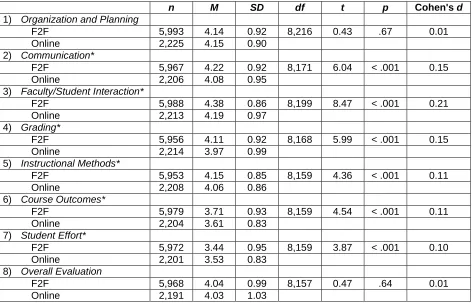
In what ways do student ratings of instruction for F2F courses differ from online courses? To answer this question, comparisons were made between students in 470 F2F classes and in 172 online classes. No effort was made to match instructors or courses for the two delivery methods.
Table 3. Eight independent samples t-tests comparing face-to-face and online ratings
n M SD df t p Cohen's d
1) Organization and Planning
F2F 5,993 4.14 0.92 8,216 0.43 .67 0.01
Online 2,225 4.15 0.90
2) Communication*
F2F 5,967 4.22 0.92 8,171 6.04 < .001 0.15
Online 2,206 4.08 0.95
3) Faculty/Student Interaction*
F2F 5,988 4.38 0.86 8,199 8.47 < .001 0.21
Online 2,213 4.19 0.97
4) Grading*
F2F 5,956 4.11 0.92 8,168 5.99 < .001 0.15
Online 2,214 3.97 0.99
5) Instructional Methods*
F2F 5,953 4.15 0.85 8,159 4.36 < .001 0.11
Online 2,208 4.06 0.86
6) Course Outcomes*
F2F 5,979 3.71 0.93 8,159 4.54 < .001 0.11
Online 2,204 3.61 0.83
7) Student Effort*
F2F 5,972 3.44 0.95 8,159 3.87 < .001 0.10
Online 2,201 3.53 0.83
8) Overall Evaluation
F2F 5,968 4.04 0.99 8,157 0.47 .64 0.01
Online 2,191 4.03 1.03
Note. F2F = face-to-face. Responses for scales one through five and eight ranged from 1 (ineffective) to 5 (very effective); for scales six and seven responses were 1 (much less than most courses), 2 (less than most courses), 3 (about the same as other courses, 4 (more than most courses), and 5 (much more than most courses). An asterisk (*) indicates a significant difference.
Interestingly, mean ratings were very high for both F2F and online courses, with almost all being greater than four. Significant differences in student ratings were found between the two delivery methods in Communication, Faculty/Student Interaction, Grading, Instructional Methods, Course Outcomes, and Student Effort. In all significant comparisons except Student Effort, the F2F ratings were higher than the online ratings. Effect sizes (Cohen's d) indicated that differences were trivial to small and should not be considered meaningful (Cohen, 1992; McMillan & Foley, 2011).
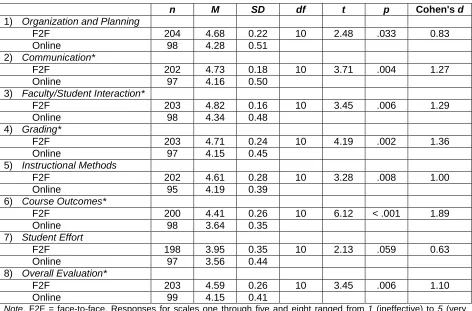
For F2F and online courses that are matched by course and instructor, how do student ratings of instruction differ? For this analysis, 11 pairs of courses met the criteria of being the same course taught by the same instructor using both a F2F and an online delivery method. Six of the 11 pairs of courses were undergraduate and five were graduate level.
Eight dependent samples t-tests were used to examine the differences between F2F ratings and online ratings. A significance level of .0063 was used for each t-test (adjusting .05 for the eight t-tests). Class averages were calculated using individual student scores and these class averages were used in the dependent samples t-test analysis. Dependent samples t-tests require related data to be paired and the only possible pairing was at the course level, using online and F2F courses taught by the same instructor. Results are shown in Table 4.
that mean differences were large and, from a practical perspective, the effect of type of delivery is obvious; students perceive F2F instruction as clearly more effective than online instruction.
Table 4. Eight dependent samples t-tests comparing face-to-face and online ratings on matched courses
n M SD df t p Cohen's d
1) Organization and Planning
F2F 204 4.68 0.22 10 2.48 .033 0.83
Online 98 4.28 0.51
2) Communication*
F2F 202 4.73 0.18 10 3.71 .004 1.27
Online 97 4.16 0.50
3) Faculty/Student Interaction*
F2F 203 4.82 0.16 10 3.45 .006 1.29
Online 98 4.34 0.48
4) Grading*
F2F 203 4.71 0.24 10 4.19 .002 1.36
Online 97 4.15 0.45
5) Instructional Methods
F2F 202 4.61 0.28 10 3.28 .008 1.00
Online 95 4.19 0.39
6) Course Outcomes*
F2F 200 4.41 0.26 10 6.12 < .001 1.89
Online 98 3.64 0.35
7) Student Effort
F2F 198 3.95 0.35 10 2.13 .059 0.63
Online 97 3.56 0.44
8) Overall Evaluation*
F2F 203 4.59 0.26 10 3.45 .006 1.10
Online 99 4.15 0.41
Note. F2F = face-to-face. Responses for scales one through five and eight ranged from 1 (ineffective) to 5 (very effective); for scales six and seven responses were 1 (much less than most courses), 2 (less than most courses), 3 (about the same as other courses, 4 (more than most courses), and 5 (much more than most courses). An asterisk (*) indicates a significant difference.
Discussion and Conclusion
Similar to the findings of Mentzer et al. (2007) and Summers et al. (2005), in this study, students rated instructors higher in F2F settings on most factors that were included on the rating forms. In the large dataset that included 642 unmatched courses, with more than 8,000 student ratings, students in F2F courses rated their instructors significantly higher than students in online courses in the areas of Communication, Faculty/Student Interaction, Grading, Instructional Methods, and Course Outcomes. Student Effort, however, was rated significantly higher for the online courses compared to the F2F courses, reflecting the typically increased workload and the difficulty of working asynchronously in the online environment (Young, Thompson, Shaw, Bruce, & Mundfrom, 2005). Although these mean differences were significant and all differences but one were in the same direction, the effect sizes were small indicating that the practical significance of these differences may be questionable. Ratings may have been influenced by other factors such as instructor or student characteristics. Instructors may choose to teach in the environment in which they are most comfortable and skilled, just as students may choose the environment that best suits their learning style. It is also worth noting that, because a majority of F2F students were undergraduate students and a majority of online students were graduate students, student level may have impacted the student ratings. In addition, as Mentzer et al. noted, factors such as instructor personality and likeability may have a greater impact on F2F student ratings.
be equally good teachers in both environments, and they may be the kinds of teachers who strive for excellence. However, there are many characteristics that may influence these ratings, and some of these may not be within the control of the instructors. For example, learning preference of the students may be a factor as well as the many reasons that students may choose an online course rather than a F2F course (Horspool & Lange, 2012). Interestingly, students rated their effort in this analysis higher in F2F classes than online classes compared to the unmatched analysis. This may be due to the instructors incorporating features from the online environment into the F2F courses, thus increasing the workload for students (Horspool & Lange, 2012).
The difference between the effect sizes found for the two analyses is an interesting but not surprising finding. Large samples with similar means can easily yield significant differences. The first analysis, with its small effect sizes, may indicate that when considering a broad range of course and instructors, student ratings appear not to be different for F2F and online courses. However, when courses and instructors are controlled, as in the second analysis, F2F courses have a clear advantage over online courses. One limitation that must be considered is that, although instructor and courses are matched, the effect of student characteristics was not controlled; students self-selected online or F2F courses. A second limitation is that this analysis only included 11 pairs of courses; this small number is not sufficient to generalize the findings beyond the present study.
Both analyses supported the earlier research conducted by Mentzer et al. (2007) and Summers et al. (2005), suggesting that students are more satisfied with traditional, F2F courses compared to online courses. However, the findings contradicted those of Horspool and Lange (2012), who found that students were equally satisfied with online and F2F courses. It is difficult to determine if the level of student satisfaction derives from the type of course delivery or from the quality of instruction. Many students may be unable to enroll in traditional, F2F courses for various reasons, including location, job and family responsibilities, and many others that make online learning an attractive option, especially for less traditional, older adults (Chau, 2010).
How can instructors in both F2F and online courses use what they learn from student ratings to strengthen their teaching? The data from the matched analysis likely provide the more interesting answer to this question. These instructors are already very effective in the traditional, F2F environment and are likely to continually give effort to enhancing their teaching based on feedback from students. Most teachers have had experience, education, and professional development that help them to be effective in the F2F environment. Online teaching is quite different, however, and involves skills that are relatively new in higher education; instructors likely learn to be more effective from their own experiences as well as from other instructors. According to Allen and Seaman (2011), the majority of training for online instruction comes from mentoring or internal training.
The instructors in the matched sample are all seen as highly effective in all eight rating areas, yet they were rated lower in most areas overall by students in their online courses compared to the F2F courses. Instructors can use their evaluations to help identify areas in which they can strengthen their online teaching. Communication is often more challenging in online courses and instructors who wish to increase their effectiveness in this area will have to use different strategies in this environment compared to their F2F courses. They might have to respond to email more often, for example, or set up synchronous online chats or audio/video sessions for their office hours. In the area of faculty/student interaction, instructors may find it difficult to create connections between themselves and their students when they do not see them in person. Indeed, the challenges appear to be even more difficult in an online environment (Young & Bruce, 2011).
Thus faculty who receive additional support from administrators may be more successful in their teaching.
The second recommendation is that instructors who deliver online courses must continuously work to enhance their teaching by participating in professional development. They might benefit from workshops on online teaching (that offer more than techniques and strategies) or collaborating with other colleagues. According to Horspool and Lange (2012) and also Bruce, Young, and Kennedy (2012), student learning and satisfaction in online courses can be enhanced by peer-to-peer interaction. Instructors can benefit by designing activities to increase student engagement with each other and build students' feelings of community.
Suggestions for future studies include that researchers delve more deeply into the instructional methods and course design used by highly successful online instructors. Online students may be more satisfied with their learning experience and may benefit more from instruction that is designed for a distance, asynchronous environment, rather than instruction that is carefully crafted to match the F2F instructional environment. A carefully controlled experimental design comparing the two types of delivery would control for factors such as student preference. Also, researchers could examine the issue of student satisfaction in a large survey study of courses carefully matched by instructors. Online instruction is becoming increasingly popular and pervasive (Allen & Seaman, 2013) in higher education and faculty must ensure that students continue to learn as much as in F2F courses. Faculty must also develop instructional skills that work best in the online environment so that students are satisfied, engaged, and well connected with instructors and their peers.
References
Agosto, D. E., Copeland, A. J., & Zach, L. (2013). Testing the benefits of blended education: Using social technology to foster collaboration and knowledge sharing in face-to-face LIS courses. Journal of Education for Library and Information Science, 54(1), 94-107.
Allen, I. E., & Seaman, J. (2011). Going the distance: Online education in the United States, 2011. Babson Park, MA: Babson Survey Research Group and Quahog Research Group. Retrieved from http://www.onlinelearningsurvey.com/reports/goingthedistance.pdf
Allen, I. E., & Seaman, J. (2013). Changing course: Ten years of tracking online education in the United States. Babson Park, MA: Babson Survey Research Group and Quahog Research Group. Retrieved from http://www.onlinelearningsurvey.com/reports/changingcourse.pdf
Borup, J., West, R. E., & Graham, C. R. (2012). Improving online social presence through asynchronous video. The Internet and Higher Education, 15(3), 195-203. doi:10.1016/j.iheduc.2011.11.001
Bruce, M. A., Young, S., & Kennedy, A. (2012, October). Discovering student and instructor perceptions of trust-building in online courses. Paper presented at the 30th Annual Conference of the Northern Rocky Mountain Educational Research Association, Park City, UT.
Centra, J. A. (2006). The Student Instructional Report IITM: It's development, uses and supporting research [White paper]. Princeton, NJ: Educational Testing Service. Retrieved from
http://www.ets.org/Media/Products/SIR_II/pdf/53228_sirII_white_paper.pdf
Chau, P. (2010). Online higher education commodity. Journal of Computing in Higher Education, 22(3), 177-191. doi:10.1007/s12528-010-9039-y
Cohen, J. (1992). A power primer. Psychological Bulletin, 112(1), 155-159. doi:10.1037/0033-2909.112.1.155
Dresel, M., & Rindermann, H. (2011). Counseling university instructors based on student evaluations of their teaching effectiveness: A multilevel test of its effectiveness under consideration of bias and unfairness variables. Research In Higher Education, 52(7), 717-737. doi:10.1007/s11162-011-9214-7
Duncan, H. E. (2005). Online education for practicing professionals: A case study. Canadian Journal of Education, 28(4), 874-896. doi:10.2307/4126459
González, C. (2009). The relationship between approaches to teaching, approaches to e-teaching and perceptions of the teaching situation in relation to e-learning among higher education teachers.
Instructional Science, 40(6), 975-998. doi:10.1007/s11251-011-9198-x
Hauck, W. E. (2006). Online versus traditional face-to-face learning in a large introductory course.
Journal of Family & Consumer Sciences, 98(4), 27-29.
Horspool, A., & Lange, C. (2012). Applying the scholarship of teaching and learning: Student
perceptions, behaviours and success online and face-to-face. Assessment & Evaluation in Higher Education, 37(1), 73-88. doi:10.1080/02602938.2010.496532
Karatas, S., & Simsek, N. (2009). Comparisons of Internet-based and face-to-face learning systems based on "equivalency of experiences" according to students' academic achievements and satisfactions. Quarterly Review of Distance Education, 10(1), 65-76.
Kirtman, L. (2009). Online versus in-class courses: An examination of differences in learning outcomes.
Issues in Teacher Education, 18(2), 103-116. Retrieved from http://www1.chapman.edu/ITE/ public_html/ITEFall09/12kirtman.pdf
Leen, E. A. E., & Lang, F. R. (2013). Motivation of computer based learning across adulthood.
Computers in Human Behavior, 29(3), 975-983. doi:10.1016/j.chb.2012.12.025
Lindholm, J. A., Szelényi, K., Hurtado, S., & Korn, W. S. (2005). The American college teacher: National norms for the 2004-2005 HERI faculty survey. Los Angeles, CA: University of California, Los
Angeles, Higher Education Research Institute. Retrieved from http://www.heri.ucla.edu/PDFs/pubs/ FAC/Norms/Monographs/TheAmericanCollegeTeacher2004To2005.pdf
Marsh, H. (2007). Students' evaluation of university teaching: Dimensionality, reliability, validity, potential biases and usefulness. In R. Perry & J. Smart (Eds.), The scholarship of teaching and learning in higher education: An evidence-based perspective (pp. 319-384). Dordrecht, The Netherlands: Springer. doi:10.1007/1-4020-5742-3_9
Mayne, L. A., & Wu, Q. (2011). Creating and measuring social presence in online graduate nursing courses. Nursing Education Perspectives, 32(2), 110-114. doi:10.5480/1536-5026-32.2.110
McMillan, J. H., & Foley, J. (2011). Reporting and discussing effect size: Still the road less traveled?
Practical Assessment, Research, & Evaluation, 16(14). Retrieved from http://www.pareonline.net/ pdf/v16n14.pdf
Means, B., Toyama, Y., Murphy, R., & Baki, M. (2013). The effectiveness of online and blended learning: A meta-analysis of the empirical literature. Teachers College Record, 115(3), 1-47.
Mentzer, G. A., Cryan, J., & Teclehaimanot, B. (2007). Two peas in a pod? A comparison of face-to-face and web-based classrooms. Journal of Technology and Teacher Education, 15(2), 233-246.
Available from from EdITLib Digital Library. (19863)
Pascarella, E. T., & Terenzini, P. T. (2005). How college affects students: A third decade of research. San Francisco, CA: Jossey-Bass.
Reilly, J. R., Gallagher-Lepak, S., & Killion, C. (2012). Me and my computer: Emotional factors of online learning. Nursing Education Perspectives, 33(2), 100-105. doi:10.5480/1536-5026-33.2.100
Roseth, C. J., Saltarelli, A. J., & Glass, C. R. (2011). Effects of face-to-face and computer-mediated constructive controversy on social interdependence, motivation, and achievement. Journal of Educational Psychology, 103(4), 804-820. doi:10.1037/a0024213
Seaman, J. (2009). The paradox of faculty voices: Views and experiences with online learning. Vol. 2. Online learning as a strategic asset. Washington, DC: Association of Public and Land-Grant Universities. Retrieved from http://www.aplu.org/document.doc?id=1879
Summers, J. J., Waigandt, A., & Whittaker, T. A. (2005). A comparison of student achievement and satisfaction in an online versus a traditional face-to-face statistics class. Innovative Higher Education, 29(3), 233-250. doi:10.1007/s10755-005-1938-x
Young, S. (2006). Student views of effective online teaching in higher education. American Journal of Distance Education, 20(2), 65-77. doi:10.1207/s15389286ajde2002_2
Young, S., & Bruce, M. A. (2011). Classroom community and student engagement in online courses.
MERLOT Journal of Online Learning and Teaching, 7(2), 219-230. Retrieved from http://jolt.merlot.org/vol7no2/young_0611.htm
Young, S., Thompson, K. D., Shaw, D. G., Bruce, M. A., & Mundfrom, D. (2005, April). Course difficulty, workload, expected grades and student evaluations in online courses. Paper presented at the 2005 Annual Meeting of the American Educational Research Association, Montréal, Canada.
Zach, L., & Agosto, D. E. (2009). Using the online learning environment to develop real life collaboration and knowledge-sharing skills: A theoretical discussion and framework for online course design.
MERLOT Journal of Online Learning and Teaching, 5(4), 590-599. Retrieved from http://jolt.merlot.org/vol5no4/zach_1209.htm
Zacharis, N. Z. (2010). The impact of learning styles on student achievement in a web-based versus an equivalent face-to-face course. College Student Journal, 44(3), 591-597.
This work is published under a Creative Commons Attribution-Non-Commercial-Share-Alike License