DEMOGRAPHIC RESEARCH
VOLUME 39, ARTICLE 31, PAGES 871
,
882
PUBLISHED 16 OCTOBER 2018
https://www.demographic-research.org/Volumes/Vol39/31/ DOI: 10.4054/DemRes.2018.39.31
Descriptive Finding
Immigrant women and Medicaid-financed births
Masanori Kuroki
© 2018 Masanori Kuroki.
This open-access work is published under the terms of the Creative Commons Attribution 3.0 Germany (CC BY 3.0 DE), which permits use, reproduction, and distribution in any medium, provided the original author(s) and source are given credit.
1 Introduction 872
2 Methods 873
3 Results 875
4 Discussion 878
5 Conclusions 879
6 Acknowledgments 880
Demographic Research: Volume 39, Article 31 Descriptive Finding
Immigrant women and Medicaid-financed births
Masanori Kuroki1
Abstract
BACKGROUND
While immigrants’ propensity to use social programs has been extensively examined by researchers, whether immigrant women are more likely to use Medicaid for birth delivery than US-born women is understudied, and discussion on fiscal costs of immigration should include Medicaid-financed births among immigrants.
OBJECTIVE
This study documents Medicaid-financed births by dividing the sample based on age, education levels, and marital status and calculating the extent of Medicaid-financed births for each sociodemographic group, paying special attention to the difference between US-born women and immigrant women.
METHODS
Cross-sectional data on 11,451,478 women come from the 2014–2016 Natality Detail dataset compiled by the US Center for Disease Control and Prevention’s National Center for Health Statistics (NCHS).
RESULTS
Overall, immigrant women are more likely than US-born women to report using Medicaid for birth delivery. However, among unmarried high school dropouts, married teenage high school dropouts, and unmarried teenage high school graduates, US-born women are more likely to use Medicaid for birth delivery than their immigrant counterparts.
CONCLUSIONS
Considerable heterogeneity in the likelihood of Medicaid-financed births by age, education, and marital status highlights the importance of not bundling all immigrant women together to better identify subgroups with higher Medicaid-financed births.
CONTRIBUTION
This paper extends the literature on fiscal costs of immigration in the United States by focusing on Medicaid, which is an important source of financing for births for low-income women and families.
1. Introduction
Anti-immigrant sentiments have been rising in many areas in the United States. President Donald Trump, during his campaign for president in 2015 and 2016, gained popularity partly due to his anti-immigration rhetoric (Lee 2015). Aside from concern about crime and terrorism committed by immigrants, one popular view in favor of the restriction of immigration is that they are a fiscal burden for American taxpayers. This study examined whether this was true in the case of Medicaid-financed births (MFB henceforth), a major source of public financing for health care services provided to pregnant women. While immigrants’ propensity to use social programs has been extensively examined by researchers (see Kerr and Kerr 2011 for a review), I am not aware of any empirical studies that look at whether immigrant women are more likely to use Medicaid for birth delivery. Currently, over 40% of births are paid for by Medicaid. Thus, discussion on fiscal costs of immigration should include MFB among immigrants.
In this study I compared the degree to which US-born women and immigrant women relied on Medicaid for birth delivery during the period 2014–2016. Specifically, I examined whether immigrant women were more likely to use Medicaid as the primary source of financing their delivery than otherwise similar US-born women. To answer these questions, I used the most comprehensive source for US births data, the Natality Detail dataset, which is a nationally representative source of data for the financing of births in the United States.
Demographic Research: Volume 39, Article 31
to lawfully residing pregnant women without a five-year waiting period (Healthcare.gov 2018).
In the United States, the Medicaid program covers a significant number of birth deliveries. Medicaid financed 48% of all births in 2010, with the proportion of births financed by Medicaid varying substantially among states (Markus et al. 2013). In 2010, Hawaii, Maryland, and Massachusetts had the lowest proportions of MFB (approximately 24%, 26%, and 27% respectively), while Louisiana, the District of Columbia, and Arkansas had the highest proportions (69%, 68%, and 67% respectively). More recent statistics from the period 2013–2016 from the Kaiser Family Foundation reveal a similar pattern, with the percentage of MFB ranging from 72% in New Mexico to 27% in New Hampshire (The Kaiser Family Foundation 2018).
The consumption of welfare services and other social benefits among immigrants is an important factor that contributes to economic impacts of immigration. The previous literature suggests that the average net cost or benefit of a single immigrant is very small (Kerr and Kerr 2011). Of course, some groups of immigrants use more social benefits than others. One study found that education, language proficiency, and labor market success were important determinants of welfare use (Hu 1998). The same study also found that older immigrants were more likely to use social benefits than younger immigrants, in relative comparison to natives of similar ages. Immigrant men used less social benefits, with the exception of food stamps, while immigrant women used more social benefits than natives (Gustman and Seinmeier 2000). Though one immigrant was estimated to provide a net benefit of only $7,400 over his lifetime, the values ranged from $96,000 benefit for a highly educated immigrant to $36,000 cost for an uneducated immigrant (Storeslettern 2000). Overall, the magnitude relative to the GDP seems to be modest (Kerr and Kerr 2011).
2. Methods
who was not a US citizen at birth or who was born outside the United States, Puerto Rico, or other US territories and whose parents were not US citizens.
Aside from whether mothers were immigrants, my variable of interest was whether a birth was financed by Medicaid. Since 2011, the Natality Detail dataset contains information on how mothers paid for the delivery of their children. This “principal source of payment for this delivery” question provided four options: Medicaid, private insurance, self-pay, and other. However, it is important to keep in mind that the payer information on the standard birth certificate is self-reported and represents her expectation for payment for delivery.
In order to examine the difference in MFB between immigrant women and US-born women across different socioeconomic groups, I focused on three factors: age, education levels, and marital status (married or unmarried). For age, I used four categories (<20, 20s, 30s, and 40 and over). For education, I created four categories: high school dropouts, high school graduates, college graduates, and those with a postgraduate degree. After excluding 491,542 births by women who did not report their source of payment, whether they were US-born, their level of education, those who were younger than 20 but reported that they had a bachelor or postgraduate degree (most likely by mistake or out of embarrassment), the resulting sample size was 11,451,478, of which 2,536,585 were immigrant women.
Demographic Research: Volume 39, Article 31
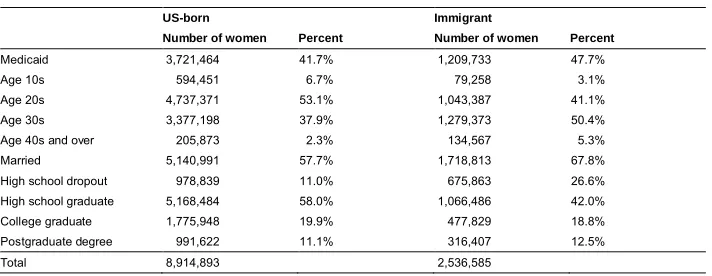
Table 1: Summary statistics by nativity
US-born Immigrant
Number of women Percent Number of women Percent
Medicaid 3,721,464 41.7% 1,209,733 47.7%
Age 10s 594,451 6.7% 79,258 3.1%
Age 20s 4,737,371 53.1% 1,043,387 41.1%
Age 30s 3,377,198 37.9% 1,279,373 50.4%
Age 40s and over 205,873 2.3% 134,567 5.3%
Married 5,140,991 57.7% 1,718,813 67.8%
High school dropout 978,839 11.0% 675,863 26.6%
High school graduate 5,168,484 58.0% 1,066,486 42.0%
College graduate 1,775,948 19.9% 477,829 18.8%
Postgraduate degree 991,622 11.1% 316,407 12.5%
Total 8,914,893 2,536,585
In the next section, the sample was divided into 28 groups: eight groups for high school dropouts (age <20, 20s, 30s, and 40 and over; married and unmarried), eight groups for high school graduates (age <20, 20s, 30s, and 40 and over; married and unmarried), six groups for college graduates (20s, 30s, and 40 and over; married and unmarried), and six groups for those with a postgraduate degree (20s, 30s, and 40 and over; married and unmarried). For each group, the average of MFB was calculated for US-born women and immigrant women.
3. Results
Figure 1: Medicaid-financed births among high school dropouts
Figure 2 shows the comparison of MFB between US-born women and immigrant women who were high school graduates. Compared to Figure 1, MFB for all age groups were lower, suggesting the importance of education in reducing the probability of MFB. As expected, MFB was much higher for unmarried women than for married women, and age again tended to be associated with a lower likelihood of MFB. Among married high school graduates, MFB was higher for immigrant women than for their US-born counterparts, though the difference is small for teenage mothers in this category. Among unmarried high school graduates, MFB was slightly higher for US-born women in their 10s, 20s, and 30s, though the differences were fairly small.
Demographic Research: Volume 39, Article 31
Figures 3 and 4 show the comparison of MFB among college graduates and those with a postgraduate degree respectively. They exhibit a similar pattern; the likelihood of MFB tended to be higher for immigrant women than for US-born women, regardless of age or marital status. The difference between US-born and immigrant women was especially higher for the married. Regardless of age, married immigrant women with a bachelor or postgraduate degree were more than twice as likely as married US-born women to use Medicaid for birth delivery.
Figure 3: Medicaid-financed births among college graduates
To summarize major findings, among unmarried high school dropouts and among married teenage high school dropouts, US-born women tended to have a higher likelihood of using Medicaid for birth delivery than that of their immigrant counterparts. Among high school graduates, US-born women and immigrant women had similar propensities of MFB if they were married teens or unmarried women in their 10s, 20s, or 30s. For other sociodemographic groups (non-teenage married high school dropouts, married high school graduates, unmarried high school graduates aged 40 and over, college graduates, and those with a postgraduate degree), MFB were higher among immigrant women than among US-born women, often by a large margin. The differences in the propensity of MFB between US-born women and immigrant women in each group were statistically significant at the 0.01 level, except for unmarried high school graduates in their 30s in Figure 2. Regardless of whether women were US-born or immigrants, age, marriage, and higher education levels were all associated with a lower likelihood of MFB.
4. Discussion
Between US-born women and immigrant women, considerable heterogeneity in the likelihood of MFB by age, education level, and marital status exists, and it highlights the importance of not bundling all immigrant women together to better identify subgroups with a higher propensity to rely on Medicaid for delivery. Age, marital status, and higher education levels were associated with a lower probability of MFB, but the magnitudes of these correlations were often different for US-born women than for immigrant women.
Demographic Research: Volume 39, Article 31
One limitation of this study is that the data did not reveal whether the father of a child was US-born or foreign-born. If many MFB among immigrant women came from immigrant women whose spouse or partner was a US-born man, defining all MFB among immigrant women as the fiscal cost of immigrants may not be appropriate. Another limitation is that women self-reported their principal source of payment as well as whether they were US-born or immigrants. It is certainly conceivable that some women who used Medicaid were too embarrassed to admit it. Similarly, some undocumented immigrant women might have concealed their immigration status. Finally, due to missing information and reporting error, the number of observation was reduced by 491,542. These issues might have affected the findings of this study.
5. Conclusions
Medicaid is an important source of financing for births for low-income women and families, and during the period 2014-2016, more than 40% of births were financed by Medicaid, even though the poverty rates during the same period were approximately 12%–15% (US Census Bureau 2015, 2016, 2017). As this study found that immigrant women were overall more likely to use Medicaid for delivery than US-born women, one way to reduce MFB is the restriction of immigration. However, policy measures to reduce unwanted, out-of-wedlock pregnancies among young, less educated US-born women may be far more effective in reducing overall MFB than immigration policies. As shown above, MFB were highest among unmarried high school dropouts and teenagers, regardless of whether women were US-born or immigrants. Among unmarried high school dropouts, US-born women were actually more likely to use Medicaid for delivery than immigrant women. Although not necessarily causal, education perhaps lowers the likelihood of MFB not only by reducing the chance of being in poverty, but also by reducing the chance of an unwanted pregnancy. Therefore, policies that discourage people from dropping out of high school or make college more affordable may be more effective in reducing MFB than immigration policy.
single-headed households (Autor, Dorn, and Hanson 2018). Policies that successfully tackle the declining economic position of men may lead to an increase in marriage, especially among less educated individuals, and thus reduce MFB among these populations.
6. Acknowledgments
Demographic Research: Volume 39, Article 31
References
Autor, D., Dorn, D., and Hanson, G. (2018). When work disappears: Manufacturing decline and the falling marriage-market value of young men. American
Economic Review: Insights, forthcoming.
Centers for Medicare and Medicaid Services (2018). National health expenditures by type of service and source of funds: Calendar years 1960 to 2016 [electronic resource]. Baltimore: Centers for Medicare and Medicaid Services.
https://www.cms.gov/Research-Statistics-Data-and-Systems/Statistics-Trends-and-Reports/NationalHealthExpendData/Downloads/NHE2016.zip.
Ellwood, M. and Kenney, K. (1995). Medicaid and pregnant women: Who is being enrolled and when?Health Care Financing Review 17(2): 7–28.
Gustman, A. and Steinmeier, T. (2000). Social security benefits of immigrants and the US born. In: Borjas, G. (ed.) Issues in the economics of immigration. Chicago: University of Chicago Press: 309–350.
Healthcare.gov (2018). Coverage for lawfully present immigrants [electronic resource]. Baltimore: Centers for Medicare and Medicaid Services.https://www.healthcare. gov/immigrants/lawfully-present-immigrants.
Hu, W.-Y. (1998). Elderly immigrants on welfare.Journal of Human Resources 33(3): 711–741.doi:10.2307/146339.
Kearney, M.S. and Wilson, R. (2018). Male earnings, marriageable men, and non-marital fertility: Evidence from the fracking boom. The Review of Economics and Statistics, forthcoming.doi:10.1162/rest_a_00739.
Kerr, S.P. and Kerr, W.R. (2011). Economic impacts of immigration: A survey.Finnish
Economic Papers, Finnish Economic Association 24(1): 1–32. doi:10.3386/
w16736.
Lee, M.Y.H. (2015, July 8). Donald Trump’s false comments connecting Mexican immigrants and crime.The Washington Post.https://www.washingtonpost.com/ news/fact-checker/wp/2015/07/08/donald-trumps-false-comments-connecting-mexican-immigrants-and-crime.
Sonfield, A. and Kost, K. (2015). Public costs from unintended pregnancies and the role of public insurance programs in paying for pregnancy-related care: National and state estimates for 2010 [electronic resource]. New York City: The Guttmacher Institute. https://www.guttmacher.org/sites/default/files/report_pdf/public-costs-of-up-2010.pdf.
Storesletten, K. (2000). Sustaining fiscal policy through immigration. Journal of
Political Economy 108(2): 300–323.doi:10.1086/262120.
The Kaiser Family Foundation (2018). Births financed by Medicaid [electronic resource]. San Francisco: The Kaiser Family Foundation. https://www.kff.org/ medicaid/state-indicator/births-financed-by-medicaid.
US Census Bureau (2015). Income and poverty in the United States: 2014 [electronic resource]. Suitland: US Census Bureau. https://www.census.gov/library/ publications/2015/demo/p60-252.html.
US Census Bureau (2016). Income and poverty in the United States: 2015 [electronic resource]. Suitland: US Census Bureau. https://www.census.gov/library/ publications/2016/demo/p60-256.html.