Iranian Rehabilitation Journal, Vol. 8, No. 11, 2010
Original Article
The effect of anger management skills training on reducing of
aggression in mothers of children’s with attention deficit hyperactive
disorder (ADHD)
Shirin Valizadeh
1Islamic Azad University, Central Tehran Branch, Tehran, Iran
Objectives: The purpose of this study was to investigate the Effectiveness of group anger management
skills training on reducing aggression of mothers with ADHD children's.
Method: The research method was quasi experimental with pre-test and post-test design with a control
group. Population of the study was all of the mothers of children's with ADHD that referred to counseling and psychological clinics in Tehran. The sample was 40 mothers children's with ADHD that randomly selected from population. They were placed randomly to experimental group (20 mothers) and control group (20 mothers). Experimental group received 10 session of anger management skills training, while control group didn’t receive any intervention.
Results: The results showed that experimental group had significantly decreased in aggression level after
intervention than control group (p<0.001).
Conclusion: Results of this study indicated that anger management skills training in decreasing
aggression level of mothers with ADHD children's is effective. Based on the results anger management skills training can be considered an effective program for prevention of aggression and promoting anger management skills in mothers with ADHD children's.
Keywords: AD/HD children, mothers, anger management skills, aggression Submitted:????
Accepted: ???
Introduction
Attention-deficit/hyperactivity disorder (ADHD) is a commonly diagnosed behavioral disorder of childhood that is characterized by symptoms of inattention, hyperactivity and impulsivity. Children with ADHD often have pronounced difficulties and impairments across multiple settings such as in the home, at school, and with their peers. They can also experience long-term adverse effects on academic, vocational, psychosocial, and psychiatric outcomes (1). This disorder is a chronic condition that starts in early childhood and lasts into adolescence and even adulthood (2).
There has been a dramatic increase in diagnoses of ADHD in recent years. This disorder is now a widely diagnosed chronic and impairing disorder occurring in 3 – 7% of school aged population (3). Some studies reported that the prevalence of the disorder in Australian children aged four to 11 and
12 – 16 years is 5.5% and 7.6%, respectively (4). The results of ADHD studies in Iran are not consistent (5); for example, the frequency of school children (aged seven to eight years) with ADHD was estimated 3.77% in Isfahan (6); in another study, it has been reported that ADHD is a common disorder among 4% of elementary students of Ilam (6). The prevalence of school children’s with ADHD in elementary schools was reported 10- 14/8 % in Neyshaboor (7). According to the epidemiologic survey in Tehran, the prevalence of the disease was estimated at 6 – 7% of school-aged (seven to 12 years) children (8).
has shown that, approximately 40% of mothers of children with ADHD have a history of major depressive disorder. Furthermore, regardless of depression status, parents of children with ADHD make more negative attributions for their children’s misbehavior, particularly their oppositional and aggressive behaviors, than parents of children without behavior problems (12). These negative attributions likely contribute to negative parenting behavior, such as harsh/inconsistent discipline and uninvolvement (13; 14). Another study (15) has shown, parents of children with ADHD may fail to focus on positive behaviors that occur in the context of ADHD or oppositional/aggressive behaviors. They may also withdraw from attempts to manage their children due to beliefs that certain behaviors are beyond their control. Importantly, these parental cognitions may negatively impact parenting, which may then exacerbate child behavior problems, creating a reciprocal pattern of negative interactions in these families (16; 17; 18).
Furthermore, Parents of children with ADHD perceive themselves as less competent in their parenting role, and they perceive their quality of life as being lower than that of parents of children without problems (19; 20). One study (2) has shown that, parents of children with the disorder are more often exposed to social criticism due to the inappropriate behavior of their children. Consequently, they can feel the need to shy away from many social situations in everyday life, thus suffering social isolation. In addition, compared to parents of children without problems, parents of children with ADHD feel significantly more depressed and consider that their parenting role places more restrictions on their personal time (21).
At this situation, mothers in the role of main care giving experience some bad things like feeling frustration, mental problems, emotional instability, anger, discomfort and continuous psychological pressure, But about this issue(22), expressed anger to the child, thinking that having bad luck of being in mothers of the children, anger and resentment from a partner is common. A great body of research has shown that women bear a greater pressure than men in care of their special child. They, because, not only spend more time caring of other family member’s, but they tend to also experience greater depression, poorer well-being and worse physical health outcomes than men in care giving roles(23). The continuous of pressure and depression make mothers weaker and fall them into deep depression
and make them unable to spent more time and be useful for their family members and affect their relationship with their wives, children, and also community (24)
There are various treatment interventions to ADHD, but parents play a key role in modifying maladaptive behaviors of the children; hence, it is notable that relieving parental stress—particularly mothers—in the first step may elaborate mental health of parents and prepare them to do their parental roles better (5). Some studies investigated the effectiveness of anger management programs in various populations. Results of one study (25) in the effect of an anger management program for family members of patients with alcohol use disorders has shown that total anger expression score of the experimental group was significantly more reduced as compared with that of the control group. Results of another study (26), that investigated the cognitive- behavioral depression treatment for mothers of children with attention deficit hyperactivity disorder, has shown improvements in maternal depressive symptoms, maternal self-esteem, child – related cognitions, and family impairment at post treatment compared to a wait-list control group that were maintained at follow up. Results of another study (27) that investigated the efficacy of anger management training on relationship between mothers and their mildly mentally retarded and slow learner children, has shown that intensity of anger in anger eliciting situations decreased and use of anger control strategies increased in participants.
The current study was designed to test the efficacy of anger management skills training on reducing of aggression in mothers with ADHD children. We hypothesized that this intervention would decrees total aggression scores.
Materials and Methods
Measurements -Participants completed the 30-item
aggression general questionnaire (AGQ, Najariyan; 2001), which assessed participants’ aggression on 4-point scales (0 = “never” 4 = “always”). The total score provides a measure of overall aggression, but three subscale scores have been identified through factor analysis. These subscales represent aggressive behavior; 12 item, aggressive thoughts; 7 items and aggressive feelings; 11 items. Higher scores indicate more general aggression. Reliability of the questionnaire was substantiated in various studies. For example, the internal consistency of the questionnaire via Chronbach Alpha method was estimated at 82.5 (28). Validity assessments have shown moderate to strong psychometric properties (29).
Procedure - The efficacy of the anger management
skills training was tested using a quasi experimental with pre test - post test control group design, based on self- report data. Mothers were randomly assigned to either the anger management skills training or the control group. The mothers in the experimental group receive 10 weekly sessions (per sessions 70 minute) anger management skills training, while mothers in the control group did not receive any intervention but were contacted only for the assessments. All mothers were asked to complete questioner at two times: at pre test (one week prior to the intervention) and pos test (one week after the intervention). Spss 16.0 (Statistical Package for Social Sciences) software package were used in the analysis of the data obtained from the implementation.
Results
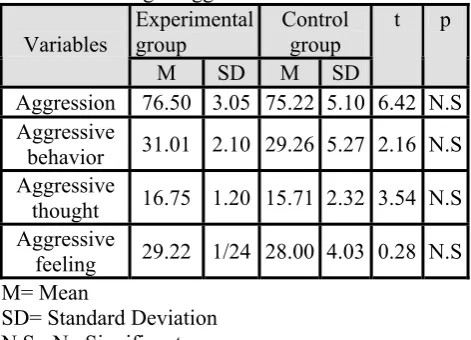
Preliminary analysis were conducted to determine whether there were any pre-test differences between the two groups on the described questioner measuring different aspects of the aggression. No significant differences were found for total aggression, aggressive thought, aggressive behavior and aggressive feelings as measured with the AGQ (see table 1).
In order to explore changes in the pre-test post-tests scores of the experimental and control group in aggression, Analysis of Covariance was used. Results showed a significant group main effect
F=25.23, P<0.05,η2 = 0.482. This result shows that
aggression is clearly decreased among mothers of children with ADHD that participated in the anger management skills training group (see table 2).
Table 1. t- Test results of the experimental and
control group according to the pre test scores according to aggression and subscales
Experimental
group Control group Variables
M SD M SD
t p
Aggression 76.50 3.05 75.22 5.10 6.42 N.S Aggressive
behavior 31.01 2.10 29.26 5.27 2.16 N.S Aggressive
thought 16.75 1.20 15.71 2.32 3.54 N.S Aggressive
feeling 29.22 1/24 28.00 4.03 0.28 N.S M= Mean
SD= Standard Deviation N.S= No Significant
As seen in Table 1, it was appeared that there were not any significant differences between the total aggressions, aggressive behavior, aggressive thought and aggressive feeling scores in experimental and control group in the pre test.
Table 2. Analysis of Covariance for total aggression η2
F MS
SS df
Source
0.098 2.88
52.71 52.71
1 Pre test
0.482 25.23*
625.05 625.05
1 Group
21.72 571.64
37 Error
1106.4 40
Total * P<0.05
As seen in Table 2, after controlling for pre test scores, total aggression decreased significantly in the intervention group, F = 25.23, P<0.05, η2 = 0.482.
Discussion
A great body of research has shown that women bear a greater pressure than men in care of their special child. They, because, not only spend more time caring of other family member’s, but they tend to also experience greater depression, poorer well-being and worse physical health outcomes than men in care giving roles (23).
children with ADHD. The results indicated that total aggression scores decreased significantly among participants who took part in the intervention group. A similar finding was reported by Ju-Young Son & Yun-Jung Choi (2010) that investigated the effectiveness of an anger management program for family members of patients with alcohol use disorders. Results of this study have shown that total anger expression score of the experimental group was significantly more reduced as compared with that of the control group. Results of another study (27) that investigated the efficacy of anger management training on relationship between mothers and their mildly mentally retarded and slow learner children, has shown that intensity of anger in anger eliciting situations decreased and use of anger control strategies increased in participants. These findings consist with this research. The explanation of results is possible via social learning theory. Social learning theory explanation is that, these mothers may learn a lot of things from each other to handle their distress. Furthermore, the most important advantage of such psycho educational groups is its internal dynamics (i.e., self-disclosure
and feedback) which force participants involve in team work; the process of reciprocal and interactional relationships among subjects cause something like catharsis about their same concerns about child rearing. This would help participants cope better with the problems (5).
In this study, the mothers of children with ADHD were the subjects. For further research, working with mothers of children with other special problems (for example, autism, mental retarded children, and so on) is recommended. In addition, studying with samples from different backgrounds could provide a broader picture on the effectiveness of anger management skills training. There are a limited number of studies on aggression levels of mothers with ADHD children; therefore, it is valuable to study aggression levels and to conduct better programs and training strategies for countering aggression. Anger management skills training are crucial for mothers of children with special problems. Therefore, the educators, psychologists, counselors and who work with these mothers and children should be trained and educated on these trainings.
References:
1. Barkley, R. A. Attention-Deficit Hyperactivity Disorder. Scientific American. 1998; 98: 1-8.
2. Miranda, A., Grau, D., Rosel, R. & Melia, A.
Understanding Discipline in Families of Children with Attention-Deficit/Hyperactivity Disorder: A Structural Equation Model. The Spanish Journal of Psychology. 2009; 12(2): 496-505.
3. Angold A, Erkanli A, Egger HL, Costello EJ. Stimulant
treatment for children: a community perspective. Journal of the American Academy Child and Adolescent Psychiatry. 2000; 39: 975 – 984.
4. Cann W, Rogers H, Matthews Y. Family intervention
services program evaluation: a brief report on initial outcome for families. Australian E-Journal for the Advancement of Mental Health. 2003; 2: 2 – 3.
5. Pouretemad, H.R., Khooshabi, K., Roshanbin, M., Jadidi, M. The Effectiveness of Group Positive Parenting Program on Parental Stress of Mothers of Children with Attention-Deficit/ Hyperactivity Disorder, Arch Iranian Med 2009; 12 (1): 60 – 68).
6. Kalantary, M., Neshatdoost, H., Zareee, M.B. Influence of behavioral education of parents and drug therapy on symptoms of ADHD. Journal Psychology. 2001; 5:118 – 134.
7. Moradi, A., Khabaz khob, M., Agah, F., Javaher
frooshzadeh, A., Rezvan, B., Haery Kermani, Z., Palahang, S. The prevalence of attention-deficit hyperactivity disorder among preliminary school children in Neyshaboor City,2006-2007. Journal of Gorgan University of Medical Sciences. 2008; 37-43.
8. Khooshabi K, Puretemad H. Investigation of rate of ADHD and co morbid disorders on elementary students of Tehran. Research Report, for Welfare Sciences and Rehabilitation University, Tehran; 2002.
9. Fischer, M. Parenting stress and the child with attention deficit hyperactivity disorder. Journal of Clinical Child Psychology. 1990; 19: 337–346.
10. Johnston, C., & Mash, E. J. Families of children with attention deficit hyperactivity disorder: Review and recommendations for future research. Clinical Child and Family Psychology Review. 2001; 4: 183–207.
11. Chronis, A. M., Lahey, B. B., Pelham, W. E., Kipp, H. L., Baumann, B. L., & Lee, S. S. Psychopathology and substance abuse in parents of young children with attention deficit/ hyperactivity disorder. Journal of the American Academy of Child and Adolescent Psychiatry. 2003; 42: 1424–1432.
12. Johnston, C., & Freeman, W. Attributions for child behavior in parents of children without behavior problems and children with attention deficit-hyperactivity disorder. Journal of Consulting and Clinical Psychology. 1997; 65: 636–645.
13. Johnston, C., & Patenaude, R. Parent attributions for inattentive-overactive and oppositional-defiant child behaviors. Cognitive Therapy and Research. 1994; 18: 261– 275.
14. Johnston, C., Patenaude, R. L., & Inman, G. A.
Attributions for hyperactive and aggressive child behaviors. Social Cognition. 1992; 10: 255–270.
15. Freeman, W. S., Johnston, C., & Barth, F. M. Parent attributions for inattentive-overactive, oppositional-defiant, and pro social behaviors in children with attention deficit hyperactivity disorder. Canadian Journal of Behavioral Science. 1997; 29: 239–248.
behaviors. Journal of Abnormal Child Psychology. 1999; 27: 177–189.
17. Cummings, E. M., & Davies, P. T. Maternal depression and child development. Journal of Child Psychology and Psychiatry. 1994; 36: 73–112.
18. Downey, G., & Coyne, J. C. Children of depressed parents: An integrative review. Psychological Bulletin. 1990; 108: 50–76.
19. McLaughlin, D., & Harrison, C. Parenting practices of mothers of children with ADHD: The role of maternal and child factors. Child and Adolescent Mental Health.2006; 11: 82- 88.
20. Whalen, C.K., Henker, B., Janner, L.D., Ishikawa, Sh.S., Floro, J.N., Swindle, R., Perwien, A.R., & Johnston, J.A. Toward mapping daily challenges of living with ADHD: Maternal and child perspectives using electronic diaries. Journal of Abnormal Child Psychology. 2006; 34: 115-130. 21. Escobar, R., Soutullo, C.A., Hervas, A., Gastaminza, X.,
Polavieja, P., & Gilaberte, I.Worse quality of life of for children with newly diagnosed attention-deficit / hyperactivity disorder, compared with asthmatic and healthy children. Pediatrics. 2005; 116: 364-369.
22. Trostre, H, Sources of stress in mothers of children with impairment. Journal of Visual Impairment and Blindness. 2001; 8(1).13-26.
23. Pinquart,M., Sorensen, S. Gender differences in caregiver experiences: An update meta-analysis. Journal of Gerontology: Psychological Sciences, 2006; 61: 33-45. 24. Valizadeh, Sh., Ozouni Davaji, R. B., Dadkhah, A. The
Effectiveness of Group Coping Skills training on reducing stress of mothers with disabled children's, Iranian rehabilitation Journal, 2009; 7(10).
25. Ju-Young Son & Yun-Jung Choi, The Effect of an Anger Management Program for Family Members of Patients With Alcohol Use Disorders, Archives of Psychiatric Nursing. 2010; 24(1): 38–45.
26. Chronis, A.M., Gamble, S .A., Roberts, J. E., Pelham, W.E. Cognitive-Behavioral Depression Treatment for Mothers of Children With Attention-Deficit/Hyperactivity Disorder, Behavior Therapy.2006; 37: 143–158.
27. Yekta, Sh., Zamani, N. Efficacy of Anger Management
Training on Relationship between Mothers and Their Mildly Mentally Retarded and Slow Learner Children. Journal of Family Research.2008; 4(3): 231- 246.
28. Sadegi, A. Role of emotinal – behavioral based group anger management training on reduction of eggression in Esfahanian students, unpublished master thesis, faculty of psychology, Univbersity of Esfahan.2002.