Volume 57, 2018, Pages 534–542
LPAR-22. 22nd International Conference on Logic for Programming, Artificial Intelligence and Reasoning
SMTS: Distributed, Visualized
Constraint Solving
Matteo Marescotti, Antti E. J. Hyv¨arinen, and Natasha Sharygina
Universit`a della Svizzera italiana, Switzerland
Abstract
The inherent complexity of parallel computing makes development, resource monitor-ing, and debugging for parallel constraint-solving-based applications difficult. This paper presents SMTS, a framework for parallelizing sequential constraint solving algorithms and running them in distributed computing environments. The design (i) is based on a gen-eral parallelization technique that supports recursively combining algorithm portfolios and divide-and-conquer with the exchange of learned information, (ii) provides monitoring by visually inspecting the parallel execution steps, and (iii) supports interactive guidance of the algorithm through a web interface. We report positive experiences on instantiating the framework for oneSMTsolver and oneIC3solver, debugging parallel executions, and visualizing solving, structure, and learned clauses of SMTinstances.
1
Introduction
Constraints expressed as logical formulas are widely used for modelling systems in formal ver-ification and optimization. The high complexity of such computational problems limits the scalability of this approach to face more complex problem instances. Algorithm parallelization helps overcoming this limitation by exploiting parallel hardware architectures, or even better, distributed computing clusters. However, constraint techniques differ considerably between dif-ferent applications, and often each needs a tailored parallelization procedure. An important challenge in constraint solving is therefore the design of parallel techniques capable of scaling to high degrees of parallelism, and extendible by domain-specialists to a wide range of different applications.
cluster resources usage, and study the history of events and statistics from individual solving tasks.
SMTSis based on theparallelization tree formalism[9], a parallelization approach relying on
recurrent aspects of constraint solving algorithms, and therefore designed to be general enough to suit many different domains. We prove that SMTS is general enough to parallelize both theSMTsolver OpenSMT2 [8] and the software model checkerZ3-Spacer [2, 16], which is based on theIC3algorithm. In particular, three high-level elements recurring in most efficient implementations ofSMTandIC3thatSMTSexploits in order to improve solving performance are: (i) the use of heuristic assumptions for dividing the search-space (see e.g. [19] forSMT, and [16] for IC3), (ii) learning lemmas from the logical formula [18, 7], and (iii) the use of
restartsto guide the solver to a more relevant search space [15].
The non-deterministic behaviour caused by the interleaving of sequential executions in dif-ferent machines could make identifying correctness and performance problems an overwhelming task. To help understanding SMTSparallel executions, a web-based graphical user interface allows the user to inspect at a high level the executions both in real time and by browsing their history. To the best of our knowledge there are no other tools supporting these features.
Related work. The parallelization tree formalism was initially proposed in [11], adapted to SMT in [9, 17], and analysed further in [10]. The seminal paper on the model-checking algorithm IC3 [3] already provides experimental evidence on the efficiency of parallelization. Parallelization of IC3 is further investigated in [6], and by the authors in [16] in the context of the parallelization tree formalism. This paper presents a new tool for developing, supervis-ing, and interacting with parallel algorithms. The tool is based on the general parallelization tree framework and we believe this makes the tool applicable to a wide range of problems. Visualization of parallel executions of constraint logic programs is studied in [5]. Similarly to
SMTS, the tool allows inspecting the execution at different time points, however without using the general parallelization tree formalism. In this paper we present the fullSMTSframework together with the features available within its graphical interface. An earlier work [4] is related to the GUI only, focuses on its monitoring feature and is specific toSMTonly. Finally, our tool contributes to visualizing the structure of constraint problems and the executions of related, sequential search algorithms. In this domain we want to acknowledge in particular [20] for SAT solving, [14] for answer set programming, and [12] for parallel k-induction.
2
Background
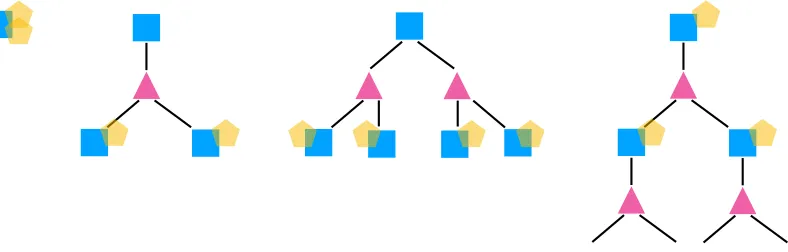
The parallelization tree formalism [9] is a general framework to allow different parallel ap-proaches for constraint solving to be combined with the aim of exploiting each others’ strengths. The formalism supports recursively combining divide-and-conquer (or partitioning), and algo-rithm portfolios. These are commonly used in combination with sharing of learned information. We have observed analytically forSMT[10] and in practical experiments for both SMT[17] andIC3[16] that when used alone, both partitioning and algorithm portfolios have their own shortcomings and one often seems to perform well exactly when the other performs badly. The parallelization tree is a hybrid approach capable of exploiting the strengths of each parallel approach in such circumstances.
contains the input instance. Nodes are labeled satisfiable or unsatisfiable during solving based on the following rules. A p-node is (un)satisfiable if an associated solver proved (un)satisfiability, or one of the d-node children is (un)satisfiable. A d-node is unsatisfiable if all its p-node children are unsatisfiable. A d-node is satisfiable if at least one of its p-node children is satisfiable. Some example trees are given in Fig.1.
2.1
SMT and IC3 Instantiations
The parallelization tree framework is proven versatile enough to instantiate and therefore par-allelizeSMTandIC3. Instantiating parallelization trees on different domains requires domain-specific knowledge, in particular to properly define partitioning, portfolio and lemma sharing. In the following we provide an overview of theSMTandIC3instantiations, and we refer the reader respectively to [17], and [16] for further details.
Details on the SMT instantiation. SMT partitioning is based on [9]. Given an SMT
instance Φ and an arbitraryn > 1, the algorithm returns a set of constraints c1, . . . , cn such
that its disjunctionWni ci is a tautology. The partitions are the set Φ1, . . . ,Φn, having each
Φi := Φ∧ci. Lemma sharing is done by exchanging clauses learnt during the search. Such
clauses are implied by Φ and can be used to refine the search performed by other solvers. Portfolio is achieved by randomizing the heuristics of the underlying SAT solver, and when possible the theory-specific decision procedures.
Details on IC3 instantiation. IC3 partitioning [16] is based on the computation of one or more formulas whose disjunction represents all the states leading to an error state in one transition step. Lemma sharing is done by exchanging reachability lemmas, namely formulas representing an abstraction of the reachable states in a specific number of transition steps. Portfolio is achieved by randomizing the way bad states are selected for being tested reachable, and by randomizing the search heuristics of the underlyingSMTsolver.
Main Node
...
Lemma DB
Configuration
Event DB
Manager
Parallelization tree
Control Socket
p-node / Parameters Result / Statistics
Events Requests
Web Server GUIUser
Solver
API
Cluster
SolverAPI
Solver
API
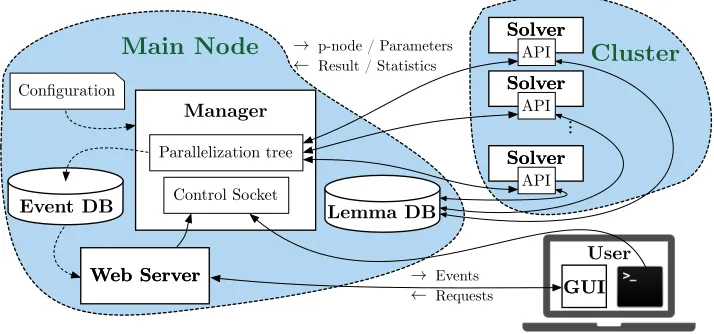
Figure 2: SMTSframework overview. Solid lines represent TCP/IP connections, while dashed lines represent disk I/O.
3
SMTS Architecture
The SMTS architecture (Fig.2) consists of several components representing processes running on different computing nodes and communicating using TCP/IP. Themanager receives tasks from the user through the control socket, which can be accessed either through the terminal interface, or through the GUI. Aconfiguration file provides both general settings (e.g. paral-lelization tree and network configurations), and solver-specific parameters that will be forwarded together with each p-node solving task. The Parallelization treekeeps track of the mapping betweensolversand p-nodes by distributing the instances of each unsolved p-node among all the available solvers. Events such as solver failures and additions occurring during the exe-cution are managed soundly by the server. The API layer each solver implements makes the underlying algorithms transparent to the rest of the framework. The lemma database stores and provides lemmas to the solvers, filtering lemmas based on different heuristics. The history of events related to the solving task is stored in theevent databasewhich can be inspected using the GUI either live or once the solving has terminated.
3.1
SMTS Application Program Interface
The API takes care of handling communication between the solvers and both the manager and lemma database. This includes scheduling incoming solving tasks, reporting solving results and statistics, and importing and exporting lemmas. The API consists of the methods of the C++classsolver, that provide the SMTS functionalities to any given solver. The abstraction with the manager is provided by fivesolverclass methods: init()for initializing the solver, solve() for solving a given instance,partition() for creating a given number of partitions of the current solving instance, interrupt() for interrupting the solver, and report() for reporting solving status and statistics.
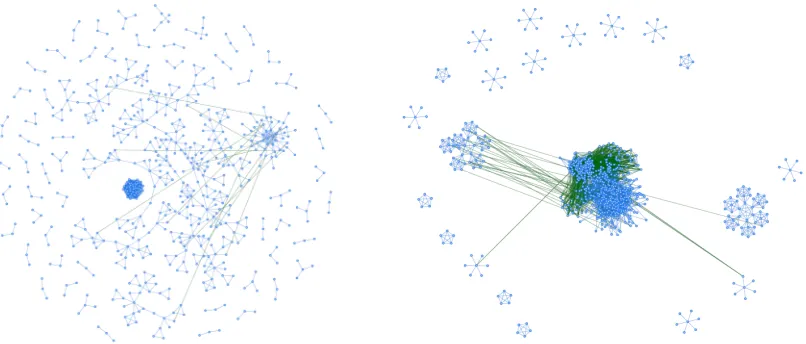
Figure 3: Two QF LRA SMTS GUI CNF visualization examples. Nodes represent theory atoms, edges are variable incidences, and green edges represent learned binary clauses.
the parallelization tree node currently being solved by the solver. Lemmas complying with the
smtlib format specification make the cooperation between different solvers natively possible. Each solver is responsible for proper lemma marshaling and unmarshaling, in particular for taking care of uniqueness and self-containedness.
We provedSMTSAPI versatility by implementing a parallelSMTsolver based on
Open-SMT2 [8], and a parallel IC3 solver based on Z3-Spacer [13]. Both OpenSMT2 and Z3-Spacerimplementations share basic design principles: init()initializes the required solver’s data structures by setting parameters as requested by the manager (contained in the configu-ration file);solve()provides the given instance to the underlying engine, and calls the solving function whose output is then given as input toreport(). Using just theseSMTSfeatures, a portfolio of solvers can be easily obtained by properly initializing solver randomness ininit().
3.2
Graphical User Interface
The SMTS GUI shows the parallelization tree and allows the user to trace back the status of the tree in any moment in the past, visualize resource allocation, interact with the current parallel solving, and show the history of events and statistics of past and current solving tasks. If the manager is currently running, theGUI is connected to the control socket, enabling the user to interact with the current parallel solving task. As an example, a double click on a p-node currently being solved triggers partitioning of such node.
0 200 400 600 800 1000
120 130 140 150 160 170
ru
n
ti
m
e
(s
ec
.)
# solved instances
p1
p1CS
p2
p2CS
p8
p8CS
sequential
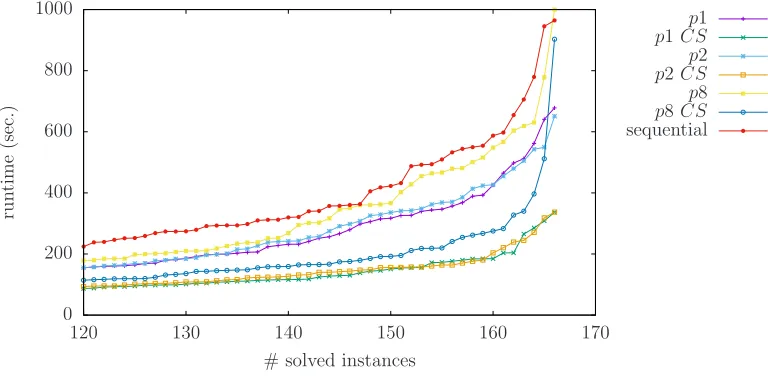
Figure 4: ComparingSMTSexecuted in a cluster using different configurations of the Open-SMT2solver.
view shows them as green edges between two nodes.
More details about GUI features are available in the appendix.
4
Experimental Evaluations
In this section we report experimental results over both parallel SMT andIC3 using SMTS
within a distributed environment. A more in-depth analysis on the techniques is available at [17] and [16], respectively. For all our experiments we use a modern Intel-based cluster of 24 nodes, each with 64GB of memory and 20 cores. The nodes are connected with Intel Infiniband 40Gbps network.
Experiments on SMT. Figure 4 evaluates SMT parallel techniques over the QF UF and QF LRA benchmarks using theOpenSMT2engine, with differentSMTSconfigurations. The partitioning tree instantiationsp1,p2 andp8 are respectively pure portfolio and partitioning in 2 and 8 partitions (see first and second examples from Fig.1). The flagCSindicates that clause sharing is enabled. In general we see that SMTS provides speed-up on these instances, and that clause sharing is effective. Interestingly clause sharing performs badly with partitioning in two, and often partitioning is not as efficient as one would think.
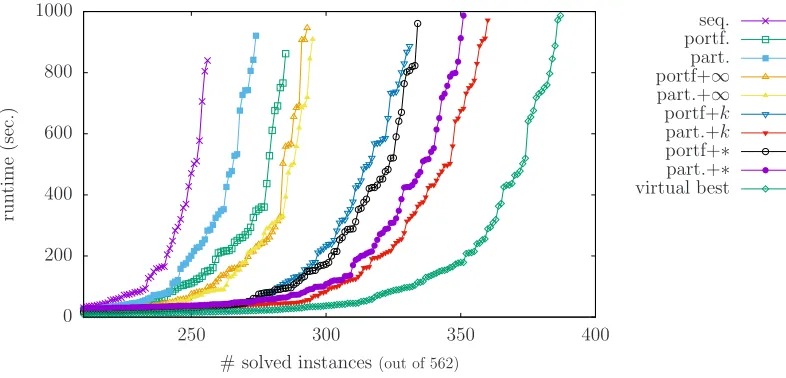
Experiments on IC3. Figure 5 shows results on parallel IC3 obtained using SMTS. The different configurations reported are sequential run, and a combination of two parallelization trees approachesportfolioand partitioning, each with and without lemma sharing (see Fig.1). The instances are taken from the software model checking competition Linux device drivers category [1]. TheIC3API implementation ofSMTSsupports different lemma sharing modes: none,F∞,Fk, and all (∗) (see [16]). We notice that the partitioning approaches are particularly
effective, and interestingly sharing only Fk suffices for a very good speedup. However, from
0 200 400 600 800 1000
250 300 350 400
ru
n
ti
m
e
(s
ec
.)
# solved instances(out of 562)
seq. portf. part. portf+∞ part.+∞ portf+k part.+k portf+∗ part.+∗ virtual best
Figure 5: Comparing SMTS executed in a cluster using different configurations of the Z3-Spacersolver.
Table 1: Lemma sharing statistics forIC3.
portfolio partitioning
∞ k ∗ ∞ k ∗
time 0.38% 1.12% 1.18% 1.16% 4.01% 3.86%
#lemmas 405 299 295 286 289 269
approaches are orthogonal. Table 1 reports the average time spent in network delays due to lemma sharing with respect to the total solving time of each instance, and the average amount of lemmas exchanged before solving each instance. We note that the number of shared lemmas in IC3 is relatively low compared to what one would expect on SMTsolving, and that the overhead is mostly insignificant, suggesting that the implementation of SMTS is efficient for these numbers.
Graphical User Interface Effectiveness. The SMTS GUI helped us to find a bug in the manager code. An analysis of a parallel SMT execution revealed that, under certain circumstances, some solvers were assigned to nodes having an already solved ancestor. By construction if the satisfiability of an ancestor in the parallelization tree is known, also the satisfiability of all the children of that ancestor is know. Therefore this behaviour witnesses a performance bug that was due to the concurrency involved in the message exchange between all the solvers and the manager.
5
Conclusion
on the general parallelization tree formalism. The parallel features are readily exploitable by different solvers through the available API and a user-friendly graphical interface helps development and research. Our personal positive experiences withSMTSgives us confidence that the tool will be both interesting and valuable to the community in general.
References
[1] SV-COMP benckmarks (2018),https://github.com/sosy-lab/sv-benchmarks
[2] Bjørner, N., Gurfinkel, A.: Property directed polyhedral abstraction. In: Proc. VMCAI 2015. pp. 263–281 (2015)
[3] Bradley, A.R.: SAT-based model checking without unrolling. In: Proc. VMCAI 2011. pp. 70–87 (2011)
[4] Budakovic, J., Marescotti, M., Hyv¨arinen, A.E.J., Sharygina, N.: Visualising SMT-based parallel constraint solving. In: Proc. SMT 2017. CEUR Workshop Proceedings, vol. 1889, pp. 40–49 (2017) [5] Carro, M., Hermenegildo, M.V.: Tools for search-tree visualisation: The APT tool. In: Proc. the
DiSCiPl project. LNCS, vol. 1870, pp. 237–252. Springer (2000)
[6] Chaki, S., Karimi, D.: Model checking with multi-threaded IC3 portfolios. In: Proc. VMCAI 2016. pp. 517–535 (2016)
[7] E´en, N., Mishchenko, A., Brayton, R.K.: Efficient implementation of property directed reachabil-ity. In: Proc. FMCAD 2011. pp. 125–134 (2011)
[8] Hyv¨arinen, A.E.J., Marescotti, M., Alt, L., Sharygina, N.: OpenSMT2: An SMT solver for multi-core and cloud computing. In: Proc. SAT 2016. pp. 547 – 553. No. 9710 in LNCS, Springer (2016) [9] Hyv¨arinen, A.E.J., Marescotti, M., Sharygina, N.: Search-space partitioning for parallelizing SMT
solvers. In: Proc. SAT 2015. LNCS, vol. 9340, pp. 369–386. Springer (2015)
[10] Hyv¨arinen, A.E.J., Wintersteiger, C.M.: Parallel satisfiability modulo theories. In: Hamadi, Y., Sais, L. (eds.) Handbook of Parallel Constraint Reasoning. Springer (2018)
[11] Hyv¨arinen, A.E.J., Junttila, T.A., Niemel¨a, I.: A distribution method for solving SAT in grids. In: Proc. SAT 2006. LNCS, vol. 4121, pp. 430–435. Springer (2006)
[12] Kahsai, T., Tinelli, C.: Pkind: A parallel k-induction based model checker. In: Proc. PDMC 2011. pp. 55–62 (2011)
[13] Komuravelli, A., Gurfinkel, A., Chaki, S.: SMT-based model checking for recursive programs. Formal Methods in System Design 48(3), 175–205 (2016)
[14] K¨onig, A., Schaub, T.: Monitoring and visualizing answer set solving. TPLP 13(4-5-Online-Supplement) (2013)
[15] Luby, M., Sinclair, A., Zuckerman, D.: Optimal speedup of las vegas algorithms. Inf. Process. Lett. 47(4), 173–180 (1993)
[16] Marescotti, M., Gurfinkel, A., Hyv¨arinen, A.E.J., Sharygina, N.: Designing parallel PDR. In: Proc. FMCAD 2017. pp. 156–163. IEEE Press (2017)
[17] Marescotti, M., Hyv¨arinen, A.E.J., Sharygina, N.: Clause sharing and partitioning for cloud-based SMT solving. In: Proc. ATVA 2016. pp. 428–443 (2016)
[18] Marques-Silva, J.P., Sakallah, K.A.: GRASP: A search algorithm for propositional satisfiability. IEEE Transactions on Computers 48(5), 506–521 (1999)
[19] Moskewicz, M.W., Madigan, C.F., Zhao, Y., Zhang, L., Malik, S.: Chaff: Engineering an efficient SAT solver. In: Proc. DAC 2001. pp. 530–535. ACM (2001)