Managing Data Replication in Mobile Ad-Hoc Network Databases Using Content
Based Energy Optimization
Mobarak Abaker Adam Hassan
1, Nayyar Ahmed Khan
2and Mohammad Ahmad Mohammad Nasim
31Assistant Professor, Department of Computer Science, Shaqra University, Saudi Arabia. Email: [email protected] 2Lecturer, Department of Computer Science, Shaqra University, Saudi Arabia. Email: [email protected] 3Lecturer, Department of Computer Science, Shaqra University, Saudi Arabia. Email: [email protected]
Article Received: 09 October 2017 Article Accepted: 27 November 2017 Article Published: 14 December 2017
1. INTRODUCTION
MANET is a collection of wireless autonomous nodes that may move unpredictably, forming a temporary
network without any fixed backbone infrastructure [2]. All the nodes in MANET are mobile and, thus, restricted
by power. These nodes not only can communicate with nodes that are within their communication ranges, but
also can communicate with nodes that are outside their transmission ranges using multi hop communication.
Since no fixed infrastructure is required, they fit well in military, rescue operations a nd sensor networks [3].
MANET has dynamic topology as mobile nodes move around or even enters and exit the network. Every mobile
nodes of a MANET work as a router to discover and maintain routes, and forward packets to other nodes. In
many ad hoc networks, each node is powered by a battery and has a limited energy supply. Over time, various
nodes will deplete their energy supplies and drop out from the network.
Unless nodes are replaced or recharged, the network will eventually become partitioned. In a large network,
relatively few nodes may be able to communicate directly with their intended destinations. Replication of hot
data items before such a partitioning occurs, improve data accessibility in MANET. With the current MANET
data replication protocols which are based on Update broadcast/ Connection broadcast methods consistency can
be assured but energy saving cannot. Energy-preserving replication strategies for MANET have received
ongoing attention. In general incorporating information about nodes battery levels in replication can help to
preserve energy. In this paper, we are presenting On Demand Update of Replica in MANET based upon estimate
of the remaining lifetime of each node. In our scheme (On Demand Update of Replica) host will update data items
at multiple nodes by invalidating their replicas On Demand instead of every updating. Moreover many A B S T R A C T
A Mobile Ad-hoc Network (MANET) is a collection of wireless autonomous nodes without any fixed backbone infrastructure. All the nodes in MANET are mobile and power restricted and thus, disconnection and network partitioning occur frequently. In addition, many MANET database transactions have time constraints. Data Replication technique for real-time Ad-hoc Mobile databases (Dream) is proposed that addresses all those issues. [1] It improves data accessibility while considering the issue of energy limitation by replicating hot data items at servers that have higher remaining power. It addresses disconnection and network partitioning by introducing new data and transaction types and by considering the stability of wireless link. It handles the real-time transaction issue by replicating data items that are accessed frequently by firm transactions before those accessed frequently by soft transactions. However there are certain problems that may arise in the Dream concept and in order to overcome the issue proposed as a fail back in Dream the paper represents a better approach so as to handle the scenario. This approach is a schema presented in order to handle the content based system replica for the MANET and provide a better congestion free and energy efficient distribution amongst the servers. In MANETs, mobile nodes can move randomly and autonomously. They form a temporary communication network without any prior infrastructure.
applications in this environment are time critical and, hence, their transactions should be executed not only
correctly, but also within their deadlines. In a distributed database system, data are often replicated to improve
reliability and availability. However one important issue to be considered while replicating data is the correctness
of the replicated data. Since nodes in MANET are mobile and have limited energy, disconnection may occur
frequently, causing a lot of network partitioning. Data that is available in mobile hosts in one partition cannot be
accessed by mobile hosts in another partition. The issues related to data replication in MANET databases are as
follows:
1. Server Power Consumption: Servers in MANET run on battery power. If a server has low power
remaining and if it is replicated with many frequently accessed data items, then the frequent data access
requests for these hot data will drain its power.
2. Server mobility: Due to their mobility, servers might sometimes move to a place where they could not
be reached by any other server or client.
3. Client mobility: Clients that query servers for information are also mobile. Clients usually send their
transactions to the nearest servers to get a quick response. The decision to replicate data items at a
particular server may be based on the access frequencies of data items from that specific server. Hence, the
decision to replicate data items at appropriate servers must be dynamic and based on the current network
topology.
4. Client Power: Clients in MANET also run on battery power. If a client waits too long for its
transactions’ results, it might lose its power rapidly. The replication technique should be able to
replicate data items at appropriate servers in such a way that a client might be able to access its
requested data items from its nearest server which has the least workload.
5. Time-critical applications: Many MANET applications, like rescue networks, military operations, are
time-critical. Data replication should be used to improve data accessibility and
Performance of the system, thereby reducing the time to execute transactions. Transactions with short
deadlines should be sent to the nearest servers that have the least workload for their execution. These
transactions should also be executed before other transactions that have longer deadlines.
6. Frequent Disconnection and Network Partitioning: Disconnection and network partitioning is a
severe problem in MANET as servers in one partition that hold required data items cannot provide
services to other clients and servers in different partitions.
7. Update transactions: If there are no constraints in storage space and if there are read-only transactions,
data accessibility and performance of MANET databases can be increased by fully replicating the database
in all the servers. However, maintaining consistency in a fully replicated database is a major issue when
there are frequent update transactions.
2. RELATED WORKS
A data replication technique that replicates data items based on their access frequencies and the current network
items are similar, there could be replica duplications at many mobile nodes. Hence, two other techniques to
reduce replica duplication between mobile nodes are proposed in [4]. They also detect network partitioning and
replicate hot data items before such a partitioning occurs to improve data accessibility. However in those
techniques, when there is a replica duplication between any two connected mobile nodes, one of the duplicate
replicas is replaced by another hot data item, irrespective of how high the access frequency of the replaced data
item is or how low the access frequency of the new data item is.
A data replication technique that replicates data items at multiple nodes and employs quorum based strategies to
update and query information is proposed in [5]. It sends the update information to nodes in such a way that other
nodes while querying for this update information gets the most updated information, and thereby, reducing
inconsistency and dirty read transactions. It determines the time to send the updates, where to send them and
which nodes to query for the information in such a way that it mitigates the impacts of network partitioning.
Another way of disseminating the update information to mobile nodes is by data broadcasting as proposed in [6].
This replication technique delays the updates to replicas for performance and bandwidth considerations. It also
determines what updates to broadcast and when to broadcast them in an efficient manner.
A set of protocols that use a gossip-based multi-cast protocol to probabilistically disseminate updates in a quorum
system is proposed in [7]. It achieves high reliability even when there are large concurrent update and query
transactions. A new metric for evaluating wireless link robustness that is used to detect network partitioning is
proposed in [7]. Its decision to replicate data items is taken not only at the time of detecting network partitioning,
but also during the time when the wireless connections become bad in terms of reliability, bandwidth and delay.
Roam [8] is a replication technique that attempts to provide data availability to mobile hosts irrespective of the
mobility of the hosts. It models the mobility of hosts by grouping them into wards and determines periods of
motion of the mobile hosts. Ward masters are elected to provide communication across wards, but hosts
belonging to the same ward may directly communicate with each other. Roam maintains consistency of replicas
across the network, irrespective of the locations of movements’ different hosts. None of the above replication
techniques addresses the issues related to real-time database transactions and mobile hosts’ power limitation. It
should also be noted that network partitioning might occur not only due to mobile hosts’ mobility, but also due to
battery power drainage of some mobile hosts.
3. NON ECCENTRIC - MANET DATABASE ARCHITECTURE WITH MULTIPLE SERVER POINTS
AND CLIENT POINTS
Depending on communication strength, computing power, disk and memory storage size, and mobile hosts can
be classified into two groups: Clients and Servers. Clients are equipped with reduced memory and computing
capabilities. They store only the Query Processing module of the Database Management System (DBMS) that
allows them to submit transactions to appropriate servers and receive results. Servers are equipped with higher
are equipped with handy portable computers like PDA’s and smart phones, could be considered as clients, while
tanks and Humvee equipped with high end portable computers like laptops could be considered as servers. This
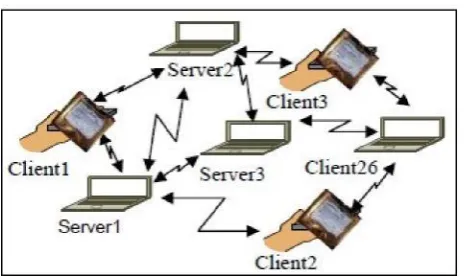
paper assumes a decentralized architecture, where clients are free to communicate (single-hop or multi-hop) and
submit their transactions to any of the available servers in the network as shown in Figure 1. This architecture
does not place reliance on any centralized server and, thus, improves system resilience by avoiding a single
point of failure.
Figure 1: Non Eccentric MANET Database Architecture with multiple client and server access points (SAP’s)
4. PROPOSED MANET DATA REPLICATION TECHNIQUE CONTENT BASED DATA
REPLICATION
A data replication for MANET databases, is proposed that extends the techniques proposed in [6] that have briefly
been reviewed in [2] to consider additional issues including mobile hosts’ power limitation, real-time database
transactions as well as various data and transaction types that exist in many MANET applications. The active data
items at the server are having high remaining power. It handles the real-time transaction issue by giving a higher
priority for replicating data items that are accessed frequently by perfect transactions than those accessed
frequently by temporal transactions. It addresses disconnection and network partitioning by introducing new data
and transaction types and by determining the stability of wireless links connecting servers.
The remaining energy of connecting servers is also used to measure their link stability. Each server in the design
proposed holds the original copy of a data item is termed its primary copy server and the other servers that hold
the replicas of the data item are termed its secondary copy servers. The scheme addresses the replica
synchronization issue by maintaining two timestamps that indicate when a particular data item is updated in its
primary and secondary copy servers.
The main parts for the replication mechanism are as: first part determines the data items to be replicated by
obtaining the need for the items that are to be replicated and the servers in which they have to be replicated. The
second part determines how the allocated replicas can be accessed for transaction processing based on their data
A. Data Types
Data items are classified into read-only and read-write data items. Read-write data items can be further classified
into two types: Temporal and Persistent. The former are those data items the values of which are valid only for a
certain period of time. The location of a soldier and the location of an enemy are examples of temporal data items
as they move frequently in a battlefield. However, persistent data items are valid throughout their existence in the
database. All read-write data items can be further classified into periodic and aperiodic update data items.
Periodic update data items are those data items that are updated periodically at fixed intervals of time. For
example, the location of a soldier may be updated frequently at a constant interval of time. Aperiodic-update data
items are those data items that are updated at random intervals of time. For example, the location and information
about an enemy may be updated at random time intervals.
1. Computing Access Frequencies based on Data and Transaction Types Access frequency of a data item d at a
particular server s, Access Frequency, is the number of times that d is accessed at s. From the access logs, similar to
[6], the access frequency of each data item at each server is computed. In addition, in DREAM, the numbers of
times a data item is accessed by Firm, Soft, MRV and Non- UCV transactions at all servers are computed. These are
computed only once by all the servers when running the replication algorithm for the first time. These access
frequencies are then further calculated using a weight factor based on the data and transaction types presented in
Sections 4.1 and 4.2. The resulting access frequencies are thus the weighted ones to reflect replication prioritization
as shown in the following sections.
a) Firm and Soft Transactions: if a data item is accessed more often by firm transactions than another data item is,
then the former data item is given a higher priority to be replicated than the latter. This is to reduce the number of
transaction aborts since firm transactions must be aborted if they missed their deadlines. Firm transactions’
execution time can decrease considerably if their required data items reside in the servers to which the requests
were sent. The replication priority is set by assigning weighted access frequencies to data items that are accessed
by firm transactions using the below formula where Access frequency Firm s is the number of times data item d
2. Read Transactions
If the requested data item is a read-only data item, it can be accessed from any server that holds it. Similarly, if
the initiated transaction is an OD transaction, it can be accessed from any server that holds it. For both of these
two cases, if the requested data item is available at more than one server, the decision to choose an appropriate
server is based on the real time transaction type. A firm transaction is sent to the nearest server with the least
workload, while a soft transaction is sent to the highest energy server with the least workload, for transaction
processing. The objective is to reduce the number of transaction aborts and, at the same time, balance the energy
consumption distribution among servers.
If the requested transaction is a MRV transaction, the requested data item should be accessed from the server that
has its most recent value among all the servers that hold it. If the requested transaction is a MRVP transaction, the
requested data item should be accessed from the server that has its most recent value among all the servers in its
network Partition that hold it. Based on the Local_Update_Timestampd s of all servers s, the most recent value
of data item d can be determined. A periodic update data item is updated once every certain period of time called
its update frequency. Hence, a MRV or a MRVP transaction accessing a periodic update data item can access it
from any server that has updated it during its last known update time interval. For example, consider a periodic
data item d that is updated every one hour. A server s has the most recent value of d if the difference between the
current time (Tnow) and the last update timestamp of d in s (Local_Update_Timestampds) is less than its update
frequency (Frequency_Updateds), which is one hour in this example.
3. Write Transactions
If the transaction is an update transaction and if the coordinating server is connected to the primary copy
server of the requested data item, the u pdate transaction is forwarded to the primary copy server for
transaction processing. If the coordinating server holds a replica of the requested data item, and if the transaction
is not an UCV transaction, the local replica is also updated as further read requests for that data item can be
accessed directly from the local replica. However, if the coordinating server is not connected to the primary copy
server, and if the transaction is not an UCV transaction, the update transaction is forwarded to the server that holds
the requested data item. If there is more than one server that holds the requested data item, a firm transaction is
sent to the nearest server that has the least workload and a soft transaction is sent to the highest energy server that
has the least workload for transaction processing.
However, if the coordinating server is not connected to the primary copy server as in this case, the transaction
cannot be executed successfully. Hence, the coordinating server will try to connect to the primary copy server
unless the deadline of this transaction has expired, in which case the transaction is aborted. The deadline here
How to Synchronize Replicas?
Every time during the relocation period, the primary copy server of a data item tries to synchronize its data item
with other connected servers that hold its replica. The primary copy server requests for the last updated timestamps
from all replicas. Based on the update timestamp of the primary copy and the update timestamps of the replicas, the
primary copy server determines if there is any other server that has a more recent value of its data item. If such a
server exists, the new value of the data item is synchronized with all other servers. However, a server that is
disconnected from the network during the relocation period cannot synchronize its data item. Even if the
disconnected server has the most recent value of the data item, the primary copy server cannot determine it since the
former is disconnected. Hence, it will only try to synchronize the data item during the next relocation period.
5. REPLICA RELOCATION
As mentioned above, optimal replica allocation cannot be determined in MANETs due to the mobility of mobile
hosts. Therefore, we embrace the following heuristic approach:
Replicas are relocated in a specific period (relocation period).
At every relocation period, replica allocation is determined based on access frequency from each mobile host to
each data item and the network topology at the moment. Based on this approach, in [5] we proposed three replica
allocation methods that differ in the emphasis placed on access frequency and network topology.
A. Static Access Frequency (SAF)
Each mobile host allocates replicas of data items in descending order of the access frequencies within the limit of
its own memory space. In the SAF method, mobile hosts do not need to exchange information with each other for
replica allocation. Moreover, replica relocation does not occur after each mobile host allocates all necessary
replicas. As a result, this method allocates replicas with low overhead and low traffic. On the other hand, since
each mobile host allocates replicas based only on access frequencies to data items, mobile hosts with the same
access characteristics allocate the same replicas. However, since a mobile host can access data items or replicas
held by other connected mobile hosts, it is more effective to share many kinds of replicas among them. Therefore,
SAF provides low data accessibility when many mobile hosts have the same or similar access characteristics.
B. Dynamic Access Frequency and Neighborhood (DAFN) to solve the problem with the SAF method, first the
DAFN method determines replica allocation in the same way as SAF. If there is replica duplication of a data item
between two neighboring mobile hosts, the mobile host with the lower access frequency relative to the data item
replaces the replica with another replica. This procedure is performed at every relocation period. Since the DAFN
method eliminates replica duplication and more kinds of replicas can be shared among neighboring mobile hosts,
data accessibility is expected to be higher than in the SAF method. However, DAFN cannot eliminate replica
duplication among mobile hosts connected by two or more hop links. Moreover, both the overhead and the traffic
for replica relocation are higher than the SAF method.
C. Dynamic Connectivity based Grouping (DCG): The DCG method shares replicas in larger groups of mobile
hosts than DAFN. At every relocation period, each mobile host broadcasts its host identifier. After all mobile
received host identifiers. In each set of mobile hosts connected to each other, the mobile host with the lowest host
identifier suffix (I) executes an algorithm to find disconnected components with the network topology known by
received messages. Even if a mobile host belongs to more than one disconnected component, it can only belong
to one group in which the corresponding disconnected component was found first. By grouping mobile hosts as
disconnected components, the group is not divided even if one mobile host disappears from the network or one
link is disconnected in the groups. Thus, it is assumed that the group has high stability. Next, replicas of data
items are allocated on mobile hosts in each group in descending order of the access frequencies in the group.
More specifically, in each group, the mobile host with the lowest host identifier becomes the coordinator of the
group, who calculates the group’s access frequency to each data item as a summation of access frequencies of
mobile hosts in the group to the item. Then the coordinator determines replica allocation in the group according
to the calculated access frequencies. Compared with the DAFN method that shares replicas among neighboring
hosts, the DCG method shares replicas in larger groups of mobile hosts that have high stability. Thus, data
accessibility is expected to be higher. However, both the overhead and the traffic are higher than the other two
methods because at each relocation period, mobile hosts exchange information and widely relocate replicas.
6. CONSISTENCY MANAGEMENT
In [9], we assumed an environment where each data item is updated by the mobile host that holds the original at
inconstant intervals and proposed two cache invalidation methods that reduce the number of accesses to old
replicas whose original has been updated. We call them the update broadcast and connection rebroadcast methods,
respectively. In the following, we describe the details of the two methods A. Update broadcast method [10].
In the update broadcast method, a mobile host holding an original data item broadcasts an invalidation report to
connected mobile hosts every time it updates the data item. The invalidation report includes a data identifier and
update time (time stamp). When a mobile host receives an invalidation report, it refers to its own time stamp table
and checks whether the replica held by the host is valid. More specifically, first the mobile host compares the time
stamp in the received invalidation report with the corresponding data item in its own time stamp table. If the
former is larger, the host updates the time stamp in its own time stamp table to the received invalidation report. At
the same time, the host transmits the received invalidation report to its neighboring mobile hosts. Furthermore, if
the host holds an invalid replica of the corresponding data item, the host discards the replica from its own cache.
On the other hand, if the time stamp in the received invalidation report is identical to the time stamp table, i.e., the
host receives the same invalidation report again, it does not transmit the received invalidation report to its
neighboring mobile hosts and discards the report. In this method, the traffic caused by broadcasting invalidation
reports is light since mobile hosts broadcast only when updating the original data items. Mobile hosts connected to
the host holding the original data item can keep the time stamp of the most recent corresponding data item.
B. Connection rebroadcast method: Similar to the update broadcast method, in the connection rebroadcast method,
addition, every time two mobile hosts newly connect with each other, they rebroadcast invalidation reports that
they have already received.
1)When two mobile hosts, MI and Maj (I < j), newly connect with each other, the mobile host with larger suffix (j)
of host identifier (Maj) transmits its own time stamp table to the other one.
2)Mobile host MI compares the entry for each data item in its own time stamp table with the time stamp table
received from mobile host Maj and updates its own time stamp table. Then, the following processes are executed:
MI broadcasts invalidation reports for data items whose time stamps held by MI are smaller than the
ones held by Maj to its connected mobile hosts, except to Maj.
MI sends the information on the updated time stamps for data items whose time stamps held by Maj are
smaller than the ones held by MI to Maj. Then Mj broadcasts invalidation reports for these items to its
connected mobile hosts, except to Mi.
3) Mobile hosts that receive invalidation reports invalidate their replicas in the same way as the update broadcast
method. In this method, invalidation reports spread among a large number of mobile hosts, and cache invalidation
is performed at these mobile hosts even if they are not connected to the mobile hosts holding the original data
items. Thus, this method can further reduce the number of accesses to invalid replicas than the update broadcast
method. However, when network topology frequently changes, the traffic caused by broadcasting invalidation
reports is much higher than the update broadcast method due to the frequent rebroadcast of reports.
C. Extensions
The methods proposed in [10] can reduce the number of accesses to old replicas whose originals have been
updated, although they cannot improve data accessibility. In [12], we proposed two updated data dissemination
methods to efficiently update old replicas and reduce the number of accesses to old replicas as well as to improve
data accessibility. These methods disseminate data items of the most recent version instead of invalidation reports.
7. LOCATION MANAGEMENT
In [9], we discussed the techniques to manage the locations of data items and replicas and efficiently forward
Access requests to the locations. In the following, we call these techniques location management methods. To
efficiently manage the locations of data items, a key issue is predicting the locations of data items that
dynamically change. Here, location changes are caused by two factors: replica relocations and network topology
changes due to host mobility. To predict the locations of data items, we use replica allocation information at
every relocation time and the logs of past data accesses.
In this section, among the location management methods proposed in [9], we introduce the Access Log (AL)
which is specialized for the DCG method in [5]. Noted that the GM method can be applied to most other
replication schemes based on clusters that hierarchically manage data locations.
A. AL method
In this method, each mobile host holds an access log (AL) table that consists of pairs of a data identifier and a list of
host identifiers that represents holders of the data item corresponding to the data identifier.
1) Recording location information: Suppose that a mobile host issues an access request to data item Do and the
request succeeds by accessing the original or its replica held by mobile host Mi. In this case, the request issued host
inserts data identifier MI at the top of the list of host identifiers corresponding to do. If MI already exists in the list,
the old one is deleted from it. Here, the size of each list is limited to L and the last one is deleted if the size exceeds
L. Every time a relocation period comes, each mobile hosts Discards all the information in its own AL table.
8. FUTURE DIRECTIONS
As mentioned above, replica relocation, consistency management, and location management are significant issues
for data replication in MANETs. However, several other issues still remain to be addressed to put the data
replication techniques into practice. In this section, we describe these remaining issues as future directions.
A. Power Consumption
Since we consider the reduction of the power consumption of mobile hosts a significant issue in MANETs,
network traffic has been chosen as a performance metric. However, although the reduction of traffic in the entire
network can reduce the total power consumption among all mobile hosts, not every mobile host is guaranteed to
survive for a long time. In other words, the power consumption of mobile hosts may become unbalanced, causing
some to deplete their batteries and disappear from the network. Usually, such mobile hosts are at the central part
of networks that have a large number of links with other hosts and relay many communication packets. Thus, the
disappearance of these mobile hosts heavily damages the network.
In [11], [12], [13], the authors proposed routing protocols and caching strategies that consider the power
consumption of mobile hosts in MANETs. The ideas in these conventional works can be applied to balance power
consumption among mobile hosts for data replication in MANETs. We are currently considering new approaches
that relocate replicas and route data requests by taking remaining batteries into account.
B. Consistency Levels and Their Management Protocols
In our work, we assume that replicas of a data item become invalid after the host, who is holding the original,
updates it and consistency among replicas is maintained in the entire network. However, since mobile hosts
frequently disappear from the network and partitions frequently occur in a MANET, such strict consistency
require such strict consistency. For instance, consider a situation where members of a rescue operation construct
an ad hoc network in a disaster area. They are divided into several groups each of which is responsible for a
particular region and the members in each group share information on their progress, i.e., the information is
replicated at mobile hosts to deal with possible network divisions. In this situation, consistency among replicas
must be strictly maintained in the same group, which is not required among replicas in different groups since the
information being shared in a different group is only for reference.
Moreover, in our work consistency among replicas is protected by an optimistic approach in which each mobile
host tentatively accesses a replica when it is not connected to the mobile host holding the original a nd validates
the tentative access afterward. This approach may cause many transactions to remain tentatively committed for
a long time as well as cascade aborts. In [14], [15], the authors proposed consistency management protocols
based on a quorum system proposed for distributed systems. Although these protocols cannot strictly maintain
consistency among replicas in the entire network, mobile hosts can immediately commit their transactions
(database operations). We are currently addressing classification of consistency levels for database operations
in MANETs according to application requirements and determining detailed protocols. Some of them employ a
quorum system similar to the protocols in [14], [15].
C. Security
In our work we assume that the system environment is a mesoscale MANET in which mobile hosts (users)
collaboratively work for the same purpose, such as rescues and military affairs. Thus, we do not consider security
issues for data sharing in MANETs. However, if our proposed data replication technologies are used in a large and
general public MANET, security issues must be addressed. In some conventional work [4], [13], security issues for
routing in MANETs have been discussed. Some ideas in these Conventional work can be applied for data
Replication in MANETs.
9. CONCLUSION
In this paper, we briefly explained our recent work addressing data replication issues in MANETs: replica
relocation, consistency management, and location management. We also described a few prospects for future
directions: power consumption, consistency levels and their management protocols, and security. We believe
that data replication in MANETs will become a key technology in future mobile and ubiquitous computing
environments.
REFERENCES
[1] Managing Data Replication In Mobile Adhoc Network Databases (Invited Paper)* by Prasanna Padmanabhan
and Dr.Le Gruenwald.
[3] Hong, M.Gerla, G.Pei, and C.Chiang, “A group mobility model for adhoc wireless networks,” ACM/IEEE
MSWiM, Seattle,Washington, 1999, pp.53-60.
[4] T. Hara, Y.H.Loh, S.Nishio, “Data Replication Methods Based on the Stability of Radio Links in Ad Hoc
Networks”, Journal of the Information Processing Society of Japan, Vol.44, No.9, Sept. 2003, pp.2308-2319.
[5] G. Karumanchi, S. Muralidharan, R. Prakash, “Information Dissemination in Partitionable Mobile Ad Hoc
Networks”, Symposium on Reliable Distributed Systems, 1999, pp. 4-13.
[6 ] B.Xu, O.Wolfson, S.Chamberlain, Y.Yesha, “Adaptive Lazy Replication in Unreliable Broadcast Networks”, Conference on Extending Database Technology,2000.
[7] J.Luo, J.Pierre, H.P.Eugster,“PAN:Providing reliable storage in ad-hoc networks with probabilistic quorum
systems”, ACM/SIGMOBILE Symposium on Mobile Ad Hoc Networking & Computing, 2003, pp. 1 12.
[8] D. Ratner, P. Reiher, G.J. Popek, “Roam: A Scalable Replication System for Mobility”, Mobile Networks and
Applications, Vol. 9 No. 5, Oct. 2004.
[9] Data Replication Issues in Mobile Ad Hoc Networks TakahiroHara Department of Multimedia
Engineering,Osaka University 1-5 Yamadaoka, Suita, Osaka 565- 0871.
[10] H. Hayashi, T. Hara, and S. Nishio, “Cache invalidation for updated data in ad hoc networks,” Proc. of Int’l
Conf. on Cooperative Information Systems (CoopIS’03), pp.516-535, Nov. 2003.
[11] P. Nuggehalli, V. Srinivasan, and C.-F. Chiasserini, “Energy-efficient caching strategies in ad hoc wireless
networks,” Proc. MobiHoc’03, pp.25-34, 2003.
[12] S. Singh, M. Woo, and C.S. Raghavendra, “Power-aware routing in mobile ad hoc networks,” Proc. MobiCom’98, pp.181 190, 1998.
[13] C.-K. Toh, “Maximum battery life routing to support ubiquitous mobile computing in wireless ad hoc
networks,” IEEE Communications, Vol.39, No.6, pp.138-147, 2001.
[15] J. Luo, J.P. Hubaux, and P. Eugster, “PAN: Providing reliable storage in mobile ad hoc networks with probabilistic quorum systems,” Proc. ACM MobiHoc’03, pp.1-12, 2003.
[16] P. Nuggehalli, V. Srinivasan, and C.-F. Chiasserini,“Energy efficient caching strategies in ad hoc