EDITORS-IN-CHIEF
Børge Obel, Aarhus University, Denmark
Charles C. Snow, Penn State University, United States
ASSOCIATE EDITORS
Richard M. Burton (Point of View Articles), The Fuqua School of Business, Duke University, United States Samina Karim (Research Articles), Boston University, United States
Peter Klaas (Translational Articles), Aarhus University, Denmark Phanish Puranam (Research Articles), INSEAD, Singapore
EDITORIAL BOARD
Linda Argote, Carnegie Mellon University, United States Julian Birkinshaw, London Business School, United Kingdom Anne Bøllingtoft, Aarhus University, Denmark
Timothy N. Carroll, University of South Carolina, United States Lex Donaldsen, University of New South Wales, Australia Jay Galbraith, Jay Galbraith Associates, United States Anna Grandori, Bocconi University, Italy
Dorthe Døjbak Håkonsson, Aarhus University, Denmark Diem Ho, IBM
George P. Huber, University of Texas, United States
Sirkka Jarvenpaa, University of Texas, United States and Aalto University, Finland Thorbjørn Knudsen, University of Southern Denmark, Denmark
Tobias Kretschmer, Ludwig-Maximillians-Universität München, Germany
Kristina Lauche, Nijmegen School of Management, Radboud University Nijmegen, Netherlands Christopher Lettl, Vienna University, Austria
John A. Mathews, Macquaire University, MGSM, Australia
Raymond E. Miles, University of California, Berkeley, United States Georges Romme, Eindhoven University of Technology, Netherlands Henk W. Volberda, Erasmus University, Netherlands
EDITORIAL OFFICE
Marianne Sejthen, Aarhus University, Denmark
Journal of Organization Design
TABLE OF CONTENTS
RESEARCH ARTICLES
Drivers of Organizational Responsiveness:
Experiences of a Military Crisis Response Organization ...1-14
By Erik De Waard, Henk W Volberda, and Joseph Soeters
The Design Of Equity Ownership Structure In Inter-Firm Relationships:
Do Managers Choose According To Theory? ...15-30
By Prasahant Kale and Phanish Puranam
The Contingent Value of Organizational Integration ...16-43
By Virpi Turkulainen and Mikko Ketokivi
CASE STUDY
How to Design for Strategic Resilience: A Case Study in Retailing ...44-53
By Liisa Välikangas and Georges Romme
POINT OF VIEW ARTICLE
A Model of the Platform-Ecosystem Organizational Form ...54-58
1 Journal of Organization Design
JOD, 2(2): 1-14 (2013)
DOI: 10.7146/jod.7850
© 2013 by Organizational Design Community
DrIvers Of OrganIzatIOnal
respOnsIveness
experIenCes Of a MIlItary CrIsIs
respOnse OrganIzatIOn
Erik DE WaarD • HEnk VOlbErDa • JOsEpH sOEtErs
abstract: The topic of organizational responsiveness – where organizations need to flexibly
react to strategic and operational demands simultaneously – has been under-explored in
strategic management research. Our study was initiated to shed more light on this topic,
primarily by studying an organization specifically designed to handle crises. By definition,
crisis response organizations have to be prepared to react to unpredictable events. Moreover,
the volatility of the crisis situation itself requires a high degree of flexibility to get or keep
the situation under control. the study hypothesizes modular organizing and organizational
sensing to be key drivers of organizational responsiveness. Empirically, we examine the
effect these two variables have on the responsiveness of the netherlands armed forces for crisis response deployment. findings indicate that modular organizing and organizational sensing are drivers of responsiveness. In addition, our study uncovered the importance of an organization’s level of system decomposition to responsiveness. a high degree of system granularity can lead to a predominantly inward focus whereas organizational responsiveness
calls for a strong external orientation.
keywords: Organizational responsiveness; crisis response; organization design; modularity
the reality of today’s turbulent organizational environments is that most organizations have to deal simultaneously with the “here and now” and the future, and they should be capable of combining routine behavior with improvisation (Winter, 2003). Organizational
responsiveness thus has both strategic and operational aspects. Our study examines two
hypothesized antecedents of organizational responsiveness: organizational sensing and
modular organizing. We define sensing as an organization’s ability to fathom its complex
relationship with the outside world. the sensing process consists of three distinct stages:
noticing, interpreting, and acting (Daft & Weick, 1984; Kiesler & Sproull, 1982). Huber
(2004) argues that organizational responsiveness depends on the cumulative sensing effort of all organizational members. Modular organizing is defined as the combination of autonomous
organizational units into customized constellations (sanchez, 2003; schilling, 2000; Worren,
Moore, & Cardona, 2002). Sanchez and Collins (2001) explain that the key merit of modularization is to increase organizational flexibility without jeopardizing performance.
to investigate organizational responsiveness, our study draws upon the crisis-response
experiences of the Netherlands armed forces. It uses the expeditionary crisis-response task
setting of many of today’s Western armed forces as a metaphor for organizations confronted
with environmental turbulence. Almost all expeditionary crisis-response operations are unique endeavors but are conducted by similarly (modularly) organized task forces (de Waard & Kramer, 2008). Various armed forces have found modular design to be a useful
organizational approach to react effectively to very different crisis situations. Moreover, a
deployed military task force finds itself in a permanent state of operational flux. The volatility
Erik de Waard • Henk Volberda • Joseph Soeters Drivers of Organizational Responsiveness: Experiences of a Military Crisis Response Organization
continuous situational awareness (Alberts, Garstka, & Stein, 2000) – a critical success factor
for repeatedly outsmarting the opponent and staying on top of the situation.
this line of reasoning leads to the research question that guided our study: What is the effect of organizational sensing and modular organizing on the responsiveness of the netherlands
armed forces? Our article is divided into five main parts. First, we present a theoretical
model that shows relationships among sensing, modular organizing, and organizational
responsiveness. Next, we describe our study’s method which involved a large-scale survey carried out among 1,208 senior officers of the Netherlands armed forces. The third section
presents our study’s results, which show that modular organizing and organizational sensing are reinforcing drivers of responsiveness but that, in addition, the organization’s level of
system decomposition is an important factor to take into account. In the fourth section, we discuss our findings, including a comparison of the Netherlands, United States, and Australian armies to show how organizational size affects responsiveness. The final section
is the conclusion.
tHEOrEtiCal MODEl
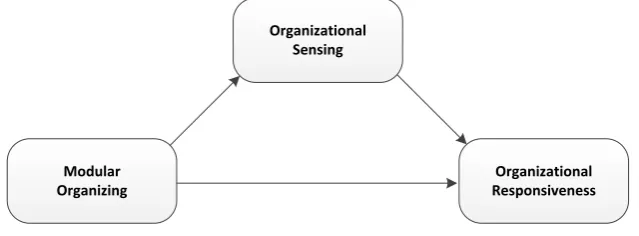
the study is based on the theoretical model shown in figure 1. Modular organizing (MO) is the independent variable, organizational sensing (Os) is the mediator variable, and responsiveness (r) is the dependent variable. relationships among these broad variables are based on three theoretical arguments. first, because of the growing belief that strategic
maneuvering and operational performance are intertwined, sensing has become a key capability associated with organizational responsiveness (Doz & Kosonen, 2008, 2010). An
implicit assumption is that organizations should try to create a culture in which all members are challenged to proactively scan and interpret their immediate environment (Cohen &
Levinthal, 1990; Lane, Koka, & Pathak, 2006; Todorova & Durisin, 2007). More specifically, Huber (2004: 57) states: “In tomorrow’s business environment, where sources of change will
be less anticipatable than in the past, eclectic responsibility will be needed to complement the practice of assigning specialized personnel to monitor and report on particular environmental components. Without eclectic responsibility, many unanticipated threats and opportunities would go unnoticed because no specialized sensor had been assigned to the source.”
Fig. 1. research Model
second, modular organizing is a design strategy that facilitates strategic as well as
structural and operational responsiveness. From a strategic perspective, for example, modular
organizing has stimulated the invention and application of new technologies, the development
of new products, and the upgrading of existing products (Brusoni, 2005; Sanchez, 1995, 1996). Taking the structural responsiveness viewpoint makes it clear that modularity has
offered organizations the ability to reorganize their internal production processes in such a way that economies of scale and scope can be achieved simultaneously (anand & Daft, 2007;
Brusoni & Prencipe, 2006; Schilling & Steensma, 2001). Looking through an operational
lens shows that modularity’s underlying principle of loose coupling creates an organizational
system that can benefit from specific advantages, such as the localization of adaptation and trouble, and the reduction of coordination costs (Orton & Weick, 1990; Weick, 1976).
Third, our theoretical model also follows existing theory explicating that modular organizing plays a dual role. It is argued that modularity not only directly influences responsiveness, but
Organizational Sensing
Modular
3 Erik de Waard • Henk Volberda • Joseph Soeters Drivers of Organizational Responsiveness: Experiences of a Military Crisis Response Organization
the mixing and matching of autonomous organizational units through standardized interfaces helps organizations to flexibly tap new sources of knowledge (Hansen, 1999). Moreover,
due to the autonomous and specialized nature of modular components, the speed of problem solving increases at the same time. In this regard, pil and Cohen (2006: 1001) state: “since each component or subsystem maintains a consistent functional focus, developers may
acquire cumulative experience with certain kinds of problems faster. This enables them to search for and evaluate alternative solutions more quickly.”
MEtHOD
the study’s empirical base is a large-sample survey. a questionnaire was distributed to a large
group of military officers drawn from the Netherlands armed forces. This group consisted of
majors, lieutenant colonels, and colonels from the three main services: army, navy, and air force. the sampling frame concentrated on the middle and higher echelons as the research
required respondents who have significant military experience and knowledge as well as
potential insight into various strategic and organizational aspects of the netherlands armed forces. the study’s main objective was to gain an understanding of the way in which modular organizing and organizational sensing supported the responsiveness of the netherlands
armed forces as a whole. Therefore, the questionnaire asked respondents to describe the armed forces collectively, despite their different service backgrounds. The questionnaire also contained room for open-ended remarks at the end.
The initial mailing consisted of 3,706 paper questionnaires sent to the officers’ home addresses. Within five weeks, a total of 1,533 officers filled out and returned the questionnaire by mail. Because of the high percentage of returned questionnaires, no reminders were sent to
increase the response rate. We cleaned the dataset by removing questionnaires with missing values on the model or control variables. Questionnaires from respondents without actual
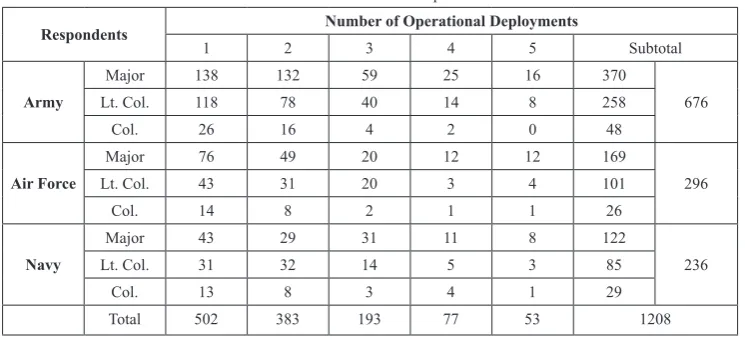
mission experience were also disregarded. Altogether, 1,208 usable questionnaires remained, resulting in a response rate of 33 percent. An overall profile of the respondents is shown in
table 1. preliminary statistics as well as instrument and construct validation details can be
found in the Appendix.
table 1. research sample
respondents number of Operational Deployments
1 2 3 4 5 subtotal
army
Major 138 132 59 25 16 370
676
lt. Col. 118 78 40 14 8 258
Col. 26 16 4 2 0 48
air Force
Major 76 49 20 12 12 169
296
lt. Col. 43 31 20 3 4 101
Col. 14 8 2 1 1 26
navy
Major 43 29 31 11 8 122
236
lt. Col. 31 32 14 5 3 85
Col. 13 8 3 4 1 29
total 502 383 193 77 53 1208
rEsUlts
table 2 presents the results of the hierarchical regression analysis, in which modular organizing (MO) and organizational sensing (Os) are entered in Model 2 as predictor variables of the
organization’s responsiveness (R). The results show that MO (β = .32) and OS (β = .31) significantly and equally contribute to responsiveness (R). Moreover, the adjusted R2 of .29
Erik de Waard • Henk Volberda • Joseph Soeters Drivers of Organizational Responsiveness: Experiences of a Military Crisis Response Organization
table 2. Hierarchical regression of variables predicting organizational responsiveness
Model 1 Model 2
B SE
B β ∆R2 B SEB β ∆R2
Constant 3.56 .04 1.76 .10
Control variables:
Dummy service 1 .02 .03 .02 .00 .02 -.00
Dummy service 2 -.03 .03 -.03 -.05 .03 -.06
Dummy Rank 1 -.16 .04 -.22*** -.09 .03 -.12*
Dummy Rank 2 -.12 .04 -.15 .02 -.06 .04 -.08 predictor variables:
Modular
organizing .33 .03 .32***
Organizational
sensing .20 .02 .31*** .28
df 1203 1201
adjusted r2 .01 .29
*p < .05 **p < .01 ***p < .001
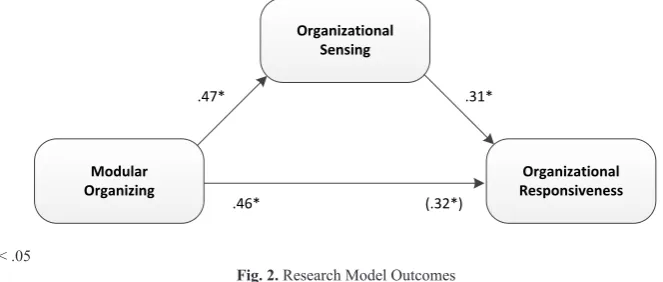
regarding the hypothesized mediation effect of organizational sensing, there was a
significant relationship between the independent variable (modular organizing) and the dependent variable (responsiveness) (β = .46, p = .000) that declined after controlling for the mediator (β = .33, p = .000). To confirm a significant decline in this relationship, a separate Sobel mediation test (Baron & Kenny, 1985) was performed, resulting in confirmation.
figure 2 schematically presents the outcome of these analyses.
*p < .05
Fig. 2. research Model Outcomes
Note: Numbers shown are the standardized regression coefficients for the relationship between modular organizing
and the netherlands armed forces’ responsiveness as mediated by organizational sensing. the standardized
regression coefficient between modular organizing and responsiveness, controlling for organizational sensing, is
in parentheses.
In general, the statistical outcomes corroborate earlier research findings on the crisis
response performance of the netherlands armed forces, indicating that intra- and inter-organizational collaboration has become a necessity for effectively dealing with the
complexity of international crisis-response situations (de Waard, Volberda, & Soeters, 2012). Most missions seek resolution of a complex mix of military, diplomatic, economic, and humanitarian problems. Under such circumstances of causal ambiguity, no single actor can
provide a complete solution. progress can only be made when military and non-military
partners work together, sharing their knowledge and generating new ideas. Working in different multinational, multi-service, multi-actor task forces has increased the armed forces organization’s learning ability. Moreover, the cooperation that takes place among different individuals and organizational groups, over a long period of time and under extreme
circumstances, deepens understanding of each other’s ways of doing things. not only is new Organizational
Sensing
Modular
Organizing ResponsivenessOrganizational
.46* (.32*)
5 Erik de Waard • Henk Volberda • Joseph Soeters Drivers of Organizational Responsiveness: Experiences of a Military Crisis Response Organization
knowledge acquired, but insights may be obtained that allow new knowledge to be translated into concrete, usable routines and processes. New knowledge and insights can then be used to
improve the tactics and techniques of a running mission as well as missions to come. On the
whole, the strong influence of modular organizing and organizational sensing is based on the fact that they appear to reinforce each other. Essentially, a positive feedback loop develops
where learning outcomes can be applied in new settings and constellations, leading to new insights that can be applied, and so on.
The regression analysis also revealed a significant effect of dummy variable Rank 1. This
control variable measures the difference in scores between colonels and majors. the result in Model 2 of -.12 means that majors assessed the netherlands armed forces’ responsiveness
significantly less positive than colonels. The other control variable (service background) did not show any statistically significant differences between the three services, despite the earlier ANOVA indicating otherwise. A possible explanation for the divergent opinions of majors and colonels can be found in the level of operational experience shown in Table 1. Majors constitute a highly experienced group in comparison to colonels. Even more interesting is that many of the critical remarks, made in the open question at the end of the survey, come mainly from experienced officers. A total of 39 remarks were made that relate to relationships among modular organizing, organizational sensing, and responsiveness. Those remarks point
in three directions.
A first group of 19 respondents argues that the Netherlands armed forces “keeps reinventing the wheel” and does not truly learn from past experiences. A second group of 16 respondents links the problem to imperfect modularization. Their remarks refer to the organization’s
permanent structure not being aligned with its crisis-response role. since a tailor-made
configuration is required for each mission, the process of mixing and matching to create an ad hoc organization cuts through existing hierarchical and functional boundaries. As a result, the
tailor-made military formations that are deployed sometimes have to deal with the problem
of unfamiliarity. The fact that a task force is formed on an ad hoc project basis, with very specific operational assignments, can lead to situations in which units and individuals have to work together closely without knowing each other very well. Despite extra training programs,
these ad hoc units seldom reach the level of operational responsiveness of standing units. Moreover, when a mission ends the units return to their original positions in the permanent
organization, making it difficult to close the organizational learning cycle. A third group of only four respondents complains about the fact that the mixing and matching strategy leads to an overemphasis on task generalization. Concrete examples that were mentioned vary from Navy and Air Force personnel having to conduct infantry-like tasks to soldiers in general being deployed as surrogate aid workers or policemen.
In general, the open-ended remarks show that affinity with either the operational or the
organizational/strategic level determines the assessment of the organization’s responsiveness.
Majors, who have a strong connection with the organization’s operational-level task execution, refer more strongly to the negative, practical consequences of certain strategic-
level decisions. Colonels, on the other hand, are at a higher organizational level and have a
better understanding of the complex mixture of factors influencing a strategic decision. They may take for granted that “perfect” design decisions do not exist and that tricky operational
consequences are just part of the crisis-response process.
DisCUssiOn anD iMpliCatiOns
Overall, our study relates to the traditional organization design dilemma of differentiation
and integration (Lawrence & Lorsch, 1967). Existing theory says that successful modular
organizational systems thrive on the differentiation principles of near-decomposability and
loose coupling (Sanchez & Mahoney, 1996). This is where the Netherlands armed forces
encounter many of their organizational problems. the unpredictability and diversity of the
current security environment make it difficult for the military crisis-response organizations
Erik de Waard • Henk Volberda • Joseph Soeters Drivers of Organizational Responsiveness: Experiences of a Military Crisis Response Organization
armed forces to spend extra time and energy on integration mechanisms, such as joint exercises and training programs, to enhance coordination and unit cohesion.
Effects of size on responsiveness
The Netherlands Army is not alone in this challenge. Most Western armies with expeditionary
crisis-response ambitions are confronted with the same differentiation and integration issues.
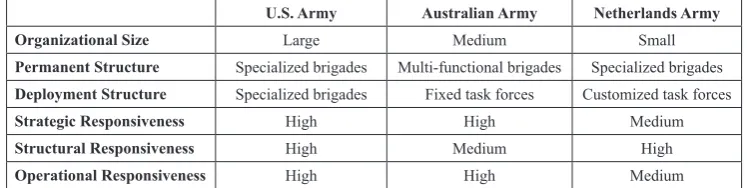
Evidence from this broader field indicates that the size of the organization is an important contingency factor influencing organizational responsiveness. Table 3 summarizes the main
relationships among organizational size, structure, and responsiveness across the netherlands,
Australian, and U.S. armies.
table 3. Organizational size, structure, and responsiveness
U.s. army australian army netherlands army
Organizational size large Medium small
permanent structure specialized brigades Multi-functional brigades specialized brigades Deployment structure specialized brigades Fixed task forces Customized task forces
strategic responsiveness High High Medium
structural responsiveness High Medium High
Operational responsiveness High High Medium
all Western land forces are hierarchically divided into standard subunits. the grouping
of these organizations is divisional (Mintzberg, 1983), which means that the structure is
constructed from a number of “smaller armies” of different sizes. to be precise, a military division consists of several brigades. a brigade, in turn, can be subdivided into battalions,
and a battalion can be split up into companies. The smaller the building-block unit becomes,
the smaller its maneuver, combat support, combat service support, and command elements
will be. A brigade is perceived to be the smallest organizational building block that has a sufficient combination of functional elements to conduct military operations autonomously
for a lengthy period of time. thus, a brigade complies with modularity theory’s rule of
near-decomposability (Bonin & Crisco, 2004). Yet for a small country such as the Netherlands,
a brigade is a rather large organization. the entire netherlands army consists of only two
mechanized brigades, with two mechanized infantry battalions and one tank battalion as its
operational core, and one air maneuver brigade made up of three light infantry battalions. Deploying a single brigade for each crisis-response mission would place too heavy a burden on the organization. Moreover, the specialized nature of these brigades – mechanized or
light/heavy – makes them less useful to cover the entire spectrum of tasks. Therefore, the
netherlands army has abandoned the brigade as its main deployment structure. When a crisis
situation occurs, the different functional elements that are needed are picked from the parent organization and merged into a temporary battalion-size task force. To perform the required operational tasks, the functional units (e.g., infantry, artillery, close air support, engineers) are
structurally dependent on one another and need tight rather than loose coupling.
given its organizational approach, the netherlands army seems to focus on structural responsiveness. It offers the organization the potential to structurally adapt to different types
of crisis-response situations. To a certain extent it also enhances strategic responsiveness because the fine-grained selection and grouping process makes it possible to execute tasks that reach beyond the limits of traditional military formations and doctrine. Having said that, strategic responsiveness is also influenced in negative ways. First, the mixing and matching strategy hinders the high-readiness, quick-response ambitions of the Netherlands armed forces, since a tailor-made task force cannot be deployed straightaway but needs to undergo
additional training. second, units that are not deployed are temporarily deprived of critical functional elements. as a result, they do not get the opportunity to train to their full potential,
making it difficult to lay a solid foundation for future military deployments.
apart from these negative consequences for the organization’s strategic responsiveness, operational responsiveness also suffers. It is questionable whether use of the integration
7 Erik de Waard • Henk Volberda • Joseph Soeters Drivers of Organizational Responsiveness: Experiences of a Military Crisis Response Organization
working system will ultimately lead to a sufficient level of organizational familiarity, meeting Weick & Roberts’ (1993) idea of “heedful interrelating.” To interrelate heedfully, a tight
professional bond is necessary to sense problems before they occur or to immediately recognize deviations from normal routine.
Comparison to U.s. and australian armies
as one of the biggest armies in the world, the problem of a brigade being too large an
organizational unit does not apply to the U.S. Army. Examining the design choices of the U.S.
army offers some additional insights into the relationship between system decomposition and organizational responsiveness. an interesting parallel with the netherlands army is
that the U.S. Army has launched an initiative to transform into a brigade-centric permanent
force. the rationale is that the traditional divisional structure is too focused on a
large-scale, mechanized Cold War-type scenario whereas the brigade structure better fits the high-readiness, expeditionary, crisis-response situations found in today’s world. The brigade
structure is smaller and more rapidly deployable. apart from the speed dimension, the brigade structure also facilitates strategic responsiveness in two other dimensions. first, it
possesses an integral mixture of maneuver, combat support, combat service support, and command elements, which enables it to conduct a wide range of military tasks. Second, its organizational independence makes it possible to be picked from the standing organization
without hampering the operational capacity of the organizational units that stay behind. another resemblance is the grouping of specialized brigades. although the netherlands
Army makes a distinction between its light air maneuver brigade and two mechanized brigades, it does not have – in comparison to the U.S. Army – the numeric capacity to deploy these large
units integrally. as described above, the netherlands army uses its standing organization as
a pool of military capabilities from which units can be picked and grouped into temporary, customized task forces. Because of its size (42 active brigade combat teams (BCTs) and 28 national guard BCTs), the U.S. Army has the luxury to diversify into three distinct types of brigades that can be deployed as a whole: (1) infantry BCTs, (2) heavy BCTs, and (3) medium Stryker BCTs (Krepinevich, 2002). This subdivision provides the organization with a strong base of structural responsiveness because the BCTs are tailored in advance for specific terrain and operational conditions. Furthermore, operational responsiveness benefits
from the balance between the basic structure and the deployment structure. not only do the
BCTs form the backbone of the permanent organization, they are also the standard unit of action for military operations. As a result, unlike the Netherlands customization approach, no extra integration mechanisms are needed when these BCTs are deployed. In a RAND report on the pros and cons of the U.S. Army’s modular force structure (Johnson, Kitchens, Martin,
& fischbach, 2012: 12), one of the respondents hails the brigade-centric modular structure
by saying that it helps “… to maximize unit cohesion through habitual association among
combat, combat support, and combat service support units… creating relationships of mutual
confidence and loyalty within companies, battalions, and brigades, which, in turn, make units
more effective in combat.”
sitting in a middle position, when it comes to size and design choices, the australian army
is an interesting organization to assess as well. Just like the U.S. and Netherlands armies,
the australian army has transformed from a divisional into a brigade-centric organization
structure. However, in contrast to the other two armies, the Australian army has abandoned
its structure of specialized brigades. Instead, multi-functional brigades have been formed that possess heavy as well as medium and light combat elements (Wainwright, 2004). the
aim is to cover the entire spectrum of operations with a single type of brigade. However,
although it is bigger in size than the netherlands army, the australian army encounters the same sustainability dilemma as the netherlands army; namely, the deployment of an entire
Erik de Waard • Henk Volberda • Joseph Soeters Drivers of Organizational Responsiveness: Experiences of a Military Crisis Response Organization
australian army aims to develop a new, smaller, unit of action at the battalion level that can
be deployed integrally for the majority of its tasks (Hutcheson, 2003; Ryan, 2003). Moreover,
the australians believe that for very specialized or unique missions this basic structure can always be further customized with additional functionalities.
On the whole, one could say that the australian deployment approach scores especially well on strategic and operational responsiveness. With respect to strategic responsiveness, both the brigade-size and the battalion-size units have a strong multi-functional character, which supports military deployment on two different organizational levels along a broad spectrum
of operations. Regarding operational responsiveness, the key point is that creating a balance
between the permanent and the deployment structure leads to units of action that have a high level of system integration and unit cohesion. a downside of the australian approach is that
forming multi-functional units inherently means making compromises regarding the number
of, and the rationing of resources between, combat, combat support, combat service support, and command elements. structural responsiveness might suffer because the standardized
units are not primarily equipped to cover the extremes of the military operational spectrum.
implications for theory and practice
Organizations that regularly use temporary inter-team project structures may benefit from the findings and insights of our study. Some research already exists on modularity and the dynamics of recombining organizational units (Helfat & Eisenhardt, 2004; Karim, 2006). Yet, these contributions focus on the aggregate, business-unit level. Generally speaking, business units have overall responsibility for a single product-market combination. Because of their autonomous position, business units are spared from all sorts of task-related external
interdependencies and, therefore, seem to comply with modularity’s basic rules of
near-decomposability and loose coupling. However, many organizations increasingly rely on project-based temporary organizations to react quickly to changes in the environment (Kenis, Janowicz-Panjaitan, & Cambré, 2009). These intra- and inter-organizational cooperation
structures are usually formed within the business unit structure, directly addressing the
competitive frontline. Our study empirically confirms Van Heck and Vervest’s (2007) view that in the contemporary context of project-based organizing in networks, the trade-off
between strategic and operational responsiveness strongly depends on the level of system
granularity. Extracting organizational elements from a parent organization and connecting them to other network partners works better when a modular structure exists. Such a structure is more responsive because “plug-and-play” speed will increase. In addition, network coordination requirements decrease, which makes it easier to focus managers’ attention on
strategic responsiveness rather than being busy with internal adjustment problems.
COnClUsiOn
Our study introduces the level of system decomposition as an important factor influencing organizational responsiveness. Based on recent crisis-response experiences of the Netherlands Army, fine-grained modularization can lead to various and numerous task interdependencies, resulting in extra coordination mechanisms to integrate the different parts
of the organization into a coherent system. such interdependencies could result in managers
developing a predominantly internal focus. Having said this, previous studies point out that organizations cannot do without task interdependencies, because points of interdependency are where relevant information and knowledge flow across organizational boundaries (Cummings, 2004; Jansen, Van den Bosch, & Volberda; 2005; Todorova & Durisin, 2007;
tsai, 2002). so it seems that striving for completely autonomous organizational structures
is also questionable. Although the U.S. and Australian armies potentially have improved
organizational responsiveness by creating modular structures based on the principle of
near-decomposability, both armies should be aware of the risk of designing units that may become too independent and isolated. After all, one of the key merits of the fine-grained mixing and
matching strategy of the netherlands army is that it has boosted the organization’s ability to
9
Erik de Waard • Henk Volberda • Joseph Soeters Drivers of Organizational Responsiveness: Experiences of a Military Crisis Response Organization
thus, regarding modularity theory, an intriguing question arises: what does the word “near” in near-decomposability actually mean? to answer this question requires researchers to
determine the maximum number of task interdependencies an organization can accommodate. Moreover, it could well be that the optimal number of task interdependencies varies
across different industries, sectors, and geographic regions. sorting out the limits of near-decomposability will help managers and designers to develop organizations that are able to respond effectively to crisis situations.
rEFErEnCEs
Alberts DS, Garstka JJ, Stein FP. 2000. Network Centric Warfare: Developing and Leveraging Information Superiority. CCrp publication series, Washington, D.C.
anand n, Daft rl. 2007. What is the right organization design? Organizational Dynamics 36(4): 329-344.
Baron RM, Kenny DA. 1985. The moderator-mediator variable distinction in social
psychological research: Conceptual, strategic, and statistical considerations. Journal of Personality and Social Psychology 51(6): 1173-1182.
Bonin JA, Crisco TE. 2004. The modular army. Military Review March-april: 21-27.
Brusoni S. 2005. The limits to specialization: Problem solving and coordination in “modular networks.” Organization Studies 26(12): 1885-1907.
Brusoni S, Prencipe A. 2006. Making design rules: A multi-domain perspective. Organization Science 17(2): 179-189.
Cohen WM, Levinthal DA. 1990. Absorptive capacity: A new perspective on learning and
innovation. Administrative Science Quarterly 35: 128-152.
Cummings JN. 2004. Work groups, structural diversity, and knowledge sharing in a global
organization. Management Science 50(3): 352-364.
Daft RL, Weick KE. 1984. Toward a model of organizations as interpretation systems. Academy of Management Review 9(2): 284-295.
de Waard EJ, Kramer FJ. 2008. Tailored task forces: Temporary organizations and modularity. International Journal of Project Management 26(5): 537-546.
de Waard EJ, Volberda HW, Soeters J. 2012. How to support sensing capabilities in highly
volatile situations. Journal of Management and Organization 18(6): 774-794.
Doz YJ, Kosonen M. 2008. The dynamics of strategic agility: Nokia’s rollercoaster experience. California Management Review 50(3): 95-118.
Doz YJ, Kosonen M. 2010. Embedding strategic agility: A leadership agenda for accelerating
business model renewal. Long Range Planning 43: 370-382.
field a. 2005. Discovering Statistics Using SPSS. Sage Publishers, London, U.K.
Hansen MT. 1999. The search-transfer problem: The role of weak ties in sharing knowledge
across organizational subunits. Administrative Science Quarterly 44: 82-111.
Helfat CE, Eisenhardt KM. 2004. Inter-temporal economies of scope, organizational
modularity, and the dynamics of diversity. Strategic Management Journal 25(13): 1217-1232.
Huber GP. 2004. The Necessary Nature of Future Firms. Sage Publishers, Thousand Oaks,
Ca.
Hutcheson J. 2003. A shield for a hardened army: The infantry mobility vehicle and the
concept of a motorised battle group. Australian Army Journal 1(2): 95-102.
Jansen JJP, Van den Bosch FAJ, Volberda HW. 2005. Managing potential and realized absorptive capacity: How do organizational antecedents matter? Academy of Management Journal 48(6): 999-1015.
Johnson SE, Peters JE, Kitchens KE, Martin A, Fischbach JR. 2012. A Review of the Army’s
Modular force structure. ranD national Defense research Institute, santa Monica, Ca.
Karim S. 2006. Modularity in organizational structure: The reconfiguration of internally
developed and acquired business units. Strategic Management Journal 27: 799-823. Kenis P, Janowicz-Panjaitan M, Cambré B. 2009. Temporary Organizations: Prevalence,
Logic, and Effectiveness. Edward Elgar Publishing, Cheltenham, U.K.
Erik de Waard • Henk Volberda • Joseph Soeters Drivers of Organizational Responsiveness: Experiences of a Military Crisis Response Organization
problem sensing from social cognition. Administrative Science Quarterly 27(4): 548-570.
Krepinevich AF. 2002. The army and land warfare: Transforming the legions. Joint Force Quarterly 32: 76-82.
Lane PJ, Koka BR, Pathak S. 2006. The reification of absorptive capacity: A critical review
and rejuvenation of the construct. Academy of Management Review 31(4): 833-863.
Lawrence PR, Lorsch JW. 1967. Organization and Environment: Managing Differentiation and Integration. Harvard University Press, Cambridge, MA.
Mintzberg H. 1983. Structure in Fives: Designing Effective Organizations. Prentice-Hall,
englewood Cliffs, nJ.
Orton JD, Weick, KE. 1990. Loosely coupled systems: A reconceptualization. Academy of Management Review 15(2): 203-223.
Pil FK, Cohen SK. 2006. Modularity: Implications for imitation, innovation, and sustained
advantage. Academy of Management Review 31(4): 995-1011.
Podsakoff PM, MacKenzie SB, Lee JY, Podsakoff N. 2003. Common method biases in
behavioral research: a critical review of the literature and recommendations. Journal of Applied Psychology 88(5): 879-903.
Podsakoff PM, Organ DW. 1986. Self-reports in organizational research: Problems and
prospects. Journal of Management 12(2): 531-544.
ryan a. 2003. Putting Your Young Men in the Mud: Change Continuity and the Australian Infantry Battalion. land Warfare studies Centre australia, Duntroon, australia.
Sanchez R. 1995. Strategic flexibility in product competition. Strategic Management Journal 16: 135-159.
Sanchez R. 1996. Strategic product creation: Managing new interactions of technology, markets, and organizations. European Management Journal 14(2): 121-138.
Sanchez R. 2003. Commentary. In R. Garud, A. Kumaraswamy, and R. N. Langlois (Eds.), Managing in the Modular Age. Blackwell Publishers, Malden, MA.
Sanchez R, Collins RP. 2001. Competing – and learning – in modular markets. Long Range Planning 34: 645-667.
Sanchez R, Mahoney JT. 1996. Modularity, flexibility, and knowledge management in
product and organization design. Strategic Management Journal 17: 77-91.
schilling Ma. 2000. toward a general modular systems theory and its application to
inter-firm product modularity. Academy of Management Review 25(2): 312-334.
Schilling MA, Steensma HK. 2001. The use of modular organizational forms: An
industry-level analysis. Academy of Management Journal 44(6): 1149-1168.
Todorova G, Durisin B. 2007. Absorptive capacity: Valuing a reconceptualization. Academy of Management Review 32(3): 774-786.
tsai W. 2002. social structure of “coopetition” within a multiunit organization: Coordination,
competition, and intraorganizational knowledge sharing. Organization Science 13(2):
179-190.
Van Heck E, Vervest PHM. 2007. Smart business networks: How the network wins. Communication of the ACM 50(6): 29-37.
Volberda HW. 1996. Toward the flexible form: How to remain vital in hypercompetitive
environments. Organization Science 7(4): 359-374.
Wainwright a. 2004. ‘Hardening’-Australian For Transformation. United States Army Command and General Staff College, Fort Leavenworth, KS.
Weick KE. 1976. Educational organizations as loosely coupled systems. Administrative Science Quarterly 21: 1-19.
Weick KE, Roberts K. 1993. Collective mind in organizations: Heedful interrelating on flight decks. Administrative Science Quarterly 38: 357-381.
Winter SG. 2003. Understanding dynamic capabilities. Strategic Management Journal 24:
991-995.
Worren N, Moore K, Cardona P. 2002. Modularity, strategic flexibility, and firm performance:
11 Erik de Waard • Henk Volberda • Joseph Soeters Drivers of Organizational Responsiveness: Experiences of a Military Crisis Response Organization
Erik DE WaarD
assistant professornetherlands Defense academy, faculty of Military sciences e-mail: [email protected]
HEnk VOlbErDa
Professor of Strategic Management and Business Policy
Erasmus University Rotterdam, Rotterdam School of Management
e-mail: [email protected]
JOsEpH sOEtErs
professor of Management and Organization studies
Erik de Waard • Henk Volberda • Joseph Soeters Drivers of Organizational Responsiveness: Experiences of a Military Crisis Response Organization
appEnDiX
Methodological Details
A first concern was the possibility of common method bias in that all variables were measured with the same questionnaire. Harman’s one-factor test was conducted to investigate whether
or not bias was present. the unrotated principal component factor analysis, principal
component analysis with varimax rotation, and principal axis analysis with varimax rotation all revealed the presence of multiple factors. The first of those factors accounted for only
18 percent of the total variance. thus, no general factor became apparent, which suggests
that potential problems associated with common method bias did not negatively influence the reliability of the research findings (Podsakoff, MacKenzie, Lee, & Podsakoff, 2003; Podsakoff & Organ, 1986).
Possible differences between early and late responders were also examined. For this purpose, each questionnaire was coded with the number of the week in which the questionnaire had been returned. An independent sample t-test showed no significant differences between groups one and five (for LC t(435) = .944, p >.05; for MO t(435) = .843, p <.05; for SF t(435) = .673, p >.05).
The sample was tested for representativeness by examining the distribution of the respondents over service and rank. There was a slight over-representation of Army respondents; therefore, an ANOVA was conducted to determine if significant differences occurred between these
two categories on the model variables. this indeed proved to be the case. a post-hoc analysis
(Hochberg) made clear that the Navy respondents scored significantly lower on modular organizing than the Air Force respondents. A second Hochberg analysis showed that colonels scored significantly higher than the majors and lieutenant colonels on all model variables. Based on these results, rank and service background were included as control variables.
instrument and construct validation
Existing Likert-type scales were used to measure the variables organizational sensing (OS)
and responsiveness (r). a new scale had to be developed to measure the variable modular organizing (MO) because no usable alternative was available (the measurement scales are
presented below). Regarding the use of existing scales, a general point of concern was in how best to translate the individual scale items from a commercial context into a military crisis-response context. Some of these changes were relatively straightforward, such as substituting “team” for “unit.” Other translations were more difficult. For example, the meaning of competitors, suppliers, and customers is clear in a business context. However, applying these
terms in an international crisis-response setting that is politically driven would undoubtedly
lead to problems of interpretation. To overcome such problems, experts with knowledge of
both the business and military domains were consulted to help with the translation process.
The resulting draft questionnaire was then discussed with a methodologist to get feedback
on the nature of the questions and on wording issues. after revision, the draft questionnaire
was pre-tested with a group of ten military experts from different services and officer ranks. Based on their comments about wording, layout, and length, the questionnaire was put in its final form.
To measure organizational sensing, Volberda’s (1996) sensing scale was used. An exploratory factor analysis was conducted to validate the sensing construct within a military crisis-response context. Because the sample size exceeds 250, a combination of the Kaiser criterion and the scree plot was used to determine how many factors to extract from the factor analysis (Field, 2005). The analysis resulted in the extraction of a single factor for measuring
organizational sensing. the variable received a satisfactory Cronbach’s alpha score of 0.74.
13 Erik de Waard • Henk Volberda • Joseph Soeters Drivers of Organizational Responsiveness: Experiences of a Military Crisis Response Organization
Volberda’s (1996) original scale. Translating the original scale items into a military crisis-
response setting probably caused this deviation.
to measure modular organizing, a new scale was developed building on the earlier
research of Sanchez and Mahoney (1996) and Worren, Moore, and Cardona (2002).
In short, the main assumption of both studies was that a modular organization is built upon an architectural system capable of recombining organizational elements into
tailor-made configurations. In order to make this architectural system work, organizations need
organizational and technological interoperability. Organizational interoperability means that by using standardized interfaces such as standardized rules, procedures, and programs, a “plug-and-play” situation is created in which organizational modules can be put together, removed, replaced, and reconnected fairly easily. this same modular principle applies to the organization’s technological resource base. to reach the desired plug-and-play end state, it is equally important for an organization to have compatible technological means. Moreover,
looking at the human aspects, a modular organization needs people with a broad operational knowledge base and a cooperative mindset to enable it to function properly within different operational contexts and in varying organizational constellations.
a scale of 14 items, covering these various areas, was developed to measure modular
organizing. Analyzing the scree plot resulted in the extraction of a single factor. Four items
had factor loadings below 0.40. for theoretical reasons, however, they were retained.
Specifically, items 8 and 9 had factor loadings of .31 and .35 respectively, but because they
address the important aspect of organizational connectivity they had to remain part of the scale. furthermore, items 1 (a loading of .36) and 3 (a loading of .37) were not dropped as
they focus on the key issue of mixing and matching units into tailor-made organizational
formations. altogether, the modular organizing scale received a Cronbach’s alpha score of 0.70.
Measurement scales
Modular Organizing (MO)
1 To execute crisis response operations the Netherlands armed forces merge units, parts
of units, and individuals into tailor-made formations.
α = .70
2 The composition of Dutch crisis response formations depends primarily upon the task that has to be executed.
3 Dutch crisis response formations mostly participate in larger multinational task forces.
4 During crisis response operations the composition of a Dutch formation can be altered if the operational circumstances require this.
5 During crisis response operations standardized work processes, such as doctrines, SOPs, and drills make it possible to cooperate with units from other services and
countries.
6 During crisis response operations our Dutch tailor-made formations rely on structured systems for planning and command & control.
7 During crisis response operations the division of work within our Dutch tailor-made formations is defined in detailed descriptions of jobs and tasks.
8 During crisis response operations everything in our Dutch tailor-made formations has been laid down in rules.
9 During crisis response operations consulting takes place between different
organizational levels within the netherlands armed forces.
10 Dutch servicemen and women master multiple tasks, SOPs, drills, skills, and
techniques.
11 Dutch servicemen and women are up to date regarding technology and necessary
know-how.
12 Dutch technological assets can be used for different types of missions and tasks.
13 The technological assets of the Netherlands armed forces are to a large extent
compatible.
14 Dutch technological assets are to a large extent compatible with the equipment of
Erik de Waard • Henk Volberda • Joseph Soeters Drivers of Organizational Responsiveness: Experiences of a Military Crisis Response Organization
Organizational sensing (Os)
1 the netherlands armed forces regularly analyze how partnering countries conduct crisis response operations.
α = .74
2 armed forces from partnering countries have no major secrets for the netherlands
armed forces regarding their organizational strengths and weaknesses.
3 The Netherlands armed forces systematically keep track of technological developments that could influence operational tasks and performance.
4 the lessons learned during actual deployment are systematically being registered within the netherlands armed forces.
5 the lessons learned during actual deployment are systematically being internalized by the netherlands armed forces.
6 the netherlands armed forces belong to the trend-setters in the international military sector.
responsiveness (r)
1 During crisis response operations our units can easily divide essential operational activities amongst each other.
α = .70
2 During crisis response operations our units can easily leave certain essential operational activities to units from other countries.
3 During crisis response operations our units can easily adjust to changing operational circumstances.
4 During crisis response operations our tailor-made formations possess a certain amount
of slack that can be used to handle fluctuating operational demands.
5 Whatever service our units belong to, they cooperate easily with one another during crisis response operations.
6 During crisis response operations our units cooperate easily with units from other countries.
7 Our organization has the capacity to easily shift functions and tasks in case a crisis
response operation requires this.
8 Our servicemen and women can easily take on alternative roles and tasks in case a
crisis response operation requires this.
9 from its permanent structure our organization is capable of repeatedly adjusting to
changing mission contexts.
10 If needed our organization can add new types of missions to its existing operational
product portfolio.
11 Our organization regularly implements new technologies.
12 Our organization is proactive in seeking a fit between what it can offer and what our politicians are expecting.
13 Our organization tries to secure its added value by being capable of dealing with all
kinds of crisis situations
summary statistics and correlations
n Mean s.D. Min. Max. (1) (2) (3)
Modular Organizing 1,208 3.51 .36 1.86 4.64
---Organizational sensing 1,208 3.08 .59 1.00 5.00 .47**
---responsiveness 1,208 3.43 .38 1.62 4.54 .46** .46**
15 Journal of Organization Design
JOD, 2(2): 15-30 (2013)
DOI: 10.7146/jod.7632
© 2013 by Organizational Design Community
The DesIgn Of equITy
OwnershIp sTruCTure In
InTer-fIrm relaTIOnshIps
DO managers ChOOse aCCOrDIng TO
TheOry?
Prashant Kale • Phanish Puranam
abstract: Theories explaining the equity ownership structure of inter-firm relationships, such
as the resource-based view or transaction cost economics, commonly assume a significant role for managerial choice, but this assumption is rarely assessed for its realism. In this study, we use the policy capture methodology to directly assess whether managers choose according to theory (and which theory). In a sample of 66 experienced managers, we find that managerial choices of equity ownership are indeed influenced both by competitive advantage and transaction hazards, though to a greater extent by competitive advantage. Further, only competitive advantage influences managers’ choices about the extent of equity ownership in
their partner; transaction hazards motivate the choice of some equity over none. we discuss
implications for how inter-firm relationships are and ought to be designed.
Keywords: Equity structure; inter-firm relations; inter-organizational design
In this study, we investigate how managers choose a key design feature of the structure of inter-firm relationships – the extent to which one party has equity ownership in another. This is a fundamental design variable in inter-firm relationships that determines the extent to which one party has the authority to build organizational linkages to, or even modify the internal organization of, the other party (Gulati, Lawrence, & Puranam, 2005; Kale & Puranam, 2004). For example, in the relationship between two firms A and B, if A acquires B, this gives Firm A a large set of design and decision rights. A minority equity stake held by A may give it board membership and observation rights to B’s inner workings. No equity stake leaves partners to their abilities to work collaboratively within a purely contractual framework.
The various theories that have been used to understand the factors that impact ownership
choices in inter-firm relationships can be broadly classified into those that focus on resource attributes and those that focus on exchange attributes (Poppo & Zenger, 1998; Schilling & Steensma, 2002). These theories include the resource-based view (RBV), transaction cost economics (TCE), real options, knowledge-based view, and property rights. While each theory emphasizes an important determinant of the equity arrangement, we focus on the RBV (Penrose, 1959; Wernerfelt, 1994) and TCE (Williamson, 1985) theories for three reasons. First, these two theories appear to dominate thinking regarding firms’ equity ownership choices in inter-firm relationships (Hagedoorn & Duysters, 2002; Madhok, 1996; Sampson, 2005; Schilling & Steensma, 2002; Steensma & Corley, 2000, 2001). Second, the two
theories also emphasize somewhat different aspects in explaining equity ownership choices: TCe mainly focuses on the anticipation and control of partner opportunism in exchange
Prashant Kale • Phanish Puranam The Design Of Equity Ownership Structure In Inter-Firm Relationships: Do Managers Choose According To Theory?
Madhok & Tallman, 1998). Third, by restricting ourselves to these two theories, we maintain some parsimony in examining the relative and interdependent impact of the criteria identified
by these theories on equity ownership choices.
Despite the extensive empirical literature that has developed around equity in inter-firm relationships, we know little about whether managers make this design decision as the RBV
and TCe theories would predict. In order to observe how managers choose equity ownership
levels in inter-firm relationships, we use a field-experimental technique known as “policy capture” (Aiman-Smith, Scullen, & Barr, 2002; Karren & Barringer, 2002; Pablo, 1994; Tyler & Steensma, 1995) to determine whether theoretical criteria representing RBV and TCE influence managers’ equity ownership decisions in inter-firm relationships.
the (untesteD) rOle OF manaGerial ChOiCe in rBV
anD tCe theOries
The assumption that managers select an appropriate form of economic organization in order
to optimize the net benefits of ownership is common to both resource-based and transaction cost theorizing. For instance, note the assumption of far-sighted contracting in response to hold-up concerns in transaction cost economics (Williamson, 1991a) and the quest for sustainable advantage in response to resource attributes in resource-based theories (Conner & Prahalad, 1996). As Schilling and Steensma (2002: 399) point out, both these perspectives on ownership and firm boundaries “... are based on the premise that these decisions are made (by managers) in attempts to optimize their firm’s performance.” Yet the nature of most studies
of governance choice and performance does not allow a test of the premise that managers are
indeed taking into account the criteria of TCE and RBV theories in making their governance
choices.
There are at least two reasons why managerial choice criteria are still unclear in decisions
about equity ownership (Kale & Puranam, 2006). First, the need for relationship-specific investments in inter-firm relationships can signal to managers not only the hazards of
hold-up (as proposed by TCe) but also an opportunity to create a unique source of competitive
advantage through partnership (Dyer & Singh, 1998; Zajac & Olsen, 1993) or through close coordination between partners (Monteverde, 1995), both of which are non-TCE-based reasons for seeking equity ownership. In principle, we can account for such alternative theoretical
explanations by simultaneously including different variables that represent them in the
empirical analysis, as some studies have tried to do (Gulati & Singh, 1998; Poppo & Zenger, 1998; Schilling & Steensma, 2002), but there are challenges in this regard. Scholars find it difficult to obtain extensive field data on these alternative drivers of governance choices, and even when such data are available they do not produce sufficiently orthogonal measures of competing constructs (Cook & Campbell, 1979). Hence, observing a positive relationship between exchange-specific assets and ownership is not sufficient to decide which of these interpretations (TCE or RBV) characterizes managers’ decision making regarding ownership
in studies that do not (or cannot) adequately control for such alternative explanations.
Second, there is another set of empirical tests of transaction cost economics that find a positive relationship between the “appropriate” ownership choice (from a transaction cost minimization perspective) and performance. However, as Williamson (1985) himself notes, managers might choose a particular ownership structure based on a variety of reasons unconnected with the theory, yet only those ownership decisions that are “appropriate” given the level of relationship-specific investments required will perform well (and hence be observed). Thus, even if managers make governance choices in their exchange relationships which are completely blind to the possibility of opportunism, such relationships will perform poorly relative to competition and may not survive, leading to an observed positive relationship between opportunism concern and ownership (Williamson, 1985). More generally, it is well known that for any efficiency-based theory of ownership, managers need
not act in consonance with the relevant theory (or even be aware of it) for it to be valid
as a theory of optimal decision making (Milgrom & Roberts, 1992). Empirical evidence
17 Prashant Kale • Phanish Puranam The Design Of Equity Ownership Structure In Inter-Firm Relationships: Do Managers Choose According To Theory?
But based on that evidence, we cannot infer that managers taking those higher performing decisions were actually aware of, or acting in conformance with, the theory.
For these reasons, extant studies that link exchange or resource characteristics to observed ownership structures in inter-firm relationships (whether conducted using primary or secondary data) shed limited light on what factors managers actually take into account while making their ownership choice. Hence, in this study we use the policy capture
technique which has been effectively used by previous management scholars to study how
hypothesized theoretical factors feature in managerial decision making in situations such as evaluating acquisition candidates (Hitt & Tyler, 1991), assessing alliance opportunities (Tyler & Steensma, 1995), and managing post-acquisition integration (Pablo, 1994).
The policy capture methodology offers advantages over extant field studies based on
archival or survey data: (a) in this technique we can simultaneously include criteria that
represent each of the different theoretical factors that potentially influence equity ownership choices in inter-firm relationships, (b) we can experimentally manipulate the criteria representing these alternative explanations by making them as orthogonal as possible; and (c) we can then observe whether these criteria/factors have an influence on managers’ ownership choices (rather than rely on observing the ownership structures or choices ex-post, which
could have resulted from competitive selection forces).
theOrY anD hYPOtheses
In this section, we present hypotheses to describe how managers might make decisions about equity ownership choices if they were to behave according to the assumptions of the RBV and TCE theories, respectively. Our goal here is not to offer new theoretical insights into how
resource or exchange factors ought to influence managers’ decisions but rather to provide
the theoretical rationale underlying each hypothesis and then test it to determine whether
managerial decision making does conform to existing theory.
resource-Based View and equity Ownership
According to the resource-based view, a firm enjoys competitive advantage over its rivals if
it possesses resources that are valuable (i.e., they enable a firm to improve its efficiency or effectiveness), generate unique value in conjunction with other existing resources (i.e., they generate value in excess of their shadow prices), and are difficult for other firms to imitate
(Barney, 1991). While the concept of competitive advantage was initially used to explain inter-firm profitability differences, scholars have since extended it to explain ownership and firm boundaries as well (Conner, 1991; Conner & Prahalad, 1996). A key assumption in
such arguments is that the generation of competitive advantage is a primary motivation for
choosing ownership in inter-firm relationships (Schilling & Steensma, 2002; Steensma & Corley, 2000, 2001; Steensma & Fairbank, 1999).
By obtaining ownership of an exchange partner that provides valuable resources, a firm gains the rights of use to those resources. Ownership also enables a firm to plausibly exclude rivals from gaining easy access to that resource, as well as gives the firm decision rights over future development of that resource in ways that might make it difficult for rivals to imitate. Ownership also gives a firm greater authority to manage those resources through administrative oversight (Gulati & Singh, 1998; Sampson, 2007). This enables better sharing and coordination of resources and know-how (Gulati, Lawrence, & Puranam, 2005) as well
as the generation of unique value by exploiting synergies or interdependencies that might
exist between them (Conner & Prahalad, 1996). Hence, RBV-based reasoning suggests that
the importance of ownership is greater when the resources in question are valuable in terms
of enhancing the focal firm’s competitive position in the various ways described above. Thus, if the assumptions about managerial choice embodied in the resource-based view of economic organization are realistic and managers make decisions according to the logic of the RBV perspective, then we would expect that:
Prashant Kale • Phanish Puranam The Design Of Equity Ownership Structure In Inter-Firm Relationships: Do Managers Choose According To Theory?
firm.
transaction Cost economics and equity Ownership
TCe theorists assume that opportunism coupled with limited rationality (and therefore
contractual incompleteness) is the primary source of transaction hazards in inter-firm
relationships. These hazards are particularly salient when exchange partners need to invest
in relationship-specific assets to derive expected benefits from the exchange, and when there is high uncertainty about future demand conditions surrounding the exchange (Williamson, 1985, 1991a). Investment in relationship-specific assets refers to “creation of assets by a firm that are specialized in conjunction with the assets of its partner” (Dyer & Singh, 1998), and it includes several types of asset specificity such as site specificity, physical asset specificity, or human asset specificity (Williamson, 1985). These investments are specialized to the
particular relationship and have little or no value outside it. If one of the parties has to invest
in such assets, the other party might “hold-up” the partner and force a contract renegotiation along terms favorable to itself. Similarly, TCE also predicts that uncertainty about market conditions suggests the need for future adaptation between partners, which is likely to be costly due to opportunistic bargaining (Williamson, 1985).
Williamson (1985), building on Coase (1998), suggests that exchanges with high transaction hazards are better organized within a firm than across firms because hierarchy enables firms to alleviate or control the transaction hazards or costs linked to some of the
factors mentioned above. a stream of literature has built on this basic idea to explain when
or why firms might seek ownership in their exchange partners. Ownership in or of the partner provides a firm the necessary hierarchical control to monitor opportunistic behavior and mitigate transactional hazards that might arise (Gulati & Singh, 1998). This is not only true for full ownership but also partial ownership in the partner firm – this is because even with partial ownership a firm is able to secure hierarchical oversight in terms of securing positions on the Board of Directors and/or voting rights commensurate with its proportion of
ownership. equity ownership also alleviates the hazards of opportunistic behavior by aligning
incentives through the creation of mutual hostages (Ahmadjian & Oxley, 2006; Kogut, 1988; Williamson, 1985). Adaptation between exchange partners, which might become necessary in the face of future demand uncertainty, is also more easily managed through ownership than in pure arm’s-length contractual exchange (Williamson, 1991b). This is because hierarchy
facilitates superior cooperation (that might be required for better adaptation) through
monitoring, sanctions, or collaborative incentives (Williamson, 1991b). If the assumption
of managerial choice embodied in the TCe perspective on economic organization is realistic
and managers make decisions according to the logic of the TCE perspective, then we would
expect that:
Hypothesis 2a: Decision makers are more likely to seek equity ownership in their partner when there is a need for relationship-specific investments to benefit from exchange with the partner firm.
Hypothesis 2b: Decision makers are more likely to seek equity ownership in their
partner when there is uncertainty about demand conditions relevant to the exchange relationship.
In addition to emphasizing the direct impact of relationship-specific investments and demand uncertainty on firms’ decisions to secure ownership, some TCE scholars have also
tested the hypothesis that the effect of demand uncertainty on ownership is contingent upon
the level of asset specificity involved – namely, if asset specificity is low, lower levels of ownership are preferred, whatever the degree of uncertainty. Therefore, we also test the
implications of this formulation in our empirical analyses.