ISSN: 2334-2986 (Print), 2334-2994 (Online) Copyright © The Author(s). 2014. All Rights Reserved. Published by American Research Institute for Policy Development
A Mechanical and Rheology Development of a Fiber-Reinforced
Architectural Concrete for the Poseidon Building in Frankfurt am
Main
Henrik L. Funke1
Abstract
In the course of revitalizing the Poseidon Building in Frankfurt, an energetically optimized façade, made of architectural concrete was developed. The development of a fiber-reinforced architectural concrete had to consider the necessary mechanical strength, design technology and surface quality. The fiber-reinforced architectural concrete has a compressive strength of 104.1 MPa and a 3-point bending tensile strength of 19.5 MPa. Beyond that, it was ensured that the fiber-reinforced high-performance concrete had a high durability, which has been shown by the capillary suction of de-icing solution and freeze thaw test with a weathering of abrasion of 113 g/m² after 28 freeze-thaw cycles and a mean water penetration depth of 11 mm.
Keywords: fiber-reinforced concrete, durability, CDF-Test, high-performance concrete
1. Introduction
Apart from designing claddings, the focus in civil engineering increasingly moves to sustainability and resource efficiency, because future-oriented living and building is hardly viable without a significant increase of resource efficiency. With respect to resource efficiency, optimized building with low input (material, energy, area) during the complete lifecycle of a building means to meet the requirements of the residents regarding indoor environment quality and home comforts.
A truly sustainable building has to meet individual design requirements. It is to be built in the desired location within a very short time and with little effort. It also has to be possible to rebuild and remove the building easily at a future date (Lemken, 2008). Using the material and technologies that are currently available, the practical implementation of these innovative ideas is rather expensive and therefore reaches its limits easily. The application of new high-performance materials which are inorganic-non-metallic offers more freedom for construction. Fiber-reinforced concrete facilitates the production of thin-walled, single- and double-curved free-form elements which are highly suitable for lightweight construction and comply with design requirements regarding surface quality (Brameshuber, 2006; Funke et al., 2013a, Mumenya, 2012; Rafi et al., 2006; Funke et al., 2013b; Schneider et al., 2004).
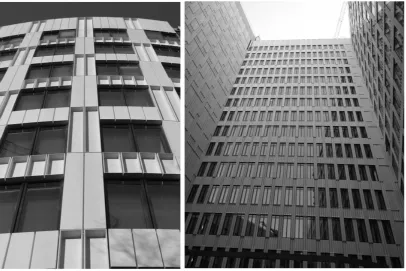
The Poseidon Building, a multistory building in Frankfurt which was built in the 1970s and 1980s, is an example for construction in existing contexts. In 2008, the Poseidon Building was planned to be replaced by a newly built skyscraper (Wirtschaft & Architektur, 2013), but a revitalization was preferred instead by reason of resource efficiency and sustainability. In the course of revitalization, an energetically optimized façade was going to be implemented to get the Green Building “Gold” certification after LEED (Leadership in Energy and Environmental Design).
The 13800 m² three-dimensional façade consists of more than 11500 elements. Of special importance in the course of redesigning the façade was the replacement of the aluminum elements with high-strength architectural concrete. That architectural concrete was to be pure white, with perfect surface quality. This means, it had to have a homogeneous coloring and be absolutely non-porous.
This paper reports the devolpment of the architectural concrete and an appropriate process technology for the production of prefabricated façade elements. An important part of this work is the testing of long-term behaviour and durability aspects of the fiber-reinforced architectural concrete.
2. Method
2.1 Components of Architectural Concrete
Except from white Portland cement CEM I 52.5 N (according to EN 197) it contained amorphous aluminosilicate as pozzolan. Dolomite sand with a grain size of
0 to 1 mm and dolomite powder with an average grain size of 70 µm were used as
aggregate and filler. The short alkali-resistant (AR) glass-fibers (16 mass percent of ZrO2) was 12 mm long and had a length weight of 45 g/km. A super plasticizer based
on polycarboxylate ether (PCE) was used with a solid content of 30 mass percent. The water binder ratio was 0.35.
Table 1: Qualitative Composition of the Architectural Concrete
Component Explanation
white cement CEM I 52.5 N white cement with high early strength
amorphous aluminosilicate pozzolan to increase mechanical strength
and durability, and as optical brightener
dolomite sand 0/1 white aggregate
dolomite powder (x50 = 70 µm)
filler to improve processability of fresh concrete and as white pigment
integral AR-glass fibers (12 mm) armoring for the fine-aggregate concrete matrix
water for mixing the concrete
high-performance plasticizer (30
M.-% PCE) electrosteric stabilizer
Table 2: Mixing Parameters for the Production of Fine Concrete
component mixing principle mixing power in % mixing time in s
1. binders + aggregates counter rotation 15 60
2. 75 % of water co-rotation 50 90
3. super plasticizer co-rotation 50 60
4. residual water co-rotation 50 30
5. ar-glass fibres co-rotation 60 60
2.2 Rheological Optimization by Superplasticizer Content
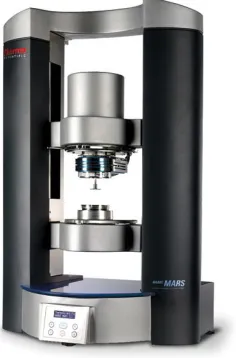
The optimization of the superplasticizer content was carried out by rheological measurements of the fresh concrete of Table 2. For this, flow curves of the fresh concrete were measured with various superplasticizers content using the rheometer Thermo Scientific HAAKE MARS III (Figure 1). The measurements were carried out with the so-called material box. As a comparing measurement variable, the torque was used at a shear rate of 10 s-1 in response to the superplasticizer content.
Figure 1: Rheometer HAAKE MARS For Rheological Measurements (Origin: Thermo Scientific)
2.3 Determination of the Hardened Concrete Characteristics
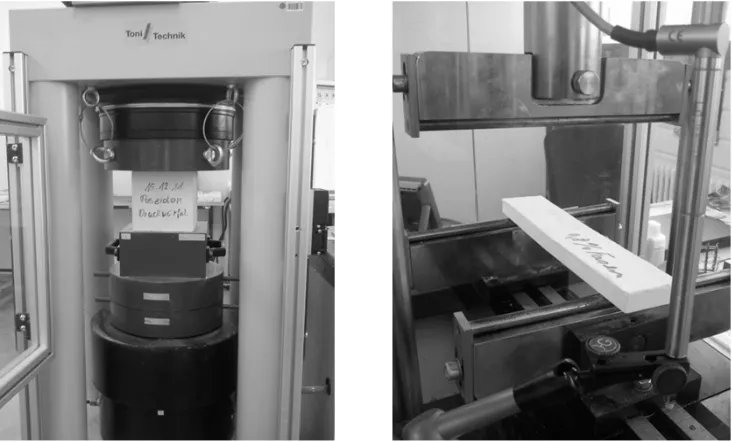
The compressive strength was determined by means of the Toni Technik ToniNorm (load frame 3000 kN) following DIN EN 12390-3, with cubes having an edge length of 150 mm (Figure 2a). The pre-load was 18 kN. The span width set was
200 mm and the load speed 100 N/s constant.
The 3-point bending tensile strength (Figure 2b) was determined with samples which measured 225 x 50 x 15 mm³ (length x width x height), based on DIN EN 12390-5 and ToniNorm (test frame 20 kN).
Figure 2. Determination of Compressive Strength and 3-Point Bending Tensile Strength
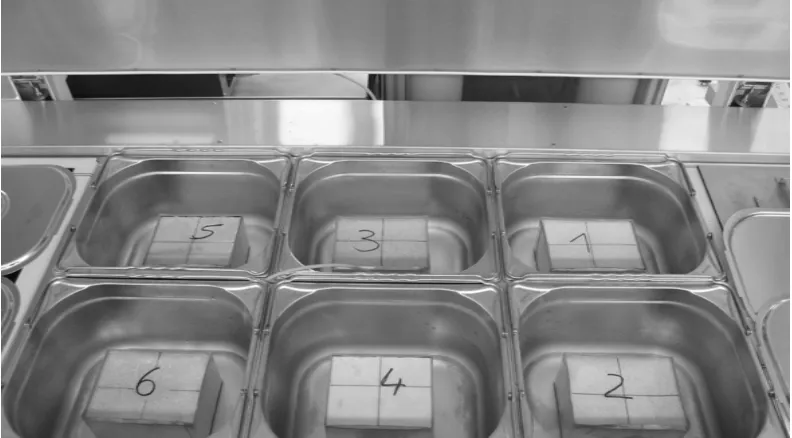
Figure 3. Determination of the Capillary Suction of De-Icing Solution and Freeze Thaw Test
3. Results
3.1 Optimization of superplasticizer content
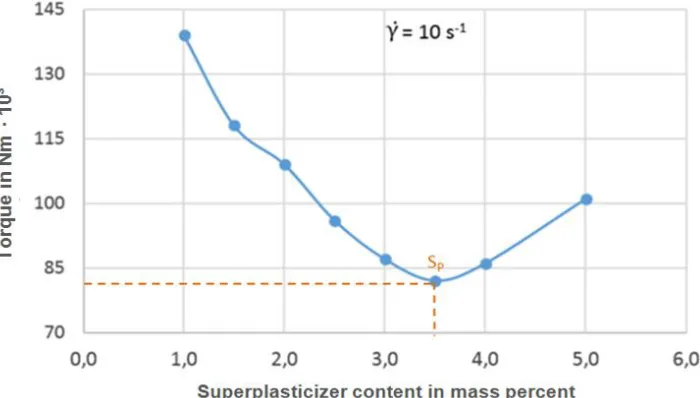
Figure 4 shows the torque as a function of the superplasticizer content at a shear rate of 10s-1. The torque decreases up to a superplasticizer content of 3.5 mass percent due to the increasing electrosteric stabilization of finely dispersed particles, such as cement particles and silica fume. The point of saturation SP, i.e. the complete
Figure 4. Torque as a Function opf Superplasticizer Content
3.2 Fresh and Hardened Concrete Characteristics
Table 3 shows the fresh and hardened concrete characteristics after 28 days. With a high flow capacity (diameter of the resulting flow table test: 650 mm) the fresh concrete complies with the flow class F6. The air content tester showed an air volume content of 2.0% and a geometric bulk density of 2.28 g/cm³ in the fresh concrete. The total shrinkage deformation, determined with a shrinkage channel, was 0.91 mm/m. The reasons for this were first the high binder content, and the high chemical shrinkage resulting from that. Second, autogenously shrinkage increased due to the low water-binder ratio. Drying shrinkage could be practically eliminated due to a two days aftertreatment including humidifying and protection against draft. The high total shrinkage deformation did not lead to shrinkage cracking and was therefore not harmful.
Table 3: Fresh and Hardened Concrete Characteristics of Fiberglass-Modified Fine Concrete after 28 Days
characteristic fresh concrete hardened concrete
geometric bulk density 2.28 g/cm³ 2.21 g/cm³
flow spread 650 mm -
air content 2.0 Vol.-% -
linear shrinkage 0.91 mm/m
compressive strength - 104.1 MPa
3-point bending tensile strength - 19.5 MPa
3.3 Durability and Recyclability
The results of the durability tests are listed in Table 4. The developed architectural concrete displays a high durability, which was validated in the CDF test (m28 = 113 g/m² and Ru,28 = 100%) after 28 freeze-thaw cycles and a water
penetration depth of 11 mm. Thus, the architectural concrete meets the requirements respecting building regulations and usability over a long period.
Table. 4: Examinations of the Durability of Architectural Concrete
test method test value
CDF test m28 = 113 g/m²
Ru,28 = 100%
water penetration depth 11 mm
3.4 Constructional Implementation
Fifty out of the 11500 façade elements were produced per day. The concrete elements were fixed to pedestals to ensure their safe transport to the building site, where they were mounted (Figure. 5).
Figure. 5: Mounted Façade Elements on the Multistory Building “Leo”
4. Conclusions
In building construction that requires lightweight construction, the increasing use of innovative high-performance materials which are fiber-reinforced and inorganic-non-metallic facilitates the production of thin-walled, single- and double-curved free-form surfaces. This entails a larger design potential for architects and planners, especially with regard to organically formed buildings.
Acknowledgements
The successful implementation of the Poseidon project was possible thanks to the close and always constructive collaboration between Fiber-Tech and Hentschke-Bau. An individual authorization could be gotten thanks to the examination of the façade system by the Steinbeis Innovation Center FiberCrete in Chemnitz.
References
Lemken, T.: Alte Orte, neuer Glanz – ressourceneffizientes Bauen und Wohnen im Bestand. Wuppertal Institut für Klima, Energie GmbH, 2008.
Brameshuber, W.: Textile Reinforced Concrete, RILEM Report 36. State-of-the-Art Report of RILEM Technical Committee, TC 201-TRC, 2006
Funke, H.; Gelbrich, S.; Ehrlich, A.: A New Hybrid Material of Textile Reinforced Concrete and Glass Fibre Reinforced Plastic. Journal of Materials Science Research, Volume 2 (No. 3): 96-102, Canadian Center of Science and Education, Kanada, 2013a.
Mumenya, S., Tait, R. & Alexander, M.: Mechanical behaviour of Textile Concrete under accelerated ageing conditions, Cement & Concrete Composites, 32, 580–588, 2012. http://dx.doi.org/10.1016/j.cemconcomp.2010.07.007
Funke, H.; Gelbrich, S.; Ehrlich, A.: Development of a new hybrid material of textile reinforced concrete and glass fibre reinforced plastic. Procedia Materials Science, Volume 2: 103-110, Elsevier, USA, 2013b.
http://dx.doi.org/10.1016/j.mspro.2013.02.013
Rafi, M., Nadjai, A., Ali, F. & Talamoa, D.: Aspects of behaviour of CFRP reinforced concrete beams in bending, Constructions and Building Materials, 22, 277-285, 2006 http://dx.doi.org/10.1016/j.conbuildmat.2006.08.014
Schneider, H., Bergmann & I., Schätzke, C.: Lightweight concrete structures, DETAIL, 844– 854, 2004