Development of an Improved Sub-Molten Salt Method for
Production of Potassium Titanate from Ilmenite
under Industrial Conditions
V. Shojaei1,3, M. Schaffie2,3, A. Mohebbi2,3, M. Ranjbar1,3∗
1- Department of Mining Engineering, Shahid Bahonar University, Kerman, Iran 2- Department of Chemical Engineering, Shahid Bahonar University, Kerman, Iran
3- Mineral Industries Research Centre, Shahid Bahonar University, Kerman, Iran
Abstract
It was reported that the industrial application of Sub-Molten Salt method for production of potassium titanate from ilmenite concentrate is limited by feed particle size. Therefore, the objective of this study was to develop an improved approach for decomposition of ilmenite under industrial conditions. Using an ilmenite concentrate from Kahnooj Titanium Complex, experiments were performed at different conditions designed by the Response Surface Methodology (RSM) method. From the results of the tests, it can be noted that high conversion rate would be achieved even for particle size distribution similar to the industrial conditions. Statistical analysis of the results showed that conversion rate of titanium was significantly affected by process temperature. Optimized decomposition conditions were obtained at temperatures around 220oC, KOH concentration of 84 wt%, KOH-to-ilmenite mass ratio of 9 and
stirring rate of 800 rpm. Under these conditions, more than 96% of titanium can be recovered as potassium titanate. A quadratic model was obtained for the prediction of decomposition. Validity of the model was also experimentally confirmed. Observed effects of the relevant operating variables on conversion rate were consistent with a chemical reaction controlled kinetic model. Apparent activation energy for decomposition of ilmenite was found to be 80.15 kJmol−1.
Keywords: Response Surface Methodology, Ilmenite, KOH, Decomposition, Potassium Titanate
∗ Corresponding author: [email protected]
1. Introduction
It is well known that titanium is an important element which is mainly related to high chemical and heat stability, exceptional optical, mechanical and electrical properties of respective titanium compounds [1, 2]. It occurs within a number of mineral deposits, the most important of which are ilmenite, rutile and pseudorutile. Ilmenite (FeO.TiO2)
temperature to obtain a cast and a slag with high titanium content [3-5]. In the hydrometallurgical method, sulfuric acid or hydrochloric acid is used as a leaching agent for upgrading ilmenite into synthetic rutile [6-11]. Upgrading reaction can be carried out both under atmospheric or pressure leaching conditions. However, both methods have many drawbacks such as high energy inputs, terrible corrosion hazard, harsh conditions and being environmentally detrimental.
Recently, a novel metallurgical process has been developed for ilmenite and titanium slag by Institute of Process Engineering, Chinese Academy of Sciences [12-14]. In this novel process, ilmenite or titanium slag was decomposed in fluid medium of concentrated KOH solution under atmospheric pressure, forming an intermediate product with high titanium and low iron content, which can be converted into pigment grade titanium dioxide after further treatment. In comparison with the conventional upgrading process of ilmenite, this process required relatively mild reaction conditions and high decomposition rate of ilmenite which can be fulfilled at relatively low temperature under atmospheric pressure. However, most of the investigations related to this method attempted to study effect of size distribution and were performed on crushed and narrow-sized fractions of ilmenite [13, 15-17]. However, in the industrial point of view, use of ilmenite concentrate with no sieving is appreciable, which includes larger particles than the investigated ranges.
The main ilmenite deposit of Iran is located in Kahnooj region and contains 82% of Iran's titanium ore deposits. The placer and
gabbroic reserves of this region are above 600 million tons. Upgrading ilmenite ore in Kahnooj complex is limited to the stage of producing ilmenite concentrate of about 40% TiO2. Further treatment of the concentrate to produce high grade titanium dioxide has not been seriously done yet. With respect to reliable applicability of KOH SMS (sub-molten salt) method to ilmenite ores, this study aimed to investigate efficiency of Ti decomposition by concentrated KOH solution from an industrial view on a large-sized distributed feed.
Optimization of the process variables is essentially required to achieve maximum process efficiency. The conventional approach for optimizing process variables requires determination of the dependent variable at each and every combination of independent variables, by just varying only one at a time and keeping all others constant in batch studies, thus requiring a very large number of experiments to be performed, which would be very expensive and time-consuming. Moreover, it does not reveal influence of the interactions between process variables and dependent variable [18]. Such limitation may be overcome by statistical experimental design approach, which reduces the number of experiments as well as providing an appropriate model for process optimization and allowing for evaluation of the influence of inter-variable interactions on the process outcome. Recently, several types of experimental design methods have been employed in multivariable chemical process optimization [19].
optimization of process variables. It develops a mathematical model with the best fit to the data obtained from the experimental design and determines optimal value of the independent variables, which produces a maximum or minimum response [20-22]. It is also useful in studying interactions of the various parameters affecting the process. The objective of the present work is to investigate decomposition of Kahnooj ilmenite ore using concentrated KOH solution. Important parameters that affect decomposition such as temperature, KOH concentration, alkali-to-ilmenite mass ratio (L/S) and agitation speed were also explored using RSM approach. Central Composite Faced Center Design (CCF) was used to obtain the experimental design matrix. This approach needs a limited number of actual experiments that are performed while allowing probing into possible interaction between the studied parameters and their effect on titanium extraction from ilmenite. Moreover, kinetic behavior and reaction mechanism were studied.
2. Experimental procedures 2-1. Materials and methods 2-1-1. Materials
The used raw ilmenite concentrate was a placer mineral obtained from Kahnooj region in Iran with characteristic size of d80=300μm.
Mineralogical analysis of the ilmenite concentrate (Fig. 1) was performed using X-Ray diffraction method (PHILIPS, XPERT-MPD SYSTEM, CuKα radiation, λ=1. 54051 Å, 30 kV and 25 mA). The result indicated that no other main phases were identified, except ilmenite phase (FeTiO3). Detailed chemical composition was examined by X-Ray Fluorescence (XRF). Analytical results are given in Table 1. According to this table, ilmenite concentrate was principally composed of TiO2 (43.61%) and FeO (39.16%) while the most important impurities were SiO2 (7.28%) and MgO (2.01%). All the reagents used for decomposition and chemical analysis were of analytical grade and used without any purification.
2-1-2. Apparatus
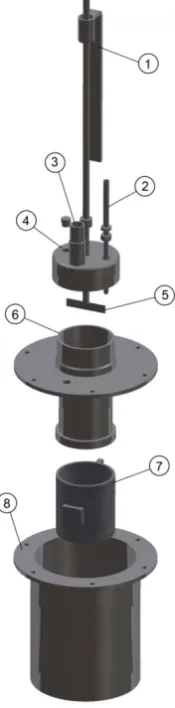
Figure 2 illustrates the experimental apparatus used in this work. The batch reactor was a stainless steel container of cylindrical shape (6) with a volume of 300 ml, equipped with a thermocouple, a mechanical stirrer (5) and a reflux condenser. The reactor was heated by a high performance heating element (HPHE) (7) to reach and maintain the desired temperature. The temperature of the reactor was controlled with a thermocouple (2), displayed with a digital multi-meter, with a precision of ±2oC.
Table 1. Chemical analysis results of the ilmenite ore sample (wt. %).
TiO2 FeO Fe2O3 SiO2 P2O5 V2O5 Cr2O3 MgO Al2O3 MnO CaO Na2O
Figure 1. XRD pattern of ilmenite concentrate.
Figure 2. The experimental apparatus; 1- Stirrer stand; 2- Thermocouple; 3- Vapors discharge (connecting to a condenser); 4- Sample point; 5- Mechanical stirrer; 6- Reaction.
2-2. Decomposition experiments
All the experiments were conducted
according to the CCF matrix at random to avoid the possibility of any systematic errors in measurements. For each run, 12 gr ilmenite and the desired amount of KOH solution were added to the reactor. The HPHE was then switched on and the system was heated under the specified stirring speed. When the temperature reached the pre-set value and became stable, it was taken as the start of the experiment. At appropriate time intervals during a run, approximately 1 gr of the sample was taken out for each time and cooled in air. Then, the products were rinsed by distilled water, filtered and the paste was dried. To calculate titanium extraction, the sample was dissolved in HCl 5 wt% solution. Titanium content in the filtrate was determined using UV–Visible spectrophotometer and conversion rate of titanium was calculated based on Eq. (1) represented by Li et al [15].
100% Ti
Ti
i p Ti
t VM X
G
m C
G
= × (1)
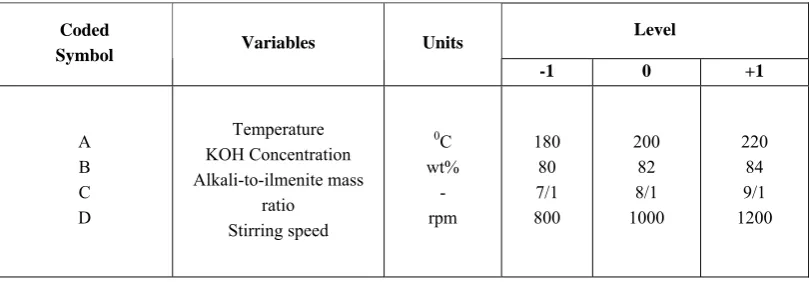
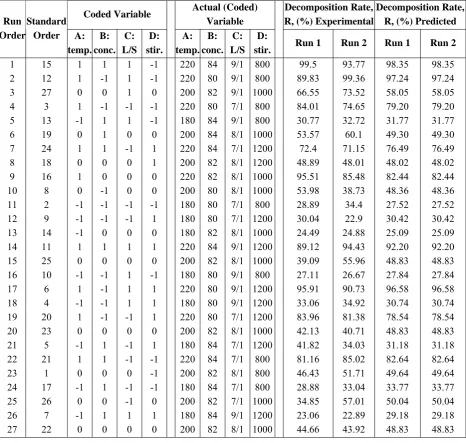
2-3. Variable selection and matrix design The predominant factors that have an influence on decomposition of ilmenite are temperature, KOH concentration, alkali-to-ilmenite mass ratio and stirring speed. Limits of parameters were chosen in such a way that maximum conversion rate was obtained. Table 2 presents the considered ranges. The number of batch experiments to be performed for optimizing the process variables was determined by CCF approach. The experimental design matrix shown in Table 3 consisted of a two-level full factorial design with 16 fact points (24 = 16), 6 center points and 8 axial points. Each experiment was replicated twice in order to estimate the experimental error.
3. Results and discussion
3-1. RSM-based modeling of Ti conversion Conversion rate of titanium is a function of temperature (A), KOH concentration (B), alkali-to-ilmenite mass ratio (C) and stirring
speed (D); so, it can be expressed as: Conversion (R) = f (A, B, C, D)
By RSM, a quadratic polynomial equation was developed to predict the response as a function of independent variables involved in their interactions [20-22]. In general, the experimental data obtained from the designed experiment is analyzed by response surface regression procedure using the following quadratic polynomial equation:
2
0 i i ii i ij i j
y b= +
∑
b x +∑
b x +∑
b x x +ε (2)where Y is the predicted response, b0 the constant coefficient, bi the linear coefficients, bii the quadratic coefficients, bij the interaction coefficients, xiand xj are coded values of the independent process variables, and εis the residual error. The value of the coefficients was calculated using Design-Expert Software v.7.1.5 (www.statease.com). The best fitted model equation was obtained as:
2 2
48.83 26.68( ) 0.47( ) 4.01( ) ).81( ) 0.70( ) 4.43( )
0.89( ) 0.58( ) 1.37( ) 4.93( ) 5.21( )
Conversion rate A B C D AB AC
AD BC BD A C
= + + + − − +
− − − + + (3)
Table 2. Level of variables considered for the decomposition of ilmenite by Central Composite Face centered Design (CCF).
Level Coded
Symbol Variables Units
-1 0 +1
A B C D
Temperature KOH Concentration Alkali-to-ilmenite mass
ratio Stirring speed
0C
wt% - rpm
180 80 7/1 800
200 82 8/1 1000
Table 3. Experimental design matrix and results for the response surface of decomposition rate of Ti.
Coded Variable Actual (Coded) Variable
Decomposition Rate, R, (%) Experimental
Decomposition Rate, R, (%) Predicted Run
Order
Standard Order A:
temp. B: conc. C: L/S D: stir. A: temp. B: conc. C: L/S D:
stir. Run 1 Run 2 Run 1 Run 2
1 2 3 4 5 6 7 8 9 10 11 12 13 14 15 16 17 18 19 20 21 22 23 24 25 26 27 15 12 27 3 13 19 24 18 16 8 2 9 14 11 25 10 6 4 20 23 5 21 1 17 26 7 22 1 1 0 1 -1 0 1 0 1 0 -1 -1 -1 1 0 -1 1 -1 1 0 -1 1 0 -1 0 -1 0 1 -1 0 -1 1 1 1 0 0 -1 -1 -1 0 1 0 -1 -1 -1 -1 0 1 1 0 1 0 1 0 1 1 1 -1 1 0 -1 0 0 0 -1 -1 0 1 0 1 1 1 -1 0 -1 -1 0 -1 -1 1 0 -1 -1 0 -1 -1 0 1 1 0 0 -1 1 0 1 0 -1 1 1 1 0 1 -1 -1 -1 0 1 0 220 220 200 220 180 200 220 200 220 200 180 180 180 220 200 180 220 180 220 200 180 220 200 180 200 180 200 84 80 82 80 84 84 84 82 82 80 80 80 82 84 82 80 80 80 80 82 84 84 82 84 82 84 82 9/1 9/1 9/1 7/1 9/1 8/1 7/1 8/1 8/1 8/1 7/1 7/1 8/1 9/1 8/1 9/1 9/1 9/1 7/1 8/1 7/1 7/1 8/1 7/1 7/1 9/1 8/1 800 800 1000 800 800 1000 1200 1200 1000 1000 800 1200 1000 1200 1000 800 1200 1200 1200 1000 1200 800 800 800 1000 1200 1000 99.5 89.83 66.55 84.01 30.77 53.57 72.4 48.89 95.51 53.98 28.89 30.04 24.49 89.12 39.09 27.11 95.91 33.06 83.96 42.13 41.82 81.16 46.43 28.88 34.85 23.06 44.66 93.77 99.36 73.52 74.65 32.72 60.1 71.15 48.01 85.48 38.73 34.4 22.9 24.88 94.43 55.96 26.67 90.73 34.92 81.38 40.71 34.03 85.02 51.71 33.04 57.01 22.89 43.92 98.35 97.24 58.05 79.20 31.77 49.30 76.49 48.02 82.44 48.36 27.52 30.42 25.09 92.20 48.83 27.84 96.58 30.74 78.54 48.83 31.18 82.64 49.64 33.77 50.04 29.18 48.83 98.35 97.24 58.05 79.20 31.77 49.30 76.49 48.02 82.44 48.36 27.52 30.42 25.09 92.20 48.83 27.84 96.58 30.74 78.54 48.83 31.18 82.64 49.64 33.77 50.04 29.18 48.83
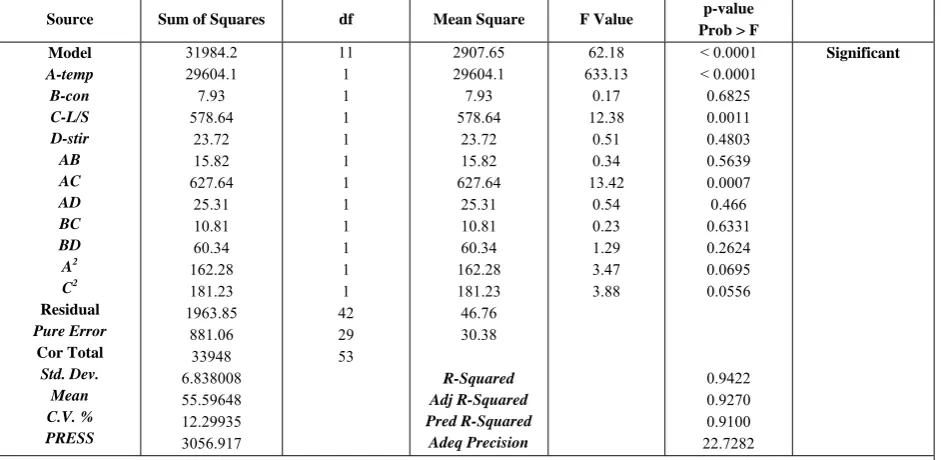
Model Eq. (3) was used to evaluate influence of the process variables on decomposition of ilmenite. Analysis of Variance (ANOVA) was performed to test significance of the model. ANOVA results (Table 4) of the quadratic regression model (Eq. (3)) suggested that the model was highly significant, as was evident from Fisher's F-test (F model=62.18) with a very low probability value (p model=0.0001). Significance of each coefficient was determined by p-values, as listed in Table 4.
KOH concentration (B), alkali-to-ilmenite mass ratio (C) and interactive term AC along with quadratic terms of temperature (A2) and alkali-to-ilmenite mass ratio (C2) exhibited positive relationship with conversion rate whereas all other terms showed a negative effect on the process. A wide range of variation in response factor (i.e. 22.89 to 99.5 %) measured in the batch study (Table 3, runs 1 and 42) suggested that conversion rate was strongly influenced by the selected process variables.
Normal probability plot of the residuals is an important diagnostic tool to detect and explain systematic departure from the assumption that errors are normally distributed and independent from each other and that the error variance is homogeneous [23]. Normal probability of the residuals for decomposition shown in Fig. 3 revealed almost no serious violation of the assumptions underlying the analyses, which confirmed normality assumptions and
independence of the residuals. All of the above considerations indicated adequacy of the developed relationship. A fairly high value of R2 (0.9422) indicated high dependence and correlation between the measured and predicted values of the response. Moreover, a relatively high value of the adjusted correlation coefficient (Adj R2= 0.9270) also showed high significance of the model; moreover, total variation of about 92% for decomposition rate was attributed to the independent variables and only about 8% of total variation could not be explained by this model. The Pred R2 was 0.91, implying that it could explain variability in predicting new observations. This was in reasonable agreement with the Adj R2 of 0.9270. Adeq precision measures signal to noise ratio; a ratio of greater than 4 is desirable. In this investigation, the ratio was 22.73 (Table 4), which indicated an adequate signal. The model could be used to navigate the design space.
Table 4. Analysis of variance (ANOVA) for response surface quadratic model for decomposition rate.
Source Sum of Squares df Mean Square F Value p-value
Prob > F Model A-temp B-con C-L/S D-stir AB AC AD BC BD A2 C2 Residual Pure Error Cor Total Std. Dev. Mean C.V. % PRESS 31984.2 29604.1 7.93 578.64 23.72 15.82 627.64 25.31 10.81 60.34 162.28 181.23 1963.85 881.06 33948 6.838008 55.59648 12.29935 3056.917 11 1 1 1 1 1 1 1 1 1 1 1 42 29 53 2907.65 29604.1 7.93 578.64 23.72 15.82 627.64 25.31 10.81 60.34 162.28 181.23 46.76 30.38 R-Squared Adj R-Squared Pred R-Squared Adeq Precision 62.18 633.13 0.17 12.38 0.51 0.34 13.42 0.54 0.23 1.29 3.47 3.88 < 0.0001 < 0.0001 0.6825 0.0011 0.4803 0.5639 0.0007 0.466 0.6331 0.2624 0.0695 0.0556 0.9422 0.9270 0.9100 22.7282 Significant
Table 5. Estimated regression coefficients.
Factor Estimated Coefficient Intercept
A-temp B-conc C-L/S D-stir AB AC AD BC BD A2 C2
48.83137 28.67639 0.469444 4.009167 -0.81167 -0.70312 4.42875 -0.88937 -0.58125 -1.37313 4.933833 5.213833
3-2. Optimizing decomposition parameters To maximize decomposition rate of ilmenite, the independent process variables were optimized using the quadratic model within the studied experimental ranges. In order to achieve maximum conversion rate (98.35%) of Ti, modeling suggested optimum values of four independent process variables, namely, temperature, KOH concentration, alkali-to-ilmenite mass ratio and stirring speed of
220oC, 84 wt%, 9/1 and 800 rpm,
respectively. The corresponding experimental value of conversion rate under optimum conditions of the variables was determined as 96.64% (mean of two replicates), which was close to the optimized value.
3-3. Analysis of the main effects
Among the four parameters, temperature had a significant effect on conversion rate. Effect of temperature on titanium extraction was examined in the range of 180 to 220oC. It was also observed that increasing temperature up to 220oC gave an enhanced effect on decomposition rate as maximum
value of 96.64% was achieved, which was due to decreasing viscosity of molten KOH with increasing temperature, which in turn enhanced mass transfer in the liquid-solid interface. The results were similar to those reported by Liu et al., [13].
Figure 3. Normal Probability plot of the residuals.
KOH-to-ilmenite mass ratio had a positive effect on conversion rate. KOH concentration influenced mass transportation and its recycling amount in the whole process. The results indicated increased conversion rate from 50 to 58% with increasing ratio from 7/1 to 9/1. Increasing mass ratio of alkali-to-ore not only decreased suspension density, but also reduced viscosity of the system and therefore decreased mass transfer resistance in the liquid-solid interface. The ranges considered in this work were over the stoichiometric ratio because some impurities such as Al and Si might also react with potassium hydroxide. Ratio of 9/1 was considered to be an optimum value.
As defined by Zhang et al. [25], SMS media is a kind of controllable ionized media of highly concentrated multi-component system with alkali metal hydroxides. Since size distribution was relatively large in this study, concentration was chosen in range of 80 to
Internally studentized residuals
No
rmal % P
ro
b
a
b
ilit
84 wt%. From the results it can be concluded that increasing KOH concentration had no significant effect on the conversion rate. Increasing KOH concentration led to high activity of OH-ions in the system and accelerated decomposition rate; however, higher KOH concentration would increase viscosity of the system as well as mass transfer resistance in the liquid-solid interface. The last parameter was stirring speed. Agitation suspends solid particles and is also an important way for preventing the influence of external mass transfer (diffusion through the liquid boundary layer). In this investigation, stirring speed was varied between 800 and 1200 rpm. Results showed that increasing stirring speed from 800 to 1200 rpm had no significant effect on the conversion rate.
3-4. Analysis of interaction effects
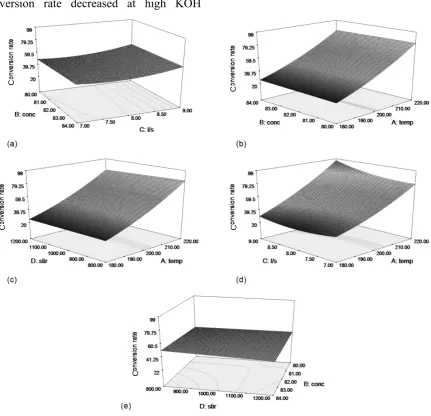
The three-dimensional (3D) response surface plots of the dependent variable as a function of two independent variables varying within their experimental ranges while maintaining all other variables at fixed (center) levels can provide information on their relationships and can be helpful in understanding both main and interaction effects of these two independent variables [26]. Each RSM plot represents an infinite number of combinations of the two tested variables with the other two maintained at their respective zero level. Therefore, in order to gain better understanding of effects of the independent variables and their interactions on the dependent variable, 3D response surface plots for the measured responses were constructed based on the quadratic model. Since the quadratic model in this study had
four independent variables, two variables were held constant at their center level for each plot.
need to KOH reagent increased (due to the reaction mechanism, which will be discussed later); so, at higher L/S ratio, the conversion rate would improve. At 220oC, increasing the L/S mass ratio to 9/1 would enhance the conversion rate by about 17%. The response surface plot for the combined effect of BD (Fig. 4e) revealed that, at stirring speed of 800 rpm, increasing KOH concentration would improve conversion rate; but, by increasing stirring speed to 1200 rpm, conversion rate decreased at high KOH
concentration. The observed trend was likely due to the fact that, at higher KOH concentration, system viscosity and its resistance to stirring increased; moreover, volume of the reactor was relatively low. These two factors resulted in disturbance of the system and some fraction of materials would be thrown to walls of the reactor and not participate in the reaction; hence, the conversion rate would decrease. But, this effect was not significant.
Figure 4. The response surface plot showing effects of (a) KOH concentration and L/S mass ratio, (b) temperature and KOH concentration, (c) temperature and stirring speed, (d) temperature and L/S mass ratio, and (e) stirring speed and KOH concentration on decomposition of ilmenite by KOH solution.
C
C
C C
3-5. Size distribution of feed
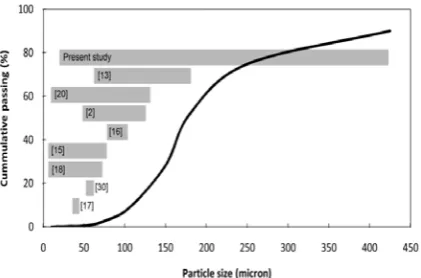
The results of almost all the ilmenite decomposition experiments have confirmed that size distribution is an important parameter that has a significantly inverse effect on the decomposition rate. Almost all of the studies on ilmenite decomposition which have been reported in the lierature are done on narrow and small-sized distributed samples, whereas a bulk ilmenite sample was used in the present study with no further size reduction. Figure 5 illustrates the difference between feed size distribution used in this study and those investigations reported by other researches. Using a wide range size distribution for the feed, an incomplete conversion of Ti could be expected. However, a high conversion yield of about 97% was obtained. The reason might be related to the reaction between ilmenite and KOH: “when ilmenite was roasted with potassium hydroxide, there was breaking of the product layer to numerous fragments. As K+ ions diffused into the ilmenite lattice, a strain was created proportional to concentrations of K+ which was too large to be accommodated within the lattice structure; thus, product layer of potassium titanate and ferrite cracks. Potassium ion (K+) had the large ionic radius of 1.38Å which was why the reaction induced strain between ilmenite lattice and product layer and contributed to rapid cracking of the product layer; this issue exposed unreacted ilmenite grain below the surface”. Elevated temperature and longer reaction times for roasting caused further breaking of ilmenite grains. Reaction became more efficient as temperature increased until initiation of the melting point. Once the solid outer layer began to melt, the reaction was deprived of oxygen and consequently, the
formation of alkali titanates/ferrites was severely limited [27]. Manhique et al. [31] reported the same effect of particle size; they used coarse particles and fine powder for fusion at temperatures of 550 to 900°C and found that, at lower temperatures, the coarser raw material produced relatively high amounts of residue; but, at high temperatures, this difference disappeared.
Figure 5. Comparison of the feed particle size distribution used in the sub-molten salt methods for ilmenite and slag.
3-6. Proposed reaction mechanism
Decomposition of ilmenite in KOH system in the temperature range of 180–220°C is a typical liquid–solid reaction, which could be analyzed using shrinking core model [32]. This model is based on the assumptions that particle of ilmenite is a nonporous homogeneous sphere, the reaction between potassium hydroxide and ilmenite is first-order for KOH and a decrease in the surface area is a result of the decrease in the initial particle size with time. The following two kinetic equations are applied for different rate-controlling steps:
Chemical reaction controlled process
1 3
1
Diffusion through ash layer controlled process
2 3 2
2
1 2(1+ −X) 3(1− −X) =6bMDC tA ρr =k t (5)
where X is the titanium fraction reacted at time t (min), M is the molecular weight of the solid reactant (kg mol−1), Kc is the first-order rate constant (m min−1), CA is the KOH concentration (mol m−3), ρ is the density of the particle (kgm−3), r is the initial radius of the particle (m), D is the diffusion coefficient (m2 min−1), b is the stoichiometric coefficient, and k1 (m min−1) and k2 (m min−1) are the overall rate constants.
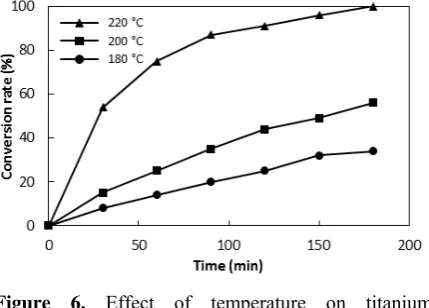
Eq. (4) is applicable to chemically controlled process and Eq. (5) is used for diffusion controlled process through porous product layer. Influence of reaction temperature on conversion of titanium to potassium titanate over temperature range of 180–220oC is shown in Fig. 6. It can be seen that reaction rate decreased with time. To determine which of the above-mentioned kinetic equation was applicable; the data presented in Fig. 6 were plotted according to Eqs. (4) and (5), respectively. The results showed that only Eq. (4) had very good linear tendency, indicating that rate of titanium extraction was controlled by chemically controlled process. Plots of the function 1 3
1 (1− −X) versus time shown in Fig. 7 indicated that extraction rate of titanium at 180–220°C had good correlation with the chemically controlled kinetic reaction, which took place on the surface of the ilmenite, and verified the present model.
Figure 6. Effect of temperature on titanium extraction.
Figure 7. Plots of 1− (1−X) 1/3 vs. time at different process temperatures.
3-7. Estimating activation energy
The relationship between the overall reaction rate constant, k, obtained from Fig. 7 at different temperatures can be expressed by the Arrhenius equation as follows:
exp( a )
k= A −E RT (6)
where k is the overall rate constant (min−1), A is the frequency factor (min−1), E
slope of this straight line was equal to −Ea/R. According to slope of this plot, apparent activation energy of the conversion of titanium to potassium titanate by KOH was found to be 80.15 kJmol−1. This value of activation energy supported the proposed chemically controlled mechanism. Furthermore, the obtained value was higher than activation energy reported by several investigators [13, 33], which was mainly due to the large size distribution. The result was confirmed by the prediction from plots of kinetic equations.
Figure 8. Arrhenius plot of the apparent rate constant.
3-8. Identification of the product
The product was characterized by X-ray powder diffraction (X’Pert PRO MPD, PANalytical, the Netherlands) using Cu Ka radiation (k =1.5408). Result of XRD study of the product under optimization condition (Fig. 9) identified potassium titanate (K4Ti3O8) and hematite (Fe2O3) as solid products and no peak was observed for ilmenite, implying that ilmenite was highly converted. This result also confirmed that reaction of ilmenite with potassium hydroxide takes place according to the Eq. (7) [15, 34]:
3 2 4 3 8 2 3 2
12FeTiO +6KOH+3O →4K Ti O +6Fe O +8H O
(7)
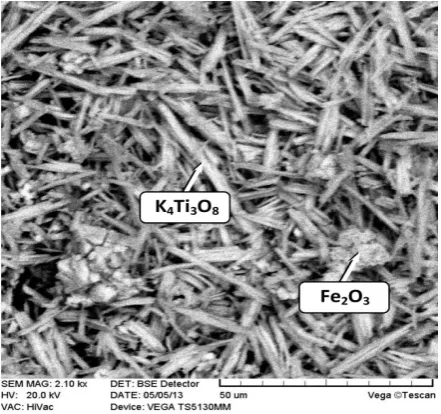
Ti in ilmenite was oxidized by oxygen anion (O2−) in molten potassium hydroxide system as well as oxygen from the free access of air. Morphology of the products was identified by field-emission scanning electron microscopy (Tescan Vega-II) and the phases were identified by an energy-dispersive X-ray spectrometer (EDX). SEM image (Fig. 10) revealed that K4Ti3O8 was lath-shaped crystal with average length of 25 μm and average diameter of 2 μm while hematite was a sub round-shaped particle with mean diameter of 15μm.
Figure 9. XRD patterns of potassium titanate.
4. Conclusions
Systematic experiments were carried out to study decomposition of a wide ranging particle size distribution ilmenite sample obtained from Kahnooj Complex (Iran) by concentrated KOH solution under atmospheric pressure. Application of a central composite experimental design combined with the response surface modeling and optimization helped to achieve optimal conditions for maximum recovery of titanium as potassium titanate. The proposed mathematical approach also provided critical analysis of the individual and simultaneous interactive influences of the selected independent process variables on Ti conversion. Optimum values of the process variables were found to be 220°C for temperature, 84 wt% for KOH concentration, 9 for KOH-to-ilmenite mass ratio and 800 rpm for stirring speed for the predicted Ti conversion rate of 98.35%, which was close to the experimentally determined conversion rate of 96.64%. The experimental results showed that temperature had a significant effect on ilmenite decomposition. Adequacy of the developed quadratic mathematical model for the decomposition rate was controlled through various statistical diagnostics. The model predicted values of the response variable were in very good agreement with the experimentally
determined ones (R2=0.94). The
decomposition rate appeared to be controlled by chemical reactions. The activation energy of the decomposition process was calculated to be about 80 kJmol-1. In addition, high decomposition rate (about 97%) could also be attributed to the large ionic radius of potassium ion (1.38Å) which induced strain
between the ilmenite lattice and product layer and contributed to rapid cracking of the product layer.
References
[1] Grätzel, M., "Dye-sensitized Solar cells", J. Photochem. Photobiol. C: Photochem. Reviews, 4, 145, (2003). [2] Xue, T., Wang, L., Qi, T., Chu, J., Qu,
J. and Liu, C., "Decomposition kinetics of titanium slag in sodium hydroxide system", Hydrometallurgy, 95, 22, (2009).
[3] Mackey, T.S., "Upgrading ilmenite into a high-grade synthetic rutile", JOM, 59, (1994).
[4] Mahmoud, Y.D. and Georges, J.K., "Processing titanium and lithium for reduced-cost application", JOM, 49(6), 20, (1997).
[5] Mohanty, S.P. and Smith, K.A., "Alkali metal catalysis of carbothermic reaction of ilmenite", Transactions J. Trans. Inst. Min. Metall., Section C, 102, 163, (1993).
[6] Jagasekera, S., Marinovich, Y., Avraamides, J. and Baily, S.I., "Pressure leaching of reduced ilmenite", Hydrometallurgy, 39, 183, (1995).
[7] Lanyon, M.R., Lwin, T. and Merritt, R. R., "The dissolution of iron in the hydrochloric acid leach of an ilmenite concentrate", Hydrometallurgy, 51(3), 299, (1999).
[8] Liang, B., Li, C., Zhang, C.G. and Zhang, Y.K., "Leaching kinetics of panzhihua ilmenite in sulfuric acid", Hydrometallurgy, 76, 173, (2005). [9] Sasikumar, C., Rao, D.S., Srikanth, S.
75, 189, (2004).
[10] Van Dyk, J.P., Vegter, N.M. and Pistorius, P.C., "Kinetics of ilmenite dissolution in hydrochloric acid", Hydrometallurgy, 65, 31, (2002).
[11] Zhang, W., Zhu, Z. and Cheng, C.Y., "A literature review of titanium metallurgical processes", Hydrometal-lurgy, 108, 177, (2011).
[12] Liu, Y., Qi, T. and Zhang, Y., "A novel way to synthesize potassium titanates", Mater. Lett., 60, 203, (2006).
[13] Liu, Y., Qi, T., Chu, J., Tong, Q. and Zhang, Y., "Decomposition of ilmenite by concentrated KOH solution under atmospheric pressure", Int. J. Miner. Process., 81, 79, (2006).
[14] Tong, Q., Qi, T., Liu, Y., Wang, L. and Zhang, Y., "Preparation of potassium titanate whiskers and titanium dioxide from titaniferous slag using KOH sub-molten salt method", Chin. J. Process. Eng., 7(1), 85, (2007) (in Chinese). [15] Li, J., Wang, Y., Wang, L., Sun, T., Qi,
T. and Zhang, Y., "Effect of atmosphere on the synthesis of potassium titanate", Rare Metals, 29, 280, (2010).
[16] Nayl, A.A. and Aly, H.F., "Acid leaching of ilmenite decomposed by KOH", Hydrometallurgy, 97, 86, (2009).
[17] Nayl, A.A., Ismail, I.M. and Aly, H.F., "Ammonium hydroxide decomposition of ilmenite slag", Hydrometallurgy, 98, 196, (2009).
[18] Sahu, J.N., Acharya, J. and Meikap, B.C., "Response surface modeling and optimization of chromium (VI) removal from aqueous solution using Tamarind wood activated carbon in batch process", J. Hazard. Mater., 172, 818, (2009).
[19] Alam, M.Z., Muyibi, S.A. and
Toramae, J., "Statistical optimization of adsorption processes for removal of 2, 4-dichlorophenol by activated carbon derived from oil palm empty fruit bunches", J. Environ. Sci., 19, 674, (2007).
[20] Clarke, G.M. and Kempson, R. E., Introduction to the design and analysis of experiments, London, Arnold, (1997).
[21] Cornell, J.A., How to apply response surface methodology, 2nd ed., American society for quality control, Wisconsin, (1990).
[22] Montgomery, D.C., Design and
analysis of experiments, 5th ed., John Wiley & Sons, USA, (2001).
[23] Yetilmezsoy, K., Demirel, S. and Vanderbei, R.J., "Response surface modeling of Pb(II) removal from aqueous solution by Pistacia vera L.: Box–Behnken experimental design", J. Hazard. Mater., 171, 551, (2009). [24] Ramachandran, C.S.,
Balasubra-manian, V. and Ananthapadmanabhan, P.V., "Multiobjective optimization of atmospheric plasma spray process parameters to deposit yttria-stabilized zirconia coatings using response surface methodology", J. Thermal. Spray. Technol., 20, 590, (2010).
[25] Zhang, Y., Li, Z., Xu, H., Zheng, S., Qi, T. and Li, H., "Sub-molten salt environmentally benign technology", Proceedings of the 100th AICHE Annual Meeting, Philadelphia, (2008). [26] Liu, H.L. and Chiou, Y.R., "Optimal
[27] Animesh, J.H.A., Graham, C. and Abhishek, L., "Process for recovering a titanium dioxide product", WO Patent 2010/032052 A1, (2010).
[28] Xu, H.B., Zheng, S.L., Zhang, Y., Li, Z.H. and Wang, Z.K., "Oxidative leaching of a Vietnamese chromite ore in highly concentrated potassium hydroxide aqueous solution at 300°C and atmospheric pressure", Miner. Eng., 18, 527, (2005).
[29] Mazzocchitti, G., Giannopoulou, I. and Panias, D., "Silicon and aluminum removal from ilmenite concentrates by alkaline leaching", Hydrometallurgy, 96, 327, (2009).
[30] Zhang, Y., Qi, T. and Zhang, Y., "A novel preparation of titanium dioxide from titanium slag", Hydrometallurgy, 96, 52, (2009).
[31] Manhique, A.J., Focke, W.W. and Madivate, C., "Titania recovery from low-grade titanoferrous minerals", Hydrometallurgy, 109, 230, (2011).
[32] Levenspiel, O., Chemical Reaction Engineering, 2nd ed. Wiley, New York, (1972).
[33] Liu, Y., Qi, T. and Zhang, Y., "Kinetics analysis of decomposition of ilmenite by KOH sub-molten salt method", Chin. J. Nonferr. Met., 19(6), 1142, (2009) (in Chinese).