Iranian J Pharmacol Ther. 2017 (December);15:1-7. This paper is available online at: http://ijpt.iums.ac.ir
Anti-depressant effects of Baluchi's formulation on spatial learning and
memory
Narges Babevey1*, Mehrdad Pooyanmehr2, Isaac Karimi3
1 Faculty of Veterinary Medicine, Razi University, Iran
2 Department Basic Science of Immunology and Pathobiology, Microbiology Section, Faculty of Veterinary Medicine, Razi University, Iran 3 Department Basic Science of Physiology and Pathobiology, Physiology Section, Faculty of Science, Razi University, Iran
Please cite this article as:
Babevey N, Pooyanmehr M, Karimi I. Anti-depressant effects of Baluchi's formulation on spatial learning and memory. Iranian J Pharmacol Ther. 2017 (December);15: 1-7.
ABSTRACT
Baluchi's formulation is an herbal blend including Date, Almond, Cinnamon, and Pumpkinseed, which have the Powerful antioxidant role and stimulate the brain to produce neurotransmitters. Cholinergic system plays an important role in learning and memory. Prescribing Baluchi's formulation is effective in animal cognitive behavior. The aim of this study was to evaluate the effects of antidepressant By Baluchi's formulation compound on decreased memory due to scopolamine in mice by relying on behavioral tests. It has also been observed that anticholinergic medicines such as scopolamine may cause disorder in the consolidation process in the memory of human beings and animals. So 40 Albino mice (25-30 g) were divided into five groups (+ & - controls and three treatments). During seven consecutive days, the mice received Baluchi's formulation (1, 2, 4 g/kg oral) thirty minutes before scopolamine (1mg/kg i.p.). At the same time, spatial memory and depression parameters were measured using MWM and EPM. The results showed that Baluchi's formulation treatments, significantly increased the time of animal presence in the target quadrant, the percentage of open arms and the time spent in the open arm compared with the control groups (p<0.001). The results of this study showed that the compounds in the Baluchi's formulation micronutrients may be effective in preventing and treating disorders such as depression and demands.
Conflicts of Interest: Declared None Funding: None
Keywords Scopolamine, Baluchi's formulation, Alzheimer,
Memory
Corresponding to: Narges Babevey,
Faculty of Veterinary Medicine, Razi University, Iran
Email:
Received: 13 June 2017 Revised: 18 July 2017, Accepted: 19 Sep 2017
INTRODUCTION
An early symptom of Alzheimer disease is gradual memory impairment, especially spatial memory. A decline in the level of acetylcholine (one of the most important neurotransmitters) caused by the release of too much
acetylcholinesterase can also be another factor of
impairment in spatial memory of those who suffer from Alzheimer. It has also been observed that anticholinergic medicines such as scopolamine may cause disorder in the consolidation process in the memory of human beings and
animals. For this reason, injection of this medicine in laboratory animals is an effective means of generating Alzheimer's disease [1-4]. Despite the superficial advantages of new medicines in comparison with traditional ones, the consumption of chemical medicines is progressively rising. Although chemical medicines are helpful in the treatment of specific diseases, long-term or even occasional use of them can have severe side effects, surpassing the dangers of the disease itself. Accordingly, using chemical medicines IRANIAN JOURNAL OF PHARMACOLOGY & THERAPEUTICS
Copyright © 2017 by Iran University of Medical Sciences Iranian J Pharmacol Ther. 2017 (December);15:1-7.
2 Babevey et al.
and/or herbal medicine including powerful antioxidant may somewhat preserve the brain from damages caused by oxidants related to Alzheimer, leading to fewer neuronal deaths [5]. In this study, Baluchi's formulation is utilized. Baluchi's formulation is an herbal blend including date (0.3 g), almond (0.3 g), pumpkin seed (0.2 g), cinnamon (0.1 g) and sugarplum (0.1 gr). Date, with the scientific name of phoenix ductylifera also known as palm [6] contains carotenoid, carotene and anthocyanin which are known as precursors of vitamin A and antioxidants that prevent molecular destruction caused by these radicals by inhibiting free radicals and improve memory functioning and learning in the mice model. Date strengthens the nerves and facilitates the transfer of neural messages [7]. Almond with the scientific name of Prunus amygdalus [8] is known to be a rich source of tocopherol and phenolic compounds which have antioxidant roles and prevent diseases caused by the formation of extra free radicals in the human body [9]. It also contains choline and phenylalanine that stimulate the brain to produce neurotransmitter, dopamine, adrenaline, and noradrenaline [10]. A large amount of selenium can be found in almond. Selenium has recognized roles in the enzyme system of Glutathione peroxidase (GPx). Antioxidant enzymes dependent on selenium decrease damages caused by oxygen reactive derivatives such as hydrogen peroxide [11]. Cinnamon is a substance with the scientific name of cinnamon zeylanicum [12]. Among phenolic and volatile non-phenolic compounds of cinnamon's crust which have antioxidant properties, cinnamaldehyde, gamma-eugenol can be mentioned [13,14]. Cinnamon alters to sodium-benzoate in the body, and edible consumption of cinnamon increases the level of sodium-benzoate in the brain. Sodium-benzoate reinforces mental and cognitive functions and decreases memorial and learning impairment related to age [15]. Cinnamic aldehyde protects Tau protein by connecting to the remainder of vulnerable cysteine, and also prevents hyperphosphorylation of this protein and formation of mental plaques in those patients who suffer from Alzheimer while decreasing cognitive impairment and slowing down the progress of Alzheimer [16]. Pumpkin seed with the scientific name of Cucurbita [17] is a rich source of essential fatty acids (oleic acid, linoleic acid, choline and…) [18]. It may cause increased mental abilities [17]. Pumpkin seed contains polyphenolic and tocopherol compounds. Tocopherols and polyphenols are among natural antioxidants existing in plants [18]. Since pumpkin seed is a rich source of choline and tryptophan intensify brain's ability and produce neurotransmitters of acetylcholine and serotonin in the brain [17]. Sugarplum is made from a saturated solution of sucrose or sugar in water [9]. In this study, sugarplum is used in Baluchi's formulation in light of its sweetening and flavoring effects [20]. It was shown that Baluchi's formulation components can improve cognitive function impairment and cause an increase in the level of acetylcholine in the cortex of the mouse's brain [21-23]. In other studies, scientists have shown the protective impacts of Baluchi's formulation components in experimental models of
Alzheimer [21-23]. Injection of scopolamine is one of the standard methods of inducing Alzheimer in laboratory animals. Accordingly, the present study is carried out to specifically investigate the protective impacts of Baluchi's formulation on attenuation of the learning process, a creation of spatial memory, and the stress induced by scopolamine with the aid of behavioral test.
MATERIALS AND METHODS Laboratory animals
Albino mice (male, 4-5 months, 25-30 g) from Center of Maintenance and Reproduction of Animals in Razi University of Pharmacy were used. These animals were housed in four groups of ten under controlled laboratory conditions with a 12-hour light-dark schedule, the temperature of 23±2 °C and ad libitum access to water and food. All experiments were performed in accordance with the guidelines of Institute animal of Razi University. Adequate measures were taken to minimize pain or discomfort with animal experimental procedures. The utilized medicines in this study were a date, almond, cinnamon, pumpkin seed, sugarplum, and scopolamine.
Drugs
As well as to determine the lethal dose Baluchi's formulation, three groups, each group of three mics (based on weight, sex, and race as the experimental group) for 30 days at doses of 1, 2 and 4 were treated Baluchi's formulation. After 30 days of the experiment, no mortality was observed in mice and new mice groups were used for the main test. Animals were divided into four groups for carrying out the experiments: A: positive control (ordinary nourishment, 1 mg/kg scopolamine), B: treated group BF1 (Baluchi's formulation, 1 g/kg–1 mg/kg scopolamine), C: treated group BF2 (Baluchi's formulation, 2 g/kg–1 mg/kg scopolamine), D: treated group BF4 (Baluchi's formulation, 4 g/kg–1 mg/kg scopolamine), E: negative control (ordinary nourishment, 1 mg/kg distilled water). During seven consecutive days, the mice received Baluchi's formulation (1, 2, 4 g/kg oral) thirty minutes before scopolamine (1mg/kg i.p.). At the same time, spatial memory and depression parameters were measured using MWM and EPM.
Memory test and learning in Morris water maze MWM (Morris water maze) the method was used to assess the impacts of materials on spatial memory and learning. A circular-shaped steel pool with a diameter of 1.8 m and height of 0.6 m was used as the water maze. In addition, a white platform with a diameter of 10 cm was positioned inside of it. Next, water with a temperature of 22 °C was added such that its height surpassed the platform top as much as 1 cm. Using an adequate amount of paint, the water was turned opaque so as to make the platform almost invisible [24]. The experiments were carried out in an almost dark room. Visible signs were attached to all four sides and the animals could find the location of the hidden platform
with the help of these signs. Each mouse was randomly released from one of tank's quarters and the time for finding the platform was registered by the examiner. Each mouse has experimented for five days and one turn per day (every turn includes 4 experiences) from four quadrants of the tank in a random manner. In every experience, the animal was released in water from one of the four starting points (north, south, east or west) while its face was held toward the cylinder's wall. Each of the four starting points was utilized once for each turn. An experiment would be finished if mice could find the way to the platform or a period of 90 seconds had passed. Then, the mice would be at ease for 30 seconds, after which the next experiment commenced. Those mice who couldn't find the platform location were transported on the platform by the examiner and were allowed to remain there for 30 seconds. The mice were then taken out of the pond after finishing the fourth experiment [25].
Anxiety test in an elevated plus-maze
To evaluating the anxiety, EPM (Elevated plus-maze) the test was used. This test is utilized to detect the drug inducing anxiety and anxiety debugging effects. This evaluation is based on Pellow and File models that were designed based on two instincts: rodent's exploratory instinct and avoidance from open and bright areas. The elevated plus maze test apparatus had the shape of plus sign and included two open arms with the dimensions of 25*5*0.5 cm that were perpendicular to another two closed arms with the dimensions of 25*5*16 cm as well as a central platform with the dimensions of 5*5*0.5 cm. Despite the small wall of the open arm (0.5 cm) to reduce the number of falls, the height of closed arms (16 cm) was more significant so as to encompass the arm. By using proper legs, the complete structure of the apparatus was positioned 50 cm above the floor level. Next, the mics were positioned in the central part while faced to an open arm [26]. The proper light was supplied with a 100 W lamp located at an elevation of 120 cm from the maze center. For five minutes when the animal moves in different parts of the maze, four parameters were measured by observation: number of open-arm entries, number of closed-arm entries, time spent in the open arm, and time spent in the closed arm. Open-arm entries or closed-arm entries means all fours legs of the animal are located in the intended arm. The time spent in every arm was also measured based on the same definition. Percentage of open-arm entries (%OAE) and open-arm spent time (%OAT) for every animal is measured by the following method:
%OAE = 100 × (number of open-arm entries) / (number of open-arm entries + number of closed-arm entries)
%OAT = 100 × (time spent in the open arm) / (time spent in the open-arm + time spent in the closed-arm)
The meaningful increase of these two parameters are signs of anxiety decrease in this test [27].
In this method, five days were devoted to the handling and preparation of animals. After this period, the first scopolamine (1 mg/kg i.p.) was injected into every mouse, and then they were fed for 25 days (from the 6th day to 30th
days) as follows: the control group was fed with ordinary food and the treatment groups (1, 2, 4 g/kg oral) were fed with Baluchi's formulation. At the end of the 30th day, the mentioned tests were performed.
Statistical data analysis
The SPSS software and method of unilateral analysis of variance (ANOVA) were used for statistical data analysis. The Tukey test was utilized for evaluation of discrepancy among different groups. Meaningful surface, p≤ 0.05, was considered in all accomplished experiments. Plotting the figures was realized using Microsoft Excel, and averages were shown as a mean ± S.E.M (standard error of the mean).
RESULTS
Effect of Baluchi's formulation in the presence of scopolamine on anxiety behavior of mics (anxiety test in EPM)
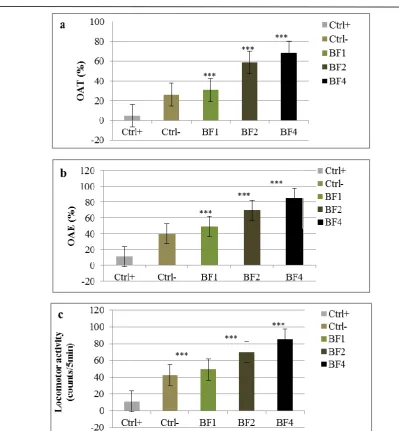
Figure 1 (a, b, c) shows the effect of different dosages of Baluchi's formulation versus percentage of open-arm entries, a percentage of spent time in open-arm, and movement activities (mobility) in an elevated plus-maze experiment. In the positive control group, the mobility (Fig. 1.c) and percentage of open-arm spent time (Fig. 1.a), the percentage of open arm entries (Fig. 1.b) decreased significantly, indicating an increase in depression and anxiety in them, but in the treatment groups, especially 4 g/kg, increased the mobility (Fig. 1.c) and percentage of open-arm spent time (Fig. 1.a), indicating a decrease in depression due to the use of the Baluchi's formulation, was observed (p< 0.001). Based on Fig.1, there was no significant difference between the negative control group and the treatment group BF1, but with treatment groups BF2, BF4 was significant.
Figure 1 shows the effect of different dosages of Baluchi's formulation versus percentage of open-arm entries, the percentage of spent time in open-arm, and movement activities (mobility) in the elevated plus-maze experiment. As it can be observed, every specific dose of treated groups, especially the dose of 4 g/kg, could lead to a meaningful increase in the percentage of open-arm spent time (Fig. 1.a), the percentage of open arm entries (Fig. 1.b), and mobility (Fig. 1.c) (p< 0.001).
Effect of edible Baluchi's formulation in the presence of scopolamine on memory and learning of mics (MWM test)
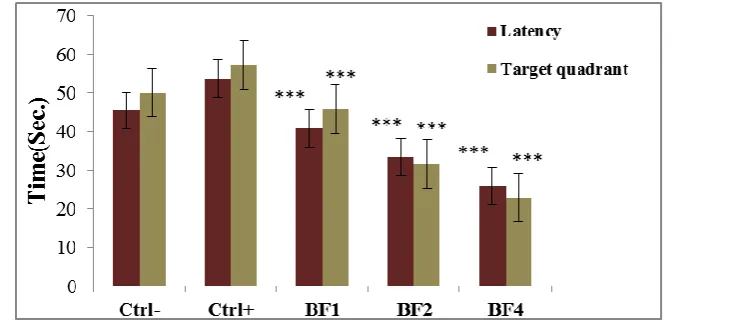
The results (Figs 2-5) of the parameters of the average of time spent for finding the platform and the distance traveled to reach the hidden platform (for studying the learning process and spatial memory) in the treatment BF1, BF2, and BF4 groups, especially BF4, showed a significant difference compared to the positive control group in the Mauritius water maze (p< 0.001). Comparing experimental groups BF1, BF2, BF4 with control group shows the mean decrease in time spent on finding the platform (Figs. 2-5). Based on Figures (Figs. 2-5), there was no significant difference between the negative control group and the treatment group
4 Babevey et al.
BF1, but with treatment groups BF2, BF4 was significant. Comparing experimental groups BF1, BF2, BF4 with
control group shows a meaningful decrease in time spent on finding the platform (Figs. 2-5). The results of this section Figure 1. EPM test. Effect of Baluchi's formulation (with doses of 1, 2 and 4 g/kg) versus (a) percentage of open-arm entries, (b) percentage of time spent in the open-arm, and (c) movement activities (mobility) in EPM experiment in comparison with a control group that received normal saline. Each column is indicative of mean ± S.E.M (p< 0.001).
0 20 40 60 80
day 1 day 2 day 3 day 4 day 5
T
im
e
(Sec.
)
DAY
Ctrl+ Ctrl-BF1
Figure 2. MWM test. Comparison of the averages of time spent on finding the platform in BF1 with the dose of 1 g/kg with respect to the control group for five consecutive days. The meaningful difference of averages concerning the first day in group BF1 (p< 0.001) is observed.
demonstrate that the average of time spent for finding the platform was effectively decreased for all control, experimental BF1, BF2, and BF4 groups with the dose of 1, 2, and 4 g/kg respectively (p< 0.001).
DISCUSSION
This study evaluated the protective effects of Baluchi's
formulation including date (0.3 g), almond (0.3 g), pumpkin seed (0.2 g), cinnamon (0.1 g) and sugarplum (0.1 g) on amnesia induced by scopolamine in EPM test and MWM. The results showed that intraperitoneal injection of scopolamine gives rise to the impairment of spatial learning process. Previous studies declared that intraperitoneal injection of 1mg/kg of scopolamine has brought about the
Figure 3. MWM test. Comparison of the averages of time spent on finding the platform in group BF2 with the dose of 2 g/kg with respect to the control group for five consecutive days. The meaningful difference of averages concerning the first day in group BF2 (P < 0.001) is observed.
Figure 4. MWM test. Comparison of the averages of time spent on finding the platform in group BF4 with the dose of 4 g/kg with respect to the control group for five consecutive days. The meaningful difference of averages concerning the first day in group BF4 (P < 0.001) is observed.
Figure 5. MWM test. Comparison of the averages of time spent on finding the platform and entry to target quadrant among different groups (P < 0.001). The meaningful difference of averages concerning the control group is observed.
6 Babevey et al.
mean decrease in the amount of acetylcholine in all parts of the brain and has also caused disorder in spatial memory [28,29]. In our experiments, dose prescriptions of 1, 2, and 4 g/kg of Baluchi's formulation could prevent anxiety, impairment of learning process and memory. It also displayed an effect by the mean decrease in the time spend for reaching hidden platform during training days. Therefore, prescription of different doses of Baluchi's formulation could improve impairment of spatial memory consolidation in those animals who received scopolamine. Evaluation of animals' presence in target quadrant showed that learning process and spatial memory of animals in our experiments were independent of possible sensual and emotional impairments due to prescribed medicines. In addition, the effects of different dose prescriptions of Baluchi's formulation were separately evaluated in order to determine whether this material had an independent effect or interferes with other systems involved in the learning process and spatial memory. The results also showed that there is a meaningful difference between Baluchi's formulation receiving groups and control group in terms of the time of arrival to the platform as well as the percentage of present time in target quadrant in the stage of probe trial.
Vitamin E was discovered in 1920 and separated from wheat germ and was then called alpha-tocopherol. This fat-soluble vitamin has antioxidant properties [30]. Researches have shown that vitamin E prevents the early death of patients suffering from Alzheimer while maintaining the integration of the nervous system [31]. Most studies show that vitamin E plays some role in the enhancement and improvement of memory and learning skills. Having a special chemical structure, this vitamin could postpone the memory loss by overcoming free radicals [32]. The tests show that vitamin E enhances the immune system which in turn postpones the cognitive disorder and memory loss. Moreover, it decreases hydrogen peroxide production and delays cell death [33]. Tocopherol, polyphenol, and selenium have been investigated as the most abundant and important constituent of Baluchi's formulation because of its powerful antioxidant activity and particularly protective effects on the nervous system [7]. In different studies, the selenium existing in almond and pumpkin seed has shown to improve mice memory impairment caused by fluoride in MWM [34]. Apart from this, cinnamic aldehyde and Eugenol of cinnamon protect the cells of the hippocampus (an effective part in the learning process and spatial memory) from impairment induced by scopolamine [35]. In addition, evaluation of date's antioxidant, antistress and neuroprotective effects has proved that its long-term uses solely affected healthy mice's cognitive function as well as meaningfully improving learning and spatial memory. It also increased the amount of acetylcholine in mice's cortex [21]. β-Carotene (date contains carotene and anthocyanins) inhibits the formation of Aβ oligomers and fibrils. As a result, it is considered to be a key molecule in the prevention and treatment of Alzheimer [36]. Studies have shown that β-Carotene has anti-oligomerization effects on Aβ [37].
Polyphenols are natural antioxidants that induce their protective effects on Alzheimer through various biologic actions such as reaction with intermediate metals, inactivation of free radicals, inhibition of inflammatory responses, modulation in enzyme activities and affecting intercellular signal paths and gene expression [35-37]. In our study, the use of different doses of Baluchi's formulation, especially the dose of 4 g/kg, prevents impairment induced by scopolamine. This is attributed to the fact that cholinergic receptor antagonist which seems to be one of its probable mechanisms is affecting acetylcholinesterase enzyme and accordingly increases the amount of acetylcholine in different parts of the brain, including the hippocampus and frontal cortex [38]. The results of our investigations showed that oral prescription of Baluchi's formulation can prevent spatial memory and learning impairments induced by scopolamine in MWM and also inhibits the increase in anxiety EPM test.
CONCLUSION
According to the obtained results, it is proposed that Baluchi's formulation can be considered an effective means of prevention and treatment of neurodegenerative diseases, such as Alzheimer, in light of having great potential in inhibition of neuronal impairment induced by scopolamine.
CONFLICT OF INTEREST
The authors declare that this research does not have any conflict of interest with anyone or any institute.
REFERENCES
1. Blokland A. Acetylcholine: a neurotransmitter for learning and memory? Brain Res Rev. 1995; 21(3), 285-300.
2. Chen Z, Kamei C. Facilitating effect of histamine on spatial memory deficit induced by scopolamine in rats. Acta Pharmacol Sin. 2000; 21(9), 814-818.
3. Jayaprakasha GK, Rao LJM, Sakariah KK. Improved HPLC method for the determination of curcumin, Demethoxycurcumin, and bisdemethoxycurcumin. J Agric Food Chem. 2002; 50(13), 3668-3672.
4. Sitaram N, Weingartner H, Gillin JC. Human serial learning enhancement is choline and choline impairment with scopolamine. Science. 1978; 201(4352), 274-276.
5. Vakili A, Eianali MR, Bandegi AR. The protective effects of Saffron against the oxidative damage in a transient model of focal cerebral ischemia in rats. Tehran University Medical Journal. 2011; 69(7),405-412.
6. Dowson, V.H.W. Date production and protection with special reference to North Africa and Near East. FAO Technical Bulletin. 1982; 35,294-301.
7. Vinson, J.A.‚ Zubik, L.‚ Bose, P.‚ Samman, N., Proch, J. Dried fruits: excellent in vivo antioxidants. Journal American Collection Nutrition. 2005; 24(1), 44-50.
8. Haider, S., Batoo, Z., Haleem D. J. Original Nootropic and hypophagic effects following long-term intake of almonds (Prunus amygdalus) in rats. Nutrition Hospital. 2012; 27(6),2109-2115.
9. Blomhoff, R., Carlsen, MH., Andersen, LF., Jacobs, DR. Health benefits of nuts: potential role of antioxidants. British Journal of Nutrition. 2006; 2,52-60.
10. Lim, GP., Chu, T., Yang, F. The curry spice curcumin reduces oxidative damage and amyloid pathology in an Alzheimer transgenic mouse. J Neuroscience. 2001; 21,8370-8377. 11. Chen, CY., Milbury, PE., Lapsley, K., Blumberg, JB. Flavonoids
from almond skins are bioavailable and act synergistically with vitamins C and E to enhance hamster and human LDL resistance to oxidation. J Nutr. 2005; 135(6),1366-1373.
12. Hlebowicz, J., Hlebowicz, A., Lindstedt, S., Bjorgell, O., Hoglund, P., Holst, JJ., Darwiche, G., Almer, LO. Effects of 1 and 3 g cinnamon on gastric emptying, satiety, and postprandial blood glucose, insulin, glucose-dependent insulinotropic polypeptide, glucagon-like peptide 1, and ghrelin concentrations in healthy subjects. American Journal Clinical Nutrition. 2009; 89(3),815-821.
13. Leela N.K, Parthasarathy V.A, Chempakam B, Zachariah T.J. Chemistry of Spices. CAB International Oxfordshire. 2008; 124-145.
14. Wu, T. S., Leu, Y. L., Chan, Y. Y., Yu, S. M., Teng, C. M. & Su, J. D. Lignans and an aromatic acid from Cinnamomum Philippines. Phytochemistry. 1994; 36,758-788.
15. Bano, F., Ikram, H., Akhtar, N. Neurochemical and behavioral effects of Cinnamomi cassia (Lauraceae) bark aqueous extract in obese rats. Pakistan Journal of Pharmaceutical Sciences. 2014; 3,17-37.
16. Marom AF, Levin A, Farfara D, Benromano T, Scherzer-Attali R, Peled S, Vassar R, Segal D, Gazit E, Frenkel D, Ovadia M. Orally Administrated Cinnamon Extract Reduces β-Amyloid Oligomerization and Corrects Cognitive Impairment in Alzheimer's Disease Animal Models. PLoS ONE. 2011; 6(1): e16564.
17. Glew, RH., Glew, RS., Chuang, LT. An amino acid, mineral and fatty acid content of pumpkin seeds (Cucurbita spp) and Cyperus esculentus nuts in the Republic of Niger. Plant Foods Human Nutrition. 2006; 61(2),51-56.
18. Yoo, SH., Lee BH., Lee H, Lee S., Bae IY., Lee HG., Fishman ML., Chau HK., Savary BJ., Hotchkiss AT. Structural characteristics of pumpkin pectin extracted by microwave heating. Journal of Food Science. 2012; 77(11), 1169-1173. 19. Bruhns, G. Kristallisation in Bewegung. Zuckerindustrie. 1985;
10,867 -873.
20. Grimsey, IM., Herrington, TM. The incorporation of colored compounds in sucrose crystals. Zuckerindustrie. 1996; 121,40 – 45.
21. Asadi Shekaari M, Panahi M, Dabiri Sh, Safi kHz, Kalantaripour TP. Neuroprotective effects of Aqueous Date Fruit Extract on focal cerebral ischemia in rats. Pak J Med Sci. 2008; 24(5),661-665.
22. Batool Z, Sadir S, Liaquat L, Tabassum S, Madiha S, Rafiq S, Tariq S, Batool TS, Saleem S, Naqvi F, Perveen T, Haider S. Repeated administration of almonds increases brain acetylcholine levels and enhances memory function in healthy rats while attenuates memory deficits in animal model of amnesia. Brain Research Bulletin. 2016; 120, 63–74.
23. Essa MM, Vijayan RK, Gonzalez GC, Memon MA, Braidy N, GJ Guillemin. Neuroprotective Effect of Natural Products Against Alzheimer's Disease. Neurochemical Research. 2012; 37(9), 1829–1842.
24. Varvel S.A, Lichtman A.H. Evaluation of CB receptor knockout mice in the Morris water maze. Journal of Pharmacology and Experimental Therapeutics. 2002; 301(3), 915-924.
25. Morris, R.G.M. Development of water maze procedure for studying spatial learning in the rat. Journal of Neuroscience Methods. 1984; 11, 47-60.
26. Komada M, Takao K, Miyakawa T. Elevated plus maze for mice. Journal of Visualized Experiments. 2008; 22, 1088. 27. Meer, P.V., Raber, J. Micebehavioral analysis in systems
biology. Biochemical Journal. 2005; 389, 593-610.
28. Brown, B.G and Crowley, J. Is There Any Hope for Vitamin E? JAMA. 2005; 293(11):1387-1390.
29. Panemangalore, M. and Lee, C.J. Evaluation of the Indices of Retinol and α Tocopherol Status in Free-Living Elderly. Journal of Gerontology. 1992; 47(3): 98-104.
30. Sullivan, P.G. and Brown, M.R. Mitochondrial aging and dysfunction in Alzheimer's disease. Progress in Neuro-psychopharmacol and Biological Psychiatry. 2005; 29(3),407-410.
31. Basha, PM, Madhusudhan, N. Pre and Post Natal Exposure of Fluoride Induced Oxidative Macromolecular Alterations in Developing Central Nervous System of Rat and Amelioration by Antioxidants. Neurochemical Research. 2010; 35(7);1017–1028. 32. Frydman-Marom A, Levin A, Farfara D, Benromano T,
Scherzer-Attali R, et al. Orally Administrated Cinnamon Extract Reduces b-Amyloid Oligomerization and Corrects Cognitive Impairment in Alzheimer's Disease Animal Models. PLoS ONE. 2011; 6(1), e16564.
33. Ono K, Yamada M. Vitamin A, and Alzheimerʼs disease. Geriatr Gerontol Int. 2012; 12: 180–188.
34. Takasaki, J, Ono K, Yoshiike Y, Hirohata M, Ikeda T, Morinaga A, Takashima A, Yamada M. Vitamin A has Anti-Oligomerization Effects on Amyloid-β in Vitro. Journal of Alzheimerʼs Disease. 2011; 27(2),271-280.
35. Dong-Young C, Young-Jung L, Jin T.H, Hwa-Jeong L. Antioxidant properties of natural polyphenols and their therapeutic potentials for Alzheimerʼs disease. Brain Research Bulletin. 2012; 87(2-3), 144-153.
36. Obrenovich M.E, Nair N.G, Beyaz A., Aliev G, Reddy V. P. The role of polyphenolic antioxidants in health, disease, and aging. Rejuvenation Research. 2011; 13(6), 631-643.
37. Rojanathammanee L, Puig K.L, Combs C.K. Pomegranate Polyphenols and Extract Inhibit Nuclear Factor of Activated T-Cell Activity and Microglial Activation in Vitro and in a Transgenic MiceModel of Alzheimer Disease. The Journal of Nutrition. 2013; 143(5), 597-605.
38. Hussain M, Awwad IA, Taha M, Khan O. A laboratory quest on use of date fruit (Phoenix Dactylifera, L) extract in prevention of chemically induced memory deficit in the mouse. Asian Journal of Biomedical and Pharmaceutical Sciences. 2015; 5(49), 5-11.