An Innovative ICT Solution for Sewer Systems
Antoni Grau
1, Yolanda Bolea
1, Alberto Sanfeliu
2, Ana Puig-Pey
21 Technical University of Catalonia UPC, Pau Gargallo 5, 08028, Barcelona, Spain 2 Robotics Industrial Institute, UPC/CSIC, Llorens i Artigas 14, 08028 Barcelona, Spain
Abstract
The objective of this paper is to explain the importance of research in wastewater transportation (sewage systems) using new technologies such as robotics systems and information and communication technologies (ICTs). ECHORD++ (European Coordination Hub for Open Robotics Development) is a very useful tool to foster this research and to meet needs and solutions. In this paper, authors explain the tool as well as the methodology to promote robotics research in urban environments, and the on-going experience will demonstrate that huge advances are made in this field.
1
Introduction
From their origins, cities have been the center of economic, political, urban, cultural and social innovation fed by growing flows of people seeking work and business opportunities and, finally, better life conditions. The growth of the cities in an ordered and planned way generated multiple challenges to the people that live, work or visit the city, but especially to those who manage and administrate it (Ontiveros, E., Vizcaíno, D. and López Sabater, V., 2016) (Smart Cities World, 2017). Europe has a long tradition of outstanding research and manufacturing in robotics. However, finding common ground between manufacturers and the research community has proven difficult in the past. Defining the future direction of robotics research has revealed to be the real challenge. European Coordination Hub for Open Robotics Development, ECHORD++ (ECHORD++, 2017), was installed as an incubator to promote innovation by facilitating the cooperation between academia and industry. ECHORD++ wants to further stimulate this interaction between robot manufacturers, researchers and users. Specifically, project managers will focus in PDTI (Public and users Driven Technological Innovation), that it is the methodology followed to develop a final technological product that is innovative and ready for commercialization (throughout the pairing academia-industry). Another key feature is that the product is not yet in the market and it is expected to be the solution for more than one cities. Regarding the PDTI side, ECHORD++ consists of different stages: initially, local authorities in city councils analyze the existing problems in the city that should be solved in a technological manner; each city can present a unique proposal in a public call; secondly, when all the presented proposals are collected a panel of experts score and rank them following some specific indicators (citizen’s needs, social impact,
Volume 3, 2018, Pages 852–857
sustainability impact, economic impact, efficiency…), only the best ranked proposal wins and this proposal will be “the challenge” to be solved; then, the proposal is refined by the winner city and presented, a public call is open to consortia (research centers and private companies) as a European project and only the two best ranked solutions are accepted to be working to solve the challenge. These two consortia are funded by ECHORD++ project to work in parallel for solving the challenge (Phase I, Phase II and Phase III) (Puig-Pey, A., Bolea, Y., Grau, A., and Casanovas, J., 2017). At the end of this process of 36 months, the suitable prototypes (evaluated by panel of experts- final reviewers) will be considered for industrial production and deployment.
2
Material and Methods
2.1
The process of the project
After a selection among 14 European cities that submit an innovative technological challenge, the city of Barcelona won the challenge in Urban Robotics with the project proposal “Robots for the inspection and the clearance of the sewer network in cities”. After this selection an open call was performed by ECHORD++ administration and a total of 10 consortiums applied for the project. Finally, two consortiums were selected to develop their research in this challenge, ending up with a real prototype which will be presented at the end of the 36-month project. To develop this research project, proposers have to follow the Barcelona city regulations in this matter, Environmental Municipal Ordinance (1999). The new robotics solutions should include: 1) mobility and autonomy and 2) communication and teleoperation (ICTs). At the end of the project, the innovative technological solutions for the challenge of the Barcelona city proposed by both consortiums will be evaluated by a panel of experts, and it is expected that two robotics commercial products are the outcome of the project.
2.2
The Challenge and The Need of Technological Solutions
that makes inspection devices more autonomous, to have more degrees of freedom to move around the network, and the possibility to intensify the checking of a zone where impairment has been detected. The objective of developing this new technology is to mechanize sewer inspections in order to reduce the labor risks, objectify sewer inspections and optimize sewer cleaning expenses of the city. Regarding the sewer monitoring, the objective of sewer monitoring is to approximate the robot to the maximum level of sensitivity which will allow the sewer manager to make decisions without exposing to risky locations. The task of sample collecting is greatly important in order to obtain valid and traceable information, which could be used afterwards to determine environmental legislation and policies.
3
Technological Results and Discussion
The current need of the City of Barcelona is to mechanize sewer inspections in order to reduce the labor risks, objectify sewer inspections and optimize sewer cleaning expenses of the city. The sewer network of Barcelona is 1,532km long, from pipe is at least 1.5m high and workers are allowed to go inside it. In order to determine the state of the network, visual inspections are done with different frequencies depending on the slope and other characteristics of the sewer. Workers walk all along the pipe, in some sections even four times a year, and decide where it is necessary to clean. Moreover, sewers are classified as confined spaces which require special health and safety measures, in addition to other risks like slippery sections, obstacles or biological risks from the eventual contact with wastewater. These features made the process of sewer inspection a risky and expensive process that requires improvements urgently. Sewer inspection is a service included in the public management of the sewers of Barcelona. Nowadays, sewer inspections are done by people performing visual inspections and collecting information about the state of the sewage like sediment level and type, pipe obstructions, etc. Because of the sewer risks, the performance of the inspections is about 1.5km of sewer every 6 hours. There are two technological solutions proposed (SIAR and ARSI projects) that are currently working and making progresses. Phase I of both projects has successfully showed the proposed solution of each one as proof of concept in the tests conducted in mobility, autonomy and communications. Currently these projects are in Phase II, during which all the aspects of the solution will be developed and validated to ensure a complete solution for robot-assisted sewer inspection. It is expected to obtain a prototype inspecting the Barcelona sewer network at the end this phase.
3.1
SIAR Solution
repeater package, including weight, batteries, autonomy and functionalities. 2) Design of the arm, including DoF (degrees of freedom), sizes, gripper and maximum payload. 3) Sensing approaches for estimating the relative position between robot and repeater for picking up the repeaters back to the robot (passive and active markers). The communication block will be equipped with a long range 2.4GHz router, the Microhard nVIP- 2400. This device has been tested indoors and proved to communicate up to 300 meters with line of sight. This link will provide a high bandwidth connection that could be used for video streaming and additional information such as the 3D reconstruction of the environment. With the proposed battery the repeater power autonomy will be close to 4 hours.
Fig. 1. (Left) SIAR and (Right) ARSI Prototypes
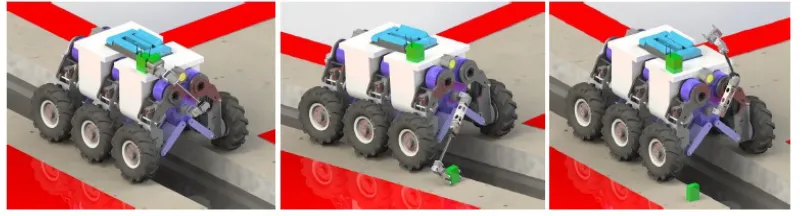
The deployment of repeaters is proposed whenever the Line-of-Sight (LoS) is expected to be lost, and therefore the quality of the links could begin to degrade. This will extend the operational range of the robot in more than 300 m for each repeater. To this end, the robotic platform will be equipped with a 4DoF manipulator on its back, which will automatically pick-up one of the available communication repeaters and deploy it on the ground (see Fig.2). This manipulator will also be used to retrieve the already deployed repeaters in its way back.
Fig. 2. SIAR Robot deploying one wifi communication repeater.
3.2
ARSI Proposal
The proposal is the use of a Micro Aerial Vehicle (MAV) (see Fig.1, right) for inspection tasks in the sewer avoids the mobility constraints from which a ground robot would suffer, such as paths with steps, steep drops and even objects in the way. Additionally, a flying platform is able to move faster through the sewer network than the terrestrial alternative and needs simpler logistics in deployment and operation. On the other hand, a MAV solution has to overcome strong constraints of size, weight and energy, as its flying space is bounded by sections less than 100 cm wide. Therefore, its size and consequently payload are limited to minimal dimensions. The ARSI consortium has addressed the problem of sewer inspection with the integral design of an aerial platform, multi-rotor type, endowed with sensors for semi-autonomous navigation and data collection within network, and capable of communicating with an on-surface operator. The different drones that will operating inside the sewer will be monitored and controlled from a van parked outside, in the street, and the workers will assist the robots to replace the batteries (Flying robots in sewers, 2015). Remote station in the sewer is used. The procedure aims at optimizing the range provided by our communications system and the autonomy of the batteries. To provide radio coverage in tunnel-like environments (tunnels, mines), two main methods are used: the leaky feeder, based on the use of radiating cables, and systems based on the natural propagation of radio-waves. Owing to the high cost of leaky-feeder installations and the fact that they are susceptible to damage and failure, the natural propagation system is preferred in many applications. Wireless propagation in these environments is described as strongly multipath, and if the wavelength of the signal is much smaller than the tunnel cross section, tunnels act as an oversized dielectric waveguide. In this case, the attenuation per unit length is low enough to allow communications over a range of up to several kilometers.
The main features of the design consist in: 1) Optimal layout of the payload on the platform (embedded PC, 2D laser scan, multiple image sensors, LED lights, gas sensor and antenna) which minimizes the weight and energy requirements. 2) Localization and motion planning methods in GPS-denied environments. 3) Careful design of the image sensors and their configuration in order to ensure a detailed view of the whole section for structure assessment and defect detection purposes. 4) Use morphology of the sewer network to enable out-of-sight communication. 5) Integration of mission planner within operational software of sewer maintenance companies.
The problem of the communications between the ARSI aerial vehicle and the Remote Station in the sewer was addressed and solved. Firstly, the challenge of the problem is described. As a result of a study of the problem and of the available technologies, the solution is described. The procedure aims at optimizing the range provided by our communications system and the autonomy of the batteries. To provide radio coverage in tunnel-like environments (tunnels, mines), two main methods are used: the leaky feeder, based on the use of radiating cables, and systems based on the natural propagation of radio-waves.
performance necessary to meet the video and data streaming requirements of this project. The prototype has been flying in a real sewer environment, see Fig.3. The tests show that the behavior of the MAV is as expected.
Fig. 3. Quadrator flight in Passeig Sant Joan in Barcelona, a real sewer environemnt.
4
Conclusions
In this paper, the challenge of sewage cleaning monitoring using robotics and communications is shown. Two selected consortia in the ECHORD++ carry out this challenge. The communication solution proposed in Phase I for both consortiums is explained obtaining satisfactory results. Next, in Phase II, a prototype (from the communication solution proposed in Phase I) will be presented. Then, both consortiums once again will be reviewed to pass Phase II.
Acknowledgment
Authors would like to thank the European Commission for launching ECHORD++ project. The “ECHORD++ EU Project FP7-ICT-2012-601116” project has received funding from the European Union’s Seventh Framework Programme for research, technological development and demonstration.
References
Ontiveros, E., Vizcaíno, D. and López Sabater, V. (2016), Las ciudades del futuro: inteligentes, digitales y sostenibles; Telefonica Fundación, 2016, in Spanish.
Smart Cities World (2017), https://smartcitiesworld.net/news/news/rise-of-therobots-879, accessed on Oct 6th 2017.
ECHORD++ website (2017), http://http://echord.eu/, accessed on Oct 6th 2017.
Puig-Pey, A., Bolea, Y., Grau, A., and Casanovas, J. (2017) “Public entities driven robotic innovation in urban areas”, Robotics and autonomous systems,Vol. 92, pp. 162-172, 2017.
Flying robots in sewers (2015) “El Pais” newspaper, December 7th, 2015,https://elpais.com/ccaa/2015/12/06/catalunya/1449424748_228383.html
Dudley, D.G., Lienard, M., Mahmoud, S.F. and Degauque, P. (2007) “Wireless propagation in tunnels”, Antennas and Propagation Magazine, IEEE, vol. 49, no. 2, pages 11–26, April 2007.