Research Journal
Volume 9, No. 28, Dec. 2015, pages 18–26
DOI: 10.12913/22998624/60778 Research Article
Received: 2015.09.30 Accepted: 2015.11.14 Published: 2015.12.04
APPROACH FOR RESOURCE MANAGEMENT IN GRID ENVIRONMENTS
USING GENETIC ALGORITHM
Seyed Javad Mirabedini1, Arman Kavosi Ghafi1, Hassan Amiri2
1 Department of Computer Software, Central Tehran Branch, Islamic Azad University, Tehran, Iran, e-mail:
[email protected], [email protected]
2 Department of Computer Software, Damavand Branch, Islamic Azad University, Damavand, Iran, e-mail:
ABSTRACT
The use of ‘proper energy computation system’ is the best method to investigate the problem of energy deficiency, since energy consumption in computational resources is proportional with the work load in the applied program. Also, the best method to im -prove the use of resources and decrease in energy consumption is dynamic integration of virtual machines which can be a base for the integration of resources in independent systems through virtualization technology, so that it is possible to use resources and equipment for long time and consequently assuring quicker return of investment. To -day, grid computation is a new technology connecting heterogeneous computational resources to each other; thus, this structure operates as an individual and integrated virtual machine. Then, it is possible to implement very complex applied programs requiring high processing capacity and huge amount of input data on this virtual ma -chine. In this regard, the purpose of this study is to present an approach for resource management in grid environments using PSO and Genetic algorithms, and also ants colony to find the location of virtual machines.
Keywords: improvement of resource management, virtualization, cloud computing, grade calculations.
INTRODUCTION
These days there is a huge amount of data and calculations, geographically distributed around the world and these have created some challenges of accessing, processing and distributing data. In fact, it is a tedious task to handle large amount of data to do complicated calculations. Data Grid is an alternative solution for these kinds of prob-lems, which is an architecture for management analyses of large scientific data sets. Data Grid is a development concept based on a “Grid”, which is an infrastructure for integrating distributed computational elements. In an advanced distrib-uted environment of a grid, there are some data access matrices, response time, access cost [12].
Energy computation system is a suitable method to study the problem of energy
mode. Electricity deficiency in unemployed sec-tors of sever causes little dynamic electricity for server (30%), i.e. though a server is completely unemployed but still consumes more than 70% of electricity. Dynamic integration of virtual ma-chines (VMs) is a method to improve the use of resources and decrease in energy consumption provided by virtualization technology. Virtual-ization enables server to establish various sam-ples of virtual machine in an individual-physical server causing improvement in resource con-sumption and increase in return on investment (ROI). Integration without restriction can lead to performance degradation. Virtualization can be a base for resource integration of independent systems to use resources and equipment for long term and consequently assuring more rapid re-turn on investment. Trust of service quality per-formed by agreements about the level of servic-es between cloud suppliers and their costumers is necessary for cloud computing environments. Therefore, cloud suppliers must manage energy-performance relationship with decrease in ener-gy consumption while considering condition of service quality.
VIRTUALIZATION
Virtualization is a technique that hidden physical features of resources and enables us-ers’ access to resources. This technique that is called ‘virtual machine’ and enables the separa-tion or sharing computer resources between sev-eral environments simultaneously; so that these virtual machines can activate balance with/ without each other. In other words, virtualiza-tion is a process of virtual resource allocavirtualiza-tion and their management in several services so that applied programs can use virtual resources cre-ated in real resources. Virtualization technol-ogy is a tool to create a method with a function similar to a physical computer. Here, features of physical hardware are created through the use of software. In other words, virtualization cre-ates software performing similar to hardware. This technology provides a possibility of install-ing an operator system on hardware without its physical existence. Virtualization differentiates application environment from host calculations, network hardware, and memories; this differen-tiation means logical classification of a device to several devices, or integration of several
physi-cal devices in logiphysi-cal storage of resources and/ or both. Sever type of virtualization includes hardware virtualization, network virtualization, virtualization of storage resources, and virtual-ization of applied programs [11].
The other capability provided by virtualiza-tion is ‘effective immigravirtualiza-tion’, i.e. capability of transforming a virtual machine between physi-cal servers related to loop or host with stop time close to zero. Using effective immigration, virtual machines can combine with small fluctuations dynamically and keep active physical servers at least in all times. Dynamic integration of virtual machine includes two main processes:
1. Immigration of virtual machines from used hosts to decrease the number of active hosts. 2. Discharge of virtual machines from hosts
when they have high loads; it is due to avoid performance degradation by virtual machines. Performance degradation can lead to violation from condition considered for service qual-ity. However, dynamic integration of virtual machine is important in clouds since new pro-grams have highly variable work load causing dynamic patterns of resource consumption; thus, infinite integration of virtual machine can lead to performance degradation [11].
METHODS OF VIRTUALIZATION
Complete virtualization
Partial virtualization
Partial virtualization simulates some parts of lower hardware; in this method, most hardware features (but not all of them) are simulated. As a result, it creates virtual machines where some parts of software could be performed without change, i.e. input operator systems cannot be performed on a virtual machine but most applied programs can [11].
Semi-virtualization
Virtual machine based on semi-virtualization presents a software intermediate closely similar (not completely) to lower hardware. The difference between this virtual machine and that of complete virtualization is that the former change in order to recognize middle layer. This helps cloud supervi-sor to prevent their virtualization through substi-tuting processor instructions with common proce-dures. This type of virtualization provides possibil-ity of sharing memories between virtual machines without changing host’s operator system.
Virtualization at level of operator system This type of virtualization is a model in which operator system core creates several separate op-erator systems that are distinct in view of user. In UNIX systems, this technology can be recog-nized as and advances type of change mechanism of standard root; thus, the main OS installed on physical server provides the possibility of creat-ing several secure virtual servers. Guest OS is completely similar to OS of a host running indi-vidually [2, 8].
According to what was said, virtualization also has some benefits including:
• Decrease in costs. Costs of organizations that use virtualization strategy are controlled significantly due to optimization of servers, decrease in hardware, decrease in occupied space, reduction in system’s overall complex-ity, and decrease in consistency of applica-tions. Thus, we can reduce hardware costs with virtualization due to decrease in physi-cal constructs, physiphysi-cal location, and required power. Decrease in costs is performed by inte-gration of smaller servers and creating bigger ones either reducing accreditation level of the obtained software; thus, overall saving is be-tween 29–64% [2].
• Creating agility. Virtualization causes dy-namic allocation of resources, readiness of hardware and systems for effective support of business growth, and ease supply in level of services. Database virtualization through effective sharing of resources would cause agility in business activities; therefore, vir-tualization respond to demands of internal and external costumer in terms of applied programs, speed, and efficiency [2].
• Simplification of procurement. Increase of computational resources can be acceler-ated through a hardware support process. If a particular business activity needs addi-tional abilities to supply its activities, then it is possible to add this capability through virtualization. Advanced virtual environ-ment supplies computational load require-ments automatically and performs dynamic resource allocation. The risks of lack of rap-id access to resources would be removed by help of virtualization and supplying virtual resources dynamically. In fact, virtualization decreases access time to required resources up to 90%; as a result, it increases response of suppliers against advanced needs of cus-tomers [1].
• Increase of efficiency. Virtualization pro-vides space to improve efficiency of applied programs and to enhance overall perfor-mance simultaneously; this is an effective factor for optimum implementation of avail-able resources.
VIRTUAL MACHINE
CLOUD COMPUTING
Most software and data storage systems need to perform on a hardware space with high acces-sibility and extenacces-sibility. In traditional approach of calculations, system resources are not used optimally and in a period of time, it is possible for a series of resources to be unemployed; in this typology, system failure in one of hardware parts would lead to service breakdown. On the other hand, providing necessary equipment to present services will require great investments. Apply-ing hardware and software resources appropriate with overall needs is very extensive. In this re-gard, it is necessary to apply new methods and techniques in order to effective execution and to prevent loss of resource. Cloud computing is one of growing technologies attractive for scientific and trade communities, so that most countries and also great firms are investing and studying in this field. It must be noted that cloud computing re-lies on virtualization technology. As said before, virtualization is one of effective and useful ideas in order to increase efficiency of hardware and software systems; it is also proposed as a new technology providing integration of several hard-ware and softhard-ware resources so that all users have access to their private environments. Virtual in-frastructures provide virtualization techniques of resources and applications anywhere and anytime necessary. Some benefits of this method are de-creased in main costs due to lower needs for hard-ware, and decrease in operational costs including maintenance and management; at the same time, increase of systems and available spaces would decrease the need to physical development of re-sources [6, 7, 8].
Main features of cloud computing
Cloud computing has mostly features simi-lar to other computational styles, but correct use of these features caused superiority of this technique.
• extensive access to network: access to cloud resources is possible throughout the network with standard methods. This system uses the Internet to deliver and present services; thus, costumers of services need not to any specific hardware and software and they can enjoy cloud services just using a web browser. • rapid development capability: the principle of
‘rapid development’ performs well in cloud
computing well. Expectation and viewpoint of costumers toward cloud computing is that they must be infinite and purchasable anytime with any scale.
• choosing services based on demand: costumer can supply cloud computing of his/her re-sources without the need to interaction with service provider personnel; here, we pay mon-ey due to the use of resources. In this system, it is easily possible to demand for additional processors and/or memory and band width. • calculation service: one of other unique
fu-tures of cloud computing is measurement and report delivery to costumer. This calculation is performed based on services and resources used by costumers.
• resource density: we a observe great amount of resources in cloud computing. Using vir-tualization, these resources are independent from their physical location. Therefore, they can move through the network easily and in fact all resources (databases, web servers, OS, applied software, storage media, and ...) ap-pear in system as virtual servers.
• multi-tenant: this feature increases applying non-used resources and provides possibility of sharing resources between a group of users. • cloud changes in life: since firms and trade brands are transforming their software on the web and these applications are displayed by browsers everyday with new and more inter-esting features, we are able to get access any-thing using any browser and computer without any boundary between our personal computer and internet.
In addition to features mentioned above, cloud computing has some advantages [6, 7, 8]: 1. Optimum efficiency of resources. Efficiency
increases in system without need to pay, as it is possible to use available equipment without need to specific hardware. You will observe better efficiency of your PC because of few-er programs occupying its memory. In othfew-er words, computers with a cloud computing sys-tem are booted and installed more rapidly so once they have less programs and processes on the memory [9].
3. Scaling. Users can supply resources dynami-cally in time of demand, and there is no need to former provision for times of maximum load. 4. Infinite storage capacity. Cloud computing
provides infinite capacity for data storing. 1 terabyte hard disk of your current computer is nothing against hundreds of Petabyte (one million gigabyte) provided by cloud. You can save anything you need on cloud environment. Virtualization is used in formats of cloud computing below:
• program, • processor, • access, • storage space.
Hardware and software virtualization are used in cloud more than other items. Hardware vitalization is used in management of hardware equipment in a form of ‘plug & play’. Therefore, it is possible to add hardware equipment to the system or remove them; also computational ca-pacity and cloud storing space change dynami-cally. Software virtualization is used for software sharing [5].
GRID COMPUTING NETWORKS
Generally, grid computing is a new technol-ogy that provides remote access to resources us-ing communication infrastructures, computer net-works, and also valuable concepts and equipment of distribution systems. Today, we can connect heterogeneous computational resources using grid technology, so that this structure seems like an integrated virtual machine ;then, it is possible to perform very complex applied programs on this virtual; machine. For example, it is possible to connect multiple supercomputers, clusters, and personal computers all together. Grid has no con-straints in terms of geographical location and type of resources under coverage. More generally, a grid network can cover multiple big clusters, sev-eral microchips, and thousands of personal com-puters and work stations throughout the world; it also provides high level connection of these heterogeneous computers and identifies different resources and remote access to them. In fact, con-nection to one of grid networks provides access to high computational power performing huge proj-ects. On the other hand, grid provides cooperation of several firms throughout the world in the field
of joint projects; it establishes an appropriate field to realize dynamic virtual firms [1, 2].
In fact, grid technologies can support decen-tralized resources and systems and provide con-nection of systems with each other. When grid was invented for the first time, its goal was just sharing system’s resources and having a power-ful system; generally, it was in hand of research institutes. But today, grid has more importance especially in e-commerce and distributed trade systems. For example, let’s assume B2B e-com-merce model in which two trade institutions ex-change their information through internet; in a similar manner, grid can connect two or more trade systems so that firms can share their infor-mation. Grid technology also can be a proper so-lution for access increases, reliability and security of decentralized systems. Parts forming grid are: • user link,
• security members, • workload management, • scheduler,
• data management, • resource management.
Grid computational networks are a set of sev-eral systems with different computational power that altogether forms a virtual supercomputer to perform most complex calculations of math, as-tronomy, biology, etc. in a very short time. The standard of computational networks is to ignore concerns caused by hardware constraints of com-puter systems. In computational networks, re-sources (i.e. physical ones) are similar between several users in the network. Each user shares his/her demands with other users simultaneously; thus, processes and works are done by several us-ers independently and each demand is different from others. Resource management usually re-ceives works with different calculations, speed, and measures; then, it assigns these input process-es to computational nodprocess-es available in network. Now, grids are available in 3 forms:
1. Cluster grids as the simplest type of this sys-tem are a set of computers working together; they create an access point to system for users of a specific project or organizational sector. 2. Campus grid allows various projects and
3. Global grid is a set of several campus grids going beyond organizational boundaries to create a huge virtual system. Users can access computer resources beyond what they have in organization.
In this regard, researchers conducted several studies of the field. Khana et al. proposed a dy-namic management algorithm that starts when a physical server is loading more or less than stan-dard value. Main goals of algorithm are:
• assuring lack of failure in SLAs (SLA is pow-er and response time),
• minimizing immigration costs,
• optimization of system’s maintained capacity and minimizing number of physical servers.
The other project to study SLAs is proposed by Babrov et al. They suggest and evaluate dy-namic server integration algorithm to decrease required capacity and SLA error rate. This algo-rithm uses historical data to predict further de-mand and relies on periodic performance to mini-mize the number of physical servers. Spitamp and Bichler describe linear programming for in-tegration problems of dynamic and static server. They also designed development constraints to limit the number of virtual machines in physical servers assuring that some virtual machines are related to different physical servers. Mapping vir-tual machines relates to a specific set of physical servers including some unique features and limit-ing the total number of immigration for dynamic integration. In addition, they proposed a method to minimize cost of linear programming formu-lation. Mahta and Nogy introduced ‘Recon’ with purpose of dynamic server integration in clusters of data centers. Recon investigates dynamic and static costs of physical service providers, costs of VM immigration and historical resources to pres-ent an optimum and dynamic program to physi-cal mapping server during time. Similarly, Verma et al. developed p-Mapper architecture and a set of server integration algorithm for heterogeneous virtual resources. Algorithms calculate power, immigration costs, and performance profitability in physical server during integration of applied programs. Wood et al. developed ‘sandpiper’ sys-tem to monitor and recognize important points and re-mapping. sandpiper classifies them using volume to size ratio (VSR) that is a metric based on processor, network, and physical server; it tries to transform most VMs overloaded in a physical server to a server with enough additional
capac-ity. Besides several methods available for server integration, we also study the fact that VMs have fixed loads; thus, users must experience such sta-bility. Further, keeping VMs on their main physi-cal servers will reduce partial error. Recently, problem of determining location of virtual ma-chines is highly attractive since virtualization is one of the main subjects in cloud computing; the goal is reducing energy consumption in data cen-ters. In an algorithm, finding location is a hier-archy that considers requirements of processing resources, communications, and also availability. We use birds’ algorithm to optimize performance costs of virtual machines, their running time and cost of communications between resources lead-ing to answer close to optimum [6, 7, 8].
METHODOLOGY
The research method includes several con-secutive steps:
1. Main definitions and concepts in virtualization space.
2. Theoretical analysis of dynamic integration virtual machine algorithms.
3. Study of problems related to virtual machine dynamic integration in cloud computing envi-ronment.
4. Applying PSO, genetic, and ant algorithms to determine location of virtual machines.
5. Evaluation of algorithm proposed through event virtual simulation using clouds.
Since target system is a ‘service infrastruc-ture’, a cloud computing environment is neces-sary to evaluate algorithms proposed for a data-base infrastructure [10].
RESULTS
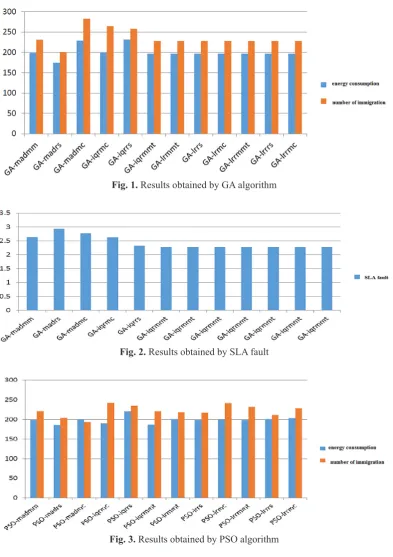
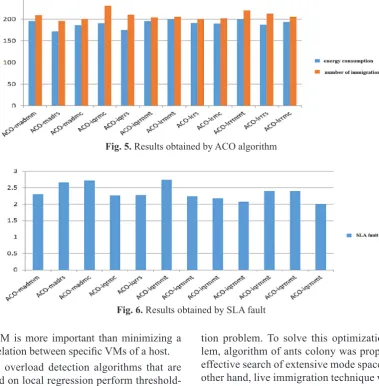
Using the data of the detailed work, all pos-sible combinations of four proposed algorithms were simulated to determine host overload (LPR, LR, MAD, and IQR) and four selection algo-rithms (MMT, VM, MC and RS). In addition, we used genetic and ant algorithms to determine lo-cation of virtual machines (Figures 1–5):
1. The algorithms that recognize overload based on statistics would perform better because of reducing SLA violation level.
Fig. 1. Results obtained by GA algorithm
Fig. 4. Results obtained by SLA fault
Fig. 3. Results obtained by PSO algorithm
of VM is more important than minimizing a correlation between specific VMs of a host. 3. Host overload detection algorithms that are
based on local regression perform threshold-based algorithms because of reduction in SLA violation level and number of immigra-tion of VMs.
4. LR algorithm yields better results than its fixed version; since what is important for simulated workload is rapid reaction to load pulses, not prepare rapture samples.
5. To detect location of virtual machines, algo-rithm of ants colony yields better results than that of two other algorithms.
CONCLUSIONS
Virtualization can be a base to integrate the resources of independent systems, so that we can use resources and equipment for a longer period by help of this technology and to ensure quicker return on investment. Also, cloud providers must manage performance-energy relationship by re-ducing energy consumption while considering the quality of services. In this article, virtual ma-chine assignment was described as an
optimiza-tion problem. To solve this optimizaoptimiza-tion prob-lem, algorithm of ants colony was proposed for effective search of extensive mode space. On the other hand, live immigration technique was used to optimize location of virtual machines. Also several experiments were performed by simula-tion to investigate the efficiency of the proposed method. The results showed that the proposed method has a better performance than problem solving known methods in terms of waste in electrical energy and resources. Further, studies showed that time delay caused by virtual ma-chine immigration will have a little impact on the efficiency of these machines.
REFERENCES
1. Abdi H. Multiple correlation coefficient. In: N.J. Salkind (Ed.) Encyclopedia of Measurement and Statistics. Sage, Thousand Oaks, CA, USA, 2007, 648–651.
2. Albers S. Energy-efficient algorithms.
Communi-cations of the ACM, 53(5), 2010, 86–96.
3. Anagnostopoulou V., Biswas S., Saadeldeen H., Savage A., Bianchini R., Yang T., Franklin D., Chong F.T. Barely alive memory servers: Keep-ing data active in a low-power state. ACM Journal
Fig. 6. Results obtained by SLA fault
on Emerging Technologies in Computing Systems (JETC), 8(4), 2012, 31, 1–20.
4. Andreolini M., Casolari S., Colajanni M., Models
and framework for supporting runtime decisions in web-based systems. ACM Transactions on the Web (TWEB), 2(3), 2008, 17, 1–43.
5. Andrew L.L., Lin M., Wierman A. Optimality, fair-ness, and robustness inspeed scaling designs. In: Proceedings of the ACM International Conference on Measurement and Modeling of Computer Sys-tems (SIGMETRICS), 2010, 37–48.
6. Armbrust M., Fox A., Griffith R., Joseph A.D., Katz R., Konwinski A., Lee G., Patterson D., Rabkin A., Stoica I., Zaharia M. A view of cloud computing. Communications of the ACM, 53(4), 2009, 50–58.
7. Ashrae T.C. Thermal guidelines for data process-ing environments. American Society of Heatprocess-ing and Refrigerating and Air-Conditioning Engineers, Tech. Rep. 9.9, 2004, pp. 205.
8. Baliga J., Ayre R., Hinton K., Tucker R.S. Green
cloud computing: Balancing energy in processing, storage and transport. In: Proceedings of the IEEE, 99(1), 2011, 149–167.
9. Baliga J., Hinton K., Tucker R.S. Energy consump-tion of the Internet. In: Proceedings of the Interna-tional Conference on the Optical Internet (COIN) with the 32nd Australian Conference on Optical Fi-bre Technology (ACOFT), 2007, 1–3.
10. Barford P. and Crovella M. Generating representa-tive web workloads for network and server perfor-mance evaluation. ACM Perforperfor-mance Evaluation Review, 26(1), 1998, 151–160.
11. Barham P. , Dragovic B., Fraser K. , Hand S., Har-ris T., Ho A., Neugebauer R., Pratt I., Warfield A. Xen and the art of virtualization. In: Proceedings
of the 19th ACM Symposium on Operating Systems
Principles (SOSP), 2003, 16–17.