A Highly Sensitive Method for the Determination of Some
Pyrethroid Insecticides in Different Environmental and
Biological Samples
J. S. Thakur, R. S. Dhundhel and R. M. Patel
Department of Applied Chemistry,
Shri Shankrachrya Institute of Professional Management and Technology, Raipur -492015, C.G., INDIA.
Department of Chemistry,
Government College Bhanpuri, District-Bastar-494224, C.G., INDIA. email: [email protected]
(Received on: October 17, 2016)
ABSTRACT
A modified and sensitive spectrophotometric method for the determination of nitrile insecticides i. e., cypermethrin, fenvalerate, deltamethrin, in sub-microgram levels is described. During alkaline hydrolysis of pyrethroids to produce cyanide ion, which react with bromine-water to form cynogen bromide, the pyridine rings are spilt by Konig reaction and the reaction products are coupled with p-anisidine. The colour system obeys Beer’s law in the following working range in ppm : cypermethrin, 0.11-0.89; fenvalerate, 0.21-1.76 ; and deltamethrin, 0.2-1.24 respectively. The Molar absorptivity, Sandell’s sensitivity, Correlation coefficient have been determined. Other pyrethroids not containing a hydrolysable nitrile group (permethrin, resmethrin, allenthin, etc), should not interfere: moreover organochlorine, organophosphorous and carbamate insecticides do not give colour spot. The method is highly reproducible and have been successfully applied to determination of nitrile containing insecticides in environmental and biological samples.
Keywords: Nitrile pesticides (Cypermethrin, Fenvalerate, Deltamethrin), Environmental and Biological samples.
INTRODUCTION
927
acute oral LD50 value for rats proposed for pyrethroids group is 251- 4150 mg/kg.1-3
Pyrethroid insecticides are used to control a number of insect species on economic crops. These pyrethroid are effective pest control chemical and have low mammalian
toxicity.4-5 Three major pyrethroid insecticides containing a nitrile group, viz., cypermethin
fenvalerate and deltamethrin, have been identified as highly effective contact insecticides. Their use is increasing for the control of insects. Owing of their availability, insecticides are misused in homicidal suicidal poisoning cases. Consequently, characterization of these
insecticides is necessary in forensic toxicology.6
Pyrethroids are digestive and contact insecticide effective against a wide range of pests, particularly leaf – and fruit – eating Lepidoptera and Coleoptera in cotton, fruit, vegetables, vines, tobacco and other crops. These are widely used by farmers to control insect pests of vegetables. There is currently an increasing concern and awareness on the hazards of pesticides to consumers. Even with the adoption of integrated pest management, farmers still
believe in the control of pests using pesticide because of its quick effect.7
A large number of gas – liquid chromatographic methods8-10 for residue analysis of
synthetic pyrethroids have been reported, as has autoradiographic thin layer chromatography
(TLC), using 14C – labeled compounds, particularly in metabolic studies where the unlabelled
compounds were detected by visualization on silica gel 60 F254 chromatographic plates under
ultraviolet (UV) light,11-13 Gas Chromatography- Flame ionization detection,14,15 silver
nitrate16 and copper (II) acetate6 are selective for pyrethroid insecticides containing a nitrile
group. Some instrumental method i.e., gas chromatography-high resolution mass spectrometry17,
direct high-performance liquid chromatographic method18 and leaching of pesticides in herbal
decoction19 have been reported.
In the present paper a new simple and sensitive spectrophotometric method is described for the determination of pyrethroids, where pyrethroids is hydrolysed to give cyanide ion, which further react with bromine-water to form cyanogen bromide, the pyridine rings are spilt by Konig reaction and the reaction products are coupled with p-anisidine. The reagent is selective for pyrethroids group. The color system obeys Beer’s law in the following working range in ppm: cypermethrin, 0.13-0.93; fenvalerate, 0.27-2.0; and deltamethrin, 0.2-1.33 respectively. The method have been applied to the determination of pyrethroids in various samples of water, vegetables, fruits, foliages and biological samples.
EXPERIMENTAL
Apparatus and reagents
A Systronics UV-Vis spectrophotometric model 104 with matched silica cells was used for all spectral measurements. A Systronic pH meter model 335 was used for pH measurements. A Remi C-854/4 clinical centrifuge force of 1850 g with fixed swing out rotors was used for centrifugation.
Cypermethrin (Syngenta Crop Protection Private Limited, India ), Deltamethrin (Bayer Crop Science, India) and Fenvalerate (Rallts, Tata Enterprise) : A stock solution of 1
mg ml-1 was prepared in ethanol. Working standard solutions were prepared by appropriate
dilution of the stock standard solution with water.
Sodium hydroxide : A 20% aqueous solution was used.6
Absorbing solution (bromine water) : Saturated bromine water was used.
Sodium nitrite: A 1% m/v solution was prepared in 10 v/v hydrochloric acid. Pyridine : Pyridine was used.
p-anisidine: 0.1% (m/v) solution of the reagent was prepared by dissolving 500 mg of p-anisidine in 50 ml ethanol.
Procedure
Preparation of calibration graph
An aliquot of test solution containing 5.0 to 25 µg of pyrethroids were taken in a 35-ml calibrated midget impinger, 4.0 35-ml of 20% sodium hydroxide was added and kept in hot
water bath (~ 600C ). The impinger was then connected to an air sampling train carrying one
impinger containing brown water and a rotameter connected in series20. Air was sampled in
the beginning at flow rate of less than 0.5 liter/min for 5 min and the flow rate was then increased to ~ 1 liter/min for next 10 min. After sampling the absorbing solution was quantitatively transferred to a 25-ml graduated tube. The excess of bromine was decolorized by drop wise addition of 1% formaldehyde solution. 3 ml pyridine and 1ml of 1 molar sodium
hydroxide were added and kept in a hot water bath (40-500C) for 30 min. A pink color solution
was obtained. The tube was taken out, cooled and, to it, 1 ml p-anisidine was added, shaken thoroughly and kept for 15 min for full color development. The solution was then diluted to the mark with water and absorbance was measured against a reagent blank.
RESULTS AND DISCUSSION
Spectral Characteristics
The color system shows maximum absorption at 610 nm for cypermethrin, fenvalerate and deltamethrin, respectively. All spectral measurements were carried out against demineralized water as the reagent blank showed negligible absorption at this wavelength. (Table 2)
Conditions for the Color Development
Hydrolysis of pyrethroids to cyanide ion was studied at different temperatures and alkalinity. It was observed that alkaline conditions were required for the hydrolysis. Maximum
hydrolysis6 was observed with 20% sodium hydroxide at temperature range of 45 - 60oC as it
929
It was observed that 1 ml of p- anisidine was sufficient for complete color reaction.
Effect of pH
The effect of pH on the color reaction was studied and it was found that constant absorbance values were obtained at pH range of ~ 9.5 – 11.0 and no buffer solution was required to stabilize the color. The colored species remain stable for more then 7 hr. under optimum conditions.
Effect of foreign species
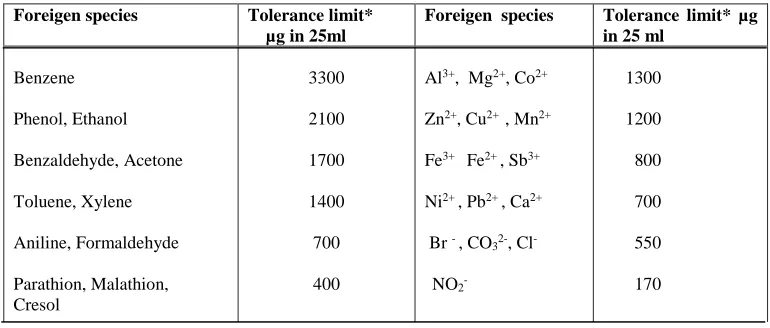
The effect of common foreign species and pesticides were studied to assess the validity of the method. Known amounts of foreign species and pesticides were added to the standard solution containing 5µg/ml of pyrethroids group prior to hydrolysis and the solution was analysed by the proposed method. The method was found to be free from interferences of most of the foreign species and pesticides. (Table 1)
Precision
Precision of the method was checked by the replicate analysis of working standard solution containing 6µg of cypermethrin, fenvalerate and deltamethrin in 25 ml final solution over a period of seven days, respectively. The standard deviation, relative standard deviation and correlation coefficient have been calculated, respectively. (Table 2)
APPLICATION
Determination of pyrethroids in vegetables, fruits and foliages
Various samples of vegetables, fruits and foliages each of 25 gm, were taken, collected from agricultural field, where pyrethroids had been sprayed as an insecticide. The samples were macerated with two 20 ml portions of ethanol-demineralized water (1+1), filtered through a thin cotton cloth and filtrate was centrifuged at 1850 g for 10 min. In case of vegetables and fruits the filtrate was quantitatively transferred into a 50 ml calibrated flask
and made up to the mark with 50% ethanol.21 An aliquot of supernatant were taken in a 35-ml
calibrated midget impinger, 4.0 ml of 20% sodium hydroxide was added and kept in hot water
bath (~ 600C ). The impinger was then connected to an air sampling train carrying one impinger
containing brown water and a rotameter connected in series20. Air was sampled in the
beginning at flow rate of less than 0.5 liter/min for 5 min and the flow rate was then increased to ~ 1 liter/min for next 10 min. After sampling the absorbing solution was quantitatively transferred to a 25-ml graduated tube. The excess of bromine was decolorized by drop wise addition of 1% formaldehyde solution. 3 ml pyridine and 1ml of 1 molar sodium hydroxide
930
obtained. The tube was taken out, cooled and, to it, 1 ml p-anisidine was added, shaken thoroughly and kept for 15 min for full color development. The solution was then diluted to the mark with water and absorbance was measured against a reagent blank.
In case of foliages, the filtrate was passed through a silica gel column (10x1cm) filled
with 5 gm silica gel,20 which was found to be sufficient for removal of chlorophyll and other
interfering materials present in the extracted sample. The column was washed with 10 ml of 50% ethanol, washings were collected in a 35-midget impinger and aliquots were analysed as recommended above (Table 3).
Determination of pyrethroids in water
River water samples, which received run off water from agricultural field, were
collected.20 These samples were filtered through a Whatman No. 40 filter paper. Aliquots of
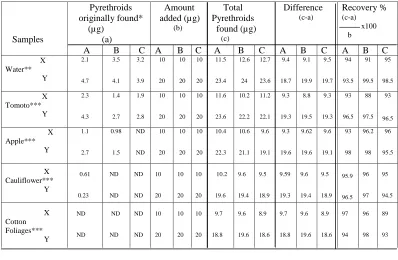
water samples were taken in a 35-midget impinger, to it sodium hydroxide was added and analysed as described above (Table 3).
Recovery of Pyrethroids in biological samples
Since the presence of pyrethroids in blood, urine and cystein has been reported in
detectable concentration.22-23 The method has been applied for the determination of pyrethroids
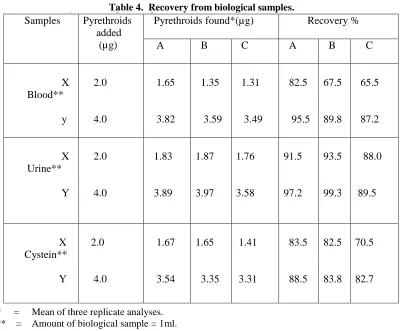
in biological samples. Synthetic samples were prepared by adding known amounts of pyrethroids to these samples and than analysed after deproteination with trichloroacetic acid24-25 as described above. (Table 4)
Table 1. Effect of foreign species for pyrethroids group (5 ppm)
* = The amount causing an error of ±2% in absorbance value.
Foreigen species Tolerance limit* µg in 25ml
Foreigen species Tolerance limit* µg in 25 ml
Benzene
Phenol, Ethanol
Benzaldehyde, Acetone
Toluene, Xylene
Aniline, Formaldehyde
Parathion, Malathion, Cresol
3300
2100
1700
1400
700
400
Al3+, Mg2+, Co2+
Zn2+, Cu2+ , Mn2+
Fe3+ Fe2+ , Sb3+
Ni2+ , Pb2+ , Ca2+
Br - , CO 32-, Cl
NO2
1300
1200
800 700
550
170
931
Table 2. Optical characteristics, precision and accuracy of the method with the coupling agent.
Table 3. Determination of pyrethroids in environmental and agricultural samples.
* = Mean of three replicate analyses. ** = Water sample 25 ml.
*** = Sample 25 gm (taken from a field wherepyrethroids have been sprayed) A = Cypermethrin , B = Fenvalerate, C = Deltamethri , ND = Not Detected, X and Y = Different sample from different site
Effect Cypermethrin Fenvalerate Deltamethrin
1. Beer ‘s Law(ppm) 0.11-0.89 0.21-1.76 0.2-1.33
2. Molar absorptivity 8.3x 10⁵(± 100) 6.5x10⁵ (±100) 3.5x10⁵(±100)
(liter mol-1 cm-1)
3. Sendell’s Sensitivity 0.021 0.034 0.061
(µg cm-2)
4. Relative standard deviation (%) 0.34 0.42 0.85
5. Stability of colour (h) 7 5 7
6. Correlation coefficient 0.9816 0.9981 0.9992
_____________________________________________________________________________________________________
Table 2. Determination of pyrethroids in environmental and agricultural samples.
* = Mean of three replicate analyses.
** = Water sample 25 ml.
*** = Sample 25 gm (taken from a field wherepyrethroids have been sprayed)
A = Cypermethrin , B = Fenvalerate, C = Deltamethri , ND = Not Detected, Samples Pyrethroids originally found* (µg) (a) Amount added (µg) (b) Total Pyrethroids found (µg) (c) Difference (c-a) Recovery % (c-a) x100 b
A B C A B C A B C A B C A B C
Table 4. Recovery from biological samples.
* = Mean of three replicate analyses. ** = Amount of biological sample = 1ml.
A = Cypermethrin, B = Fenvalerate, C = Deltamethrin
CONCLUSION
The proposed method is rapid, simple and sensitive and reagent described here is sensitive and selective for pyrethroids insecticides containing a nitrile group.
The proposed method has been applied satisfactorily to the determination of pyrethroids in various samples of water, vegetables, fruits, foliages and biological samples. To check the recoveries, known amount of pyrethroids were added to various samples of vegetables, fruits, foliages and biological samples and then analysed by the proposed method. (Table 3, 4 ).
e 50 ml.
ACKNOWLEDGEMENT
Authors are thankful to the Head School of Studies in Chemistry Pt. Ravishankar Shukla University and Director of Shri Shankrachrya Institute of Professional Management and Technology, Raipur, to provide laboratory and financial facilities.
Table 3. Recovery from biological samples.
Samples
Pyrethroids added (µg)
Pyrethroids found*(µg) Recovery %
A B C A B C
X
Blood** y
2.0
4.0
1.65
3.82
1.35
3.59
1.31
3.49
82.5
95.5 67.5
89.8
65.5
87.2
X
Urine** Y
2.0
4.0
1.83
3.89
1.87
3.97
1.76
3.58
91.5
97.2
93.5
99.3
88.0
89.5
X
Cystein** Y
2.0
4.0
1.67
3.54
1.65
3.35
1.41
3.31
83.5
88.5
82.5
83.8 70.5
933 REFERENCES
1. “ Pesticide Residues in Food 1981, Report of the Joint Meeting of the FAO Panel of
Experts on Pesticide Residues in Food and the Environment and the WHO Expert Group on Pesticide Residues,” FAO Plant Production and Protection Paper, No. 37, FAO, Rome, (1982).
2. Fine, B. C.; Pyrethrum Post, 7, 18 (1963).
3. Farnham, A. W.; Pestic. Sci., 4, 513 (1973).
4. Elliott, M.; Janes, N. F.; Potter, C.; Annu. Rev. Entomol., 23, 443 (1978).
5. Elliott, M.; Pestic. Sci., 11, 119 (1980).
6. Vitthal, B. P.; Murlidhar, T. S.; Sudhakar, V. P., Analyst, 117, 75 (1992).
7. Abdullah, M.; Sarnthoy, O.; Jiwajinda, S., Kasetsart J. (Nat. Sci.), 35, 115 (2001).
8. Chapman, R. A.; Simmons, H. S., J. Assoc. Off. Anal. Chem., 60, 977 (1977).
9. Talekar, N. S., J. Assoc. Off. Anal. Chem., 60, 908 (1977).
10. Lee, Y. W.; Westcott, N. D.; Reichle, R. A., J. Assoc. Off. Anal. Chem., 61, 869 (1978).
11. Roberts, T. R.; Standen, M. E., Pestic. Sci., 8, 305 (1977).
12. Ruzo, L. O.; Holmstead, R. L.; Casida, J. E., J. Agric, Food Chem., 25, 1385 (1977).
13. Gaughan, L. C.; Ackerman, M. E.; Unai, T.; Casida, J. E., J. Agric. Food Chem., 26, 613
(1978).
14. Farajzadeh, M.A.; Khoshmaram, L.; Alizadeh Nabil, A.A.; Journal of Food Composition
and Analysis, 34, 128-135 (2014).
15. Arvand, M.; Bozorgzadeh, E.; Shariati, S.; Journal of Food Composition and Analysis, 31,
275-283 (2013).
16. Bicker, W.; Lammerhofer, M.; Lindner, W.; Journal of Chromatography A, 1035, 37
(2004).
17. Tewary, D.; Kumar, V.; Shanker, A., Chemical Health and Safety, 11, 25 (2004).
18. Das, J. V.; Ramachandran, K. N.; Gupta, V. K., Microchemical Journal, 50, 51 (1994).
19. Bose D., Shivhare, P.; Gupta, V. K., Journal of Planar Chromatography, 7,415 (1994).
20. Upadhyay, S.; Gupta, V. K., Analyst, 109, 1619 (1984).
21. Raju, J.; Gupta, V. K., Microchem J., 39, 25 (1989).
22. Aldridge, W. N., Analyst, 69, 262 (1994).