INTRODUCTION
Titanium Dioxide (TiO2), is a material of in-terest for semiconductor industries due to its wide band gap property. In general, it is found naturally in different structures and crystalline forms like, monoclinic, orthorhombic, simple tetragonal, cu-bic [1]. It provides many intermediary utilization ways when it is grown in different polymorphic forms. Naturally, titanium dioxide forms in three different structures namely most stable rutile, me -dium stable anatase and less stable brookite [2]. Since last century, many types of advanced mate-rials has been invented by applying high pressure on the crystal structure which may be significant for many electronic and industrial applications. Jin- Hua Wang etal. used the technique such as laser light excitation to investigate the Raman and photoluminescence spectra of a cubic struc-ture named as yttrium oxide (Y2O3) [3]. Yugui et al. synthesized noble nitride material, under
high pressure and high temperature [4]. Thus, it is clear that, high pressure plays an important role which transform a material to other form of material. Gong et al. [5] simulated many ther-modynamic properties of an ideal glass and got concluded that, ideal glass manifest cooperative diffusion and clearly shows distinguished behav -iour from the liquid state. They also clearly dem-onstrated that, glass state has flat potential land -scape which was the most critical feature of ideal glass. So it is important to analyse the optical as-pect of catalytic material like titanium dioxide. It is found that, if high pressure is applied to rutile type polymorphs, they get converted to fluorite type (CaF2) and pyrite (FeS2) structure. In past few years, titanium dioxide has been evolved as most promising photo catalysts due to its number of merits like eco- nontoxicity, cost-effectiveness, long term stability [6, 7]. TiO2 materials mainly utilized in civil products such as interior deco-ration, personal hygiene and beautification until
DETERMINATION OF DIFFERENT OPTICAL PROPERTIES FOR CUBIC
TITANIUM DIOXIDE: AN
AB-INITIO
APPROACH
Debashish Dash1*, Chandan K. Pandey1, Saurabh Chaudhury1, Susanta K. Tripathy2
1 Department of Electrical Engineering, National Institute of Technology, Silchar, Assam, India
2 Department of Electronics and Communication Engineering, National Institute of Technology, Silchar, Assam,
India
* Corresponding author’s e-mail: [email protected]
Research Journal
Volume 12, Issue 3, September 2018, pages 223–232
DOI: 10.12913/22998624/94942 Research Article
ABSTRACT
This paper presents an analysis of optical properties of cubic titanium dioxide (TiO2) using Orthogonalized Linear Combinations of Atomic Orbitals (OLCAO) basis set under the framework of Density Functional Theory (DFT). Many optical properties such as refractive index, extinction coefficient, reflectivity, absorption coefficient, photoconductivity, and loss coefficient have been studied and analyzed thoroughly. From the analysis of optical properties, it is seen that, cubic TiO2 supports inter- band transition between states. Reflectivity of pyrite structure TiO2 lies within IR- visible – UV region due to which it qualifies for coating industry. Furthermore, the results are compared with previous theoretical as well as with experimental results. It is found that DFT based simulation produces results which are close approxima-tion to experimental results.
Keywords: DFT, cubic TiO2, refractive index, absorption coefficient, reflectivity Received: 2018.04.11
powdered form, this can be used as pigment for painting as well as for making plastics. How -ever, considering future conservation of energy and cleanliness of environment, solar cell is most important application for which cubic TiO2 may be a preferred material [14-16]. So, for various monitoring or control applications, optical char-acterization is much necessary. Optical proper-ties are unique in nature and easy to characterize any type of semiconductor material. Some optical properties can be (1) They can be adaptive with any type of environment including high-vaccume environment (2) They provide much necessary information which will be helpful for analyse transport properties of impurity or various defects and electrical behaviour. (3) They have abilities to provide analysis for long-range wave length/ energy, finest results and high degree of accuracy by which it’s possible for chemical and elemental analysis (4) Finally, these properties act as “table-top” properties for semiconductor manufacturing industry. In general, the cubic TiO2 is synthesized from anatase TiO2 by heating at a high tempera-ture of 1900 to 2100 K in a diamond-anvil cell under a pressure of 48 GPa [17-19]. Investigation on both phases of cubic TiO2 have been carried out by many research groups both experimentally and theoretically. Kim et al. [20] performed neu-tron scattering experiment and concluded that py-rite TiO2 is unstable because of the imaginary fre-quencies in the phonon spectra during the entire pressure range, however fluorite TiO2 is stable because of absence of such imaginary frequen-cies [20]. Imaginary frequency can be implied as a negative force constant i.e. in one direction en-ergy is maximum whereas other orthogonal direc-tions energy is minimum. Miloua et al. [6] stud-ied both the cubical TiO2 in detail using full po-tential linearized augmented plane wave method.
properties of both phases of cubic TiO2 have not been studied.
From the literature, it is clear that, numerous investigations are being carried out for natural TiO2. Most of the investigations of TiO2 are on its structure, electronic and thermodynamic proper-ties whereas very few investigations are carried out on dielectric properties of both phases cubic TiO2. Hence, detailed investigation and analysis of structural and dielectric properties are motivated for various applications. In this paper, a systematic ab-initio investigation of the structural, and dielec-tric properties of cubic TiO2 are studied in detail.
COMPUTATIONAL METHODS
Geometrical atom positions for fluorite struc -ture: Titanium 4a (0, 0, 0) and Oxygen 8c (1/4, 1/4, 1/4). Similarly for pyrite structure: Titanium 4a (0, 0, 0) and Oxygen, 8c (x, x, x), x = 0.3411. The interatomic distance for each phase of cubic TiO2 was shown in Figure 1 [24].
Big balls (white) represents Ti (Titanium) at-oms and small balls (red) represents O (oxygen) atoms.
RESULTS AND DISCUSSION
With the density functional theory framework presented in the computational section, the simu-lation results and analysis on optical properties of fluorite and pyrite TiO2 is shown here. This
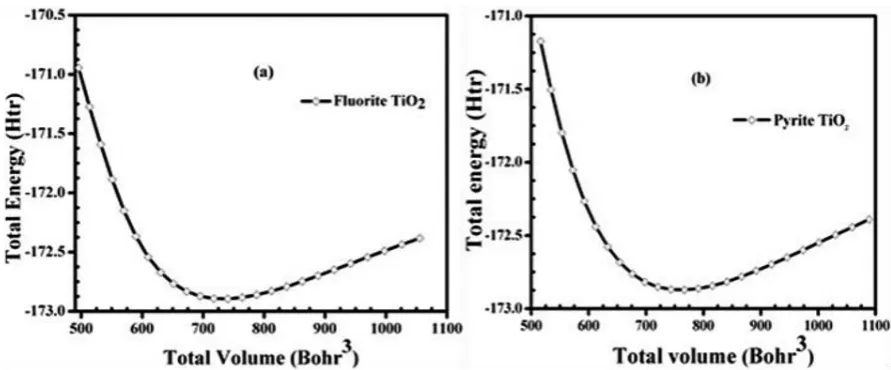
simu-Fig. 1. (a) Total Energy vs Total Volume for fluorite type TiO2 (b) Total Energy vs Total Volume for pyrite type TiO2
Fig. 2. (a) Optimized Fluorite TiO2, (b) Optimized Pyrite TiO2
lations are performed in a 12 GB Z380 HP work -station with 12 GB RAM using Virtual Nano Lab (VNL) software from Quantumwise Atomistix Tool Kit (ATK) [25-27].
Optical properties
plished if study on the dielectric properties of it is carried out. As in Eq. (1), the imaginary part, that is the complex dielectric constant ε2, consists of two parts: one due to intraband transition of the inci-dent electromagnetic (EM) wave and the other due to interband transition of the incident EM wave. For metals, intraband transition was considered whereas interband transition is for semiconduct-ing materials. Again, the interband transition is of two types, direct band and indirect band transi-tions. Due to little contribution towards dielectric function, indirect interband transitions can be ne-glected, although it provides information regarding electron-phonon scattering. The direct interband transitions contributes mainly to the dielectric function (imaginary part) which can be found out from the momentum matrix between occupied and unoccupied wave functions. For evaluating real and imaginary parts of the dielectric function, the Kubo-Greenwood formalism has been used [24, 28]. Mathematically, it can be expressed as:
( )
2 2 4 2( )
( )
0
i i
m n
ij nm mn
nm nm
f E f E
e
m V E i
χ ω ε ω ω − = − ∏ ∏ − − Γ
∑
(2) Where ∏inm is the ith component of the dipole
matrix element between state n and m, v is the volume, Γ is the broadening factor, and f the fer-mi function. The dielectric response co-efficients such as, the relative dielectric constant (εr), po-larizability (α) and optical conductivity (σ) are related to susceptibility as:
( )
(
( )
)
( )
( )
( )
0 0( )
1 , , r V i ε ε ω χ ω α ω χ ω σ ω ωε χ ω = + =
= − (3)
The fluorite and pyrite TiO2 single crystals have a cubic symmetry, because of which they require only one dielectric tensor component to
Where ψc
k and ψvk are the conduction band
and valence band wave functions at k, u is the vector defining the polarization of the incident electric field, ω is the light frequency and е is the electronic charge. According to Kramers-Kronig transforms [29] the imaginary part given in Eq. (1) and calculates the real part of the dielectric constant. Mathematically, this can be expressed as,
( )
2( )
1 2 2
0 2
1 P ε ω ω ωd
ε ω
π ω ω
∞ ′ ′
= +
′ −
∫
(5)In the above equation, P representing domi-nant value of integral.
Using the above dielectric constants Eq. (4) and (5), several optical properties such as refrac-tive index (η), extinction co-efficient (k), reflec -tivity (r), absorption coefficient (α), photo-con-ductivity (σ), and loss coefficient (L) have been calculated.
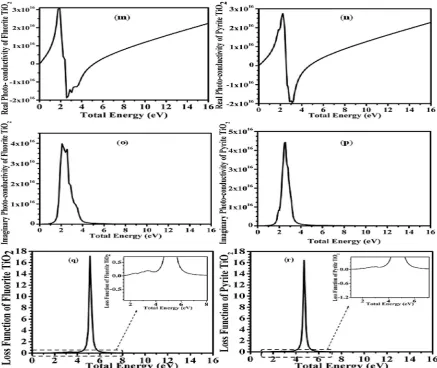
Fig. 3. (a) Real part of dielectric constant of fluorite TiO2 (b) Real part of dielectric constant of pyrite TiO2 (c) Imaginary part of dielectric constant of fluorite TiO2 (d) Imaginary part of dielectric constant of pyrite TiO2 (e) Refractive index of fluorite TiO2 (f) Refractive index of pyrite TiO2 (g) Extinction coefficient of fluorite TiO2 (h) Extinction coefficient of pyrite TiO2 (i) Reflectivity of fluorite TiO2 (j) Reflectivity of pyrite TiO2 (k) Absorption coefficient of fluorite TiO2 (l) Absorption coefficient of pyrite TiO2 (m) Real photo conductivity of fluorite TiO2 (n) Real photo conductivity of pyrite TiO2 (o) Imaginary photo conductivity of fluorite TiO2 (p) Imaginary photo conductivity of pyrite TiO2 (q) Energy Loss Function of fluorite TiO2 (r) Energy Loss Function of pyrite TiO2
caused due to transition of electron from conduc-tion band minimum at Ti 3d states and valence band maximum at O 2p states. For pyrite, the ob-served dielectric constant is lower than fluorite structure having value of 3.5 eV.
The absorption property of any material can be known from the imaginary part of the dielec -tric constant as in Eq. (1). If this value is, then the material is transparent. When absorption begins, this value becomes non-zero. The peak absorption occurs at 2.1 eV which is due to direct interband transitions as well as direct excitons of the fluo -rite structured TiO2 whereas for pyrite structured TiO2, the peak occurs at 2.45 eV. The imaginary part of dielectric constant for both the structure shown in Figure 3c and 3d respectively.
The calculated values of dielectic constants as obtained from Eq. (2), (3), (4) and (5) also vali-date the equation for dielectric constant in terms of refraction [30] as given below:
2
ε η= (6)
Where η is the index of refraction. It is a func-tion of photon energy and it can be given as:
n= +
η
ik (7)where: n – the complex refractive index, η – the refractive index,
k – the extinction co- efficient.
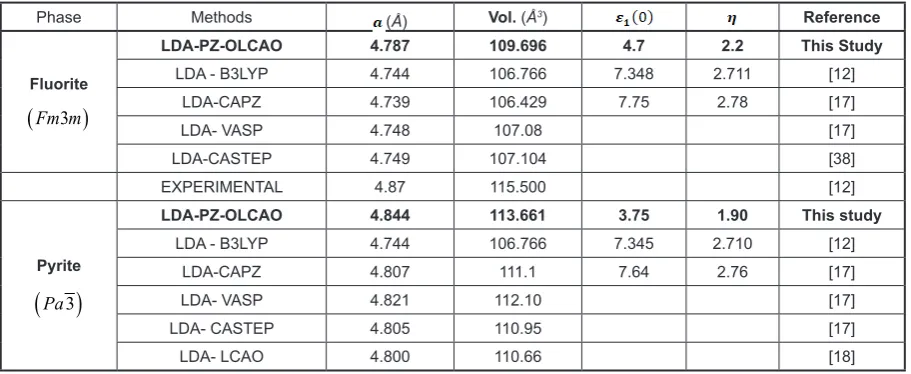
-ing of light. As temperature increases, the inter-action of molecules decreases. From Fig. 3 (e) and (f), it can be seen that the calculated value of refractive index η is 2.16 for the fluorite TiO2 and 1.9 for pyrite TiO2 respectively. The refrac-tive index for other type of exchange correlation methods given in Table 1. With lower refrac-tive index, more and more light absorption takes place. Moreover, due to this light also travels fast -er. Because of these reasons, efficiency of solar energy conversion increases. So, pyrite type TiO2 is much more efficient compared to fluorite type TiO2. In this case, the fluorite structure will have more bending effect as compared to pyrite TiO2, because it has more refractive index [31].
The extinction coefficient (k) for both the struc-tures is displayed in Figure 3g and 3h. Basically, k indicates the amount of absorption loss when the electromagnetic wave propagates through the ma-terial. Normally, similar characteristics for (k) and absorption coefficient (α)can be observed. It is found from Figure 3g that, for fluorite type TiO2, molar absorptivity starts from 0 eV and continues up to 9 eV. Thus in the energy range, 0 eV<k ≤9 eV, fluorite type TiO2 behaves as a transparent ma-terial. At 3 eV, rises to its global maximum value, and then gradually falls to its minimum value at around 9 eV. Similarly, for pyrite structured TiO2, molar absorptivity starts from 0 eV and continues up to 7 eV. In the energy range, 0 eV<k≤7 eV, py-rite type TiO2 behaves as a transparent material. At ~2.5 eV, rises to its global maximum value, and then gradually falls to its minimum value at around 7 eV as seen from Figure 3h.
Figure 3i and 3j shows the reflectivity curve of fluorite and pyrite structures of TiO2. The term reflectivity means when a photon beam is bom -barded with the material, some portion of the beam is reflected back or scattered at the interface between the two media even if both materials are transparent in nature. The reflectivity R(ω) of any material with normal light incidence can be cal-culated using refractive indices (η)and extinction coefficient (k) by the following Fresnel equation [32, 33]:
( ) (
)
(
)
2 2 2 2 1 1 k R k η ω η − + =+ + (8)
From Eq. (8), it can be observed that at lower energy, fluorite type TiO2 shows strong reflectiv -ity. For fluorite structure TiO2, the global maxi-mum occurs at 4.15 eV which arises due to inter-band transition. This global maxima occurs at an
energy level within the Infrared and ultraviolet region, from which it can be inferred that, fluo -rite type TiO2 can be best used as a coating ma-terial [34, 35]. After this, a sharp decrement can be seen which results in minimum reflectivity at energies in the range 6–9 eV, beyond which re-flectivity is much lower and can be negligible. This minimized reflectivity is due to a collective plasma resonance. This plasma resonance can be determined by the imaginary part of dielectric con-stant which also represents the degree of overlap-ping between the inter-band absorption regions. When total energy increases towards higher range, fluorite material shows no reflectivity. Similarly, for pyrite structure TiO2, a strong reflectivity can be observed in the energy range 0–5 eV. The maxi-mum reflectivity also happens around 4.7 eV. Then reflectivity sharply decreases and comes to very low value at 9 eV. In pyrite type TiO2 also reflectiv -ity lies within IR-visible-UV region, due to which it is also suitable as coating material [34, 35].
of the material, more number of electrons released from the surface due to which electrical conduc-tion can be expected from the surface of material when bombarded with photons. Similarly, in the case of semiconductor, when photons are bom-barded with energy greater than the band gap en-ergy, it may resulted in creation of electron-hole pairs. This process is called photo-conductivity. The current produced due to photo-conductivity is directly related to the incident light intensity. This property is very important in case of photo-voltaic cell popularly known as solar cell which is used for conversion of solar energy to electricity. The conductivity for real part (σr) and imaginary part (σi) for the dielectric function ε(ω) are related through the expression [33] given below,
( )
1r
σ
=ωε ω
( )
2i
σ
=ωε ω
(10)From eq. (10), it can be observed that, con-ductivity is proportional to real and imaginary part of dielectric constant which is in good agree-ment with our results as shown in Figure 3(i-j) and Figure 3(k-l). The electrical conductivity of any medium increases, as it absorbs more and more photons. It can be seen that both fluorite and pyrite TiO2 has good absorption values. So these two structures can provide good electrical conductivity.
Figure 3q and 3r shows the energy loss func-tion (ELF) for fluorite and pyrite TiO2. It explains, how much is the energy loss occurs when a fast electron traverse through the material. In quan-tum physics, it can be defined as the bulk plasma frequency ωp, which occurs when the imaginary dielectric constant, ε2<1 and real dielectric con-stant ε1=0. The loss spectra is much weaker in the lower energy regime, however it becomes sig-nificant at around 4 eV and continues up to 8 eV.
semiconductor [36, 37]. Mathematically, ELF can be given as [32]:
ELF = 𝑙𝑙𝑙𝑙 (𝜀𝜀−1(𝜔𝜔)) (11)
CONCLUSIONS
agree with experimental values in case of both the cubic -TiO2 with a minimal error. These under-estimation can be avoided if better optimization algorithms are used.
REFERENCES
1. Jian-Zhi Zhao, Wang Guang-Tao, Yong-Cheng Liang. Mechanical properties and electronic struc-ture of cotunnite TiO2. Chin. Phys. Lett., 25, 2008, 4356.
2. Landmann M., Rauls E. and Schmidt W.G. The electronic structure and optical response of rutile, anatase and brookite TiO2. J. Phys.: Condens. Mat-ter, 24, 2012, 195503.
3. Wang Jin-Hua, Li Ze-Peng, Liu Bo, Liu Bing-Bing. Local microstructural analysis for Y2O3/Eu3+/Mg2+ nanorods by Raman and photoluminescence spec-tra under high pressure. Chinese Phys. B, 26(2), 2017, 026101.
4. Fan Long by, Zhang Ping, Has Songyan, Wang Yuan Xu, Liu Ping day, Wang Wenkui, Yao Yugui. Recent studies on the crystal structure, electronic structure and mechanical properties of noble metal nitrides. Physics, 36, 2007, p. 03:0.
5. Sun Deyan, Shang Cheng, Liu Zhipan, Gong Xin-gao. Intrinsic Features of an Ideal Glass. Chin. Phys. Lett., 34(02), 2017, 026402.
6. Miloua R., Kebbab Z., Benramdane N., Khadraoui M., Chiker F. Ab initio prediction of elastic and thermal properties of cubic TiO2. Comp. Mat. Sci., 50, 2011, 2142-2147.
7. Shougaijam Biraj, Ngangbam Chitralekha, Lenka Trupti Ranjan. Plasmon-Sensitized Optoelectronic Properties of Au Nanoparticle- Assisted Vertical Aligned TiO2 Nanowires by GLAD Technique. IEEE Trans. on electron dev., 64(3), 2017, 1127-1133. 8. Fujishima A. and Honda K. Electrochemical
pho-tolysis of water at a semiconductor electrode. Na-ture, 238, 1972, 37-38.
9. Liu Yan, Li Zhe, Green Michael, Just Michael, Yang Li Yang, Chen Xiaobo. Titanium dioxide nanomaterials for photocatalysis. J. of Phys. D, 50, 2017, 193003.
10. Shougaijam Biraj, Ngangbam Chitralekha, Lenka Trupti Ranjan. Enhancement of Broad Light De-tection Based on Annealed Al-NPs Assistaed TiO2- NWs Deposited on p-Si by GLAD Technique. IEEE Trans. on Nanotechnol., 17(2), 2018, 285-292. 11. Zhou Xiang-Feng, Dong Xiao, Qian Guang- Rui,
Zhang Lixin, Tian Yonjun, and Wang Hui- Tian. Unusual compression behaviour of TiO2 poly-morphs from first principles. Phys. Rev. B, 82, 2010, 060102.
12. Qi Jun Liu, Zhang Ning-Chao, Liu Fu-Sheng, and Liu Zheng-Tang. Structural, elastic, electronic and optical properties of various mineral phases of TiO2 from first- principles calculations. Phys. Scr., 89, 2014, 047101.
13. Li Jyun-Yi, Chang Sheng-Po, Hsu Ming-Hung and Chang Shoon- Jinn. Influence of Annealing Ambi-ence on TiO2 Film Ultraviolet Photodetector. ECS J. Solid State Sci. Technol., 6(2), 2017, Q3056-Q3060. 14. Zhang Jinfeng, Zhou Peng, Liu Jianjun and Yu
Jiaguo. New understanding of the difference of Table 1. Dielectric constants of cubic TiO2 using the OLCAO, and other exchange correlation methods used with LDA
Phase Methods (Å) Vol. (Å3) Reference
Fluorite
(
Fm m3)
LDA-PZ-OLCAO 4.787 109.696 4.7 2.2 This Study
LDA - B3LYP 4.744 106.766 7.348 2.711 [12]
LDA-CAPZ 4.739 106.429 7.75 2.78 [17]
LDA- VASP 4.748 107.08 [17]
LDA-CASTEP 4.749 107.104 [38]
EXPERIMENTAL 4.87 115.500 [12]
Pyrite
( )
Pa3LDA-PZ-OLCAO 4.844 113.661 3.75 1.90 This study
LDA - B3LYP 4.744 106.766 7.345 2.710 [12]
LDA-CAPZ 4.807 111.1 7.64 2.76 [17]
LDA- VASP 4.821 112.10 [17]
LDA- CASTEP 4.805 110.95 [17]
LDA- LCAO 4.800 110.66 [18]
mad, Idrees Faryal, Ahmed Maqsood, Tanveer M., Imran Aslam, Zahid Usman, Ali Zulfiqar, Hus-sain Sajan. Electronic, elastic, acoustic and optical properties of cubic TiO2: A DFT approach. Physica B, 420, 2015, 74-80.
18. Liang Yongcheng, Zhang Bin, and Zhao Jianzhi. Mechanical properties and structural identification of cubic TiO2. Phys. Rev. B, 77, 2008, 094126. 19. Kong X. G., Yu Y., and Gao T. Electronic
exci-tation energies in TiO2 in the fluorite phase. Eur. Phys. J. B., 76 2010, 365.
20. Kim D. Y., Almeida J. S. de, Koci L., Ahuja R. Dy-namical stability of the hardest known oxide and the cubic solar material: TiO2. Appl. Phys. Lett., 90, 2007, 171903.
21. Mattesini M., Almeida J. S. de, Dubrovinsky L., Dubrovinskaia N., Johansson B., and Ahuja R. Cu-bic TiO2 as a potential light absorber in solar-en-ergy conversion. Phys. Rev. B, 70, 2004, 115101. 22. Mattesini M., Almeida J. S. de, Dubrovinsky L.,
Dubrovinskaia N., Johansson B., and Ahuja R. High-pressure and high-temprature synthesis of cubic TiO2 polymorph. Phys. Rev. B, 70, 2004, 212101.
23. Hu Xue-Lan, Zhao Ruo-Xi, Luo Yang, Song Qing-Gong. Effect of P impurity on NiAlΣ5 grain bound-ary from first-principles study. Chin. Phys. B, 26, 2017, 023101.
24. Dash Debashish, Pandey Chandan K., Chaudhury Saurabh, Tripathy Susanta K. Structural, elec-tronic, and mechanical properties of cubic TiO2: A first-principles study. Chin. Phys. B, 27, 2018, 017102.
25. Atomistix ToolKit version 2014.3, QuantumWise A/S (www.quantumwise.com)
30. Callister William D. Materials Science and Engi-neering – An introduction, sixth edition. John Wi-ley & Sons Inc. 2004.
31. Ralls K.M., Courtney T.H. and Wulff J. Introduc-tion to Materials Science and Engineering. New York John Wiley & Sons Inc., 1976.
32. Materials Studio CASTEP Manual Accelrys, 2010, http://www.tcm.phy.cam.ac.uk/castep/documenta-tion/WebHelp/CASTEP.html.
33. Zhao Cuihua, Huang Dewei, Chen Jianhua, Li Yuqiong, and Du Zheng. First- principle study for influence of an external electric field on the elec-tronic structure and optical properties of TiO2. RSC Adv., 6, 2016, 98908-98915.
34. D. Di Claudio, A.R. Phani, S. Santucci. Enhanced optical properties of sol-gel derived TiO2 films us-ing microwave irradiation. J. of opt. mat., 30, 2007, 279-284.
35. Maruszczyk A., Dudek A., Szala M. Research into Morphology and Properties of TiO2 – NiAl Atmo-spheric Plasma Sprayed Coating. Adv. in Sci. and Technol. Res. J.,11(3), 2017, 204-210.
36. Saniz R., Ye L. H., Shishidou T., and Freeman A. J. Structural, electronic and optical properties of NiAl3 : First-principle calculations. Phys. Rev. B 74, 2006, 014209.
37. Marton L. Experiments on Low-Energy Electron Scattering and Energy Losses. Rev. Mod. Phys., 28, 1956, 172-183.