1
LEXICO-SEMANTIC IMPACTS OF ENGLISH ON THE
NIGERIAN LANGUAGES-AN EXAMPLE OF YOURUBA
LANGUAGE
M.S. Abdullahi - Idiagbon (Ph.D) University of Ilorin, Ilorin, Kwara State, Nigeria: [email protected]
Abstract
English language is spoken across the continents of the world and, perhaps, one of five people knows how to speak it notwithstanding their proficiency. The task of assessing English as a modern and the most global language will be strongly influenced by its status in a particular country. The peculiarity of the Nigerian socio-political terrain in terms of ethnic suspicion and cultural and religious sentiments makes English unrivalled. In Nigeria, It is a case of a well-behaved adopted child that has become a bonafide and legitimate heir. The language swiftly swept through ethno-linguistic barriers and religious divides that threaten the nationhood of the country into becoming the most widely spoken and accepted means of communication in the country. Its influence is overwhelming though devastating to the linguistic development of the indigenous languages at all levels of language studies. This paper mainly identifies how the lexis and semantics of Yoruba have been compromised, especially at the level of performance of its speakers, thereby partially resulting in language and semantic shift and gradually leading to language death. A number of lexical items were identified and a field survey was conducted to further observe the bilingual and reciprocal effects on the users of English and Yoruba in non-official domains. The research predicts protracted and imminent supremacy and growing prestige for English, particularly, in Nigeria as well as in some ESL countries due to non-internationality of their local languages.
Key words: Lexico-Semantics, English, Nigerian Languages, Yoruba
Background to the Study
The Nigerian experience of the English language has generated illuminating and thought-provoking public discourse and academic debates such that discussants are always pitched into two camps of friends and foes of the English legacy bequeathed to the indigenous languages in Nigeria. Asides its language-language impacts, the effects have permeated through all spectra of life of the speakers of English in Nigeria whose ways of reasoning and behaviours are marked from other fellow compatriots not western educated. Explanation for this trend is within the horizon of sociolinguistics because sociolinguists recognise and affirm the consequential effects of language contact on the speakers and communities at large.
There is no consensus on the exact number of the local languages in Nigeria; it is more of a plus to 500 than a minus! However, only three are designated as major languages; Hausa in the Northern region, Yoruba in the Western region and Igbo in the Eastern Region. The multilingual, multicultural and multireligious nature of the country naturally set the scope of operation and domains of use for both the native and English languages: indigenous languages are used conveniently to foster intra-cultural communications and understanding among homogeneous speakers in Nigeria and among the minor tribes within the domain of each of these major languages; English, on the other hands, maintains inter-cultural relationship among the heterogeneous tribes in Nigeria in
IJCC
S
EC Volum
e 2, Issu
e 2
,
2 addition to its functions as a language of education as well as an official language. The imminent interaction of thediverse ethnic groups with English has left behind overwhelming though devastating impacts on the linguistic development of the indigenous languages at all levels of language. This paper shall investigate the impediments of English to the preservation of Yoruba as a language and a cultural identity. It would also assess the consequence of this phenomenon on language education in this English as a Second Language(ESL) context.
English in Nigeria
The introduction of English by the British traders, its spread and consolidation by the missionary and colonial activities and its consequent adoption as the lingua franca and later as official language in Nigeria all enhance it a primus inter pares status among all existing languages, be it native or other foreign languages like Arabic and French which are also being spoken and offered as school subjects at both secondary and tertiary institutions of learning in Nigeria.
Bamgbose (1989) asserts that, from the out-set, the manner and method in which English language was introduced coupled with its status as the language of pedagogy and administration inevitably predetermined a secondary role for the native languages at both primary and post-primary schools. So, while English is used as a language of instruction virtually for all subjects, each of the three major indigenous languages is offered as a school subject; each language is predominantly offered by schools that fall within the region that houses it. Paradoxically, in some cases, teachers revert to English words to explain some lexical items or concepts in these indigenous languages. Godswill (2011) corroborates the weak position of native languages further:
The orthographies of many languages in Nigeria are yet to be developed. Theregisters or terms to be used in teaching many of the languages (called meta-language) have not been developed. The technical terms to be used in the teaching of other subjects in the Mother Tongue, for effective communication in the media and conduct of other activities in the so called national domains,have not been fully and formally developed.
The Federal Ministry of Education has made series of intervention policies in order to save the Nigerian languages, especially the three major ones from extinction, decay or loss by making it mandatory for elementary school pupils as well as students in secondary school up to the first three years of the Junior Secondary School to offer one of the major local languages as a compulsory subject alongside English. It declares the Mother-Tongue (MT) as the language of initial literacy at the pre-primary and junior primary levels, and of adult and non-formal education. The document further declares English as not only the official language but also the language of formal literacy, bureaucracy, secondary and higher education, the law courts, etc. in Nigeria while languages like French, and Arabic were classified as being foreign.
This catch-them-young policy has not achieved the desired practical success as designed. Emenanjo (1996) queries why the Mother Tongue, which is acclaimed to be vital at the pre-primary and primary levels is not been solely used at this level. Afterall, according to Emenanjo citing Fafunwa et al. (1989, p. 141):
IJCC
S
EC Volum
e 2, Issu
e 2
,
3 The Ife SYPP and "experimental" MT projected in Niger Republic have confirmedthat those who have their total primary education in MT who had turned to technical pursuit have proved more resourceful than their counterparts from other schools when they met on the technical plane. The SYPP children have demonstrated greater manipulative ability, manual dexterity and mechanical comprehension. In their relationship to their colleagues the project children have demonstrated a great sense of maturity, tolerance and other affective qualities that make them integrate easily and readily with those they come in contact with.
The language Policy on Education also states that the dominant indigenous language in a particular region could be employed to complement English as a medium of instruction at these two identified levels. However, a critical look at the provisions of this national policy reveals that the use of any Nigerian language as a medium of instruction is limited to the pre-primary and primary levels as contained in paragraph 11:3(p.10); and paragraph 15:4, (p.13). Although Nigerian Educational Research Council (NERC) identifies some efforts made at standardising the native languages such as design and provision of braille and manual orthographies as well as text materials. It asserts that the deficiency of the local languages in conceptualising many concepts in various teaching subjects coupled with the communicative incompetence of the teachers continue to be an impediment to the realisation of this laudable aim.
Method of Data Collation and Analysis
Questionnaire forms were administered to test these hypotheses and research questions.
H1 Educated parents prefer speaking English to the Mother Tongue with their children. Ho Educated parents do not prefer speaking English to the Mother Tongue with their children.
See the research questions in the Questionnaire form in the Appendix.
About 200 questionnaire forms where administered on the educated Nigerian parents and 100 on the secondary and post-secondary school students out of which we were able to retrieve, study and analyse 157 and 73 respectively. The choice of the sampled population was not deliberate; it was based on two parameters, the marital and educational statuses of the target audience.The age block is between 25 and 50 and btw 15 and 24 for the respective samples. Stratified sampling technique of selection was adopted.
100 of the respondents of different Mother Tongue background were asked to talk for five minutes on any topic of their choice in order to observe and measure their oral proficiency in Mother Tongue. Apart from this classroom exercise, the researcher, for the same purpose, observed speakers outside of the classrooms without being noticed. This is because setting was considered a vital factor on the performance of the speakers, and could affect the research findings if confined to the classroom setting.
Language Acquisition and Teaching --Krashen’sApproach
Monitor Model, a theory of second/foreign language learning propounded by Krashen comprises five major hypotheses, namely; The Acquisition-Learning, The Natural Order, The Monitor, The Input and The Affective Filter hypotheses. However, this paper is interested in Acquisition-Learning hypothesis.The Hypothesis states that IJCC
S
EC Volum
e 2, Issu
e 2
,
4 there are two ways of developing language ability: by acquisition and by learning. Acquisition is a sub-conscious process involved when a child begins to learn its own language while learning is the conscious process of developing language skills. In an ESL situation where foreign language is learnt in school setting, grammatical rules are introduced to the learners but as Krashenobserves, this does not necessarily help in becoming better users of language in actual performance. However, he does not deny the usefulness of learning a language through the knowledge of its grammar; after all, this activates the self-correction capability of the learners in speaking and most especially in self-editing as a writing skill. In other words, though the competence may be Chomskyan (1965) in nature, the performance is Hyme’s (1971).
This implies that the degree of proficiency in a bilingual or a multilingual setting varies from one speaker to the other. It is rare to possess equal competence and performance in two or more languages; there is a strong tendency to tilt the balance in favour of one. Those who possess this rare quality are referred to as the balanced bilinguals. Even then, a balanced bilingual may not be bi-cultural; in this sense, adaptability to the two cultures of the languages he speaks may be unachievable. In an ESL environment, most speakers are not bi-cultural because they hardly have contact with the native-English communities where social norms and values of the natives flourish. A balanced bilingual, who is at the same time cultural, is referred to as a narrow bi-lingual.
At the societal level, two or more languages may exist side by side with different but complementary roles. A language is designated high variety if it used to execute official transactions while others used for local interactions are low variety. A diglossic society exhibits this trait on two languages while a triglossic one has three languages assigned with different functions. The Nigerian environment is cosmopolitan; it virtually exhibits all these traits of bi and multi lingual phenomena.
Krashen together with Terell introducedCommunicative Approachto language teaching which compartmentalises communicative competence of the learner into three stages: (a) aural comprehension, (b) early speech production, and (c) speech activities. These three techniques are systematically aimed at providing a natural environment and resources similar to the ones the child acquires his first language. The receptive skill of the learner is first put to task through listening followed by speech production. Errors from the speech are not corrected discreetly but contextually. Items within the experience or environment of the learner are used to teach reading and writing afterwards.
Series of classroom interactive and visualisation activities are introduced to add value to teaching-learning environment. Through these same activities, writing could be introduced. For instance, identification and description of things or processes become easier to do. While emphasis is on the use of language, the introduction of basic grammatical concepts is gradually introduced. This approach makes teaching more student-centered with the teacher allowing students to fully take part in the class.Does this theoretical framework have impacts in protecting and preserving the host languages in Nigeria? Next is the presentation of analysis and result of our field research on the subject of enquiry.
Analysis, Discussion and Results
The mode of acquisition of Yoruba, for instance, as a Mother Tongue is through imitation from birth, and so the child grows to be a proficient speaker even though may not be able to subject this natural knowledge to formal parameters of analysis. On the other hand, English is taught and learnt in a formal setting with rigorous drills on mastery
IJCC
S
EC Volum
e 2, Issu
e 2
,
5 of rules of the language. This mostly affects the rate and level of child’s competence and performance in the two target languages. While speaking or writing, average Nigerians can hardly express themselves in their local languages without code-mixing or even completely code-switching to English especially if the discourse participants understand the language. This has been observed in the course of field survey.
As natural bilinguals, Nigerian speakers of English have different modes of contact with their native languages and English. The mode of contact in the former is essentially informal; through child’s acquisition of the language basically from his parents and through interactions with his environment, the latter is through formal teaching-learning setting. Home, as a domain plays significant roles in imparting native language to a child at the early stage of life when the Language Acquisition Device in the child is fresh and most effective. He grows up as, at least, an average speaker of his mother-tongue making use of nature-nurtured mechanisms. The child is then exposed to English in a controlled environment where the rules of language form the basis for correctness. The teaching and learning of the English grammar and skills takes place using various pedagogical approaches and often enforced through a number of disciplinary measures.
Lexicalisation: Names, Naming Practices& Loan Words
Traditional Yoruba names appear in westernised forms. They are re-configured orthographically though with a high level of sameness in pronunciation when compared to their original, normal forms. This naming pattern is commonly used as business names and commonly found among Yoruba social network users. Let’s consider the following examples.
Table1.Westernisation/EnglicisationofYoruba words
A sizeable amount of Yoruba vocabularies has been forgotten or going into extinction as a result of this language loss syndrome. For instance take a look at the following words in English and their equivalents in Yoruba.
Table: 2. Samples of Loan Words
English Yoruba(Loan words) Yoruba pure
Table Tabili ----
railway Rail’way or Train ----
Window Window Ferese
Phone Foonu Ero ibanisoro
Bed Beedi Ibusun
Mango Mangoro ---
Yoruba (Original) Form Westernised Form
Ayomide Haryourmidey
SaniRabiu Investments Sanrab Investments
Temilade Temilarde/Temmy
YemiSolade Group of Company Yemsolad Group of Company
IJCC
S
EC Volum
e 2, Issu
e 2
,
6
Cup Koopu Aha
Television Telivisan Eromohun-aworan
Pillow Pillow Irori
Rice Rice
Fence Fence Agbo
Rug Rug
Milk Milk/Miliki Wara
Radio Radio Ero asoro ma gbesi
As an imminent language contact phenomenon, switching and mixing of the English superordinate code and Nigerian native language has been seen by majority of Nigerians as an elitist sign, a symbol of exposure, literacy and socialisation. Thus, from the early childhood, the so-called educated parents speak more of English to their children than the mother tongue. This, they believe would not only earn them recognition and advantage when they are enrolled into nursery or primary school but also make it easier for them to interact with people of diverse language in Nigeria. All this is done with no consideration to the language endangerment effect on the local language.
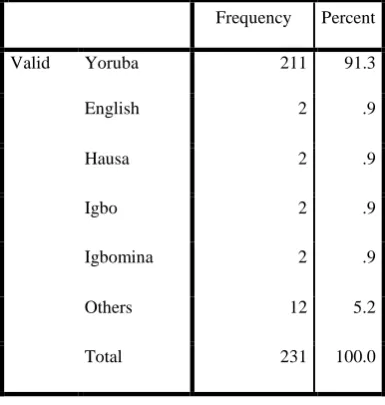
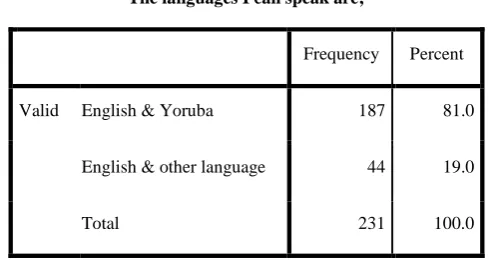
Below are tables which capture responses to the questionnaire and show frequency and percentage of each of the questions contained in the form except two of the questions which are not statistically captured but are reflected in our analysis.
Which language do you rate higher
Freq uenc y
Per cen t
V a l i d
English 101 43.
7
Nigerian language
130 56.
3
Total 231 10
0.0
Mother tongue and language you speak more
Frequency Percent
Valid Yoruba 211 91.3
English 2 .9
Hausa 2 .9
Igbo 2 .9
Igbomina 2 .9
Others 12 5.2
Total 231 100.0
I can speak my language without code-mixing it with English
Frequency Percent
Valid Yes 105 45.5
No 126 54.5
Total 231 100.0
Table 3
Table 5
7
Sex
Frequency Percent
Valid Male 82 35.5
Female 149 64.5
Total 231 100.0
How many language can you speak?
Frequency Percent
Valid 1.00 1 .4
2.00 165 71.4
3.00 57 24.7
4.00 5 2.2
5.00 3 1.3
Total 231 100.0
The languages I can speak are;
Frequency Percent
Valid English & Yoruba 187 81.0
English & other language 44 19.0
Total 231 100.0
Are you proficient the same way in all languages you speak?
Frequency Percent
Valid Yes 24 10.4
No 207 89.6
Total 231 100.0
Which language do you speak to your children?
Frequency Percent
Valid English 26 11.3
Yoruba 85 36.8
Both 31 13.4
Other 89 38.5
Total 231 100.0
Table 6 Table 7
Table 8
Table 9
Table 10
IJCC
S
EC Volum
e 2, Issu
e 2
,
8
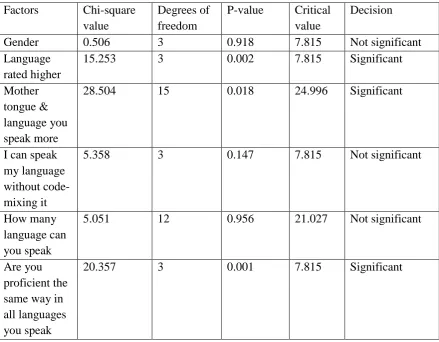
Table11: Summary of chi-square test of independence between language spoken to children by their parents and some selected factors
Factors Chi-square value
Degrees of freedom
P-value Critical value
Decision
Gender 0.506 3 0.918 7.815 Not significant
Language rated higher
15.253 3 0.002 7.815 Significant
Mother tongue & language you speak more
28.504 15 0.018 24.996 Significant
I can speak my language without code-mixing it
5.358 3 0.147 7.815 Not significant
How many language can you speak
5.051 12 0.956 21.027 Not significant
Are you proficient the same way in all languages you speak
20.357 3 0.001 7.815 Significant
Table 12; Summary of chi-square test of independence between speaking of language without code-mixing it with English and some selected factors
Factors Chi-square value
Degrees of freedom
P-value Critical value
Decision
Gender 0.006 1 0.940 3.841 Not significant
Language rated higher
4.387 1 0.031 3.841 Significant
Mother tongue & language you speak more
4.260 5 0.513 11.071 Not significant
How many language can you speak
4.307 4 0.366 9.488 Not significant
Are you proficient the same way in
9 all languages
you speak
Table 11 shows the summary of Pearson Chi-Square Test of Independence between language spoken to children by their parents and some selected factors. The objective of the test is to determine the likely factors that may contribute to or influence the choice of language the parents speak to their children and whether this has negative effects on the deteriorating proficiency in native languages. Factors considered are sex of the parents, language rating by the parents; mother tongue and language the parent speak most. Among the questions raised are whether the parents speak their language without code-mixing it with English, how many languages can the parent speak and what is the level of proficiency in speaking the Mother Tongue.
From the summary of Table 11, three factors have their p-value less than 0.05 (alpha level of significance), and the factors are Language rated higher (p-value = 0.002), Mother tongue and language you speak most (p-value = 0.018) and the proficiency in all the spoken languages (p-value = 0,001). This implies that the factors- language the parent rate higher, mother tongue & most spoken language and proficiency in all the spoken languages -determine the choice of language spoken to children. While other factors like gender, speaking alocal language or a number of languages without code-mixing them with English do not determine the choice of language spoken to children by their parents. Likewise, Table 12 shows the summary of Pearson Chi-Square Test of Independence between speaking language without code-mixing it with English and selected factors. The objective of the test is to determine the likely factors that may determine code-mixing of Yoruba language with English by parents. The factors considered are sex of the parent, language rating by the parent, mother tongue and language the parent speak most, how many languages can the parent speak and their proficiency in speaking language.
From the Tables, only two factors have their p-value less than 0.05 and the factors are language rated higher (p-value = 0.031) and the proficiency in all the spoken languages (p-value = 0.027). This implies that both rating of language and proficiency in spoken language determine or have a great influence in whether parents will code-mix the language they speak with English or not.
Conclusion
A substantial amount of Yoruba vocabularies has been forgotten,loss or gone into extinction as a result of imminent cross linguistic interaction with English. This undoubtedly has brought about devastating impacts on the development of Yoruba as a major indigenous language in Nigeria.The dearth of Yoruba vocabulary equivalents of some English words, in emerging concepts and innovations in humanities, science and technology render it incapable to compete favourably with English for supremacy.The mandatory scope of teaching Yoruba as a school subject to pre-primary and primary levels is not a potent strategy to rid it off English lexes.Furthermore, it was observed that the diverse modes of contact with the two languages influence learners’ competence and performance. This research concludes that in the absence of frantic, genuine and sustained efforts on the part of government to re-vitalise and strengthen the teaching–learning and use of local languages like Yoruba,language development as well as patronage from Nigerians will continue to eludelocal languages like Yoruba.
IJCC
S
EC Volum
e 2, Issu
e 2
,
10
Bibliography
1. Chomsky, N. (1965) Aspects of the Theory of Syntax. Cambridge: Massachusetts. MIT Press
2. Bamgbose,A (1989). Issues for a model language planning.Language problems and language planning.Vol. 13(1). 24 – 34.
3. Emenanjo, E.N. (1996) Languages and the National Policy on Education:Implications and Prospects.Fafunwa Foundation Internet Journal of Education
http://fafunwafoundation.tripod.com/fafunwafoundation/id9.html
4. Godswill, O. Published online: 2011 A Keynote Address at National Conference on Nigerian Languages and Teaching and Usage, Held at the Institute for Nigerian Languages (INLAN), University of Nigeria, Aba Campus.
5. Hymes, D. (1971) Competence and performance in linguistic theory.Language acquisition: Models and methods. pp. 3-28.
6. Chomsky, N.(1965) Aspects of the Theory of Syntax. Cambridge: MIT Press 7. National Policy on Education(1981) Lagos: Federal Ministry of Information. 8. NERDC (2008) Language Map of Nigeria and Report of the Sociolinguistic
Survey of Nigerian Languages. Lagos: NERDC Press
9. Krashen, S. (1981a) Second Language Acquisition and Second Language Learning. New York: Pergamon Press. Retrieved 2013-05-20.
IJCC
S
EC Volum
e 2, Issu
e 2
,