University of Kentucky
UKnowledge
Management Faculty Patents
Management
4-3-2007
Data Shuffling Procedure for Masking Data
Krishnamurty Muralidhar
University of Kentucky
, [email protected]
Rathindra Sarathy
Right click to open a feedback form in a new tab to let us know how this document benefits you.
Follow this and additional works at:
https://uknowledge.uky.edu/management_patents
Part of the
Management Sciences and Quantitative Methods Commons
This Patent is brought to you for free and open access by the Management at UKnowledge. It has been accepted for inclusion in Management Faculty
Patents by an authorized administrator of UKnowledge. For more information, please [email protected].
Recommended Citation
Muralidhar, Krishnamurty and Sarathy, Rathindra, "Data Shuffling Procedure for Masking Data" (2007).Management Faculty Patents. 1.
(12) United States Patent
Muralidhar et a1.
US007200757B1
(10) Patent N0.:
(45) Date of Patent:
US 7,200,757 B1
Apr. 3, 2007
(54) DATA SHUFFLING PROCEDURE FOR MASKING DATA
(75) Inventors: Krishnamurty Muralidhar, Lexington,
KY (US); Rathindra Sarathy,
Stillwater, OK (U S)
(73) Assignee: University of Kentucky Research
Foundation, Lexington, KY (US)
( * ) Notice: Subject to any disclaimer, the term of this patent is extended or adjusted under 35
U.S.C. 154(b) by 774 days.
(21) Appl. No.: 10/437,315
(22) Filed:
May 13, 2003
Related US. Application Data
(60) Provisional application No. 60/380,245, ?led on May 13, 2002.
(51) Int. Cl.
G06F 11/30 (2006.01) G06F 17/30 (2006.01)
(52) US. Cl. ... .. 713/189; 713/193; 707/4; 707/200 (58) Field of Classi?cation Search ... .. 380/252,
380/210; 707/4, 200; 713/189, 193; 712/300
See application ?le for complete search history.
(56) References Cited
OTHER PUBLICATIONS
Security of Random Data Perturbation Methods, Muralidhar et al, pp. 487-493, ACM, 2000*
A General Additive Data Perturbation Method for Database Secu rity, Muralidhar et al, pp. 1399-1415, Management Sciences, 1999.*
Let X be the con?dential
variables (X = xi. X1, -- ~. 1K)
99 " Let s be the non-con?dential variables (S =si, 52,. ., sL).
Let the number of observations
be n.
Transform the data set into a multivariate normal distribution
using eopula. Let X' and S'
I represent the normalized variables.
Derive the conditional
2 L4 ,1 distribution r(x‘|s').
Generate the normalized perturbed
values UK) of the con?dential variables using the conditional
distribution rrx‘ts' = s’).
Masking Microdata Files, Kim et al, pp. 114-119, US Bureau of Census, 1995.*
Controlled Data-swapping Techniques for Masking Public Use Microdata Sets, Moore, Jr., pp. 1-27, US Bureau Census, 1996.* Producing Public-Use Microdata that Are Analytically valid and con?dential, Winkler et al, pp. 41-50, US Bureau of census, 1997.* Statistical Notions of Data Disclosure Avoidance and Their Rela tionship to Traditional Statistical Methodology: Data Swapping and Loglinear Models, Fienberg et a1, Proceedings of Bureau of Census 1996 Annual Research.*
* cited by examiner
Primary ExamineriNasser MoaZZami
Assistant ExamineriShanto M Z Abedine
(74) Attorney, Agent, or F irmiKing & Schickli, PLLC
(57)
ABSTRACT
A method for data shu?ling to preserve data con?dentiality
is provided. The method comprises masking of particular
attributes of a dataset which are to be preserved in con?
dentiality, followed by a shu?ling step comprising sorting
the transformed dataset and a transformed con?dential attribute in accordance with the same rank order criteria. For
normally distributed datasets, transformation may be
achieved by general additive data perturbation, followed by
generating a normalized perturbed value of the con?dential attribute using a conditional distribution of the con?dential and non-con?dential attribute. In another aspect, a software
program for accomplishing the method of the present inven tion is provided. The method of the invention provides greater security and utility for the data, and increases user
comfort by allowing use of the actual data without identi
fying the origin.
21 Claims, 3 Drawing Sheets
Store si either y,‘ or the re trans?oimed values yi with the non-con?dential variables to create a new data set.
30
Sort the entire new data set 7
consisting of S and Y (or Y') by )
variable Y J.
Sort only the original con?dential variable X;
I' of all other
variables).
Replace the sorted (rank ordered)
values of Y1 by the sorted (rank I
ordered) values of X1.
U.S. Patent
Apr. 3, 2007
Start
A90
Let X be the con?dential
variables {X = x1, x1, XK}.
‘r,’ I? a Let S be the non-confidential
variables { S 1 s1, s2, 5L}.
Let the number of observations
be n.
Transform the data set into a
multivariate normal distribution
using copula. Let X’ and S’
,7 represent the normalized
variables.
Derive the conditional
distribution f(x*|s‘).
Generate the normalized perturbed
78
values (yii) of the con?dential
7 variables using the conditional
distribution foCis‘ : 5?).
51%. 4
Sheet 1 0f 3
Store si either yi' or the re‘ transformed values yi with the
non-con?dential variables to
create a new data set.
Sort the entire new data set
consisting of S and Y (or Y‘) by
variable Y).
Sort only the original
con?dential variable X J
(independent of all other
variables).
US 7,200,757 B1
30
em
3Q
Replace the sorted (rank ordered)
values OfYJ by the sorted (rank
ordered) values of X1.
14/
U.S. Patent
Apr. 3, 2007
Sheet 2 0f 3
US 7,200,757 B1
103m <m_cm <m_.m:m mmszmm
AO:@_:m_ msn mscEmnc
. @538 0
055m;
Savings
. ,
.3?
$8.898 38
mumoboobo
mmmoboobo wmooboobo
103m <mEm
U
S. Patent
Apr. 3, 2007
Sheet 3 0f 3
US 7,200,757 B1
Savings
afmooboobo
m?oooboobo
wmooboobo
wmooboobo
8888.8
wmooboobo
8.8
>nm 9.0% mag mmismm
0 mjcgma .
@1932
bmw 9.96
US 7,200,757 B1
1
DATA SHUFFLING PROCEDURE FOR MASKING DATA
This application claims the bene?t of US. Provisional
Patent Application Ser. No. 60/380,245, ?led May 13, 2002.
TECHNICAL FIELD
The present invention relates to the art of masking data to
prevent release of con?dential portions thereof into the public domain. More particularly, the present invention
relates to an improved method for use in masking data variables Which are not to be released, Wherein the masked data retains the same univariate characteristics, the same relationships betWeen con?dential variables, and the same
relationships betWeen con?dential and non-con?dential
variables as in the original data set.
COPYRIGHTED MATERIALS
A portion of the disclosure of this patent document
contains materials to Which a claim of copyright protection is made. The copyright oWner has no objection to the
reproduction by anyone of the patent document or the patent
disclosure as it appears in the US. Patent and Trademark Of?ce patent ?les or records, but reserves all other rights
With respect to the copyrighted Work.
BACKGROUND OF THE INVENTION
Protecting numerical con?dential data from disclosure is an important aspect of security. Such data Was once the
purvieW of data gathering and disseminating organizations,
such as for example the US. Census Bureau. HoWever, With recent advances in information technology, more organiza tions are storing extensive amounts of data for purposes of
analysis using sophisticated tools and techniques. While
such analyses are of tremendous value to organizations and individuals making use of the data, there is also risk that the analyses may result in disclosure of con?dential informa
tion. Consequently, the need for protection of con?dential
data from disclosure, While still alloWing dissemination of at least a portion thereof, has groWn.
Disclosure to unauthorized users can be prevented by
passWords, by ?reWalls, and the like. HoWever, authorized
users must be provided access to the data as part of their authorization, to alloW making use thereof. There remains a risk that the authorized users Will use their access to access the data for illegitimate purposes. Such users are often referred to as “snoopers” or “data spies.” It is almost impossible to identify a user a priori as a snooper. The challenge is then to provide users With the requisite access
to data to perform legitimate tasks, While still preventing
access to con?dential information. This creates problems in
restricting access totally unlike the relatively straightfor
Ward task of preventing access by unauthorized users.
A variety of disclosure limitation techniques are knoWn,
and can be broadly classi?ed as masking techniques and
query restriction techniques. Masking techniques modify the
original data. Users are provided either complete or restricted access to the masked data, and no access to the
original data. Performance of masking data methods is
evaluated based on the extent to Which they satisfy the needs of the legitimate user While preventing disclosure of con? dential information to snoopers. Disclosure may occur When the identity of an individual, the exact value of a con?dential attribute, or both are disclosed as the result of a query.
20 25 30 35 40 45 50 55 60 65
2
Disclosure may also occur When su?icient information is provided to alloW a user to infer the identity of an individual, the exact value of a con?dential attribute, or both With a greater degree of accuracy than possible Without access to the data. In the strictest sense, disclosure may be said to have occurred if providing access to data alloWs the snooper to
gain any knoWledge regarding con?dential information.
Accordingly, an optimal disclosure limitation technique
must provide legitimate users With unrestricted access to accurate data, While at the same time providing the user With
no additional knoWledge regarding any portion of the data
deemed con?dential.
Data masking techniques are knoWn in the art. Of the
most utilized conventional procedures, three of them (Per turbation, Imputation, and PRAM) rely on denying the user
access to the “true” values of con?dential attributes. The
techniques either modify the true values (Perturbation and PRAM) or provide simulated or synthetic data in place of the
true values (Imputation). These methods are generally effec
tive for their intended purpose. HoWever, acceptance by the
user is a signi?cant concern. Because the data provided to the user has been altered from its original form, the user may be more reluctant to accept the data, and to trust any result or analyses derived therefrom.
A fourth method of data masking, data sWapping, pro
vides the advantage that users are alloWed access to the
original, true values of the con?dential attributes. Masking is achieved by exchanging the values of attributes betWeen different records, Whereby the given value of a con?dential
attribute does not necessarily belong to that record With Which it is associated after sWapping. The user is more easily able to understand the process, and acceptance of the data
may be higher. Unfortunately, simple data sWapping is
primarily based on the concept of data tables, and does not
directly address the issue of continuous, numerical con? dential attributes. For such attributes, existing data sWapping methods are primarily heuristic procedures. Data utility is
poor, since all relationships betWeen the variables are modi
?ed. Further, disclosure risk is high.
Accordingly, a need is identi?ed for an improved method for data masking. The method should minimize disclosure risk, While maximizing user comfort With the data accessed. The method should produce masked data having the same characteristics as the original data, including the same univariate characteristics, the same relationships betWeen con?dential variable, and the same relationships betWeen non-con?dential variable. Access to the con?dential vari ables should provide the user With no additional informa tion, and minimize the risk of actual or inferential disclo
sure.
SUMMARY OF THE INVENTION
In accordance With a ?rst aspect of the invention, a method for ensuring con?dentiality of variables in a dataset having at least one con?dential attribute (also referred to
herein as a variable) is provided comprising separating the
dataset into at least one non-masked con?dential attribute and at least one non-con?dential attribute, normalizing the dataset into a multivariate normal distribution, and calcu lating a masked con?dential attribute comprising a normal ized perturbed value for the con?dential attribute derived from a conditional distribution of the con?dential and non
con?dential attribute. Next, is the step of creating a second, masked dataset comprising the masked con?dential
US 7,200,757 B1
3
same as the relationship of the non-con?dential attribute to the con?dential attribute from Which the masked con?den tial attribute Was derived. The second dataset is then sorted
by a predetermined parameter, followed by independently
sorting the unmasked con?dential attribute by the predeter mined parameter. Finally, the sorted masked con?dential
attribute in the sorted second dataset is replaced With the sorted non-masked con?dential attribute.
Each of the con?dential and non-con?dential attribute may be selected from the group consisting of numerical and
categorical attributes, and any combination thereof. The
normalized conditional distribution of the con?dential and non-con?dential attribute is calculated as fQ(*|S*), Where X* is the normalized con?dential attribute, S* is the nor
malized non-con?dential attribute, and f is the marginal density of X* and S*.
In one embodiment, if the dataset has a non-normal
distribution, the dataset is normalized by transforming into
a multivariate normal distribution using copula-based gen
eral additive data perturbation (GADP) prior to deriving the
conditional distribution of the con?dential and non-con? dential attribute. In another embodiment, if the dataset has a
normal distribution, the dataset is normalized by transform ing into a multivariate normal distribution using GADP prior
to deriving the conditional distribution of the con?dential and non-con?dential attribute.
Next is the step Wherein the normalized perturbed value
of the con?dential attribute Yl- is calculated as fQ(*|S*:sl-),
Where Y1. is the normalized perturbed con?dential attribute,
X is the normalized con?dential attribute, S is the normal
ized non-con?dential attribute, f is the marginal density of
X* and S*, and sl- is the value of the non-con?dential attribute for the ith observation. The masked dataset and unmasked con?dential attribute are then sorted by rank order. It Will be appreciated that the masked dataset and unmasked con?dential attribute should be sorted by the same criteria, such as in ascending order or in descending order.
In another aspect of the present invention, a computer softWare program for ensuring con?dentiality of variables or attributes in a dataset having at least one con?dential vari able is provided, Wherein the softWare performs the steps as described above.
In yet another aspect, the invention provides a method for ensuring con?dentiality of variables in a dataset least one con?dential variable or attribute, comprising selecting a
masking procedure of choice, masking at least one con?
dential variable in the dataset to created a second dataset
including the masked con?dential variable, and rank order ing the second dataset. Next is the step of rank ordering the
con?dential variable using the same criteria as the rank
ordering of the second dataset, folloWed by replacing the
rank-ordered masked con?dential variable With the rank ordered con?dential variable. The con?dential variable may
be masked by generating a normalized perturbed value
thereof, and the second dataset and con?dential variable may be rank-ordered in either ascending order or descending order.
BRIEF DESCRIPTION OF THE DRAWING
FIG. 1 is a How chart of the method of the present
invention for ensuring con?dentiality of data in a dataset; FIG. 2 graphically compares the utility of age group versus savings data for original data and data shu?led by the method of the present invention; and
20 25 30 35 40 45 50 55 60 65
4
FIG. 3 graphically depicts the relationship betWeen home
value and savings using original data and data shu?led by
the method of the present invention.
DETAILED DESCRIPTION OF THE INVENTION
Reference is noW made to FIG. 1, Wherein is described a
presently preferred embodiment of the present invention.
The Figure describes a method 10 for ensuring data con? dentiality, comprising a step 20 of selecting a database folloWed by the step 22 of selecting one or more attributes or variables X Which are to be kept in con?dentiality, and one or more attributes or variables S Which are non-con? dential. The con?dential and non-con?dential attributes X and S may be either numerical or categorical. Next, in step 24 the data set is transformed into a multivariate normal distribution. In the case of a dataset having a non-normal
distribution, in step 24 the transformation may be done by
copula-based general additive data perturbation (GADP)
(Sarathy et al., 2002, Perturbing Normormal Con?dential
Attributes: The Copula Approach, Management Science 48: l6l3il 627, incorporated herein by reference in its entirety).
The con?dential and non-con?dential attributes can be con sidered as a realization of values resulting from deriving the conditional distribution thereof in accordance With the for mula f(X*|S*) as shoWn in step 26, Where X* is the normalized con?dential attribute, S* is the normalized non
con?dential attribute, and f is the marginal density of X* and
S*.
Next, in step 28 for each value of S as given, the actual
values of the ith observation X is masked by calculating as
a realization yl- from the conditional distribution of
f(X*|S*:sl-), Where yl- is the normalized perturbed con?den tial attribute, X* is the normalized con?dential attribute, S* is the normalized non-con?dential attribute, f is the marginal
density of X* and S*, and sl. is the value of the non con?dential attribute for the ith observation. This process is
repeated for every observation i, and the normalized yl.* or
the retransformed yl- are matched With the non-con?dential variables or attributes to create a second, masked dataset
(Step 30).
It Will be appreciated that masking the con?dential
attributes in this manner satis?es the requirements for secu
rity and lack of bias for the dataset. The bias requirement
states that the distribution of the collection of values Yl- (Y) should have the same characteristics as X, and should have the same relationship With S as X has With S. In other Words,
it is necessary that: f(Y):fQ() and f(Y,S):fQ(,S). Since
yi:f(X|S:sl-), then f(Y|S):f(X|S). Further, f(Y,S):f(X|S)*
f(s):f(X,S). In addition, f(Y):If(Y,S)ds:If(X,S)ds:fQ().
These calculations shoW that if the values yl- are generated
from the conditional distribution fQGSIsi), then the resulting masked values satisfy the unbiased requirement for masked data. In addition, the conditional independence value also
implies that for a given value SIsi, the values of yl. are
independent of the values xi. Expressed formulaically: f(X,
Y|S:si):fQ(|S:si)f(Y|S:si).
The predictive ability of a snooper is determined by the
conditional distribution of X. When the snooper only has
information about S, the predictive ability of the snooper is
based on f(XIS). When the snooper has additional informa
tion in the form of masked values, the predictive ability of the snooper is based on f(X|S,Y). HoWever, fQ(|S,Y):f
Q(Y|S)/f(Y|S):fQ(|S)f(Y|S)/f(Y|S):f(XIS). Thus, providing
US 7,200,757 B1
5
?dential attributes X. Hence, generating the masked values
using the conditional distribution fQilS) provides optimal
results since the characteristics of the original database and the released database are the same. The snooper does not
gain additional information regarding the con?dential
attributes When access to the masked data is provided, and ?nally, complete access to the microdata can be provided.
In the special case Where all the attributes are to be masked (S is null) or if there is no relationship betWeen the con?dential and non-con?dential attributes, then the condi
tional distribution f(X|S) reduces to fQ() and generating an
independent set of values from the conditional distribution
of X directly Will provide the appropriate masked values.
It is important to note that the derivations described above are suited to both numerical and categorical attributes. In order to derive the conditional distribution of XIS, it is ?rst necessary to describe the joint distribution of X and S, the distribution of S, and derive the conditional distribution
using both. If the joint distribution is described by a multi
variate normal distribution, the conditional distribution can
be easily derived by GADP. For non-normal distributions, a
copula-based GADP may be more suitable for approximat
ing the true joint distribution.
Once the data have been optimally masked, bias is elimi
nated and security of the con?dential data is maximised. HoWever, as described above, there is often reluctance on the part of the user to accept analyses based on “arti?cial” data such as masked data. Accordingly, the present invention provides a method for shuf?ing data already masked as described above to alloW use of the actual con?dential attributes, but Without risk that a snooper may be able to ascertain any more information about the con?dential attributes than When the masked data is used. Further, the user must be able to analyse the data as desired, and achieve a statistically identical result as if the original, non-masked data had been used.
The next step (Step 32) is to sort the entire masked data set comprising S and Y (or Y* Which is the normaliZed
masked con?dential attribute) by variable Yj. Next, in Step
34 only the original con?dential attribute Xj is sorted by the
identical method as the sorting of the masked dataset. and to
repeat this step. The sorted values of Y]. are then (Step 36)
replaced by the sorted values of X], i.e. the jth rank ordered
value of Yl- is replaced With the jth rank ordered value of X. This step is repeated for every observation (Step 38). While
20 25 30 35 40
6
in a presently preferred embodiment GADP is used to generate conditional values of X|S for a normally distributed
dataset, and copula-based GADP is used to generate condi
tional values for datasets not having a normal distribution, it must be emphasiZed that any conventional method of data
masking is suited to the method of the present invention, and
that the data shul?ing steps (Steps 32*38) may be performed
on any perturbed data set regardless of the methodology
used to generate the perturbed values.
Other aspects of the present invention Will become appar ent to those skilled in this art from the folloWing description Wherein there is shoWn and described a preferred embodi ment of this invention, simply by Way of illustration of one of the modes best suited to carry out the invention. As it Will
be realiZed, this invention is capable of other different
embodiments and its several details are capable of modi?
cation in various, obvious aspects all Without departing from
the intended scope of the invention. Accordingly, the
descriptions and examples herein Will be regarded as illus
trative in nature and not as restrictive.
EXAMPLE 1
A dataset Was selected Where all attributes therein Were numerical, With a multivariate normal distribution. The database consisted of 25,000 records and three attributes. All 3 attributes Were required to be masked prior to release, i.e. the dataset included no non-con?dential attributes. Accord ingly, all that Was required Was to generate an independent set of 25,000 observations from a multivariate normal dis tribution With the same parameters as the original data. Next, for each con?dential attribute the ordered values of Y1- Were
replaced by ordered values of X. For comparison, a rank
based proximity sWap Was performed. TWo different sWaps
Were generated, one using RO:0.95 and another using RO:0.80. As described by Moore (1996, Controlled Data
SWapping Techniques for Masking Public Use Microdata
Files, Census Bureau Research Report Series RR96-04,
incorporated herein by reference), speci?cation of a large
value for R0 results in a higher level of accuracy, but also a
loWer level of security because the sWapped and alternative
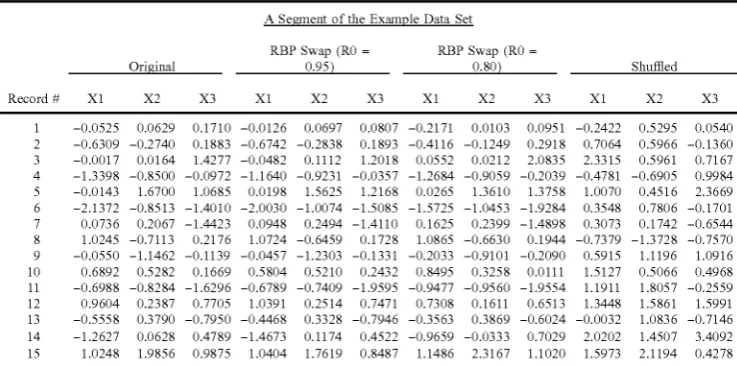
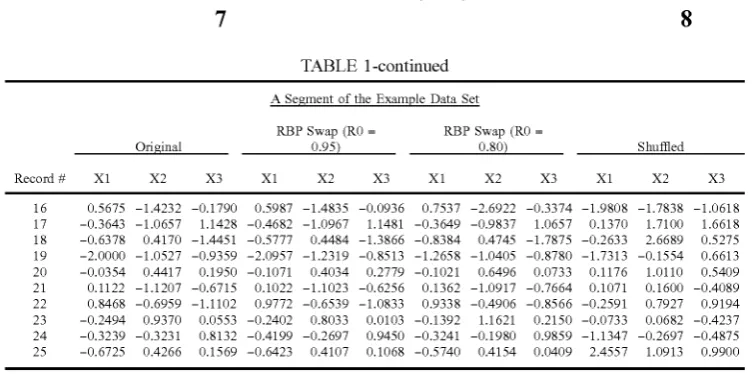
values are closer to one another. Table 1 shoWs a sample data
set of 25 observations comparing the original values, the rank-based proximity sWap values, and the values shu?led according to the present invention.
TABLE 1
A Segment of the Example Data Set
RBP SWap (R0 = RBP SWap (R0 =
Original 0.95) 0.80) Shuf?ed
Record # X1 X2 X3 X1 X2 X3 X1 X2 X3 X1 X2 X3
1 —0.0525 0.0629 0.1710 —0.0126 0.0697 0.0807 —0.2171 0.0103 0.0951 —0.2422 0.5295 0.0540
2 —0.6309 —0.2740 0.1883 —0.6742 —0.2838 0.1893 —0.4116 —0.1249 0.2918 0.7064 0.5966 —0.1360
3 —0.0017 0.0164 1.4277 —0.0482 0.1112 1.2018 0.0552 0.0212 2.0835 2.3315 0.5961 0.7167
4 —1.3398 —0.8500 —0.0972 —1.1640 —0.9231 —0.0357 —1.2684 —0.9059 —0.2039 —0.4781 —0.6905 0.9984
5 —0.0143 1.6700 1.0685 0.0198 1.5625 1.2168 0.0265 1.3610 1.3758 1.0070 0.4516 2.3669
6 —2.1372 —0.8513 —1.4010 —2.0030 —1.0074 —1.5085 —1.5725 —1.0453 —1.9284 0.3548 0.7806 —0.1701
7 0.0736 0.2067 —1.4423 0.0948 0.2494 —1.4110 0.1625 0.2399 —1.4898 0.3073 0.1742 —0.6544
8 1.0245 —0.7113 0.2176 1.0724 —0.6459 0.1728 1.0865 —0.6630 0.1944 —0.7379 —1.3728 —0.7570
9 —0.0550 —1.1462 —0.1139 —0.0457 —1.2303 —0.1331 —0.2033 —0.9101 —0.2090 0.5915 1.1196 1.0916
10 0.6892 0.5282 0.1669 0.5804 0.5210 0.2432 0.8495 0.3258 0.0111 1.5127 0.5066 0.4968
11 —0.6988 —0.8284 —1.6296 —0.6789 —0.7409 —1.9595 —0.9477 —0.9560 —1.9554 1.1911 1.8057 —0.2559
12 0.9604 0.2387 0.7705 1.0391 0.2514 0.7471 0.7308 0.1611 0.6513 1.3448 1.5861 1.5991
13 —0.5558 0.3790 —0.7950 —0.4468 0.3328 —0.7946 —0.3563 0.3869 —0.6024 —0.0032 1.0836 —0.7146
14 —1.2627 0.0628 0.4789 —1.4673 0.1174 0.4522 —0.9659 —0.0333 0.7029 2.0202 1.4507 3.4092
US 7,200,757 B1
TABLE l-continued
A Segment of the Example Data Set
RBP Swap (R0 = RBP Swap (R0 =
Original 0.95) 0.80) Shuf?ed
Record # X1 X2 X3 X1 X2 X3 X1 X2 X3 X1 X2 X3
16 0.5675 —1.4232 —0.1790 0.5987 —1.4835 —0.0936 0.7537 —2.6922 —0.3374 —1.9808 —1.7838 —1.0618
17 —0.3643 —1.0657 1.1428 —0.4682 —1.0967 1.1481 —0.3649 —0.9837 1.0657 0.1370 1.7100 1.6618
18 —0.6378 0.4170 —1.4451 —0.5777 0.4484 —1.3866 —0.8384 0.4745 —1.7875 —0.2633 2.6689 0.5275
19 —2.0000 —1.0527 —0.9359 —2.0957 —1.2319 —0.8513 —1.2658 —1.0405 —0.8780 —1.7313 —0.1554 0.6613
20 —0.0354 0.4417 0.1950 —0.1071 0.4034 0.2779 —0.1021 0.6496 0.0733 0.1176 1.0110 0.5409
21 0.1122 —1.1207 —0.6715 0.1022 —1.1023 —0.6256 0.1362 —1.0917 —0.7664 0.1071 0.1600 —0.4089
22 0.8468 —0.6959 —1.1102 0.9772 —0.6539 —1.0833 0.9338 —0.4906 —0.8566 —0.2591 0.7927 0.9194
23 —0.2494 0.9370 0.0553 —0.2402 0.8033 0.0103 —0.1392 1.1621 0.2150 —0.0733 0.0682 —0.4237
24 —0.3239 —0.3231 0.8132 —0.4199 —0.2697 0.9450 —0.3241 —0.1980 0.9859 —1.1347 —0.2697 —0.4875
25 —0.6725 0.4266 0.1569 —0.6423 0.4107 0.1068 —0.5740 0.4154 0.0409 2.4557 1.0913 0.9900
Table 2 shows the correlation matrix of the original
variables, the swapped variables, and the shuf?ed variables. In comparison with the swapped variables, the correlation of the shu?led variables closely mirrored the original correla
tion matrix. Only minor differences were observed between
the original and shul?ed correlation matrices, mainly due to
sampling error. The marginal distributions of the individual attributes were the same before and after shu?ling, and the correlation matrix of the shu?led attributes were the same as
the original attributes.
20 25
TABLE 2
Correlation Matrix of the Original and Masked Attributes
Original RBP Swap (R0 = 0.95)
Attribute 1 Attribute 2 Attribute 3 Attribute 1 Attribute 2 Attribute 3 Attribute 1 Attribute 2 Attribute 3 Attribute 1 Attribute 2 Attribute 3 Attri
bute
1
Attri bute
2
Attri bute
3
1.0000 1.000
0.4946 1.0000 0.4783 1.0000
0.4022 0.6032 1.0000 0.3915 0.5827 1.0000
1.000 1.000
0.4560 1.0000 0.5001 1.0000
0.3670 0.5561 1.0000 0.3984 0.5954 1.0000
To evaluate security of the shu?led data, a regression
analysis was performed to predict the values of the con?
dential attribute X1, using the masked values. For rank
based proximity swap, results indicated that a snooper
would be able to predict 96.6% of the variability in X1 using
the released information. As shown in Table 3, a rough 95% con?dence interval estimate of the true value of the con? dential attribute for the shu?led data approached 0. The
regression analysis also indicated that the shul?ed values
provided a potential snooper with no information regarding the con?dential attributes.
TABLE 3
Results of Regression Analysis to Predict Original
Attribute 1 using Masked Values
RBP Swap RBP Swap Shuf?e
(R0 = 0.95) (R0 = 0.80) d
Intercept 0.000 0.000 —0.003 Coefficient of Masked Attribute 1 0.971 0.930 0.005
50 55 60 65
TABLE 3-continued
Results of Regression Analysis to Predict Original
Attribute 1 using Masked Values
RBP Swap RBP Swap Shuf?e
(R0 = 0.95) (R0 = 0.80) d
Coefficient of Masked Attribute 2 0.020 0.038 0.001 Coefficient of Masked Attribute 3 0.005 0.022 —0.005
R2 0.966 0.916 0.000
Standard Error 0.185 0.290 1.000
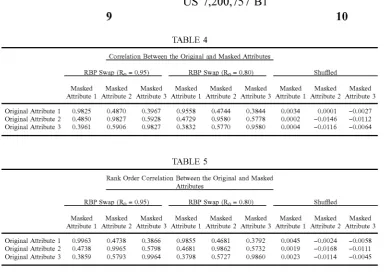
A correlation between the original and masked data is shown in Table 4. The rank-based proximity swap values correlated well with the original data attributes. In contrast, there was practically no correlation between the original and
shu?led attributes, evidencing the security provided by the
method of this invention. Table 5 provides the rank-order correlation between the original and masked values. As with
product moment correlation, the rank order correlation
US 7,200,757 B1
TABLE 4
Correlation Between the Original and Masked Attributes
RBP Swap (R0 = 0.95) RBP Swap (Rn = 0.80) Shuf?ed
Masked Masked Masked Masked Masked Masked Masked Masked Masked Attribute 1 Attribute 2 Attribute 3 Attribute 1 Attribute 2 Attribute 3 Attribute 1 Attribute 2 Attribute 3 Original Attribute 1 0.9825 0.4870 0.3967 0.9558 0.4744 0.3844 0.0034 0.0001 —0.0027 Original Attribute 2 0.4850 0.9827 0.5928 0.4729 0.9580 0.5778 0.0002 —0.0146 —0.0112 Original Attribute 3 0.3961 0.5906 0.9827 0.3832 0.5770 0.9580 0.0004 —0.0116 —0.0064
TABLE 5
Rank Order Correlation Between the Original and Masked Attributes
RBP Swap (R0 = 0.95) RBP Swap (R0 = 0.80) Shuf?ed
Masked Masked Masked Masked Masked Masked Masked Masked Masked Attribute 1 Attribute 2 Attribute 3 Attribute 1 Attribute 2 Attribute 3 Attribute 1 Attribute 2 Attribute 3 Original Attribute 1 0.9963 0.4738 0.3866 0.9855 0.4681 0.3792 0.0045 —0.0024 —0.0058 Original Attribute 2 0.4738 0.9965 0.5798 0.4681 0.9862 0.5732 0.0019 —0.0168 —0.0111 Original Attribute 3 0.3859 0.5793 0.9964 0.3798 0.5727 0.9860 0.0023 —0.0114 —0.0045
EXAMPLE 2
TABLE 6-continued A dataset of 10,000 observatlons, 1nclud1ng the varlabtles 30 RESULTS OF REGRESSION ANALYSIS TO Of Gender (males coded as 0, females coded as I), Mar1tal PREDICT SAVINGS USING OTHER VARIABLES Status (married coded as 0, others coded as 1), age (input as
a discrete variable consisting of integer values from 1 to 6 MEASURE ORIGINAL SHUFFLED ADDITWE SWAPPED in increasing order of age), Value of Home (top coded at COEFFL
500,000), and Savings was considered. The last two numeri- 35 CIENTS cal variables (Value of Home and Savings) were required to
. . . INTERCEPT —93071 —93338 —94798 —78240
be ma1nta1ned 1n con?dentlahty. As shown 1n FIG. 2, the GENDER _3229 _5744 10858 _21212 data shu?ling method of the present invention resulted in MARITAL 37919 35964 39534 20540 increased data utility, as well as preserving the relationship STATUS
~ ~ ~ AGE GROUP 34496 35427 23920 32570
between the variables, for example the relat1onsh1p between 40 VALUE OF 0.2896 0.2825 0.4211 0.2865 Value of Home and Savmgs for origlnal and shu?led data HOME
(FIG. 3).
Of course, the objective of data masking is to provide
users with access to data that can be analyzed to provide EXAMPLE 3 results that are very close to the analysis by a simulated user 45
attemptlhg te Predlet Savmgs based eh Gender: Marttat In another aspect of the present invention, computer Status, Age Group, and Value Of Home The data Shu?hhg executable instructions as part of computer readable media procedure of the present inventionwas comparedtoaknown may he used to accomplish the method Of the present
Pheh aftdltlve helse teehhlque as Well as to rahk'hased
invention. When described in the context of computer read
Prexhhlty SWaPP1hg~AS shown In Table 6, fer eaeh Vanahte 50 able media having computer executable instructions stored
evaluated: the hlethed 0t the Present lhvehtleh resulted 1h
thereon, it is denoted that the instructions include program
values resembling the or1g1nal values, and cons1stently out-
modules, routines, programs, Objects’ Components, data
Perfenhed the swappthg and addltlve helse teehhlques- structures, and patterns that perform particular tasks or Regressleh ahatysls uslhg data Shuthed by the method efthe implement particular abstract data upon or within various
present invention closely resembled the original data in all 55 Structures of the Computing environment Executable
respeets- 1h eehtrasta swapped and helse added data PreVlde
instructions exemplarily comprise instructions and data
results that dllfer considerably from the origlnal data. which Cause a general purpose Computer’ Special purpose computer, or special purpose processing device to perform a TABLE 6 certain function or group of functions. A copy of the source 60 code coding for the computer executable instructions
embodying a presently preferred embodiment of the present
invention is appended hereto as a Code Appendix, and is
RESULTS OF REGRESSION ANALYSIS TO
PREDICT SAVINGS USING OTHER VARIABLES
MEASURE ORIGINAL SHUFFLED ADDITIVE SWAPPED incorporated herein by reference,
R2 72% 72% 65% 67% ~ The foregolng descr1pt1on 1s presented for purposes of STANDARD 53083 52864 71899 57506 65 1llustrat1on and description of the var1ous aspects of the
ERROR invention. The descriptions are not intended to be exhaustive
US 7,200,757 B1
11
embodiments described above Were chosen to provide the best illustration of the principles of the invention and its
practical application to thereby enable one of ordinary skill
in the art to utilize the invention in various embodiments and With various modi?cations as are suited to the particular use contemplated. All such modi?cations and variations are Within the scope of the invention as determined by the
appended claims When interpreted in accordance With the breadth to Which they are fairly, legally and equitably
entitled.
What is claimed is:
1. A method for ensuring con?dentiality of variables in a dataset having at least one con?dential attribute or variable,
comprising:
separating the dataset into at least one non-masked con ?dential attribute and at least one non-con?dential
attribute;
normalizing the dataset into a multivariate normal distri
bution;
calculating a masked con?dential attribute comprising a
normalized perturbed value for the con?dential
attribute derived from a conditional distribution of the con?dential and non-con?dential attribute; and creating a masked dataset comprising the masked con?
dential attribute Wherein a relationship of the masked con?dential attribute to the non-con?dential attribute is substantially the same as the relationship of the non con?dential attribute to the con?dential attribute from Which the masked con?dential attribute Was derived; and
sorting the masked dataset by a predetermined parameter;
and
independently sorting the unmasked con?dential attribute
by the predetermined parameter; and
replacing the stored masked con?dential attribute in the sorted masked dataset With the sorted non-masked con?dential attribute.
2. The method of claim 1, Wherein each of the con?dential and non-con?dential attribute is selected from the group
consisting of numerical and categorical attributes, and any
combination thereof.
3. The method of claim 1, Wherein the normalized con ditional distribution of the con?dential and non-con?dential attribute is calculated as:
Where X* is the normalized con?dential attribute, S* is the
normalized non-con?dential attribute, and f is the marginal density of X* and S*.
4. The method of claim 1, Wherein the dataset has a
non-normal distribution, and the dataset is normalized by
transforming into a multivariate normal distribution using
copula-based general additive data perturbation (GADP)
prior to deriving the conditional distribution of the con?
dential and non-con?dential attribute.
5. The method of claim 1, Wherein the dataset has a normal distribution, and the dataset is normalized by trans forming into a multivariate normal distribution using GADP
prior to deriving the conditional distribution of the con?
dential and non-con?dential attribute.
6. The method of claim 1, Wherein the normalized per turbed value of the con?dential attribute yl- is calculated as:
Where yl- is the normalized perturbed con?dential attribute,
X* is the normalized con?dential attribute, S* is the nor
malized non-con?dential attribute, f is the marginal density
20 25 30 35 40 45 50 55 60 65
12
of X* and S*, and sl- is the value of the non-con?dential attribute for the ith observation.
7. The method of claim 1, Wherein the masked dataset and unmasked con?dential attribute are sorted by rank order.
8. The method of claim 7, Wherein the masked dataset and unmasked con?dential attribute are sorted in ascending order.
9. The method of claim 7, Wherein the masked dataset and unmasked con?dential attribute are sorted in descending order.
10. A computer-readable medium having computer-ex ecutable instructions for ensuring con?dentiality of
attributes or variables in a dataset having at least one con?dential attribute or variable, by the steps of:
(a) separating the dataset into at least one non-masked con?dential attribute and at least one non-con?dential
attribute;
(b) normalizing the dataset into a multivariate normal
distribution;
(c) calculating a masked con?dential attribute comprising
a normalized perturbed value for the con?dential attribute derived from a conditional distribution of the
con?dential and non-con?dential attribute;
(d) creating a masked dataset comprising the masked
con?dential attribute, Wherein a relationship of the masked con?dential attribute to the non-con?dential attribute is substantially the same as the relationship of the non-con?dential attribute to the con?dential attribute from Which the masked con?dential attribute Was derived;
(e) sorting the masked dataset by a predetermined param eter;
(f) independently sorting the unmasked con?dential
attribute by the predetermined parameter; and
(g) replacing the sorted masked con?dential attribute in
the sorted masked dataset With the sorted non-masked con?dential attribute.
11. The computer-readable medium of claim 10, Wherein
each of the con?dential and non-con?dential attribute is selected from the group consisting of numerical and cat
egorical attributes, and any combination thereof.
12. The computer-readable medium of claim 10, Wherein the computer-readable medium calculates the normalized
conditional distribution of the con?dential and non-con? dential attribute as:
may)
Where X* is the normalized con?dential attribute, S* is the
normalized non-con?dential attribute, and f is the marginal density of X* and S*.
13. The computer-readable medium of claim 10, Wherein
the dataset has a non-normal distribution, and the computer
readable medium normalizes the dataset by transforming
into a multivariate normal distribution using copula-based
general additive data perturbation (GADP) prior to deriving
the conditional distribution of the con?dential and non con?dential attribute.
14. The computer-readable medium of claim 10, Wherein
the dataset has a normal distribution, and the computer
readable medium normalizes the dataset by transforming
US 7,200,757 B1
13
15. The computer-readable medium of claim 10, wherein the computer-readable medium calculates the normalized
perturbed value of the con?dential attribute yl- as: ?X*\S*:s,-)
Where yl. is the normalized perturbed con?dential attribute, X
is the normaliZed con?dential attribute, S is the normaliZed
non-con?dential attribute, f is the marginal density of X*
and S*, and sl- is the value of the non-con?dential attribute
for the ith observation.
16. The computer-readable medium of claim 10, Wherein
the softWare sorts the masked dataset and unmasked con?
dential attribute by rank order.
17. The computer-readable medium of claim 16, Wherein
the computer-readable medium sorts the masked dataset and
unmasked con?dential attribute in ascending order. 18. The computer-readable medium of claim 16, Wherein
the computer-readable medium sorts the masked dataset and
unmasked con?dential attribute in descending order. 19. A method for ensuring con?dentiality of variables in
a dataset having at least one con?dential variable and at least
one non-con?dential variable, comprising:
selecting a masking procedure;
masking the at least one con?dential variable in the dataset to create a second dataset including the masked
15 20
14
con?dential variable, Wherein the masked con?dential variable comprises a normalized perturbed value for the con?dential variable derived from a conditional distri bution of the con?dential and non-con?dential variable and Wherein a relationship of the masked con?dential variable to the non-con?dential variable is substantially the same as the relationship of the non-con?dential variable to the con?dential variable from Which the masked con?dential variable Was derived;
rank ordering the second dataset;
rank ordering the con?dential variable using the same criteria as the rank ordering of the second dataset; and
replacing the rank-ordered masked con?dential variable
in the second dataset With the rank-ordered con?dential variable.
20. The method of claim 19, Wherein the second dataset and con?dential variable are rank-ordered in ascending order.