www.ijeee-apm.com International Journal of Electrical & Electronics Engineering 5
IJEEE, Vol. 1, Issue 6 (December, 2014) e-ISSN: 1694-2310 | p-ISSN: 1694-2426
PERFORMANCE EVALUATION AND
OPTIMIZATION OF BLOCKING
PROBABILITY IN PASSIVE OPTICAL
BURST SWITCHING NETWORK
1
Bharti Tagra, 2Sukhvinder Kaur, 3Dr. Amit Wason 1,2
Swami Devi Dyal Institute of Engineering and Technology, Haryana, India
3
Ambala College of Engineering & Applied Research, Haryana, India
1[email protected], 2[email protected], 3[email protected]
Abstract- The generalized Engset model can be applied to evaluate the blocking probability in the Passive Optical Burst Switching Network. We provide a wide range of simulation and numerical results to validate our method and demonstrate various effects on Blocking Probability such as Number of Wavelength, Round Trip Delay and Mean Packet interarrival Time.
Keyword- Optical Network, Passive Optical Network, Optical Burst Switching Network, Engset Model, Blocking Probability.
I. INTRODUCTION
All-Optical Networks are seen as a way to accommodate the continued exponential growth in Internet Traffic. For all-optical networks to be feasible, they must be both stable and sufficient [2].
A Passive Optical Network is a single, shared optical fiber that uses inexpensive optical splitters to divide the single fiber into separate strands feeding individual subscribers. Optical Networks are called “passive” because other than at the CO and subscriber endpoints, there are no active electronics within the access network. A Passive Optical Network includes an optical line terminal (OLT) and an optical network unit (ONU). The OLT resides in the CO (POP or local exchange). This would typically be an Ethernet switch or Media Converter platform. The ONU resides at or near the customer premise. It can be located at the subscriber residence, in a building, or on the curb outside. The ONU typically has an 802.3ah WAN interface, and an 802.3 subscriber interface. Passive Optical Networks is configured in full duplex mode (no CSMA/CD) in a single fiber point-to-multipoint (P2MP) topology [1].
Optical Burst Switching (OBS) is a technology that facilitates one-way dynamic resource reservation of data flows suited to all-optical networks. In OBS networks, data packets with the same destination are aggregated at ingress node and form bursts. A control packet is sent ahead of a burst to reserve a wavelength channels along the burst transmission path. Since the wavelength channels are reserved hop by hop, the reservation time ahead of data transmission is shorter than in an end-to-end reservation scheme used in optical circuit switching (OCS). Another benefit of OBS over OCS is that an OBS lightpath is fully utilized during a burst transmission. OBS is also compared to OCS and optical flow switching (OFS), where
end-to-end network resources are reserved in advance, so that payload sent always reaches its destination. In OBS, a burst may be blocked and dumped after utilizing some network resources [6].
Performance studies of OBS networks have focused on Blocking Probability defined as the ratio of the bursts that are lost to the bursts that are sent and utilization [6]. This paper is organized in three sections. Introduction on Optical Network, Passive Optical Network and OBS Network is presented in section I. Section II describes the overview of related work done regarding Optical Burst Switching Network and its related research papers. Section III describes the Proposed Model. Finally Results and conclusion is given in section IV and V.
II. LITERATURE REVIEW
Jayant Baligaet. al [2], developed a new analytical model for the estimation of blocking probabilities in OPS and OBS networks which was used to analyze the performance of a new deflection method and gives network designers greater control over the performance of the network and demonstrated that multiple link reservation thresholds give network designers more control over network performance. Eric W.M. Wong et. al [3] considered an optical hybrid switch that can function as an optical burst switch and/or optical circuit switch and proposed and described a new implementation whereby circuits have non-preemptive priority over bursts. Also presented an analysis based on a 3-D Markov chain that provided exact results for the blocking probabilities of bursts and circuits, the proportion of circuits that were delayed and the mean delay of the circuits that were delayed. Extensive numerical results had demonstrated the accuracy of the approximations.
methods were used for a different range of parameter values. From the numerical results obtained using NSFNet and internet2 networks, it is observed that when link capacity was large, A-EFPA results were very close to those of EFPA, but A-EFPA saves approx. 99.9999% of the computing time.
Meiqian Wang et. al[6] classified trunk utilization into effective and ineffective utilizations used for bursts that reach and do not reach their destinations, respectively. As a benchmark for OBS, an idealized version of OCS was considered, designated I-OCS that does not incur ineffective utilization. The efficiency of OBS versus I-OCS network for selected scenarios was studied to facilitate the understanding of performance implications of effective and ineffective utilizations. By considering a 4-node ring topology, it had been demonstrated that very high network utilization was achievable by OBS if traffic was balanced, blocking probability was kept low and the number of channels per trunk was large.
Jianan Zhang et. al [7] considered a bufferless optical burst switching optical cross connect modeled as a continuous-time Markov chain based on a generalized Engset model and focused specifically on critical load and other given levels of high utilization conditions and evaluated the required number of wavelength channels per cable to kept the blocking probability below a given level and also proposed a new blocking probability approximation that was more accurate than previous approximations under critical load condition. To maintain the blocking probability below 10−6, a large number of channels per cable are required under critical load condition. The required number decreases significantly in underload conditions where the utilization was still high.
Moshe Zukerman et. al [8] provided teletraffic models for loss probability evaluation of OBS and showed that the popular Engset formula was not exact for OBS modeling and proposed a more accurate alternative for a single OXC loaded by on-off sources and demonstrated that the proposed method was not too sensitive to on and off time distributions and also provided a simple formula to evaluate blocking probability for OBS/BS.
Andrew Zaleskyet. al [9] considered Optical Burst Switching with acknowledgement in an edge router served by a limited number of wavelength channels and approximated the latency of an arbitrary packet and derived exact expressions for the mean burst and the stationary burst blocking probability for an OBS/A edge router. By adjustment of burst assembly delay, the desired blocking probability was designed and with high probability, the latency requirement of packets was satisfied.
Ms. Denisa S. Gardhariyaet. al [10] considered OBS as a promising switching technique for the next generation of optical networks and compared the result of traffic model with existing Engset model and showed that this model also helped to reduce the burst blocking ratio at the edge node.
III.PROPOSED MODEL
The Engset traffic model explores the relationship between offered traffic usually during the busy hour and the
which the traffic is generated is known. The Engset formula is used to determine the blocking probability or probability of congestion occurring within a circuit group.Blocking Probability of a network is a common measure of its performance and is the fraction of time a request is rejected because of busy of all channels. The main aim of the work is to minimize burst loss rate in the network by adaptively balancing the burst traffic based on the measurement and analysis of path congestion. To overcome these obstacles, we have to reduce the Probability of Burst Blocking.
This mathematical model is to reduce the blocking probability.
Various symbols used in this model are
𝑇𝑅𝑇𝑃= Round Trip Delay or Round Trip Time in ms.
𝑇𝑑= Waiting Time in ms.
1 𝜆= Mean OFF Time/ Mean Packet interarrival Time for each buffer in s
1 𝜇= Mean ON Time/ Mean Packet Length for each buffer in B
𝑇𝑏= Busy Period of buffer
𝑅𝑜𝑢𝑡=Output Transmission Rate of channel in Gb/s
𝐿𝑏= Burst Length
𝑆𝑇= Static Traffic
𝐵= Bandwidth of the fiber in Hertz
𝐾= Number of Wavelength
𝐶𝐹= Fiber Capacity in Gb/s
𝑁𝑐= Number of class i.e. the Number of Wavelength used
𝜌𝑇= Actual Traffic
𝐵𝑢= Number of Buffers
𝑃𝑘= Loss Probability
𝑇𝑜= Offered Traffic/ Offered burst Load to the network
𝑇𝑐= Carried Traffic/ Carried burst load to the network
𝐵𝐿= Blocking probability
𝜆𝑏= Time for a Burst
From [9] it is found that 𝑇𝑑 is directly proportional to 𝑇𝑅𝑇𝑃, so
𝑇𝑑 = 𝛽𝑇𝑅𝑇𝑃for0 ≤ 𝛽 ≤ 10 (1) Where 𝛽 is a constant
𝑇𝑏from [9] can be expressed as given in equation (2)
𝑇𝑏 = 1 𝜇+
𝜆
𝜇 (𝑇𝑑+ 𝑇𝑅𝑇𝑃) (2) Further solving the equations (1) and (2) we get equation (3)
𝑇𝑏 = 1 𝜇+
𝜆
𝜇 (𝛽𝑇𝑅𝑇𝑃 + 𝑇𝑅𝑇𝑃) (3)
𝑇𝑏 = 1 𝜇+
𝜆
𝜇 𝑇𝑅𝑇𝑃(𝛽 + 1)
𝑇𝑏 = 1
𝜇(1 + 𝜆𝑇𝑅𝑇𝑃 𝛾 ) (4)
Where 𝛾 is a constant
𝛾 = 𝛽 + 1 (5)
𝐿𝑏from [9] can be expressed as given in equation (6)
𝐿𝑏 = 𝑅𝑜𝑢𝑡𝑇𝑏 (6)
Further solving the equations (4) and (6) we get equation (7)
𝐿𝑏 = 𝑅𝑜𝑢𝑡
𝜇 1 + 𝜆𝑇𝑅𝑇𝑃 𝛾 (7)
𝑆𝑇from [10] can be expressed as given in equation (8)
𝑆𝑇 = 𝑇𝑅𝑇𝑃+𝑇𝑏
1 (𝜆+𝑇𝑑) (8)
www.ijeee-apm.com International Journal of Electrical & Electronics Engineering 7 𝐴𝑇from [10] can be expressed as given in equation (10)
𝐴𝑇= 𝑆𝑇𝐶𝐹
𝐾𝑁𝑐𝐿𝑏 (10)
Acc. To Nyquist Formula, 𝐶𝐹 can be expressed as given in equation (11)
𝐶𝐹= 2𝐵 log2(𝐾) (11)
Further solving the equations (7), (9), (10) and (11) we get the equation (12) as
𝐴𝑇=
𝑇𝑅𝑇𝑃 +𝜇 11+𝜆 𝑇𝑅𝑇𝑃 𝛾
1 𝜆 +𝛽 𝑇𝑅𝑇𝑃 (2𝐵 log2(𝐾))
𝐾𝑁𝑐 𝑅𝑜𝑢𝑡𝜇 1+𝜆𝑇𝑅𝑇𝑃 𝛾
(12)
1 𝜆from [10] can be expressed as given in equation (13)
𝜆𝑏 = 1
𝐿𝑏 (13)
Further solving equations (6) and (13) we get the equation (14)
𝜆𝑏 =
1
𝑅𝑜𝑢𝑡
𝜇 1+𝜆𝑇𝑅𝑇𝑃 𝛾
(14)
𝜌𝑇from [10] can be expressed as given in equation (15)
𝜌𝑇 = 𝜆𝑏𝐴𝑇 (15)
Further solving equations (12), (14) and (15) we get the equation (16) as
𝜌𝑇 =
1
𝑅𝑜𝑢𝑡
𝜇 1+𝜆𝑇𝑅𝑇𝑃 𝛾
𝑇𝑅𝑇𝑃 +1𝜇 1+𝜆 𝑇𝑅𝑇𝑃 𝛾
1 𝜆 +𝛽 𝑇𝑅𝑇𝑃 (2𝐵 log2(𝐾))
𝐾𝑁𝑐 𝑅𝑜𝑢𝑡𝜇 1+𝜆𝑇𝑅𝑇𝑃 𝛾
(16)
𝑃𝑘from [10] can be expressed as given in equation (17)
𝑃𝑘 =
𝐵𝑢𝐶𝑘𝜌𝑇𝑘
(𝐵𝑢𝐶𝑞𝜌𝑇𝑞)
𝑘
𝑞 =0 (17)
Further solving equations (16) and (17) we get the equation (18) as 𝑃𝑘 = 𝐵 𝑢 ! 𝑘! 𝐵 𝑢 −𝑘 ! 1 𝑅𝑜𝑢𝑡
𝜇 1+𝜆 𝑇𝑅𝑇𝑃 𝛾
𝑇𝑅𝑇𝑃 +1𝜇 1+𝜆 𝑇𝑅𝑇𝑃 𝛾
1 𝜆 +𝛽 𝑇𝑅𝑇𝑃 (2𝑩 log 2 (𝐾))
𝐾 𝑁 𝑐 𝑅𝑜𝑢𝑡𝜇 1+𝜆 𝑇𝑅𝑇𝑃 𝛾 𝑘
𝐵 𝑢 ! 𝑞 ! 𝐵 𝑢 −𝑞 !
1 𝑅𝑜𝑢𝑡
𝜇 1+𝜆 𝑇𝑅𝑇𝑃 𝛾
𝑇𝑅𝑇𝑃 +𝜇 11+𝜆 𝑇𝑅𝑇𝑃 𝛾
1 𝜆 +𝛽 𝑇𝑅𝑇𝑃 (2𝐵 log 2(𝐾))
𝐾 𝑁 𝑐 𝑅𝑜𝑢𝑡𝜇 1+𝜆 𝑇𝑅𝑇𝑃 𝛾 𝑞
𝑘 𝑞 =0
(18)
𝑇𝑜from [10] can be expressed as given in equation (19) as
𝑇𝑜= 𝜌𝑇 𝐾𝑘=0(𝐵𝑢− 𝑘)𝑃𝑘 (19) Further solving equations (16), (18) and (19) we get the equation (20) as
𝑇𝑜=
1
𝑅𝑜𝑢𝑡
𝜇 1+𝜆𝑇𝑅𝑇𝑃 𝛾
𝑇𝑅𝑇𝑃 +1𝜇 1+𝜆 𝑇𝑅𝑇𝑃 𝛾
1 𝜆 +𝛽 𝑇𝑅𝑇𝑃 (2𝐵 log2(𝐾))
𝐾𝑁𝑐 𝑅𝑜𝑢𝑡𝜇 1+𝜆𝑇𝑅𝑇𝑃 𝛾
(𝐵𝑢− 𝐾 𝑘=0 𝑘) 𝐵 𝑢 ! 𝑘! 𝐵 𝑢 −𝑘 ! 1 𝑅𝑜𝑢𝑡
𝜇 1+𝜆 𝑇𝑅𝑇𝑃 𝛾
𝑇𝑅𝑇𝑃 +𝜇 11+𝜆 𝑇𝑅𝑇𝑃 𝛾
1 𝜆 +𝛽 𝑇𝑅𝑇𝑃 (2𝐵 log 2(𝐾))
𝐾 𝑁 𝑐 𝑅𝑜𝑢𝑡𝜇 1+𝜆 𝑇𝑅𝑇𝑃 𝛾 𝑘
𝐵 𝑢 ! 𝑞 ! 𝐵 𝑢 −𝑞 !
1 𝑅𝑜𝑢𝑡
𝜇 1+𝜆 𝑇𝑅𝑇𝑃 𝛾
𝑇𝑅𝑇𝑃 +1𝜇 1+𝜆 𝑇𝑅𝑇𝑃 𝛾
1 𝜆 +𝛽 𝑇𝑅𝑇𝑃 (2𝐵 log 2(𝐾))
𝐾 𝑁 𝑐 𝑅𝑜𝑢𝑡𝜇 1+𝜆 𝑇𝑅𝑇𝑃 𝛾 𝑞
𝑘 𝑞 =0
(20)
𝑇𝑐from [10] can be expressed as given in equation (21) as
𝑇𝑐= 𝐾𝑘=0𝑘𝑃𝑘 (21)
Further solving equations (18) and (21) we get the equation (22) as 𝑇𝑐= 𝑘 𝐵 𝑢 ! 𝑘! 𝐵 𝑢 −𝑘 ! 1 𝑅𝑜𝑢𝑡
𝜇 1+𝜆 𝑇𝑅𝑇𝑃 𝛾
𝑇𝑅𝑇𝑃 +1𝜇 1+𝜆 𝑇𝑅𝑇𝑃 𝛾
1 𝜆 +𝛽 𝑇𝑅𝑇𝑃 (2𝐵 log 2(𝐾))
𝐾 𝑁 𝑐 𝑅𝑜𝑢𝑡𝜇 1+𝜆 𝑇𝑅𝑇𝑃 𝛾 𝑘
𝐵 𝑢 ! 𝑞 ! 𝐵 𝑢 −𝑞 !
1 𝑅𝑜𝑢𝑡
𝜇 1+𝜆 𝑇𝑅𝑇𝑃 𝛾
𝑇𝑅𝑇𝑃 +1𝜇 1+𝜆 𝑇𝑅𝑇𝑃 𝛾
1 𝜆 +𝛽 𝑇𝑅𝑇𝑃 (2𝐵 log 2(𝐾))
𝐾 𝑁 𝑐 𝑅𝑜𝑢𝑡𝜇 1+𝜆 𝑇𝑅𝑇𝑃 𝛾 𝑞 𝑘 𝑞 =0 𝐾 𝑘=0 (22)
𝐵𝐿from [10] can be expressed as given in equation (23) as
𝐵𝐿= 𝑇𝑜−𝑇𝑐
𝑇𝑜 (23)
Further solving equations (20), (22) and (23) we get the equation (24)
𝐵𝐿=
1 𝑅𝑜𝑢𝑡
𝜇 1+𝜆 𝑇𝑅𝑇𝑃 𝛾
𝑇𝑅𝑇𝑃 +1𝜇 1+𝜆 𝑇𝑅𝑇𝑃 𝛾
1 𝜆 +𝛽 𝑇𝑅𝑇𝑃 2𝐵 log 2 𝐾
𝐾 𝑁 𝑐 𝑅𝑜𝑢𝑡𝜇 1+𝜆 𝑇𝑅𝑇𝑃 𝛾
− 𝑘 𝐵 𝑢 −𝑘 𝐾 𝑘=0 1 𝑅𝑜𝑢𝑡
𝜇 1+𝜆 𝑇𝑅𝑇𝑃 𝛾
𝑇𝑅𝑇𝑃 +1𝜇 1+𝜆 𝑇𝑅𝑇𝑃 𝛾
1 𝜆 +𝛽 𝑇𝑅𝑇𝑃 (2𝐵 log 2 (𝐾))
𝐾 𝑁 𝑐 𝑅𝑜𝑢𝑡𝜇 1+𝜆 𝑇𝑅𝑇𝑃 𝛾
(24)
𝐵𝐿= 1 −
𝐾𝑁𝑐 𝑅𝑜𝑢𝑡𝜇 1+𝜆𝑇𝑅𝑇𝑃 𝛾 2
𝑘
𝐵 𝑢 −𝑘 𝐾 𝑘=0
𝜆+𝛽 𝑇𝑅𝑇𝑃 (2𝐵 log2 𝐾 ) 𝑇𝑅𝑇𝑃𝜇 +1+𝜆 𝑇𝑅𝑇𝑃 𝛾
(25)
IV.RESULTS
We set the Output Transmission Rate
(𝑅𝑜𝑢𝑡)=1Gb/s, Number of Wavelength (K)=20, Number of class(𝑁𝑐)=15, Mean Packet Length (1 𝜇 )=0.025,
Bandwidth (B)=30 Hz, Number of Buffers
Table-1 Simulation Parameters for Engset Model Parameters
Symbols
Numerical Values
𝜷 10
𝝀 0.5
s
, 0.25
s
,0.1666
s
𝝁 59
𝑹𝒐𝒖𝒕 1Gb/s
B 30Hz
K 20
𝑵𝒄 15
𝑩𝒖 50
1. Blocking Probability v/s Number of
Wavelength for 𝑻𝒓𝒕𝒑=0.005s
Figure 1 Blocking Probability v/s Number of Wavelength for
𝑇𝑟𝑡𝑝=0.005s
2. Blocking Probability v/s Number of
Wavelength for 𝑻𝒓𝒕𝒑=0.010s
Figure 2 Blocking Probability v/s Number of Wavelength for
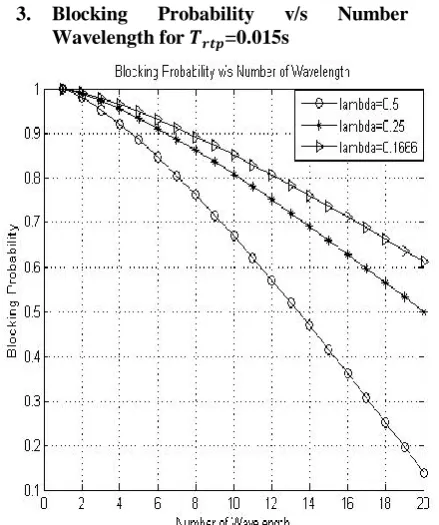
3. Blocking Probability v/s Number of
Wavelength for 𝑻𝒓𝒕𝒑=0.015s
Figure 3 Blocking Probability v/s Number of Wavelength for
𝑇𝑟𝑡𝑝=0.015s
4. Blocking Probability v/s Number of
Wavelength for 𝑻𝒓𝒕𝒑=0.020s
Figure 4 Blocking Probability v/s Number of Wavelength for
𝑇𝑟𝑡𝑝=0.020s
V.CONCLUSION
In this paper we have analyzed the performance of Passive optical Burst Switching Network and demonstrated using simulation that by reducing the Round Trip Delay and increasing the Mean Packet interarrival Time and Number of Wavelength, the Blocking Probability is reduced.
REFERENCE
1. Satish Sharma, “A Review of Passive Optical Networks,”
IJAIEM, vol. 2, Issue 5, pp. 181-185, May 2013.
www.ijeee-apm.com International Journal of Electrical & Electronics Engineering 9 3. Eric W.M. Wong and Moshe Zukerman, “An Optical Hybrid
Switch with Circuit Queueing for Burst Clearing,” J. Lightw. Technol., vol. 26, pp. 3509-3527, Nov. 2008.
4. Eric W.M. Wong, Andrew Zalesky and Moshe Zukerman, “A State-Dependent Approximation for the Generalized Engset Model,” IEEE Commun. Lett., vol. 13, pp. 962-964, Dec. 2009.
5. VyacheslavAbramov, Shuo Li, Meiqian Wang, Eric W.M. Wong, and Moshe Zukerman, “Computation of Blocking Probability for Large Circuit Switched Networks,” IEEE Commun. Lett., vol. 16, pp. 1892-1895, Nov. 2012.
6. Meiqian Wang, Shou Li, Eric W.M. Wong, and Moshe Zukerman, “Evaluating OBS by Effective Utilization,” IEEE Commun. Lett., vol. 17, pp. 576-579, March 2013.
7. Jianan Zhang, Eric W.M. Wong, and Moshe Zukerman, “Modeling an OBS Node under Critical Load and High
Utilization Conditions,” IEEE Commun. Lett., vol. 16, pp. 544-546, April 2012.
8. Moshe Zukerman, Eric W.M. Wong, ZviRosberg, GyuMyoung Lee, andHai Le Vu, “On Teletraffic Applications to OBS,” IEEE Commun. Lett., vol. 8, no. 2, pp. 116-118, Feb. 2004.
9. Andrew Zalesky, Eric W.M. Wong, Moshe Zukerman, Hai Le Vu, and Rodney S. Tucker, “Performance Analysis of an OBS Edge Router,” IEEE Photon. Technol. Lett., vol. 16, pp. 695-697, Feb. 2004.