Advances in Science and Technology Research Journal
Volume 11, Issue 4, December 2017, pages 168–174
DOI: 10.12913/22998624/79656 Research Article
STONE DUST AGGLOMERATION FOR UTILIZING
AS BUILDING MATERIAL
Gabriel Borowski1, Tomasz Świderski2, Małgorzata Ozga1
1 Lublin University of Technology, Faculty of Environmental Engineering, Nadbystrzycka 40b St., 20-618 Lublin, Poland, e-mail: [email protected]
2 Polskie Górnictwo Skalne Sp. z o.o. (Polish Rock Mining Company), Chałubińskiego 42 St., 25-619 Kielce, Poland
ABSTRACT
In the paper we discuss the possibility of using stone dust for utilizing as building material. The tested material was amphibolite, found in the Sudeten Mountains and the Tatra Mountains in Poland. The chemical composition of dust was determined by means of spectrometry methods. Moreover, the basic physical properties of the mate-rial were designated. Stone dust was mixed with starch or cement binder. The binder addition was from 5% to 20% by weight. The water content was adjusted to about 25% humidity. The mixture was then compressed in a hydraulic press at 50 MPa. The results of the mechanical toughness of agglomerates were shown. On the basis of the results, acceptable toughness of agglomerates was found, with the addition of cement in mass share 20% and seasoning for 48 hours. However, starch was not suitable as a binder for agglomeration of amphibolite.
Keywords: agglomeration, stone dust, amphibolite, utilization
INTRODUCTION
Broken aggregates of stone are basic raw ma-terials used mainly in construction, almost from
the beginning of civilization. Obtaining specific
fractions of aggregates, thanks to the use of spe-cialized machinery and equipment and
process-ing technology, results in significant amounts of
dusts. In Poland, the production of aggregates in 2011–2014 amounted from 6.216.000 up to 10.497.000 tons per year [15].
Stone dust is produced by the process of cut-ting into bricks and cleaning, where it is
neces-sary to use dust extraction systems or water flush -ing systems. These fractions often exhibit strong mutual attraction, hence the need for separation techniques from coarse particles [14]. Stone dust is used increasingly often to produce road pave-ments [8, 9]. It is also interesting to use dust for agricultural purposes [5]. Delivery of stone dust to barren soil causes re-mineralization, as stone is Received: 2017.08.28
Accepted: 2017.11.02 Published: 2017.12.05
the source of many elements and minerals. An-other direction for the use of dust is the ceramic industry, as a component of ceramic tile clinker, and glass industry [15]. The possibility of using basalt dust in cement mortars has been demon-strated [4]. This dust, used as a substitute for sand, increases the strength of cement mortars
[2]. It fills the pores in the cement matrix and
seals the structure of the mortar with increasing its density. Additionally, it exhibits pozzolanic properties. The addition of basalt dust also in-creases frost resistance of cement mortars and concrete [3]. Stone dust (granite) was recycled by incorporating it into building materials. Bricks were made in order to study their proper-ties. It was found that the compressive strength of bricks depended on the percentage of dust mixed
Stone dust is a serious environmental prob-lem because it is a non-biodegradable material. Stone dust dumped on land can reduce the rate of rain water percolating and deteriorate soil fertil-ity. When dumped in rivers and streams, it con-taminates the water. Stone dust can be utilized for developing low cost building materials such as block, brick, tiles etc. [10]. A building prod-uct was presented consisting mainly of lime-stone dust, mixed with Portland cement [6]. They showed that quarry dust-cement mixtures can be used for the production of molded masonry bricks with acceptable mechanical properties. Various
methods of agglomerating fine-dust materials,
including briquetting, pelletizing and granulation have been investigated [1]. Commonly, there are mineral or organic binders used for agglomera-tion processes. Morover, binderless briquetting
was found to be successful in the case of the fine and ultra-fine coking coals [12].
The goal of this study is to investigate the possibility of utilizing the stone dust agglom-erate as building material. This stone, named amphibolite, are widespread in Poland and are found in the Sudeten Mountains as well as the Tatra Mountains.
MATERIAL AND METHODS
The material we investigated was amphibolite stone dust. Amphibolite is a metamorphic rock, dark green, dark gray, black or brown in color. The main minerals are amphiboles as well as quartz, epidot, zoisite, grenadine, biotite,
cordi-erite, andalusite, sillimanite, tourmaline, titanite, ilmenite and pyroxene.
The material was delivered by the Quarry “Piława Górna” located in Lower Silesia. It is one of the largest raw material fields in Poland for the production of broken aggregates of stone. Production capacity of the mine is about 7.5 mil-lion tons per year. Crushed stone is used for the construction of roads. railway lines, and as an or-namental stone to diversify the gardens, whereas stone dust is used for the production of mineral asphalt, mechanically stabilized substructures and high strength concrete.
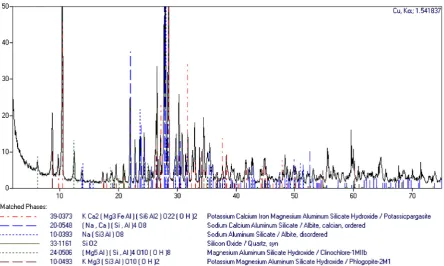
The mineral composition was analyzed by the X-ray diffraction (XRD) method (Fig. 2). XRD test of mineral composition are aimed at determining the presence of individual elements (qualitative analysis) and the percentage content of compounds (quantitative analysis).
Percentage of chemical compounds was de-termined with the spectrometry method of fu-sion-inductively coupled plasma (FUS-ICP). The presence of the most important elements was de-termined using a spectrometer of total digestion-inductively coupled plasma (TD-ICP) and the method of instrumental neutron activation analy-sis (INAA). The gradation of stone dust was
spec-ified by means of sieve analysis, according to the
Polish standard PN-EN 933-1. The basic physi-cal properties of the material were designated and shown in Table 1.
Advances in Science and Technology Research Journal Vol. 11 (4), 2017
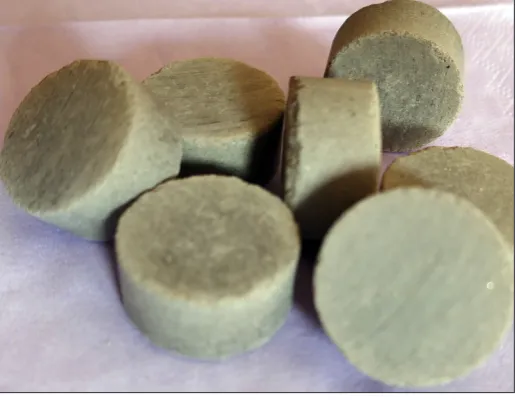
addition was from 5% to 20% by weight. During mixing, water content was adjusted to about 25% humidity. The mixture was then compressed in a hydraulic press at 50 MPa (Fig. 3). The press was equipped with a molding matrix consisting of a cylindrical die and a punch (Fig. 4), allowing two samples to be made simultaneously. We obtained uniform agglomerates (briquettes) having a cylin-drical shape, a diameter of 28 mm and a height of 14 mm (Fig. 5).
For further study of mechanical toughness, both new-made and seasoned samples were se-lected. Seasoning consisted in storing samples in a closed airy room for a few days to sever-al weeks after they were made. The toughness of the agglomerates was determined using the gravitational drop test. Samples were dropped three times from a height of 2.0 m onto a metal
base, and weight loss was measured after every drop. Than percentage Impact Strength Index was calculated – minimum index should be at least 90% [1].
RESULTS AND DISCUSSION
Chemical composition and grain size
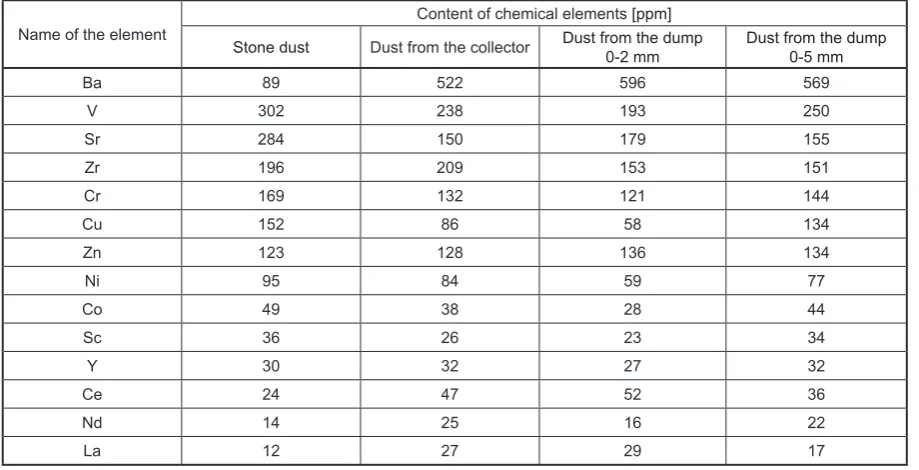
Table 2 shows the percentage of chemical compounds comprised in the amphibolite stone dust. The presence of the most important ele-ments is shown in Table 3. The results of sieve analysis of stone dust are shown in Table 4.
On the basis of data, a high proportion of sili-cates in the tested material was found, ranging from 49.66% to 58.38%. Alumina and iron oxides also have a significant share, with a combined Fig. 2. Sample of XRD of amphibolite stone dust
Table 1. Physical properties of amphibolite stone dust
Properties Standard Unit Result
The content of remains PN-EN 933-1 % 8.60
Flow indicator PN-EN 933-6 s 42.0
Dust quality PN-EN 933-9 g/kg 1.00
Volumetric density PN-EN 1097-6 Mg/m3 2.90
Bulk density PN-EN 1097-3 Mg/m3 1.65
Absorptivity PN-EN 1097-6 % 0.50
Fig. 5. Look of agglomerates (Phot. G. Borowski)
Fig. 3. Hydraulic press (Phot. G. Borowski) Fig. 4. Molding matrix (Phot. G. Borowski)
Table 2. Chemical compounds of the amphibolite stone dust
Compound name Chemical compound content [%]
Stone dust Dust from the collector Dust from the dump 0-2 mm Dust from the dump 0-5 mm
SiO2 49.66 57.88 58.38 56.13
Al2O3 15.56 15.22 15.8 16.04
Fe2O3 total 11.73 9.37 8.33 9.92
CaO 9.49 5.34 3.83 5.19
MgO 6.96 4.26 3.9 4.36
Na2O 2.84 2.39 2.94 2.22
TiO2 1.99 1.06 1.04 1.19
K2O 0.49 1.70 1.94 1.98
P2O5 0.23 0.20 0.15 0.12
Advances in Science and Technology Research Journal Vol. 11 (4), 2017
value of 25.48%, on average. The outstanding metal oxides represent an average share of about 22.5%. Among the elements, the highest content was found in the case of barium, as well as vana-dium, strontium, zirconium, chromium and zinc. Other metals, including rare earth metals, are present in the amounts lower than the vanadium alone, which is regarded as an additive in the pro-duction of high quality steel.
The chemical composition of amphibolite dust is very similar to the composition of basalt dust [11]. Silicon oxide SiO2 and aluminum ox-ide Al2O3 prevail in its composition constituting a share of 56% by weight, as well calcium oxide CaO and iron oxide Fe2O3 [3]. Similarly to basalt, the tested material shows quite a high crystallisa-tion capacity, which supports the use of amphibo-lite dust for the manufacture of glass and ceramic products [5, 11].
Mechanical toughness
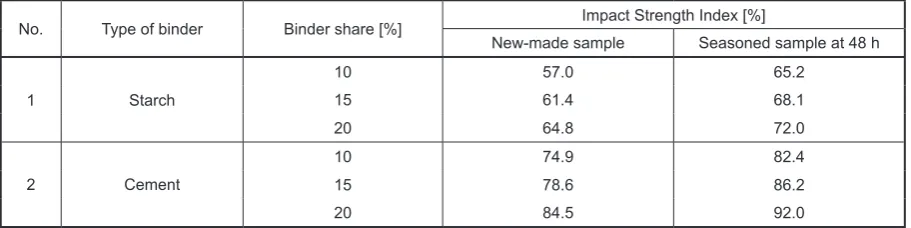
The results of preliminary amphibolite dust agglomeration tests, together with the mechani-cal toughness of obtained bodies, are presented in Table 5.
On the basis of the presented results, unfa-vorable properties of starch-enhanced aggregates were found. Seasoning of body led to an increase in their Impact Strength Index, but the required values were not achieved. However, the results of the others research indicate the possibility of obtaining tough organic-binder aggregates in the compacting and briquetting processes [1, 7].
Satisfactory results of the drop tests were obtained for aggregates with cement as a bind-er. Finding the correct briquettes needs to be seasoned for a minimum of 48 hours. Increas-ing the binder’s contribution raised the Impact
Table 3. Content of the most important chemical elements
Name of the element Content of chemical elements [ppm]
Stone dust Dust from the collector Dust from the dump 0-2 mm Dust from the dump 0-5 mm
Ba 89 522 596 569
V 302 238 193 250
Sr 284 150 179 155
Zr 196 209 153 151
Cr 169 132 121 144
Cu 152 86 58 134
Zn 123 128 136 134
Ni 95 84 59 77
Co 49 38 28 44
Sc 36 26 23 34
Y 30 32 27 32
Ce 24 47 52 36
Nd 14 25 16 22
La 12 27 29 17
Table 4. Results of sieve analysis of stone dust
Sieve mesh size [mm] Residual material [%] Screened material [%]
4.0 0 100
2.8 0 100
2.0 9 91
1.0 28 63
0.5 19 43
0.25 17 27
0.125 12 15
0.063 6 8.6
Strength Index in the gravitational drop test. The best result on average of 92% was achieved for seasoned agglomerates with a 20% share of cement.
According to the literature, increasing in the proportion of binder with stone dust in the compound for agglomeration does not always produce positive results [10, 13]. Acceptable bricks were obtained for the 15% addition of ce-ment in a mixture of limestone and compressive strength was greater than 7 MPa [6]. In the case of the production of fine stone cobble cubes the cement content is from 15% to 30% [14]. It has been noted that attaining agglomerates depends on the molding process and on the range of pres-sure forces [7].
The authors have plans for further consolida-tion of stone dust with various types of cement along with the selection of its mass share. This will allow to obtain durable bricks that will be used in the construction industry.
CONCLUSIONS
On the basis of the results presented in the pa-per, it was stated that:
1. The amphibolite stone dust was defined as “hardly merged”. The mechanical strength of new-made samples was insufficient, regard -less of the type and proportion of the binder. No satisfactory results were obtained using a starch binder.
2. Seasoning for 48 hours increased the mechani-cal properties of agglomerates.
3. Agglomerates with acceptable toughness were found with the addition of cement in mass share 20%, compressed in a hydraulic press at 50 MPa.
Table 5. The results of gravitational dump test
No. Type of binder Binder share [%] Impact Strength Index [%]
New-made sample Seasoned sample at 48 h
1 Starch
10 57.0 65.2
15 61.4 68.1
20 64.8 72.0
2 Cement
10 74.9 82.4
15 78.6 86.2
20 84.5 92.0
REFERENCES
1. Borowski G., Hycnar J.J., Józefiak T. 2016. Indus-trial briquetting Indus-trials for the waste management of bearing grinding. Annual Set The Environment Protection, Vol. 18, 205–217.
2. Cholerzyński A., Tomczak W., Świtalski J. 1999.
Application of sulfur concretes for solidification of radioactive waste and construction of landfills
(in Polish). Institute of Atomic Energy Annual Re-port, pp. 139–146.
3. Dobiszewska M. 2016. Use of basalt powder in a cementitious mortar and concrete as a substitute of sand. Construction and Architecture, 15(4), 75–85.
4. Dobiszewska M., Franus W., Turbiak S. 2016. Analysis of the possibility of using powder ba-salt in cement mortar. Journal of Civil Engineer-ing, Environment and Architecture, Vol. XXXIII, 63(1), 107–114.
5. Gacki F., Feliks J., Wyszomirski P., 2013. Re-search into the use of waste basalt dust (in Pol-ish). Engineering and Chemical Engineering, 52(3), 174–175.
6. Galetakis M., Raka S. 2004. Utilization of lime-stone dust for artificial lime-stone production: an ex-perimental approach. Minerals Engineering, 17, 355–357.
7. Hycnar J.J., Borowski G., Józefiak T. 2014. Condi-tions for the preparation of stable ferrosilicon dust
briquettes. Journal of the Polish Mineral Engineer -ing Society, 33( 1), 155–162.
8. Kozioł W., Kawalec P. 2008. Alternative aggre-gates in construction (in Polish). Modern Engi-neering Construction, 7-8(18), 34–37.
9. Kozioł W., Uberman R. 1996. Możliwości i warun-ki zagospodarowania odpadów z górnictwa i ener-getycki w drogownictwie. zwłaszcza do budowy autostrad i dróg ekspresowych. Przegląd Geolo-giczny, 44(7), 701–709.
Advances in Science and Technology Research Journal Vol. 11 (4), 2017
products: A state of the art review. Journal of En-gineering Science and Technology Review, 7(3), 180–187.
11. Lubas M., Wyszomirski P. 2009. Unconventional application of Lower Silesian amphibolites. Cera-mic Materials, 61(1), 31–34.
12. Mangena S.J., duCann V.M. 2007. Binderless bri-quetting of some selected South African prime coking, blend coking and weathered bituminous coals and the effect of coal properties on binderless briquetting. International Journal of Coal Geology, 71, 303–312.
13. Rajgor M., Pitroda J. 2013. Stone sludge: Eco-nomical solution for manufacturing of bricks. In-ternational Journal of Innovative Technology and Exploring Engineering, 2(5), 16–20.
14. Stankiewicz J. 2016. Directions of the manage-ment of small fraction arising in processing and extraction of mineral raw materials. Mining Sci-ence – Mineral Aggregates, 23(1), 155–166. 15. Wyszomirski P., Szydłak T. 2016. Fine grain
![Fig. 1. Stone dust utilization [10]](https://thumb-us.123doks.com/thumbv2/123dok_us/8807032.1775136/2.595.161.429.75.259/fig-stone-dust-utilization.webp)