Copyright © 2012 IJECCE, All right reserved
Optimized MSE Analysis of Maximum Power
Adaptation with Code Rates over Wireless Cropped
Image Transmission using Labview
M. Padmaja
Asst. Prof., ECE Dept., VR Siddhartha Engg. College,
Vijayawada A.P., India [email protected],
Dr. P. Satyanarayana
Prof. and Head of EEE, Sri Venkateswara University College ofEngg. Tirupati (A.P.), India [email protected],
K. Prasuna
Asst. Prof., ECE Department, Vijaya Institute of Technology for Women,
Vijayawada (A.P.) [email protected]
Abstract – Coding plays significant role in wireless transmission as the most important scheme for communication of cropped images over wireless channels, due to its ability to deal with various channel qualities and to approach the hypothetical limits of transmission rates. In this paper, Maximum Power Adaptation Algorithm is implemented along with convolution codes for different rates. This Proposed method shows better performance compared to Conventional Power Adaptation Algorithm combined with convolution codes for different rates. The proposed scheme works iteratively to find the optimal combination of coding and power transmitted for individual bits to minimize the mean square error for better cropped image excellence. It is shown that bits of major importance i.e most significant bits should always be coded and allocated most of the power transmitted. However, other bits of less significance may be transmitted with less power. This is done while maintaining the average power per bit at the same level. Code rate ½ showed better performance compared with other codes.
Keywords – Convolution Codes, Code Rate, maximum.
I.
I
NTRODUCTIONOne of the most important and challenging goal of current and future communication is transmission of high quality cropped images from source to destination quickly with least error where limitation of bandwidth is a prime problem. By the advent of multimedia communications, the multimedia transmission of multimedia over wireless links is considered as one of the major applications of future communication systems. However, such systems require the use of relatively high power adaptation compared to other applications.
With such requirement, it is very challenging to provide acceptable quality of services as measured by the Root Mean Square Error (RMSE) due to the limitations imposed by the wireless communication channels such as fading and multipath propagation. With the increasing complexity of these communication systems comes increasing complexity in the type of content being transmitted and received. The early content of plain speech/audio and basic black and white cropped images used in early radio and television has developed into high definition audio and video streams; and with the introduction of computers into the mix even more complex content needs to be considered from cropped images, video and audio to medical and financial data. Techniques are continuously being developed to maximize data throughput and efficiency in these wireless communication
systems while endeavoring to keep data loss and error to a minimum. Power control has been an effective approach to mitigating the effect of fading channels in the quality of signal transmission over wireless channels [1-2].
The use of power in multimedia communications is becoming more and more important and intricate, predominantly when multimedia signal processing is incorporated. Since high power wireless systems are distorted, it is essential to adjust power of the transmitted bits to guarantee signal reliability. Wireless cropped image transmission is important for a variety of applications, from security and surveillance to in-home monitoring. Most existing studies on Power optimization of wireless communications consider error-free bit transmission, where the entire bit stream has to be retransmitted if there is even a single bit error. However, for cropped image transmission applications, there is often a certain tolerance to errors in the received data, as errors in the decoded data become distortion in the cropped image content.
Appadwedula et al. [2] formulated an energy optimization problem subject to statistical distortion and rate constraints for transmitting cropped images over wireless channels. Considering transmission, source, and channel coding components in the formulation of the problem, the authors deployed a gradient based method to solve the problem. Without considering transmission power, Zhang et al. [5] proposed a generic power optimization problem subject to distortion and rate constraints for transmitting video across wireless backbone.
II.
S
YSTEMM
ODELThe system is a typical binary phase shift keying (BPSK) digital communication system for multimedia transmission. The signal is sampled, quantized and then coded into binary bits for transmission. The transmitted BPSK signal is represented as
𝐒 𝐭 = 𝐰𝐢𝐛𝐤𝐢
𝐌−𝟏
𝐢=𝟎 𝐠(𝐭 − (𝐤𝐌 + 𝐢)𝐓𝐛
∞
𝐤=𝟎
(1) Modulation is the process by which signal waveforms are transformed and enabled to better withstand the channel impairments.
In a BPSK system the received signal is given by
Y = x + n (2) Where x∈ −A, A and σ2=No
Pb= 1 2πσ22 ∞
A e
−x 2 σ2 2
(3) And the Q-function is given by
Q(x)= 1 2π e
−x 22
∞
x dx
(4)
Q x = 1
1 − a x + a(x2+ b)0.5
1 (2π)0.5e
−x
2
2
(5) Equation (6) is widely used in Bit error rate calculation. The Q-function can be described as a function of error function defined over [0,∞) and is given by
erf x = 2
π e
−y2dy x
0
(6) With erf 0 = 0 and erf(∞)=1
Pb= Q( 2γb) (7)
Ps= 1 − [1 − Q( (2γb ))]2 (8)
γs =2γb =A2
No
(8a) Where the Q function is defined as:
Q(x) ≤ 1
2π e ∞
x −x 2
2 dx
(9)
The Bit Error rate of BPSK involves two BPSK modulations on in-phase and quadrature components of the signal. The bit error probability is given by
Q(z) ≤ 1
z 2πe
−x 2
2dx
(10) Ps≤ 3
2πγse
−0.5γs
(11)
Pb Can be approximated from Ps by Pb as Pb=
Ps
2 (12) The Bit Error Rate for BPSK signaling can be calculated by an approximation of symbol error rate using nearest neighbor approximation. The Symbol error probability can be approximated by
Ps=2Q 2Asinπ
M
2No = 2Q 2γs Sin π
M (13) When there are N number of images and M number of bits in a multimedia system, then the powers transmitted by the bits are P = [P1, P2, … … … . . PM] and the
respective RMSEs at the bits
be RMSE = [RMSE1, RMSE2, … … … . . RMSEM] . Let
RMSET be the target RMSE. For a system with M bits per sample, there are 2M different samples to be transmitted.
The probability that ith sample with a decimal value of (i) is reconstructed is given by
PDi= M−1k=0[pkϑ(k) +(1 − pk)ϑ k ] (14) Where pk is the probability that the kth bit is in error.ϑ(k) is equal to zero if the indices of i and k are same and the value will be equal to 1 if the indices are different. The notation ϑ k ] represents the binary inversion of ϑ(k).
by averaging over all possible samples. It is possible to show that, on average, all MSE values are approximately the same and hence equation (7) will be average MSE. The Root Mean Square Error (RMSE) is obtained by taking the square root of (7)[15-18] .The probability of the kth bit to be in error for the AWGN case is given by
Pk = Q( 2 Eb
No k ) (16)
Algorithm:
1. Initialize number of iterations 2. Initialize number of bits 3. Initialize power step size to ∆P. 4. Initialize𝐏𝐀𝐏𝐑𝐦𝐚𝐱..
For i = 1 to iterations 5. Initialize power vector to all ones
6. Define two bits, R is recipient power and C is contributing power,
For j = 1 to bits 7. Compute RMSE.
8. Update power of all the bits using
𝐏𝐢𝐧+𝟏= 𝐑𝐌𝐒𝐄𝐢𝐧𝐱𝐏𝐢𝐧 (17) Where 𝐑𝐌𝐒𝐄𝐢𝐧 = 𝐌𝐀𝐗(𝐑𝐌𝐒𝐄𝐢𝐧, 𝐑𝐌𝐒𝐄𝐓) 𝐑𝐌𝐒𝐄𝐢𝐧 (18) 𝐏𝐢𝐧+𝟏 =Power allocated in the n+1 state
𝐏𝐢𝐧 = Power allocated in the n state
𝐑𝐌𝐒𝐄𝐢𝐧=Root mean square error of ith bit in nth
iteration
𝐑𝐌𝐒𝐄𝐓 =Target Root Mean Square Error Calculate the maximum power of each bit.
10. Repeat the same procedure 8 and 9 above but with the Contributor bit C incremented by one until all least significant bits are used.
11. Calculate the maximum MSE.
12. Plot Energy per Bit versus RMSE, BER.
IV.
C
ONVOLUTIONC
ODINGConvolution coding is the most common and widely used channel coding technique used in global mobile communication systems, and it has many sub-categories which are standards of different wireless communication mechanisms. The convolution technique of channel coding involves the encoding of specified number of bits, which are the smallest units of data. These bits contain information about current or recently transmitted data values within streams of transmitted data. These data values inform the receiver about the size and features of the transmitted data. This information regarding data values not only help recipients check the received bits for any loss or path corruption, but also help to make sure the data received is as it was transmitted.
Copyright © 2012 IJECCE, All right reserved RC=k/n. Typically k and n range from 1 to 8, the value of
v ranges from 2 to 60, and the value of RC from 1/4 to 7/8.
V.
N
UMERICALR
ESULTS ANDC
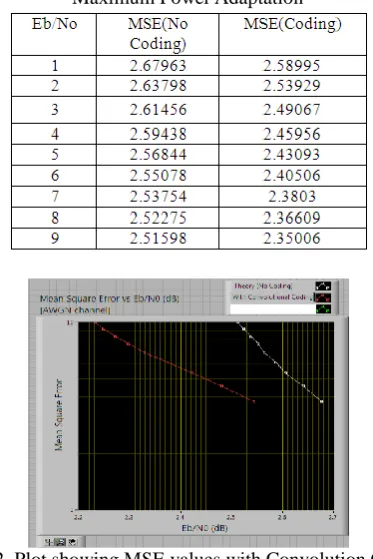
ONCLUSIONSThis Paper is implemented in Lab View. Laboratory Virtual Instrumentation Engineering Workbench (Lab VIEW) is a platform and development environment for the visual programming language from National Instruments. The purpose of such programming is automating the usage of processing and measuring equipment in any laboratory setup. Lab VIEW is commonly used for data acquisition, instrument control, and industrial automation. In this first the cropped image is given to IMAQ read file where the cropped image is read from a file and then the cropped image is converted into array using IMAQ cropped image to array block then the rows and columns of cropped image pixels are calculated and all are initialized with zeros and now the binary cropped image is applied to PSK modulator then AWGN noise is added and decimates the over samples and then the bits are passed through BER block for BER calculation. The optimized power vector is transmitted through the channel. This process is done by first passing the binary data to convolution coding block followed by above process followed by decoding and BER block. Fig.1 shows the Original cropped image. And cropped image Cropped image transmission over AWGN is considered with M = 8 bpp for Maximum power adaptation methods with and without coding. The performance obtained by the coding and No coding along with the Maximum Power Adaptation Algorithm are shown in Tabular forms I , II , III , IV and V.Better Performance is observed in Maximum Power Adaptation Algorithm (MAPAA) with coding compared with No Coding as shown in Fig.8,10.The Plots show that the performance with code rate ½ achieves better
performance compared with other code
rates1/3,1/4,2/3,3/4.
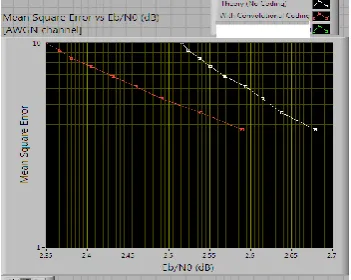
Fig.7 shows the received cropped image using Maximum Power Adaptation Algorithm. Ihe cropped image proves that better Performance is observed in Maximum Power Adaptation Algorithm using Coding with Code Rate 1/2 compared with other code rates1/3, 1/4, 2/3, 3/4. And No Coding as shown in fig.2, 3, 4 and 5.A better performance is observed with code rate 1/3 and ¾ after code rate ½.Higher values are observed with code rate 2/3.As Eb/No increases , MSE decreased using code rate ½ rather than no coding. This code rate-1/2 shows better performance compared with conventional power adaptation algorithm.Fig.11 shows plot of MSE values with Convolution Code Rate 1/2 and No Coding with Conventional power Adaptation Algorithm. Table VI shows MSE values with Conventional Power Adaptation Algorithm along with Convolution Code Rate ½.
Fig.1. Original Cropped image and cropped image
Table I MSE values with Convolution Code Rate ½ and Maximum Power Adaptation
Fig.2. Plot showing MSE values with Convolution Code Rate ½ and No Coding
Fig.3. Plot showing MSE values with Convolution Code Rate 1/3 and No Coding
Table III MSE values with Convolution Code Rate 1/3 and Maximum Power Adaptation
Fig.4. Plot showing MSE values with Convolution Code Rate 1/4 and No Coding
Table IV MSE values with Convolution Code Rate 2/3 and Maximum Power Adaptation
Fig.5. Plot showing MSE values with Convolution Code Rate 2/3 and No Coding
Table V MSE values with Convolution Code Rate 3/4 and Maximum Power Adaptation
Copyright © 2012 IJECCE, All right reserved Fig.8. Plot showing Eb/No vs MSE values with different
Code Rates
Fig.9. Plot showing Eb/No vs MSE values with No Coding at different rates
Fig.10. Plot showing Eb/No vs. MSE values with No Coding at different rates
R
EFERENCES[1] Mahes Subramanian, Alagan Anpalgan “A brief Introduction to Power Control Techniques in Cellular DS-CDMA Networks” Computer Science and Engineering Conference May.2003, CSE2003
[2] K. Stuhlmüller, N. Färber, M. Link, and B. Girod, “Analysis of video transmission over lossy channels,” IEEE J. Select. Areas Commun. , vol. 18, pp. 1012–1032, June 2000.
[3] T. H. Meng, A. C. Hung, E. K. Tsern, and B. M. Gordon, “Low-power signal processing system design for wireless applications,” IEEE Pers. Commun. , pp. 20–31, June 1998.
[4] S. Appadwedula, M. Goel, N. R. Shanbhag, D. L. Jones, and K. Ram-chandran, “Total system energy minimization for wireless cropped image trans-mission,” J. VLSI Signal Processing Syst. , vol. 27, no. 1/2, pp. 99–117,Feb. 2001.
[5] Q. Zhang, Z. Ji, W. Zhu, and Y. Q. Zhang, “Power-minimized bit allocation for video communication over wireless channels,” IEEE Trans. Circuits Syst. Video Technol., vol. 6, pp. 398–410, June 2002.
[6] Technical specification group radio access network: physical layer –general specification, 3GPP, Release 6,December 2003, www.3gpp.org.
[7] J. Proakis, Digital Communications, 4th ed., McGraw-Hill,2001.Talukder, K.H. and Harada, K., A Scheme of Wavelet Based Compression of 2D Cropped image, Proc. IMECS, Hong Kong, pp. 531-536, June 2006.
[8] Ahmed, N., Natarajan, T., and Rao, K. R., Discrete Cosine Transform, IEEE Trans. Computers, vol. C-23, Jan. 1974, pp. 90-93.
[9] Pennebaker, W. B. and Mitchell, J. L. , Still Cropped image Data Compression Standards, Van Nostrand Reinhold, 1993. Press, 1990.
[10] Wallace, G. K., The Still Picture Compression Standard , Comm. ACM, vol. 34, no. 4, April 1991, pp. 30-44.
[11] Colm Mulcahy, Cropped image compression using the Haar Wavelet transforms, Internal Report.
[12] Wireless Communications by Andrea Goldsmith
A
UTHOR’
SP
ROFILEMs. M. Padmaja
is currently working as Associate Professor in the Department of ECE, VR Siddhartha Engineering College, Vijayawada. She is working towards her Ph.D at Sri Venkateswara University College of Engineering, Tirupati, under the guidance of Dr P Sathyanarayana. She has 16years of experience in teaching various courses at B.Tech and M.Tech. Her research areas are Signal Processing and Communications. She has more than 12 research papers to her credit. She is Fellow of IETE, Life member of IE (I), ISTE, SEMCEI, and BMESI.
Dr. P. Sathyanarayana
received the B. E., M. E., and Ph. D. degrees from Sri Venkateswara University, Tirupati, A. P., India, in 1976, 1978 and 1987 respectively all in Electronics and Communication Engineering. He Joined the Department of Electrical and Electronics Engineering, Sri Venkateswara University College of Engineering, Tirupati, in July 1979 as an assistant Professor and became Professor in July 1999. His research interests are in the field of one and two dimensional Signal Processing particularly in Image / video processing and Communication. He was with the Dept. of Electrical and Computer Engg., Concordia University Montreal, Canada from 1988 to 1990 as Post Doctoral Fellow, and he was with School of Aerospace Engg., University Sains Malaysia, Penang, Malaysia as a visiting faculty from 2004 to 2007.