Three Graceful Operations
Sarah Minion
∗1and Christian Barrientos
†21, 2Department of Mathematics, Clayton State University, Morrow, Georgia 30260, USA
ABSTRACT ARTICLE INFO
A graph of sizenis said to begraceful when is possible to assign distinct integers from {0,1, . . . , n} to its vertices and{|f(u)−f(v)|:uv∈E(G)}consists ofnintegers. In this paper we present broader families of graceful graphs; these families are obtained via three different operations: the third power of a caterpillar, the symmetric product of G and K2 , and the disjoint union of G and Pm,
where G is a special type of graceful graph named α -graph. Moreover, the majority of the graceful labelings obtained here correspond to the most restrictive kind, they are α-labelings. These labelings are in the core of this research area due to the fact that they can be used to create other types of graph labelings, almost independently of the nature of these labelings.
Article history:
Received 26, July 2014
Received in revised form 27, August 2014
Accepted 31 October 2014 Available online 15, November 2014
Keyword: graceful labeling,-labeling, union, third power, sym-metric product.
AMS subject Classification: 05C76, 05c78.
∗Email: [email protected] †Email: chr [email protected]
1
Introduction
A graceful labeling of a graph Gof sizen is an injective functionf :V(G)→ {0,1, . . . , n}
such that when each edge uv of G has assigned the weight |f(u)−f(v)|, all induced weights are distinct. If G admits a graceful labeling is said to be a graceful graph. Let
f be a graceful labeling of a graph G; suppose that there exists an integer λ such that for each edge uv of G, either f(u) ≤ λ < f(v) or f(v) ≤ λ < f(u), then f is said to be an α-labeling of G with boundary value λ and G is called an α-graph. An α-graph is necessarily bipartite and λ is the smaller of the two end-vertices of the edge of weight 1. Suppose G is an α-graph of size n. Let f be an α-labeling of G with boundary value
λ. If {A, B} is the bipartition of V(G), we may assume, without loss of generality, that
A ={v ∈V(G) : f(v) ≤λ} and B ={v ∈V(G) : f(v) > λ}. When a positive constant
k is added to every vertex in B, the resulting labeling is a k-graceful labeling, where the weights are {k + 1, k+ 2, . . . , k+n}. This operation was introducted independently by Maheo and Thuiller [8] and Slater [11]. We refer to this operation as an amplification. We study here three operations on graphs that result on graceful graphs. In Section 2 we introduce an operation related to the nth power Gn of a connected graph G, where
n ≥ 1; Gn is that graph with V(Gn) = V(G) for which uv ∈ E(Gn) if and only if 1 ≤dG(u, v)≤ n. In our case, Gn denotes the graph with V(Gn) = V(G) and E(Gn) =
E(G)∪ {uv : dG(u, v) = n}. In particular, we prove that C3 is graceful when C is a
caterpillar; futhermore, the labeling obtained satisfies the conditions to be an α-labeling. In Section 3 we generalized the result of Seoud and El Sakhawi [10] about the symmetric product Pn⊕K2. We prove that G⊕K2 is an α-graph when Gis an α-graph.
Section 4 deals with the union of graphs, specifically we prove that G∪Pm is graceful
provided that G admits an α-labeling that does not assign the integer λ+ 2 as a label, where λ is its boundary value. We finish this section listing several families of α-graphs that admit α-labelings of this kind.
Alpha labelings of graphs are extremely useful in the area of graph decompositions [9]; in addition, they are located in the center of this research area because they can be modified to produce other types of labeling. For more details at this respect, we recommend [4] and [6].
[5].
2
A Graceful Third Power
In his dynamic survey, Gallian [5] defines Pnk, thekth
power of Pn, as the graph obtained
from the path of order n by adding edges that join all vertices u and v with d(u, v) = k. This definition differs of the one given by Chartrand and Lesniak [3], where d(u, v)≤k. We use here the definition given by Gallian and we extend it to any connected graph. We are aware of only one result related to the gracefulness of a power of a graph. Kang et al [6] proved thatP2
n is graceful. In our first theorem, we prove thatC3 is graceful for every
caterpillar of diameter at least 3; moreover, the resulting labeled graph is an α-graph. LetC be a caterpillar of diameter at least three. Its cubeC3 is the bipartite graph defined by V(C3) =V(C) and E(C3) =E(C)∪ {uv:dC(u, v) = 3}.
In his seminal paper, Rosa [9] proved that all caterpillars are α-graphs. For the sake of completeness, we show in Figure 1 the technique used to find this α-labeling.
Figure 1: α-labeling of a caterpillar
Suppose C is a caterpillar of size q which has been α-labeled using Rosa’s scheme; let g
be the α-labeling obtained and λ be its boundary value. If {A, B} is the bipartition of
V(C) we assume A = {u ∈ V(G) : g(u) ≤ λ} and B = {v ∈ V(C) : g(v) > λ}. Thus,
A = {ui : 1 ≤ i ≤ λ+ 1 and g(ui) = i−1} and B = {vj : 1 ≤ j ≤ q−λ and g(vj) =
q+ 1−j}. Let v ∈ V(G), by N(v) we understand the subset of V(G) consisting of all the vertices adjacent to v, that is the neighborhood ofv. In the next theorem we assume that this labeling is known.
Theorem 1. If C is a caterpillar of diameter at least three, then C3 is an α-graph.
• f(ui) =g(ui) for every ui ∈A
• f(v1) =n
• f(vj) =n+ min{f(u) :u∈N(vj)} − j−1
P
i=1
deg(vi) for everyj ≥2.
We claim that f is an α-labeling of C3.
First, we prove that f is an injective function. Clearly, when f is restricted to A, f is injective. Consider now the labels of vj and vj+1, j ≥ 2; we claim that f(vj+1) > f(vj).
Since d(vj, vj+1) = 2, N(vj)∩N(vj+1)6=∅, thus |N(vj)∩N(vj+1)|>0. Then,
min{f(y) :y ∈N(vj+1)} −min{f(x) :x∈N(vj)}<deg(vj)
min{f(y) :y ∈N(vj+1)} −deg(vj)<min{f(x) :x∈N(vj)}
n+ min{f(y) : y∈N(vj+1)} −
j−1
X
i=1
deg(vi)−deg(vj)
< n+ min{f(x) :x∈N(vj)} − j−1
X
i=1
deg(vi),
n+ min{f(y) :y∈N(vj+1)} −
j
X
i=1
deg(vi)
< n+ min{f(x) :x∈N(vj)} − j−1
X
i=1
deg(vi),
∴f(vj+1)< f(vj).
Therefore, f is an injective function.
Now, notice that max{f(x) :x∈A} <min{f(y) :y ∈B}; in fact, |A| −1 = max{f(x) :
Since,
|A| X
i=1
deg(ui) =
|B| X
j=1
deg(vj) =n
|A| X
i=1
deg(ui)−n =n−
|B| X
j=1
deg(vj)
|A| X
i=1
deg(ui)−n+ deg(v|B|) =n− |B|−1
X
j=1
deg(vj)
f(v|B|) =
|A| X
i=1
deg(ui)−n+ deg(v|B|) + min{f(y) :y∈N(v|B|)}
∴f(v|B|) = deg(v|B|) + min{f(y) :y ∈N(v|B|)}=|A|.
In the following step we need to prove that all the induced weights are distinct. Letvj ∈B
and N(vj) = {uk+1, uk+2, . . . , uk+deg(vj)}. Since f(uk+1) < f(uk+2)< · · · < f(uk+deg(vj)),
the edge vju of biggest weight is vjuk+1, which weight is f(vj)−f(uk+1). Consider now
vj−1 ∈B and N(vj−1) ={ut+1, ut+2, . . . , ut+deg(vj−1)}. We know that
f(ut+deg(vj
−1))≥f(uk+1),
that is
t+ deg(vj−1)≥k+ 1.
Since
f(vj) =n+ min{f(x) :x∈N(vj)} − j−1
X
i=1
deg(vi)
=n+k+ 1−
j−2
X
i=1
deg(vi)−deg(vj−1)
∴f(vj)−f(uk+1) =f(vj)−(k+ 1) =n−
j−2
X
i=1
On the other side,
f(vj−1)−f(ut+deg(vj−1)) =f(vj−1)−t−deg(vj−1)
=n+ min{f(y) :y ∈N(vj−1)} − j−2
X
i=1
deg(vi)−t−deg(vj−1)
=n−
j−2
X
i=1
deg(vi)−deg(vj−1) +t+ 1−t=f(vj)−f(uk+1) + 1.
Therefore,
(f(vj−1)−f(ut+deg(vj−1)))−(f(vj)−f(uk+1)) = 1
Thus, all induced weights are distinct, being n the largest weight. Hence f is a graceful labeling of C3. Take λ = |A| −1; notice that f(u) ≤ λ < f(v) for every ordered pair
(u, v)∈A×B. Thus, f is an α-labeling of C3 as we claimed.
We must observe here that the labeling f does not assign the numberλ+ 2 as a label of
C3. In Figure 2 we show an example of this construction for a caterpillar of size 18.
Figure 2: α-labeling of C3
3
A Graceful Symmetric Product
In [10] Seoud and El Sakhawi introduced the following operation of graphs. Thesymmetric product G1⊕G2, of two graphsG1 and G2, is the graph having vertex setV(G1)×V(G2) and edge set {(u, v)(u′, v′) : uu′ ∈ E(G
1) or vv′ ∈ E(G2) but not both}. In Figure 3
of order 2, they proved that this graph is arbitrarily graceful. In our next theorem we extend this result proving that when G1 is an α-graph, the symmetric product G1⊕K2
is also an α-graph, which implies that it is arbitrarily graceful.
Theorem 2. If G is an α-graph, then the symmetric product G⊕K2 is an α-graph.
Proof. Suppose that g is an α-labeling with boundary value λ of a graph G of size n. Within G⊕K2, we can distinguish two copies of G, named G1 and G2. Consider the following labeling of the vertices of G⊕K2:
f(v) =
4g(v) if v ∈V(G1),
4g(v) + 1 if v ∈V(G2) and g(v)≤λ,
4g(v)−2 ifv ∈V(G2) and g(v)> λ.
We claim that f is an α-labeling of G⊕K2.
First of all, notice that f is injective and that the labels assigned by it are in the set
{0,1, . . . ,4n}. Let uv ∈ E(G) such that g(v)−g(u) = i for any 1 ≤ i ≤ n. In G⊕K2
there is an edgeu1v1, withu1, v1 ∈V(G1), which weight isf(v1)−f(u1) = 4g(v)−4g(u) = 4(g(v)−g(u)) = 4i. Thus, the edges ofG1 have by weights all the integers in{1,2, . . . ,4n}
congruent to 0 modulo 4. In G⊕K2 there is an edge u2v2, with u2, v2 ∈ V(G2), which weight is f(v2)−f(u2) = (4g(v)−2)−(4g(u) + 1) = 4(g(v)−g(u))−3 = 4i−3. So
the edges of G2 have as weights all the integers in {1,2, . . . ,4n} congruent to 1 modulo
4. In G⊕K2 there is an edge u1v2 with u1 ∈ V(G1) and v2 ∈ V(G2), which weight
is f(v2)−f(u1) = (4g(v)−2)−4g(u) = 4(g(v)−g(u))−2 = 4i−2. Thus the edges of this form have as weights all the integers in {1,2, . . . ,4n} congruent to 2 modulo 4. Finally, in G⊕K2 there is an edge u2v1 with u2 ∈V(G2) and v1 ∈V(G1), which weight is f(v1)−f(u2) = 4g(v)−(4g(u) + 1) = 4(g(v)−g(u))−1 = 4i−1. Hence the edges
of this form have as weights all the integers in {1,2, . . . ,4n} congruent to 3 modulo 4. Therefore, f is a graceful labeling ofG⊕K2. Moreover the integer 4λ+ 1 is the boundary
value for this labeling, which is in fact an α-labeling of G⊕K2.
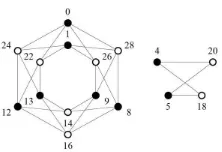
In Figure 3 we show an example of this labeling for the disconnected α-graph of order 8 and size 7, G=C6∪P2.
Figure 3: α-labeling of (C6∪P2)⊕K2
4
A Graceful Union
There are several papers devoted to the gracefulness of disconnected graphs (see [5]). Within this section we analyze the union of a path and a certain type ofα-labeled graph. First, we construct an ad hoc labeling of the path of size m, Pm+1, which is used later together with an amplification of an α-labeling of a graph G to produce anα-labeling of
G∪Pm+1. We conclude the section with a list ofα-graphs that can be used in the place of the graph G just mentioned.
Let G be a graph of size n. Any injective assignment f of nonnegative integers to the vertices of Gthat induces the weights 1,2, . . . , n is called acomplete labeling ofG. In the next proposition we show that the path Pm+1 admits a complete labeling other that its well-known α-labeling.
Proposition 3. The path Pm+1 admits a complete labeling with labels taken from the set
{0,1, . . . , m−1, m+ 1}, m ≥3.
Proof. LetPm+1 be a path of order m+ 1 with{A, B}the natural partition of V(Pm+1);
without loss of generality, we are assuming that |A| ≥ |B|. Let A = {u1, u2, . . . , u|A|}
and B = {v1, v2, . . . , v|B|}, so Pm+1 is described by the edges uivi and viui+1 for every
1≤i≤ |B|. We analyze six cases based on the congruence modulo 3 of|A|and |B|, and the fact that |A| − |B| ≤1.
Case I: |A| ≡1(mod 3) and |B| ≡0(mod 3).
Let f :V(Pm+1)→ {0,1, . . . , m−1, m+ 1} be the injective function defined below:
For every i≡2(mod 3),f(vi) =i−2,f(vi−1) = i−1, andf(vi+1) =i.
For every i≡1(mod 3),f(ui) =m+ 2−i, f(ui+1) = m−i, and f(ui+2) =m−2−i.
The function f is defined as in Case I except forv|B|, here f(v|B|) =|B|.
Case III: |A| ≡2(mod 3) and |B| ≡1(mod 3).
Again, f is defined as in Case I except foru|A|, in this case f(u|A|) =|B| −1.
Case IV:|A| ≡1(mod 3) and |B| ≡1(mod 3).
In this case the exceptions arev|B|−1andv|B|, heref(v|B|−1) = |B|−1 andf(v|B|) =|B|−2.
Case V: |A| ≡0(mod 3) and|B| ≡2(mod 3).
Now we proceed as in Case I except for u|A|−1 and u|A|, here f(u|A|−1) = |A| −1 and
f(u|A|) =|A|.
Case VI: |A| ≡2(mod 3) and |B| ≡2(mod 3). In this case we assign the labels as in Case I.
We claim that f, so defined, is a complete labeling of Pm+1. Because the proof is similar for all cases, we prove our claim for Case I and leave the remaining cases for the interested reader.
When i ≡ 2(mod 3), there is an integer k, 1 ≤ k ≤ |B3|, such that i = 3k −1. It is not difficult to see that the edges ui−1vi−1, uivi−1, uivi, ui+1vi, ui+1vi+1, and ui+2vi+1 have
weightsm−6k+6,m−6k+4,m−6k+5,m−6k+3,m−6k+1, andm−6k+2, respectively. Since 1 ≤ k ≤ |B3|, we have that the induced weights form the set {1,2, . . . , m}. Notice that the larger labels used are m−1 and m+ 1, on the vertices u2 and u1, respectively. Therefore, f is the complete labeling of Pm+1 described by the proposition.
In Figure 4 we show some complete labelings of Pm+1 corresponding to each case within
the proof of the previous proposition.
Figure 4: Complete labelings of Pm+1
Theorem 4. Let G be an α-graph of size n and order at most n. If there exists an α -labeling f of G, with boundary value λ, such that λ+ 2is not a label of G, then G∪Pm+1
Proof. Suppose that the vertices of G have been labeled using the function f. This labeling is amplified in such a way that the largest induced weight is m +n. In this manner, the integer λ+m+ 2 is not assigned as a label of G. On the other hand, we apply to Pm+1 the complete labeling described in Proposition 3 shiftedλ+ 1 units, so the
largest label on Pm+1 is λ+m+ 2. Thus, we have a graceful labeling of G∪Pm+1.
In Figure 5 we show an example for a graph of the form G∪ Pm+1. The labeling of
G=C8⊕K2 was obtained using the α-labeling of C8 given in [6]; the complete labeling
of P8 was obtained using Proposition 3, Case IV, shifted 14 units.
Figure 5: α-labeling ofC8⊕K2∪P8
Notice that when Pm+1 fits with case I, VI, V, or VI in Proposition 3, the labeling of
G∪Pm+1 is an α-labeling.
Someα-labeled graphs that satisfy the conditions of Theorem 4 are the complete bipartite graphKm,n form, n >1, given by Rosa [9] (see also [2]), thekC4-snake given by Barrientos
[1], the cube Qn for n≥2 and the book B2n given by Maheo [7]; the symmetric product
of the pathPn,n≥2 with the null graphK2, Pn⊕K2, given by Seoud and El Sakhawi [7];
G1⊕G2, that is the weak tensor product of two α-graphs, when an α-labeling of G, does not use the label λ+ 2, this operation was introduced by Snevily [12]. We must mention that C3, where C is a caterpillar, labeled as in Section 2 also satisfies the conditions of
Theorem 4 as well as those of the graphs G⊕K2 presented in Section 3.
5
Conclusions
6
Acknowledgements
We want to thank the referee(s) for his/her valuable comments and fine work.
References
[1] C. Barrientos, Graceful labelings of cyclic snakes, Ars Comin., 60(2001) 85-96.
[2] C. Barrientos, The gracefulness of unions of cycles and complete bipartite graphs,
J. Combin. Math. Comput., 52(2005) 69-78.
[3] G. Chartrand and L. Lesniak, Graphs & Digraphs, 2e, Wadsworth & Brooks/Cole Advanced Books & Software, Monterey, CA (1986).
[4] R. Figueroa-Centeno, R. Ichishima, and F. Muntaner-Batle, The place of super edgemagic labelings among other classes of lableings, Discrete Math., 231(2001), 153-168.
[5] J.A. Gallian, A dynamic survey of graph labeling, Elect. J. Combin., DS6(2013).
[6] Q.D. Kang, Z.H. Liang, Y.Z. Gao, and G.H. Yang, On labeling of some graphs, J. Combin. Math. Comput.,22(1996), 193-210.
[7] M. Maheo, Strongly graceful graphs, Discrete Math., 29(1980) 39-46.
[8] M. Maheo and H. Thuillier, On d-graceful graphs, Ars Combin., 13(1982) 181-192.
[9] A. Rosa, On certain valuations of the vertices of a graph,Theory of Graphs (Internet. Symp., Rome, July 1966), Gordon and Breach, N.Y. and Dunod Paris (1967) 349-355.
[10] M.A. Seoud and E. El Sakhawi, On variations of graceful labelings, Ars Combin., 87(2008) 127-138.