University of New Orleans University of New Orleans
ScholarWorks@UNO
ScholarWorks@UNO
University of New Orleans Theses and
Dissertations Dissertations and Theses
Summer 8-2-2012
Trouble Every Day
Trouble Every Day
Nina E. Schwanse
University of New Orleans, [email protected]
Follow this and additional works at: https://scholarworks.uno.edu/td
Part of the Fine Arts Commons
Recommended Citation Recommended Citation
Schwanse, Nina E., "Trouble Every Day" (2012). University of New Orleans Theses and Dissertations. 1535.
https://scholarworks.uno.edu/td/1535
Trouble Every Day
A Thesis
Submitted to the Graduate Faculty of the University of New Orleans in partial fulfillment of the requirements for the degree of
Master of Fine Arts in
Fine Arts
Digital and Trans Media
by
Nina Schwanse B.F.A. Cooper Union, 2005
TABLE OF CONTENTS
LIST OF ILLUSTRATIONS... iii
ABSTRACT ... iv
INTRODUCTION ... 1
ORIGINS & CONTEXT ... 3
UNPOPULAR CULTURE... 8
BODIES OF LABOR... 10
CONCLUSION... 21
BIBLIOGRAPHY... 22
LIST OF ILLUSTRATIONS
Figure 1... 2
Figure 2... 6
Figure 3... 11
Figure 4... 14
Figure 5... 18
ABSTRACT
My interests lie in the intersection of the public and private, the corporate and
personal, especially with regard to self-representation within cultural power structures.
Utilizing video and web technologies, performance, and painting, I create imagined
realms of fantasy, desire, obsession, and anxiety. Operating within, but not bound by,
feminist discourse, my work explores the vehicles and effects by which both analog and
digital technologies influence the relationship between the self and the object of desire
(whether physical or virtual, interior or exterior to the body) and have produced both
progressive and regressive offspring. By performing the role of both producer of cultural
archetypes and the compulsive consumer of signs, my characters embody the
representation(s) of their source but, through action and voice, invent a mutant surrogate
who dictates its own agency.
INTRODUCTION
An old Chevy pickup truck sits abandoned in a vacant back lot. Nearby a woman
is relaxing on a pool chair, her eyes focused on the snow being emitted from an old
television. She wears a long cream-colored wool coat over her black bikini. On her feet
are work boots; on her face are safety goggles. She rises and removes her coat, placing it
coolly on the back of the chair. Strewn across the ground amongst dirt and weeds are
brushes, rags, sponges, buckets of green paint and water, and a convenient backpack-style
garden sprayer. Somewhat disinterested, the woman hikes the sprayer onto her back and
dispenses its bright green contents onto the truck. She moves on to the brushes, rags, and
sponges, simultaneously coating the vehicle with the chroma-key color and washing her
work away with subsequent gestures. Circling and climbing the old Chevy, she does a
thorough if not sloppy job; her marks are apparent. In the truck’s bed she finds a metal
baseball bat and takes aim at its body, hitting it with full force, putting her whole body
into every impact. The city’s urban hum is pierced by the echoing crash of metal beating
metal. Determinedly and methodically, she batters the vehicle at single-second intervals
until she is exhausted, at which point she returns to the lawn chair and television. After a
few minutes, with her strength restored, she repeats the process.
Version Girl’s Auto Wash and Detailing (2011) was a one-night performance that
conflated my interests in the body, advertising, labor, violence, and the traditional art
practice of painting. A spin on the bikini car wash, this two-hour performance presents
conventional, sexualized femininity as an act of confrontation. Though scantily clad,
aggressive interaction with the vehicle. In contrast to the traditional bikini car wash, the
acts of her labor do not play to the male viewer. Her gesture is exclusively for the truck,
an object of both desire and contempt and a stand-in for the presumably male audience.
Cultural artifacts (bikini, automobile, car wash) have been appropriated, but through a
durational, disjunctive narrative strategy and symbolic manipulations, the origin’s
psychological and political objectives have been subverted. Operating within, but not
bound by, contemporary feminist and post-structuralist discourse, my work explores the
vehicles and effects by which performative practices and digital technologies influence
the relationship between the self and the object of desire (whether physical or virtual,
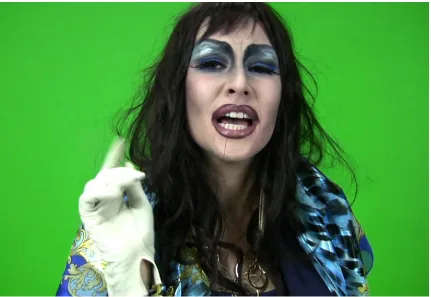
interior or exterior to the body) and have produced both progressive and regressive
offspring.
ORIGINS & CONTEXT
My practice can be traced along two distinct lineages, both of which relate to the
performance of self as a reflection of and/or challenge to reified commodity images of
gender. The first is character-based self-portraiture as first exemplified by the
photography of Claude Cahun. Far ahead of her time, Cahun’s radical work is often
overshadowed by her male Surrealist colleagues. Posing in androgynous costume and
often utilizing masks and props as fetishistic phallic displacements, these early affronts to
singular identity remain eerily timeless while located in the specific moment of
pre-World War II modernism. Consider Cahun’s project alongside Walter Benjamin’s
Arcades Project; through critical observation, Benjamin’s unfinished collection of critical
observations presents a similarly disjointed, “post-modern” view of city life in Paris on
the verge of political and social upheaval.
More ubiquitous and contemporaneously relevant are Cindy Sherman’s
caricatures of femininity, beginning with her 1979 series Untitled Film Stills through her
later Untitled works in the 1980s. Responding to the spectacle of consumerism
prophesized by Guy Debord, Sherman’s work follows the trajectory initiated by Cahun
but locates it specifically in American popular culture. At the time, these cold, distant
photographic representations of the self as an archetypical other were a departure from
both minimalist and romantic conceptions of what art should look like and be about. As
many critics and theorists have elaborated upon, Sherman appropriates image signifiers
from cinema, advertising, fashion and art history and re-invents them, most often using
specific source, Sherman’s host material remains only vaguely familiar. She thereby
brilliantly taps into subconscious cultural memory to highlight how pervasively
expectations of the feminine have penetrated our society, and also how dependent on
commodity image our collective identity has become.
Sherman’s use of cinematic clues, including makeup, costuming and props,
camera angle, composition, depth of field, etc. imply situations that the audience is
already familiar with, though they lack narrative specificity beyond the single frame.
What Sherman and Cahun do with still photography I attempt to expand via time-based
media. Enabling would-be caricatures to perform actions independent of their
appropriated image or informational “text” opens up more complicated readings of
existing identity signifiers and proposes creative possibilities for self-representation.
Another history from which my work draws heavily is the body-oriented work of
feminist artists in the 1970s. Like many of these women working forty years ago, I use
myself as model in every video and performance I have made thus far. This again places
my work within a tradition of self-portraiture, though I consider myself a prop or
instrument for larger truths and contradictions, rather than speaking directly from my
personal history. I am not comfortable exploiting another person’s physical,
psychological or emotional state in order to achieve the necessary effect for a given
piece. Rigorous self-exploitation is exhausting but has become an integral element of my
process.
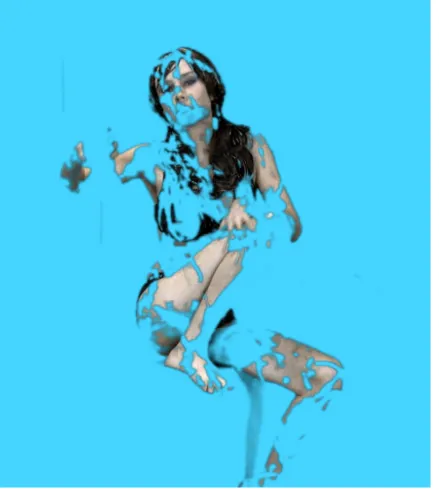
In Squirting RGB216X (2011), I utilize the painted gesture and apply it to my own
body. One of my least character-driven works, this video opens with me sitting atop a
pigtails. Staring directly at the video camera, I go through a series of seductive and
awkward poses that conjure moments from art history and fashion advertisements. The
pedestal and background are keyed out and have been replaced with solid flashing colors
at single frame intervals; this chromatic arrangement is based on the 216 web-safe colors
in alphanumeric order. After a few moments, I lift a bottle and begin squirting myself
with green screen paint. The paint is also keyed and therefore the marks made on my
body disappear into the background. As the performance progresses, my body almost
completely disappears under the gesture of wet paint upon its surface. The only audio
throughout this single take is the sound of liquid squirting, my uncomfortable moans as
the paint gets into my mouth and eyes, and a fan running in the background.
From the pedestal to the poses, Squirting RGB216x intends to confront the male
gaze and question how viewing conditions have shifted with digital technologies. Though
situated in a studio environment, the pedestal references the museum while the body
functions as a stand-in for traditional figurative sculpture. (In Squirting RAW—the
un-keyed version—green canvases are visible hanging salon-style on the wall behind the
pedestal.) Thus situated in an art context, the piece sets up a traditional viewing
experience; the female body is on full display for the exclusive pleasure of the looker.
However, the physical materiality of the paint responds to the model’s actions over time,
and is further mediated by the camera and post-production technology to disrupt gaze of
Figure 2 – Video still, Squirting RGB216x (2011)
Painting is the aesthetic language in which women have historically been most
objectified, surpassed only in the last century by photography and cinema. In Squirting
psychological resemblance not to painting, but to male ejaculation. But this ejaculatory
gesture, enacted by the object of desire herself, effectively disintegrates the figure. This
creates an effect of alienation from the viewer; though the skin is exposed the body is
cold and impossible to visually grasp.
Despite these concerns, this piece still sexualizes the female body. This operates
within the aforementioned trajectory of second-wave feminist artists who used their
bodies in order to make a statement, prove a point, horrify, seduce, or educate. Carolee
Schneemann intentionally eroticized her body in order to explore its physical limits, and
portray an unrepressed, non-violent image of female sexuality. Her Fuses (1967) is
considered the first piece of feminist erotic film, and Interior Scroll (1975) notoriously
confronted the male-dominated art world’s sexist power structure via Schneeman’s
vagina. Hannah Wilke, too, had no fear of placing her naked body on display, or of the
retaliation it would generate from mainstream feminism. In Starification Object Series
(1975), a group of photographs in which she is topless and adorned with vulva-like forms
fashioned from chewing gum, Wilke mimics poses from women’s magazine
advertisements. Most influential is Lynda Benglis’ infamous November 1974 Artforum
ad. Naked, tan and oiled, but with cropped hair and a double dildo protruding from her
genitals, Benglis created a female monster who is sexy but threatening, feminine but
emasculating, and ultimately resists any straightforward interpretation, further
emphasized by her dark sunglasses that deflect the viewer’s gaze. Her use of “ad space”
to disseminate her work beyond the walls of the gallery also effectively converts an art
UNPOPULAR CULTURE
Like Schneemann, Wilke, and Benglis, I’m not hesitant to sexualize my own
body, or my work, in order to respond to what remains a culture of violence. Though the
art world, in part, has evolved to praise and validate an almost equal number of female
artists, much of mainstream culture remains largely misogynist. Advertising, television,
music and (what passes as) cinema continue to proliferate bigoted representations of both
feminine and masculine identity that reinforce power relationships against which much of
the last century was spent fighting. In our supposed “post-feminist,” “post-race”
environment, much of cultural production still prescribes an excess of gender and ethnic
stereotypes as commodity lifestyle. Whether dictated by high culture (fashion) or low
(Jersey Shore), the message is similar and carried via coded visual and narrative
signifiers. With an expanded fetish vocabulary and more efficient methods of
communication, corporate consumerism simultaneously markets ignorance and
submission while converting human action into saleable data. How can this
objectification and dehumanization be subversively resisted in everyday life?
It is in this space of confluence, where culture and politics intersect with private
life, that I find an opportunity for creative intervention. I draw inspiration from both
popular and unpopular cultures. Pop culture can be defined as the process by which
material information is disseminated through consumption. Privately owned cultural
information becomes public psychological property and is integrated into the private lives
of its consumers. The same happens with counter-cultural movements, as they are
can account for the contradictions and idiosyncrasies that inform marginalized identities
and subversive body politics. This instability of the self in society and the unpopular
culture it generates is the subject of my work. Through a hybridized regurgitation of
celebrity, the avatar, the violence of images (still and moving) and the self-portrait, my
work renegotiates the contours of gender roles and promotional identity tactics.
Subconscious cultural entities are externalized through characters that enact these larger
BODIES OF LABOR
The notion of the gaze has been widely theorized in terms of the objectification of
the female body. Over the course of the last two decades, the threshold between viewer
and viewed has coalesced as a result of new technologies that allow for expanded forms
of self-representation. With tools such as social networking sites and web-cams in
popular circulation, users of both sexes simultaneously occupy the position of subject and
object through a networked exchange of self-portraiture. Despite this step toward agency
in the mediation of the self, technology has also contributed violent misfortunes that
reinforce a masculine chauvinist way of vision. This is most readily witnessed in the
pornography industry, where relationships of power and control are paramount beneath
the surface titillation of image and narrative.
With this in mind, Babe-Rental.com (2011) attempts to subvert the male gaze by
positing a faux web-cam company. Whereas Sherman’s work addressed the cinematic
gaze via still photography, my web-based project confronts the world of internet porn
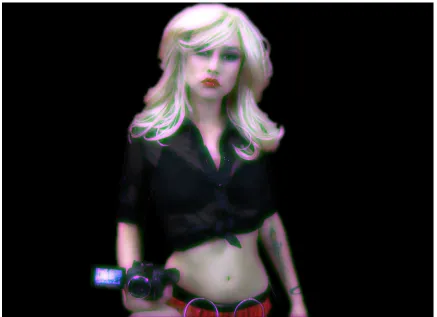
head-on under a guise in close proximity to reality. This deceptively real site features a
selection of twelve call girls, each filling a different archetype that may appeal to a
customer’s special interests. Operating within the technological boundaries of the
commercial porn industry sets up an effective (web)site to undermine its ideological
implications.
Though the site itself contains no actual pornographic imagery, its home page
bears a standard warning regarding adult content. Upon clicking to “enter,” the visitor is
(supposed but not actual) live feed video of varying lengths in which a woman, partially
dressed and with a prop to match her personality, awkwardly “performs” for the camera.
Though each bears distinct characteristics that mark her particular appeal, they are
essentially interchangeable representations of already culturally existent displays of
highly sexualized femininity. There are twelve “babes” to chose from, each to represent a
different month in the year and therefore a calendar page. They are in a void, a black hole
that removes their existence from any established setting; this blank site provides an
empty backdrop against which this singular body mutates between characters.
The Babe-Rental workers’ identification with a fetish object points to sexual
disavowal, but besides their outfits, there isn’t too much that’s sexy about these videos.
The image is disjointed by severe differences in video quality, and frequently interrupted
by close-ups that don’t make sense. Their actions consist of repeating certain non-sexual
tasks, and reciting and (often incorrectly) spelling their names: Carmen, Bunny, Darlene,
etc. For the most part, there is a lack of escalation and conclusion, a lack of narrative in
general. In essence these are sex workers who don’t deliver, so why do they even exist?
They gaze directly into the camera, but one gets a sense that they are producing these
videos for themselves, and collectively they function to form a single identity.
These bodies combine into a single corporate unit—as individuals they are
protected by their pseudonyms and by their umbrella organization. The Babe-Rental
company brand also engages in similar marketing strategies that are employed by
legitimate corporations. For instance, they manufacture call-girl cards that recreate the
Vegas porn aesthetic but leave out essential contact information. Leaving these souvenirs
on the streets and in bathrooms, I can direct unassuming customers/ potential audiences
to the website. Navigating this fine line between art and reality is something I explore
further in public performances.
Babe-Rental.com took on a live routine in Babe-Rental.com Marketing Strategy
#6: Community Outreach (2011), a public performance in the French Quarter for a
non-art audience. The twelve faux sex workers combined into a single entity and walked
Bourbon Street, New Orleans distributing the call-girl cards and “trying to find a job.”
Combining these twelve virtual characters into a single physical body resulted in a
interaction. Greeted with enthusiasm, skepticism, disdain or outright disinterest by the
public, “Carmen/Jennifer/Allison et al” demonstrated, if nothing else, how essentially
un-out-of-place she was among the strippers, drunks, street freaks and service industry
workers that occupy any tourist hotspot, thereby highlighting the dysfunctional
functionality of a location rich with human purchasing capital.
Community Outreach marked my first foray into public performance. Accustomed
to working in total isolation during both my research and production process in the
studio, I started feeling the need to bring my work back into the culture from whence it
came. The mutated “Twelve-In-One” sex worker fits in superficially as image with the
source material from which she is appropriated, but she is psychologically isolated from
her colleagues and potential customers. This struggle for collective identification within
an alienating popular society is something I explore further.
***
My next performance-based project, The Comeback (2012), explores another
manifestation of self-definition in public space. Similarly enacted in both private space
(the artist’s studio) and the public arena (sports fandom), this multi-faceted piece expands
upon the ideas of body politics and psychological trauma.
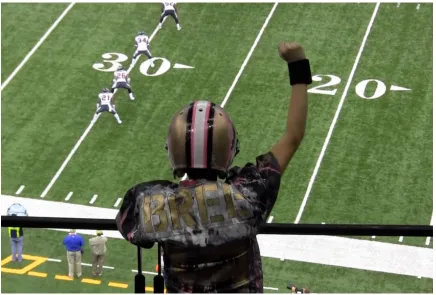
Meet Bree Andrews, a local football fan who engages in an everyday struggle to
manage her reality. Bree’s fandom extends into obsession, fueled primarily by her
inability to understand why she does not possess the physique to play in the National
Despite her disability, she believes that her body was cloned from the DNA of star
quarterback Drew Brees through a scientific effort to cure breast cancer. If she follows
his mantras and puts forth full effort, not only will they find a cancer cure together, but
also her dreams of playing on the field will come true. If only she had a chance, she could
prove her prowess to him and the world.
Figure 4 – Video still, The Comeback (2012)
In the video component to this project, we see a petite female with short dark hair
attend a football game at the Superdome, New Orleans. The full football gear she wears,
including cleats and helmet, appear very dirty, though she is in fact covered with paint. It
minimal but civil; she feels like she has a responsibility to do something and she takes
herself very seriously.
This character’s delusions stem from the emotional and psychological strain that
accompanies trauma, both individual and collective. Bree’s symbolic confusion of self
and her desire to attain the physically and culturally impossible is symptomatic of larger
struggles to identify oneself in a culture that prescribes normative gender roles. Her
schizophrenia functions as a displacement of her self-deprecation-- a by-product of her
injury, which remains ambiguous. Whether a shot to the head, a fall, or a nervous
breakdown, her specific trauma has mutated into a single all-encompassing physical
event.
Bree Andrews is also a local artist. In addition to obsessively reciting Drew
Brees’ advice in how to “unleash the hidden power of adversity” (mantras extracted from
his autobiography), she repeatedly paints small portraits of him. She also obsessively
practices her own signature, which doubles as an autograph, the most prized memento of
a fan encounter (the resulting scribbled product resembles a cross between Pollock and
Twombly). Bree’s self-esteem is reinforced by these two strands of identity
mark-making; her absence of self is filled by the repetitive autograph gesture associated with
the Ab-Ex macho man, as the oil portraits of Brees on her wall resemble a teenager’s
bedroom turned artist studio as she searches for a way to define her identity according to
her surrounding culture.
Though the small portraits of Drew Brees are an extension of the obsessive
gesture, this body of work is also how she markets, and therefore defines herself, as
microcosm of the capital-driven art world at large, where artists often produce in seriality
in order to meet the demands of collectors and gallerists. Further, in our contemporary
situation, the artist often must act as entrepreneur; how often do we see seminars with
titles like “The Business of Art” that cater specifically to the “local artist” community?
Bree Andrews manages to create outside of this value system precisely by way of being a
dysfunctional loner. Though this may carry attachment to stereotypical notions of the
romantic artist who works in isolation, here it functions as a subversion of signifiers that
attempt to delineate the artist’s identity.
***
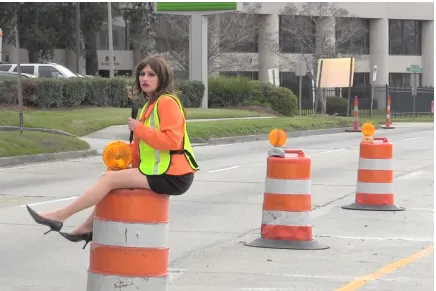
The video Live Report features another protagonist navigating the public/private
at the edge of social communications. This piece opens with a blank greenscreen and the
sound of heavy traffic. A woman appears, her face bruised and makeup messy. The video
cuts to an overpass construction zone, where we see the same woman wandering around
with a microphone. We follow this transplanted individual, dressed in a bright orange
blazer and fluorescent yellow safety vest, as she navigates this torn geography, the cause
of the traffic congestion that interests her as a reporter. We hear her interior monologue,
which refers to her current predicament and reflections on a “him” of the past. Over the
course of the narrative, it is revealed that this woman is lost and has undergone some kind
of trauma.
This traffic reporter’s origins and identity remain unknown. She could be
ravaged infrastructure around her; she unconsciously traverses construction zones in an
attempt to restructure her identity. Though lost, this is the landscape in which she feels
most comfortable. Due to her lack of self, she has only her work to identify with, and thus
takes her job very seriously, even though it is a position of self-invention.
Placing our heroine against this backdrop plays on the sexualization of female
local news reporters, transferring her to a traditionally masculine setting. The local
broadcasting studio is a space in which female representation is proliferated according to
specific cultural standards of femininity. One need only perform a simple YouTube
search to find endless examples of a “hot” or “sexy” newsperson; cleavage or a mini-skirt
is a common bonus to the already objectified reporter. This type of publicity is
detrimental to building a strong female identity that is independent of the masculine gaze
of authority. The physically public space in Live Report, however, already removes the
backdrop of the studio screen on which the female image is projected. By re-positioning
herself in an oppressive and alienating outdoor space, and actually occupying the streets
and the often misogyny-plagued zones of “road work” and construction, our reporter
defamiliarizes a coded public domain that is taken for granted in the everyday.
Acting out a gendered professional role in a public place (television, internet, and
outdoors) comes with a certain set of expectations, some to which she still conforms
despite her struggle to re-imagine her identity. She wears high heels, a memento from a
former relationship of which she is unable to completely let go. Like The Comeback, this
piece is ultimately about recovery. However, it also brings up issues of surveillance and
privacy. A reporter’s voice runs continuously in the background detailing the Intelligent
communication technology. While our character is being tracked by her own
cameraperson, the vehicles that surround her are being monitored by a variety of invasive
technologies. Traffic cameras detect vehicle activity, while GPS systems attached to cars
and smart phones monitor user location and activity. This data is then given to homeland
security, which funds many projects of the transportation intelligence network. The same
is true with privacy policies on the internet, where it is more likely one’s information will
be sold to marketing companies. Private space is literally disappearing. (It is for this
reason that I continue to find value in painting and performative practices; it is much
harder for these mediums to be converted into data.)
As seen in Live Report, the untreated greenscreen can be understood as a lack of
information, an empty space on which any fantasy can be projected. In Civil Realness:
Grant vs. Lee, two masculine historical war heroes re-stage a series of battles for a final
showdown against a green studio backdrop. In this re-enactment, however, generals
Ulysses S. Grant and Robert E. Lee are represented as two drag queens. The gender
bending is four-fold: in both personas, I, a female, am in the role of a drag queen (a man
playing a woman), who in turn is playing a historically masculine role. The resulting
equation is: a woman = a (man as a woman) = a man. The gender of the two characters is
ultimately indeterminable, though the concluding Mariah Carey lip synch sequence
would favor the feminine. In addition to borrowing Carey’s ballad, most of the dialog for
this piece was appropriated from the 1990’s MTV show Celebrity Death Match, a
stop-motion animation blood and gore celebration of crude dude humor. In using this as
source material, I intentionally feminize/queer not just a historically masculine military
event but also its popular mythology as demonstrated by cable television.
Television is further referenced by the inclusion of the naked green screen. Here,
the screen is left unmanipulated by post-production keying techniques. Its role as a
placeholder for a fantastical backdrop for action is made obvious. The screen is a surface
onto which anything can be projected, whether a series of images, an idea, or a body.
Thus the green screen serves as a philosophical symbol for the video screen itself, a space
in which psychic desires and politics of the body are often enacted. In Civil Realness, the
seemingly whimsical vogueing contest still references the real physical horror of the Civil
CONCLUSION
Over the course of the last few years and the projects discussed, I’ve elaborated
and refined my process of creating alternative mythologies to societal expectations using
the excesses of culture and limits of personal experience as inspiration. Several artists
working today also use the self as model to enact larger cultural conflicts and
contradictions. Kalup Linzy invents stereotype-driven but highly personal alternate pop
realities that meander gender and race relations to achieve an agency of the individual
over the pressures of society. Stanya Kahn, in both her collaborations with Harry Dodge
and her more recent solo work, creates videos that blur the line of reality and fiction by
staging and improvising situations that explore the relationship between identity and
trauma at the edge of sanity. It is along this trajectory that I would locate the work I
completed during my graduate studies, and will continue to pursue as an artist in the
BIBLIOGRAPHY
Benjamin, Walter. The Arcades Project. Cambridge, MA: Belknap/Harvard, 1999.
Blessing, Jennifer. Rrose is a Rrose is a Rrose: Gender Performance in Photography. New York: Guggenheim Museum, 1997.
Burton, Johanna, ed. Cindy Sherman (OCTOBER Files 6). Cambridge, MA: MIT Press, 2006.
Butler, Judith. Gender Trouble. 2nd ed. New York: Routledge, 2006.
Debord, Guy. The Society of the Spectacle. Trans. Donald Nicholson-Smith. New York: Zone Books, 1995.
Despentes, Virginie. King Kong Theory. Trans. Stéphanie Benson. New York: Feminist Press/CUNY, 2010.
Fraser, Andrea. “An Artist’s Statement.” Institutional Critique: An Anthology of Artists’ Writings. Ed. Alexander Alberro and Blake Stimson. Cambridge, MA: MIT Press, 2009. 318-329.
---. “Official Welcome.” The Artist’s Joke. Ed. Jennifer Higgie. London: Whitechapel, 2007. 162-173
Gautherot, Frank, et al., eds. Lynda Benglis. Dijon: Les presses du réel, 2009.
Hales, N. Katherine. How We Became Posthuman: Virtual Bodies in Cybernetics, Literature, and Informatics. Chicago: The University of Chicago Press, 1999.
Haraway, Donna. Modest_Witness@Second_Millennium.FemaleMan_Meets_Onco-Mouse: Feminism and Technoscience. New York: Routledge, 1997.
---. Simians, Cyborgs, and Women: The Reinvention of Nature. New York: Routledge, 1991.
Joselit, David. Feedback: Television Against Democracy. Cambridge, MA: MIT Press, 2007.
Kelley, Mike. Foul Perfection: Essays and Criticism. Cambridge, MA: MIT Press, 2003.
Kraus, Chris. I Love Dick. Los Angeles: Semiotext(e), 2006.
Lehman, Peter, ed. Pornography: Film and Culture. New Brunswick: Rutgers, 2006.
Mark, Lisa Gabrielle, ed. WACK! Art and the Feminist Revolution. Los Angeles: Museum of Contemporary Art, 2007.
Munder, Heike. “Humor: The Secret of Aesthetic Sublimation.” The Artist’s Joke.
Ed. Jennifer Higgie. London: Whitechapel, 2007. 212-215.
Mulvey, Laura. Fetishism and Curiosity. Bloomington: Indiana University Press, 1996.
---. Visual and Other Pleasures. 2nd ed. Basingstoke, Hampshire: Palgrave Macmillon, 2009.
Nusselder, Andre. Interface Fantasy: A Lacanian Cyborg Ontology. Cambridge, MA: MIT Press, 2009.
Rosler, Martha. Decoys and Disruptions: Selected Writings, 1975-2001. Cambridge, MA: MIT Press, 2004.
Schor, Mira. WET: On Painting, Feminism, and Art Culture. Durham: Duke University Press, 1997.
VITA
The author was born in Los Angeles, CA. She obtained her Bachelor’s degree in Fine
Arts from The Cooper Union in 2005. In 2009 she began Master’s studies at the
![Figure 1- Performance, Version Girl’s Auto Wash and Detailing (2011) [Photo: Jason Derouin]](https://thumb-us.123doks.com/thumbv2/123dok_us/8941803.1851171/7.612.91.522.403.645/figure-performance-version-girl-detailing-photo-jason-derouin.webp)