P etroleum
B usiness
R eview
40
The Impact of ERP Implementation
on Financial Processes: A Case Study
Ali Mohammad Ghanbari a*, Leila Soleimani b
In this research we try to investigate impact of Enterprise Resource Planning
(ERP) implementation on the effectiveness of financial processes in PE -TROPARS Ltd as a case study in petroleum industry. In this regard, three in-dicators of Ahituv and Neumann model containing time, content, and format have been utilized to compare traditional systems used in PETROPARS Ltd before implementation of ERP/SAP system. For this purpose, four
hypoth-esis related to financial processes were developed and data collected from 101 employees related to financial processes in PETROPARS Ltd. There
were 10 research questions related to the three indicators of Ahituv and
Neu-mann model. Research findings show that ERP/SAP implementation has a positive and significant impact on financial processes effectiveness com -pared to the traditional systems previously used (before ERP/SAP system) in PETROPARS Ltd. This research contributes to the body of knowledge for investigation and documentation of actual results of ERP implementation in the petroleum industry of Iran. A phenomenon that has not been previously touched.
A B S T R A C T
Keywords: ERP system Financial Processes Effectiveness
Ahituv and Neumann Model, PETROPARS Ltd
A R T I C L E I N F O
Received: 22.Apr.2017
Received in revised: 10.July.2017
Accepted: 17.July.2017
1. Introduction
Modern organizations use modernized processes and
automation in different operational fields extending from
accounting, supply chain management to production su-pervision. Throughout the years, modern businesses have been considering Enterprise Resource Planning (ERP) system implementation as a necessary attempt in the ter-ritory of information and operation management. The implementation of ERP systems has been recognized as a standout amongst the most broadly embraced advance-ments in management information systems (Al-Mashari., 2002).
ERP is a pact of wide programming bundles made to bolster improvement of coordinated information in various
departments of an organization, such as manufacturing, fi
-nancial and human resources. Organizations endeavor to execute ERP by keeping in mind the end goal to make a value chain inside their organizations. These frameworks are searching for incorporating and versatility in
hierar-chical procedures and information flow within the organi -zation (Cahyadi, 2016). In recent years, ERP has turned
out to be prevalent in mid-sized and large firms across the
world. Before this, each function within an organization had its own information system operating independently from information systems of other organizational func-tions (Rom and Rohde, 2007).
A business process consists of a structured set of activi-ties, which are performed by actors in an organization in order to collaboratively achieve a common business goal- the provision of a service or the production of a product- for an internal or external customer (Melcher, 2014).
a
Assistant Professor , Accounting Department, Petroleum Faculty of Tehran, Petroleum University of Technology, Iran.Email: [email protected]
bMA student in Finance, Petroleum Faculty of Tehran, Petroleum University of Technology, Iran, Email: [email protected]
Volume 1, Issue 1
November 2017
41
The bottleneck of financial activities in an organizationrefers to the fact that these activities have their own
partic-ular importance. High level of diversification of financial activities and their interdependence and effects of finan -cial performance on another part of organizations require a necessity for developing such activities, in particular;
processes. Continuous corrections and improvements in fi
-nancial processes improve fi-nancial performance, provide
on-time information and reduce time and cost. Based on
the importance of financial department in an organization
and its impact on other organizational departments,
cor-rection and improvement of financial processes requires particular attention. Improvement in financial processes
will result in improvements in overall conditions of or-ganization. PETROPARS Ltd Company was established in January 1998 in partnership with the Employees
Retire-ment Fund of Oil Ministry and IDRO` of Iran with the
approval of the Supreme Economic Council on the island of the British Virgin Island. The primary objective of establishing an Iranian general contractor was to
imple-ment developimple-mental projects in the oil and gas fields in
the country and entering the international markets of oil and gas. In this regard, the 1st, 4th, 5th, 6th, 7th, 8th, 12th,
and 19th phases of South Pars gas field was awarded to
the PETROPARS ltd based on Buyback or EPC contracts. These contracts have a value of more than 18 billion dol-lars. PETROPARS ltd has recently implemented ERP sys-tem. Therefore, the effects of such implementation should
be investigated. One of them is ERP impact on the finan -cial processes of an organization. This effect has not been previously addressed. Therefore, we try to investigate the
impact of ERP implementation on the financial processes
effectiveness at PETROPARS.
The remainder of this paper is organized as follows:
Section 2 begins with the literature review in the field of
ERP. Section 3 describes the methodology employed for this study. Section 4 represents and analyses the results of our study. Finally, the paper concludes with a summary including suggestions provided for future research.
2. Materials and Methods
Olhager and Selldin (2003) recommended that organi-zations which adopted an ERP system are encountering enhancements in performance mainly from the informa-tion perspective. They resulted that ERP implementainforma-tion enhances the accessibility of information, integration of business strategies and functions and the quality of infor-mation.
O’Leary (2004) investigated and measured ERP
sys-tem benefits and its differences between industries. ‘’He added some other benefits to Deloitte Consulting study which are inventory reduction, financial close cycle reduc -tion, personnel reduc-tion, management improvements, IT cost reduction, on-time delivery, information visibility,
integration, flexibility, better decisions, financial controls,
new reports – reporting capability’’ .
Spathis and Constantinides (2004) inspected the pur-poses for endeavors’ choice to supplant traditional infor-mation systems (IS) with completed ERP systems and investigated the progressions that happen as far as ac-countant applications. The results delineated that the three most important motives that led to ERP adoption were increased demand for real-time information, information generation for decision-making and need for integration of
applications. The most important benefits for accounting due to ERP implementation were increased flexibility in
information generation, increased integration of account-ing applications, improved quality of reports statement of accounts, improved decisions based on timely and reliable accounting information and reduction of time for closure of annual accounts.
Sutton (2006) showed that data collection and usage change using ERP systems. The accounting process is im-pacted by these changes. Jarvenpaa (2007) noticed that ERP systems help companies adopting new management accounting practices and accountants accomplish their ac-tivities effectively and report more quickly.
Galani, Gravas, and Stavropoulos (2010) in their re-search about the impact of ERP systems on accounting processes in Greece companies concluded that ERP
sys-tems provide higher information integration and flexibility
in information availability.
Mohammad Zadeh, Akhavan Safar, and Bakhshaei moghadam (2012) in their article entitled “Enterprise Resource Planning and its effect on accounting”, concen-trated on the effect of ERP implementation on qualitative
characteristics of accounting information. Research find -ings represent that ERP systems have a favorable effect on reviewed topics. Five hypotheses were explained and examined the impact of ERP implementation on each of qualitative characteristics of accounting information such as relevance, reliability, understandability, and compara-bility.
Hejazi and Ismaili Kia (2013) in a study entitled the effects of Enterprise Resource Planning systems on
P etroleum
B usiness
R eview
42
Planning systems. Also, companies that are unprofitable,
have Mergers and acquisitions activities in this period, lower market value and short life of ERP implementation, are less likely prone to internal control weaknesses and ex-perience compared with companies without ERP systems. Hamidi (2014) in her research about the impact of ERP system on accounting processes in Gilan Power Dis-tribution Company provided evidence that the utilization
of ERP greatly improves financial processes compared
to traditional systems. Implementation of ERP systems increases the precision of data recording in all processes and reduces the time for carrying out all processes. Also, it increases the reliability of data processing and reporting.
Hesam al-Dini (2015) in his thesis, investigated the effect of ERP on business agility in Hedco Design and Engineering Company. He used questionnaire for data gathering. Results of his survey represent that ERP affects organizational agility, business process satisfaction and goal realization of business processes. He also concluded that ERP has a direct impact on business processes.
Studies in the field of ERP in Iran are more relevant to
feasibility studies before the implementation of ERP. Very few companies implement and use ERP systems. So there is not much evidence about the actual results of ERP
im-plementation. The oil industry has its own specific charac
-teristics and PETROPARS is the first petroleum company that has recently implemented ERP system. So as the first
ERP experience in the oil industry, this research tries to
examine the actual results of ERP implementation in this company.
There were three phases of data collection used for the
study. The first phase involved library method for literature
review, second and third steps involved a comprehensive
case study analysis comprising interviews for financial process identification and documentation and distributing
questionnaires for data collection from PETROPARS Ltd employees and managers.
According to Mishra and Mishra (2010), “case study examination gives an advanced understanding of inade-quately understood phenomena in a real-world setting with
the assistance of transferability of research findings. The
researcher analyses a particular case at each time restricted by the activity process or a social group under investiga-tion. This allows the researcher to obtain detailed insights via a diverse range of data collection procedures”.
Mabert, Soni and Venkataramanan (2003) recom-mended that case studies and interviews help researchers provide reliable and detailed information about the ERP implementations.
For the purpose of this study, the researcher used data collection methods including interviews for processes documentation and questionnaire for data collection about
the ERP impact on financial processes effectiveness.
2.1. Conceptual Framework
Based on the results of prior studies conducted in the
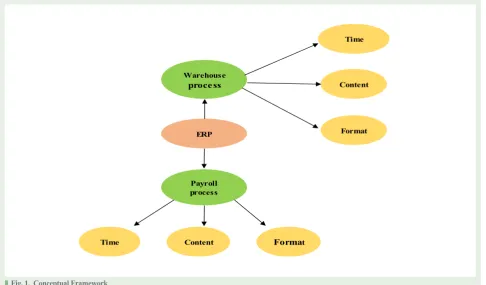
Fig. 1. Conceptual Framework
5
2.2.
Conceptual Framework
Based on previous researches conducted in the field of ERP, following theoretical model will be used
in our research.
Figure 1. Conceptual Framework
2.3.
Variable definition
This research is an applied research based on its purpose. Research variables are as follows:
Dependent variable
: effectiveness of financial processes
Independent variable
: ERP system
Since final products of financial processes are providing reports to external and internal users, we use
information attributes of Ahituv and Neumann model for financial processes effectiveness evaluation.
There are five models for information systems
ی
evaluations. These models are Ahituv and Neumann
Model, Portfolio Model, Strategic alignment Model, Architecture Model, Chandler Two-dimensional
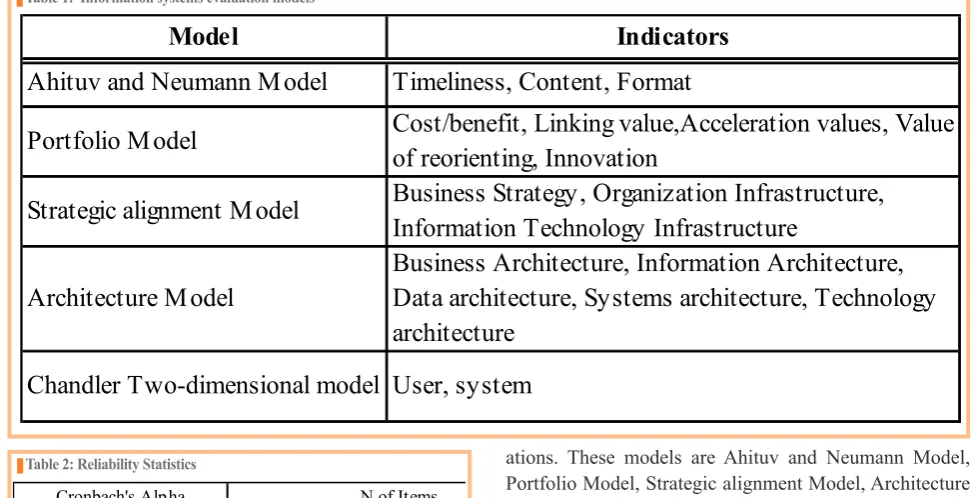
model. Indicators of each model are presented in table 1 [
Derakhshani and Vahedi, 2015
].
Table 1. Information systems evaluation models
Warehouseprocess
Time
ERP Format
Content Time
Content Payroll process
Format
Model Indicators
Ahituv and Neumann Model Timeliness, Content, Format
Portfolio Model Cost/benefit, Linking value,Acceleration values, Value of reorienting, Innovation
Strategic alignment Model Business Strategy, Organization Infrastructure, Information Technology Infrastructure
Architecture Model Business Architecture, Information Architecture, Data architecture, Systems architecture, Technology architecture
Volume 1, Issue 1
November 2017
43
Table 1: Information systems evaluation models
5
2.2.
Conceptual Framework
Based on previous researches conducted in the field of ERP, following theoretical model will be used
in our research.
Figure 1. Conceptual Framework
2.3.
Variable definition
This research is an applied research based on its purpose. Research variables are as follows:
Dependent variable
: effectiveness of financial processes
Independent variable
: ERP system
Since final products of financial processes are providing reports to external and internal users, we use
information attributes of Ahituv and Neumann model for financial processes effectiveness evaluation.
There are five models for information systems یevaluations. These models are Ahituv and Neumann
Model, Portfolio Model, Strategic alignment Model, Architecture Model, Chandler Two-dimensional
model. Indicators of each model are presented in table 1 [
Derakhshani and Vahedi, 2015
].
Table 1. Information systems evaluation models
Warehouse
process
Time
ERP Format
Content Time
Content Payroll process
Format
Model
Indicators
Ahituv and Neumann Model
Timeliness, Content, Format
Portfolio Model
Cost/benefit, Linking value,Acceleration values, Value
of reorienting, Innovation
Strategic alignment Model
Business Strategy, Organization Infrastructure,
Information Technology Infrastructure
Architecture Model
Business Architecture, Information Architecture,
Data architecture, Systems architecture, Technology
architecture
Chandler Two-dimensional model User, system
field of ERP, following theoretical model will be used in our research. We use Ahituv and Neumann model for fi -nancial processes effectiveness evaluation which include time, content and format. For the purpose of this study, we use warehouse and payroll processed in PETROPARS ltd.
2.2. Research Hypothesis
Based on the results of prior studies in the field of ERP
and effects of ERP systems on business processes, follow-ing research hypotheses are developed:
H_1: ERP implementation has significant impact on
payroll process effectiveness compared with traditional systems.
H_2: ERP implementation has significant impact on
warehouse process effectiveness compared with tradition-al systems.
2.3. Variables definition
This research is an applied research based on its pur-pose. Research variables are as follows:
Dependent variable: effectiveness of financial
processes
Independent variable: ERP system
Since final products of financial processes are the re -ports provided to external and internal users, we use in-formation attributes of Ahituv and Neumann model for
financial processes effectiveness evaluation.
There are five models for information systems evalu
-ations. These models are Ahituv and Neumann Model, Portfolio Model, Strategic alignment Model, Architecture Model, Chandler Two-dimensional model. Indicators of each model have been presented in table 1 (Derakhshani & Vahedi, 2015).
As our research population was small, all members of population were considered for data gathering. Members of population are all PETROPARS employees who were related to each of research hypothesis. So research sample is equal to research population.
The SPSS 22 software has been used for analysis of the data collected through questionnaires (descriptive
statis-tics). Since effectiveness of financial processes is a latent
variable and we cannot measure it directly, we used Smart-PLS software and Structural Equation Modeling (SEM) based on partial least square approach for hypothesis test-ing which is the best method when research hypothesed include latent variables.
The data reliability test of this study was calculated
us-ing Cronbach’s Coefficient Alpha and the SPSS software.
As it is shown in Table 2, results of calculating 20 sam-ples emphasize on the reliability of questionnaires (0.803)
which is above 0.7. Nunnaly specifies a value of Cron -bach’s Alpha above 0.70 as indicative of reliability [Nun-nally and Bernstein, 1978].
3. Results
Table 3 shows each department’s population. As it is shown, a total of 54 employees worked and involved in the
financial processes studied within the PETROPARS Ltd.
Based on Table 4, about 15 percent of respondents
Table 2: Reliability Statistics
6
As our research population was small, all member of population considered for data gathering. Member of population are all PETROPARS’S employees who are related to each of research hypothesis. So research sample is equal to research population.
SPSS 22 is used for analysis of data from questionnaire for descriptive statistics. Since effectiveness of financial processes is a latent variable and we cannot measure it directly, we used Smart-PLS software and structural equation modeling based on partial least square approach for hypothesis testing which is the best method when research hypothesis is about latent variables.
Data reliability of this study calculated using Cronbach’s Coefficient Alpha by SPSS software. As shown in table 2, Calculation results of 20 samples show that reliability of questionnaire is 0.803 which is above 0.7. Nunnaly specifies a value of Cronbach’s Alpha above 0.70 as indicative of reliability
[Nunnally and Bernstein, 1978].
Table 2. Reliability Statistics
3.
Results
Tables 3 shows research populations which are 54 employees who work in PETROPARSLtd and relate to studied financial processes.
Table 3. Respondent for each process
Based on table 4, about 15 percent of respondents work in contract and commercial department, 37 percent in financial management department, 22 percent in HR department, 19 percent in project, and 7 percent in planning department. Because of our concentration on financial process, most respondent work in financial management department.
Table 4. Respondent’s Department
Cronbach's Alpha N of Items
.803 15
Frequency Percent Valid Percent Cumulative Percent
Payroll 26 48.15 48.15 48.15
Warehouse 28 51.85 51.85 100.00
Total 54 100.0 100.0
valid
Frequency Percent Valid Percent Cumulative Percent Contracts &
Commercial 8 14.81 14.81 14.81 Financial Man 20 37.04 37.04 51.85 Human Resource 12 22.22 22.22 74.07
Planning 4 7.41 7.41 81.48
Project 10 18.52 18.52 100.00
Total 54 100.00 100
P etroleum
B usiness
R eview
44
Table 3: Respondent for each process
6
As our research population was small, all member of population considered for data gathering. Member
of population are all PETROPARS’S employees who are related to each of research hypothesis. So
research sample is equal to research population.
SPSS 22 is used for analysis of data from questionnaire for descriptive statistics. Since effectiveness of
financial processes is a latent variable and we cannot measure it directly, we used Smart-PLS software
and structural equation modeling based on partial least square approach for hypothesis testing which is
the best method when research hypothesis is about latent variables.
Data reliability of this study calculated using Cronbach’s Coefficient Alpha by SPSS software. As
shown in table 2, Calculation results of 20 samples show that reliability of questionnaire is 0.803 which
is above 0.7. Nunnaly specifies a value of Cronbach’s Alpha above 0.70 as indicative of reliability
[
Nunnally and Bernstein, 1978
].
Table 2. Reliability Statistics
3.
Results
Tables 3 shows research populations which are 54 employees who work in PETROPARS
Ltd
and relate
to studied financial processes.
Table 3. Respondent for each process
Based on table 4, about 15 percent of respondents work in contract and commercial department, 37
percent in financial management department, 22 percent in HR department, 19 percent in project, and 7
percent in planning department. Because of our concentration on financial process, most respondent
work in financial management department.
Table 4. Respondent’s Department
Cronbach's Alpha N of Items
.803 15
Frequency Percent Valid Percent Cumulative Percent
Payroll 26 48.15 48.15 48.15
Warehouse 28 51.85 51.85 100.00
Total 54 100.0 100.0
valid
Frequency Percent Valid Percent Cumulative Percent
Contracts &
Commercial 8 14.81 14.81 14.81
Financial Man 20 37.04 37.04 51.85
Human Resource 12 22.22 22.22 74.07
Planning 4 7.41 7.41 81.48
Project 10 18.52 18.52 100.00
Total 54 100.00 100
Valid
Table 4: Respondent’s Department
6
As our research population was small, all member of population considered for data gathering. Member
of population are all PETROPARS’S employees who are related to each of research hypothesis. So
research sample is equal to research population.
SPSS 22 is used for analysis of data from questionnaire for descriptive statistics. Since effectiveness of
financial processes is a latent variable and we cannot measure it directly, we used Smart-PLS software
and structural equation modeling based on partial least square approach for hypothesis testing which is
the best method when research hypothesis is about latent variables.
Data reliability of this study calculated using Cronbach’s Coefficient Alpha by SPSS software. As
shown in table 2, Calculation results of 20 samples show that reliability of questionnaire is 0.803 which
is above 0.7. Nunnaly specifies a value of Cronbach’s Alpha above 0.70 as indicative of reliability
[
Nunnally and Bernstein, 1978
].
Table 2. Reliability Statistics
3.
Results
Tables 3 shows research populations which are 54 employees who work in PETROPARS
Ltd
and relate
to studied financial processes.
Table 3. Respondent for each process
Based on table 4, about 15 percent of respondents work in contract and commercial department, 37
percent in financial management department, 22 percent in HR department, 19 percent in project, and 7
percent in planning department. Because of our concentration on financial process, most respondent
work in financial management department.
Table 4. Respondent’s Department
Cronbach's Alpha
N of Items
.803
15
Frequency
Percent
Valid Percent
Cumulative
Percent
Payroll 26 48.15 48.15 48.15
Warehouse 28 51.85 51.85 100.00
Total 54 100.0 100.0
valid
Frequency Percent Valid Percent Cumulative Percent Contracts &
Commercial 8 14.81 14.81 14.81
Financial Man 20 37.04 37.04 51.85
Human Resource 12 22.22 22.22 74.07
Planning 4 7.41 7.41 81.48
Project 10 18.52 18.52 100.00
Total 54 100.00 100
Valid
Table 5: . R Square
9
Figure 3. T-statistics of path coefficient
Table 4 shows R Square and GOF for both hypothesizes. Construct reliability and validity is shown in table 5. The AVE is equivalent to the communality of a construct. Since AVE is more than 0.6, so construct explains more than half of the variance of its indicators.
Table 4. R Square
Table 5. Construct Reliability and Validity
R Square GOF
Payroll process 0.80 0.48 Warehouse process 0.85 0.51
Cronbach's Alpha Composite Reliability Average Variance Extracted (AVE)
ERP 1 1 1
Payroll process 0.7 0.83 0.63
Content-p 0.7 0.87 0.77
Format-p 1 1 1
Time-p 1 1 1
Warehouse process 0.8 0.87 0.64
Content-w 0.7 0.86 0.75
Format-w 0.73 0.88 0.79
Time-w 1 1 1
worked in contracts and commercial department, 37
per-cent in financial management department, 22 perper-cent in
HR department, 19 percent in project, and 7 percent in
planning department. Because of our concentration on fi -nancial process, most of the respondents selected from the
financial management department.
3.1. Hypothesis Testing
We used Smart-PLS software for hypothesis testing. The Smart-PLS software is used for the structural equa-tion modeling and testing relaequa-tionship between dependent and independent variables which one or both of them is/ are latent variable(s) that are not observable directly and substitute indicators are used instead of them.
In this research, dependent variable was financial pro -cess effectiveness that could not be measured directly. Based on the research model, three indicators were used: timeliness, content and format. For each of these three in-dicators the related questions were asked in the question-naire.
In structural equation modeling, each model includes two models which are measurement model and structural model. Measurement model computes relationship be-tween each latent variable and its indicators. Structural model measures relationship between latent variables.
After the algorithm calculation of the construct scores, the scores are used to estimate each partial regression model in the path model.
PLS-SEM is an OLS regression-based estimation tech-nique that determines its statistical properties. Unlike CB-SEM, PLS-SEM does not optimize a unique global scalar function. The lack of a global scalar function and the
con-sequent lack of global goodness-of-fit measures are tradi -tionally considered major drawbacks of PLS-SEM.
When using PLS-SEM, it is important to recognize that
the term fit has different meanings in the contexts of
CB-SEM and PLS-CB-SEM. Fit statistics for CB-CB-SEM are derived from the discrepancy between the empirical and the mod-el-implied (theoretical) covariance matrix, whereas PLS-SEM focuses on the discrepancy between the observed (in the case of manifest variables) or approximated (in the case of latent variables) values of the dependent variables and the values predicted by the model in question.
The structural model estimates are not examined until the reliability and validity of the constructs have been
quali-Volume 1, Issue 1
November 2017
45
8
If path coefficient between dependent and independent variables shows non-zero numbers, it means that
there is relationship between dependent and independent variables. After accepting
�
�
,
significance of
this relationship should be examined. So we should use following hypothesis testing
.
�
�
: T<1.96
�
�
: T
�
1.96
If T-statistics of path coefficient shows number more than 1.96,
�
�
will be rejected and
�
�
will be
accepted; which indicates that ERP has significant difference on financial processes effectiveness
compared with traditional systems in the significance level of 95 percent.
If path coefficient between dependent and independent variables shows positive numbers and
T-statistics shows number more than 1.96, it means that ERP has positive impact on financial process
effectiveness. If path coefficient between dependent and independent variables shows negative numbers
and T-statistics shows number more than 1.96, it means that ERP has negative impact on financial
process effectiveness compared with traditional systems
.
3.3.
Hypothesis Testing:
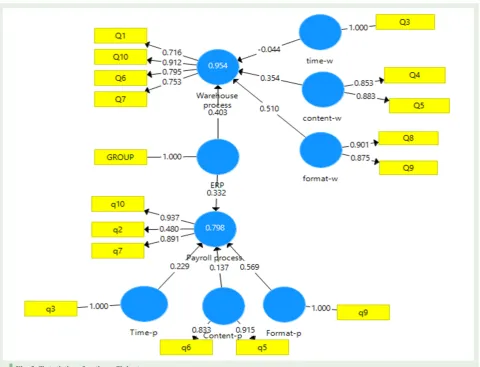
Considering Regarding figure 1 final path coefficient between dependent and independent variables
show positive numbers and mean that there is a positive relationship between ERP and payroll process
effectiveness and warehouse process effectiveness in comparison to traditional systems. Regarding
figure 2 which shows T statistics for each path, T statistics between dependent and independent variables
is more than 1.96 and hence we reject
H
�
and accept
H
�
in the Confidence level of 95 percent. We
conclude that ERP has a positive impact on payroll process effectiveness and warehouse process
effectiveness. Tables 4, 5, and 6 show all indicators of validity and reliability of model that all indicators
are in acceptable levels in our model.
Figure 2. path coefficient
Fig. 2. path coefficient
ty, the structural model estimates are evaluated. PLS-SEM assessment of the structural model involves the model’s ability to predict. Hence, after establishing reliability and validity, the primary evaluation criteria for PLS-SEM
re-sults are the coefficients of determination (R2 values) as well as the level and significance of the path coefficients which are five percent in this research’’ (Hair, Hult, Ringle,
and Sarstedt, 2016).
3.2. Convergent Validity
‘‘A common measure to establish convergent validity on the construct level is the average variance extracted (AVE). Therefore, the AVE is equivalent to the communal-ity of a construct. Using the same logic as that used with the individual indicators, an AVE value of 0.50 or higher indicates that, on average; the construct explains more than half of the variance of its indicators” (Hair, Hult, Ringle, and Sarstedt, 2016).
For each hypothesis the path coefficient for measure -ment and structural models will be shown.
For the path coefficient, following hypothesis testing
are used:
H0: Path coefficient=0
H1: Path coefficient≠0
If path coefficient between dependent and independ -ent variables shows non-zero numbers, it means that there is relationship between dependent and independent
vari-ables. After accepting H1, significance of this relationship
should be examined. So we should use following hypoth-esis testing.
H0: T<1.96 H1: T≥1.96
If T-statistics of the path coefficient presents a figure
bigger than 1.96, H_0 is rejected and H_1 accepted; which
indicates that ERP has significant effect on the financial
processes effectiveness compared with traditional systems
at the significance level of 95 percent.
P etroleum
B usiness
R eview
46
positive impact on the financial process effectiveness. If the path coefficient between dependent and independent variables reflects negative numbers and T-statistics shows
a number bigger than 1.96, it means that ERP has a
nega-tive impact on the financial process effecnega-tiveness com -pared with traditional systems.
3.3. Hypothesis Testing
According to the figure 1, the final path coefficient be -tween dependent and independent variables shows posi-tive numbers. It means that there is a posiposi-tive relation-ship between ERP and the payroll process effectiveness and warehouse process effectiveness in comparison to the traditional systems. Figure 2 shows T-statistics for each path. The T-statistics between dependent and independent variables is bigger than 1.96. As a result, H0 is rejected and
H1 is accepted at the confidence level of 95 percent. It is
concluded that ERP has a positive impact on the payroll process effectiveness and warehouse process
effective-ness. Tables 4, 5, and 6 show all indicators of validity and reliability of the model. All indicators are in acceptable levels in the model.
Table 5 shows R Square and GOF for both hypotheses. GOF is an indicator that considers both measurement model and structural model. It is used as a benchmark for measur-ing the overall performance of the model. Tenenhaus, vinzi, Chantelinc, and Lauro (2005) considered three values of 0.1, 0.25, and 0.36 as a weak, medium, and strong for GOF. In this study GOF shows values more than 0.36 which are strong amount for GOF. Construct reliability and validity is shown in table 6. The AVE is equivalent to the communal-ity of a construct. Since AVE is more than 0.6, so construct explains more than half of the variance of its indicators.
Table 7 represents discriminant validity of the model. For-nell-Lacker criterion is an assessment method for discriminant validity. It compares the square root of the average variance extracted with the correlation of latent constructs. A latent con-struct should explain better the variance of its own indicator
9
Figure 3. T-statistics of path coefficient
Table 4 shows R Square and GOF for both hypothesizes. Construct reliability and validity is shown in
table 5. The AVE is equivalent to the communality of a construct. Since AVE is more than 0.6, so
construct explains more than half of the variance of its indicators.
Table 4. R Square
Table 5. Construct Reliability and Validity
R Square GOF
Payroll process
0.80
0.48
Warehouse process
0.85
0.51
Cronbach's Alpha Composite Reliability Average Variance Extracted (AVE)
ERP 1 1 1
Payroll process 0.7 0.83 0.63
Content-p 0.7 0.87 0.77
Format-p 1 1 1
Time-p 1 1 1
Warehouse process 0.8 0.87 0.64
Content-w 0.7 0.86 0.75
Format-w 0.73 0.88 0.79
Time-w 1 1 1
Volume 1, Issue 1
November 2017
47
rather than the variance of other latent constructs. Therefore, the square root of each construct’s AVE should have a greater value than the correlations with other latent constructs. Table 6
shows that how discriminant validity of the model is confirmed.
4. Discussion
Table 8 below summarizes the results of hypotheses testing.
based on research findings, ERP has a positive and significant impact on the effectiveness of financial processes in PETRO
-PARS Ltd. Results of this study are in accordance with studies of Olhager and Selldin, Galani, Hamidi, and Hessam al-Dini which resulted that ERP has a positive effect on business processes.
5. Conclusion
ERP leads companies to being process oriented albeit the traditional systems which lead them to functional orientation.
ERP has had a positive and significant impact on the effec
-tiveness of financial processes in PETROPARS Ltd. Finan -cial process effectiveness means receiving on-time informa-tion and reports, reliable and more accurate informainforma-tion in comparison to traditional systems were used in organizations. Using more accurate and reliable information enables man-agers to make better decisions in such a way that the ultimate performance of their organizations will increase considerably.
Table 6: Construct Reliability and Validity
9
Figure 3. T-statistics of path coefficient
Table 4 shows R Square and GOF for both hypothesizes. Construct reliability and validity is shown in
table 5. The AVE is equivalent to the communality of a construct. Since AVE is more than 0.6, so
construct explains more than half of the variance of its indicators.
Table 4. R Square
Table 5. Construct Reliability and Validity
R Square
GOF
Payroll process
0.80
0.48
Warehouse process
0.85
0.51
Cronbach's Alpha
Composite Reliability
Average Variance
Extracted (AVE)
ERP
1 1 1Payroll process
0.7 0.83 0.63Content-p
0.7 0.87 0.77Format-p
1 1 1Time-p
1 1 1Warehouse process
0.8 0.87 0.64Content-w
0.7 0.86 0.75Format-w
0.73 0.88 0.79Time-w
1 1 110
Table 6 represent discriminant validity of our model. Fornell-Lacker criterion is one method of
discriminant validity assessment. This method compares the square root of the average variance
extracted with the correlation of latent constructs. A latent construct should explain better the variance
of its own indicator rather than the variance of other latent constructs. Therefore, the square root of each
construct’s AVE should have a greater value than the correlations with other latent constructs.
Considering table 6, discriminant validity of model is confirmed.
Table 6. Discriminant Validity
4.
Discussion
Table 7 shows the summary of hypothesis testing results. based on research findings, ERP has a positive
and significant impact on the effectiveness of financial processes in PETROPARS Ltd. Results of this
study are in accordance with studies of Olhager and Selldin,
Galani
, Hamidi, and Hessam al-Dini which
resulted that ERP has a positive effect on business processes.
Table 7. Result Summary
5.
Conclusions
ERP leads companies to being process oriented but traditional systems lead them to functional
orientation. ERP has a positive and significant impact on the effectiveness of financial processes in
PETROPARS Ltd. Financial process effectiveness means receiving on time information and reports,
reliable and more accurate information in comparison to traditional systems used in organizations. Using
more accurate and reliable information lead managers to better decision making which will have better
results for organizations. So it is necessary to pay attention to ERP systems and provide necessary
prerequisites for implementing such systems which one of these important prerequisites is business
process reengineering which leads to implementing effective business processes in organizations. Based
on research results, it is recommended PETROPARS Ltd to pay attention to processes documentation
and document all processes after ERP implementation. Based on documented processes, instructions
and procedures for each process should be identified and organizational tasks should be defined using
new processes after ERP implementation. Also as SAP has best practices for each industry, it is
recommended that PETROPARS Ltd evaluate its processes and try to match them with SAP best
practices which are experience all around the worlds in many companies in each industry. The
Content-p ERP Format-p Payroll process Time-p Warehouse process Content-w Format-w Time-w
Content-p 0.87
ERP 0.13 1
Format-p 0.35 0.24 1
Payroll process 0.53 0.51 0.77 0.8
Time-p 0.68 0.07 0.31 0.52 1
Warehouse process 0.21 0.65 0.19 0.35 0.11 0.8
Content-w 0.15 0.07 0.07 0.04 0.06 0.71 0.87
Format-w 0.22 0.5 0.22 0.31 0.15 0.68 0.64 0.89
Time-w 0.03 0.86 0.16 0.35 0.02 0.58 0 0.54 1
Table 7: Discriminant Validity
Table 8: . Result Summary
10
Table 6 represent discriminant validity of our model. Fornell-Lacker criterion is one method of
discriminant validity assessment. This method compares the square root of the average variance
extracted with the correlation of latent constructs. A latent construct should explain better the variance
of its own indicator rather than the variance of other latent constructs. Therefore, the square root of each
construct’s AVE should have a greater value than the correlations with other latent constructs.
Considering table 6, discriminant validity of model is confirmed.
Table 6. Discriminant Validity
4.
Discussion
Table 7 shows the summary of hypothesis testing results. based on research findings, ERP has a positive
and significant impact on the effectiveness of financial processes in PETROPARS Ltd. Results of this
study are in accordance with studies of Olhager and Selldin,
Galani
, Hamidi, and Hessam al-Dini which
resulted that ERP has a positive effect on business processes.
Table 7. Result Summary
5.
Conclusions
ERP leads companies to being process oriented but traditional systems lead them to functional
orientation. ERP has a positive and significant impact on the effectiveness of financial processes in
PETROPARS Ltd. Financial process effectiveness means receiving on time information and reports,
reliable and more accurate information in comparison to traditional systems used in organizations. Using
more accurate and reliable information lead managers to better decision making which will have better
results for organizations. So it is necessary to pay attention to ERP systems and provide necessary
prerequisites for implementing such systems which one of these important prerequisites is business
process reengineering which leads to implementing effective business processes in organizations. Based
on research results, it is recommended PETROPARS Ltd to pay attention to processes documentation
and document all processes after ERP implementation. Based on documented processes, instructions
and procedures for each process should be identified and organizational tasks should be defined using
new processes after ERP implementation. Also as SAP has best practices for each industry, it is
recommended that PETROPARS Ltd evaluate its processes and try to match them with SAP best
practices which are experience all around the worlds in many companies in each industry. The
Content-p ERP Format-p Payroll process Time-p Warehouse process Content-w Format-w Time-w Content-p 0.87
ERP 0.13 1
Format-p 0.35 0.24 1
Payroll process 0.53 0.51 0.77 0.8
Time-p 0.68 0.07 0.31 0.52 1
Warehouse process 0.21 0.65 0.19 0.35 0.11 0.8
Content-w 0.15 0.07 0.07 0.04 0.06 0.71 0.87
Format-w 0.22 0.5 0.22 0.31 0.15 0.68 0.64 0.89
P etroleum
B usiness
R eview
48
So it is necessary to pay attention to the usefulness and neces-sity of ERP systems and provide necessary prerequisites for implementing such systems. One of these important prerequi-sites is business process reengineering which leads to imple-menting effective business processes in organizations. Based on the research results, it is recommended PETROPARS Ltd to reconsider documentation of its procedures and provide
sufficient evidence for the all processes after ERP imple -mentation. Based on documented processes, instructions and
procedures for each process should be identified and organi
-zational tasks should be defined using new processes after
ERP implementation. Also as SAP provides the best practices for each industry, it is recommended that PETROPARS Ltd evaluates its processes and try to match them with SAP best practices which have been experienced and used by many companies in different disciplines all around the world. This study contributes to the body of knowledge by investigating and documenting the actual results of ERP implementation in one case company within the oil industry as an important industry in Iran. The Partial Least Square (PLS) and SMART-PLS software were used for data analysis. It is a new method of structural equation modeling in data analysis. Further
re-search is recommended to determine ERP impact on financial
processes in other industries. Also, it is recommended that the relationship between ERP and other management account-ing practices such as Activity Based Costaccount-ing, performance evaluation, is investigated. As PETROPARS Ltd decided to implement ERP system and has been trying to implement it
since 2013, it is necessary to investigate cost-benefit analysis
of ERP implementation in PETROPARS Ltd. It is recom-mended to evaluate the impact of ERP implementation on the
financial performance of PETROPARS Ltd as well.
References
Al-Mashari, M. (2002). Enterprise Resource Planning Sys-tems: a research agenda. Industrial Management &Data Systems, 102(3), 165-170.
Cahyadi, I. (2016). Factors Influencing Knowledge Trans -fer in ERP System Implementation within Indonesian Small and Medium Enterprises. PhD Thesis, University of Victoria, MA, Mar.See also URL http://www.vuir. vu.edu.au
Derakhshani, J. and Vahedi, M. (2015). Evaluation of in-formation systems effectiveness: case study in Tabriz hospitals. Depiction of health, 2, pp.1-7.
Galani, D., Gravas, E. and Stavropoulos, A. (2010). The impact of ERP systems on accounting processes. World Academy of Science, Engineering and Technology, 66, 418-423.
Hair Jr, J.F., Hult, G.T.M., Ringle, C. and Sarstedt, M. (2016). A primer on partial least squares structural equa-tion modeling (PLS-SEM). Sage Publicaequa-tions.
Hamidi, l. (2014). ERP implementation effects on finan -cial processes in Gilan Power Distribution Company. Third national accounting and management conference. Hejazi, R. Esmaeli Kia. (2013). ERP effects on internal
controls effectiveness in relation to financial reporting.
Emoirical Research in Accounting, 2, 17-38
Hesam al-dini, M. (2015). ERP systems effect on business processes agility. Case study in Hedco Company. Master thesis. Azad University of Marvdasht.
Jarvenpaa, M. (2007). Making business partners: a case study on how management accounting culture was changed. European Accounting Review, 16(1), 99-142. Mabert, V.A., Soni, A. and Venkataramanan, M.A., (2003).
Enterprise resource planning: Managing the implemen-tation process. European journal of operational research, 146(2), 302-314.
11. Melcher, J. (2014). Process measurement in business process management: Theoretical framework and
analy-sis of several aspects. KIT Scientific Publishing.
Mishra, A. and Mishra, D. (2010). ERP systems imple-mentation in FMCG sector. Tehnicki vjesnik/Technical Gazette, 17(1)
Mohammad Zadeh, M. Akhavan Safar, H. and Bakhshaei moghadam, M. (2012). ERP systems and its
implemen-tation effects in accounting field. National IT confer -ences, Payam Noor University.
Nunnally, J.C. and Bernstein, I.H. (1978). Psychometric Theory. McGraw-Hill New York.
O’Leary, D.E. (2004). Enterprise resource planning (ERP)
systems: an empirical analysis of benefits. Journal of
Emerging Technologies in Accounting, 1(1), 63-72. Olhager, J. and Selldin, E. (2003). Enterprise resource
planning survey of Swedish manufacturing firms. Euro -pean Journal of Operational Research, 146(2), 365-373. Rom, A. and Rohde, C. (2007). Management accounting
and integrated information systems: A literature review. International Journal of Accounting Information Sys-tems, 8(1), 40-68.
Spathis, C. and Constantinides, S. (2004). Enterprise re-source planning systems’ impact on accounting process-es. Business Process Management Journal, 10(2),234-247.
Sutton, S.G. (2006). Enterprise systems and the re-shaping of accounting systems: A call for research. International Journal of Accounting Information Systems, 7(1), 1-6. Tenenhaus, M., Vinzi, V.E., Chantelinc. Y.M., and Lauro,