in the population sciences published by the Max Planck Institute for Demographic Research Konrad-Zuse Str. 1, D-18057 Rostock·GERMANY www.demographic-research.org
DEMOGRAPHIC RESEARCH
VOLUME 15, ARTICLE 17, PAGES 485-498
PUBLISHED 29 NOVEMBER 2006
http://www.demographic-research.org/Volumes/Vol15/17/ DOI: 10.4054/DemRes.2006.15.17
Reflexion
Anticipatory analysis and its alternatives
in life-course research.
Part 2: Two interacting processes
Jan M. Hoem
Michaela Kreyenfeld
c
°2006 Hoem & Kreyenfeld
1 Introduction 486
2 Marriage in anticipation of parenthood 486
3 Separate modeling of the different transitions 489
4 Mirrored hazard rates 490
5 Conclusions 494
6 Acknowledgement 495
References 496
Anticipatory analysis and its alternatives in life-course research.
Part 2: Two interacting processes
Jan M. Hoem1
Michaela Kreyenfeld2
Abstract
In the present second part of these reflections, we use the connection between marriage and first birth to demonstrate further issues involved in anticipatory analysis when two individual-level processes operate in interaction. The wish to have children is proba-bly a very important determinant of marriage. Unfortunately, longitudinal data on fertil-ity intentions are rarely available. In order to demonstrate how childbearing intentions guide marriage behavior, one might be tempted to use anticipatory research strategies. In this paper we discuss the drawbacks involved with such an approach and display a non-anticipatory research strategy.
1.
Introduction
As common sense would tell us, people are rational actors who plan their lives ahead of time. (For traces in the literature, see, e.g., Buchmann 1989; Willekens 1991: 14; De Bruijn 1999.) Behavior will be guided by expectations about the future. In this sense, it is the very nature of human behavior to be anticipatory. Take childbearing and marriage formation. Surely, people who form a partnership consider the possibility of marrying the partner. Correspondingly they marry because they want children or they buy a house in anticipation of family formation. Perhaps they even become happier because they anticipate a marriage or the birth of a child (Clark et al. 2000; Stutzer 2006). How one can draw such intentionality into empirical analysis of data that contain no explicit information about intentions has caused considerable concern, however, particularly since methodologists keep warning us about the dangers of anticipatory analysis. In this paper the critical question is how one can address these aspects in life course research, given that access to longitudinal data on people’s intentions rarely are available.
With this in mind we discuss two approaches that aim at unraveling the interrela-tion between childbearing and marriage. The first approach is based on an anticipatory research strategy that we have found in the literature, but that we find problematic. A second approach that draws on standard ingredients in elementary event-history analysis avoids these problems. It contains no real novelty, but it seems little known among prac-titioners, and we have decided to make our reflections generally available, particularly since discussions of these issues seem to be rare. We hope that a clarification will prove as useful to others as it has been to us.
2.
Marriage in anticipation of parenthood
For a description of how a future event impacts on current attitudes and behavior, the following suggestion can be found in the literature (see, e.g., Huinink 1998; Clark et al 2000; Mulder and Wagner 1998, 2001; Feijten and Mulder 2002; Stutzer 2006). It runs like this.
procedure here to see whether one can say that marriages often are formed in anticipation of entry into parenthood. To this end, we fix the time of first birth to a woman and let marriage be a process which we study in relation to the first birth. We then calculate the duration of marriage at first birth by subtracting the respondent’s age at marriage from her age at first birth. This duration will be negative if the child is born before marriage forma-tion.3 We then compute and plot occurrence/exposure rates4of marriage by this duration and see that marriages are heaped around the arrival of the first child, as in Figure 1.
For this empirical illustration we have used data from the German Family and Fertility Survey of 1992. We have selected women aged 30 to 39 years at the date of interview and have omitted respondents with invalid fertility or marriage histories. The computation just described cannot be done for childless respondents (one has to fix the time of entry into motherhood), so we have omitted them and got a remaining sample of 886 cases and 840 first marriages. The computations produce a curve of marriage risks (occurrence/exposure rates) as in Figure 1, which shows a clear pattern. Two years before first birth, marriage risks quickly increase, they peak during the year when the child is born and fall off rapidly thereafter. This looks like a strong coupling of the two events (marriage and first child-birth). According to this type of analysis, marriages are likely to happen shortly before childbirth, the interpretation being that many marriages are triggered by the motivation to have a child soon. If people make scripts of their lives, couples would think in terms of a plan for a good while ahead and would let plans for future childbearing guide present marriage formation behavior.
The question is whether one can legitimately interpret such a result as an indication that marriages are formed in anticipation of parenthood. Obviously, we only observe man-ifest fertility behavior, but one could argue that future fertility behavior must be strongly correlated with past fertility intentions. When marriage risks are higher two years before a child is born than five years before, can we then assume that childbearing intentions were lower five years before childbirth than two years before childbirth? An argument along these lines seems to support the hypothesis that childbearing intentions guide marriage behavior.
The pitfall in this argumentation is that current childbearing behavior is only loosely associated with past fertility intentions. Many births are unplanned. Conversely, some
3If one subtracts the age at marriage from the age at first birth, one gets negative values for respondents
who married after they had their first child. Most computer programs will not estimate a survival or hazard function for negative durations. If one adds some arbitrary high number to the process time, one can perform the analysis.
4We use the term “occurrence/exposure rate” here as shorthand for “the number of marriages observed
Figure 1: First marriage rates per 1000 women months, by age of first child.
0 10 20 30 40 50 60 70 80
-5 -4 -3 -2 -1 0 1 2 3 4 5
Age of first child (years)
Notes: The sample comprises West German mothers aged 30 to 39 at the time of interview. The hazards are
estimated for single years of age of the child (see Table 1). The hazard rates are plotted against the start of each age interval.
Source: German Family and Fertility Survey 1992 (our own estimates).
women might have gotten married with the intention to have children but never actually gave birth. These cases are not considered in the analysis, and that would bias the out-come.
It must also generally be problematic that the analysis only comprises respondents who actually experience a first birth. In fact the first birth must even have occurred before the end of the period of observation. However, childbearing had not come to an end for “our” respondents when the data were collected, so many respondents are eliminated needlessly.
Table 1: First-marriage rates per 1000 woman-months, by age of first child.
Age of child (in integer years) Absolute marriage risks
-5 4.3
-4 5.9
-3 10.9
-2 15.7
-1 33.2
0 76.7
1 24.9
2 11.8
3 10.8
4 8.5
5 10.2
Notes: The sample comprises West German mothers aged 30 to 39 at the time of interview. Source: German Family and Fertility Survey 1992 (our own estimates).
events as given. For this “fixed” process one cannot consider the censored cases (i.e., births after the time of data collection cannot enter the analysis, as we just mentioned). A better procedure should avoid these weaknesses.
3.
Separate modeling of the different transitions
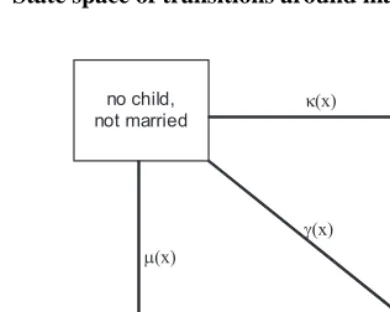
Methods for studying interrelations between two life-course processes have roots going back almost a century (DuPasquier 1912/13; see also Simonsen 1936). The ideas have also become common in contemporary event-history research (see, e.g., Courgeau and Lelièvre 1992: 82ff.; Petersen 1995; Blossfeld and Rowher 2002: 134ff.). The first step in a non-anticipatory procedure is to define a status space as in Figure 2. Boxes represent life-course states and arrows indicate possible transitions; the functions written beside the arrows represent transition intensities (hazards) that here depend on agex, durationtof marriage, and durationusince first birth, as the case may be.5
In this picture,κ(x)denotes the first-birth intensity of a (childless) unmarried woman at agex. Her marriage-formation intensity isµ(x), and she has an intensityγ(x)of the simultaneous occurrence of marriage formation and a first birth. The two latter hazards represent risks that compete with the risk of having a child while unmarried. Similarly, λ(t)denotes the first-birth intensity for a woman who has been married fortmonths, and η(u)denotes the first-marriage intensity for a woman with a child bornumonths ago. For
5If we take conception to occur a standard nine months before childbearing, we can letube duration since
Figure 2: State space of transitions around marriage formation and first birth.
no child, not married
with child, married with child, not married
no child, married
m(x) h(u)
g(x) k(x)
l(t)
simplicity of argument we disregard the woman’s age in the two latter intensities, and we also disregard complications like marriage disruption and mortality.
Figure 3a through Figure 3d show the estimated hazard rates. We have included the intensityγ(x)of the simultaneous occurrence of marriage formation and a first birth in Figure 2 because of its interest in principle,6but it cannot be represented by a hazard rate for our data set. There are only nine respondents (out of 1.003 for whom we have a first marriage recorded) who experienced birth and marriage in the same month, and this is too few to draw a sensible curve. In practice, we takeγ(x)to be identically zero in this application.
4.
Mirrored hazard rates
7The procedure that builds on the transition space in Figure 2 and on the intensities in Figures 3a-d and Table 2 represents the dynamics of the interactions between marriage and first birth, but it does not lead immediately to anything like the neat curve in Figure 1, which seemed so nicely to demonstrate the strong coupling of marriage and childbirth.
6See for instance the attention that Petersen (1995) has given the question of a simultaneous transition. 7In order to describe the coupling of two events, Billari (2001) introduces the term “mirrored survival
Figure 3a: First-birth rates per 1000 woman-months, childless unmarried women.
0 10 20 30 40 50 60 70 80
16 17 18 19 20 21 22 23 24 25 26 27 28 Age of woman (years)
Figure 3b: First-marriage rates per 1000 woman-months, childless women, all ages combined.
0 10 20 30 40 50 60 70 80
Figure 3c: First-birth rates per 1000 woman-months, childless married women, all ages combined.
0 10 20 30 40 50 60 70 80
0 1 2 3 4 5 6 7 8 9 10
Marriage duration (years)
Figure 3d: First-marriage rates per 1000 woman-months, women with children, all ages.
0 10 20 30 40 50 60 70 80
0 1 2 3 4 5 6 7 8 9 10
Age of first child (years)
Note: The sample comprises West German women aged 30 to 39 at the time of interview. The hazards are
Table 2: First-birth and marriage rates per 1000 woman-months.
Age of first child (u)
Age of woman Marriage risk Birth risk or duration of Marriage risk Birth risk marriage (t) in years
µ(x) κ(x) η(u) λ(t)
16 1.0 0.1 0 76.7 21.1
17 2.9 1.0 1 24.9 19.6
18 5.1 2.3 2 11.8 19.8
19 8.1 5.0 3 10.8 14.4
20 9.7 7.1 4 8.5 15.7
21 10.4 7.7 5 10.2 7.8
23 10.8 8.8 6 8.2 10.0
24 13.2 10.0 7 4.8 5.0
25 10.0 8.1 8 2.6 4.9
26 12.8 10.0 9 16.3 7.1
27 7.8 6.6 10 4.4 5.0
Notes: The sample comprises West German mothers aged 30 to 39 at the time of interview. Source: German Family and Fertility Survey 1992 (our own estimates).
The following procedure moves toward a similar picture by combining two of the separate transitions.
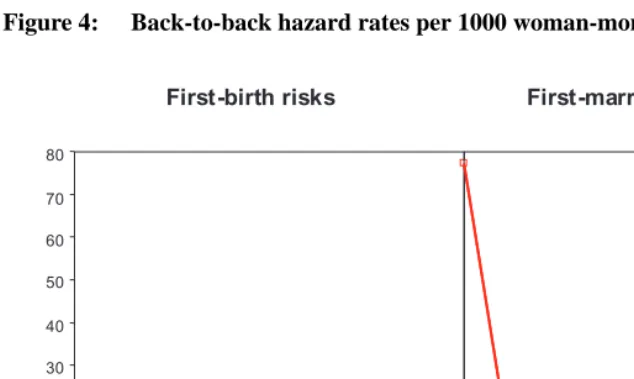
In Figure 4, we have plotted the two functionsλ(t)andη(u)from Figures 3c and 3d back-to-back in a diagram with the origin (‘zero-point’) in the middle of the abscissa, the duration t of marriage running leftwards from that origin, and the ageuof the first child running rightwards. The right-hand curve in Figure 4 is the same as the right-hand branch of the curve in Figure 1. The hand curve is, however, different. In Figure 1, the left-hand curve represented the first marriage risks before first birth. In Figure 4, the left-left-hand curve represents first birth risks by marriage duration. In principle, both processes are similar. If there is an increase in marriage risks before childbirth, one would also expect that there is an increase in birth risks after marriage. However, this pattern is not supported by this figure. Contrary to Figure 1, Figure 4 does not show much of an increase of birth rates after marriage. We see problems with a representation in the manner of Figure 1 of the possibility that many marriages are formed with the intention of producing a birth. It is hard to represent intentionality in event-history analysis unless one measures intentions explicitly. At best one can account for the coupling of the two events via back-to-back hazard curves as demonstrated above. Our conclusion is that an anticipatory research strategy will not unravel intentional behavior.
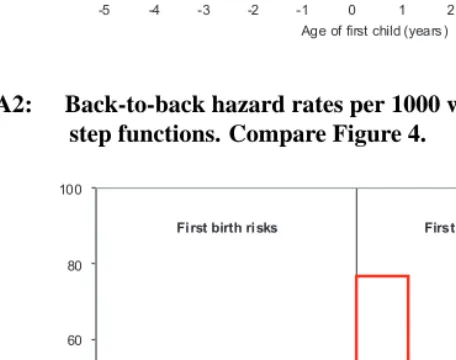
fertility rate is given as a single curve point plotted against the left-hand start of each age group (for the child). In reality, the occurrence/exposure rates have been computed for (single-year) age intervals as usual. Plots where the rates are given as step functions over the corresponding intervals (Figures A1 and A2 in the Appendix) give a more realistic picture where the differences are more muted but still considerable.
Figure 4: Back-to-back hazard rates per 1000 woman-months.
First-marriage risks First-birth risks
1 2 3 4 5 6 7 8 9 10
Age of first child (years) 0
10 20 30 40 50 60 70 80
10 9 8 7 6 5 4 3 2 1 0
Marriage duration (years)
Note: The sample comprises West German women aged 30 to 39 at the time of interview. The hazards are
estimated for single years of age. The hazard rates are plotted against the start of each age interval.
Source: German Family and Fertility Survey 1992 (our own estimates)
5.
Conclusions
and Kreyenfeld 2006), we addressed the interrelation between education and fertility and found it cumbersome to provide summary fertility indicators for women at different edu-cational levels without conditioning on the future. A major problem was that the data on educational attainment was very incomplete. In the present Part 2 we have focused on the empirical analysis of two parallel event-history processes for which one has “complete” information. We have shown that an anticipatory procedure makes marriage intensities appear to increase in anticipation of parenthood, while a non-anticipatory approach pro-vides a different picture.
We make no pretense that this paper provides anything really novel in the method-ological literature. We feel, however, that our contribution has clarified some matters that need not remain problematic, the way they appear in the current empirical literature. We hope that our two case studies can serve as a reminder that the risk of bias inherent in most anticipatory analysis can be avoided if one uses procedures not much more difficult than a simple extension of age-old life-table methods.
6.
Acknowledgement
References
Billari, Fransesco C. (2001): “The analysis of early life courses: Complex descriptions of the transition to adulthood.” Journal of Population Research, 18: 119-142.
Blossfeld, Hans-Peter and Rohwer, Götz (2002): Techniques of Event History Modeling:
New Approaches to causal analysis. 2nd edition. Mahwah (New Jersey): Lawrence
Erlbaum.
Bruijn, Bart J. (1999): Foundations of Demographic Theory: Choice, Process, Context. Amsterdam: Thela Thesis.
Buchmann, Marlis (1989): The Script of Life in Modern Society: Entry into adulthood in
a Changing World. Chicago [et al.]: University of Chicago Press.
Clark, A. and Diener,E. and Georgellis, Y. (2000): “Lags and leads in life satisfaction: A test of the baseline hypothesis.” Paper presented at the German Socio-Economic Panel Conference.
Courgeau, Daniel and Lelievre, Eva (1992): Event History Analysis in Demography. Ox-ford: Clarendon Press.
DuPasquier, Louis G. (1912/13): “Mathematische Theorie der Invaliditätsversicherung.”
Mitteil. Vereinigung schweizerischer Versicherungsmathematiker, Vol 7, 1-7, and
Vol 8, 1-153.
Feijten, Peteke and Mulder, Clara H. (2002): “The timing of household events and hous-ing events in the Netherlands: A longitudinal perspective.” Houshous-ing Studies 17: 773-792.
Hoem, Jan M. and Kreyenfeld, Michaela (2006): “Anticipatory analysis and its alter-natives in life-course research. Part 1: The role of education in the study of first childbearing”, Demographic Research 15(16): 461-484.
Huinink, Johannes (1998): “Ledige Elternschaft junger Frauen und Männer in Ost und West.” In: Metze, R. and Mühler, K. and Opp, K.-D. (eds): Der
Transformation-sprozess: Analysen und Befunde aus dem Leipziger Institut für Soziologie. Leipzig:
Leipziger Universitätsverlag: 301-320
Mulder, Clara and Wagner, Michael (1998): “First time home ownership in the family life course.” Urban studies 35: 687-713.
Petersen, Trond (1995): “Models for interdependent event-history data: specification and estimation.” Sociological Methodology 25, 317-375.
Simonsen, William (1936): “Über die Grundformeln der Invaliditätsversicherung.”
Skan-dinavisk Aktuarietidskrift 19, 27-41.
Stutzer, Bruno S. (2006): “Does marriage make people happy, or do happy people get married?” Journal of Socio-Economics 35: 326-347
Willekens, Frans (1991): “Understanding the interdependence between parallel careers.” In: Siegers, J.J. and de Jong-Gierveld, J. and E. van Imhof (eds.): Female Labour
Market Behaviour and Fertility: A Rational-Choice Approach. Berlin: Springer:
Appendix
Figure A1: First-marriage rates per 1000 women months, by age of first child, represented as a step function. Compare Figure 1.
-5 -4 -3 -2 -1 0 1 2 3 4 5
Age of first child (years) 100
0 20 40 60 80
Figure A2: Back-to-back hazard rates per 1000 woman-months, represented as step functions. Compare Figure 4.
5 4 3 2 1 0 1 2 3 4 5
Marriage duration (years)
First birth risks
0 20 40 60 80 100
First marriage risks