Vol. 3, No. 2, Autumn−Winter 2018-19
Investigation of Hot-extrusion Effect on Microhardness,
Microstructure and Corrosion Behavior of
Magnesium-based Bio-composites
E. Ghazizadeh, A.H. Jabbari Mostahsan, M. Sedighi
∗School of Mechanical Engineering, Iran University of Science and Technology, Tehran, Iran.
Article info
Article history:
Received29Novemder 2018 Received in revised form 05March 2019
Accepted06March 2019
Keywords:
Magnesium/Hydroxyapatite Bio-composites
Hot-extrusion Microstructure Microhardness Corrosion properties
Abstract
Magnesium alloys are a unique choicefor orthopedic implants due to their biocompatibility and biodegradability properties. In this article, the impact of hot-extrusion process is investigated on microhardness, microstructure, and corrosion behavior of magnesium/2.5wt% hydroxyapatite (HA) rods as a bio-composite. Hot extrusion process was implemented on the as-cast samples in two different steps resulting two various total extrusion ratios of 5:1 and 20:1. The corrosion susceptibility of the extruded composites was studied by polarization test in simulated body fluid (SBF) as a corrosive environment. According to the results, adding hydroxyapatite reinforcing particles and applying higher extrusion ratios caused grain refinement in the matrix comparing to the pure magnesium. Moreover, while the hardness of the pure magnesium sample decreased slightly after the second extrusion pass, it was enhanced in the composite specimens. Besides, both extrusion ratio and reinforcing particles had direct effects on the corrosion behavior, so that with the presence of HA particles and applying the higher extrusion ratio, the corrosion resistance of the samples was improved.
1. Introduction
Metal matrix composites (MMCs) have recently got in-creasing demands in different industries due to the pos-sibility of minimizing corrosion rate and their improved mechanical properties such as strength to weight ra-tio, specific stiffness, and creep resistance [1]. Gener-ally, various methods are used to produce metal ma-trix composites such as powder metallurgy, stir casting, and squeeze casting methods. Amongst all of them, stir casting can be considered as one of the most cost-effective methodsas well as efficient [2].
Bio-composite materials can be adjusted to gain a wide amplitude of mechanical properties as well as the corrosion behavior by selecting the appropriate matrix and reinforcing phases [3].
Previously, in-vivo studies have indicated that mag-nesium and its alloys are capable components as biodegradable and biocompatible metal implants, al-though their corrosion rate is not proper enough. Though magnesium alloys are more favorable than pure magnesium to be used as matrix, one of the biocompatibility concerns is that existing alloying el-ements such as aluminum can cause neurological dis-orders and diseases such as dementia and Alzheimer [4].
Hydroxyapatite (HA) is the natural bone com-position which has a similar chemical and crystallo-graphic structure to bone. It possesses a low solubil-ity in body environment and it is attractive due to its bioactivity which can form a chemical bond with osseous tissue [5–7]. As a result, hydroxyapatite parti-∗Corresponding author: M. Sedighi (Professor)
E-mail address: [email protected]
http://dx.doi.org/10.22084/jrstan.2019.17307.1068 ISSN: 2588-2597
cles are a suitable choice to be used as reinforcements in magnesium based composites. Mg/HA composites could increase corrosion resistance, microhardness, and yield stress comparing to as-extruded bulk pure Mg [8]. Furthermore, in order to obtain MMCs with re-fined structure and improved mechanical properties, thermo-mechanical treatment such as hot-extrusion, hot-rolling, and hot-forging could be implemented on the as-cast materials. Unlike rolling and open-die forg-ing, increasing the applied plastic deformation would not create macro and micro cracks in the material dur-ing hot-extrusion process. Moreover, by increasdur-ing ex-trusion ratio, more grain refinement would happen in the matrix and more desirable distribution of the re-inforcing particles would be achieved. It could also increase mechanical properties such as hardness [9].
In General, grain refinement can increase corrosion resistance of Mg alloys; however, in some of the mag-nesium matrix composites, the formation of galvanic corrosion between matrix and reinforcement in the in-terface is the main problem for reduction of corrosion resistance [10, 11].
In the present article, firstly Mg/HA2.5wt% bio-composite was manufactured by stir casting method. Subsequently, the as-cast pure Mg and Mg/HA bio-composite were hot-extruded (as a bulk metal form-ing process) usform-ing two various extrusion ratios. The aim of this step was to improve both mechanical and microstructural properties and eliminate inevitable porosities of the casting process. Finally, the effect of extrusion ratio was investigated on the grain refine-ment, microhardness, and corrosion behavior of Mg and Mg/HA bio-composite.
2. Experimental Method
2.1. Preparation of Mg/HA Composites
Pure magnesium (99.93% purity) and hydroxyapatite particles (average particle size: 0.5µm) were used as starting materials. The chemical composition (wt%) of the as-received pure Mg ingot is shown in Table 1. In this work, HA powder (Ca3(PO)4(OH)) was obtained from bovine bone [12]. Fig. 1 indicates the scanning electron microscopy (SEM) image of the hydroxyap-atite powder. Stir casting method was applied to fab-ricate pure Mg and Mg/HA2.5wt% composite samples (with a diameter of 50mm) under argon atmosphere.
Table 1
Chemical composition of the as-received pure-Mg ingot (wt%).
Mg Al Cu Mu Zn Sn Ca
Based <0.01 0.001 0.05 <0.007 <0.002 0.001
Fig. 1. SEM image of the hydroxyapatite powder.
2.2. Hot Extrusion Process
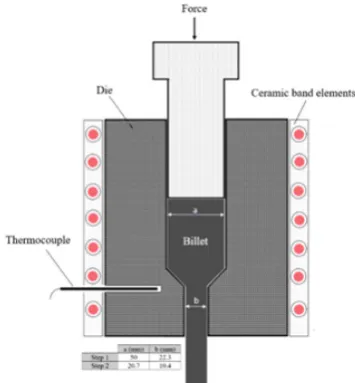
Hot extrusion process was implemented in two differ-ent steps at350◦C. The total extrusion ratio at the end of the first and second steps were 5:1 and 20:1, respec-tively. Furthermore, the diameters of the samples were approximately 22.3mm and 10mm after two extrusion steps. The extrusion process was carried out using a hydraulic press with a capacity of 75tons at a speed of 5mm/s. In order to achieve350◦C, electric ceramic band heating elements with a heating rate of8◦C/min were used around the dies. Before starting the extru-sion process, the dies and the samples were kept at
350◦C up to 1 hour to accessa uniform temperature at the whole of the billet specimens. The tempera-ture was monitored and controlled near the extrusion zone using a K-type thermocouple. Fig. 2 shows the schematic equipment of the extrusion process.
2.3. Microstructure and Microhardness
For microstructural evaluation, the samples were grinded, polished, and then etched. The applied etchant was composed of 10mL acetic acid, 70mL ethanol, 4.2g picric acid, and 10mL distilled water with an immersion time of 5-10s. For microhardness tests, 2N force was applied on the grinded samples for 10s as Vickers microhardness method according to ASTM E384. Since it is impossible to obtain a quite uniform distribution of the HA powder in the magnesium ma-trix, the tests were performed on five different random points through the cross-section of the samples and the average amount have been reported [13].
2.4. Electrochemical Tests
Since magnesium composites could be used as biodegradable orthopedic implants, it is essential to understand their corrosion behavior in the environ-ments similar to human body. For electrochemical tests, first the samples were grinded with sand papers up to 2500 grit. Then, they were cleaned by distilled water and ethanol. The electrochemical tests were carried out at (37±0.5)◦Cs in SBF [14]. For mea-suring electrochemical data, a three-electrode cell was employed which possessed a Saturated Calomel Elec-trode (SCE) as a reference, and a platinum elecElec-trode as a counter. Additionally, the open circuit poten-tial (EOCP) was determined as a function of time and the polarization curve was recorded at a scanning rate of 1mV/s in the potentiodynamic polarization tests. The volume of the SBF solution which was poured in the electrochemical test chamber was approximately 200mL.
3. Results and Discussion
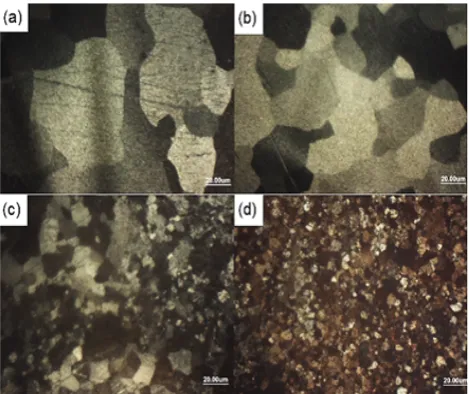
3.1. MicrostructureThe microstructure of the pure Mg and Mg/HA com-posite samples are shown in Fig. 3 for both extrusion ratios. While the average grain size of the as-cast pure Mg is about 241µm, it decreases to 38.7µm and 18.4µm after the first and second steps of the extrusion, re-spectively. For Mg/HA bio-composite, the grain size is 4.2µm at the first step of extrusion, which reduces to 2.0µm at the second step.
Hot-extrusion process and presence of HA parti-cles caused grain refinement in the samples. In both pure magnesium and composite samples, grain size de-creased approximately 52% between two steps of the extrusion. Moreover, presence of HA caused a reduc-tion of 89% in the both composite samples in compar-ison to the respective pure magnesium specimens. So, presence of HA particles had greater effect on the grain size.
Fig. 3. Microstructure of; a) Pure Mg-step 1, b) Pure Mg-step 2, c) Mg/2.5%HA-step 1, d) Mg/2.5%HA-step 2.
It can be explained that during hot-extrusion pro-cess, dynamic recrystallization is the main responsible for grain refinement. On the other hand, reinforcing particles act as barriers to prevent grain growth (pin-ning effect) during solidification and recrystallization [15]. Furthermore, it was observed that higher extru-sion ratio is suitable to break and disperse particle clus-ters and agglomeration uniformlyin magnesium matrix [16].
3.2. Microhardness
Fig. 4 shows Vickers microhardness of the different specimens. According to the results, presence of HA particles has a remarkable effect on the mi-crohardness. Indeed, these particles cause decrease in grain size, increase in dislocation density (due to the mismatch between thermal expansion coef-ficients and elasticity modulus of the matrix and reinforcing particles), and prevention of dislocations movement and local plastic deformation in the matrix.
Table 2
Eloctrochemical parameters extracted from polarization curve of the pure and the composites samples.
Sample Ecorr(V) icorr(µA/cm2) Corrosion rate (mmy−1)
Mg/2.5%HA-step 1 −1.80 −1.80 18.41
pure Mg-step 1 −1.70 1198.53 27.41
Mg/2.5%HA-step 2 −1.76 429.50 9.71
pure Mg-step 2 −1.85 661.83 15.13
Moreover, it is indicated that the second step of the extrusion approximately has no valuable effect on the microhardness of the pure Mg sample, while it in-creases the microhardness of the biocomposite. The most possible reason could be the effects of preheat-ing at 350◦C (before hot-extrusion process) with and without the presence of reinforcing particles. Although extrusion has a special effect on grain refinement and increasing dislocation density, preheating step acts in-versely. For pure sample, preheating effect is more considerable and as a result, the hardness decreases slightly. But in the composite, particles cause creation of new dislocations and prevention of grain growth (in preheating step) and more dynamic recrystallization (during extrusion).
3.3. Corrosion Behavior
The potentiodynamic polarization curves of the samples in SBF are displayed in Fig. 5. According to the results, adding HA particle in the magne-sium matrix has not changed the general shape of the corrosion graphs significantly. Therefore, it could be concluded that the corrosion mechanism was the same for both pure and composite samples.
Fig. 5. Potentiodynamic polarization curves of the pure and the composite samples in SBF.
Electrochemical parameters of the pure and the composites samples are shown in Table 2.
Fig. 6 shows the corrosion rate of the pure and the composite specimens after the first and the second extrusion steps. According to the results, both extru-sion process and adding HA particles decrease corro-sion rate. This could be due to the smaller grain sizes
after each extrusion step, especially for Mg/2.5%HA composite, which leads toforming a stronger passive layer (Mg(OH)2) on the samples surfaces and increas-ing the corrosion resistance.
It has been confirmed that the grain refinement increases the resistance of Mg alloys [17]. In magne-sium/hydroxyapatite with smaller grain sizes, there are more grain boundaries with more grain boundary de-fects. Since these defects could act as nucleation sites, creation and growth of the passive layer would be fa-cilitated.
Finally, this protective layer prevents the penetra-tion of the released ion from SBF (OH-) and dimin-ishes corrosion rate. [18]. Therefore, it can be con-cluded that applying higher extrusion ratio causes bet-ter corrosion resistance inboth pure mg and magne-sium/hydroxyapatite composite samples.
On the other hand, porosity has been introduced as one of the effective parameters on the corrosion rate. Pitting corrosion occurs in the porous pure magnesium and magnesium/hydroxyapatite composite. Thus, higher extrusion ratios help to decrease the porosi-ties and increase corrosion resistance, consequently.
Fig. 6. Corrosion rate of the samples in SBF.
4. Conclusions
and 92%, respectively, in comparison to as-cast mag-nesium. Additionally, the grain size of both compos-ite samples in the first and second steps has decreased about 89%, comparing to the corresponding pure sam-ples. Presence of reinforcing particles and happening of dynamic recrystallization during hot-extrusion process could be the most important reasons for grain refine-ment. In addition, although the presence of HA par-ticles and applying higher extrusion ratio have a con-siderable effect on the microhardness of the compos-ite samples, the second step of the extrusion approxi-mately has no valuable effect on the microhardness of pure Mg sample. Potentiodynamic polarization curves showed that corrosion mechanisms of both pure and composite samplesare equal in SBF environment. Nev-ertheless, corrosion resistant of the samples increased by adding reinforcing particles or applying higher ex-trusion ratio, which could be because of the presence of the smaller grains resulting in faster formation of the passive layer on the samples’ surfaces.
References
[1] F. Witte, F. Feyerabend, P. Maier, J. Fischer, M. Störmer, C. Blawert, W. Dietzel, N. Hort, Biodegradable magnesium-hydroxyapatite metal matrix composites, Biomaterials, 28(13) (2007) 2163-2174.
[2] M. Gui, P. Li, J. Han, Fabrication and character-ization of cast magnesium matrix composites by vacuum stir casting process, J. Mater. Eng. Per-form., 12(2) (2003) 128-134.
[3] M. Haghshenas, Mechanical characteristics of biodegradable magnesium matrix composites: A review, J. Magnesium Alloys, 5(2) (2017) 189-201.
[4] X. Gu, W. Zhou, Y. Zheng, L. Dong, Yulin Xi, D. Chai, Microstructure, mechanical property, bio-corrosion and cytotoxicity evaluations of Mg/HA composites, J. Mater. Sci. Eng., 30(6) (2010) 827-832.
[5] M.T. Fulmer, I.C. Ison, C.R. Hankermayer, B.R. Constantz, J. Ross, Measurements of the solubil-ities and dissolution rates of several hydroxyap-atites, Biomaterials, 23(3) (2002) 751-755.
[6] D. Tadic, M. Epple, A thorough physicochemical characterisation of 14 calcium phosphate-based bone substitution materials in comparison to nat-ural bone, Biomaterials, 25(6) (2004) 987-994.
[7] N. Omidi, A.H. Jabbari, M. Sedighi, Me-chanical and microstructural properties of tita-nium/hydroxyapatite functionally graded mate-rial fabricated by spark plasma sintering, J. Pow-der. Metall., 61(5) (2018) 417-427.
[8] A. Shafiee, A.H. Jabbari, M. Sedighi, Fabrication of magnesium/hydroxyapatite bio-composite us-ing stir castus-ing method. In 5th International Con-ference on Composites: Characterization, Fabri-cation and AppliFabri-cation (CCFA-5), Tehran, Iran, Dec. (2016).
[9] Y. Chen, Q. Wang, J. Peng, C. Zhai, W. Ding, Ef-fects of extrusion ratio on the microstructure and mechanical properties of AZ31 Mg alloy, J. Mate. Process. Technol., 182(1-3) (2007) 281-285.
[10] K.D. Ralston, N. Birbilis, Effect of grain size on corrosion: A review, Corrosion, 66(7) (2010) 075005-1-13.
[11] A. Bakkar, V. Neubert, Corrosion characterisa-tion of alumina-magnesium metal matrix compos-ites, J. Corros. Sci., 49(3) (2007) 1110-1130.
[12] A.S. Sabet, A.H. Jabbari, M. Sedighi, Microstruc-tural properties and mechanical behavior of mag-nesium/hydroxyapatite biocomposite under static andhighcyclefatigueloading,J.Compos.Mater.,
52(13) (2018) 1711-1722.
[13] A.K. Khanra, H.C. Jung, S.H. Yu, K.S. Hong, K.S. Shin, Microstructure and mechanical prop-erties of Mg-HAP composites, Bull. Mater. Sci., 33(1) (2010) 43-47.
[14] T. Kokubo, H. Takadama, How useful is SBF in predicting invivo bone bioactivity, Biomaterials, 27(15) (2006) 2907-2915.
[15] M.J. Shen, X.J. Wang, T. Ying, K. Wu, W.J. Song, Characteristics and mechanical properties of magnesium matrix composites reinforced with micron/submicron/nano Sic particles, J. Alloys Compd., 686 (2016) 831-840.
[16] X.J. Wang, L.Xu, X.S. Hu, K.B. Nie, K.K. Deng, K. Wu, M.Y. Zheng, Influences of extrusion pa-rameters on microstructure and mechanical prop-erties of particulate reinforced magnesium matrix composites, Mater. Sci. Eng., 528(21) (2011) 6387-6392.
[17] G.R. Argade, S.K. Panigrahi, R.S. Mishra, Effects of grain size on the corrosion resistance of wrought magnesium alloys containing neodymium, Corros. Sci., 58 (2012) 145-151.