Application of Linear Programming Techniques in the Effective Use of
Resources for Staff Training
Fagoyinbo, I. S and Ajibode, I.A
Department of Mathematics and Statistics, Federal Polytechnic, Ilaro, Ogun State, Nigeria
Corresponding Author: Fagoyinbo, I.S
_____________________________________________________________________________________________ Abstract
The success and failure that an individual or organisation experiences, depends to a large extent on the ability of making appropriate decision. Making of a decision requires an enumeration of feasible and viable alternatives (course of action or strategies). To embark on the developments/application of specific operations research techniques to determine the optimal choice among several courses of action, which will include numerical values (if required), linear programming as a tool of operations research may be employed where there is a need to formulate a mathematical model to represent the problem at hand allocate the scarce/limited resources to several competing activity for optimality. This piece of work has employed the application of linear programming in the area of personnel management in minimizing the cost of staff training. The method gives an integer optimum solution to all the models formulated. Data collected may not yield a feasible solution, when this occurs the model needs to be reformed to give an optimum solution. However, this study recommends to the management of the Federal Polytechnic Ilaro, the number of staff (junior and senior) to be sent for training program when there is need for such in the academic and non-academic sections of the institution.
_____________________________________________________________________________________________ Keywords: linear programming, management, training programme, constraint, objective function, minimize, model, operations research
_____________________________________________________________________________________________ ITRODUCTIO
Decision-making in today’s social and business environment has become a complex task. In reality, however, the decision maker often attempts to attain a set of multiple objectives in an environment of conflicting interests, incomplete information, limited resources, and limited analytic ability (Lee, 1972). High cost of technology, materials, labour, competitive pressures, energy consumptions and so many different economic, social as well as political factors and viewpoints greatly increase the difficulty of managerial decision-making. Knowledge and technology are changing rapidly the new problems with little or no precedents continually arise. The classical process of scheduling staff in any organization includes several stages (Tien and Kamiyama, 1982). Well-structured problems are routinely optimized at the operational level of organization, and increased attention is now focused on boarder tactical and strategic issues. To effectively address these problems and provide leadership in the advancing global age, decision-makers cannot afford to make decision by simply applying their personal experiences, guesswork or intuition, because the consequences of wrong decisions are serious and costly. Hence, an understanding of the applicability of quantitative methods to decision-making is of fundamental importance to decision makers. For example, entering the wrong markets, producing the
new equipment, projects etc, on a basis of given optimality (Jenness, 1972). The phrase scarce resources mean resources that are not available in infinite quantity during the planning period. The criterion for optimality is either performance, return on investment, profit cost, utility, time, distance etc.
PURPOSE OF THE STUDY
The purpose of this study is to provide a report on how the management of The Federal Polytechnic Ilaro, can have effective and judicious use of scarce resources when it comes to Staff training in the institution. The basic research questions that prompted this write up are;
1. Does the current method adopted in staff selection for training favours all staff? 2. Does the resources at hand sufficient for staff
training when the needs arises?
3. Is there any other means of staff selection that can minimize cost of staff training and can make it possible for all staff to be well represented?
BACKGROUD OF THE STUDY
Training is the process of helping employees develops maximum effectiveness in their present and future jobs. This implies that the training process is student centred; it is tailored to the individual needs and abilities of the learners. It also means that training is a continuous process, starting with the introduction of employees to their first jobs and continuing throughout their careers.
Consequently, organizations must adopt the attitude that “to expect a particular kind of performance from employees, we must teach them how we want them to perform”. Organization would then direct the training process toward a number of different but compatible objectives such as, employee orientation, skill development, attitude change, education and development. Employee training is a major undertaking for employers. Almost all organisations run their own training program. The reasons for this are as follows:
1. To improve the quality of output. 2. To improve the quantity of output.
3. To lower the costs of waste and equipment maintenance.
4. To reduce accident rates.
5. To lower turnover and absenteeism and increase job satisfaction, since training can improve the employee’s self-esteem.
LITERATURE REVIEW
It is generally agreed that operations research came into existence as a discipline during World War II when there was a critical need to manage scarce
resources. However, a particular model and technique of OR can be traced back as early as in world war I, when Thomas Edison (1914-1915) made an effort to use a tactical game board for solution to minimize shipping losses from enemy submarines instead of risking ships in actual conditions. About the same time A.K. Erlang, a Danish engineer, carry out experiments to study the fluctuations in demand for telephone facilities using automatic dialling equipment, such experiment later on were used as the basis for the development of the waiting-line theory. The term “Operation Research” was coined out as a result of research on military operations during World War II. Since, the war involve strategic and tactical problems which were greatly complicated, to expect adequate solutions from individuals or specialists in mathematics, economics, statistics and probability theory, engineering, behavioural and physical sciences were formed as special units within the armed forces to deal with strategic and tactical problems of various military operations. Such groups were first formed by the British Air Force and later, the American armed forces formed similar groups. One of the groups in British came to be known as Blackett’s Circus. This group, under the leadership of Professor Blakkett was attached to the Reader Operational Research unit, was assigned the problem of analysing the coordination of radar equipment at gun sites. The efforts of such groups, especially on the area of radar detection are considered vital in British winning the air battle (Sharma, 2008). Following the success of this group, such a mixed-team, such a mixed approach was adopted in other ailed nations. After the world war II ended, the scientist who had been active in the military OR groups made efforts to apply the operation research approach to civilian problems, related to business, industry, research and development, etc. There are three important factors behind the rapid development in the use of operation research approach:
• The economic and industrial boom after World War II resulted in continuous mechanization, automation, decentralization of operations and division of management functions. This industrialization also resulted in complex managerial problems and therefore application of operation research to managerial decision making became popular.
OR, such as statistical quality control, dynamic programming, queue theory and inventory theory were well developed before the end of the 1950.
• Analytic power was made available by high-speed computers. The used computers made it possible to apply many OR techniques for practical decision analysis.
METHODOLOGY
Linear Programming is a mathematical technique for generating & selecting the optimal or the best solution for a given objective function. Technically, Linear Programming may be formally defined as a method of optimizing (i.e. maximizing or minimizing) a linear function for a number of constraints stated in the form of linear in equations. According to Fagoyinbo (2008) and Martin (1983) the problem of Linear Programming may be stated as that of the optimization of linear objective function of the following form:
Z = C1X2 + C2X2 + C3X3 + ... + CnXn (Objective function)
Subject to the linear constraints of the form: a11x1 + a12x2 + a13x3 + ...+ a1nxn (≤ or≥) b1 a21x1 + a22x2 + a23x3 + ...+ a2nxn (≤ or≥) b2. . am1x1 + am2x2 + am3x3 + ...+ amnxn (≤ or≥) bm
x1,x2,x3 ... xn (≤ or≥) 0
These are called the non-negative constraints. From the above, it is linear that a LP problem has:
(i) Linear objective function which is to be maximized or minimized.
(ii) Various linear constraints, which are simply the algebraic statement of the limits of the resources or inputs at the disposal.
(iii) Non-negatively constraints.
Linear Programming is one of the few mathematical tools that can be used to provide solution to a wide variety of large, complex managerial problems. The data for the research study were collected from the personnel department of the institution. However, the research study covers training exercise that will last for four days (4) in the institution. The following variables are defined:
1. Decision Variables: These are junior and senior staff from the polytechnic. It is represented by X1 and X2 respectively. These variables are used in the two models formulated under the academic and n on-academic staff of the polytechnic.
X1 = Junior Staff, X2 = Senior Staff
2. Objective Function: In any business set up the main aim is to minimize cost and in this case; it is a minimization problem because the cost of training of staff to the establishment has to be minimized. Therefore, the objective function is given by:
Minimize: Z = C1X1 + C2X2
Where C1 and C2 are average costs associated to training of junior and senior staff for academic and non-academic staff in the polytechnic; for this study, the cost units are unity in both cases.
3. Constraints: The constraint for this study is the time available for training as the programme is in-service training.
Model Assumptions
The followings are the underline assumptions for the models in this research work.
(a) The unit cost of training is unity; this is because data on the exact cost on each staff trained could not be extracted from the source of data collection.
(b) The available time used is in days (4 days) in the academic staff models and hours (96) in the non-academic staff model. This arises as a result of the nature of the data, the 4 days is converted to hours for uniformity; while for all the other models they remain unconverted. (c) The decision variables are linearly related
with the data of each junior and senior staff in each department of the schools and also for non-academic staff.
(d) The objective function is also having a linear relationship with the decision variables. Data Presentation
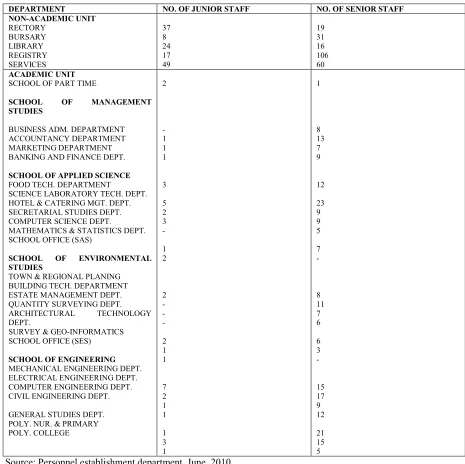
The data used for this study is a secondary data collected from the personnel establishment department of the institution. The data is in the appendix of the paper.
Table I: List of Staff in Various Units and Departments of the Polytechnic (Junior and Senior)
DEPARTMET O. OF JUIOR STAFF O. OF SEIOR STAFF
O-ACADEMIC UIT RECTORY
BURSARY LIBRARY REGISTRY SERVICES
37 8 24 17 49
19 31 16 106 60 ACADEMIC UIT
SCHOOL OF PART TIME
SCHOOL OF MAAGEMET STUDIES
BUSINESS ADM. DEPARTMENT ACCOUNTANCY DEPARTMENT MARKETING DEPARTMENT BANKING AND FINANCE DEPT.
SCHOOL OF APPLIED SCIECE FOOD TECH. DEPARTMENT
SCIENCE LABORATORY TECH. DEPT. HOTEL & CATERING MGT. DEPT. SECRETARIAL STUDIES DEPT. COMPUTER SCIENCE DEPT.
MATHEMATICS & STATISTICS DEPT. SCHOOL OFFICE (SAS)
SCHOOL OF EVIROMETAL STUDIES
TOWN & REGIONAL PLANING BUILDING TECH. DEPARTMENT ESTATE MANAGEMENT DEPT. QUANTITY SURVEYING DEPT. ARCHITECTURAL TECHNOLOGY DEPT.
SURVEY & GEO-INFORMATICS SCHOOL OFFICE (SES)
SCHOOL OF EGIEERIG MECHANICAL ENGINEERING DEPT. ELECTRICAL ENGINEERING DEPT. COMPUTER ENGINEERING DEPT. CIVIL ENGINEERING DEPT.
GENERAL STUDIES DEPT. POLY. NUR. & PRIMARY POLY. COLLEGE
2
- 1 1 1
3
5 2 3 -
1 2
2 - - -
2 1 1
7 2 1 1
1 3 1
1
8 13 7 9
12
23 9 9 5
7 -
8 11 7 6
6 3 -
15 17 9 12
21 15 5 Source: Personnel establishment department, June 2010
RESEARCH MODEL:
The model formulated is of two types viz:
Let X1 = Junior Staff and X2 = Senior Staff in both the academic and non-academic sections of the institution. MODELS:
NON-ACADEMICS Minimize: Z = X1 +X2 Subject to:
37X1 + 19X2 ≥ 96 Rectory Department 8X1 + 31X2 ≥ 96 Bursary Department 24X1 + 16X2 ≥ 96 Library Department 17X1 + 106X2 ≥ 96 Registry Department 49X1 + 60X2 ≥ 96 Service Department
X1, X2 ≥ 0
ACADEMICS
SCHOOL OF MAAGEMET Original Model
Adjusted Model Minimize: Z = X1 + X2
Minimize: Z = X1 + X2 Subject to:
8X2 ≥ 4 Business Administration Department X1 + 13X2 ≥ 4 Accountancy Department
X1 + 7X2 ≥ 4 Marketing Department
X1, X2 ≥ 0
SCHOOL OF APPLIED SCIECE Minimize: Z = X1 + X2
Subject to:
3X1 + 13X2 ≥ 4 Food Technology Department 5X1 + 23X2 ≥ 4 Science Lab. Technology Department
2X1 + 9X2 ≥ 4 Hotel and Catering Department 3X1 + 9X2 ≥ 4 Secretariat Studies Department 5X2 ≥ 4 Computer Science Department 2X1 ≥ 4 School Office
X1 + 7X2 ≥ 4 Mathematics and Statistics Department
X1, X2 ≥ 0
SCHOOL OF EVIROMETAL STUDIES Minimize: Z = X1 + X2
Subject to:
2X1 + 8X2 ≥ 4 Town & Regional Planning Department
11X2 ≥ 4 Building Technology Department 7X2 ≥ 4 Estate Management Department 6X2 ≥ 4 Quantity Survey Department 2X1 + 6X2 ≥ 4 Architecture Department X1 + 3X2 ≥ 4 Surveying and Geo-informatics X1 ≥ 4 School Office
X1, X2 ≥ 0
SCHOOL OF EGIEERIG Original Model
Minimize: Z = X1 + X2 Subject to:
7X1 + 15X2 ≥ 4 Mechanical Engineering Dept. 2X1 + 17X2 ≥ 4 Elect./Electr. Engineering Dept. X1 + 9X2 ≥ 4 Computer Engineering Department
X1 + 12X2 ≥ 4 Civil Engineering Department X1, X2 ≥ 0
OTHERS
SCHOOL OF EVIROMETAL STUDIES Minimize: Z = X1 + X2
Subject to:
2X1 + X2 ≥ 4 School of part-time studies X1 + 21X2 ≥ 4 General studies
3X1 + 15X2 ≥ 4 Polytechnic Nursery and Primary X1 + 5X2 ≥ 4 Polytechnic College
X1, X2 ≥ 0
DATA AALYSIS
The models were analyzed using computer software. The results are in two parts, one gave the optimum solution and the other gave the integer optimum solution. The integer optimum solution is obtained because the decision variables are representing human beings where we cannot have decimals or fraction of human beings. The computer software used is mathematical 6.
RESULTS O ACADEMIC Solution:
Optimum: Z = 4.83, X1 = 2.34, X2 = 2.49 Integer Optimum: Z = 5, X1 = 2, X2 = 3
From the solution to the model for non-academic staff using integer optimum solution, the minimized objective function is given as Z = 5, X1 (junior staff) is 2 and X2 (senior staff) is 3 which implies that 2 of the junior staff and 3 senior staff from the non-academic staff should be send for training programme which will cost 2 multiply by the cost of training junior staff plus 3 multiply by the cost of training senior staff.
ACADEMICS
SCHOOL OF MAAGEMET Solution:
Original Model
Optimum: Z =?, X1 =?, X2 = ? Integer Optimum: Z =?, X1 =?, X2 = ? Adjusted Model
Optimum: Z = 0.51, X1 =0.00, X2 =0.58 Integer Optimum: Z =1, X1 =0, X2 =1
From the solution of the model for academic staff (school of management) using integer optimum solution, there is no feasible solution for the model that was formulated with the given data. The reformulated model given a feasible solution with minimized objective function Z = 1, X1 (junior staff = 0) and X2 (senior staff) n =1, which implies that only one senior staff from the school of management should be send for training programme which will cost 1 multiply by the cost of training one participant.
SCHOOL OF APPLIED SCIECE Solution:
Adjusted Model
Optimum: Z = 2.8, X1 =2, X2 =0.8 Integer Optimum: Z =3, X1 =2, X2 =1
From the solution of the model of academic staff (School of Applied Science) using integer optimum solution, the minimized objective function Z = 3, X1 (junior staff) is 2 and X2 (senior staff) is 1, which implies that 2 junior staff and 1 senior staff from the school of applied science should be send for training programme which cost 2 multiply by the cost of training junior staff plus 1 multiply by the cost of training senior staff.
OTHERS Solution:
Adjusted Model
Optimum: Z = 2.22, X1 =1.78, X2 =0.44 Integer Optimum: Z =3, X1 =2, X2 =1
staff and 1 senior staff should be send for training programme which cost 2 multiply by the cost of training junior staff plus 1 multiply by the cost of training senior staff.
COCLUSIO
The objective of this study is to apply the linear programming techniques in the effective use of resources for staff training in Federal Polytechnic, Ilaro, from the non-academic and academic units of the institution. The study uses the junior and senior staff from the units as the decision variables. Secondary data of numbers of staff in the various departments under these units are used in formulating the problem (model). The analysis was carried out using computer software mathematica 6 (Wolfram). It gives two solutions viz: the optimum solution and the integer solution, not all the models gives an optimum solution from the data collected, these occurs in models for the school of management and school of engineering. The model was adjusted to give an optimum solution to achieve the desired objective. The results from these models shows that the number of junior and senior staff from each unit (Non-Academic and Academic) that should be send for training program can be reduced compare to the numbers that has attended training program in the past for effective management and control of resources.
RECOMMEDATIOS
The researchers strongly recommends to the management of the institution that whenever there is a program that is compulsory for the staff to attend in non-academic and academic units of the institution they can use these results to achieve their aim by minimizing their cost of training. From the non-academic unit where there are five (5) departments (Rectory, Bursary, Registry, Library and Services). The management should send two (2) junior and three (3) senior staff for the training that last for four (4) days. This can be achieved by using a simple random sampling method to select the staff. From the academic units, where there are four (4) schools (Management, Applied Science, Engineering and Environmental Studies). From the school of management, there is no feasible solution to the model formulated from the data obtained, therefore the model was adjusted to give an optimum solution and before this was achieved there is need to increase the number of staff in both the senior and junior level of the departments. The affected department is business administration where they have 8 senior staff only. The constraint was adjusted to nine (9) junior staff and eight (8) senior staff to give an optimum solution. Hence, after adjusting the model the integer optimum solution is 1 for senior staff, which means only one
senior staff should be send for training program from the school of management. For the school of applied sciences, it is recommended that two (2) junior staff and one (1) senior staff should be send for training program that lasted for four (4) days. Also, for the school of environmental studies, this work recommends that four (4) junior staff and seven (7) senior staff should be send for training from the school which can be selected using simple random sampling method or any other desirable method of sample selection. In the school of engineering, the data on the junior and senior staff in the model did not give feasible solution, therefore the model was adjusted. While adjusting the mechanical engineering department was not affected but electrical, computer and civil engineering was affected, where at least 10 junior staff are needed in these departments to enable the model give a feasible solution. The integer optimum solution gives one (1), which implies that only one (1) junior staff should be send for training program. Finally, from others where the school of part time studies, general studies, polytechnic nursery/primary and polytechnic college was classified. This study recommends that two (2) junior staff and one (1) senior staff should be sent for training program. However, for all these numbers of junior and senior staff that will be send for the training program, the cost will just be the addition of the product of the cost of training the junior and the number of junior staff with the product of the cost of training the senior staff and the number of senior staff involve in training.
REFERECES
Fagoyinbo, I.S. (2008): Compendious Text on Quantitative Techniques for Professionals, Ilaro, Nigeria, Jombright Productions
Hiller, F.S., G.J. Lieberman and G. Liebeman (1995): Introduction to Operations Research, New York: McGraw-Hill
Jenness, J.S. (1972): Change for the future, Training and Development Journal, pp. 26
Lee, S.M. (1972): Goal Programming for Decision Analysis. Philadelphia: Auerback Publishers, 1972.
Martin, E.T. (1983): Statistics, London: Mitchel Beazley
Sharma, J.K. (2008): Operation Research: Theory and Applications, Third Edition, London, Macmillian