Copyright © 2012 (Ilya Kiriya). Licensed under the Creative Commons Attribution Non-commercial No Derivatives (by-nc-nd). Available at http://ijoc.org.
The Culture of Subversion and Russian Media Landscape
ILYA KIRIYA
National Research University Higher School of Economics Moscow, Russia
This paper provides a conceptual framework for analyzing parallel (or subversive) media activities in Russia that enable Russian media consumers to act independently from official institutionalized sets of rules and constantly violate both traditional rules (based on great state pressure on content) and the globalized capitalist media economy based on commercial interests. These alternative sets of activities can be interpreted either like an entire parallel public sphere where alternative debate is articulated, or like separate parallel activities recompensing supply and demand failures. Two hypotheses are posed by author. The first states that accessibility of media production in general in Russia is a key element of a contemporary social contract. The second hypothesis relates parallel media practices with certain acts of political activism among narrow groups of the population that could not find places for self-expression in the institutionalized media field and use alternative media outlets (especially blogs and another new media) that ultimately constitute the parallel public sphere.
Parallel Public Sphere and Parallel Activity: Theoretical Framework for Analysis
To explore the concept of the parallel public sphere, this discussion proposes at least two theoretical bases—namely, the Habermasian and post-Habermasian theory of the public sphere and institutional theory, particularly the concept of formal and non-formal institutions. Habermas’ concept of the public sphere stemmed from the political debate that organized mediation between the bourgeois civil society and elective authorities through different public channels, such as the periodical press (and especially mass press), debate clubs, and saloons (Habermas, 1991). According to Habermas, one of the foundations for public sphere was the literary public sphere, which consisted in debating literature and different art productions in particular periodicals, libraries, and literary clubs. As such, not only could mass communication channels diffusing political opinion be interpreted as parts of a public sphere, but also any
cultural production based on a transfer of symbolic forms (Thompson, 2007, p. 10). In the last 40 years, a great part of such production has been recorded on different media.1
In the original Habermasian concept, the public sphere figures also like non-perfect debate. Habermas refers to the public sphere as “bourgeois” to designate that the debate that benefits such social organization is much more publicized. He characterizes French and German public spheres (the country-model of the bourgeois public sphere was in the UK) as having limited participation. Based on such categories, Bernard Miège—in his recent book on public sphere—indicated that certain elements of public spheres are present even in non-democratic or semi-democratic countries; thus, this notion cannot be regarded as a peculiarity for only democratic political systems (Miège, 2010, p. 36). In other words, Habermas is considering the concept of public sphere as an ideal type. Such ideas were developed by Habermas’ assistant, and a scholar of the late Frankfort school, O. Negt, who proposed studying forms of resistance and the auto-organization of alternative debates facing the dominant bourgeois public sphere (for example, the proletarian public sphere). Negt called such forms “counter-public spheres” (Negt, 2007).
Meanwhile, the original concept of the parallel public sphere was proposed by Tristan Mattelart, who analyzed the role of non-authorized media practices, such as listening to Western radio broadcasts and engaging in the illegal traffic of non-authorized literature and Western cultural products during the anti-Soviet emancipation of Central and Eastern Europe (including the USSR; Mattelart, 1995). Such parallel media consumption during Soviet times generated a political debate parallel to the official public sphere, which—according to this scholar—contributed to anti-Soviet political activities (i.e., dissident activities) in such countries, as well as to destruction of the official public sphere. The same struggle between alternative and main public spheres has been argued by Negt and Kluge (1972). As it comes from the French scholar’s argument, the parallel public sphere deals with imperfections of political debate within the official public sphere. But the political debate in the Habermasian concept is in continuity with economic role of the public sphere, which also serves to help the bourgeois class to negotiate rules on the market. According to Christian Fuchs, among all the dimensions of alternative media which really create an alternative public sphere (or counter-public sphere), the organizational one is also important. It means that, really, the alternative public sphere is independent from the commercial mode of production, and its products that generate alternative debate are self-produced and distributed according to non-commercial rules. He relates such production to any and all media content, including recorded media content. For example, according to his definition, independent cinema, underground cinema, and avant-garde film represent a kind of alternative media generating alternative debate (Fuchs, 2010, p. 187).
The second theoretical contribution to the concept of the parallel public sphere stems from institutional theory and the institutional approach to the formal economy, which considers the non-formal economy to be an important element of any non-formal economy, as the non-non-formal economy
1 It is necessary to exclude certain computer software that, in general, represents different pragmatic
reproduces a set of rules (institutions) that cannot be reproduced by formal economic regulations (Tamasz, 2002). The same situation is possible when the formal set of regulations is not perfect or not corresponding to the social contract (beliefs, habits, etc.; Gerchuni, 1999). According to Douglas North (1990), efficient institutions (here, humanly devised constraints that shape human interaction) should be grounded in social life. In this case, formal institutions (regulation frameworks, contractual rules, etc.) correspond to non-formal institutions (practices of everyday life, rites, conventions, etc.). However, in the case of the adoption of new formal institutions (e.g., in importing institutions), it could generate a conflict between formal and non-formal institutions that could, itself, lead to the rise of opposing practices going beyond new formal institutions. Institutional theory also shapes the connectivity between economic rules and political rules. Development of widespread non-estate based political rules opens the doors for concurrence within political life, which leads to perfection of exchange rules, and consequently, to economic growth (North, Wallis, & Weingast, 2009).
From this point of view, the author proposes explaining the rise of informal activities in the USSR through extremely tough regulations of social life, and of the same phenomena in post-Soviet Russia through incompatibility between formal and non-formal traditional rules. In other words, Russian authorities could not eradicate non-formal activities (in particular, piracy) because it takes time to change non-formal institutions both in the political (tradition of parallel media flows consumption) and economic (orientation toward accessibility of cultural products) fields.
Ultimately, the parallel public sphere represents a set of interconnected media consumption and media production practices that constitute an alternative debate to the dominant one existing in the official public sphere and also opposing the traditional organization forms of such production. Parallel activity, according to such a theoretical framework, represents a set of settled practices that smooth over institutional imperfections related to the main activity.
Social Tradition of Non-Formal Institutions in Russia
A long tradition of non-formal institutions and parallel economic activity exists in Russia. Such a tradition was likely grounded in society long before the Soviet period, and it has been structured by factors such as the position of resources in the network (Barsukova, 2000), the climate, and the character of labor—all elements that have significantly influenced the Russian economic mentality (Balabanova, 2001). However, the Soviet period and state-predator that pretended to be completely dominant within social life created a total network of parallel activity that has often been illegal. Thus, the hidden social activity (not only in terms of consuming, but also in the field of self-expression) during the Soviet period has been a response to the state’s overregulated and often disproportional official economy, politics, etc.
Several hidden (or parallel) activities were specific to the Soviet period:
Non-formal relations between middle management and workers in the system of distribution of bonus payments (Clarke, 1995).
Parallel mechanism of enterprise control in the late Soviet-period (i.e., the Gorbachev period), when directors of enterprises created parallel networks of non-formal relations with ministries and other enterprises and became non-formal owners of enterprises (Kabalina & Clarke, 1996).
Hidden exchange of prohibited goods. This has been probably the biggest segment of parallel activity. Official authorities prohibited the circulation of a large range of goods, a policy which provoked such a response in the society.
The period of transition (i.e., perestroika) was based on the reforming initiatives of the current power and its leader, Gorbachev (Castells, 1999). Such reforms, to a certain degree, imported elements of Western political and economic orders (for the first time), such as the freedom of speech, free initiatives in the field of business, a free electoral process and real political alternatives, and self-repayment of state enterprises, as well as (for the second time) private property, prices determined by the market, real exchange rates, and proportional electoral systems. Such elements required the complete importation of Western (or “globally dominant”) formal institutions which did not correspond to the cultural basis (i.e., non-formal institutions). Grounded non-formal institutions conflicted with global official institutions that provoked some kind of mix between imported formal and grounded non-formal rules. Such rules work as compensatory practices for the defects of formal orders (Ledeneva, 2006). For example, to a great extent, the privatization of state property involved the quasi-free distribution of property among those politically loyal to the power oligarchs (Nureev, 2003), thereby completely transforming the political system into a pseudo-democratic system. Meanwhile, “free prices” determined by the market were artificially “fixed” prices for particular privileged industries (evident, for example, in the market price and “taxed price” for real estate). Instead of laying off workers from ineffective enterprises, the state engaged in the non-repayment of salary (which provoked the “gray” employment of those “officially employed” in other firms; Sinyavskaya, 2005). In other words, market and political reforms did not lead to a market economy and democratic political system, but to the strange mix of what Castells (1999) referred to as statism and capitalism.
Such institutional conflict provoked the installation of parallel activities in seemingly all spheres of social life, including the importation of goods, money laundering, barter exchange (Yakovlev, 2006), double accounting, shadow bartering, manipulative campaigning within political life (Ledeneva, 2006), informal medical services (Shishkin, 2003), non-formal labor (Sinyavskaya, 2005), and the non-formal preparation of doctoral works (Kalimullin, 2005). Thus, the parallel sphere was omnipresent in social life, and in everyday life, people could migrate between the official and hidden spheres.
low prices or even making some cultural products free of payment. The second dimension is the protest activity within the public sphere generated by opposition media, which identifies hidden practices as a political response to official rules.
Archaeology of Accessibility
Accessibility of Culture and Soviet Normativity
The historical orientation of Soviet (Russian) people to the accessibility of any cultural and mass communication product is based on the Soviet propagandist function. To ensure this function, the Soviet mass communication apparatus had to first build an audience (i.e., to ensure that the masses were literate), and second, to make products of mass communication accessible to people.
The propagandist function has been crucial to the Soviet identity, which was constructed under the principle of double identity—the national identity and the Soviet identity—as the basis of a new culture and ideology (Castells, 1999). The communication of the new ideology was the biggest challenge for the Bolshevik authorities, who had to develop effective mass communications forms consistently, and who tended to limit personal communications (telephone communications, transportation means, etc., that did not serve point-to-point personal communication functions). This centralized form of communication administration is called communicational control (Kiriya, 2004, 2007). The USSR constructed a centralized system of cable radio and a unique system of television broadcasting in real time across 11 time zones, in addition to building a gargantuan newspaper industry, with a total circulation of 230 million copies in 1989 (Ovsepian, 1999).
In this context, propaganda should make products of mass communication and culture accessible to people; without such access, the Soviet identity could not be maintained, and communication control could not be ensured. Television and radio were offered free of charge and without advertising. Newspapers were paid communication forms, but the majority of the population received a free subscription from Communist Party cells in their workplaces. Sometimes, the Communist Party cells in big enterprises also distributed free tickets to movie theaters. Every large Soviet structure had its own cultural club, where theatrical or cinema productions were offered to employees.
From another point of view, such accessibility of official content conflicted with the Soviet policy (here, we could find some intersections between the economic and political dimensions) of controlling the incoming flows of communication. Only the authorized (and mainly, locally produced) content framing and feeding into the state propaganda could be accessible. The selective isolation of the Soviet cultural sphere provoked the existence of a parallel flow of disallowed content that, in the Soviet system, was categorized as illegal practice (shadow activity). Thus, accessible content was installed in the non-formal hidden system of circulation of non-allowed content (“samizdat,” illegally listening to Western radio, illegally trafficking in Western music, etc.) under other rules of exchange, albeit for a very narrow group of the population.
institution for the diffusion of information and culture. In a centralized and planned economy, the state apparatus economically supported culture, which was not made for profit. Yet the parallel hidden communication system was recompensing bottlenecks (primarily in the field of content) in the official communication system. Thus, the dissemination of Western and global content was a kind of non-formal institution based on general interest in foreign (limited in access) culture, generating a demand for Western content in the “hidden market.” This means that parallel media circulation during the Soviet period could also be interpreted within a framework of a market failure problem within an authorized media market.
Accessibility’s Likeness to Subversion of the Market Exchange during the Post-Soviet Period
During the transition period, the state imported global market economic institutions (such as market-driven prices, private property, etc.), yet it also maintained the old social contracts under pressure from the population. It structured the industry to be more accessible for people by subverting some commercial mechanisms.
First, the state adopted strategies to ensure accessibility to traditional mass media—namely, television, radio, and print media. The state television chose the only possible model of financing: commercial advertising. This was the only possible alternative, given the shortage of state funding, as well as the non-readiness of the population to pay for it. Thus, classic paid public TV (financed by both the state and people) could not exist, thereby provoking the structural dualism of Russian state television—the biggest players in the advertising market (state television channel Rossia and the 51% state-owned Channel One, which had a collective daily share of about 40%) accounted for about 50% of television advertising revenues in the market (Kiriya & Degtereva, 2010), while also ensuring the public content of broadcasting.
In 2015, Russia will completely shift to digital terrestrial broadcasting (DTB), which was announced as a big governmental project. However, without forcing the population to buy new equipment (i.e., set-top boxes), the Russian government cannot accomplish this task. Experiences in some Russian regions (where DTB was launched as a pilot test) demonstrate that the government is ready to make such equipment more accessible for people and distribute set-top boxes (seemingly) for free (Kachkaeva, 2008).
ones). The difficult economic situation has led the majority of print outlets to be sold and financed either by the state (local authorities, city authorities, federal authorities, regional governors, etc.), or by large industrial groups that also represent one of the means for making such outlets accessible to people (even if their objectives are purely propagandist).
One of the structural mechanisms that made the press more independent from readers’ payment was the tolerance of a parallel form of financing media. A more developed mechanism is information coverage contracts (from big companies or authorities), which are also known as purchasing loyalty contracts. Research conducted by the author in 15 regions in 2009–2010 shows that this parallel market is bigger in some regions than the official advertising one (Kiriya, 2011b).2 Such a need to ensure
accessibility sometimes pushes the state to distribute some kind of cultural and informational goods under non-market conditions (as gifts or donations). For example, in sports (mainly in soccer), broadcasting rights do not represent a real market; state companies (e.g., Gazprom,) are the main owners and sponsors of soccer teams, and they are sometimes forced to sell broadcasting rights to state-owned television channels at low prices. In 2007, President Putin publicly announced that sports—soccer in particular—should be accessible for free, which forced the Russian Soccer Federation to cancel the deal with pay television platform NTV+, and to give the rights to state-owned broadcasters for a non-disclosed price.
For a long time, the desire to ensure accessibility meant opposing the changing of tariffs for private, fixed telephonic communications (before the mid 2000s, local telephone calls were semi-free, because the monthly payment did not correspond to the total duration of telephone line use—namely, unlimited access for quite a low price, as financed by the state). For example, in Moscow, the passage of an hourly tariff has been postponed three times due to social pressure from the population and different associations. In 2009, according to the Ministry of Communications, the total income from fixed telephone services collected by state-owned companies was about 102 billion rubles (US$3.3 billion), equating to an income averaging 1,000 rubles (US$33) per person, per year (Ministry of Telecommunication and Mass Communication, 2009). Thus, this sector is also supported by the state to ensure accessibility.
In the field of cultural products, only one segment has drastically dropped off: the book publishing sector. According to the Russian Center for Public Opinion Study (VCIOM), in 2009, 36% of Russians were not reading books (in 1996, this number was only 20%; VCIOM, 2010). In other spheres of cultural industry (the cinema industry, the software industry, the music industry, etc.), the shift to commercial financing (and, consequently, the price growth for such products) has been accompanied by piracy practices that continued the accessibility of such products for people.
During the first years of Gorbachev’s reforms and the “new Russia,” piracy was a quasi-legal practice tolerated by the state. State enterprises and Komsomol (the political organization of young Communists) organized a widespread network of video saloons (a movie theater, of sorts) that primarily
2 The two years of financed research were made possible by the Laboratory for Media Research at the
showed pirated films and cartoons (Interactive Research Group [IRG], 2001). Videocassettes with two recorded films (usually Western productions), a unique distribution method, became the most popular form of home video. The state tolerates the existence of the “Gorbushka” market, a known location where pirated videos, computer software, music, etc., are sold. In 1991, in response to blatant piracy in Russia, Jack Valenti (the then-president of the MPAA) initiated the boycott of the Russian legal market by major players in American cinema, which led the market to absolutely uncontrollable piracy (Beumers, 1999). Prior to 1995 (when Russia joined the Bern convention), piracy was a non-regulated business; thus, this non-formal sector represented a practice which was not covered by any norms and, consequently, was omnipresent.
After joining the Bern convention in 1995 and installing a Business Software Alliance (BSA) office in 1997, Russian authorities engaged in what could be characterized like a spectacular struggle against piracy. Authorities tolerated home piracy, non-formal exchanges (Internet and home Ethernet networks became the major instrument of such exchanges), and even the existence of some privileged sales points (such as Gorbushka, which obtained a new building near the park where pirates had previously traded), although police sometimes engaged in enforcement actions and pursued pirates in the center of cities. Such a policy moved piracy from being an activity not covered by the rules to being a shadow activity that was even more tolerated by the state.
The state changed the structure of legal home videos for Russian films considerably. Before 2000, the Russian cinema sector was quite small; however, after the growth of state oil revenues, Russian authorities became increasingly important players in the cinema industry. In 2008, the total movie-making budget in Russia was estimated to be 6.07 billion rubles (about US$209.11 million), but the market income (income from box office) was about 5.77 billion rubles (Ivanov, 2009a). The total volume of state support for filmmaking the same year, according to an official report from the Ministry of Culture (2011), was about 1.6 billion rubles. By supporting filmmaking in Russia, authorities considerably changed the balance of forces in the entire DVD market. Russian producers who had already obtained money from the state could significantly decrease the prices for their legal discs, bringing their price closer to the price for pirated DVDs. This changed the balance in the legitimate market to favor Russian cinema, ultimately bringing foreign movies into the pirate segment. Indeed, today only 18% of pirated films are Russian films (Ivanov, 2009b). In general, this intersection between parallel and legal markets makes the prices for media goods higher and the variety of accessible goods lower, due to the high degree of monopolization by multi-national companies (Sezneva & Karaganis, 2011, p. 151), but also by some local majors sponsored by state companies.
the state’s identified strategies to maintain such a contract resulted in the Russian media and communication sector becoming non-commercially oriented.
Hidden Practices as a Parallel Public Sphere
Media consumption cannot be perceived only as a passive activity of absorbing symbolic forms, but also as some kind of possible resistance to dominant symbolic forms or as the protection of specific cultural forms. Thus, by consuming some kinds of symbolic forms (independently from their medium and distribution), people affirm their cultural identities, which is partly connected with their political orientation, ethnicity, etc. (Hoggart, 1998; Morley & Brunsdon, 1999), and which contributes to organizing them according to different social groups with particular forms of debate. This provides the possibility to examine some parallel forms of media consumption, such as the parallel public sphere. However, it seems necessary to examine free-of-charge and quasi-free-of-charge mass media practices of the public sphere (television, radio, Internet-based media, newspapers, etc.) and customer-paid mass media (the book sector, the recorded media sector, the music sector, the film sector, etc.) separately, due to different models of their valuation. In the first case, the demand is entirely based on content choice and depends less on prices (Picard, 1989). In the second, which is the customer-paid model, the value is unpredictable (Huet, Miège, & Peron, 1984), and demand could depend on the price level, which means that the consumer choice could be determined either by content choice or pure supply and demand (which has been pointed out precisely in the previous section).
Mass Media in the Parallel Public Sphere
The parallel public sphere should be examined with a connection to the official one. In the 19th century (when the English public sphere flourished; Habermas, 1991), 90% of the Russian population (dominated by serfs) had neither political rights nor special needs in information, due to their literacy level (very low, as previously discussed). Consequently, the Russian public sphere in the 19th century was extremely narrow. Russian intellectuals discussed actual political problems and possible paths of social development in the printed media (primarily in literary journals), but these discussions were understood and read by a limited range of audiences, which, in Habermasian theory, is a stage of the literary public sphere.
identify some main peculiarities of the parallel public sphere in Russia—namely, the very narrow character of protest activity and the parallel flow of information due to social passivity and social structure.
Interactions between Communist authorities’ decisions concerning media industries and consumption of this parallel flow are particularly interesting. Under the pressure of such parallel practices (listening to Western radio and the illegal trafficking of music and videos), the Communist Party progressively authorized entertainment in the official media sphere. The Soviet government launched the first radio station that broadcasted music, Mayak. After a few years of non-successful struggles against videos, the Kremlin authorized a state-run video industry (Mattelart, 1995). This reaction by the state to social pressures is quite similar to providing accessibility in the actual dominant economical system (see above, “Archaeology of Accessibility”).
In contemporary Russia, the parallel public sphere is still present. Its existence is due to the quite restrictive character of the official public sphere, where the large, widespread media (mostly government itself or state-owned companies) are subordinate to censorship and filtering of their content (Koltsova, 2006). Such dualist public activity correlates well with two major attitudes of the population toward media. The majority of the Russian population relies more on media and expects some kind of support from it (Klimov, 2007). Research on television audiences’ attitudes (Kachkaeva & Kiriya, 2007) shows that, for the majority of Russians, media is a state institute that explains all external realities for them. The remaining Russian population is more pragmatic regarding media functions. These people use media both to be more informed, and to make their own decisions and their own interpretations of reality. Such people rely on themselves (Klimov, 2007).
The large, widespread media and official public sphere serve the needs of the greater part of the population, providing them with enlightening content that maintains social stability and ensures the reproduction of the power elite. Such media have the largest share of the audience (Channel One, Rossia, and NTV account for approximately 50% of daily audience shares on television, which is the main consumed media in Russia) and the advertising market (state-owned Channel One and Rossia account for 50% of the entire television advertising market; Kiriya & Degtereva, 2010). These media are primarily owned by the state or close to the state power elite groups.3
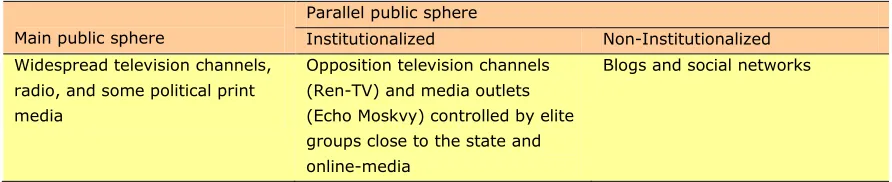
Meanwhile, some niche media outlets may be more critical, as they have a news agenda that differs from that of the official media. Such media serve the informational needs of a very narrow group of socially active people, whose needs are also catered to by Internet use. These media are the Ren-TV television channel, Echo Moskvy radio broadcast, and Novaya Gazeta print media. Online media also play a role in this field4 (Etling, Alexanyan, Kelly, Faris, et al., 2010). Yet all these media outlets are
3 Channel One is 51% owned by the state, and 25% of its stock is owned by Yuri Kovaltchuk and his bank
Rossia, which are known to be very close to Prime Minister Putin. The media Rossia, Kultura (Rossia K), Rossia 2, and Rossia 24 are directly owned and operated by the state. NTV and TNT (entertainment channels) are owned by Gazprom, which is a state-owned company.
4 In his interview to three of the biggest TV channels in December 2010, President Dmitry Medvedev
institutionalized within the system of state-related ownership: Ren-TV is owned by the bank Rossia, which is close to Prime Minister Putin (owned by his old colleague Kovalchuk), Echo Moskvy belongs to Gazprom, and Novaya Gazeta belongs to the deputy of the State Duma (the lower chamber of Parliament) and the businessman Lebedev. Such media do not play the role of mediators (the basic function of the public sphere, according to Habermas), but rather, they ensure the isolation and marginalization of the opposition and other critically thinking people. Consequently, such media can be called “information ghettos” (Kiriya, 2007; Kiriya & Degtereva, 2010). Such ghettos reproduce the old Russian culture of a narrow public sphere from the 19th century and the late Soviet period. The use of a parallel public sphere represents the subversion of the traditional public sphere, but it does not play an important role in the subversion of the entire social order.
[image:11.612.83.529.438.529.2]
In parallel to such an institutionalized parallel public sphere, another public sphere has appeared within social networks on the Internet. According to Etling et al. (2010), public discourse within social networks in Russia has its own peculiarities—namely, quasi-exclusive fields for public discourse for isolated clusters of the population, such as democratic opposition and nationalists. As such, the parallel public sphere is represented in its institutionalized form, as well as in a non-institutionalized form (see Table 1). Sometimes, public discourse from blogs (i.e., the non-institutionalized sphere) can migrate into the institutionalized parallel public sphere (Internet media or some another “ghetto”), but it does, though rarely, sometimes appear in the official public sphere, as evident in some police corruption affairs (e.g., the Dymovsky case or revelations of illegal actions of traffic police), the scandal over improper quality of social security in nursing homes in the Pskov region, the scandal involving the Tver region’s governor Zelenin,5 etc.
Table 1. Main and Parallel Public Spheres in Russia.
Main public sphere
Parallel public sphere
Institutionalized Non-Institutionalized Widespread television channels,
radio, and some political print media
Opposition television channels (Ren-TV) and media outlets (Echo Moskvy) controlled by elite groups close to the state and online-media
Blogs and social networks
The question now is how the state will react to the non-institutionalized public sphere. Recent initiatives of regulation indicate that the state will either legalize this field and force bloggers to be more responsible for the content they create (the most recent initiative proposed registering every blogger account as separate media) or create a non-institutionalized main public sphere in which the state will— through loyal bloggers—organize public discourse. As such, in the field of public protest activity, such a parallel public sphere is still quite narrow, which reproduces the old cultural tradition of the narrow political debate. Another peculiarity of this parallel debate is the inclusion of actors in both the production and consumption of symbolic forms. The same situation was observed in the 19th century in the literary
public sphere (literary men were themselves reading) and during the Soviet period, when the consumption of Western content was actively debated (Firsov, 2008).
Cultural Goods in the Parallel Public Sphere
During the Soviet era, the cultural industry in general was not a business, and consequently, it played a dirigiste role (see above, “Archaeology of Accessibility”). In such a tradition, literary content was politically and ideologically charged, which considerably reduced the offer in this field, particularly by limiting and filtering global content. It further provoked (as in the mass media field) an increase in parallel practices that contributed to establishing a parallel public sphere. Such practices included exchanges of Western music in the early post-war period (e.g., the Beatles’ first albums were prohibited in the official phonographic industry), auto-publication and circulation of prohibited literature (from both Western and dissident authors), and the illegal exchange of videos (Western films often recorded from foreign television broadcasts in nearby border zones, such as the Baltic countries). The traffic of such prohibited recorded cultural goods was based not only on consuming, but also on producing activities.
Samizdat was an illegal activity of auto-edition, where some groups of dissidents not only circulated prohibited literary works, but also contributed to their diffusion, copying and producing them for others. The field of music was the same: Music lovers purchased (generally from visiting foreign citizens) Western vinyl discs and then reproduced them on old X-ray photographs (Rafikova, 2010). In other words, some parallel media activities during Soviet times represented not so much consumer practices as protest activities (traffic of Western music was more popular among the “Soviet fops” social movement). Consequently, some such activities (e.g., auto-publication of samizdat and non-formal exchange of prohibited books, music, and video programs) were based on non-monetary exchanges (Lisjutkina, 1993). Such separate organizational structures of production (quite similar to artisanal models) and differentiated from industrial mass-produced books, music, and movies corresponds in this case to “alternative debate” defined by Fuchs (2010).
After the collapse of the Soviet Union, its ideological barriers were destroyed, which is why it is still not possible to simply apply the same reasons in structuring the Soviet parallel circulation of cultural products to post-Soviet piracy. However, at the same time, the lack of financial accessibility to cultural goods and the population’s limited income could not be the only reasons. Between 2000 and 2008, the average salary per habitant increased 8 times (from 2,223.4 to 17,290.1 rubles; Federal Statistic Bureau, 2011), but the level of piracy in the music field did not drop significantly (from 75% to 67% of the total music market volume between 2000 and 2006), while the total pirate market volume doubled (from US$200 to 450 million; IFPI, 2006). Thus, other strategies exist beyond piracy.
identified in a survey by Sezneva and Karaganis (2011). The second motivation is access to the non-commercial culture; such movies (art house or other non-mass-produced products) could not be purchased through official channels because localized versions were not available, and in general, they are not distributed commercially. The final motivation is access to locally produced films for those who live abroad or in some very distant regions where the official market is very poor. As such, piracy partly represents a reaction to the imperfect content of a market-driven cultural economy. In other words, piracy is, to a certain degree, more oriented to narrow markets’ demands than to that of the official mass cultural market, and in that sense, it is a parallel reaction to institutional conflict between a formal set of rules (driven by the global market economy of big distributers) and a non-formal set of rules based on the tradition of an alternative cultural consumption.
Yet even if some consumers’ motivations for accessing pirated cultural goods have no relation to financial motivation (and, consequently, to accessibility), they could be interpreted not as a parallel public sphere, but just as an result of the market’s failure (non-correspondence of monopolized, majors-dominated supply to local market demand and the particular interests of users). Unlike the Soviet situation, in which the consumption of Western music, movies, etc. both has been connected with alternative mass media practices (such as listening to Western media) and contributed to the creation of an alternative debate, the actual parallel activities of sharing media content for free have no connection with alternative debate and represent, instead, some kind of non-organized anti-market protest.
The state policy in the field of filtering cultural content has no connection with Soviet practices. Indeed, practically all cultural content is accessible and not prohibited because, universally, Russia’s most important media channel is free television. Other media (due to their character of paid consumption) are consumed by quite a limited range of the population, a segment whose opinion does not represent the most important target for Kremlin propagandists. Consequently, cultural content is not filtered, and pirating cannot have serious political motivations. Moreover, the organizational structure of piracy corresponds perfectly to the industrial production proper to the legal cultural market production, a situation which does not respond to criterions of Fuchs’ alternative debate.
Both systems of rules (formal during Soviet times and non-formal during the current period) provoked the existence of parallel public spheres characterized by narrowness and social atomization, thereby not leading to considerable reforms in the official public sphere. In other words, this parallel flow simply reproduced the dominant social order.
The political dimension in the field of cultural industries and recorded content is quite similar. After the Soviet era, the formal system of institutions opened doors for the quasi-non-controllable import of any global entertainment content (with very rare exceptions), but in this case, the state bureaucratic filter was replaced by market policies filter of global players in the field of content, which also provoked a lack of some kind of value being added for cultural products and contributed to the creation of parallel pirated practices. However, such practices could be interpreted not as a parallel public sphere, but (much more likely) as market failure.
Conclusion
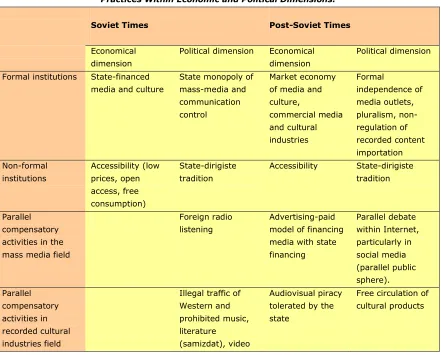
In conclusion, this article highlights that a kind of subversive media culture has long been grounded in the entire social tradition in Russia, and that it is strongly connected with the official set of rules and represents a kind of social response to their imperfection. The significant pressure that the Russian state historically applied to manage social reforms led to escapism among the population, ultimately yielding attempts to delve into parallel and alternative practices. Such practices had two historical dimensions: the economical dimension, based on the grounded social tradition of media accessibility, and the political dimension, based on different kinds of alternative debate practices that could be interpreted as a parallel public sphere.
Table 2. Transformation of Formal and Non-Formal Institutions Structuring Media Piracy Practices Within Economic and Political Dimensions.
Soviet Times Post-Soviet Times
Economical dimension
Political dimension Economical dimension
Political dimension
Formal institutions State-financed media and culture
State monopoly of mass-media and communication control
Market economy of media and culture, commercial media and cultural industries Formal independence of media outlets, pluralism, non-regulation of recorded content importation Non-formal institutions Accessibility (low prices, open access, free consumption) State-dirigiste tradition
Accessibility State-dirigiste tradition
Parallel compensatory activities in the mass media field
Foreign radio listening
Advertising-paid model of financing media with state financing Parallel debate within Internet, particularly in social media (parallel public sphere). Parallel compensatory activities in recorded cultural industries field
Illegal traffic of Western and prohibited music, literature (samizdat), video
Audiovisual piracy tolerated by the state
Free circulation of cultural products
public sphere, represented by very limited opposition media, but controlled by the state to manage the alternative discourse, and the not-yet-institutionalized public sphere, which acts via Internet blogs. To manage the isolation of opposition communities within parallel “information ghettos,” the Russian state should operate as a “switcher” (Castells, 2009, p. 45) and ensure non-connectivity between the large-scale official public sphere (the exclusive field of the state propaganda, where the state prefers to act like a programmer) and the narrow opposition communities on the Internet. However, in the field of cultural industries, the strategy of the state is not to filter the content. This means that piracy does not represent alternative political debate, but merely consumers’ reaction to the imperfection of the market-based cultural economy.
Finally, a conflict exists between formal and non-formal institutions of economy and politics. The state uses an advertising-based model (which is an imported global element) for mass media to ensure accessibility, yet it maintains a strong affiliation with mass media outlets and uses the dotation state-paid model to continue playing the dirigiste role in the official public sphere. As a result, the imported formal institutions of commercial media are in conflict with non-formal institutions of the state bureaucracy’s communication control. Ultimately, the subversive parallel media practices—even if some represent a reaction to the imperfect rules of the institutionalized media environment—are based on a historical and cultural framework that also determines state policy in this field. Such practices are complementing and inciting official state policy in media to maintain and reproduce social order.
References
Balabanova, E. S. (2001). Osobennosti Rossijskoj ekonomicheskoj mentalnosti [Peculiarities of Russian economic mentality]. Mir Rossii [World of Russia], 3, 67–77.
Barsukova, S. Y. (2000). Neformalnaya ekonomika i setevaja organizatsia prostranstva v Rossii [Non-formal economy and networked organization of space in Russia]. Mir Rossii [World of Russia], 1, 52–68.
Beumers, B. (1999). Cinemarket, or the Russian film industry in “Mission Possible.” Europe-Asia Studies, 51(5), 889.
Castells, M. (1999). The information age, volumes 1–3: Economy, society and culture. London: Wiley-Blackwell.
Castells, M. (2009). Communication power. Oxford, UK: Oxford University Press.
Clarke, S. (Ed.). (1995). Management and industry in Russia: Formal and informal relations in the period of transition. Aldershot, UK: Edward Elgard.
Etling, B., Alexanyan, K., Kelly, J., Faris, R., Palfrey, J., & Gasser, U. (2010). Public discourse in the Russian blogosphere: Mapping RuNet politics and mobilization. Cambridge, MA: Berkman Center for Internet and Society, Harvard University. Retrieved from
http://cyber.law.harvard.edu/sites/cyber.law.harvard.edu/files/ Public_Discourse_in_the_Russian_Blogosphere_2010.pdf
Firsov, B. (2008). Raznomyslie v SSSR. 1940–1960-e gody [Differences of opinion in USSR in 1940– 1960s]. St. Petersburg: European University in SPB.
Fuchs, C. (2010). Alternative media as critical media. European Journal of Social Theory, 13(2), 173–192.
Gerchuni, J. (1999). Budgety vremeni i neformalnaya ekonomitsheskaya deyatelnost’ [Time budgets and non-formal economic activity]. In T. Shanin (Ed.), Neformalnaya ekonomika. Rossija i mir [Non-formal economy. Russia and Worldwide] (pp. 343–356). Moscow: Logos.
Habermas, J. (1991). The structural transformation of the public sphere: An inquiry into a category of bourgeois society. Cambridge, MA: MIT Press.
Hoggart, R. (1998). The uses of literacy. Piscataway, NJ: Transaction Publishers.
IFPI. (2006). The recording industry 2006 piracy report. London: IFPI. Retrieved from www.ifpi.org/content/library/piracy-report2006.pdf
IRG. (2001). Russia: Video market in transition. Interactive Research Group report for European Audiovisual Observatory. Strasbourg, France: EAO. Retrieved from
http://www.obs.coe.int/online_publication/reports/IRG_video.pdf.en
Ivanov, O. (Ed.). (2009a). Analiticheskij doklad "O sostoyanii kinootrasli Rossii" [Analytical report “About Russian cinema industry”]. Moscow: Movie Research. Retrieved from
http://www.rb.ru/inform/126607.html
Ivanov, O. (Ed.). (2009b). Kinostatistika 2008 [Movie statistics 2008] [Analytical report about Russian movie industry]. Moscow: Movie Research. Retrieved from
http://www.movieresearch.ru/catalog/uploads/file/116KinoStatistika_2008.pdf
Kabalina, V., & Clarke, S. (1996). Politika privatizatsii I borba za control nad predpriatiem v Rossii [The policy of privatization and struggle for control of enterprise in Russia]. Roubezh [Border], 8–9, 60–97.
Kachkaeva, A. (Ed.). (2008). Tsifrovizatsii teleradioveshtshanija: opyt perekhoda v Rossii i v mire [Digitalizing television and radio broadcasting: Russian and worldwide experience]. Moscow: Elitkomstar, State University–Higher School of Economics.
Kachkaeva, A., & Kiriya, I. (Eds.). (2007). Rossijskoe televidenie: Mezhdu sprosom i predlozheniem [Russian TV: Between demand and supply]. Moscow: Elitkomstar.
Kalimullin, T. (2005). Rossijskij rynok dissertacionnykh uslug [Russian market of PhD-writing services]. Ekonomitcheskaya Sotsiologia [Economic sociology], 6(4), 14–39.
Kiriya, I. (2004). La production des biens culturels en URSS, une “autre” industrie culturelle. Les enjeux de la transformation actuelle [Production of cultural goods in USSR : « another » cultural industry. Reasons of actual transformation]. Les enjeux de l’information et de la communication [Issues on information and communication]. Retrieved from
http://w3.u-grenoble3.fr/les_enjeux/2004/Kiriya/home.html#une
Kiriya, I. (2007). La persistance du non-marchand dans l’appropriation des medias et des TICs en Russie post-sovietique [Persistence of non-market in appropriation of media and ICTs in post-soviet Russia]. Thèse de doctorat en sciences de l’information et de la communication [PhD paper in sciences of information and communication]. Grenoble, France: Grenoble University.
mondialisation culturelle [Audivisual piracies—Underground paths of cultural globalization]. Brussels: De Boeck.
Kiriya, I. (2011b). Nerynochnye printcipy I ogranichenya konkurentsii na regionalnykh mediarynkakh v Rossii [Non-market principles and limitations of concurrence in regional media markets in Russia]. In E. Vartanova (Ed.), Economika I menedzhment SMI [Economics and management of media]. Moscow: Mediamir.
Kiriya, I., & Degtereva, E. (2010). Russian TV market: Between state supervision, commercial logic and simulacrum of public service. Central European Journal of Communication, 1, 37–51.
Klimov, I. (2007). Social'nye vyzovy ‘privatizirovannogo’ televidenija [Social challenges of privatized TV]. In A. Kachkaeva & I. Kiriya (Eds.), Rossijskoe televidenie: Mezhdu sprosom i predlozheniem [Russian TV: Between demand and supply]. Moscow: Elitkomstar.
Koltsova, O. (2006). News media and power in Russia. London: Routledge.
Ledeneva, A. (2006). How Russia really works. New York: Cornell University Press.
Lisjutkina, L. (1993). Samizdat i agitprop. Glasnost’ pered vyzovom svobodnogo rynka [Samizdat and agitprop. Glasnost facing challenge of free market]. Obchtchestvennye nauki i sovremennost’ [Social sciences and modernity], 4, 101–113.
Mattelart, T. (1995). Le cheval de Troie audiovisuel. Le rideau de fer à l’épreuve des radios et télévisions transfrontières [Audiovisual Trojan Horse. The “Iron Curtain” under the attack of cross-border television and radio broadcasting]. Grenoble, France: Presses Universitaires de Grenoble.
Miège, B. (2010). L’espace public contemporain [Contemporary public sphere]. Grenoble, France: Presses Universitaires de Grenoble.
Ministry of Culture. (2011). Ob itogah raboty Ministerstva kul'tury Rossijskoj Federacii v 2010 godu i zadachah na 2011 god [About the results of activity of Ministry of Culture of Russian Federation in 2010 and tasks for 2011]. Moscow: Russian Federation Ministry of Culture. Retrieved from http://mkrf.ru/activity/reports/detail.php?ID=166518
Ministry of Telecommunication and Mass Communication. (2009). Ekonomicheskye pokazateli otrasli [Economic indicators of telecommunication industry]. Moscow: Russian Federation Ministry of Telecommunication and Mass Communication. Retrieved from
http://minsvyaz.ru/ru/directions/stat/stat/
Morley, D., & Brunsdon, C. (1999). The nationwide television studies. London: Routledge.
Negt, O., & Kluge A (1972). Offentlichkeit und erfahrung. Zur organisationsanalyse von burgerlicher und proletarischer offentlichkeit [Public and experience. Organizational analysis of bourgeois and proletarian public sphere]. Frankfurt am Main: Suhrkamp.
North, D. C. (1990). Institutions, institutional change and economic performance (Political economy of institutions and decisions). Cambridge, UK: Cambridge University Press.
North, D. C., Wallis, J. J., & Weingast, B. R. (2009). Violence and social orders: A conceptual framework for interpreting recorded human history. Cambridge, UK: Cambridge University Press.
Nureev, R. (2003). Gosudarstvo: Istoricheskie sud'by vlasti-sobstvennosti [The state: Historical destinies of power-property]. Paper presented at the Internet-conference “Poisk jeffektivnyh institutov dlja Rossii XXI veka” [The search for effective institutes for Russia in the 21st century]. Retrieved from http://ecsocman.edu.ru/db/msg/129880.html
Ovsepian, R. (1999). V labirintakh istorii otechestvennoj zhurnalistiki [In the labyrinth of the history of Russian journalism]. Moscow: RIP-holding.
Picard, R. (1989). Media economics: Concepts and issues. Newbury Park, CA: SAGE Publications. Rafikova, S. (2010). Subkultura ili podrazhatelstvo: styliagi sibirskoj provintsii [Subculture or imitation:
Fops of the Siberian province]. Kulturologichesky jurnal [Journal of cultural research], 2.
Rosstat [Federal Statistic Bureau]. (2011). Rossijskij statistichesky ezhegodnik [Russian statistics yearbook], section “Dokhody naselenija” [Population’ revenues]. Moscow: Rosstat. Retrieved from http://www.gks.ru/bgd/regl/b11_13/IssWWW.exe/Stg/d1/06-09.htm
Sezneva, O., & Karaganis, J. (2011). Russia. In J. Karaganis (Ed.), Media piracy in emerging economies (pp. 149–218). New York: Social Sciences Research Council. Retrieved from
http://piracy.ssrc.org
Shishkin, S. (Ed.). (2003). Informal out-of-pocket payments for health care in Russia. Moscow: Independent Institute for Social Policy.
Sinyavskaya, O. (2005). Neformalnaya zaniatost’ v sovremennoy Rossii : Izmerenie, mashtaby, dinamika [Non-formal employment in contemporary Russia: Measurement, scale and dynamics]. Moscow: Pomatour.
Thompson, J. (2007). The media and modernity: A social theory of the media. Stanford, CA: Stanford University Press.
VCIOM (Russian Center for Public Opinion Study). (2010). Kniga v menyayushchemsya mire: Starye i novye tehnologii chteniya v Rossii [Book in the changing world: Old and new technologies of reading in Russia]. Moscow: VCIOM.
Yakovlev, A. (2006). Agenty modernisatsii [Agents of the modernization]. Moscow: State University-Higher School of Economics.