Cryptography and Network Security
Chapter 3
Fifth Edition
by William Stallings
Content
●
Block Cipher Principles
●
The Data Encryption Standard
●Simplified-DES
●
DES Details
●
DES Design Issues and Attacks
The objectives
now look at modern block ciphers
one of the most widely used types of
cryptographic algorithms
Block Ciphers
●
Encrypt data one block at a time
●
Used in broader range of applications
●
Typical block size 64 – 128 bits 128 bits
●
Most algorithms based on a structure referred to as
Block cipher principles
● n-bit block cipher takes n bit plaintext and produces n bit ciphertext
● 2n possible different plaintext blocks
● Encryption must be reversible (decryption possible)
● Each plaintext block must produce unique ciphertext block
Ideal Block Cipher
Ideal Block Cipher
● n-bit input maps to 2n possible input states
● Substitution used to produce 2n output states
● Output states map to n-bit output
● Ideal block cipher allows maximum number of possible encryption mappings from
plaintext block
● Problems with ideal block cipher:
– Small block size: equivalent to classical substitution cipher; cryptanalysis based on statistical characteristics feasible
– Large block size: key must be very large; performance/implementation problems
● Key length :
– In general, key length is 2n × n
Feistel Structure for Block Ciphers
● Feistel proposed applying two or more simple ciphers in sequence so final result
cryptographically stronger than component ciphers
● n-bit block length; k-bit key length; 2k transformations (rather than 2n !)
● Feistel cipher alternates: substitutions, transpositions (permutations)
● Applies concepts of diffusion and confusion
● Applied in many ciphers today
● Approach:
– Plaintext split into halves
– Subkeys (or round keys) generated from key – Round function, F, applied to right half
– Apply substitution on left half using XOR – Apply permutation: interchange to halves
Confusion and Diffusion
● Diffusion
– Statistical nature of plaintext is reduced in ciphertext
– E.g. A plaintext letter affects the value of many ciphertext letters – How: repeatedly apply permutation (transposition) to data, and
then apply function
● Confusion
– Make relationship between ciphertext and key as complex as possible
– Even if attacker can find some statistical characteristics of ciphertext, still hard to find key
Using the Feistel Structure
Exact implementation depends on various design features
Block size, e.g. 64, 128 bits: larger values leads to more diffusion
Key size, e.g. 128 bits: larger values leads to more confusion, resistance against brute force
Number of rounds, e.g. 16 rounds
Subkey generation algorithm: should be complex
Round function F: should be complex
Other factors include fast encryption in software and ease of
analysis
Data Encryption Standard (DES)
● Symmetric block cipher
– 56-bit key, 64-bit input block, 64-bit output block
● One of most used encryption systems in world
– Developed in 1977 by NBS/NIST
– Designed by IBM (Lucifer) with input from NSA
– Principles used in other ciphers, e.g. 3DES, IDEA
● Simplified DES (S-DES)
– Cipher using principles of DES
Simplified DES
●
Input (plaintext) block: 8-bits
●
Output (ciphertext) block: 8-bits
●
Key: 10-bits
●
Rounds: 2
●
Round keys generated using permutations and left shifts
●
Encryption: initial permutation, round function, switch halves
●
Decryption: Same as encryption, except round keys used in
S-DES Algorithm
IP = { 2, 6, 3, 1, 4, 8, 5 , 7 }
S-DES Key generation
P10 = { 3, 5, 2, 7, 4, 10, 1, 9, 8, 6}
S-DES Encryption Details
EP = { 4, 1, 2, 3, 2, 3, 4, 1}
P4 = { 2, 4, 3, 1}
IP = { 2.,6, 3 , 1 , 4 , 8 , 5 , 7 }
S-Box
● S-DES (and DES) perform substitutions using S-Boxes
● S-Box considered as a matrix: input used to select
row/column; selected element is output
● 4-bit input: bit1; bit2; bit3; bit4
– bit1 , bit4 species row (0, 1, 2 or 3 in decimal) – bit2bit3 species column
S-DES Example
●
S-DES Example
– Plaintext: 01110010
– Key: 1010000010
– Ciphertext: 01110111
S-DES Summery
●
S-DES expressed as functions:
●
Security of S-DES:
– 10-bit key, 1024 keys: brute force easy
Comparing DES and S-DES
●
S-DES
– 8-bit blocks
– 10-bit key: 2 x 8-bit
round keys
– IP: 8-bits
– F operates on 4 bits
– 2 S-Boxes
– 2 rounds
●
DES
– 64-bit blocks
– 56-bit key: 16 x 48-bit
round keys
– IP: 64 bits
– F operates on 32 bits
– 8 S-Boxes
DES
3: Expansion permutation (E )
4 : Permutation Function (P)
Single Round of DES Algorithm
DES Key Schedule Calculation
Table 3.2
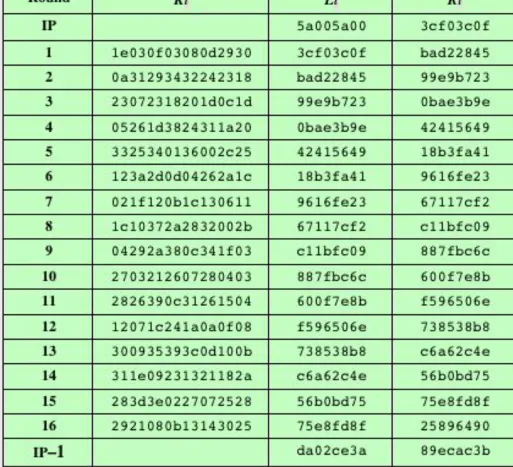
DES
Example
Note: DES subkeys are shown as eight 6-bit values in hex format (Table can be found on
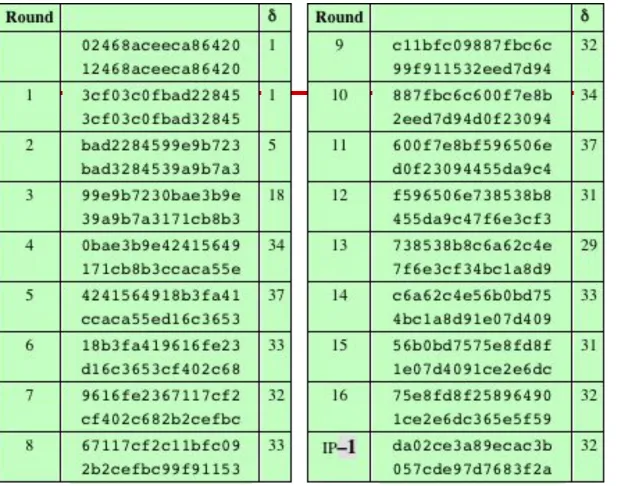
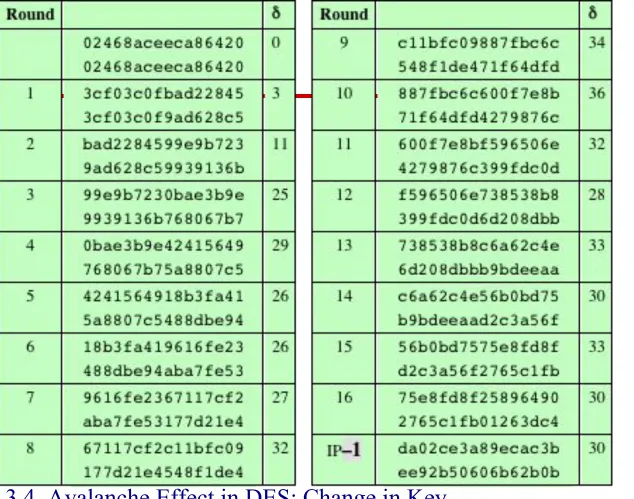
Avalanche Effect
● Aim: small change in key (or plaintext) produces large change in
ciphertext
● Avalanche effect is present in DES (good for security)
● Following examples show the number of bits that change in output
when two different inputs are used, differing by 1 bit – Plaintext 1: 02468aceeca86420
Table 3.5
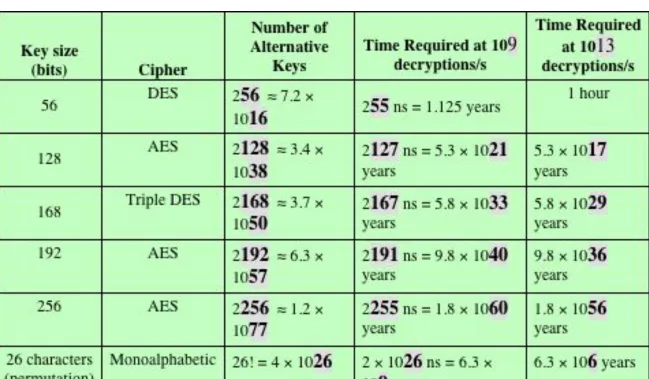
Key size
●
Although 64 bit initial key, only 56 bits used in
encryption (other 8 for parity check)
●
2
56= 7.2 x 10
16– 1977: estimated cost $US20m to build machine
to break in 10 hours
– 1998: EFF built machine for $US250k to break
in 3 days
– Today: 56 bits considered too short to
withstand brute force attack
Attacks on DES
●
Timing Attacks
– Information gained about key/plaintext by observing how
long implementation takes to decrypt
– No known useful attacks on DES
●
Differential Cryptanalysis
– Observe how pairs of plaintext blocks evolve
– Break DES in 247 encryptions (compared to 255); but
require 247 chosen plaintexts
●
Linear Cryptanalysis
DES Algorithm Design
●
DES was designed in private; questions about the
motivation of the design
– S-Boxes provide non-linearity: important part
of DES, generally considered to be secure
– S-Boxes provide increased confusion
Multiple Encryption with DES
●
DES is vulnerable to brute force attack
●
Alternative block cipher that makes use of DES
software/equipment/knowledge: encrypt multiple
times with different keys
●
Options:
Double Encryption
●
For DES, 2 56-bit keys, meaning 112-bit key
length
Triple Encryption
●
2 keys, 112 bits
●3 keys, 168 bits
Summary
●
have considered:
– block vs stream ciphers
– Feistel cipher design & structure
– DES
» details » strength