R E S E A R C H
Open Access
Functional characterization of EZH2
β
reveals the
increased complexity of EZH2 isoforms involved
in the regulation of mammalian gene expression
Adrienne Grzenda
1, Gwen Lomberk
1, Phyllis Svingen
1, Angela Mathison
1, Ezequiel Calvo
2, Juan Iovanna
3,
Yuning Xiong
1, William Faubion
1and Raul Urrutia
1,3,4,5*Abstract
Background:Histone methyltransferase enhancer of zeste homologue 2 (EZH2) forms an obligate repressive complex with suppressor of zeste 12 and embryonic ectoderm development, which is thought, along with EZH1, to be primarily responsible for mediating Polycomb-dependent gene silencing. Polycomb-mediated repression influences gene expression across the entire gamut of biological processes, including development, differentiation and cellular proliferation. Deregulation of EZH2 expression is implicated in numerous complex human diseases. To date, most EZH2-mediated function has been primarily ascribed to a single protein product of theEZH2locus. Results:We report that theEZH2locus undergoes alternative splicing to yield at least two structurally and functionally distinct EZH2 methyltransferases. The longest protein encoded by this locus is the conventional enzyme, which we refer to as EZH2α, whereas EZH2β, characterized here, represents a novel isoform. We find that EZH2βlocalizes to the cell nucleus, complexes with embryonic ectoderm development and suppressor of zeste 12, trimethylates histone 3 at lysine 27, and mediates silencing of target promoters. At the cell biological level, we find that increased EZH2βinduces cell proliferation, demonstrating that this protein is functional in the regulation of processes previously attributed to EZH2α. Biochemically, through the use of genome-wide expression profiling, we demonstrate that EZH2βgoverns a pattern of gene repression that is often ontologically redundant from that of EZH2α, but also divergent for a wide variety of specific target genes.
Conclusions:Combined, these results demonstrate that an expanded repertoire of EZH2 writers can modulate histone code instruction during histone 3 lysine 27-mediated gene silencing. These data support the notion that the regulation of EZH2-mediated gene silencing is more complex than previously anticipated and should guide the design and interpretation of future studies aimed at understanding the biochemical and biological roles of this important family of epigenomic regulators.
Keywords:Chromatin, Enhancer of zeste homologue 2, Epigenetics, EZH2, Histone methyltransferase, Polycomb, Polycomb repressive complex 2, PRC2
* Correspondence:[email protected]
1
Laboratory of Epigenetics and Chromatin Dynamics, Mayo Clinic, Rochester, MN 55905, USA
3
INSERM U.624, Stress Cellulaire, 163 Avenue de Luminy, Case 915, Parc Scientifique et Technologique de Luminy, 13288, Marseille Cedex 9, France Full list of author information is available at the end of the article
Background
The currently accepted hierarchical model of Polycomb-mediated gene repression begins with the trimethylation of histone 3 at lysine 27 (H3-K27me3) through the action of Polycomb repressive complex (PRC) 2, a multi-subunit complex. The H3-K27me3 mark subsequently recruits PRC1, leading to the propagation of the repressed state through a variety of mechanisms, including chro-matin compaction and recruitment of other chrochro-matin- chromatin-remodeling enzymes, such as DNA methyltransferases [1]. However, it must be noted that alternative pathways for PRC1 recruitment, independent of inscription of the H3-K27me3 mark, have also been observed [2]. The en-zymatic engine of PRC2 is enhancer of zeste homologue 2 (EZH2), which possesses the evolutionarily conserved SET domain that confers the complex with its histone methyltransferase (HMT) activity [3,4]. The catalytic function of EZH2 is strictly dependent on the presence of both WD40-repeat protein embryonic ectoderm develop-ment (EED) and zinc finger protein suppressor of zeste 12 (SUZ12), which serve to link and stabilize the en-zyme to its histone substrate [5-9]. A number of other proteins, such as retinoblastoma binding proteins 4 and 7 (RBBP4/7), Adipocyte enhancer-binding protein 2 and PHD finger protein 1 enhance the enzymatic function of the complex [5,10-12]. Thus, within these complexes, EZH2 proteins serve as the key histone code writers of the H3-K27me3 mark that leads to long-term epigenetic gene silencing.
PRC2 proteins are extremely well conserved from plants to humans, indicating the fundamental importance of this epigenetic mechanism to organism development and sur-vival [13]. Interestingly, several alternative PRC2 complexes have been identified. EED undergoes alternative translation to yield four protein products. PRC2 complex was defined as a complex between EZH2, SUZ12, RBBP4/7 and the longest isoform of EED, EED1. However, a second com-plex, PRC3, was found with the substitution of the shortest isoforms of EED, EED3/4, that was capable of H3-K27 methylation [14]. Another alternative complex, PRC4, was found with the substitution of EED2, an isoform normally undetectable in differentiated cells but prevalent in embry-onic stem cells and transformed tissues [15]. EZH1, a homologue of EZH2 encoded at a separate locus, is also capable of H3-K27 trimethylation and transcriptional silen-cing. EZH1 forms a non-canonical PRC2 complex with EED and SUZ12. However, current evidence supports the idea that PRC2-EZH1-mediated H3-K27 trimethylation is less widespread than for PRC2-EZH2. PRC2-EZH1, for in-stance, has been shown to repress transcription through chromatin compaction in the absence of methyltransferase co-factor S-adenosyl methionine [10]. Together, these data suggest a more intricate regulation of H3-K37me3 depo-sition than previously anticipated.
The multiplicity of downstream biological functions mediated by EZH2 points to a pervasiveness of Polycomb-mediated repression well beyond development. Roles for EZH2 have been identified in cell cycle, cellular differen-tiation and pluripotency, among many others [16]. Patho-logically, EZH2 has been implicated in the neoplastic transformation of a number of cell types, including for many solid tumors and hematopoietic malignancies. Levels of EZH2 strongly associate with the severity of ma-lignant progression and poor prognosis in breast and prostate cancer [17,18]. The medical relevance of this ob-servation is congruent with the functions for EZH2 as revealed by experimental methods. For instance, EZH2 overexpression promotes cellular proliferation [19-24], migration [25-27], angiogenesis [28] and survival [29,30]. Thus, both basic and translational investigations have established a solid role for EZH2 and its partners as an epigenetic system involved in oncogenesis (epigenetic on-cogenes), for which detailed mechanisms underlying their function have become an area of intensive investigation.
The current study increases our knowledge on the complexity of EZH2-mediated processes by providing biochemical evidence revealing extended isoform diver-sity within EZH2 proteins that function in mammalian cells. Indeed, our molecular and functional data indicate that the EZH2 locus encodes a novel isoform, EZH2β. This isoform localizes to the cell nucleus, complexes with EED and SUZ12, and binds to promoters where it increases H3-K27me3 levels, all properties in common with EZH2αprotein. Importantly, however, EZH2β par-ticipates in the regulation of gene expression with a pat-tern that is not only shared but also distinct from that regulated by EZH2α, pointing to both redundancy and specialization within members of this HMT family of proteins. Combined, these results reveal that the regula-tion of H3-K27 methylaregula-tion is more complex than previ-ously anticipated and expands our knowledge of how cells generate and use different histone code writers to achieve distinct biochemical and biological functions. This new knowledge must be taken into consideration in the design and interpretation of studies on gene ex-pression, distinct cell functions, single target gene pro-moters or genome-wide epigenomics, as it reveals for the first time the need for isoform-specific tools to dis-sect Polycomb functions.
Results
Identification of EZH2βreveals the existence of an expanded repertoire of EZH2 isoforms widely expressed in human tissues
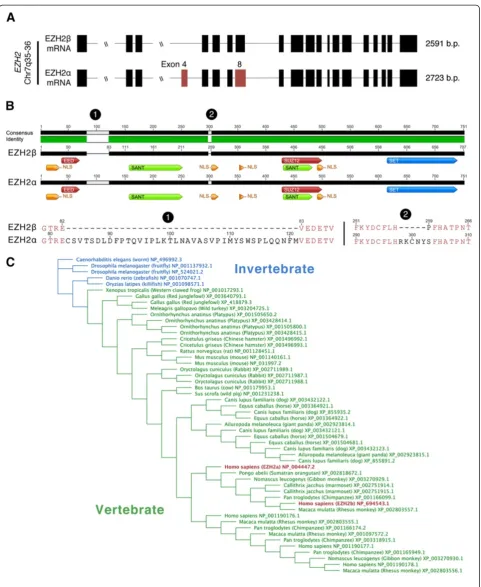
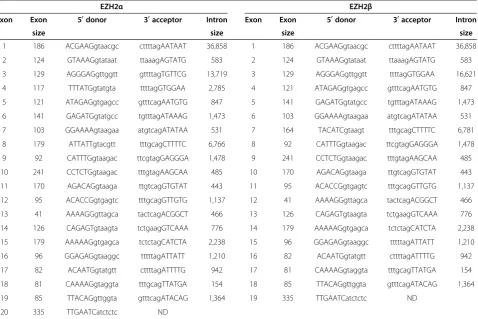
[31]. Initial western blot analyses in pancreatic cancer cells revealed the presence of multiple EZH2-positive bands (Additional file 1: Figure S1). To date, over 30 different EZH2 mRNAs have been validated by high-throughput genomic sequencing efforts. One of the pro-teins generated from this locus, EZH2α, encoded by 20 exons, is the HMT classically associated with the func-tion of the PRC2 complex (Figure 1A and Table 1). EZH2β, a novel isoform that the current study function-ally characterizes in better detail, skips exon 4 of EZH2α and utilizes an alternative 50splice donor on EZH2αexon 8/EZH2β exon 7. At the protein sequence level, EZH2α and EZH2βdiffer by 44 amino acids, measuring 751 and 707 amino acids, respectively (Figure 1B). A highly similar third splice variant encoding five less amino acids than EZH2αhas also been cited as EZH2. Structural compari-son of these closely related variants does not reveal any noticeable differences that would suggest differing func-tion and thereby have been considered interchangeable in the literature.
For the purposes of our manuscript, we have selected the longest transcriptional variant (751 amino acids) as the reference sequence to provide a numbering framework for our bioinformatics. Compared with this reference EZH2α sequence, the shorter EZH2β displays conserva-tion of several domains, namely the nuclear localizaconserva-tion signals, SANT (DNA-binding domains) and the SET do-main. Together, the conservation of these domains should confer this protein with the ability to localize to the nu-cleus and function as an HMT (Figure 1B). Notably, the regions that have previously been described to interact with the obligate EZH2α co-factors SUZ12 and EED are also preserved in EZH2β[7,32], suggesting that different EZH2 gene products complex with molecules significant to its major biochemical function. Additionally, compari-son of all currently available genome sequences generated by world-wide sequencing efforts revealed that alternative splicing of theEZH2locus is conserved from invertebrates to vertebrates. The number of predicted EZH2 orthologs within each of the surveyed species suggests multiple ex-pansion and reduction events may have occurred during the evolution of the protein as evolutionary distance in-creases from invertebrates to higher-order mammals (Figure 1C). We find that the EZH2αand EZH2βare pre-dicted to be greater than 99% conserved in higher-order mammals (Table 2), suggesting that these two proteins may account for a large number of the functions evolu-tionarily selected for theEZH2locus.
Using a panel of 22 different tissues, we demonstrated that these two transcripts share a similar expression profile in most human organs. Additional comparative analyses of the expression pattern for other Polycomb-related co-factors demonstrated that tissues expressing high levels of EZH2α or EZH2β transcripts display a
concordant enrichment of transcripts encoding other PRC2 complex proteins, ones previously described to be exclusive partners of the conventional enzyme, EZH2α (Figure 2A). More importantly, we validated the exis-tence of EZH2β at the protein level using an affinity-purified antibody specifically generated against this novel isoform (Figure 2B). The electrophoretic mobility of these two isoforms as resolved by SDS-PAGE is in agree-ment with the molecular weights predicted from the re-spective amino acid compositions (EZH2α: 86.03 kDa; EZH2β: 81.05 kDa). Experiments with these specific anti-bodies confirmed that the EZH2β transcript is readily translated into a protein that has the potential to function as a novel member of the PRC2 complex (Figure 2C). Fur-thermore, the pattern of expression of EZH2βas defined by western blot was highly concordant with that predicted by PCR-based transcript analysis with a marked enrich-ment in testes and ovary and absence from brain. For com-parison, we generated an antibody against EZH2α that, similar to all commercially available tools, primarily detects this protein but has the potential to cross-react with other EZH2 products. Our results demonstrate that our anti-bodies readily recognize both EZH2αand EZH2βproteins with high specificity (Figure 2B). To our surprise, we did not observe additional bands besides those corresponding to EZH2αand EZH2β, suggesting that, in spite of the large splicing potential of EZH2, these two proteins are the most readily detected products generated from this locus in human cells. Next, given the high degree of expression shown for EZH2β by our transcriptional and proteomic screens, we performed immunohistochemistry against this protein in human testis (Figure 2D), where cell fate deter-mination relies on two pools with different proliferative mechanisms, namely meiosis and mitosis. Interestingly, the EZH2β-specific antibody revealed its preferential expres-sion in the primary spermatogonia nuclei (white arrow, Figure 2D, left), a subpopulation of cells that are concen-trated along the basal lamina and actively undergoing mitosis. Staining for EZH2βwas absent in the nuclei of pri-mary and secondary spermatocytes that are located more centrally in the tubules and divide by meiosis (white circle, Figure 2D, left). This difference in labeling hints at differ-ences in the function of EZH2β versus the total EZH2 pool. Comparatively, the use of a well-characterized EZH2α antibody revealed immunoreactivity across all cel-lular types within seminiferous tubules, including in the nuclei of spermatogonia as well as primary and secondary spermatocytes (white circle, Figure 2D, right).
perform functional studies to test whether these different EZH2 isoforms play redundant or overlapping functions in human cells by analyzing their cellular localization, co-factor binding, and behavior as H3-K27 writers during gene silencing on an isolated gene promoter, as well as their genome-wide effects on gene expression. We also sought to gain insight into their biological function by analyzing their effect on cell proliferation, one of the best-characterized functions attributed to the EZH2 locus in normal morpho-genesis and cancer.
EZH2βlocalizes to the nucleus and interacts with SUZ12 and EED
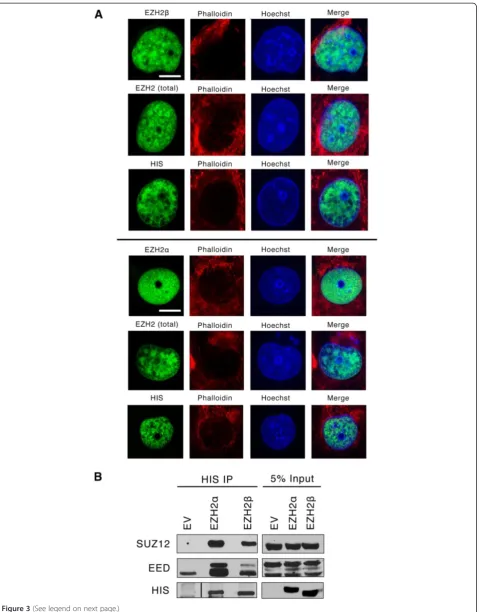
EZH2 has been historically considered an exclusively nu-clear protein, although previous studies have described EZH2 immunoreactivity in the cytoplasm of cancer cells [31]. This knowledge prompted us to better define the cell compartment where the new EZH2 isoform func-tions using confocal microscopy on isolated epithelial cells. We found that although EZH2βas well as EZH2α localize to the cell nucleus (Figure 3A), neither of our
Table 1 Comparison of EZH2αand EZH2βtranscripts yielded by alternative splicing of EZH2 locus transcripts
EZH2α EZH2β
Exon Exon 50donor 30acceptor Intron Exon Exon 50donor 30acceptor Intron
size size size size
1 186 ACGAAGgtaacgc cttttagAATAAT 36,858 1 186 ACGAAGgtaacgc cttttagAATAAT 36,858
2 124 GTAAAGgtataat ttaaagAGTATG 583 2 124 GTAAAGgtataat ttaaagAGTATG 583
3 129 AGGGAGgttggtt gttttagTGTTCG 13,719 3 129 AGGGAGgttggtt ttttagGTGGAA 16,621
4 117 TTTATGgtatgta ttttagGTGGAA 2,785 4 121 ATAGAGgtgagcc gtttcagAATGTG 847
5 121 ATAGAGgtgagcc gtttcagAATGTG 847 5 141 GAGATGgtatgcc tgtttagATAAAG 1,473
6 141 GAGATGgtatgcc tgtttagATAAAG 1,473 6 103 GGAAAAgtaagaa atgtcagATATAA 531
7 103 GGAAAAgtaagaa atgtcagATATAA 531 7 164 TACATCgtaagt tttgcagCTTTTC 6,781
8 179 ATTATTgtacgtt tttgcagCTTTTC 6,766 8 92 CATTTGgtaagac ttcgtagGAGGGA 1,478
9 92 CATTTGgtaagac ttcgtagGAGGGA 1,478 9 241 CCTCTGgtaagac tttgtagAAGCAA 485
10 241 CCTCTGgtaagac tttgtagAAGCAA 485 10 170 AGACAGgtaaga ttgtcagGTGTAT 443
11 170 AGACAGgtaaga ttgtcagGTGTAT 443 11 95 ACACCGgtgagtc tttgcagGTTGTG 1,137
12 95 ACACCGgtgagtc tttgcagGTTGTG 1,137 12 41 AAAAGGgttagca tactcagACGGCT 466
13 41 AAAAGGgttagca tactcagACGGCT 466 13 126 CAGAGTgtaagta tctgaagGTCAAA 776
14 126 CAGAGTgtaagta tctgaagGTCAAA 776 14 179 AAAAAGgtgagca tctctagCATCTA 2,238
15 179 AAAAAGgtgagca tctctagCATCTA 2,238 15 96 GGAGAGgtaaggc tttttagATTATT 1,210
16 96 GGAGAGgtaaggc tttttagATTATT 1,210 16 82 ACAATGgtatgtt cttttagATTTTG 942
17 82 ACAATGgtatgtt cttttagATTTTG 942 17 81 CAAAAGgtaggta tttgcagTTATGA 154
18 81 CAAAAGgtaggta tttgcagTTATGA 154 18 85 TTACAGgttggta gtttcagATACAG 1,364
19 85 TTACAGgttggta gtttcagATACAG 1,364 19 335 TTGAATCatctctc ND
20 335 TTGAATCatctctc ND
Deposited cDNA sequences for EZH2α(NM_004456.4) and EZH2β(NM_152998.2) were aligned against the most recently published human genome sequence (Feb. 2009 GRCh37/hg19) to determine splice donors, splice acceptors, and exon and intron sizes using the University of California, Santa Cruz BLAT tool. ND: not determined.
(See figure on previous page.)
Table 2 Conservation of the EZH2αand EZH2βisoforms across species
RefSeq Species Common name EZH2α/NP_004447.2 EZH2β/NP_694543.1
% identity % identity
NP_004447.2 Homo sapiens Human 100.0 94.0
NP_694543.1 Homo sapiens Human 94.0 100.0
XP_002923814.1 Ailuropoda melanoleuca Giant panda 98.7 92.7
XP_002923815.1 Ailuropoda melanoleuca Giant panda 92.6 98.3
NP_001179953.1 Bos taurus Cow 97.6 91.8
NP_496992.3 Caenorhabditis elegans Worm 23.8 23.4
XP_003496992.1 Cricetulus griseus Chinese hamster 96.6 92.3
XP_003496993.1 Cricetulus griseus Chinese hamster 96.2 90.3
XP_002751914.1 Callithrix jacchus Marmoset 97.9 93.5
XP_002751915.1 Callithrix jacchus Marmoset 92.6 98.3
XP_003432121.1 Canis lupus familiaris Dog 97.9 93.5
XP_003432122.1 Canis lupus familiaris Dog 96.7 92.3
XP_003432123.1 Canis lupus familiaris Dog 92.6 98.3
XP_855891.2 Canis lupus familiaris Dog 86.9 92.3
XP_855935.2 Canis lupus familiaris Dog 91.0 86.5
NP_001137932.1 Drosophila melanogaster Fruit fly 53.6 51.9
NP_524021.2 Drosophila melanogaster Fruit fly 53.6 51.9
NP_001070747.1 Danio rerio Zebrafish 84.0 80.6
XP_001504679.1 Equus caballus Horse 98.7 94.2
XP_001504681.1 Equus caballus Horse 93.5 99.4
XP_003364921.1 Equus caballus Horse 97.5 93.0
XP_003364922.1 Equus caballus Horse 91.7 87.3
XP_003640793.1 Gallus gallus Red jungle fowl 91.2 97.0
XP_418879.3 Gallus gallus Red jungle fowl 96.1 92.0
XP_001097572.2 Macaca mulatta Rhesus monkey 98.0 93.6
XP_002803555.1 Macaca mulatta Rhesus monkey 99.2 94.8
XP_002803556.1 Macaca mulatta Rhesus monkey 92.3 87.8
XP_002803557.1 Macaca mulatta Rhesus monkey 94.0 100.0
XP_003204725.1 Meleagris gallopavo Wild turkey 91.0 86.8
NP_001140161.1 Mus musculus Mouse 97.1 91.3
NP_031997.2 Mus musculus Mouse 97.6 93.3
XP_003270929.1 Nomascus leucogenys Gibbon monkey 99.2 94.8
XP_003270930.1 Nomascus leucogenys Gibbon monkey 92.3 87.8
XP_001505650.2 Ornithorhynchus anatinus Platypus 90.4 86.1
XP_001505800.1 Ornithorhynchus anatinus Platypus 92.3 98.2
XP_003428414.1 Ornithorhynchus anatinus Platypus 97.3 93.0
XP_003428415.1 Ornithorhynchus anatinus Platypus 92.3 98.2
XP_002711987.1 Oryctolagus cuniculus Rabbit 98.3 93.8
XP_002711988.1 Oryctolagus cuniculus Rabbit 93.1 99.0
XP_002711989.1 Oryctolagus cuniculus Rabbit 97.9 91.9
NP_001098571.1 Oryzias latipes Killifish 82.0 78.6
XP_002818672.1 Pongo abelii Sumatran orangutan 95.5 90.7
antibodies noticeably labeled the cytoplasm. Thus, al-though it remains possible that alternative splicing can contribute to the generation of a cytoplasmic form of EZH2, we found no evidence for this localization with EZH2βunder the conditions studied.
We also performed co-immunoprecipitation experiments to define whether EZH2βinteracts with other members of the PRC2 complex. We found that this protein is capable of complexing with SUZ12 and EED (Figure 3B), previ-ously described as obligate co-factors of conventional EZH2 methyltransferase function, although the interaction between SUZ12 and EZH2βis seemingly weaker than that between SUZ12 and EZH2α. Thus, the sequences used by various EZH2 proteins for complexing to its enzymatic partners are not only conserved but also functional. To-gether, the results of these biochemical studies demonstrate that EZH2β shares with EZH2α the ability to localize to the cell nucleus and complex with SUZ12 and EED, suggesting that both proteins display mechanistic proper-ties that are expected for them to participate in the regula-tion of gene repression, an idea which was tested at higher stringency in subsequent experiments.
EZH2βmediates H3-K27me3-associated gene silencing on promoters for homeodomain-containing proteins in genomically integrated reporter systems and isolated murine T cells
The histone code hypothesis represents a useful paradigm for understanding how histone marks deposited by writer proteins (for example, HMTs) recruit mark readers to gene promoters, which triggers the transition between permissive and non-permissive chromatin that ultimately regulates gene transcription. Currently, the conventional EZH2 protein (EZH2α) is the most characterized writer of the H3-K27me3 mark in organisms ranging from flies to humans. For instance, via this mechanism, EZH2-containing PRCs have an evolutionarily conserved role in regulating the expression of entire families of transcrip-tional regulators, such as those for homeobox, Sry-related high-mobility-group box and forkhead box (FOX) families [33]. The promoter of the human forkhead homologue, FOXP3, has recently been described by our group as a
PRC2-regulated gene containing one of the few identified mammalian Polycomb response elements [34]. Therefore, we used theFOXP3promoter as a model for assaying the transcriptional regulatory function of EZH2β. This system allowed us to test the hypothesis that, similar to EZH2α, EZH2βfulfills the criteria as a writer of the H3-K27me3 known to precipitate gene silencing. Because EZH2 func-tion associates with long-term silencing, instead of using the typical episomally based reporter systems, we used an integrated luciferase gene system in which the FOXP3 promoter was cloned after the cytomegalovirus (CMV) promoter (JFOXP3-FLP). This design allowed us to mea-sure the dominant effects of EZH2-mediated silencing effects over the robust activation provided CMV promoter in a highly sensitive integrated system.
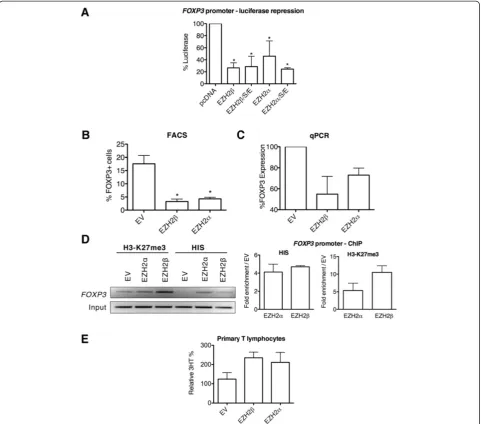
Our experiments demonstrated that EZH2β alone or when combined with obligate PRC2 complex partners (SUZ12 and EED) significantly represses luciferase activ-ity in JFOXP3-E1 FLP compared to transfection with empty vector alone. Compared with empty vector, EZH2
βhad luciferase expression of 26.53 ±8.53% when alone and 28.60 ±17.23% when in complex, which is equivalent to a 73.7% reduction in promoter activity when alone. EZH2αwas included in these experiments as a compari-son and also repressed luciferase expression. EZH2αhad luciferase expression of 45.97 ±25.45% and 24.46 ±2.36% compared with empty vector, alone and in complex, respectively (Figure 4A), corresponding to a 54.03% re-duction in promoter activity when alone. Thus, using this engineered cell reporter system, we conclude that, in vitro, EZH2β displays key functional properties that are expected from a histone code writer. Equally impor-tant, these results demonstrate that various EZH2 pro-teins can achieve the gene silencing function previously attributed to a single HMT protein.
In light of these results, we subsequently sought to gain insight as to whether this process is also operational in vivoin primary cells by evaluating the role of EZH2β in the regulation of FOXP3 expression in isolated mur-ine T lymphocytes. As these primary cells are noto-riously difficult to transfect or infect with most of the viruses used for ex vivo gene transfer, we isolated
Table 2 Conservation of the EZH2αand EZH2βisoforms across species(Continued)
XP_001166099.1 Pan troglodytes Chimpanzee 94.0 100.0
XP_001166174.2 Pan troglodytes Chimpanzee 99.2 94.8
XP_003318915.1 Pan troglodytes Chimpanzee 98.0 93.6
NP_001128451.1 Rattus norvegicus Rat 97.5 93.2
NP_001231238.1 Sus scrofa Wild pig 96.7 92.2
NP_001017293.1 Xenopus tropicalis Western clawed frog 93.2 89.0
lymphocytes from a mouse line transgenically expressing the adenoviral receptor (CAR transgenic mouse, Taconic, model 4285) that are amenable to adenoviral-mediated transduction. Thus, naïve CD4+ splenocytes were isolated from the CAR transgenic mouse and infected with EZH2β, EZH2α or control empty adenoviruses. Primary naïve murine CD4+ lymphocytes transduced with EZH2β did not express FOXP3 upon stimulation when compared with cells transduced with empty vector (Figure 4B and Additional file 2: Figure S2), indicating that recruitment of EZH2 to the FOXP3core promoter results in specific and persistent silencing of FOXP3expression. This result was also observed for EZH2α. Compared with 17.6 ±3.12% of FOXP3-expressing cells under control conditions, EZH2β overexpression reduced the number of FOXP3 -expressing cells to 3.26 ±0.94%, and EZH2α reduced this population to 4.28 ±0.58%. Complementary qPCR assay detected a reduction of FOXP3 transcription of 45.1 ±16.7% by EZH2β and 26.9 ±6.9% by EZH2α com-pared with empty vector (Figure 4C). Furthermore, in these experiments, EZH2βoverexpression led to increased levels of EZH2β and H3-K27me3 bound to the FOXP3 core promoter, which was also found with EZH2α over-expression (Figure 4D).
Through the use of two well-defined systems specially engineered to analyze EZH2-mediated gene silencing in lymphocytes (Jurkat-FLP and primary CD4+ splenocytes), we demonstrate that EZH2βis capable of gene repression that is mediated by trimethylation of H3-K27, indicating that EZH2βbehaves as a histone code writer in a manner which is highly similar to the conventional EZH2α pro-tein. These results suggest that both EZH2 proteins share mechanisms and potentially regulate similar cellular pro-cesses and gene targets. Thus, we tested these ideas by first performing functional cell assays, and subsequently, through the generation of genome-wide expression pro-files for these EZH2 proteins.
Expression of EZH2βstimulates cellular proliferation
EZH2 is among the best-characterized epigenetic regula-tors which, when overexpressed, increases proliferation and functions as an oncogene. Consequently, we investi-gated whether the new EZH2β isoform is functional in cell biological assays using cell proliferation as a model. We performed these experiments in naïve primary lym-phocytes transduced with empty vector, EZH2β, or EZH2α. Figure 4e shows that overexpression of EZH2βand EZH2α results in an increase in cellular proliferation compared with the control empty vector. This functional analysis is congruent with the localization of these proteins to ac-tively proliferating cell populations (Figure 2D) and with our data from genome-wide expression analyses, shown below, which support that both EZH2 isoforms regulate pro-proliferative gene targets. Taken together, these data
indicate that EZH2β is functional in well-established cell biological assays.
Expression of EZH2βgives rise to a unique genome-wide transcriptional profile
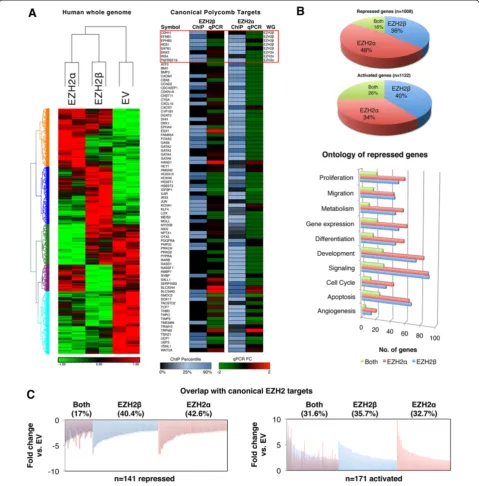
Expression profile experiments offer a genome-wide level reporter assay to investigate whether EZH2α and EZH2β possess common or divergent functions. This experiment was chosen because EZH2β expression follows, in most cases, the expression pattern of EZH2αin the majority of tissue types studied. EZH2 is a known oncogene for a large number of tissues, including pancreatic cancer. Thus, we used a pancreatic epithelial cell system combined with adenoviral-mediated introduction to overexpress each iso-form in an attempt to model the effects of pathological overexpression of each EZH2 isoform on gene repression. For this purpose, we performed Affymetrix GeneChip Human Gene 1.0 ST arrays, which showed that of the 28,869 well-annotated genes assessed, 366 unique targets (36.3% of total repressed) were uniquely repressed by EZH2β (P <0.05 and log2 fold change >−2 for EZH2β,
P >0.05 for EZH2α, Figure 5). EZH2α-generated ex-pression profiles displayed a downregulation of 480 tar-gets (47.6% of total repressed, P <0.05 and log2 fold
change >−2 for EZH2α,P>0.05 for EZH2β, Figure 5). Not-ably, 162 targets (16.1% of total repressed) were repressed by both EZH2αand EZH2β(Figure 5,P <0.05, log2fold
change >−2 for both). Both isoforms also induced up-regulation in the expression of a significant number of targets, which may reflect indirect effects mediated by the repression of upstream regulators. Of the genes assayed, 444 (39.6% of total activated) were activated by EZH2β, 382 (34%) by EZH2α and 296 (26.4%) by both isoforms. Therefore, as demonstrated by the overall array data, the novel EZH2βisoform described here is responsible for the expression pattern of its own unique set of genes, in addition to a group of common targets with EZH2α.
subset of genes previously thought to be regulated by a single EZH2 HMT, we determined the overlap between the isoform-specific targets we identified and this subset of canonical EZH2 targets. Figure 5A-right depicts both occupancy and expression measured on a subset of well-validated canonical Polycomb targets that have previously been shown to be regulated by EZH2α. The box highlights a subset of targets that were identified as EZH2βor EZH2α -specific from our whole genome assay (Figure 5A-left). Thus, although each isoform possesses similarity in terms of ontological functions, mediation of these functions ap-pears to be executed through the repression of primarily unique, although sometimes common, targets.
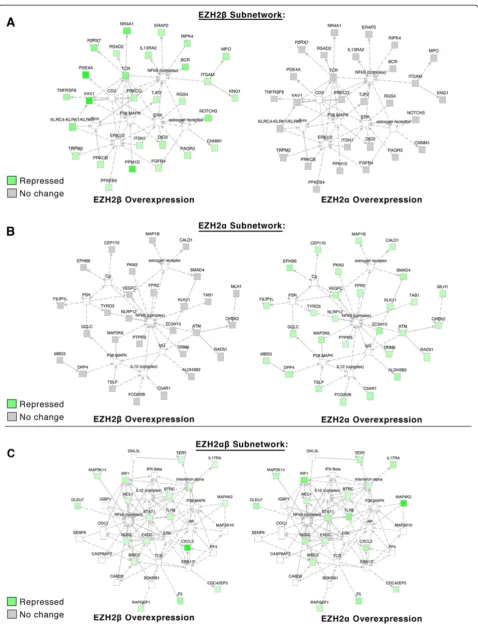
IPA-based network analysis identified a number of subnetworks of interdependent genes enriched for par-ticular functions and/or participation in disease pro-cesses. EZH2β, for instance, was able to uniquely repress a subnetwork enriched for functions in cellular mainte-nance and function as well as hematological system de-velopment and function (Figure 6A). Overexpression of EZH2α, however, led to no significant alteration of these targets. EZH2αoverexpression resulted in the significant repression of a subnetwork of targets that associates to the regulation of cellular growth, cell cycle and prolifera-tion (Figure 6B). Again, EZH2αrepressed many of these targets uniquely without apparent contribution from EZH2β. However, subnetwork enrichment for function in cell death survival displayed equal repression by either isoform (Figure 6C). Thus, these data indicate that al-though biochemically quite similar at the level of nuclear localization, transcription and interaction with critical co-factors, each isoform displays a preferential gene expres-sion pattern, which, according to our ontological analyses, supports their participation in a large number of shared biological functions.
Discussion
The humanEZH2gene was originally isolated in a screen for proteins which interact with Vav1, a human proto-oncogene [36,37]. Notably, although most Polycomb func-tions have been attributed to require the enzymatic activity of PRC2, recent data indicate that other related enzymes may possess redundant or overlapping functions with EZH2, such as EZH1 [10,38]. Despite these advances, most
Polycomb experiments are designed with the paradigm that EZH2α is the sole H3-K27me3 methyltransferase. Thus, it has become essential to explore the isoform com-plexity of the EZH2 family of proteins. Consequently, the goal of the current study has been to address this impor-tant gap in the existing knowledge.
Drosophilapossess only one E(z) gene, whereas verte-brates possess two paralogs: EZH1 and EZH2, with gene duplication occurring early in evolution, as two paralogs have been identified in zebrafish [10]. Evidence for alter-native splicing is evident even in the ancestral E(z) gene with observed expansions and reductions in the progres-sion from invertebrate to vertebrate. Although gene dupli-cation of HMT genes, as observed with Ez proteins and other HMTs, such as Suv4-20 h1/h2 and Suv39h1/h2 [39], appear to serve redundant functions, the early ex-pansion of EZH2 through alternative splicing hints at a neofunctionalization phenomenon. The preservation of al-ternative splicing events from invertebrates to vertebrates supports an evolutionary model in which pressures were high to maintain a diverse pool of EZH2 proteins to facili-tate precise regulation of repressive programs.
We have characterized the alternative splicing and translation of the EZH2 locus to yield a minimum of two distinct functional HMTs: EZH2α, a known enzyme, and EZH2β, a new enzyme. Biochemical characterization of EZH2β indicates that it exhibits a similar tissue expression pattern as EZH2α and that this isoform is widely expressed in human tissues with particularly high levels of expression in tissues dependent on replenish-ment from a progenitor pool of multipotent cells, such as the thymus and testes. Multiple EZH2-positive bands have been observed by Southern and western blot in previous studies [25,40,41], but were often labeled as artifact. However, our investigation is the first to posi-tively confirm and characterize two distinct isoforms using antibodies designed to distinguish between each protein. Furthermore, we demonstrate that EZH2β is localized exclusively to the nucleus and capable of partnering with obligate Polycomb co-factors SUZ12 and EED to form the minimal PRC2 complex necessary to permit enzymatic activity of the protein. Since the identification of its mammalian homologue, a number of EZH2 transcripts have been identified by genomic (See figure on previous page.)
Figure 4EZH2βrepresses transcription through H3-K27 trimethylation of gene promoters and increases cellular proliferation.
(A) Luciferase values are shown relative to control (pcDNA) upon nucleofection of EZH2βor with co-factors SUZ12 and EED (EZH2β/S/E) in cells with an integrated FOXP3 luciferase reporter. EZH2αalone or with co-factors SUZ12 and EED (EZH2α/S/E) is included. *P<0.05. (B) Quantification of flow cytometry analysis of primary mouse naïve T cells transduced with empty vector, EZH2βor EZH2αforFOXP3expression. *P<0.05. (C) qPCR ofFOXP3expression in primary mouse naïve T cells indicates that transcription is reduced by transduction of EZH2βand EZH2α. Glyceraldehyde-3-phosphate dehydrogenase and hypoxanthine phosphoribosyltransferase were used as expression controls. (D) ChIP assay of H3-K27me3 on theFOXP3promoter in primary mouse naïve T cells. Transduction with EZH2αor EZH2βincreases H3-K27me3 on theFOXP3
sequencing efforts, supporting the existence of a family of EZH2 proteins that mediate mammalian gene repres-sion. Extensive future characterization will be required to determine the precise role of each protein variant in gene repression.
PRC2-EZH1 and PRC2-EZH2αregulate a largely over-lapping set of genes, albeit through different mechanisms; PRC2-EZH1 possesses greatly reduced HMT activity com-pared with PRC2-EZH2α [10]. Both EZH2α and EZH2β are capable of repressingFOXP3 expressionin vitro, in a manner that is increased by transfection with obligate co-factors SUZ12 and EED. More importantly, using primary mouse naïve T cells, we demonstrate that both isoforms are able to occupy theFOXP3promoter with resultant in-creases in H3-K27me3 and repression of FOXP3 expres-sion, suggesting identical mechanisms of repression. These results highlight the importance for future studies to con-sider the relative contributions of both isoforms in the regulation of gene repression.
We demonstrate that EZH2β represses a predomi-nantly unique subset of gene targets from EZH2α with a much smaller percentage of redundant targets than observed between EZH paralogs EZH1 and EZH2 [10]. Although ontology reveals that both isoforms participate in a similar repertoire of biological processes, subnet-work analysis of significantly repressed genes indicates that each isoform regulates distinctive gene networks within process categories. Furthermore, comparison of EZH2αand EZH2βtargets with published ChIP-seq data performed with an antibody that fails to discriminate between isoforms reveals a similar pattern as gene ex-pression data, with each isoform possessing a larger sub-set of unique rather than redundant targets [35]. The primary difference between the two isoforms is the 39 amino acid insert absent in EZH2β compared with EZH2α. Examination of this insert reveals the presence of potential sites of post-translational modification, in-cluding an (ST)-Q motif, which have the potential to be
targeted by kinases that participate in a variety of cel-lular processes including DNA replication and repair. Thus, these data serve as the foundation for future stud-ies aimed at investigating how post-translational modifi-cations can contribute to impart functional specificity of each isoform. Coupled with biochemical data, these studies indicate that EZH2α and EZH2β are capable of forming distinct repressive complexes that mediate the repression of unique gene networks within a wide variety of biological processes already characterized for PRC2, including proliferation, migration and differenti-ation, among others [42].
Whole genome gene expression data reveals enrichment for cell cycle and proliferation targets. Overexpression of either isoform in naïve T cells results in increased cellular proliferation. Additionally, immunohistochemistry of total EZH2 versus EZH2βreveals that EZH2βis localized pri-marily to developing spermatogonia whereas total EZH2 expression is localized throughout the spermatogonia and spermatocytes. As spermatogonia undergo mitosis, com-pared to the meiosis occurring in spermatocytes, a potential role for EZH2β in the regulation of cell cycle transitions is likely [43]. Thus, our studies offer a solid rational and build the trajectory for future careful studies aimed at deciphering the role of EZH2 isoforms at the G1/S and G2/M transition points, as well as the type of post-translational modifications, that can regulate these processes.
Conclusions
Thus far, the functions of EZH2 have been ascribed en-tirely to isoform EZH2α. The current body of literature will require revision to address the relative contribution of EZH2 isoforms to the biochemical, cellular and pathobiological functions under study. Furthermore, the contribution of alternative splicing to the regulation of HTMs and their function furthers our understanding of the complexity of regulatory mechanisms underlying the (See figure on previous page.)
operation of the histone code. As a result of these find-ings, a new paradigm of Polycomb-mediated repression must be considered in which cells are armed with a multitude of repressive complexes to regulate distinct gene networks, exponentially increasing the plasticity of the system to meet the broad spectrum of functions re-quired in development, growth and maintenance of bio-logical systems.
Methods
Plasmids and recombinant adenovirus
The search for EZH2-related proteins was performed by comparing the human EZH2 SET domain protein se-quence (GenBank: BC010858) against the Expressed Se-quence Tag database using the BLAST and the UniGene programs from the National Center for Biotechnology Information (National Institutes of Health, Bethesda, MD, USA). This comparison indicated the presence of the EZH2β-encoding sequence (NCBI: NM_152998.2). The exact sequences matching this entry as well as other PRC2 proteins, such as SUZ12 (GenBank: BC015704) and EED (GenBank: BC068995), were verified by se-quencing and analysis of publically deposited cDNAs. Standard molecular biology techniques were used to clone full-length EZH2α, EZH2β, SUZ12 and EED into pcDNA3.1/HIS (Invitrogen, Carlsbad, CA, USA). All constructs were verified by sequencing at the Mayo Clinic Molecular Biology Core Facility. QuickChange Site-Directed Mutagenesis was performed as suggested by the manufacturer (Agilent Technologies, Santa Clara, CA, USA). Silent mutations were made to delete endog-enous HindIII and XbaI restriction enzyme sites to permit passage of EZH2αand EZH2βcDNAs into pacAd5 CMV K-N pa shuttle vector. Epitope-tagged (6XHis-Xpress)
EZH2α and EZH2β were generated as recombinant
adenoviruses by the Gene Transfer Vector Core at the University of Iowa. Empty vector (pacAD5 CMV) was used as the experimental control.
Human tissue RNA panel
Human total RNA for 22 major organs and tissues was commercially obtained from Ambion (Austin, TX, USA) and Stratagene (Agilent). cDNA was generated from 1 μg RNA using SuperScriptTIII enzyme (Invitrogen) according to manufacturer’s instructions. cDNA concentrations were assessed via internal housekeeping gene glyceraldehyde-3-phosphate dehydrogenase or hypoxanthine phosphoribo-syltransferase. PCRs were performed with the following cycle conditions: 30 to 35 cycles of 94°C for 15 s, 50°C for 30 s, and 72°C for 2 min using 1 to 2μl of cDNA product. Amplified products were electrophoresed on 1.5% agarose gels, digitally imaged, and quantified with ImageJ (National Institutes of Health, Bethesda, MD, USA). Primers were synthesized by Integrated DNA Technologies (Coraville,
IA, USA). PCR primers may be found in Additional file 3: Table S1.
Western blot analysis
Samples were run on 4% to 20% (Lonza, Walkersville, MD, USA), 6% or 10% SDS-PAGE gels and electroblotted onto polyvinylidene difluoride membranes (Millipore, Billerica, MA, USA). The membranes were blocked in 5% bovine serum albumin or milk in Tris buffered saline with Tween (TBST) for 1 h at room temperature. The blots were incubated overnight at 4°C with primary antibody. After repeated washes in TBST, horse radish peroxidase -conjugated anti-rabbit or mouse IgG secondary antibody (1:2,000 to 5,000) was added for 1 h at room temperature. Blots were developed by Pierce ECL Chemiluminescent Substrate (Thermo Scientific, Rockford, IL, USA). Human tissue lysates were procured from Calbiochem (Millipore) as a ready-to-probe INSTA-blot. Approximately 20μg of lysate was loaded per tissue with loading controlled via amido black straining by the manufacturer. The blot was incubated overnight with EZH2β (purified, 1:2,000) and subsequently stripped and re-incubated with β-actin (1:1,000; Sigma, St. Louis, MO, USA).
Synthesis, purification and validation of EZH2αand EZH2βantibodies
A 21-mer peptide bridging across the large insert region missing from EZH2β compared to EZH2α was synthe-sized, high performance liquid chromatography-purified and conjugated to keyhole limpet hemocyanin by the Mayo Clinic Protein Core. For the EZH2α antibody, a 21-mer peptide was synthesized that localized to the in-sert region. Subsequently, a rabbit was immunized with the peptide, and test and final bleeds were performed by Cocalico Biologicals (Reamstown, PA, USA). For the antibody that recognizes both EZH2αand EZH2β, a 21-met peptide in a region conserved between the two proteins was synthesized. The anti-serum was affinity purified using the Protein A IgG Purification Kit ac-cording to the manufacturer’s protocol (Pierce Biotech-nology, Rockford, IL, USA). To test the specificity of the antibodies, Chinese hamster ovary epithelial cells were transfected with a histidine-tagged (HIS)/EZH2α and HIS/EZH2β. Whole cell lysates (30 μl) and pancreatic cell lines (30 μg) were resolved on 4% to 20%
SDS-PAGE gels, and probed with whole sera of EZH2α
(1:200), EZH2β (1:200) and EZH2αβ(1:200). Blots were stripped and re-probed with Omni-probe (D-8) (1:1,000; Santa Cruz Biotechnology, Santa Cruz, CA, USA) to ensure equal loading.
Immunoprecipitation
(6XHis-Xpress) EZH2α, EZH2βor empty vector at multi-plicity of infection (MOI) 150. Subconfluent cells were lysed in a buffer containing 20 mM Tris-Cl at pH 8.0, 100 mM NaCl, 1 mM EDTA, 0.5% Nonidet P-40 and a protease inhibitor tablet (Roche, San Francisco, CA, USA). Proteins were immunoprecipitated as previously described using 10 μg of Omni-probe (D-8) (Santa Cruz Biotechnology) [44]. Resulting complexes were resolved on a 6% or 10% SDS-PAGE gels, using antibodies against SUZ12 (1:1,000; Cell Signaling, Beverly, MA, USA) and EED (1:1,000; Cell Signaling). Membranes were stripped and incubated with Omni-probe (D-8) (1:1,000; Santa Cruz), to ensure equal loading of precipitated EZH2 proteins. A 5% input control of whole cell lysates under all conditions was included to ensure the presence of uniform levels of the proteins of interest.
Cell culture, immunofluorescence and confocal microscopy
Cell lines were obtained from the American Type Culture Collection (ATCC, Rockville, MD, USA) and maintained according to their recommendations. Immunofluorescence and confocal microscopy were performed as previously de-scribed [44]. Panc1 cells were plated in eight-chamber glass slides at a density of 5 × 10⁴ cells/chamber and transduced with epitope-tagged (6XHis-Xpress) EZH2α, EZH2β or empty vector at MOI 150. Primary antibodies were used at the following dilutions: EZH2α (1:50; de-scribed above), EZH2β (1:50; described above), EZH2 (1:200; Cell Signaling) and Omni-probe (D-8) (1:250; Santa Cruz). Images were obtained at 100× magnification. Frozen cryosections of human testis (5μm) were purchased from Zyagen (San Diego, CA, USA). Sections were fixed in ice-cold acetone for 10 min and rehydrated in PBS for 3 min. Endogenous peroxidase activity was quenched using a 3% hydrogen peroxide in methanol for 20 min (Sigma). Avidin/Biotin blocking was performed using a kit from Vector Laboratories (Burlingame, CA, USA). Tissues were blocked in CAS Block for 1 h (Invitrogen) prior to over-night incubation at 4°C in primary antibody. Dilutions were as follows: EZH2β (1:200; described above) and EZH2 (1:200; Cell Signaling). Sections were subsequently washed in PBS and incubated in biotinylated goat anti-rabbit sec-ondary antibody (Vector Laboratories) for 30 min. Samples were incubated in Alexa Fluor-488-streptaviding conjugate (Invitrogen). Sections were counterstained with Hoescht. Images were obtained at 10× magnification.
Microarray, validation and subnetwork constructions
BxPC3 epithelial cells were plated at a density of 1 × 10⁶ cells/100 mm dish and transduced with empty vector,
EZH2α or EZH2β (Ad5CMV) at an MOI of 150. RNA
was prepared as previously described 48 h after trans-duction [44]. Experiments were performed from pooled
biological triplicates in technical duplicates. The trans-duction efficiency of these cells at MOI 150 is 81.3 ± 1.99% as determined by transduction with GFP adeno-virus. Global gene expression profiling was carried out at the Microarrays Facility of the Research Center of Laval University CRCHUL using the Affymetrix Human Gene 1.0 ST arrays (28,869 well-annotated genes and 764,885 distinct probes). Intensity files were generated by Affymetrix GCS 3000 7 G and the GeneChip Operating Software (Affymetrix, Santa Clara, CA, USA). Data analysis, background subtraction and intensity nor-malization was performed using robust multiarray analysis [45]. Genes that were differentially expressed along with false discovery rate were estimated from t test (>0.005) and corrected using Bayes approach [46,47]. Data analysis, hierarchical clustering and ontology were performed with the OneChanelGUI to extend affylmGUI graphical inter-face capabilities [48] and Partek Genomics Suite, version 6.5 (Partek Inc., St. Louis, MO, USA) with analysis of vari-ance analysis. A cutoff of expression log2 fold change of
two andP <0.05 was set to identify molecules whose ex-pression was significantly differentially regulated. EZH2β and EZH2α baseline transcript levels were assessed com-pared to overexpression by qPCR to assure that each isoform was expressed at approximately equivalent levels (Additional file 4: Figure S3A). Additionally, a small sub-set of targets was validated by qPCR (Additional file 4: Figure S3C).
Selected probes and their fold changes were loaded into IPA Software (Ingenuity Systems. Each identifier was mapped to its corresponding object in the Ingenuity Knowledge Base. These molecules, called Network Eli-gible molecules, were overlaid onto a global molecular network developed from information contained in the Ingenuity Knowledge Base. For the purposes of network reconstruction, a log2 fold change of two was used.
Networks of Network Eligible molecules were then algo-rithmically generated based on their connectivity. The functional analysis of a network identified the biological functions and/or diseases that were most significant to the molecules in the network. The network molecules associated with biological functions and/or diseases in the Ingenuity Knowledge Base were considered for the analysis. Right-tailed Fisher’s exact test was used to cal-culate a P-value determining the probability that each biological function and/or disease assigned to that net-work was due to chance alone.
Flp-in system, transfection and luciferase assays
The PCR product was subcloned in the pGL3 basic vec-tor (Promega, Madison, WI, USA). Similarly, theFOXP3 core promoter plus the first enhancer (E1) containing −511 bp to +2,738 was also amplified by PCR and subcloned in the pGL3 basic vector (Promega). The Flp-In system (Invitrogen) was used for the generation of a stable humanFOXP3core promoter and FOXP core +E1 promoter Flp-In-Jurkat. Flp-In-Jurkat cells (Invitrogen) were co-transfected withFOXP3core orFOXP3core + E1 in a pcDNA5/ FLP recombination target (FRT) vector and a FLP-recombinase vector (pOG44) (pOG44:FOXP3 core or FOXP3 core + E1/pcDNA5/FRT ratio = 9:1), resulting in a stable integration of the gene of interest at the FRT-site in the genome. For the selective growth test, individual cells were grown in 24-well plates. The culture medium was supplemented with hygromycin at 250 μg /ml or 100 μg/ml. Two million FOXP3 core and FOXP3 core + E1 Flp Jurkat cells were transfected using the Amaxa Cell Line Nucleofector Kit V for Jurkat cells according to the optimized protocol provided with the kit. Two micrograms of plasmid DNA for EZH2α, EZH2β, SUZ12 and EED were used in the nucleofection proce-dure. Luciferase assays were done following the manu-facturer’s recommendations (Promega). Data represent the mean and SD of three independent experiments (*P<0.05).
Adenoviral transduction and flow cytometry
The CAR transgenic mouse was obtained through the NIAID Exchange Program, NIH: Balb/cJ[Tg]CARdelta1-[Tg]DO11.10 mouse line #4285 [49,50]. Murine naïve CD4+ splenocytes were isolated using a combination of magnetic separation kits (Miltenyi Biotec, Auburn, CA, USA). Sequential use of the CD4+CD25+ regulatory T cell isolation kit and the CD4+CD62L+ T cell isolation kit resulted in naïve FOXP3-negative T cells used for in vitro induction ofFOXP3. Naïve T cells were isolated from the CAR transgenic Balb/cJ[Tg]CARdelta1-[Tg] DO11. Cells were activated for 48 h with empty vector, EZH2α or EZH2β at an MOI of 250. The transduction efficiency of these cells as determined by flow cytometry with propidium iodide exclusion using GFP adenovirus is 89.4 ±2.1%. Cells were activated under the typical stimulation conditions for 3 days and processed for ChIP and qPCR to determine methylation of H3K27me3 marks at theFOXP3core promoter and levels ofFOXP3 expression, respectively. Flow cytometry was used to look at levels of FOXP3 expression within the CD4+ population across four biological replicates. Intracellular staining procedures for FOXP3were followed using the application notes from Alexa Fluor 488 anti-mouse/rat/ human FOXP3 (BioLegend, San Diego, CA, USA). For qPCR analysis, biological triplicates were pooled and
analyses performed in technical duplicate. Data
represent the mean and SD of four independent experi-ments (*P<0.05).
T cell stimulation
In vitro activation of the isolated T cells followed similar conditions among the different cell types. Anti-CD3, OKT3 (eBioscience, San Diego, CA, USA) for the Jurkat cells, 145-2C11 (BD Biosciences, San Jose, CA, USA) for the mouse T cells, and UCHT1 (BD Biosciences) for the human T cells was platebound at 2 μg/ml. Soluble anti-CD28 (BD Biosciences) at 2μg/ml plus 100 units/ml
IL-2 was added to the cultures throughout the
incubation period. Human transforming growth factor beta-1 recombinant (AUSTRAL, San Romano, CA, USA) at a concentration of 5 ng/ml was used to generate adap-tive Treg cells.
Chromatin immunoprecipitation assays
ChIP assays were performed as previously described using H3-27me3 (Cell Signaling) and Omni-probe (D-8) (Santa Cruz) antibodies [51]. Primers used to analyze the FOXP3promoter are listed in Additional file 3: Table S1. For the Polycomb target screen, mRNA and ChIP sam-ples were processed from BxPC3 epithelial cells as de-scribed above and used with the Human Polycomb and Trithorax Target Genes ChIP PCR Array (SA Biosci-ences, Valencia, CA, USA). ChIP were performed in bio-logical duplicate and of the 84 targets present on the array, 78.6% (66 out of 84) were occupied by EZH2α, serving as an internal positive experimental control. Ex-pression profiling was performed in biological triplicate with the averaged values reported.
3
H-thymidine incorporation proliferation assay
Naïve T cells from a CAR D011.10 mouse were isolated and transduced with empty vector, EZH2α and EZH2β as described above. Cells were plated at 6.6 × 10⁵/ml in complete Roswell Park Memorial Institute medium containing αCD28 at 2 μg/ml plus 100 units/ml IL-2, and 200 μl was added per well to a 96-well round bot-tom plate coated with αCD3 at a concentration of 2 μg/ml. Five days after plating, 20 μl of 3H-thymidine (6.7 Ci/mmol NET-027) at a 1:20 dilution in complete Roswell Park Memorial Institute medium (1.0μCi) was added to each well and incubated for approximately 18 h. Cells were harvested and counted on the micro-titer plate counter.
Bioinformatics and statistical analysis
open penalty of 12 and a gap extension penalty of 3 (no outbound group selected). Predicted EZH2 splice variant sequences were curated from National Center for Biotech-nology Information. Statistical analyses were performed using Graphpad Prism (La Jolla, CA, USA). Descriptive analyses including means and SDs were performed in nor-mally distributed data. One-way analysis of variance with Tukey’s post-hoc test was utilized to determine statistically significant observations. A P-value of <0.05 was consid-ered as statistically significant.
Additional files
Additional file 1: Figure S1.Identification of multiple EZH2-positive bands in pancreatic epithelial cells. Thirty micrograms of whole cell extracts from a subset of pancreatic cells lines were examined for EZH2α and EH2βexpression and probed with whole sera of EZH2α(1:200), EZH2β(1:200) and EZH2αβ(1:200). Note that while in some instances, EZH2αand EZH2βare equally spliced, in other cases, only one isoform predominates.β-actin is used here as a loading control. Red arrows indicate bands of interest.
Additional file 2: Figure S2.FACS analysis of FOXP3+ cells under EZH2βand EZH2αoverexpression. Representative figure of raw data. Primary naïve murine CD4+ lymphocytes transduced with EZH2βdid not expressFOXP3upon stimulation when compared to cells transduced with empty vector. Bracket indicates the population of FOXP3+ lymphocytes from the total population of viable naive lymphocytes. Quantification of results reported in Figure 4B represents the average of four biological replicates.
Additional file 3: Table S1.PCR primers. Tables of primers utilized for experiments described in this manuscript.
Additional file 4: Figure S3.Affymetrix microarray validation.(A)qPCR of EZH2βand EZH2αexpression in transduced BxPC3 epithelial cells was used to assess the levels of EZH2βand EZH2αtranscript at baseline (empty vector control) and overexpression conditions (MOI 150). Hypoxanthine phosphoribosyltransferase was used as a housekeeping control for normalization.(B)Western blot of whole cells extracts from the overexpression conditions described in A probed with antibodies against EZH2α, EZH2βand HIS-tag.β-actin was used as a loading control.
(C)To validate the results of the Affymetrix GeneChip Human Gene 1.0 ST microarray, five targets were selected for validation via qPCR. Results are presented as a scaled, comparative heatmap.
Abbreviations
BLAST: Basic Local Alignment Search Tool; bp: Base pair; ChIP: Chromatin immunoprecipitation; CMV: Cytomegalovirus; EED: Embryonic ectoderm development; EZH2: Enhancer of zeste homologue 2; GFP: Green fluorescent protein; H3-K27me3: Trimethylation of histone 3 at lysine 27; HIS: Histidine; HMT: Histone methyltransferase; Ig: Immunoglobulin; IL: Interleukin; IPA: Ingenuity Pathways Analysis; kDa: kiloDalton; MOI: Multiplicity of infection; PBS: Phosphate-buffered saline; PCR: Polymerase chain reaction; PRC: Polycomb repressive complex; qPCR: Quantitative polymerase chain reaction; RBBP: Retinoblastoma binding protein; RT-PCR: Reverse transcription polymerase chain reaction; SD: Standard deviation; SUZ12: Suppressor of zeste 12; TBST: Tris buffered saline with Tween.
Competing interests
The authors declare that they have no competing interests.
Authors’contributions
AG, GL and RU generated the main idea of the work and developed the study design, both conceptually and methodologically. AG, PS, AM, EC and YX made substantial contributions to acquisition of data. AG, GL, PS, AM, YX, EC, JI, WF and RU contributed to analysis and interpretation of data. AG, GL, PS, AM, YX, EC, JI, WF and RU were in charge of writing the manuscript from
first draft to completion. AG, GL, PS, AM, YX, EC, JI, WF and RU made comments, suggested appropriate modifications and corrections that were included in the final version of this article, which all authors read and approved.
Acknowledgements
This work was supported by funding from National Institutes of Health grants DK52913 (RU), Fraternal Order of Eagles Cancer Award (GL), T32CA148073 (AG), the Mayo Clinic Center for Cell Signaling in Gastroenterology (P30DK084567), and the Mayo Foundation.
Author details
1Laboratory of Epigenetics and Chromatin Dynamics, Mayo Clinic, Rochester,
MN 55905, USA.2Molecular Endocrinology and Oncology Research Center,
CHUL Research Center, Quebec, Canada.3INSERM U.624, Stress Cellulaire, 163
Avenue de Luminy, Case 915, Parc Scientifique et Technologique de Luminy, 13288, Marseille Cedex 9, France.4Translational Epigenomics Program, Center
for Individualized Medicine (CIM), Mayo Clinic, Rochester, MN 55905, USA.
5Departments of Medicine, Physiology and Biochemistry, Mayo Clinic,
Rochester, MN 55905, USA.
Received: 25 April 2012 Accepted: 5 February 2013 Published: 28 February 2013
References
1. Margueron R, Reinberg D:The Polycomb complex PRC2 and its mark in life.Nature2011,469:343–349.
2. Tavares L, Dimitrova E, Oxley D, Webster J, Poot R, Demmers J, Bezstarosti K, Taylor S, Ura H, Koide H, Wutz A, Vidal M, Elderkin S, Brockdorff N: RYBP-PRC1 complexes mediate H2A ubiquitylation at polycomb target sites independently of PRC2 and H3K27me3.Cell2012,148:664–678. 3. Cao R, Wang L, Wang H, Xia L, Erdjument-Bromage H, Tempst P, Jones RS,
Zhang Y:Role of histone H3 lysine 27 methylation in Polycomb-group silencing.Science2002,298:1039–1043.
4. Czermin B, Melfi R, McCabe D, Seitz V, Imhof A, Pirrotta V:Drosophila
enhancer of Zeste/ESC complexes have a histone H3 methyltransferase activity that marks chromosomal Polycomb sites.Cell2002,111:185–196. 5. Cao R, Zhang Y:SUZ12 is required for both the histone methyltransferase
activity and the silencing function of the EED-EZH2 complex.Mol Cell
2004,15:57–67.
6. Denisenko O, Shnyreva M, Suzuki H, Bomsztyk K:Point mutations in the WD40 domain of Eed block its interaction with Ezh2.Mol Cell Biol1998, 18:5634–5642.
7. Han Z, Xing X, Hu M, Zhang Y, Liu P, Chai J:Structural basis of EZH2 recognition by EED.Structure2007,15:1306–1315.
8. Margueron R, Justin N, Ohno K, Sharpe ML, Son J, Drury WJ 3rd, Voigt P, Martin SR, Taylor WR, De Marco V, Pirrotta V, Reinberg D, Gamblin SJ:Role of the polycomb protein EED in the propagation of repressive histone marks.Nature2009,461:762–767.
9. Tie F, Stratton CA, Kurzhals RL, Harte PJ:The N terminus ofDrosophilaESC binds directly to histone H3 and is required for E(Z)-dependent trimethylation of H3 lysine 27.Mol Cell Biol2007,27:2014–2026. 10. Margueron R, Li G, Sarma K, Blais A, Zavadil J, Woodcock CL, Dynlacht BD,
Reinberg D:Ezh1 and Ezh2 maintain repressive chromatin through different mechanisms.Mol Cell2008,32:503–518.
11. Tie F, Furuyama T, Prasad-Sinha J, Jane E, Harte PJ:TheDrosophila
Polycomb group proteins ESC and E(Z) are present in a complex containing the histone-binding protein p55 and the histone deacetylase RPD3.Development2001,128:275–286.
12. Sarma K, Margueron R, Ivanov A, Pirrotta V, Reinberg D:Ezh2 requires PHF1 to efficiently catalyze H3 lysine 27 trimethylation in vivo.Mol Cell Biol
2008,28:2718–2731.
13. Schuettengruber B, Chourrout D, Vervoort M, Leblanc B, Cavalli G:Genome regulation by polycomb and trithorax proteins.Cell2007,128:735–745. 14. Kuzmichev A, Jenuwein T, Tempst P, Reinberg D:Different
EZH2-containing complexes target methylation of histone H1 or nucleosomal histone H3.Mol Cell2004,14:183–193.
complexes change during cellular differentiation.Proc Natl Acad Sci U S A
2005,102:1859–1864.
16. Sparmann A, van Lohuizen M:Polycomb silencers control cell fate, development and cancer.Nat Rev Cancer2006,6:846–856.
17. Kleer CG, Cao Q, Varambally S, Shen R, Ota I, Tomlins SA, Ghosh D, Sewalt RG, Otte AP, Hayes DF, Sabel MS, Livant D, Weiss SJ, Rubin MA, Chinnaiyan AM:EZH2 is a marker of aggressive breast cancer and promotes neoplastic transformation of breast epithelial cells.Proc Natl Acad Sci U S A
2003,100:11606–11611.
18. Varambally S, Dhanasekaran SM, Zhou M, Barrette TR, Kumar-Sinha C, Sanda MG, Ghosh D, Pienta KJ, Sewalt RG, Otte AP, Rubin MA, Chinnaiyan AM: The polycomb group protein EZH2 is involved in progression of prostate cancer.Nature2002,419:624–629.
19. Bohrer LR, Chen S, Hallstrom TC, Huang H:Androgens suppress EZH2 expression via retinoblastoma (RB) and p130-dependent pathways: a potential mechanism of androgen-refractory progression of prostate cancer.Endocrinology2010,151:5136–5145.
20. Bracken AP, Pasini D, Capra M, Prosperini E, Colli E, Helin K:EZH2 is downstream of the pRB-E2F pathway, essential for proliferation and amplified in cancer.EMBO J2003,22:5323–5335.
21. Kotake Y, Cao R, Viatour P, Sage J, Zhang Y, Xiong Y:pRB family proteins are required for H3K27 trimethylation and Polycomb repression complexes binding to and silencing p16INK4alpha tumor suppressor gene.Genes Dev2007,21:49–54.
22. Shi B, Liang J, Yang X, Wang Y, Zhao Y, Wu H, Sun L, Zhang Y, Chen Y, Li R, Zhang Y, Hong M, Shang Y:Integration of estrogen and Wnt signaling circuits by the polycomb group protein EZH2 in breast cancer cells. Mol Cell Biol2007,27:5105–5119.
23. Tang X, Milyavsky M, Shats I, Erez N, Goldfinger N, Rotter V:Activated p53 suppresses the histone methyltransferase EZH2 gene.Oncogene2004, 23:5759–5769.
24. Tonini T, Bagella L, D’Andrilli G, Claudio PP, Giordano A:Ezh2 reduces the ability of HDAC1-dependent pRb2/p130 transcriptional repression of cyclin A.Oncogene2004,23:4930–4937.
25. Bryant RJ, Cross NA, Eaton CL, Hamdy FC, Cunliffe VT:EZH2 promotes proliferation and invasiveness of prostate cancer cells.Prostate2007, 67:547–556.
26. Cao Q, Yu J, Dhanasekaran SM, Kim JH, Mani RS, Tomlins SA, Mehra R, Laxman B, Cao X, Kleer CG, Varambally S, Chinnaiyan AM:Repression of E-cadherin by the polycomb group protein EZH2 in cancer.Oncogene
2008,27:7274–7284.
27. Fujii S, Ochiai A:Enhancer of zeste homolog 2 downregulates E-cadherin by mediating histone H3 methylation in gastric cancer cells.Cancer Sci
2008,99:738–746.
28. Lu C, Han HD, Mangala LS, Ali-Fehmi R, Newton CS, Ozbun L, Armaiz-Pena GN, Hu W, Stone RL, Munkarah A, Ravoori MK, Shahzad MM, Lee JW, Mora E, Langley RR, Carroll AR, Matsuo K, Spannuth WA, Schmandt R, Jennings NB, Goodman BW, Jaffe RB, Nick AM, Kim HS, Guven EO, Chen YH, Li LY, Hsu MC, Coleman RL, Calin GA,et al:Regulation of tumor angiogenesis by EZH2.Cancer Cell2010,18:185–197.
29. Zeidler M, Kleer CG:The Polycomb group protein enhancer of zeste 2: its links to DNA repair and breast cancer.J Mol Histol2006,37:219–223. 30. Zeidler M, Varambally S, Cao Q, Chinnaiyan AM, Ferguson DO, Merajver SD,
Kleer CG:The Polycomb group protein EZH2 impairs DNA repair in breast epithelial cells.Neoplasia2005,7:1011–1019.
31. Nolz JC, Gomez TS, Billadeau DD:The Ezh2 methyltransferase complex: actin up in the cytosol.Trends Cell Biol2005,15:514–517.
32. Yamamoto K, Sonoda M, Inokuchi J, Shirasawa S, Sasazuki T:Polycomb group suppressor of zeste 12 links heterochromatin protein 1alpha and enhancer of zeste 2.J Biol Chem2004,279:401–406.
33. Bracken AP, Dietrich N, Pasini D, Hansen KH, Helin K:Genome-wide mapping of Polycomb target genes unravels their roles in cell fate transitions.Genes Dev2006,20:1123–1136.
34. Xiong Y, Khanna S, Grzenda AL, Sarmento OF, Svingen PA, Lomberk GA, Urrutia RA, Faubion WA Jr:Polycomb antagonizes p300/CREB-binding protein-associated factor to silence FOXP3 in a Kruppel-like factor-dependent manner.J Biol Chem2012,287:34372–34385. 35. Ku M, Koche RP, Rheinbay E, Mendenhall EM, Endoh M, Mikkelsen TS,
Presser A, Nusbaum C, Xie X, Chi AS, Adli M, Kasif S, Ptaszek LM, Cowan CA, Lander ES, Koseki H, Bernstein BE:Genomewide analysis of PRC1 and
PRC2 occupancy identifies two classes of bivalent domains.PLoS Genet
2008,4:e1000242.
36. Cardoso C, Mignon C, Hetet G, Grandchamps B, Fontes M, Colleaux L:The human EZH2 gene: genomic organisation and revised mapping in 7q35 within the critical region for malignant myeloid disorders.Eur J Hum Genet2000,8:174–180.
37. Hobert O, Jallal B, Ullrich A:Interaction of Vav with ENX-1, a putative transcriptional regulator of homeobox gene expression.Mol Cell Biol
1996,16:3066–3073.
38. Shen X, Liu Y, Hsu YJ, Fujiwara Y, Kim J, Mao X, Yuan GC, Orkin SH:EZH1 mediates methylation on histone H3 lysine 27 and complements EZH2 in maintaining stem cell identity and executing pluripotency.Mol Cell
2008,32:491–502.
39. Schotta G, Lachner M, Sarma K, Ebert A, Sengupta R, Reuter G, Reinberg D, Jenuwein T:A silencing pathway to induce H3-K9 and H4-K20 trimethylation at constitutive heterochromatin.Genes Dev2004,18:1251–1262.
40. Hyland PL, McDade SS, McCloskey R, Dickson GJ, Arthur K, McCance DJ, Patel D:Evidence for alteration of EZH2, BMI1, and KDM6A and epigenetic reprogramming in human papillomavirus type 16 E6/E7-expressing keratinocytes.J Virol2011,85:10999–11006.
41. Su IH, Basavaraj A, Krutchinsky AN, Hobert O, Ullrich A, Chait BT, Tarakhovsky A:Ezh2 controls B cell development through histone H3 methylation and Igh rearrangement.Nat Immunol2003,4:124–131.
42. Schwartz YB, Pirrotta V:Polycomb silencing mechanisms and the management of genomic programmes.Nat Rev Genet2007,8:9–22. 43. Zeng X, Chen S, Huang H:Phosphorylation of EZH2 by CDK1 and CDK2:
a possible regulatory mechanism of transmission of the H3K27me3 epigenetic mark through cell divisions.Cell Cycle2011,10:579–583. 44. Gebelein B, Urrutia R:Sequence-specific transcriptional repression by KS1,
a multiple-zinc-finger-Kruppel-associated box protein.Mol Cell Biol2001, 21:928–939.
45. Irizarry RA, Hobbs B, Collin F, Beazer-Barclay YD, Antonellis KJ, Scherf U, Speed TP:Exploration, normalization, and summaries of high density oligonucleotide array probe level data.Biostatistics2003,4:249–264. 46. Prasanth SG, Prasanth KV, Siddiqui K, Spector DL, Stillman B:Human Orc2
localizes to centrosomes, centromeres and heterochromatin during chromosome inheritance.EMBO J2004,23:2651–2663.
47. Kondo Y, Shen L, Ahmed S, Boumber Y, Sekido Y, Haddad BR, Issa JP: Downregulation of histone H3 lysine 9 methyltransferase G9a induces centrosome disruption and chromosome instability in cancer cells.PLoS One2008,3:e2037.
48. Wettenhall JM, Simpson KM, Satterley K, Smyth GK:AffylmGUI: a graphical user interface for linear modeling of single channel microarray data. Bioinformatics2006,22:897–899.
49. Murphy KM, Heimberger AB, Loh DY:Induction by antigen of intrathymic apoptosis of CD4+CD8+TCRlo thymocytesin vivo.Science1990, 250:1720–1723.
50. Bao Y, Peng W, Verbitsky A, Chen J, Wu L, Rauen KA, Sawicki JA:Human coxsackie adenovirus receptor (CAR) expression in transgenic mouse prostate tumors enhances adenoviral delivery of genes.Prostate2005, 64:401–407.
51. Lomberk G, Mathison AJ, Grzenda A, Seo S, Demars CJ, Rizvi S, Bonilla-Velez J, Calvo E, Fernandez-Zapico ME, Iovanna J, Buttar NS, Urrutia R: Sequence-specific recruitment of heterochromatin protein 1 via interaction with Krüppel-like factor 11, a human transcription factor involved in tumor suppression and metabolic diseases.J Biol Chem2012,287:13026–13039. 52. Thierry-Mieg D, Thierry-Mieg J:AceView: a comprehensive
cDNA-supported gene and transcripts annotation.Genome Biol2006,7(Suppl 1): S12.11–14.
doi:10.1186/1756-8935-6-3
Cite this article as:Grzendaet al.:Functional characterization of EZH2β reveals the increased complexity of EZH2 isoforms involved in the regulation of mammalian gene expression.Epigenetics & Chromatin2013