Financial Stability an Imperative Condition to Develop the Enterprise
Phenomenon
Isac Bors1 1 University of Economic Studies, Bucharest, Romania
Correspondence: Isac Bors, University of Economic Studies, Bucharest, Romania. E-mail: [email protected]
Received: January 29, 2015 Accepted: February 17, 2015 Online Published: February 25, 2015 doi:10.5430/afr.v4n2p14 URL: http://dx.doi.org/10.5430/afr.v4n2p14
Abstract
The recent years’ research that aimed at identifying means and tools of encouraging entrepreneurship, have shown how important it is to be profoundly acknowledged and to improve the business environment as well as the investment climate. In the present paper, I am focusing my studies on the impact the financial stability has on the investment climate and its pertinence to the entrepreneurship phenomenon in Romania, during the years of 1996 – 2012, where I make use of an aggregated index for the specific purpose of measuring the financial stability.
The main objective of the present article is to highlight the important role the financial stability plays, as essential integral part of the business environment, in ensuring the most favorable context of developing the entrepreneurship phenomenon. The tests applied to indicate there is a strong connection, statistically significant, between the entrepreneurship and a better business environment, financial stability having a positive impact on the financial system’s ability to ensure financing for new businesses, for young companies or for Small and Medium Enterprises.
Keywords: Entrepreneurship, Financial stability, Business environment, Aggregated index
1. Introduction
The entrepreneurship is considered a determining factor for the evolution of a modern and dynamic economy. The contribution that the entrepreneurship brings to the economic growth and, ultimately, to the economic development, is obvious. It is the positive impact on the development of the new companies that, on one hand, bring their contribution to encourage competition and to improve productivity in the technological field, and, on the other hand, it plays a part in generating new work places. The importance on the entrepreneurship, determined by the impact it has on the evolution on the economic development, has imposed the study on the phenomenon on the national and global level, in order to identify the specific factors that influence the activity degree, especially in the context were not all the entrepreneurial efforts have a similar outcome on the economic development.
Public authorities set a strategic direction aiming at improving the business environment, in their own endeavors of identifying the policies intended for sustaining the economic development. It is important for the public authorities to have a high level of awareness and monitors the business environment to implement the most suitable policies of sustaining the entrepreneurship as well as to identify and to adjust the necessary instruments to measure the efforts made, and the outcome achieved.
It is certain that the business environment covers a wide range of aspects, under its different forms of manifestation, by the numerous studies in the reference literature. In the present work, I have put forth the idea of studying an extremely integral part of the business environment, such as, financial stability, as well as the impact it has on the entrepreneurial activity.
In a macroprudential approach, I have studied the connection between the evolution of the financial stability and the changes that have happened in the investment climate of Romania, during the years 1996 – 2012, starting from the fact that, one of the basic conditions to set up a new business or even to continue it, is represented by the access to the external financing.
companies’ incapacity of accessing external financing at fair costs and, in the end, to the inhibition of the entrepreneurial sense.
The objective of the present paper is to demonstrate the interrelationship between the business environment and the entrepreneurial activity, respectively, how can financial instability affect the intensity of the entrepreneurial phenomenon, by reducing the facile access to the formal financing.
Hereafter, the paper is organized in this manner: Introduction; Section 2 Literature review; Section 3 Data and methodology presentation; Section 4 Results and discussions; Conclusions.
2. Literature review
The entrepreneurship and the relationship to this phenomenon with the business environment has been frequently approached in the literature on long standing, especially, after the year 2008, when the financial and economic crisis has profoundly affected the business and financial environment in many countries throughout the globe. Starting from acknowledging how important the entrepreneurship is in stimulating the economic development, it has been revealed the necessity of developing specific instruments that the governing authorities could use to quantify and to understand the entrepreneurial phenomenon.
The World Bank is one of the international institutions that showed interest on this matter, helping the researchers and the governing authorities by developing an indicator that can measure the entrepreneurial activity. The World Bank Entrepreneurship survey highlights the fact that a friendly business environment can activate the entrepreneurial activity (Klapper, Lewin and Delgado, 2009).
Public authorities as well as the international financing institutions (IMF, WB, etc.) have put greater emphasis on the investment environment, included in the strategies of supporting the economic development on long term. The condition to incorporate this parameter in the above-mentioned strategies, is to establish, in advance, the correct definition of the investment environment or the business environment.
Xu Colin Lixin, in one of his studies during the year 2010, defines the business environment as „ whatever external environment that affects the returns and risks faced by investors.” In his defining the concept, the author shows there are three important categories of components included:
Category that includes macroeconomic related aspects, such as: fiscal policy, monetary policy, currency exchange policy, etc.;
Category that refers to govern, institutions, etc.;
Category that includes elements referring to goods needed to develop economic activities, such as: railways, electricity, means of communication, etc.;
As it can be seen, there are three important components of the business or investment environment that determine its characteristics and according to which, governments could be capable of build up what a favorable business environment can be called, namely: financial stability, political stability and infrastructure.
In the present work, I am studying the relationship between the entrepreneurial activity and the business environment, focusing the research on the influence this specific component, namely, financial stability has over the investors. Defining the financial stability concept proves to be a difficult endeavor, because of its complexity of a phenomenon and because of the multiple available approaches. For the present work, I am going to use the definition given by Isarescu (2009, pp 32) who illustrates that financial stability represents „the situation in which the financial system is capable of drawing and placing pecuniary funds effectively and to hold up to shocks without impairing the real economy.” The definition quoted above points out two major aspects that bring their contribution decisively to improve the business environment such as: ensuring financing intermediation and not influencing the real economy. Concentrating on the relation between the financial stability, as it has been defined above and the entrepreneurial activity, Chavis, Klapper and Love (2010) discover, in a study over the impact on the business environment on the young companies, how important the facile access to financing is for the success of the new businesses. The authors demonstrate, in a comparative analysis, that the big corporate, with long business tradition behind, are less dependent on the external financing resources than the smaller or younger companies, these ones being more dependent on the banking financing. Small, young companies or the most-recent businesses, that represent the entrepreneurial spirit, with no relevant business history and highly dependent on the external financing resources, especially the banking financing, are seriously affected during the financial instability times.
macroeconomic context is very well reflected in a study of the OECD (Recent Trends in SME and Entrepreneurship Finance, 2013). According to the present study, the financial and economic crisis during the years 2008 – 2009, has profoundly affected the business environment and the financial instability, has brought its contribution to the investors’ hostility against risk, discouraging the banking loaning. The research, once more, highlights the dependence of the SMEs on the banking financing comparing it with the big companies, that can access financing more easily from any other sources (for example, capital market). The loaning terms, especially, the loan costs and more (warranty requested, loaning background) have become more and more restrictive for SMEs. This situation has had consequences on the lowering of the loaning stocks in many countries that have been seriously affected by the crisis (Italy, Hungary, Portugal, UK, USA). In the same time, the research talks about the late payments, the bankruptcy registered among the SMEs, this growing number reflecting the difficulties encountered in ensuring the liquidity the companies need. This situation has been definitely determined by the financial system incapability, affected by the crisis, to be „ capable of drawing and placing pecuniary funds effectivelyand to hold up to shocks without impairing the real economy.”
Klapper and Love (2010, pp. 4) have also made research on this particular situation, studying the consequence the financial crisis during the year 2008 has on the process of setting up a new company. The two authors suggest for the entrepreneurship phenomenon the following definition for their study: „The activity of an individual or a group aiming at initiating economic enterprise in the formal sector under a legal form of business,” in the light in which is studied the impact of the financial crisis on the entrepreneurship. As a result of their research, the authors illustrate there is a robust correlation between the gravity of the financial crisis and the setting up of a new business. In other words, the financial instability and its influence on the business environment by changing conditions, has a strong negative impact on the opening of new businesses, and generally on the entrepreneurial phenomenon on global perspective.
Another perspective on the impact of the financial crisis and changing economic environment produced by it in the entrepreneurial phenomenon is presented by McCauley (2012) showing that the meaning of international financial flows of liquidity and capital situation is in close correlation with equity markets. When financial markets and capital are characterized by calm and low volatility, capital flows from developed economies to emerging markets, and when volatility increases, the flow is reversed.
This change in respect of financial and capital flows strongly affects the banking system and its ability to provide financing the real economy, the effect is a sharp reduction in lending during the crisis in emerging countries as shown Claessens and van Hören (2012) and deleveraging thus triggered affect financial stability. Of course this process is aggravated by the contagion of the crisis shocks produced that are transmitted throughout the global financial system (Cetorelli and Goldberg, 2011).
Considering the entrepreneurship is studied from the perspective of the risks assumed by the entrepreneurs in the context of initiating new businesses, then, the rising hostility against risk, determined by the changing terms for the business environment as well as operating under confusing contexts, all these lead to lessening the intensity of the entrepreneurial activity. Provided that, to the rising hostility against risk is added the impact on the financial instability, the other side of the business environment, resulting into a difficult accessibility to financing facilities, it could seriously inhibit the entrepreneurial spirit hence having unwanted long-term effects on ensuring sustainable economic development.
3. Data and Methodology
In my investigation into the relation between the financial study and the entrepreneurial process, a hypothesis analyzed by numerous studies, of which I have presented in the previous chapter, I am going to apply a methodology that consists of two important stages.
The first step is to determine the financial stability level and its evolution in time in Romania, and further, I am going to test the relation between it and the entrepreneurial process, helped by econometric instruments.
3.1 Measuring financial stability
The analysis made up to the present (Illing and Liu, 2003; Gersl and Hermanek, 2006; Cardarelli, Elekdag and Lall, 2009; Gadanecz and Jayram, 2009; Albulescu, 2010; Drehman, Borio and Tsatsaronis, 2011; Hollo, Kremer and Lo Duca, 2012; Paries, Maurin and Moccero, 2014) demonstrate that, broadly, the methodology of developing an aggregated index consists in the selection of the most appropriate variables and their aggregation.
As far as the variables’ selection is concerned, this has to be done extremely thoughtfully to offer relevant information about the current tensions within the system and the majority of research individuals who have as a starting point the suit of suggested indicators (Financial Soundness Indicators, 2006) as Gadanecz and Jayram indicate (2009). Moreover, the two authors point out, and the above quoted studies reaffirm the fact that, regarding the method of aggregation that is being used, what it matters most is the importance is assigned to every variable. There is a large number of approaches to this situation when the level of importance assigned can be different, and they should be determined by statistical or econometrically methods (Illing and Liu, 2003; Gersl and Hermanek, 2006) or they can be assigned equal level of importance, this last method being the most widely used one (Gadanecz and Jayram, 2009).
Following the reference literature presented, we used to measure financial stability for Romania, an aggregate index developed by the methodology described in these studies. The method is similar with the one presented by Albulescu (2010), what is new in the paper is the method of selecting the variables, the variables included in the index, the method of testing strength and definitely the purpose for which the index is being used. Therefore, the purpose of the present paper is to use a suitable instrument to measure the financial stability, possibly the improvement of an existing one or the employment and improvement of an already well tried method, to test the relation between the financial stability and the entrepreneurial process.
3.2 Measurement data and the calculation of the stability measurements index
The selection of variables included in the index represents the most important aspect of the methodology on which the results obtained depend to a large extent. Given the fact that the most suitable variables are used to capture the tensions and the vulnerabilities of the system, as well as the interconnetions pertained, accurate information on the financial stress can be expected.
I started the selection process from the definition given in the article to the financial stability concept, definition that synthesizes the main ideas that need to be followed. According to this definition and to the characteristics of the national economy, the indicator should include all the variables that can give evidence or offer information about: the capacity of the financial system to ensure financing for the real economy, the interdependence between the different sectors of the national economy, the international interdependences, the level of development of the national financial system, etc.
In the same time, the variables’ selection is supposed to lead to the innovation of an instrument that has to fulfill all the expected requests of simplicity, transparency and international comparability.
There are fifteen selected variables, combined into three groups, which have been observed for a long amount of time, for better relevance. I considered this long period of time, namely, December 1996- December 2012, in order to get the picture of major events that have had influence on the Romanian economy. The information studied in the reference literature focuses on: the economic and banking crisis during the years 1997-1999, the financial crisis during the years 2007 – 2008 or Romania’s joining to EU (2006) .
The data used were observed on quarterly terms, and they have the same unit of measurement (%). Data were collected from authorized sources (National Institute of Statistics, National Bank of Romania, Ministry of Finance, Stock Exchange Bucharest etc.) and some variables, such as the ones belonging to the spreads’ category or the ones that have been determined as weights of GDP for example, have been established as a result of the author’s calculations and elaborations.
Former to the aggregation process, the values observed had undertaken a normalization process, which consisted in the reestablishment of every value observed on a scale from 0 to 1. The purpose of this elaboration was to ensure the information comparability, every value observed being assigned the proper consideration on the same dimension of value, according to the preestablished benchmark values. The process of normalization has been done using the formula:
⁄ (1)
where:
vt – the resulting rescaled value for variable x at time t max – the highest value observed for the x variable min – the lowest value observed for the x variable
The result of the present method is that every variable added in the index shows at value 1 a positive impact on stability and at value 0 it shows a negative impact. Next I realized aggregate values using the following equation for calculating:
∑ , (2)
where:
It – The aggregated index at time t
yi,t – The variable y at time t (variable value obtained by the rebase using formula (1)) gi = – The weight assigned to the variable (equal weight)
r – The total number of variables
Aggregate index constructed whose method of calculation, meaning and component, I am going to present hereafter, is composed as shown, of three sub-indices which, in turn, each includes five variables.I used the method of equal weighting variables (weight assigned to each variable g is the same), this is as shown in the specialty literature (Gadanecz and Jayram, 2009) most commonly used method.
Banking stability sub-index (ISB) indicates the importance to the banking system from the perspective of the impact it may have on the financial stability. Simultaneously, it reflects one characteristics of the Romanian financial system, namely, the great importance this specific sector play, in comparison with the rest of components (capital market, exchange market, insurances market). Variables comprised in the index reveal the existence of some kind of tensions or vulnerabilities of the banking system, for example, variables that reflect the system capitalization or the assets’ quality indicate its capacity to absorb external shocks, while the variables that reflect the system liquidity, offer information about its capacity to ensure financing for the real economy. The index is calculated according to the following formula:
∑ (3)
where :
n - total number of observations ISt - capital adequacy ratio IEPt - leverage ratio IRRCt - credit risk rate ICADAt - loan to deposits ratio IROAt - economic profitability
Sub-index of real economy stability (ISER) offers signs, through the variables included, about the existing mutual relations and influences between the real economy, the government system and the financial system (for example, variables like public debt and budgetary deficit). The index reveals in the same time, among other variables (eg. the inflation or the GDP fluctuation), the context in which the activity develops on national level or, among other things, as the current account deficit, the external context and the place of the local economy in the global context. The index is calculated according to the following formula:
∑
(4)where:
n - total number of observations IPCt - consumer price index IPIBt - GDP
IDPt - public debt
IDBt - government deficit
Sub-index of financial market development (IDPF) is designed to show the depth of the financial market, the development level of every component, through variables as the degree of banking or market capitalization. All these variables offer signs about how great their specific sectors are, this being a determinate element in establishing their capacity to ensure the financing suitable to the real economy also to substitute itself in various occasions. Moreover, through the variables belonging to the spread interest group, I tried to see the existing tensions on different markets at different moments that may also affect the financing capacity of real economy. The index is calculated according to the following formula:
∑
_ _(5)
where:
n - total number of observations made IGIBt - banking intermediation rate ICBt - market capitalization
IISDt - foreign direct investment
IED_FCBORt the interbanking lending interest facility spread IED_CDt - the rate of interest loans-deposits spread
Aggregate financial stability index for Romania (ISFR) is calculated by aggregating the three sub-indices following formula:
∑
(6)
where:
n - total number of observations made ISBt - banking stability subindex
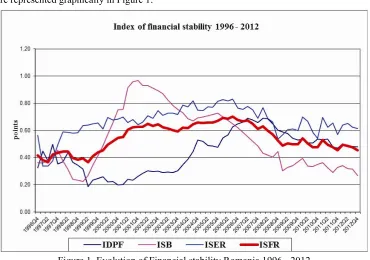
ISERt- subindex of the real economy stability IDPFt- subindex of financial market development The results are represented graphically in Figure 1:
3.3 Testing the validity of preliminary hypotheses
The decision to invest is a function of many factors in which the business environment and in this case the financial stability as an essential feature of it, plays, as noted, an important place. The risk appetite of the investors determines the intensity of the entrepreneurial phenomenon, which even if it is influenced by other factors, may be inhibited by the emergence of excessive risks in an economic area or sector. Global investors always aim at achieving maximum yield and in the same time, they look for the most appropriate safe keeping of their investment. The financial flows, course and extent are directly dependent on the changes intervening in the economic environment. An economic environment unfriendly to the entrepreneurial activity, characterized by financial instability, brings down the amount of financial flows concentrated in that direction, although it doesn’t stop them entirely. Thenceforth, there will be investors willing to take bigger risks, who will supply funds, yet at much bigger costs, correlated with the risks taken. However, this situation will not lead to the definite easing of the financing of the economic activity, though, to the decrease of it, and definitely, to the costs rise. Limited funds and their increased costs result into restricting access to finance affecting, as I have shown in the present paper, especially the SMEs and the start-up companies, companies that represent the essence of the entrepreneurial phenomenon.
To describe the evolution of the entrepreneurial process, I made use of the government bonds yield spreads as a variable, which derives from the difference between the Romanian bonds yield and those of some more financially stable economies. The hypothesis I used when I considered this variable is that the so- determined spread reflects why the investors ask for overprice to compensate the risks taken. The risk premium associated with every economy plays a major role, alongside many other factors, to set the final yield asked by the investors for the government bonds issued.
In other words, looking to the situation from the global investor’s perspective, the lower financial stability will lead to higher requests on the specific government bonds, in comparison with the more financially stable economies. According to this assumption, the difference between the government bonds issued by various states is determined, in a good proportion, by the inherent risk premium. The risk premium, in its turn, varies according to the global investors’ perspective of the risk applicable to a specific area or economy, and their entrepreneurial behavior changes according to the evolution of the financial stability of the specific area or economy.
The relation between the government bonds and the risk applicable to a specific economy is studied by Gyntelberg et al. (2013) who, using a similar methodology, considers that the integral part of the credit risk can be isolated from the government bonds’ yields, and this can be identified with what is called spread. The authors of the present study are making research on the relation between the government bonds spreads and CDS (credit default swaps), as interpretation given by the investors to the country risk applicable in every country of the Eurozone. The proposed method involves a comparative analysis of sovereign bond yields issued by a different group of countries affected by the sovereign debt crisis in Europe.
Thus, Germany is considered the least affected by the debt crisis and it is counted as the economy without risk, France is counted as the less affected and it is applied lower risky other countries as Greece, Ireland, Italy and Spain, etc. are affected by the crisis on a different scale, and definitely, are applicable with different country risks. The result from the study reaffirms the relation between the spread of the government bonds issued, determined from the difference between the yield applicable throughout the country studied and the economy without risk (Germany) and the spread CDS. Moreover, it highlights the existing relation between their evolution and the financial crisis, during which investors demanded yields increased.
Mihai and Neagu (2011) address the issue about the relation of the CDS with the spread of the government bonds and the information offered by these about the financial stability for Romania. One of the themes studied by the authors is the extent to which the spread of the government bonds reflects the risk specific to the economy of the issuing state. They consider the dynamic of the CDS spread or of the government bonds can be separated into three factors: global or regional systemic risk, liquidity risk, and the risk specific to every country. To determine the risk – free interest rate, there have been considered three variables, because of the fact, the reference literature is unclear on this specific matter, including the difference between the yields on the government bonds issued by the US and Germany (2-years and 10-years). The results from the research show that the evolution of the spread for Romania is determined, on a greater extent, by the first two factors, and on a smaller extent, by the third factor.
_ (7) where:
DS_TSt - dependent variable - the sovereign bonds spread (determined in relation to each of the three situations EU, USA, Japan)
ISFRt - independent variable –financial stability variation (determined according to the formula no. 6)
α - regression intercept
β - independent variable coefficients (to be estimated)
εt - residual variable
To quantify changes in the Romanian business environment, I used as variable the aggregated index of measuring the financial stability (ISFR), whose conception has been briefly presented in the previous chapters.
As a variable able to offer accurate signals about the global investors’ opinion, I used the spread of the government bonds (S_TS) about the risk applicable to the Romanian economy, spread that is determined as the difference between the Romanian government bond yields (Government benchmark bond yield_10-year) and those of more stable economies or economic areas, comparing to the Romanian area.
In the tests performed I considered three entities as standard economies, namely: USA, Japan and the European Union, in order to obtain more complete information for better explaining the relationship in terms of comparability. The evolution of the spread should show that when financial stability is increasing in Romania, while the financial stability in the standard economies remains constant, the difference between the two yields, on which the spread was determined, decreases. On the borderline, when the financial stability of the two economic systems tends to become comparable it is only when yields are comparable and spread tends to zero. Of course, in practice this does not happen because the spread is determined, as shown, and other factors beyond the venture premium associated at the level of financial stability.
In the given case, I counted as stable economy, with applicable zero risk, the economy of EU. The spread evolution should indicate the fact that when the financial economy increases and approaches the standard one (EU), the difference between the two yields decreases and vice-versa. In other words, on similar contexts about the risks taken, the investors will require prices equal to their funds, and, definitely, we can expect a proper direction of the financial flows.
4. Results and Discussion
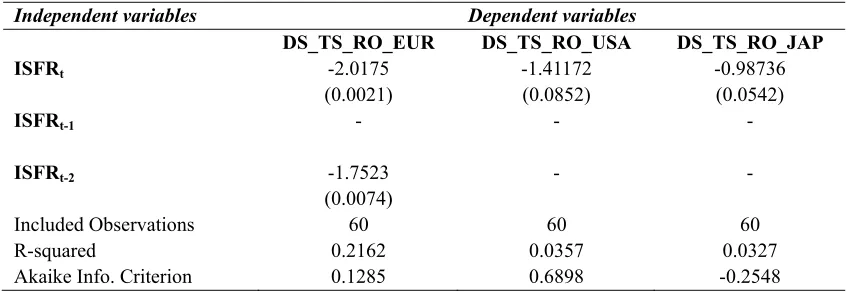
The regression model presented aims therefore to explain the move of the government bonds spread through the fluctuation recorded by the financial stability in Romania, previously quantified using aggregate index ISFR. Estimation of model parameters was performed by the method of least squares (OLS), after previously the series were transformed becoming stationary, and during the tests performed we found that there is an influence of past values of the explanatory variable on the present values. Given this information to improve results, we further estimated every model, taking into account as the explanatory variable the lags up to order 2 of the explanatory variable, the results are presented in Table 1.
Table 1. Regression results
Independent variables Dependent variables
DS_TS_RO_EUR DS_TS_RO_USA DS_TS_RO_JAP
ISFRt -2.0175 -1.41172 -0.98736
(0.0021) (0.0852) (0.0542)
ISFRt-1 - - -
ISFRt-2 -1.7523 - -
(0.0074)
Included Observations 60 60 60
R-squared 0.2162 0.0357 0.0327
Akaike Info. Criterion 0.1285 0.6898 -0.2548
Note: p-values in parenthesis
The results show that statistically there is a significant relationship between the variables analyzed for the spread Romania - EU (DS_TS_RO_EUR), Romania - Japan (DS_TS_RO_JAP) as well as for Romania - USA (DS_TS_RO_USA). The highest value for R², reported in the tests performed, derives from the relationship with EU (R² = 0.21), which leads to the conclusion that the intensity of the relationship is good, changes of the financial stability explaining relatively well the evolution of spreads. Hence changes at the level of financial stability are able to explain very well the spread evolution and, consequently, the yields of the sovereign bonds issued. However, there are many other factors that bring their contribution to reaching this scale that are not included in this model. Hereafter, given the results, I have chosen the first variant for the evaluation, namely the relationship with the EU, this way. The resulted estimated equation is:
_ _ _ 2.0175 _ 1.7523 _ (8)
It can be seen that for the model to be improved, it has been used the second lag of the explanatory variable and the constant term and lag one of the variable were removed for statistical value obtained shows that it does not differ significantly from zero. Economic interpretation shows that, as expected, the index number β is negative, which means that the two variables may change in opposite directions. An increase as the value as the stability index, which means increased stability, results in a lower spread. In other words, financial stability leads to improved perception of the investors regarding the country risk and they finally decide to decrease the venture premium required.
5. Conclusions
The importance of the entrepreneurship in ensuring economic growth and ultimately of the economic development, has determined public authorities to increase their concerns in designing and implementing policies to stimulate the phenomenon. Decision maker’s activity is directed to creating the best facilities for the entrepreneurs to develop their activity, this meaning having an in-depth knowledge about the business environment and afterwards, identification of the best ways and means of improving it.
Creating a favorable business and investment environment to the entrepreneurship involves oriented actions to improve the three integral parts of it, presented at the beginning of the article, namely: infrastructure, political stability, macroeconomic context. Every single component of the business environment is important in supporting entrepreneurship. A corresponding infrastructure, political stability, proper governing simplifying legal procedures to set up a new company etc., all these bring their contribution to stimulate new companies to develop and to innovate, though, both, to start up a new business as well as to carry it through and to maintain it subsequently, there is needed one imperative element financing.
The present work proves the fact that the facile access to the external financing represents an imperative condition to start up a new business or to develop it is in a close connection with the existing macroeconomic conditions, more precisely, with financial stability. The absence of financial stability has as an immediate effect, the difficult access to external financing for companies and the study illustrates that, the most affected ones are the start-up companies, the new companies and the SMEs, generally, thus inhibiting the entrepreneurial phenomenon.
The research confirms the existence of a bi-univocal relationship between financial stability, in its capacity of important integral part of the business environment and the investors’ taste for risk. Increasing financial instability causes a deterioration of the conditions offered by the business environment, resulting in a change of the investors’ behavior who, confronting with an increasing risk applicable to the specific economy, either will enquire higher yields for their resources, or they will direct them towards other areas. In the same time, the reverse situation can be valid when other integral parts of the business environment deteriorated (e.g. political stability), and increased risk perceived by investors induces higher yields required and causes a redirection of financial flows to other areas, the consequence being the diminishing of the financing of the real economy and ultimately financial instability.
To conclude, solution proposed in this paper for measuring and monitoring financial stability, by an instrument consisting of combining some variables and measures that offer signals about the changes emerging on the markets, may help in guiding orientation of the public policies and decisions, to improve the business environment and to stimulate the entrepreneurial phenomenon, simultaneously stating the major role played by the financial stability.
References
Albulescu, T. (2010). Forecasting the Romanian financial system stability using a stochastic simulation model. Romanian Journal of Economic Forecasting, pp. 81 – 98.
Bruhn, M., Zia, B. (2011). Stimulating Managerial Capital în Emerging Markets. The Impact of Business and Financial Literacy for Young Entrepreneurs. Policy Research Working Paper 5642. The World Bank. http://dx.doi.org/10.1596/1813-9450-5642
Cardarelli, R., Elekdag, S., Lall, S. (2009). Financial Stress, Downturns, and Recoveries, IMF Working Paper No. 09100. International Monetary Fund.
Cetorelli, N., Goldberg, L., (2011). Global Banks and international Shock Transmission: Evidence from the Crisis, IMF Economic Review. Vol. 59, Pp. 41-76, International Monetary Fund; http://dx.doi.org/10.1057/imfer.2010.9 Chavis, L.W., Klapper, L., Love, I. (2010). The Impact of the Financial Crisis on Young Firm Financing. Policy
Research Working Paper 5322. The World Bank.
Claessens, S., Horen, N., (2012). Foreign Banks: Trends, Impact and Financial Stability. IMF Working Paper No. 1210. International Monetary Fund; http://dx.doi.org/10.2139/ssrn.1977446
Cull, R., Haber, S., Imai, M. (2011). Related Lending and Banking Development. Policy Research Working Paper 5570. The World Bank. http://dx.doi.org/10.1596/1813-9450-5570
Drehmann, M., Borio, C., Tsatsaronis, K. (2011). Anchoring countercyclical capital buffers: the role of credit aggregates. BIS Working Papers No 355. Bank for International Settlements.
Gyntelberg, J., Hordahl, P., Ters, K., Urban, J. (2013). Intraday dynamics of euro area sovereign CDS and bonds. BIS Working Papers No 423. Bank For International Settlements.
Gadanecz, B., Jayaram, K. (2009). Measures of financial stability – a review. IFC Bulletin No 31. Proceedings of the IFC Conference on "Measuring financial innovation and its impact. Basel. Bank for International Settlements, pp. 365-380.
Gersl, A., Hermanek, J. (2006). Financial Stability Indicators: Advantages and Disadvantages of their Use in the Assessment of the Financial System Stability. Czech National Bank Financial Stability Report, pp. 69-79. Hollo, D., Kremer, M., Lo Duca, M. (2012). CISS – A composite indicator of systemic stress in the financial system.
Working paper series No 1426. Macroprudential research network, European Central Bank; http://dx.doi.org/10.2139/ssrn.1611717
Illing, M., Liu, Y. (2003). An Index of Financial Stress for Canada. Working Paper 2003-14. Bank of Canada. Isărescu, M. (2009). Contribuţii teoretice şi practice în domeniul politicilor monetare şi bancare. Editura Academiei
Romane. Bucureşti.
Jose, A., Georgiu, A. (2009). Financial soundness indicators (FSIs): framework and implementation. IFC Bulletin No 31, Proceedings of the IFC Conference on "Measuring financial innovation and its impact. Basel. Bank for International Settlements. pp. 277-282.
King, M.R. (2010). Mapping capital and liquidity requirements to bank lending spreads. BIS Working Papers No. 324. Bank for International Settlements; http://dx.doi.org/10.2139/ssrn.1716884
Klapper, L., Lewin, A., Delgado, J.M.Q. (2009). The Impact of the Business Environments on the Business Creation Process. Policy Research Working Paper 4937. The World Bank. http://dx.doi.org/10.1596/1813-9450-4937 Klapper, L., Love, I. (2010). The Impact of the Financial Crisis on New Firm Registration. Policy Research Working
Paper 5444. The World Bank. http://dx.doi.org/10.1016/j.econlet.2011.05.048
McCauley, R.N. (2012). Risk-on/risk-off, capital flows, leverage and safe assets. BIS Working Papers No. 382. Bank for International Settlements; http://dx.doi.org/10.2139/ssrn.2206758
Mihai, I., Neagu F. (2011). CDS and government bond spreads – how informative are they for financial stability analysis. IFC Bulletin No 34. Proceedings of the Fifth IFC Conference on "Initiatives to address data gaps revealed by the financial crisis", Basel, Bank for International Settlements, pp. 415 – 429.
OECD, (2013). Recent Trends în SME and Entrepreneurship Finance, Chapter 2 - Financing SMEs and Entrepreneurs 2013 AN OECD SCOREBOARD, pp. 19 – 35.
Paries, D.M., Maurin, L., Moccero, D. (2013). Financial conditions index and credit supply shocks for the Euro area, Working paper series No 1644. European Central Bank. http://dx.doi.org/10.5089/9781451859546.001
Schinasi, G. (2004). Defining financial stability. IMF Working Paper 04/187. International Monetary Fund;