Can Anyone Read Accounting Footnotes
Well Enough to Understand Them?
Kelly Wilkinson1 & Alan B. Czyzewski21 Professor and Chair, Management, Information Systems, and Business Education, Scott College of Business, Indiana State University, Terre Haute, IN 47809, USA
2 Professor, Accounting, Finance, Insurance, and Risk Management, Scott College of Business, Indiana State University, Terre Haute, IN 47809, USA
Correspondence: Kelly Wilkinson, Professor and Chair, Management, Information Systems, and Business Education, Scott College of Business, Indiana State University, Terre Haute, IN 47809, USA. E-mail: [email protected]
Received: April 9, 2015 Accepted: May 14, 2015 Online Published: May 18, 2015 doi:10.5430/afr.v4n2p123 URL: http://dx.doi.org/10.5430/afr.v4n2p123
Abstract
Increasingly, people are asked to make investment decisions that affect their retirement. In the past, “experts” in the federal government, pension plans, and/or other money management entities made these decisions. The “expert” investor’s skill set includes the ability to read and understand financial material. While there are many sources of financial information newspapers, mutual fund reports, annual reports and others, the purpose of this study is to determine the reading level of footnotes in financial statements. FASB has issued a Discussion Paper concerning footnote effectiveness (FASB, 2012) supporting the importance of the clarity of the footnotes. 100 firms’ footnotes were analyzed using Word (from Office 2003 suite) spelling and grammar check. The average Flesch Index reading level of the footnotes was 20.4.This score indicates it is very difficult to read the footnotes. In fact based on the average reading level of adults, a large portion of the U.S. population are unable to understand footnotes.
Keywords: Readability, Financial statements, Footnotes, Decisions
1. Introduction
Increasingly, people are asked to make investment decisions that affect their retirement. In the past, these decisions were made by “experts” in the federal government, pension plans, and/or other money management entities. The driving force of this phenomenon is the conversion from defined benefit plans to defined contribution plans which requires an individual to actively manage their portfolio rather than be dependent on decisions made by experts. This is requiring the employee to become an expert in determining worthwhile investments for retirement (AARP, 2007). Thirty-eight percent of equities were directly held by households in 2013 as opposed to indirect ownership through mutual or retirement funds. Approximately 8% of equities were held by households in 1985. Twenty percent of equities were indirectly owned by individuals’ through mutual funds. While mutual funds information is important this research is concerned with just the footnotes (Ro, 2013).
Traditionally, employees did not make any decisions regarding their retirement. Employees contributed to a “one size fits all” plan which typically a company outsourced to an investment house managed by the investment house analysts. These expert investment analysts were educated and dedicated to the business of investments. These experts were knowledgeable in the investment and finance vocabulary, Security and Exchange Commission (SEC) regulations, accounting pronouncements, and economic trends. These experts had connections to the companies themselves, colleagues with expertise in investment areas, and resources to obtain more information needed for decision making. Many of these expert analysts specialize in the economic trends of particular industries (McCarthy and Turner, 2000).
Even the well-educated professional has problems with the readability of financial documentation
“For more than forty years, I’ve studied the documents that public companies file. Too often, I’ve been unable to decipher just what is being said or, worse yet, had to conclude that nothing was being said”(Warren E. Buffett, SEC, 1998, Pg. 1).
In an analysis of 40 companies, a private firm found that the companies’ compensation discussion and analysis fell short of accepted standards of readability. Most of the disclosure statements failed to meet the readability standards states require for insurance forms, (Cox, 2007).
With the conversion from defined benefit plans to defined contribution plans, the financial decision making moved from a small group of well educated, well connected, and well-funded individuals to the general population. This general population lacks the education, connections, and key information to make critical decisions about their investments. Of the three, education is the easiest to acquire (McCartney and Turner, 2000).
The irony is the general population lacks the basic abilities to be financial literate. As easy as education is to access, there are still many Americans that do not acquire the necessary literacy skills to function in the business world. To educate the general population regarding financial literacy, reading is a necessary skill. (Canadian Foundation for Economic Education, 2012) This skill includes, obtaining, processing and understanding information. (Egbert and Nanna, 2009)
2. Purpose
The reading level of the general population may affect their ability to gather necessary information critical to financial decision making. How does the material used to make financial decision match the reading ability of the typical U.S. citizen? Is financial information written at a reading level appropriate for the general population to make critical retirement decisions?
This study will determine if the footnotes are contributing to this high reading level. This study will not include analysis of the complete 10-K. The purpose of the study is to determine the reading level of footnotes in financial statements. The study will also address the issue of tables and their impact on readability of the footnotes. Previous studies (Li, 2008) removed tables and headers so they would not affect the readability scores. We tested to determine if this work is necessary. The footnotes are becoming more important as information to the general population as the “average person” is now expected to be the expert in their own retirement decisions.
The study addresses the following questions:
1. Are there differences in the readability of financial statement footnotes with or without headers and tables? 2. Does the readability of financial statement footnotes significantly exceed the average reading level of the
U.S. population?
3. Literature Review
3.1 Literacy
The United States is suffering from a literacy deficit. Multiple studies have identified startling statistics regarding the inadequacies of the general population regarding basic literacy skills. Some of the statistics are:
Average reading level of adults in the U.S. is eighth grade (Know your readers, n.d.)
More than 20% of adults read at or below a fifth-grade level—far below the level needed to earn a living wage, (Griswold, 2008)
It is estimated that the cost of illiteracy to business and the taxpayers is $20 billion per year, (The truth about literacy in the United States, n.d.)
It should be noted that roughly 42% of all adults over the age of 16 lack the basic literacy skills to enroll in any education at the postsecondary level, (National Commission on Adult Literacy, 2008). Conversely, expert financial analyst has an education past the postsecondary and is employed in the financial services industry, while 42% of the population lack the skills necessary to acquire basic postsecondary education much less learn the much more advanced, sophisticated financial knowledge needed to make decisions that affect their retirement, (National Commission on Adult Literacy, 2008)
3.2 Role of Communication in Accounting
rational investment, credit, and other decisions. To achieve this, the information should be comprehensible to all users (FASB, 2010).
In 1998 the Security and Exchange Commission (SEC) issued “The Plain English Rule” (Rule 421(d)). This rule required companies to use “plain English” in the forepart of prospectuses and encouraged these guidelines be incorporated in other financial disclosures. Rule 421(d) requires short sentences, everyday language, active voice, tables for complex information, no legal jargon, and no multiple negatives. Arthur Levitte, then SEC chairman, noted in the foreword of “A Plain English Handbook,” “Because many investors are neither lawyer, accountant or investment bankers, we need to start writing discloser documents in a language investors can understand” (p.3). The underlying argument for the plain English disclosure regulation is that (1) firms could use vague language and format in disclosure to hide adverse information, and (2) average investors may not understand complex documents which could result in capital market inefficiency, (U.S. Security and Exchange Commission, 1998).
Rule 421d encouraged use of the “Plain English” guidelines in all other financial disclosures. This includes footnotes to the financial statements “The accompanying notes are an integral part of these statements,” is a common phrase at the bottom of financial statements. These notes serve to explain, clarify, and expand upon the Balance Sheet, Income Statement, and Statement of Cash Flows. They may provide some additional information such as accounting methods used and additional detail to name a few (U.S. Security and Exchange Commission, 1998).
3.3 Purpose of Disclosures to the Reader
The purposes of the disclosures were to . . .”explain, clarify, and expand on financial information,” (Raiborn, Payne, and Pier, 2008 p. 69). For the casual investor the disclosures should be the key to unlock the information of the financial statements so good investment decisions could be made. This has proven NOT to be the case. The purpose of the disclosures is to explain accounting to people who are not accountants. Instead, disclosures are written in “legalese” for a variety of reasons.
Warren Buffett, in the preface of the A Plain English Handbook, identified the most common problem with readers of corporate disclosures as “. . . well-intentioned and informed writer simply fails to get the message across to an intelligent and interesting reader,” (as cited by Raiborn, Payne, and Pier, 2008). Other researchers see the use of complex writing to be a way to confuse the consumer investor to hide adverse information that may affect stock prices. The term for this type of communication is “obfuscation,” (Li, 2008). Whether the language used was intention or unintentional the issue is the consumer investor can’t read the disclosures which can lead to mistrust and suspicion, (Li, 2008).
3.4 Footnotes
Footnotes are considered an integral part of the financial statements (Dyckman, Dukes, and Davis, 2001; Marshall, 1993; Kimmel, Weygandt, and Kieso, 2009). The financial statements are condensed and any explanatory information that cannot be abbreviated is added in greater detail in the footnotes. Most would say the footnotes contain some of the most important information in the financial statements (Ye, 2008; Wayman, 2003).
As early as 1939 then Chief Accountant of the Securities and Exchange Commission, William W. Werntz, spoke to the importance of footnotes in a speech to the Minnesota Statistical Association and the Minnesota Society of Certified Public Accountants. Also in 1947 King, Chief Accountant of the Securities and Exchange Commission, in a speech identified the importance of the accompanying documentation (King, 1947).
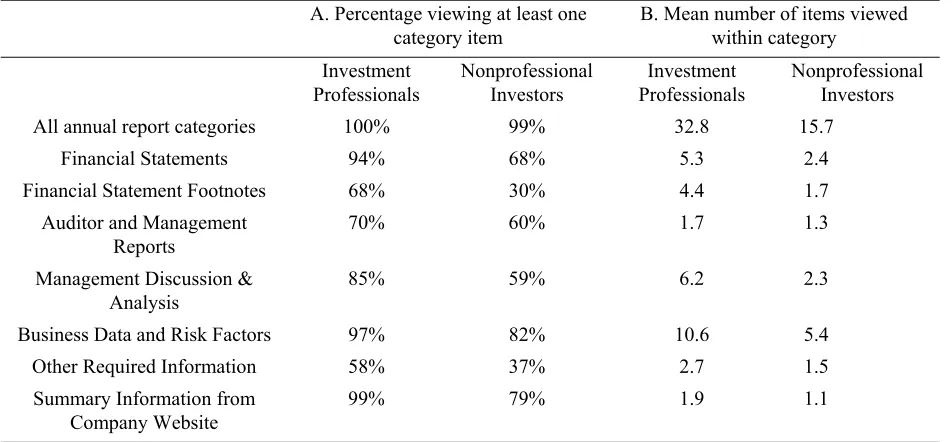
Table 1. What Information Do Investors Use?
A. Percentage viewing at least one category item
B. Mean number of items viewed within category
Investment Professionals
Nonprofessional Investors
Investment Professionals
Nonprofessional Investors
All annual report categories 100% 99% 32.8 15.7
Financial Statements 94% 68% 5.3 2.4
Financial Statement Footnotes 68% 30% 4.4 1.7
Auditor and Management Reports
70% 60% 1.7 1.3
Management Discussion & Analysis
85% 59% 6.2 2.3
Business Data and Risk Factors 97% 82% 10.6 5.4
Other Required Information 58% 37% 2.7 1.5
Summary Information from Company Website
99% 79% 1.9 1.1
Source: Arnold, Bedard, Phillips, and Sutton (2010)
Table 1 shows gaps in use of information between professionals and non-professional investors. The largest gap between these two groups was the use of footnote s with 68 % of the professional investors using them and 30% of the nonprofessional investors using them?
3.5 Understanding Financial Statements
Studies that examined the association between readability and other variables, include the identity of the external auditor Smith and Smith (1971); Barnett and Leoffler (1979) and corporate profitability Courtis (1986); Baker and Kare (1992). Subramanian, Insley, and Blackwell (1993) found that profitable firms’ annual reports were significantly easier to read than those of poor performers.
Previous studies’ sample sizes, however, are very small. Of the thirty-two studies reviewed by Jones and Shoemaker (1994) only two had a sample size slightly larger than 100. The papers examined for the information in Table I of Clatworthy and Jones (2001) 14 had a sample size of 50 or smaller out of 16 and the largest sample size is 120. Li (2008) had a sample size of approximately 50,000. This paper was the first large-sample study to examine the cross-sectional variation in annual report readability and its implications for current earnings and earnings persistence. Lehavy, Li, and Merkley (2011) found that the higher the readability of the annual report the more information a financial analyst’s report contained. Lehavy, Li, and Merkley (2011) also found that there was greater variation, uncertainty, and accuracy for earnings forecasts for the higher readability annual reports. Li (2010) focused on studies done in the last year with larger samples sizes.
Loughran and McDonald (2013) found that the length of the 10-K was a good proxy for and required less work to compute than the Fog Index. Loughran and McDonald (2013) also developed a negative word list because 75% of the negative words identified by the Harvard Dictionary are not considered negative in a financial context. The words were used to analyze 10-Ks, trading volume, fraud, material weakness, return volatility, and unexpected earnings. They found announcement returns were significantly related to the negative word list they developed on the 10-K filing date. Loughran and McDonald (2014) found firms responded to the SEC’s plain English rule. This rule requires issuers to use short sentences, active voice, definite, concrete everyday language, tabular presentation of complex information, and not use legal jargon or multiple negatives.
Results of a survey reported by The Financial Executives Research Foundations (1987) found individual investors were not comfortable with the language and complexity of traditional annual reports. They felt plainer language and understandable language without the technical jargon would improve the reports. However, professional investors did not see any problems with the way annual reports were written, (Marsh and Montondon, 2005).
3.6 Readability
Readability is typically identified by three elements. Those three elements are: interesting, legibility, and ease of understanding (Jones and Shoemaker, 1994). There are many different readability scales and each measure readability different ways. The two measures of readability used in this study are the Flesch Index and the Flesch-Kincaid Index.
Flesch Index scores are based on average number of syllables per word and words per sentence. Table 2 shows the comparison of Flesch Index scores to educational level.
Table 2. Comparison of Flesch Index Scores to Grade Level
Score Grade Level
0 to 30 College Graduate 30 to 50 13 to 16 grades 50 to 60 10 to 12 grades 60 to 70 8 and 9 grades 70 to 80 7 grade
Source: Adapted from Flesch, R. (1949). The art of readable writing. New York: Harper. p.149
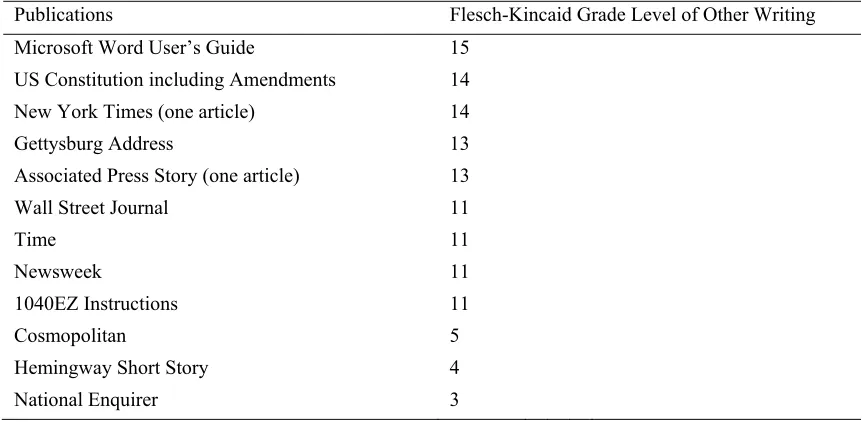
Flesch-Kincaid Index is a derivation of the Flesch Index. Although they use the same core measures (word length and sentence length), they have different weighting factors, so the results of the two tests correlate inversely: a text with a comparatively high score on the Flesch Index test should have a lower score on the Flesch-Kincaid, (Kincaid, Fishburne, Rogers, and Chissom, 1975). The higher the Flesch Index score the easier the document is to read. The Flesch Index score for standard documents should be 60 or 70. Many states’ insurance departments, by law, require that insurance policies have a minimum Flesch Index score of 40 to 45, (Hansen, D. D., n.d.) To explain the role of readability in a document, Kinnersley and Fleischman (2001) created a list of commonly known documents. As shown in Table 3. They are listed from highest to lowest grade level.
Table 3. Flesch-Kincaid Grade Level of Other Writing
Publications Flesch-Kincaid Grade Level of Other Writing
Microsoft Word User’s Guide 15
US Constitution including Amendments 14
New York Times (one article) 14
Gettysburg Address 13
Associated Press Story (one article) 13
Wall Street Journal 11
Time 11 Newsweek 11
1040EZ Instructions 11
Cosmopolitan 5
Hemingway Short Story 4
These models are common tools used in a variety of industries to evaluate the readability documents. The Security and Exchange Commission, (SEC) chairperson, Christopher Cox named the Flesch-Kincaid and the Flesch Index as two of the three models used to measure readability metrics of financial information, (Cox, 2007).
The need for nonprofessionals to understand financial disclosures has accelerated as firms move away from defined benefit retirement plans to defined contribution plans. Traditionally defined contribution and defined benefit plans were managed by professional money managers (McCarthy and Turner, 2000). Sixty percent of the workers participating in a private pension plan in 1993 indicated that a defined contribution plan was their primary plan (U.S. Department of Labor, 1994). Along with a growth in 401 (k) plans there has been a growth in individual responsibility managing their pension portfolios. According to an Employee Benefit Research Institute (1996) survey, a majority of working Americans have a limited financial knowledge about financial retirement issues, retirement planning and savings. The Boston College Center for Retirement Research found that defined benefit plans decreased from 60% of workers in 1981 with a pension plan to 10% in 2003, while defined contribution plans went from 20% in 1981 to just over 60% in 2003 (Buessing and Soto, 2006). This was to a large degree perpetuated by FASB 87 “Employees Accounting for Pensions” (Issued in December of 1985). Firms moved away from defined benefit plans to avoid recording large pension liabilities on their balance sheets required by FASB 87. For example General Motors in 1994 had approximately $54 billion of various retirement liabilities out of total liabilities of $185 billion on its balance sheet when at the same time the Stockholders equity was approximately $12 billion.
Current literature indicates people need more financial literacy. The general population reads at about the eighth grade level or a Fletsch Index score of 60 to 70 (Kirsch, Jungeblut, Jenkins, and Kolstad, 1993 and Winslow and Jacobson, 1998). There are two ways to increase readability: one increase knowledge or peoples’ reading ability or two write in such a way readers can understand. Many entities are doing the second, trying to write at a level the general public can understand, credit card companies (Prater, 2010) institutional review boards (IRBs) (Paasche-Orlow, Taylor, and Brancati, 2003), and state insurance commissions for example. (Carr, March 29, 2010) The second was chosen because attempts at the first have not been very successful. The average reading level in the United States has not increased despite efforts to do so (Gifford, 2007).
4. Methodology
4.1 Data Collection
A total of 100 firms were randomly selected from the Edgar Database. The sample size was determined using the formula from Chou (1972). A confidence level of 95% and a sampling error of 10% were used to compute the sample size. The database contains approximately 90,000 firms within a 16 year interval. The 10-Ks from the selected firms were downloaded. The footnotes from the 10-K were cut and pasted into a separate document. The researchers had two files of footnotes from the same firm, one with the headers and tables and one without the headers and tables. The Word (Office 2003 Suite) spelling and grammar check was run on both 10-K files which yielded the following data: Flesch Kincaid Grade Level, Flesch Reading Ease Score, and Passive Sentences Percent. Word Count, Number of Paragraphs, Number of Sentences, Sentences per Paragraph, Words per Sentence. The firms were from nine different industries groups identified by the Standard Industrial Classification (SIC) and from 16 different years. The nine different categories were:
Mining Construction Manufacturing
Transportation and Public Utilities Wholesale trades
Retail Trades
Finance, insurance, and Real Estate Services
4.2 Hypotheses
The hypotheses for the study were:
H1: The readability of financial statement footnotes is statistically different with headers and tables than without headers and tables.
H2: The readability of financial statement footnotes significantly exceeds the average reading level of the U. S. population.
For H1, a MANOVA was run to determine the significance of the differences among the financial statement footnotes. The two groups compared were the same financial statement of each company; group one had headers and group two was without headers. For H2, a one sample t-test using the average reading level of the U.S. population which is 8th grade as independent variable. The one sample t-test was performed using both the Flesch Index score and the Flesch Kincaid score as the dependent variable. SPSS 19th edition was used to analyze the data.
5. Results
The financial statements of the 100 companies were “pulled” from the Edgar database. The financial statements were then analyzed for their readability scores using Word 2003. The Table 4 presents the descriptive information based on the readability measures regarding the sample.
Table 4. Descriptive Data for Variables
Variable Minimum Maximum Mean Standard Deviation
Flesch Index 0 27.1 15.075 5.542
Flesch Kincaid 14 22 16.909 1.06
Passive Sentences 1 0.5 0.284 0.048
Words per Sentence 14.8 28.7 23.403 2.612
Sentences per Paragraph 1.4 8.7 3.44 1.075
Total Sentences 34 1138 287.47 215.449
Total Paragraphs 11 5168 435.284 715.577
Total Words 805 32620 8035.47 6104.28
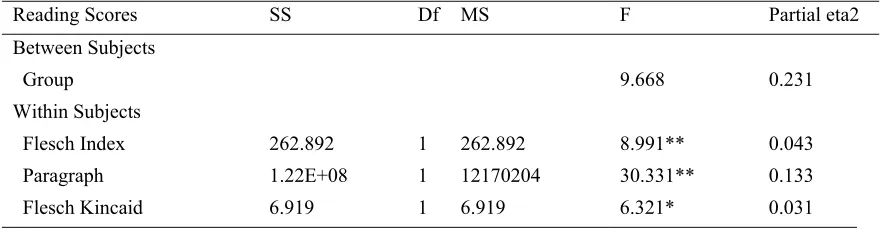
In analyzing the data for H1, significant differences were found among the two groups regarding the different reading scores. Financial statements with footnotes that include headers were significantly higher at the .01 level of significance in their reading scores than the financial statements with footnotes that do not include headers with a fairly strong effect size of partial eta2 .231. The univariate analyses yield significance at .01 for the Flesch Index and Flesch-Kincaid score and yielded significance at .05 in paragraph scores. There was little practical significance with effect sizes measured partial eta2 scores of .043, .031, and .133 respectively.
Table 5. MANOVA Reading Scores Regarding financial Statements with and without footnotes
Reading Scores SS Df MS F Partial eta2
Between Subjects
Group 9.668 0.231
Within Subjects
Flesch Index 262.892 1 262.892 8.991** 0.043
Paragraph 1.22E+08 1 12170204 30.331** 0.133
Flesch Kincaid 6.919 1 6.919 6.321* 0.031
Note *p < .05, ** p < .01
Table 6. Independent t-Test Results by Readability Score of Flesch Index and Flesch-Kincaid Index
Readability Index t df P
Flesch Index -80.526 99 .000**
Flesch-Kincaid Index 76.11 99 .000**
Note ** p < .01
6. Discussion
While there were statistical differences between the files with and without headers and tables the differences were not practical significant differences. This indicates that removing the headers and tables will not impact the results. Future research will be easier not needing to remove the headers and tables.
The average Flesch Index reading level of the footnotes was 20.4. This score indicates it is very difficult to read. Based on the average reading level of adults, a large portion of the U.S. population are unable to understand it. Forty-three percent of the U. S. populations are not able to do the following:
1. read and understand moderately dense, less commonplace prose text as well as summarizing, making simple inferences, determining cause and effect, and recognizing the author’s purpose
2. locate information in dense, complex documents and make simple inferences about the information 3. locate less familiar quantitativeinformation and use it to solve problems when the arithmetic operation is
not specified or easily inferred. (Kutner , Greenberg, Jin, Boyle, Hsu, and Dunleavy, 2007) Eighty-seven percent of the U. S. population do not have the skills to do the following:
1. read lengthy, complex, abstract prose texts as well as synthesizing information and making complex inferences
2. integrating, synthesizing, and analyzing multiple pieces of information located in complex documents 3. locating more abstract quantitative information and using it to solve multistep problems when the
arithmetic. (Kutner, Greenberg, Jin, Boyle, Hsu, and Dunleavy, 2007).
Increasingly, people are asked to make investment decisions that affect their retirement. In the past, these decisions were made by “experts”. This phenomenon is driven by the conversion from defined benefit plans to defined contribution plans which requires an individual to become an expert in determining worthwhile investments for retirement (AARP, 2007). An important part of the expert’s financial training is a higher than average reading level. The general population lacks the basic abilities to become financial literate. As easy as education is to access, without the basic literacy skills, it is extremely difficult to acquire. To educate the general population regarding financial literacy, reading is a necessary skill. There are two ways to enable people to understand documents that are this difficult, educate them or change the reading level of the document. Since such a large proportion of the population does not read at this level and the lack of success to improve their reading level it would seem to indicate that making the footnotes easier to read would be more easily attainable, (Gifford, November 19, 2007) .
Although the lack of financial literacy may be an issue for the consumer investor in making investment decisions, writing financial statement disclosures such as footnotes at a reasonable reading level that is more in line with the reading level of the consumer investor would be helpful. Footnotes are the narrative to the financial statements and play an important role in the communication of how well a company is doing. Writing them at a level beyond plain English in “legal jargon and obtuse language” leads to distrust, and therefore no investing (Loughran & McDonald, 2013).
Future research will examine if the footnotes can be rewritten at a lower reading level. The Texas Office of Consumer Credit Commissioner has examples of documents on its website written traditionally and in plain English. The traditional version of a home equity loan contract consists of 139 words and has a very low Flesch Reading Ease score of 13.9.The plain English version contains only 42 words and has a high Flesch Reading Ease of 77.8(Office of Consumer Credit Commissioner, Texas).
Traditional
Any notice that must be given to the Note Holder under this Note will be given by delivering it or by mailing it by first class mail to the Note Holder at the address stated in Section 3(A) above or at a different address if I am given a notice of first class mail to the Note Holder at the address stated in Section 3(A) above or at a different address if I am given a notice of that different address. “(Office of Consumer Credit Commissioner, Texas)
Plain English
“You or I may mail or deliver any notice to the address above. You or I may change the notice address by giving written notice. Your duty to give me notice will be satisfied when you mail it by first class mail.” (Office of Consumer Credit Commissioner, Texas)
If a home loan can be rewritten from a Flesch of 13.9 to 77.8 it would seem reasonable that the footnotes could be rewritten at a lower grade level. Rewriting the footnotes is easier than raising the reading level of the general population. Readable footnotes would lead to better decisions for investments.
References
American Association of Retired People. (2007). Preparation for retirement: The haves and have-nots, Research Report. AARP. Retrieved from http://assets.aarp.org /rgcenter /econ/retirement_prep.pdf.
Arnold, V., Bedard, J.C., Phillips, J. & Sutton., S.G. (2010). Where do investors prefer to find nonfinancial
information? Journal of Accountancy. Retrieved from
http://www.journalofaccountancy.com/Web/20102682.htm.
Baker, H.E., & Kare, D.D. (1992). Relationship between annual report readability and corporate financial performance. Management Research News, 15 (1,)1 – 4.
Barnett, A., & Leoffler, K. (1979). Readability of accounting and auditing messages. Journal of Business Communication, 16(3),49-59. http://dx.doi.org/10.1177/002194367901600305
Belkaoui, A., (1995). The Linguistic Shaping of Accounting, Westport, CT., Quorum Books.
Buessing, M & Soto, M. (2006). The state of private pensions: Current 5500 data (Report No. 42). Chestnut Hill MA: The Center for Retirement Research retrieved from http://dx.doi.org/10.2139/ssrn.908272.
Carr, S.P. (March 29, 2010.) NAIC takes on readability of insurance policies, insurancenewsnet.com, Retrieved from http://insurancenewsnet.com.article.aspx?id-175751&type=newswires#.UImIr4bhccd.
Chou, Ya-lun, (1972). Probability and Statistics for Decision Making, New York, NY: Holt, Rinehart, and Winston. Clatworthy, M. & Jones, M.J. (2001). The effect of thematic structure on the variability of annual report readability,
Accounting, Auditing and Accountability Journal,14 311 – 326. http://dx.doi.org/10.1108/09513570110399890 Courtis, J.K. (1986). An investigation into annual report readability and corporate risk return relationships,
Accounting and Business Research, 16(64). http://dx.doi.org/10.1080/00014788.1986.9729329
Cox,C. (2007, March). Speech by SEC Chairman: Closing Remarks to the Second Annual Corporate Governance Summit. USC Marshall School of Business, Los Angeles, CA.
Dyckman, T.R., Dukes, R.E., & Davis, C.J. (1995). Intermediate Accounting 3rd Edition. Chicago, IL: Irwin.
Egbert, N. and Nanna, K. (Sept. 30, 2009). Health literacy: Challenges and strategies OJIN: The Online Journal of
Issues in Nursing 14(3) Manuscript 1. Retrieved from
http://www.nursingworld.org/MainMenuCategories/ANAMarketplace/ANAPeriodicals/OJIN/TableofContents/ Vol142009/No3Sept09/Health-Literacy-challenges.aspx#NeilsenBohlman.
Employee Benefit Research Institute. (1997, January). The Reality of Retirement Today: Lessons in Planning for Tomorrow. (Issue Brief No. 181)Washington, DC: Yakoboaski, P. and Schiffenbauer, M.
FASB (Financial Accounting Standards Board). (1987). Statement of Financial Accounting Standards No. 87. FASB (Financial Accounting Standards Board). (2010). Statement of Financial Accounting Concepts no.
8:Conceptual Framework for Financial Reporting.
FASB (Financial Accounting Standards Board,). (2012). Discussion Paper Invitation to Comment Disclosure Framework.
General Motors 1994 Annual Report 10-K Retrieved from http://www.gm.com/content/dam/gmcom/COMPANY/investors/Stockholder_Information/PDFs/2011_GM_An
nual_Report.pdf.
Gifford, S. (November 19, 2007). National endowment of the arts announces new reading study. National
Endowment of the Arts. Retrieved http://www.nea.gov/news/news07/TRNR.html.
Griswold, J. (2008). Whatever happened to reading for fun? Words Alive: Advocates for Reading Retrieved from http://www.wordsalive.org/literacyfacts.html.
Hansen, D. D. (n.d.). Specifics of Insurance.Law. Legal Career Information You Can Use. Retrieved http://www.lawcrossing.com/article/150/Specifics-of-law/#.
Jones, M. J., and Shoemaker P.A. (1994). Accounting narratives: A Review of empirical studies of content and readability, Journal of Accounting Literature 13.
Kimmel, P.D., Weygandt, J.J., & Kieso, D.E. (2009). Accounting: Tools for Business Decision Making. Danvers, MA: John Wiley and Sons, Inc.
Kincaid, J.P., Fishburne, R.P., Rogers, R.L., & Chissom, B.S. (1975). Derivation of New Readability Formulas (Automated Readability Index, Fog Count, and Flesch Reading Ease formula) for Navy Enlisted Personnel. Research Branch Report 8-75. Chief of Naval Technical Training: Naval Air Station Memphis.
King, E C. (September 5, 1947). Securities and exchange commission, footnotes to financial statements, Address of to the Virginia Society of Public Accountants.
Kinnersly, R. & Fleischman. G. (2001). The readability of government’s letter of transmittal relative to public company management’s discussion and analysis. Journal of public Budgeting, Accounting, and Financial Management. 13 (1) 1-22.
Kirsch I.S, Jungeblut A, Jenkins L, Kolstad A. Adult Literacy in America. National Center for Education Statistics, U. S. Department of Education, September, 1993, Washington, D.C.
Know Your Readers, (n.d.) Plain Language at Work Newsletter. Retrieved
http://www.impact-information.com/impactinfo/literacy.htm.
Kutner,M.,Greenberg, E., Jin,Y., Boyle, B.,Hsu,Y., & Dunleavy, E. (2007). Literacy in Everyday Life: Results From
the 2003 National Assessment of Adult Literacy (NCES 2007–480).U.S. Department of Education. Washington,
DC: National Center for Education Statistics.
Lehavy, R..Li, F., & Merkley, K. (2011). The effect of annual report readability on analyst following and the properties of their earnings forecasts, The Accounting Review, 86 (3), 1087-1115. http://dx.doi.org/10.2308/accr.00000043
Li, F. (2008). Annual report readability, current earnings, and earnings persistence, Journal of Accounting and Economics, 45 2008, 221-247. http://dx.doi.org/10.1016/j.jacceco.2008.02.003
Li, F. (2010). Textual analysis of corporate disclosures: a Survey of the literature, Journal of Accounting Literature, 29, 143-165.
Loughran, T. & McDonald, B. (2013). Measuring readability in financial disclosures Journal of Finance, 69(4)1643-1671. http://dx.doi.org/10.1111/jofi.12162
Loughran, T. & McDonald, B. (2011). When is a liability not a liability? Textual analysis
dictionaries, and 10-ks,The Journal of Finance, 2013 LXVI (1) , 35-65. DOI: 10.1111/j.1540-6261.2010.01625.x. Loughran, T and McDonald, B. (2014). Regulation and financial disclosure: The impact of plain English, Journal of
Regulatory Economics, 45, 94-113 doi:10.107/s11149-013-236-5.
Marsh, T.L. & Montondon, L.G. (2005). A comparison of the readability of governmental, annual financial reports, popular reports, and management discussion and analysis. Journal of Accounting and Finance Research 13 (3) 153-161.
Marshall, D.H. (1993). A survey of accounting: What the numbers mean? 3rd edition Burr Ridge, IL: Irwin.
National Commission on Adult Literacy. (2008). Reach higher, America overcoming crisis in the U.S. workforce
retrieved from
https://www.google.com/search?q=Reach+higher%2C+America+overcoming+crisis+in+the+U.S.+workforce+ &ie=utf-8&oe=utf-8
Office of Consumer Credit Commissioner, Texas, Comparison of Traditional and Plain Language Clauses, retrieved from http://www.occc.state.tx.us/pages/Legal/plain_lang/PLcomp.htm.
Paasche-Orlow, M K., Taylor, H.A., and Brancati, F.L. (2003). Readability standards for informed-consent forms as compared with actual readability, The New England Journal of Medicine, 348:721-72. http://dx.doi.org/10.1056/NEJMsa021212
Prater, C. (July 22, 2010). U.S. credit card agreements unreadable to 4 out of 5 adults. CreditCards.com. Retrieved http://www.creditcards.com/credit-card-news/credit-card-agreement-readability-1282.php.
Radin, A.J. (2007). Have we created financial statements disclosure overload? The CPA Journal. Retrieved from http://www.cpajournal.com/2007/1107/perspectives/p6.htm
Raiborn, C., Payne, D. & Pier, C. (2008). The need for plain English disclosures. The Journal of Corporate Accounting and Finance, 60-76. http://dx.doi.org/10.1002/jcaf.20419
Ro, S. (Mar 13, 2013). Chart of the day: Here’s who owns the stock market, Business Insider, Retrieved from http://www.businessinsider.com/chart-stock-market-ownership-2013-3.
Smith, J. E., and Smith, N.P. (1971). Readability: A measure of the performance of the communication function of financial reporting, The Accounting Review 46(3) 551-562.
Subramanian, R., Insley, R. G., and Blackwell, R.D. (1993). Performance and readability: A comparison of annual reports of profitable and unprofitable corporations, Journal of Business Communication . 30(1) 49-61. http://dx.doi.org/10.1177/002194369303000103
The Canadian Foundation for Economic Education, Essential Skills and Financial Literacy: Exploring the
Correlations, Compatibility, and Success Factors, http://www.cfee.org/en/pdf/CFEE%20Financial%20Literacy%20and%20Essential%20Skills%20-%20Final%2
0Report%20July%202012.pdf.
The Princeton Review.(n.d.) Career: Financial analyst. Retrieved from
http://www.princetonreview.com/careers.aspx?cid=68.
The truth about literacy in the United States, (n.d.) Prophet, Incorporated: The Future of Education. Retrieved http://www.prophet-inc.com/literacy.html.
U.S; Department of Labor, Pension, and Welfare Benefits Administration, (1994). Pension and Health Benefits of
American Workers, Washington D. C.
U.S. Securities and Exchange Commission. (1998), A plain English handbook: how to create clear SEC disclosure documents. U.S. Securities and Exchange Commission: Washington, DC.
U.S. Securities and Exchange Commission. (n.d.). Division of corporation of finance: Standard industrial classification (SIC) code list. Retrieved http://www.sec.gov/info/edgar/siccodes.htm.
Wayman, R. (February 15, 2008). An investor's checklist to financial footnotes. Investopedia. Retrieved http://www.investopedia.com/articles/analyst/03/100103.asp#axzz2Ae6WfjY8.
Werntz, W.W. (1939). Securities and Exchange Commission, Footnotes and Financial Statements, Address to the Minnesota Statistical Association and The Minnesota Society of Certified Public Accountants, May 3, 1939. Winslow, E.H. & Jacobson, A.F. (July, 1998). According to research for practice. The American Journal of Nursing,
98 (7) 55-57.