The Thesis Journey: Travelling with Charley
1Ardra L. Cole
Ontario Institute for Studies in Education University of Toronto
I chose the title of my talk for two reasons. The first part connects with the book, The Doctoral Thesis Journey, which I co-edited with David Hunt in 1994. The journey metaphor still works for me as a way to talk about the thesis process. The sub-title, Travelling with Charley, is borrowed from an account of a particular kind of journey–John Steinbecks’s road trip across the United States with his standard poodle, Charley, chronicled in his classic novel, Travels with Charley. The sub-title connects with a new book that I am working on now, with the working title, Of Dogs and Dissertations: Notes on Thesis Writing and Life.
You don’t have to have a dog in your life or love a dog to connect with what I am going to say, but it might help. So I invite you to pause for a minute and invite a dog you have known or currently know to come forward in your mind. Let him or her be here with you for the next 40 minutes or so while we think together about what we can learn about thesis writing (among other things) from these wonderful creatures. If you are not inclined to want to invite a dog to lunch, then a horse will do, or a cat, or a rabbit.
No, I haven’t lost my mind and I am not joking. There is much to be learned from dogs if we learn to adopt what Lous Heshusius (1994) would call, a “participatory mode of consciousness” and if we engage with them with patience, openness, and feeling. To quote Suzanne Clothier in her extraordinary book, Bones Would Rain from the Sky, “To travel in the company of animals is to walk with angels, guides, guardians, jesters, shadows and mirrors” (2002, p.11). Suzanne Clothier describes her and her husband’s wedding ceremony, which took place in a pasture on their farm and which, of course, included their seven dogs. As part of the ceremony they called forward each dog in turn as an embodiment of qualities and characteristics that they, the bride and groom,
Brock Education Vol. 13, No. 1, 2003
1 1 Dr. Reginald B. Moase Invitational Address delivered at the 21st Annual Graduate Students’ Conference, Faculty of Education, Brock University, May 10, 2003.
Dr. Ardra Cole is Professor and Co-director of the Centre for Arts-informed Research in the Department of Adult Education and Counselling Psychology at OISE/UT. Her research, teaching, and writing are mainly in the area of qualitative research
hoped to emulate in their marriage: gentleness, maturity, determination, gracefulness, faithfulness, beauty, courage, playfulness, and so on. “In calling our dogs to us and naming their gifts and lessons,” she says, “we acknowledged what they helped to create in our lives and honored their role in our lives as teachers” (p. 275). Earlier in the book she states, “Of all the gifts that animals can offer, perhaps the greatest is… [the] opportunity to delve deep inside ourselves. Without judgment or timetables, with patience and an amazing capacity for forgiveness, animals are the ideal guides through our inner landscapes” (p. 12).
I take inspiration from Suzanne Clothier when I think about the thesis process. We have much to learn from dogs about thesis writing and about life. Many of the qualities they embody are lessons to thesis writers: devotion, nose-to-the-ground discipline, presence, attunement, honesty, patience, humour, companionship, curiosity, dignity, dogged persistence, joy, creativity, forgiveness, acceptance, non-judgement, a basic wisdom about the need for physical, emotional, and intellectual balance, and of course love, to name but a few.
The following three dog vignettes are from my in-progress manuscript. Each story exemplifies one or more of the qualities to be honoured in the thesis process. After each story I more directly explore the qualities and their role in the thesis process. Then I offer a list of top twenty travel tips for the thesis journey. I hope what I have to share with you is both enjoyable and helpful. The journey on which you all have embarked is a demanding one on many levels. It is as Corrine Glesne and Allan Peshkin (1992, p. 179) say about qualitative research “an odyssey into our discipline, our practice, and perhaps our souls. We cannot be sure of what we will find, but we invariably get caught up in the search.” You are all at different points along the way and are likely grappling with different issues, problems, and concerns and you likely have myriad questions. I hope I will speak to at least some of what is on your mind. So without further ado, give that dog that has joined you a gentle stroking and I will begin.
Vignette 1
The Thesis Journey
3 of the nagging pain in my right shoulder where I hold all my
tension, I move it in a slow circular motion. As I twist my head to the right in an attempt to stretch my neck muscles and release more tension, my gaze falls to the floor a metre or so from my desk. I pause and whisper his name. Thump, thump, he replies. I say it again, louder and with an inflection that he recognizes as loving (I think). More and faster thumping accompanied by an expectant yet quizzical cock of the head. I slide from my chair to the floor and sidle over to his mat. His brown velvet eyes watch my approach. A few more thumps of the tail against the hardwood floor and then, ever so subtly, he shifts his weight. Before I complete my short journey across the floor he is on his back, all four paws in the air. I lay both hands on his soft, warm belly and begin a gentle caress. At my touch, his head flops to the side in a gesture of complete trust and assent. My hand movements are slow, gentle, rhythmic. I feel my body relax, tension ease. My search for words seems unimportant. He drops a front and back paw and shifts his weight again. He is on his side now and my strokes lengthen. Beginning at the top of his head and moving along his side and toward his tail, my hands glide across the surface of his fur. Just as I reach his
hindquarter, he gently stretches, then slightly raises a back leg. It is an invitation. I follow his request and make a detour to gently rub the soft, downy crease between his leg and belly. He lets out a long and deep dog-sigh of utter contentment and in-the-moment gratification. His leg drops once again and I continue my light massage. I am aware of my breathing–slow and centred. Its rhythm has become synchronized with his. I am almost in a meditative state. A few minutes more and his gentle breathing has become a soft, purring snore. I pause to take in this moment of complete surrender before I slip away and return to my computer. Reseated, my fingers dance across the top of the keyboard–a slow skater’s waltz. I am present with my thoughts. Words come.
Writing a thesis is not just a work of the mind. It is an act of
for moments of revelation and insight, and as you desperately search for exactly the right words to say what seems so clear in your head and heart, you are engaged in an agonizingly elusive process of tough thinking and sense-making. Despite good intentions and strong will, sometimes you just have to surrender your reliance on your conscious, rational mind. Learning–deep insight and creative thinking, or what Stephen Nachmanovitch (1990), in his book, Free Play: Improvisation in Life and Art, calls “ripening”–requires mulling space. Ripening, says Nachmanovitch, takes place when our attention is directed elsewhere. In The Writing Life, Annie Dillard (1989) makes a comparison between splitting wood and writing. She tells a story about spending days and nights of agonizing cold in a cabin to which she had retreated to finish a writing project. She did not know how to split wood sufficiently well to keep a heat-radiating fire going. After mornings of what she described as “chipping flints” and “attacking the wood” and nights of trying to figure out how it was done properly, the answer came to her one night in a dream. “You aim at the chopping block, not at the wood,” the dream told her. “Treat the wood as a transparent means to an end, by aiming past it.” And so it is with writing she asserts. “Aim for the chopping block. If you aim for the wood, you will have nothing. Aim past the wood, aim through the wood; aim for the chopping block.” Incidentally, Nachmanovitch (1990, p. 157) has this to say about dreams:
Creative people, even when sleeping, are working and playing on their questions. Life is full of surprises when we’re asleep. There is something in us constantly wanting to come out, and it seems to emerge more easily when we let go of the
strictures (hope and fear) of consciousness.
The Thesis Journey
5
Vignette 2
It’s raining, hard; the kind of rain you hope for in early spring, the kind you hope will wash away the debris from urban winter and give spring green a nudge forward. I am dressed for the weather–waterproofed from head to toe. Nevertheless, my plan is for a shorter-than-usual walk; it’s late and it’s cold along with the wet. We move quickly, wending our way along the familiar sidewalks of our neighbourhood, pausing only long enough for cursory investigations of interesting smells and littered remains of lunch bags, fast food containers, the odd bone or food scrap likely dropped by a scavenger on the run. We zigzag from one side of our neighbourhood to the other ducking down back laneways, taking shortcuts, moving steadily forward through the pouring rain. He seems quite happy with our faster-than-usual pace, and for a while I think my plan for a shortened walk is going to work. And then I lead us around a corner and onto the main commercial street of our
neighbourhood. I realize my mistake too late; it’s garbage night.
During the day and evening this street is a bustle of activity, drawing shoppers to any number of restaurants, pubs, bakeries, butcher shops, fruit and vegetable markets, and specialty food boutiques. Now, the street is more or less deserted except for a few lingering bar and restaurant patrons and the occasional dog walking duo. Now, on the abandoned sidewalk slick with rain and under the glow of the streetlights, sits the week’s garbage. Curbside in front of every food establishment are mounds of polyethylene garbage bags filled to capacity and tied close, large blue and green plastic waste bins on wheels lined up in rows, and stacks of collapsed and bundled cardboard boxes. I heave a sigh of defeat as I look up the street; garbage as far as I can see.
the air twitching, honing in on what must seem like a veritable olfactory feast. I give in knowing that it is futile, not to mention unfair, to engage in a battle of wills that I could only win with brute force. I follow him to the first stop, the butcher shop. Bundle after bundle of flattened cardboard boxes are tied and neatly stacked curbside opposite the store entrance; twenty-six in all, I am about to discover. The printing still visible on the rain-soaked cardboard reads like a delivery list: Chicken Coop Poultry Products, Grade A Meats, Brown’s Beef. “There couldn’t possibly be any scent left,” I think half-aloud with a gentle tug, bidding us forward. We are at bundle number four.
The Thesis Journey
7 A thesis is completed through dogged persistence and determination. Be prepared for hard work and dedication to the task. Writing a thesis is hard work that is unlike any other academic task. It is not just another course paper. It is a book, believe it or not, and it requires a different kind and level of commitment: focused and sustained. Doing course work is the easy part of a degree program - which is why there is such a high percentage of ABDs (All But Dissertation) or ABTs (All But Thesis). A study reported on in Berkowitz (2003) indicates PhD completion rates of 55.1% and Master’s completion rates of 70.6% in the Social Sciences.
A thesis is written one word at a time. Words string together to make sentences which compose paragraphs which fill pages which add up to chapters. Working with dedication and discipline toward deadlines (working in 3-D) will carry you a long way. Establish and stick to a schedule. Write every day for a set period of time. Set goals and stick to them, regardless. For example, 3 pages a day x 6 days a week = 18 pages a week x 10 weeks = 180 pages–not all of which will be usable but nevertheless. Persist towards achieving those three pages and reward yourself when it comes easy. And on those days when you just can’t seem to put a coherent sentence together, there is always editing the previous day’s work, proofreading last week’s writing, gleaning field notes and transcripts, updating your reference list, polishing and fiddling. The longer a project is stretched out, the greater the chances of losing interest. As Stephen King (2000) would say, the mythical muse is not going to get the work done; she can only supply the inspiration.
And then just when you think you’ve finished look again, go deeper, look for overarching points to theorize. Try to answer the questions: What is your thesis about? What can a reader learn from it? To answer, stand back and look at it from a distance. If the answer to those questions is not apparent then it needs another revision. In Writing Down the Bones, Natalie Goldberg (1986, p. 103) says this of writing in general: “Sometimes when you think you are done, it’s just the edge of the beginning.”
Inevitably, life will get in the way. While it is important to
acknowledge and attend to life events and challenges, it is just as important to know when they have become excuses to stop work. You will reach a point in the thesis process where you realize that, in order to do the kind of deep thinking, mulling, and writing required you must make your thesis your priority over all else (except your dog of course). You will need to eliminate
where she is–in the mountains, by the ocean, in a busy urban setting, or in her home environment–she works to block any access to the outside world and minimize distractions within her workspace. She says she doesn’t care where she works because she doesn’t notice things around her. “One wants a room with no view,” she argues, “so that imagination can meet memory in the dark.”
Vignette 3
I want him to have a good, long run. I have a full day of writing ahead of me and I always feel better when I know he is sleeping because he is tired, not because he is bored. We arrive at the lake and I unclip his leash. He immediately heads for the water, wades in belly-high plowing the water with his snout, sits for a few seconds, and then jumps up, shakes, and walks back to shore. As always I wish he would swim; as always he keeps mostly to the shore, meandering into the water only for the occasional drink, to cool off with a quick duck, or when he wants to avoid another dog (his version of Nya, nya, nya, nya nya, can’t catch me). Instead of the fast-paced, physically challenging workout I have in mind, we inch our way along the shoreline, he with his nose to the ground and I with my eye trained on his movements and ready to offer a sharp, “Drop it”. The shoreline is littered; I must be vigilant. I try to interest him in a stick for a game of fetch or chase. He ignores my shenanigans and continues his methodical explorations sniffing, pawing the sand to unearth buried treasure, occasionally picking up something in his mouth and not always dropping it on command. I come across an empty plastic water bottle and give it a kick so that it skims along the sand, an enticement for sure I think. The noise and movement catch his attention. He looks up, satisfies his curiosity, and resumes his exploring. “Come on, play, run, exert yourself,” I silently urge.
The Thesis Journey
9 sauntering along, he relishing the journey, I intent on the
destination. My image of a tuckered-out dog sleeping peacefully at my feet while I work fades with each dawdling step. We eventually reach the crumbling remains of a concrete wall that separates two stretches of beach and I decide to turn back rather than climb over to the next accessible part of the shoreline. We reverse direction and continue ever so slowly to make our way back along the beach, I trying to resign myself to the fact that my plan is not to be and he busily picking his way through the flotsam and jetsam along the shore. (The rule about never retracing steps doesn’t apply here; there is sufficient new ground to cover to keep the walk interesting and stimulating.)
Ultimately we once again come upon the plastic bottle that I had abandoned an hour earlier. I give it a careless kick and watch it sail several metres through the air. Almost before I can take another step, he bolts forward in hot pursuit, pouncing on the bottle just as it hits the sand. A backward glance in my direction allows him to judge the range between us and assess how much of a threat I am. With the bottle firmly grasped in his mouth, he charges down the beach at full tilt until he is a safe distance away, screeches to a halt, and plops down in the sand facing me, daring me to advance. As I approach, he releases the bottle only long enough to taunt me. His body and mind on high alert, he is ready to flee at the first sign of my impending seizure. As I cross some apparently predetermined line in the sand he grabs the bottle in his mouth and takes off. The chase is on. Round and round he runs in ever widening circles, sand flying, feet pounding, his body extending with the speed and grace of a racehorse. A thing of beauty. One more loop and into the lake he dashes, dropping the bottle at the water’s edge. I rush to pick it up and hurl it into the lake; he swims towards it, snatches it from the water, and heads for shore. The game continues. He is ready now; he has found his stride. This is his way.
trust in oneself, finding voice. It is a process that takes time. I am reminded here of Stephen Nachmanovitch’s lovely analogy of an oyster:
When a grain of grit accidentally slips into an oyster’s shell, the oyster encysts it, secreting more and more of a thick, smooth mucus that hardens in microscopic layer after layer over the foreign irritation until it becomes a perfectly smooth, round, hard, shiny thing of beauty. The oyster thereby transforms both the grit and itself into something new…completing the gestalt according to its own oyster nature. (1990, p. 88)
It takes time to make a pearl and, like the oyster, we need to engage in the creation process according to our own nature. We all have different ways of being and doing, different styles of learning and creating. There is no one right way of researching and writing. Striving to follow someone else’s system, routine, practice, route will help you eventually reach your destination but it is likely that the journey itself will be void of deep meaning and you will inevitably miss a lot along the way. You need to find your own style and honour it. You need to find your own rhythm and move to it.
Travel Tips
And now we leap to a fast-paced ending with some travel tips. I leave you to find the dog stories in these points.
1. Research/write what you most want to know. Following your passions will sustain you through a long and arduous journey.
2. Striving for the ‘unique’ study or ‘original’ idea is a misdirected goal. Research is a communal act.
3. Take ownership of your work. This is your thesis.
4. Find someone besides yourself who believes in you. The thesis journey is a lonely one.
5. Work in 3D: discipline, determination, and deadlines. Read, read, read. Write, write, write.
6. See and believe in yourself as a researcher and writer. Take your work and role seriously. Dignify them.
The Thesis Journey
11 8. Take time to know who you are and what you and your work stand for.
Don’t be bullied by those with opposing views.
9. Hours spent talking about writing is time spent not doing it. A thesis is written one word at a time.
10. “The scariest moment is always just before you start” (King, 2000). Start writing NOW…and KEEP GOING
11. Maintain your focus; stay the course.
12. Be prepared for hard work and dedication to the task. Persistence and determination will take you 90% of the way.
13. Establish and stick to a disciplined schedule. The longer a project is stretched out the greater the chances of losing interest.
14. In the beginning…suspend your critic. Write as fast as you can to get it all out, in order to, as Stephen King (2000) would say “outrun your self-doubt”.
15. Be prepared to let go–of preconceptions and expectations, of plans, of that line that took you all day to perfect.
16. Trust and revel in the process.
17. Strive to nourish your body and spirit as well as your mind. 18. Your thesis is only a small piece of your life and career not all of it. 19. Be prepared to end up with more questions than answers.
20. Your relationship with your supervisor or advisor is up there with other significant relationships. At this point in your life and career this relationship matters a lot.
Proverb
On that note I will conclude with a story, a proverb, that my former supervisor, mentor, and dear colleague, Dave Hunt, recently shared with me. It is
particularly apt for today because of its consistency with our animal motif.
The Rabbit’s Thesis (Author Unknown)
One sunny day a rabbit came out of her hole in the ground to enjoy the fine weather. The day was so nice that she became careless and a fox sneaked up behind her and caught her.
“I am going to eat you for lunch!”, said the fox.
“Well, I am just finishing my thesis on the superiority of rabbits over foxes and wolves.”
“Are you crazy? I should eat you right now! Everybody knows that a fox will always win over a rabbit.”
“Not really, not according to my research. If you like, you can come into my hole and read it for yourself. If you are not convinced, you can go ahead and have me for lunch.”
“You really are crazy!”
But since the fox was curious and had nothing to lose, it went with the rabbit. The fox never came out.
A few days later the rabbit was again taking a break from writing and sure enough, a wolf came out of the bushes and was ready to set upon her.
“Wait!” yelled the rabbit, “you can’t eat me right now.” “And why might that be, my furry appetizer?”
“I am almost finished writing my thesis on the superiority of rabbits over foxes and wolves.”
The wolf laughed so hard that it almost lost its grip on the rabbit. “Maybe I shouldn’t eat you; you really are sick–in the head. You might have something contagious.”
“Come and read it for yourself; you can eat me afterward if you disagree with my conclusions.”
So the wolf went down into the rabbit’s hole and never came out.
The rabbit finished her thesis and was out celebrating in the local lettuce patch. Another rabbit came along and asked,
“What’s up? You seem very happy.” “Yup, I just finished my thesis.” “Congratulations. What’s it about?”
“The superiority of rabbits over foxes and wolves.’” “Are you sure? That doesn’t sound right.”
“Oh yes. Come and read it for yourself.”
The Thesis Journey
13
The Moral
The moral of the story: The title of your thesis doesn’t matter. The subject doesn’t matter. The research doesn’t matter. All that matters is who your advisor is.
Thank You
Thank-you for listening to me and to your dogs and bon voyage.
References
Berkowitz, P. (2003). The long haul. University Affairs, February, 8-12. Clothier, S. (2002). Bones would rain from the sky. New York: Warner Books. Cole, A. L., & Hunt, D. E. (Eds). (1994). The doctoral thesis journey:
Reflections from travellers and guides. Toronto, ON: OISE Press. Dillard, A. (1989). The writing life. New York: Harper & Row.
Glesne, C., & Peshkin, A. (1992). Becoming qualitative researchers. White Plains, NY: Longman.
Goldberg, N. (1986). Writing down the bones: Freeing the writer within. Boston, MA: Shambhala Publications.
Griffin, G. B. (1992) Calling: Essays on teaching in the mother tongue. Pasadena, CA: Trilogy Books.
Heshusius, L. (1994). Freeing ourselves from objectivity: Managing
subjectivity or turning toward a participatory mode of consciousness. Educational Researcher, 23(3), 15-22.
King, S. (2000). On writing: A memoir of the craft. New York: Pocket Books. Nachmanovitch, S. (1990). Free play: Improvisation in life and art. New
York: Jeremy T. Archer/Putnam.
Can Academic Success Come from
Five Minutes of Physical Activity?
Julienne K. Maeda University of Hawaii Lynn M. Randall University of New Brunswick
Abstract
Being physically active helps not only in the areas of health and fitness, but also in the area of academics, more specifically, mathematics. Brain-based teaching can play a large role in enhancing student learning through the use of movement, in particular, a short running activity on math fluency in addition problems. Could five minutes of a moderate to vigorous activity have any effect on students’ addition fluency? The purpose of this article is to share with readers the effects of infusing a short physical activity into an already busy day. Two primary findings were gleaned from this study. First, although there was a small positive effect on math fluency, there was no negative effect. Second, positive changes in students’ behavior were noted by the classroom teacher.
Introduction
After as little as five minutes of a moderate-vigorous physical activity (i.e., running) four days a week, a class of second grade children was able to concentrate more, the teacher was able to complete more activities, math fluency increased, and the daily classroom routines and overall grades of the students were not negatively affected by the running; rather both improved as a result. The purpose of this article is to share with readers the ingredients for infusing a short physical activity into a busy day.
Julienne K. Maeda is an Assistant Professor at the University of Hawaii at Manoa in Honolulu. Lynn M. Randall is an Assistant Professor at the University of New Brunswick in Fredericton. Both have research interests in aspects of elementary physical
Academic Success
15 Physical inactivity and unhealthy eating contribute to at least 300,000 preventable deaths each year (US Department of Health and Human Services, 2001). Becoming physically active on a regular basis is the key, and the activity need only be moderate in nature to reap benefits. Although regular
participation in 30 minutes of intense activities or shorter more vigorous bouts of 15 minutes is suggested per exercise session for adults, such
recommendations are different for children. Corbin and Pangrazi (1998) suggested that children accumulate at least 30-60 minutes of age and
developmentally appropriate physical activities on all or most days of the week. Schools provide an ideal place to help improve and develop more healthy habits (DHHS, 2001). Werner, Timms, and Almond (1996) reported that panelists from a news briefing by the American College of Sports Medicine suggested that “schools are the most likely place to change physical activity patterns and that physical education curricula should provide movement experiences that are enjoyable, provide significant amounts of physical activity, and promote lifelong participation in physical activity” (p. 49). Recesses and the time before and after school provide a small portion of time when children can be active. Regular participation in a developmentally appropriate physical education program is another portion of time for physical activity.
Elementary physical education is often children’s first formal
experience with movement instruction and it is a time where they begin building a foundation of motor skills for later participation in sports and other physical activities. Physically educated students learn the importance of being active, how to be active, and value such a lifestyle (National Association for Sport and Physical Education, 1995). They are students who become knowledgeable physical activity participants and spectators, practice the meaning of teamwork, and are provided the tools to become active, healthy adults. Although
participation in physical education is a good source of physical activity and the breadth of benefits extends beyond the physical, it is often not allotted enough time with regard to the development and maintenance of fitness and motor skills. Elementary physical education programs taught by a physical education specialist in many parts of the United States and Canada are typically scheduled once a week per class, or even less as they are in several schools in Hawaii (i.e., once every two weeks). Supplemental days of physical education and/or shorter bouts of physical activity are important and would benefit students.
found in elementary physical education classes taught by a specialist may in fact contribute to academic achievement. Spending more time in physical education did not have negative effects on standardized academic achievement test scores in the elementary school children in that study and the thinking that physical activity negatively affects cognitive function is untrue (Sallis et al., 1999).
Movement & Academics
“Movement is an indispensable part of learning and thinking” (Summerford, 2001, p. 7). Furthermore, movement can help to reinforce the academic skills of all students (Blaydes, 2001; Jensen, 1998; Sallis, et. al., 1999). Although physical activity and movement do not necessarily make children smarter, they do contribute to how they learn and how much can be learned. According to Hannaford (1995), 85% of children in school are kinesthetic learners. In other words, these children learn better by moving and interacting with their environment rather than sitting and only receiving information visually or by listening. The belief that movement should only be limited to physical activity in physical education is contrary to what is known as brain-compatible learning. In fact, with the outdated thinking that physical education is a frill, many students are missing the neural benefit movement can have on academics (Summerford, 2001). According to Jensen (2000, 1998), movement and physical education do, in fact, contribute to enhanced brain function.
However, with the increasing pressure and accountability in subject areas such as math and reading, time has become an even more precious commodity. Indeed, although time has become very valuable to teachers, planning as little as five minutes a day of concentrated physical activity could contribute to academic performance and student behavior. The purpose of this article is to share with readers a recipe for infusing physical activity into a busy day. After as little as five minutes of moderate-vigorous activity (i.e., running, walking), the children who participated in this study were able to concentrate more, the teacher reported being able to get more done, math fluency increased, and that fluency was not negatively affected by the physical activity.
Methods & Procedures
Participants
Academic Success
17
Procedures
The teacher of the class divided the students into two groups based on their performance in math related to addition concepts, a) grade level group and b) below grade level group. Three versions (e.g., three sheets per version) of addition problem sheets were used. Three different versions were used to minimize any chance of students memorizing the problems and answers. Each version was used alternately throughout the week. For example, version 1 was used on day 1, version 2 on day 2, version 3 on day 3, then back to version 1 on day 4, etc. Using dry-erase pens and transparency sheets, each student
answered as many math problems as they could within one minute upon returning to the classroom after the walk and/or run. The teacher corrected all sheets then cleaned the transparencies.
A timer was used to signal the end of one minute. The use of one-minute timings is a short yet sufficient interval for measuring performance (Binder, Haughton, & Van Eyk, 1990). The one-minute timings allow teachers and students to easily calculate per minute frequencies and accommodate those who have attention difficulties. Also, such a short period allows for many opportunities for students to respond and improve on fluency and for teachers to make curriculum-based decisions.
Fluency is a factor related to student learning. According to Binder et al. (1990), students must develop certain minimum levels of speed and accuracy on individual curriculum tasks. Fluency in this sense is defined as accurate, non-hesitant performance where work becomes steady for significant durations. Through short timings, where correct responses per minute are recorded, the number of opportunities to respond is high, thus helping to increase and improve fluency.
Design
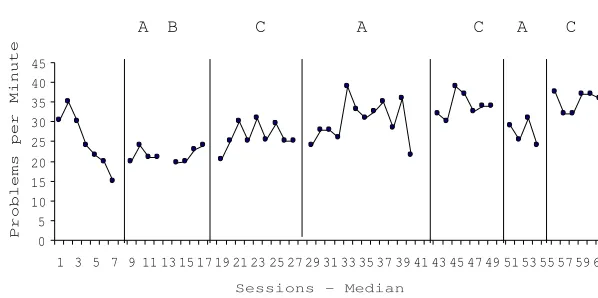
Using a multiple treatment reversal design (Cooper, Heron, & Heward, 1987), several phases depending on the intervention are provided. With this design, each phase served as a baseline for the subsequent phase (Cooper et al., 1987). Therefore, when experimental (i.e., intervention) variables are introduced, their effect is compared to the level of the baseline (i.e., Phase A) and when removed (i.e., subsequent phases other than A), the attempt is to reproduce baseline levels. It is the change in the trend of the data that is being examined via visual analysis through the use of graphs.
Data Analysis
In single-subject research, data are analyzed using visual analysis of graphs (Cooper et al., 1987). Visual analysis provides the viewer with their own means of interpreting the data and of judging any significance in behavior changes. In this study, Phase A (refer to Figure 1) otherwise known as the baseline, was composed of the one-minute timing of addition problems and no physical activity. A decreasing trend and data path are visible in all three Figures during Phase A. In other words, the number of correct problems per minute decreased during this phase.
Figure 1 - Class Medians
Phase B was the introduction of a physical activity (i.e., running) with the one-minute timing of addition problems immediately afterwards. The teacher reported that the students spent more of the five minutes walking than running. This could be explained by the low fitness level of the students. This study started approximately a little more than one month into a new school year, and in general, students do not tend to be in good physical shape after summer
0 5 10 15 20 25 30 35 40 45
1 3 5 7 9 11 13 15 17 19 21 23 25 27 29 31 33 35 37 39 41 43 45 47 49 51 53 55 57 59 61
Problems per Minute
A B C A C A C
Academic Success
vacation. During this phase, the data path was slightly higher and much more stable than in the previous phase. However, since the majority of the students were walking for the five minutes instead of running, it was decided by the researchers to use walking as the next physical activity, hence Phase C. The design of this study allows for changes to be made while the study is taking place to help improve the targeted behavior; any changes become a new phase (Cooper et al., 1987).
In Phase C, students were encouraged to walk briskly for the five-minute time period. In this phase, the data path increased and the number of addition problems answered correctly by the class increased. Once the data path in Phase C reach a point of relative stability, Phase A was re-introduced to see if a decrease in performance occurred as a result of no physical activity. In this second Phase A, math fluency seemed to continue at the level of the previous phase. However, after four sessions and a sharp increase in math problems answered correctly, performance again began to decrease. The sharp increase cannot be explained. With Phase C showing a positive effect when compared to Phase A, Phase C was introduced again. With the re-introduction of Phase C, the data path returned to a higher level of fluency than Phase A and remained at a relatively high level. To attempt to repeat a return to baseline levels of performance, Phase A was again re-introduced. According to Cooper et al. (1987), a return to baseline levels again strengthens the design and effect of the intervention.
Math fluency in the third introduction of Phase A decreased almost immediately. After four sessions, Phase C was re-introduced a last time. Math fluency returned to a relatively high level and was clearly better than
performance in Phase A. Similar trends in the data between phases can be seen in Figures 2 and 3.
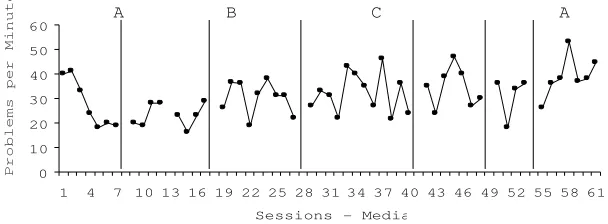
Figure 2 - Grade Level Group Medians
0 10 20 30 40 50 60
1 4 7 10 13 16 19 22 25 28 31 34 37 40 43 46 49 52 55 58 61
Sessions - Media
A B C A
Figure 3 - Below Grade Level Group Medians
Figures 2 and 3 depict the performances of the two math groups – Grade Level and Below Grade Level. Both graphs mirror performance in the class graph; however, the effect of the physical activity appears to be much stronger for the below grade level group than for their grade level peers. The number of problems answered correctly by the below grade level group appeared to be more clearly affected (i.e., higher trend in data path) by the physical activity in Phase C and in Phase A.
Despite small changes in levels of data paths between phases, it is visible that the physical activity did have some effect. Math fluency of the students on days they did not do any physical activity was drastically different from days when they did. Anecdotal comments from the teacher were
interesting and supportive of the physical activity. She reported observing some positive changes in her students’ classroom behavior and anxiety levels.
Discussion
Physical activity does not negatively affect academic performance (Blaydes, 2001; Sallis, et al., 1999). In fact, it can help children to do better. Overall, math fluency improved. However, improvement was not limited to only math fluency. Improvements in the behavior of the whole class after the physical activity were made, and the teacher reported anecdotally that they were able to get more done. She could accomplish her list of the day’s activities with some time left for the children to do their homework. However, on days when there was no physical activity, she was not often able to accomplish as much. More time was spent getting the class to settle down and maintain their attention, and
0 5 10 15 20 25 30 35 40 45
1 4 7 10 13 16 19 22 25 28 31 34 37 40 43 46 49 52 55 58 61
Sessions - Medi
A B C A C A C
Academic Success
21 often the students were not left with any time to even start their homework because they either barely finished their day’s activities or did not finish them.
The teacher also reported that the children enjoyed both activities immensely. They often chose not to drink water after the physical activity so they could get started on the math activity. It is very exciting to hear that an entire class of second grade children was very motivated to do a short physical activity. The effect of the physical activity on math fluency and behavior confirmed this teacher’s belief that outdoor activity of a physically demanding nature is an important part of every child’s day. The children were also so excited to get started on the math activity that the time it took to return to the classroom was minimal. With the math activity taking one minute to complete, it did not take much longer for the teacher to correct. In the whole scheme of things, both activities did not take much time at all. Classroom teachers have many responsibilities; however, improved student behavior after physical activity can make up for any time used outside of class in the amount of work that may be accomplished. These findings are supported by Sallis et al (1999), who reported that physical activity had no negative effect on academic
achievement. There is much more to cover relative to academics, but physical activity should not take a back seat to other subject areas when in fact it can enhance performance in those areas (Summerford, 2001).
References
Binder, C., Haughton, E., & Van Eyk, D., (1990). Increasing endurance by building fluency: Precision teaching attention span. Teaching Exceptional Children, 22(3), 24-27.
Blaydes, J. (2001). Advocacy: A case for daily quality physical education. Teaching Elementary Physical Education, 12(3), 9-12.
Cooper, J. O., Heron, T. E., & Heward, W. L. (1987). Applied behavior analysis. New York: Macmillan.
Corbin, C. B, & Pangrazi R.P. (1998). Physical activity for children. A statement of guidelines. Reston, VA: Council on Physical Education for Children (COPEC) of the National Association for Sport and Physical Education.
Hannaford, C. (1995). Smart moves. Why learning is not all in your head. Arlington, VA: Great Ocean Publishers.
Jensen, E. (1998). Introduction to brain-compatible learning. San Diego, CA: The Brain Store.
National Association for Sport and Physical Education (NASPE). (1995). Moving into the future: National standards for physical education. St. Louis, MO: Mosby.
Sallis, J. F., McKenzie, T. L., Kolody, B., Lewis, M., Marshall, S., &
Rosengard, P. (1999). Effects of health-related physical education on academic achievement: Project spark. Research Quarterly for Exercise and Sport, 70, 127-134.
Summerford, C. (2001). What is the impact of exercise on brain function for academic learning? Teaching Elementary Physical Education, 12(3), 6-8.
United States Department of Health and Human Services (DHHS). (2001). Physical activity and good nutrition: Essential elements to prevent chronic diseases and obesity (at a glance). Retrieved October 30, 2001, from: http://www.cdc.gov/nccdphp/dnpa/dnpaaag.htm
Brock Education Vol. 13, No. 1, 2003
23
Forming Social Justice Projects:
Student Activists Reflect on Coalition-Building
Darren E. Lund University of Calgary
Abstract
Student activists share their experiences with racism and more specifically, their attempts to form school diversity initiatives. The author outlines a problematic lack of engagement of student activists in the scholarly literature on social justice, particularly related to their undervalued role as leaders in school-based antiracist coalitions. Excerpts from in-depth interviews with seven student participants in western Canadian schools offer new understandings on the potential of school-based activists. They explain the challenges and successes in building and sustaining activist coalitions and in pursuing their social justice efforts beyond school. Their contributions represent new voices to join the ongoing conversation in educational research and community activism.
Never doubt that a small, group of thoughtful, committed citizens can change the world. Indeed, it is the only thing that ever has. (Margaret Mead)
School activists who work to counter discrimination in the context of
contemporary public schools face a number of challenges, particularly in light of the current backlash toward diversity initiatives. Seeking a link between the theoretical literature and the lived experience of actual student activists, this study was conducted to understand the workings of school-based initiatives designed to challenge racism and other forms of discrimination. The present study was designed to gain a clearer understanding of the realities of the activist
work of a small number of students in schools in western Canada. Among other research questions, the researcher sought to learn more about how they viewed their own activism as fostering coalition-building beyond their school
experiences.
Conducting school research around issues of social justice requires a theoretical stance that seeks intersections across issues of “race,” ethnicity, class, gender, sexual orientation, and other elements of social identity (e.g., Ng, 2003). Hall’s (1992) recognition of “race” as a social construction
acknowledges the racialized context of contemporary schooling. The researcher intentionally positioned this research itself as a vehicle for both evaluating and facilitating social justice activism, and an instrument of community building among school activists. During the data gathering and analysis phases, regular contact between the researcher and participants allowed the reciprocal sharing of readings, resources, and guidance on social justice activism.
The research literature includes relatively few detailed analyses of student social action projects in Canadian schools, aside from anecdotal summaries of a small number of particular programs or activities (e.g., Berlin & Alladin, 1996; Smith & Young, 1996). Over nearly two decades of activism, the researcher has been made aware of numerous collective student initiatives in schools across Canada that tackle social justice issues. The lack of academic attention to successful school-based activist programs suggests that their efforts are either undiscovered or undervalued by the research community. In either case, the present study has taken steps to learn more from the students
themselves and thereby to illustrate the benefits of a respectful engagement with activists in the educational community.
Students are rarely engaged in meaningful ways in educational research on social justice. Simply including students in discussions, as subjects of research projects, or as informants in surveys, is not a genuine means of engagement. In fact, these approaches may be viewed as cynical strategies by those in power, designed to falsely justify particular programming or policy changes. Another important acknowledgement needs to be made here that meaningful activist work very likely goes on in schools that remains distanced from university researchers’ agendas and hence undiscovered.
Forming Social Justice Projects
25 activists as respected participants in this research acknowledges their significant roles as leaders and valued informants in this area. Further, earlier reports on findings from this study also address what Giroux (1996) has identified as a growing conservative backlash toward “youth” culture in general (see Lund, 2001).
Initial Guiding Assumptions and Hypothesis
As a long-time activist and educator in this field, the researcher posited that ongoing projects would provide students with agency and a legitimate avenue to address diversity issues, tap into current community concerns, and provide ongoing opportunities for dialogue, debate, and consensus-building among the participants. Exploring a wide range of concerns and issues around specific activities in schools, this study focused on particular expectations, framed as a set of “guiding hypotheses” that Marshall and Rossman (1995) describe as “tools used to generate questions and to search for patterns” (p. 37). One hypothesis was that students’ activism in school-based coalitions would lead to further activism and political engagement in their lives outside the school, and that involvement in this research would extend their sharing and network-building. Many of the activists interviewed had already been involved in social issues in their communities for some time before they took on the work of coalition-building in their school settings. Past experiences with forming an activist group early in the researcher’s teaching career strongly suggested that activist efforts in schools might further encourage students’ long-term commitments to social justice.
Students Engaging in Collaborative Action
During the researcher’s first year of teaching high school in Alberta, a rowdy group of students in a non-academic English class initiated the formation of Students and Teachers Opposing Prejudice (STOP). It has remained a popular school program and has been widely recognized for its innovative approaches to challenging racism and other forms of discrimination (e.g., Alberta Human Rights and Citizenship Commission, 2000; Canadian Race Relations
Foundation, 2001). The students were excited when the US activist rock group, “Rage Against the Machine,” named the STOP program “Freedom Fighter of the Month” in March, 2000.
other school staff, government, media, and community agencies in a collective undertaking to challenge barriers to social justice. Activities have included awareness campaigns on violence against women, Tibetan independence, environmental concerns in Nigeria, First Nations issues in Canada, the rights of children, and Alberta’s human rights policies. Specific student and teacher activism has entailed interrogation of school policies and curriculum materials, presentations to government officials, drama presentations to children,
organizing local protests, international human rights advocacy, and public debates with political leaders on government policies (see Lund, 1998).
Over the past 16 years, several former STOP members have won recognition and awards for their exemplary community service and citizenship while working on projects for STOP. Numerous others have graduated to accept positions in international service agencies such as the UN and the Red Cross, with many former student activists continuing their work with human rights groups and social agencies as adults. Some former STOP student activists are engaged in related pursuits including teaching elementary school, nursing, social work, musical benefit concert promotion, and graduate studies in gender issues.
Engaging Students in Collaborative Research
An intention for the present study, reported in greater detail elsewhere (Lund, 2001) was to interview student activists engaged in social justice and diversity projects in their schools and communities around Alberta. Activists were identified using a “community nomination” method of selection, following the work of Foster (1993). Located through a network of teacher colleagues, professional associations, and community activists, participants in this research included seven students whose length of experience in this field ranged from one to five years. They lived in rural, smaller urban, and large urban settings, and came from a variety of ethnocultural backgrounds, as described briefly below. Their ethnic and geographic locations undoubtedly shape and inform their contributions, both as noted below and in complex ways to be explored in future analysis and research.
Forming Social Justice Projects
27 for embodied meaning and subjected to validity requirements as outlined by Carspecken (1996).
Participating Student Activists
Lisa1 was in grade 11 at a large Catholic high school in a smaller urban setting
in the province. She was not yet active with an organized student club, but was taking steps to form a program to address diversity issues in her school. She and other friends sought permission from their school to promote a community awareness project on diversity. Lisa was white, Catholic, and 16 years old at the time of our interview. She was interviewed in the cafeteria of her school.
Sina is a Muslim of Indo-Canadian background who was in grade 12 in a diverse high school in a large urban centre. She noted that she often faced discrimination based on religious stereotyping, commenting that “when I tell people that I’m Muslim they automatically think that I’m from Arabia and that I’m a terrorist.”2 She had been active in the school’s annual participation in a
regional student diversity leadership camp, was President of the school’s Student Council, and also tutored non-English speaking students. We spoke at a coffee shop near her high school.
Sabrina and Ramona are sisters who were in grades 10 and 11, respectively, and both were active in their high school in a large urban centre. They were involved in an enriched academic program and both had taken on leadership roles in their school. Of Asian ancestry, they were fluently bilingual and both expected to attend university after graduation from high school. Ramona coordinated the school’s Amnesty International chapter for two years. Sabrina was the student leader of another school club that also addresses social justice concerns. Both have also been actively involved in other local
organizations that address poverty, human rights, and other social issues. I interviewed them separately in a foyer at the university near their high school.
Daria was in grade 12 in a large and diverse high school in a large urban centre, and identified herself as Latina of South American origins. She was born outside Canada and said her immigrant status shaped her experiences in the area of addressing diversity issues. Together with Steve and Jason, below, she helped form a student action group across three high schools. They met weekly and organized a variety of activities to educate other young people on the benefits of diversity and the dangers of discrimination. We spoke after school and the only available space was in her principal’s office. She eagerly took his seat and I interviewed her from a small chair in front of the large desk,
creating an interesting and symbolic rearrangement of the traditional researcher role.
Jason was also in grade 12 but attended a small urban high school. He described himself as a fairly average, mainstream guy. He and two of his friends, Steve and Daria, organized a program to challenge racism and other discrimination. The group received some favourable recognition from the media and a government agency, and at the time of the interviews, was organizing presentations to schools in their region.
Steve was also in grade 12. I interviewed him and Jason after an educational conference at which they had co-presented a session to teachers on taking action against racism with students. Both are of Anglo-Saxon origins, 17 years old at the time of the interviews, and both were in an academic school program with expectations of university attendance following graduation.
Voices from the Student Activists
For the students who are relatively new to activism, participation in school-based social action is gradually becoming an important part of their lives.3 Lisa
explains that she was initially drawn into social justice activism by the experience of her father’s becoming paraplegic in recent years. Watching her father face a number of physical and attitudinal barriers in society has helped to strengthen Lisa’s resolve to assist in the struggle for social justice for
disadvantaged or marginalized groups. “That happened about five years ago,” she says, “and it probably did have something to do with [my interest in this area], because I can see how people treat disabled people differently.” She has become sensitized to seeing the world through the eyes of another person who faces serious challenges on a regular basis, and believes this to be a catalyst in her wishing to form a group to fight discrimination of various types.
Lisa’s desire to act on her sense of justice began with a strong role model; she admires that, “everywhere we would go, if it isn’t wheelchair accessible or there aren’t parking spots, my father will go in and just ask all these questions and often ask, ‘Don’t you people know anything?’ and it’s just pretty funny. Like we’ve even gone to the police station and got people ticketed for parking in handicapped spots!” Her admiration of the fighting spirit of her parent has inspired her own wish to take on issues that others in her school might simply ignore.
Even while in junior high school, Lisa had been involved in a “Justice and Peace” group sponsored by one of her teachers, but she expresses
Forming Social Justice Projects
29 disappointment that “we didn’t do a lot globally. It was more making breakfasts for the kids-that kind of thing.” Her wish to help others was fueled when she learned of antiracist activism taking place in her community that had been organized by some other young people, and she wanted to “kick-start” something similar at her school. So far, the only thing her school had done officially in the area of social justice was in response to a visit from Craig Kielburger, who was promoting his “Free the Children” movement (see Kielburger & Major, 1998), seeking to liberate young people around the world from sweat shops and other exploitation. Lisa comments that “when Craig Kielburger came, about five students shaved their heads and raised money,” but expresses frustration that momentum failed to build after his visit: “I thought there might have been a little bit more inspiration after the kids shaved their heads.” She speculates that “maybe if we kind of related that [awareness] into other issues it might raise some awareness.” Although her efforts to do so have not yet resulted in the successful formation of a lasting group at her school, she remains interested in social justice issues and in working collectively with others to confront injustice. She says, “For myself, a lot of the women’s rights issues interest me, like what’s currently going on in Afghanistan and Indonesia. I’m very interested in that personally, but we could probably build up to tackling things like that in our group.” Lisa acknowledges another hurdle, namely that her fellow student activists first need to be educated on international issues of gender discrimination of which they are unaware, “because everyone has to know what they’re supporting.”
When asked if her experiences trying to organize a school-based coalition might lead her to further engagement outside her school, Lisa says that her wish to form a student group to challenge racism and sexism is fueled by a desire to “promote societal change,” and that she expects to become a teacher after graduating from high school. She plans to keep these issues in the forefront of her own teaching, and is inspired by a woman she knows who “has taught in Africa; I’m interested in doing that.” She anticipates being involved in social justice work somehow as an adult, and remarks that, as a member of the Canadian mainstream culture, “It’s really hard to stay motivated. And then something will set you off, you’ll see something on the news or you’ll read something and you’ll be like, ‘Oh, I’ve got to get back to doing that.’”
Lisa says she values cooperation in her activism, and wants to
begin with small initiatives in her school, and then “do a little bit of work with students in other schools.” Lisa has heard of the STOP group’s annual Holocaust Awareness Symposium and says, “I want to be a part of that; I think that’s really important.”
Building on the successes of other programs seems a sensible way to start, with a greater chance of achieving results in the early stages of a group’s formation. This interview allows her to explore some of these partnership ideas aloud, and to start plans to have interested activist students learning directly from each other. Lisa is motivated both by a personal desire to seek justice for oppressed people, and a sense that disturbing international examples of
prejudice remind her of the narrow-mindedness she witnesses in her own school and community. Her identity as a member of the dominant culture of a rather homogeneous white community has perhaps played a role in building her confidence to continue with activist efforts in the face of administrative resistance and peer apathy. She seems encouraged by her modest initial efforts and genuinely committed to continuing her activism beyond school.
Sina has already been in contact with student members of STOP through an organized cultural diversity leadership camp they attended together during the previous year. Using the Internet, she and her schoolmates maintain a personal connection with other student activists hundreds of kilometers away: “We’ve been talking to them. We all chat on-line so we often talk about the stuff we’re doing in our schools. The two of us who are in charge talk to them all the time and we get suggestions and stuff.”
Some of the student members of STOP have demonstrated a high degree of computer literacy, and regularly design and modify their own web sites, take part in chat groups, and search the Internet for social action information and related contacts. STOP’s recent appearance on an
internationally known rock group’s web site has brought communication from dozens of young people from around the world, who have sought further information and collaboration with our students. Many young activists seem very comfortable with computers and with the medium of cyberspace as additional tools in their collective struggle for social justice.
Forming Social Justice Projects
31 In our school we have a drama club and the choral people.
We’ve also talked to them and they’re interested in talking about STOP and stuff and doing little skits about issues that we would like. Because we don’t have any money in [our program] either, we thought maybe we’d charge a dollar and the drama people could do a little skit about it. Then we’d make money and we could give the drama department some and then everyone would be happy.
Sina says she is inspired by her activist work in school and plans to go to university after high school and continue her work in intercultural
understanding:
I was thinking I’d go overseas and just help people there, but I don’t know exactly how. Maybe I’d teach them English or something, like with the Aga Khan Foundation. I want to join that, and go overseas and help all those people who don’t have the opportunities we do. I was thinking of doing that for a couple of years and then coming back and then doing something else, like international development. I’m not sure yet though.
Though her notions of working in less-developed nations are still somewhat broad, Sina seems realistic in her aspirations. She has a specific organization in mind that has had success in setting up educational institutions in a variety of nations. Her interest and experience in her diverse high school is likely to aid her progress toward this goal. Her identity as an Indo-Canadian female has shaped her notions of social justice, as she indicates by her frank discussions of the racism she has faced.
Likewise, Sabrina says, “I’d just really like to still be involved with Amnesty International in the future. They are effective in what they can do, they have a lot of money, and are involved in so many things.” Her involvement as a student with the well-organized international human rights group has been brought about because of the activist group she and her sister formed in their high school. She believes her rocky experiences with fund-raising for Amnesty International and planning events that have been less than successful have helped her develop a greater empathy for social causes.
Ramona, have found with their own activist work, “Once you see this sort of thing happening you can’t really stop and close your eyes and say, ‘I don’t know about that sort of thing’ anymore.” And, as others in this field have observed, Ramona notes cynically that, “80% of the volunteering is done by the same people. There are some people who volunteer a whole lot, some just a little, and a whole bunch who don’t.” Their discouragement about the apathy they see in so many of their peers is inevitably filtered by the ongoing nature of their personal experiences as Asian-Canadians living in a predominantly white urban centre. For these two sisters, the issues of racism and social injustice cannot simply be “put on the back burner” for a more convenient time, but remain pressing and lived aspects of their lives in western Canada.
The cooperation that comes from joining others in the same cause can be very rewarding, especially in this field where the issues that arise can be very sensitive and painful at times. Working with like-minded peers can remind activists that they are not alone in the struggle for fairness, and that, sometimes, voices can be better heard when they join together in a chorus (SooHoo, 1995). Ramona expresses her views about the other activist students she has found in her school: “It’s nice to be in a group of people who are all active, who all believe the same things, and who are all working toward the same goals. It’s very positive.”
Daria is a student activist who says she has found her involvement with an educational coalition to challenge discrimination to be an important part of her identity in many ways. She explains that she had already experienced racism since immigrating to Canada from a South American country, and was eager to work against it:
Forming Social Justice Projects
33 Daria says that, in the years since this difficult time, she has not seen racism against her family disappear, even as they learned English and attempted to assimilate into mainstream Canadian society:
Even now, here in [a large city], my mother has a hard time finding a job. She has two degrees in nursing and got one of the highest scores in the [English proficiency] exam in the year that she wrote it. Yet when she was interviewed for a position in nursing, she was told that she would have to go and take an English course. They said that they felt that her accent would interfere with her ability to perform the job well. And I thought that that, in itself, was quite racist, seeing as how my mom does speak fluent English. She does have an accent as do many other people in the nursing field and that does not disable them from performing their jobs.
It is significant that she names such discrimination against people who speak with an accent as “racist,” substantially dependent on the skin colour of the person with the accent. Daria also makes a direct link between her family’s personal experiences with racism and her own enthusiasm for challenging it in an activist coalition with other young people:
Within my family there has been a lot of experience with racism, so it’s a personal issue for me. That’s why I think I’ve been able to stick with it, and to want to keep active. I’m pretty passionate about it, and when I read something in the [newspaper], whether it be anti-Semitism or a racist incident, blatant or even subtle, I take it too hard and I want people to hear about it.
Daria believes that her personal experience with racism both stimulates her interest and provides a distinct advantage to her when speaking to others about the topic:
fact that you want to prevent another person from going through what you went through, that’s a big driving force.
Her involvement with the activist group has, in turn, encouraged her in many ways to continue to cooperate with other young people in the struggle to eliminate racism and other forms of discrimination. She has reaped several benefits, including becoming a person who is more likely to challenge her own prejudices. She explains:
What I do to try to fight that within myself, especially because I am in an antiracist organization, is that, in order to be a good example to others in the position I’m in now, in order to fight these prejudices with myself, I try to interact with groups that I feel I may have a prejudice against. Whether it be someone who dresses up as a “goth” or someone who is Lebanese, for example, I think that’s a way of fighting these internal feelings of racism or prejudice that we may have. When you try to develop understanding and compassion towards a certain group then you begin to eliminate fear and ignorance.
As she has shown in other parts of the interview, Daria does not naively believe that her personal attitudes are the only-nor the most damaging-form of racism in Canada, but she targets her own behaviour and values as an important starting point for becoming sensitized and working against all racism.
When asked about the future of her group, Daria is optimistic that its individual members have enough commitment to continue their work in the coming years even if the group comes apart as its members go off to various post-secondary institutions. She believes that high school graduation will likely be a “big blow” to the group but by no means the end of it:
The upside is that perhaps we could all go off to different provinces or different countries and start our own [activist group] within that community. Knowing how committed the members are, and how passionate we’ve grown to be towards the issue, I don’t think that it will fall apart. We need to make sure that we have a huge discussion about this and plan.
Forming Social Justice Projects
35 Setting a strong example for her peers, Daria is already planning to pursue a medical career and join Doctors Without Borders, to “incorporate medicine with social activism.” She brings it back to her high school activist work once again: “Just being involved with [our activist group] and doing the humanitarian work has inspired me to pursue that for a job.” She seems certain of her continued desire to struggle for social justice, in yet another example of the youthful optimism that fuels this endeavour. Further, her self-identification as a non-white Canadian also seems to drive Daria’s single-minded commitment to a career that includes social justice activism.
Steve and Jason share with me that they are often approached by community groups to collaborate on projects, but they are reluctant to be “taken under the wing” of a larger organization, preferring instead to be members of an independent, student-led group. Jason says that, “right now we have lots of contacts with people who are more than willing to give us resources.” When I ask for an example, Jason shares that a new antiracist group in their city “has just offered our group some money” but that their student group will need more information about how it fits with their own goals before accepting it. Steve concedes that their group is “still very young and we’re still trying to find our way, and this whole government funding thing, you know, we’re cautious.” Their independence and caution regarding their group’s access to resources may be tied to their identity as white males. Although they do not say so directly, their leadership roles in the group provide strategic advantages based on their positions of gendered and racialized privilege. Of course, generalizing about all white people is dangerous and counterproductive to the goals of social justice pedagogy; as Kincheloe and Steinberg (2000) remind us, “it is not contradictory to argue that whiteness is a marker of privilege but all white people are not able to take advantage of that privilege” (p. 182).
Not every student who engages in social justice activism in high school will continue with these pursuits in future. Many students do not consider their high school activist experience as a springboard for future careers and
advantages. Steve explains that, “for a lot of us, it’s something we want to do because we want to do it now. It’s not something that we want to use as a jumping point to any other fields.” In fact, says Jason, after graduating high school, “If I had absolutely no ties to bind me, I’d go to the coast and jump on an oil ship and go wherever the winds take me!” Nonetheless, they note that several of their current group members are interested in careers in politics, with at least one wanting to be an international ambassador, and that their