IJIRMPS1804004
Website :
www.ijirmps.org
Email : [email protected]
14
Compartive Analysis of Energy Aware and Location
Verification Techniques with Dynamic Source
Routing Protocol in MANET’s
1E.Gnanamanoharan, 2S.Sivagnanam, 3G.Ramprabhu
Department of Electronics and Communication Engineering, Annamalai University, Annamalainagar, Tamil Nadu, India.
Abstract: Mobile Ad hoc networks are multi-hop network that use wireless communication for transmission without any fixed infrastructure. The networks are form and deform on-the-fly without the need for any system and node acts as a router
to send and receive the data. The important challenges of MANET routing protocols are limited node energy, bandwidth,
high error rate and unexpected link failure due to random node mobility and other performance degradation. The
motivation of this comparative analysis is to assess the effects of density of nodes and implementation of Neighbour Aware Ad hoc On Demand and Neighbour Discovery and Location Verification techniques in MANET through the simulation analysis. The comparative analysis of NAAODV, NDLV and Dynamic Source Routing (DSR) are presented. The matric chosen for comparative performance analysis is network throughput, delay, packet delivery ratio and routing load with varying node density. The density of node plays significant impact on performance results for three protocols and DSR shows an overall degradation in performance.
Keywords: MANETs, Routing Protocol, Reactive, Proactive, Hybrid, Broadcasting Techniques, Dynamic topology.
I. INTRODUCTION
MANET is one of the most promising wireless multi-hop networks that has emerged from the technology world and does not require a specific network infrastructure. It is a set of wireless mobile nodes applicable to transmit and receive data packets through a wireless link without aid of any fixed infrastructure and without any base-station or a router. Due to random mobility of individual nodes the link between respective source destination pair linked with aid of intermediate nodes the packet transmission will be a challenging issue and it should be taken care of an efficient routing protocol.
The impact of density of mobile nodes plays a vital role in the performance of the ad hoc network and due to these frequent link failures, the efficient routing protocol need to search new routes and maintain the routes between corresponding source destination pair linked via intermediate nodes. The routing protocol need to collect the necessary network updates from all the nods and attempt to search reliable routes and this involves additional communication overhead and need to minimized the communication overhead also called routing overhead to improve the overall network performance. MANET routing protocols broadly categorized in to three are on-demand, table-driven and hybrid. On-demand type routing protocols try to search a route only when the route is necessary and hybrid protocols inherit the features from both on-demand and table-driven routing protocols.
II. REVIEWOFTHELITERATURE
Perkins and Bhagwat, (1994) developed DSDV reactive routing protocol to determine the shortest number of hops to the destination and the overhead is increased due to periodic network updates. The Ad hoc On-demand Distance Vector (AODV) was developed by Perkins and Royer (1999).
Jose Moses et al (2012) made comparative study of AODV, DSR and DSDV and it is effective for scalable performance with 40 nodes. Zhou and Li, (2012) observed that the impact of density of nodes. Mehmood, (2014) has given a comprehensive performance analysis of DSR, AODV, and DSDV routing protocol for different metrics in different scenarios.
Mohammed et al (2009) conducted comprehensive simulation study on the multipath routing protocols for mobile Ad hoc networks. Deepak and Yogesh, (2011) presented a probabilistic broadcasting algorithm based on traffic analysis. Manickam et al (2011) analysed the performance of the three well known protocols AODV, DSR and DSDV with respect to variable node density. Boukerche et al (2011) presented a detailed survey of proactive, reactive and hybrid routing protocols and evaluated the performance metrics.
Divecha et al (2007) studied DSR and DSDV performance protocols with different mobility models. Ni et al (1999) addressed the problems of broadcast storm. Cartigny and Simplot, (2003) developed an algorithm to combine the advantages of broadcast and probabilistic methods. Zhang and Agrawal, (2004) proposed a scheme that reduces blind flooding by fixing the probability high when receiving a broadcast packet for the first time in the network. Kim et al (2004) addressed the issue of redundant RREQ transmissions.
IJIRMPS1804004
Website :
www.ijirmps.org
Email : [email protected]
15
III. BROADCASTINGMETHODSBroadcasting refers to transmitting a data packet that will be received by all nodes in the network and when a mobile node wants to broadcast, it sends a data to the network broadcast address. The benefit of broadcasting is that same data can be received by all nodes and drawback is interference with other transmissions and consume much network resources and also in further initiates redundant rebroadcast. For a larger network, this redundant rebroadcast introduces serious broadcast storm problem [18] that finally collapses the entire network. The broadcast storm problem can be minimized by reducing the number of retransmit the broadcast packet to neighbor nodes.
A. Neighbor Aware Ad Hoc On-Demand Distance Vector (NAAODV)
Neighbour Aware AODV (NAAODV) a new approach based on existing standard AODV protocol is presented. In this proposed approach the reduction of routing overhead is based on the knowledge of neighbour presence and its remaining energy information. In this proposed approach, if the data is ready the NAAODV is initially search all possible routes by sending RREQ to its neighbour nodes. If the networks contain a greater number of mobile nodes, the redundant rebroadcast can be minimized and its more helpful to reduce routing overhead. The optimization of rebroadcast is based on knowledge of remining neighbour energy information and this information is acquired by receiving Route Replay (RREQ). The frame format of RREQ and RREP is modified to get this information whether the neighbour has adequate energy for effective routing.
The neighbour nodes check their table whether it has the route after receiving the route request packets. If it doesn’t have the route, it will forward the packets to its neighbours. The duplication of route request packets is avoided using the sequence numbers. The sequence number of the received packet is checked with the existing one for the same packet. If the received sequence number is greater than the existing one, it will be replaced. Otherwise the existing entry will be maintained. Here, the transmission of route request packets happens after getting the information about remaining energy of the node.
B. Neighbour Discovery And Location Verification (NDLV)
A Neighbour Discovery and Location Verification (NDLV) is new technique proposed to prevent the unauthorized access from adversary nodes [9] and to improve the network metrics by checking the true location of authorized neighbour. It is usually assumed that nodes are cooperative in MANET routing algorithms. Due to random mobility of nodes and open wireless medium any adversary nodes which is not belong the same network could disrupt routing and other functions and degrade the network performance mainly reduce packet delivery ratio and delay. The NDLV [18] approach efficiently determine the trusted neighbour nodes using four set of message sequence to extract timing, checking true location and computing the distance between respective source destination pair. Poll message is anonymous and it is broadcasted from verifier to each node and reply message from all neighbour nodes receiving the poll message will broadcast reply after a time interval with a freshly generated id. The reveal message broadcasting is completed by using Verifier’s real id and make it visible to neighbours and report message carries neighbour’s position.
C. Dynamic Source Routing (DSR)
DSR is on-demand routing and allows each and every mobile node to dynamically search the route and Each data packet sent includes the entire list of nodes including the source node in its header is known as route cache and utilizing this route cache, the end to end delay is Minimized. All nodes trying to send data by route discovery process can cache this routing information for later use. The DSR routing protocols is differs from AODV is source routing and it’s not relying entirely on the routing table at every intermediate node along the routes from source to destination. Header contain entire list of intermediate nodes along the entire route and list of intermediate nodes located from source to destination and also updated frequently. There is no periodic network update so that the routing overhead is reduced than table driven type routing protocols.
IV. SIMULATION METHODOLOGY
Network Simulator-2 is extensively utilized in the research community to carry out network simulation and it is one of the most popular simulator developed by VINT project and a discrete event driven, object-oriented network simulating tool, very much applicable for researchers, professors and students. Simulation is the process of creating a model with its behaviour. The table 1 shows the parameters fixed for entire simulation analysis of the four different approaches.
TABLE.I. Simulation Parameters
Parameter Value
Simulator NS2(Version-2.35)
Simulation area x (m) 1000m Simulation area y (m) 1000m Transmission range 250m Mobility speed 10 m/s Number of nodes 10,20,30,40,50
Traffic type CBR
IJIRMPS1804004
Website :
www.ijirmps.org
Email : [email protected]
16
Packet size 512 Bytes
Protocols NAAAODV, NDLV,
DSR Simulation time 50s
The four main performance metrics that substantially affect the performance of routing protocol are "throughput", "end to end delay", "Packet Delivery Ratio” (PDR) and "Routing Overhead” (RO) and these four-performance metrics are extracted for analysis from simulation outcome.
V. RESULT AND DISCUSSION
A. Comparison of Throughput
Fig.1 depicts the variation of throughput of NAAODV, NDLV and DSR for different node density from 10 to 50 mobile nodes. When nodes number increases, the data throughout decrease NAAODV is suitable for further investigations and provide better throughput for all node density variation.
Fig. 1 Variation of throughput
The performance of NDLV is degraded overall than other two techniques. Large networks with many nodes tend to have higher node densities. This results in more overlapping transmission ranges amongst the nodes, increased number of collisions and higher packet loss.
B. Comparison of Delay
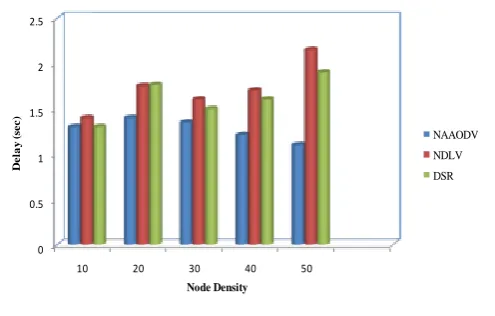
Fig. 2 Variation of delay
Fig.2 shows the variation of delay of NAAODV, NDLV and DSR for different node density from 10 to 50 mobile nodes. The results have revealed NAAODV exhibit superior performance than other two protocols and NDLV consumes average delay of 1.9 sec from node density 10 to 50.
DSR outperforms considerably better than NDLV, because it focuses on routes with the less number of hops to destination, while NDLV tend to check the location of adversary node causes more delay.
D. Comparison of Packet Delivery Ratio
The packet delivery ratio is shown in Fig. 3. The proposed NAAODV approach has better packet delivery ratio than both NDLV and DSR.
0 2000 4000 6000 8000 10000 12000 14000 16000
10 20 30 40 50
T
h
r
o
u
g
h
p
u
t
(
p
a
c
k
e
ts
/
se
c
Node Density
NAAODV
NDLV
DSR
0 0.5 1 1.5 2 2.5
10 20 30 40 50
D
e
la
y
(
se
c
)
Node Density
NAAODV
NDLV
IJIRMPS1804004
Website :
www.ijirmps.org
Email : [email protected]
17
Fig. 3 Variation of PDRThe packet delivery ratio in DSR increases from approximately 86% while increasing the number of nodes from 30 to 50. There is a slight reduction in the packet delivery ratio of NDLV s than NAAODV and DSR. This is because of increase in the number of packet collisions and presence of adversarial nodes in the network.
E. Comparison of Routing overhead
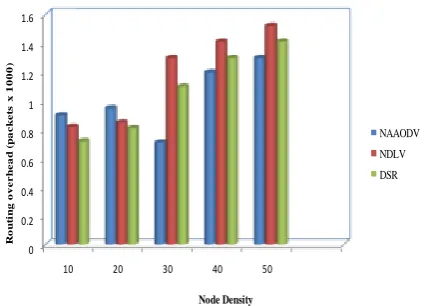
Fig.4 depicts the variation of routing overhead (in packets) of NAAODV, NDLV and DSR for different node density from 10 to 50 mobile nodes.
Fig. 4 Variation of Routing overhead
The fig.4 shows the variation of routing overhead for the three protocols.It is clear that NDLV has suffers and degraded performance in routing overhead NAAODV and DSR. In all the three protocols the routing overhead is increases with increasing number of nodes from 10 to 50. In NDLV operation, the exchange of four set of control messages gives to rise the routing overhead than NAAODV and DSR but its effusively identifying the false location of adversary nodes presence in the network.
VI. CONCLUSION
In this paper an effort has been made on the comprehensive examination and comparative study of two different new broadcasting approaches with conventional dynamic source routing protocol with node density variation. In NDLV, the routing overhead increases with the frequency of location verification and classification. NAAODV exhibits superior performance in terms of throughput, delay and packet delivery ratio compared with other two protocols. As a result, the NAAODV protocol works well and shows its effects when the network size on the network is relatively high.
REFERENCES
[1] Abdalla, M., and Hanashi (2008), Improving Route Discovery of Dynamic Probabilistic Flooding in On-Demand Routing Protocols for MANETs, Proceedings of 10th Telecommunications Forum, pp. 89-92.
[2] Abdulai, J., Ould-Khaoua, M., and Mackenzie, L.M., (2007), Improving Probabilistic Route Discovery in Mobile Ad Hoc Networks, 32nd IEEE Conference on Local Computer Networks (LCN 2007) IEEE Computer Society Press, pp. 739-746.
[3] Boukerche., Azzedine., Begumhan Turgut., Nevin Aydin., Mohammad. Ahmad, Z., Ladislau Boloni., and Damla Turgut., (2011), Routing protocols in ad hoc networks: A survey, Computer networks, Vol. 55(13), pp. 3032-3080.
[4] Camp, T., Boleng,v., and Davies, V., (2002), A survey of mobility models for Ad hoc network research, Wireless Communications & Mobile Computing(WCMC),Special issue on Mobile Ad Hoc Networking, Research,Trends and Applications, Vol. 2(5), pp. 483-502
0 10 20 30 40 50 60 70 80 90
10 20 30 40 50
P
D
R
(
%)
Node Density
NAAODV NDLV DSR
0 0.2 0.4 0.6 0.8 1 1.2 1.4 1.6
10 20 30 40 50
R
o
u
ti
n
g
o
v
e
r
h
e
a
d
(
p
a
c
k
e
ts
x
1
0
0
0
)
Node Density
NAAODV
NDLV
IJIRMPS1804004
Website :
www.ijirmps.org
Email : [email protected]
18
[5] Cartigny, J., and Simplot, D (2003), Border node retransmission based probabilistic broadcast protocols in Ad Hoc networks, Telecommunication Systems, Vol.22(1), pp. 189–204.[6] Deepak. D., and Yogesh, C (2011), Traffic based analysis of efficient and dynamic probabilistic broadcasting algorithm in MANETs routing protocols, International Journal of Wireless and Mobile Networks, Vol. 3(01), pp. 108-116.
[7] Divecha, B., Abraham, A. , Grosan, C.., and Sanyal, S., (2007), Analysis of Dynamic Source Routing and Destination-Sequenced Distance-Vector Protocols for Different Mobility models, Proceedings of First Asia International Conference on Modelling and Simulation, pp. 224-229.
[8] Ghosh, T., Pissinou, N., and Makki, K., Collaborative trust-based secure routing against colluding malicious nodes in multi-hop ad hoc networks, Annual Conference on Local Computer Networks (LCN), pp.224-231.
[9] Haas, Z., Halpern, J. Y., and Li, L., (2002), Gossip-based Ad hoc routing, Proceedings of IEEE INFOCOM '02, Vol. 21, pp. 1707-1716.
[10] Jaafar, M. A. and Zukarnain, Z. A (2009), Performance Comparisons of AODV, Secure AODV and Adaptive Secure AODV Routing Protocols in Free Attack Simulation Environment, European Journal of Scientific Research, vol. 32(03), pp. 430-443.
[11] Jagmeet Kaur., and Prabhjit Singh., (2016), Designing a Distributed Framework to Detect a Selfish Node in MANET by using a Collaborative Approach, International Journal of Computer Science Trends and Technology, Vol. 4(04).
[12] Jose Moses, G., Sunil Kumar, D., Suresh, P., Varma., and Supriya, N., (2012), A Simulation Based Study of AODV, DSR, DSDV Routing Protocols in MANET Using NS-2, International Journal of Advanced Research in Computer Science and Software Engineering, Vol.02 (03), pp 43-51.
[13] Kim, J.S., Zhang, Q., and Agrawal, D. P., (2004), Probabilistic broadcasting based on coverage area and neighbour confirmation in mobile ad Hoc networks, Proceedings of IEEE Global Telecommunications Conference Workshops (GlobeCom'2004), pp . 96-101.
[14] Manickam, P., Guru Baskar, T., Girija, M., and Manimegalai, D., (2011), Performance Comparisons Of Routing Protocols In Mobile Ad Hoc Networks, International Journal of Wireless & Mobile Networks (IJWMN), Vol. 03 (01), pp. 98-106.
[15] Mehmood, Z, (2014), Comprehensive experimental performance analysis of DSR, AODV and DSDV routing protocol for different metrics values with predefined constraints, International Journal of Information technology and computer science, pp. 24-31.
[16] Mohammadizadeh., Moyaghar, A and Safi, M., (2009), SEAODV: Secure Efficient AODV Routing Protocol for MANETs Networks, Proceedings of 2nd International Conference on Interaction Sciences: Information Technology, Culture and Human,
Seoul, Korea, Vol.24,pp. 940-944.
[17] Mohammed Tarique., Kemal Tepe, E., Sasan Adibi., and Shervin Erfani., (2009), A survey on the multipath routing protocols for mobile ad hoc networks, Journal of Networks and Computer Applications, Vol. 32(06), pp. 1125-1143.
[18] Ni, S.Y., Tseng, Y.C., Chen, Y.S., and Sheu, J.P. (1999), The broadcast storm problem in a mobile Ad hoc networks, Proceedings of the 5th Annual ACM/IEEE International Conference on Mobile Computing and Networking, pp.152-162.
[19] Gnanamanoharan, E., and Bensraj, R., (2014), Impact of Variable Bit Rate and Packet Size on the Performance Evaluation of Neighbor Aware AODV and DSDV Routing Protocols for MANET's, International Journal of Computer Applications, Vol. 92(08), pp.43-47.
[20] Zhou, P., and Li, W (2012), A bidirectional backup routing protocol for mobile Ad hoc networks, Proceedings of the 2nd IEEE International Conference on Business Computing and Global Information (BCGIN '12), pp . 603–606.
[21] Williams, B., and Camp, T (2002), Comparison of broadcasting techniques for mobile ad hoc networks, Proceedings of the 3^rd ACM International Symposium on Mobile Ad hoc Networking & Computing, MOBIHOC, pp. 194 - 205.
[22] Gnanamanoharan, E., and Bensraj, R., (2016), Performance Analysis of Probabilistic Broadcast On Demand Route Discovery Protocol for Mobile Ad hoc Networks based on Node Mobility, International Journal of Advanced Engineering technology, Vol. 07(03), pp. 174-178.
[23] Perkins, C. E., and Bhagwat, P (1994), Highly dynamic destination-sequenced distance vector routing (DSDV) for mobile computers, Proceedings of ACM SIGCOMM 94, pp. 234-244.
[24] Perkins, C. E., and Royer, E.M (1999), Ad-hoc on-demand distance vector routing, Proceedings of the 1999 Second IEEE Workshop on Mobile Computing Systems and Applications, IEEE Computer Society, New York, pp. 90–100.
[25] Gnanamanoharan, E., and Bensraj, R., (2016), Performance Analysis of Broadcast Neighbors Discovery Protocol for Mobile Ad hoc Networks based on node mobility, International Journal of Innovation and Scientific Research, Vol. 25(01), pp. 352-359.
[26] Zhang, Qi., and Agrawal, D.P (2004), Analysis of Leveled Probabilistic Routing in Mobile ad hoc Networks, IEEE International Conference on Communications, Vol.07, pp. 3896-3900.
[27] Gnanamanoharan, E., and Bensraj, R., (2016), Performance Analysis of Neighbor Discovery and Location Verification (NDLV) scheme in Mobile Ad hoc Networks against Adversarial Nodes, Communications on Applied Electronics (CAE), Foundation of Computer Science FCS, New York, USA, Vol. 04(04) , pp. 19-25.
[28] Liu, C., Zhang, G., Guo, W., & He, R. (2019). Kalman Prediction-Based Neighbor Discovery and Its Effect on Routing Protocol in Vehicular Ad Hoc Networks. IEEE Transactions on Intelligent Transportation Systems.
[29] Kiran, K., Kaushik, N. P., Sharath, S., Shenoy, P. D., Venugopal, K. R., & Prabhu, V. T. (2018, October). Experimental Evaluation of BATMAN and BATMAN-Adv Routing Protocols in a Mobile Testbed. In TENCON 2018-2018 IEEE Region 10 Conference (pp. 1538-1543).